Mostrar mensagens com a etiqueta Pete Hegseth. Mostrar todas as mensagens

sábado, 1 de agosto de 2026

Trump Has Revolutionized Executive Power


As we move toward the end of the Trump era, we need to reckon with the changes his administration has wrought in the American system of government. The most significant is the enormous concentration of power, not just in the executive branch as a whole, but in the office of the president. Any successor administration, Republican or Democratic, will inherit these powers, and will have to decide how it wants to define the limits of executive authority in the future.

The U.S. Constitution limits presidential power in a number of ways. Article I says that laws and budgets are made by Congress, and Article II says the president’s chief duty is to see that the laws are “faithfully executed.” He can choose his own cabinet officers, but they must be confirmed by the Senate. The president has more discretionary authority with regard to foreign policy and national security, where he is designated commander-in-chief of the armed forces. Yet even in this sphere, the right to declare war and ratify treaties is given to Congress.

Donald Trump has tried to expand executive authority in any number of ways. From Day One of his second administration, he has issued a blizzard of executive orders that have in effect usurped Congress’s legislative powers. In some cases he has acted under obscure legal powers, many of which were later found by the courts to be inappropriate. In other cases he has simply acted illegally or unconstitutionally. Among the many examples are:
  1. Ending birthright citizenship;
  2. His failure to spend money appropriated by Congress;
  3. The closing of entire departments, such as the U.S. Agency for International Development, that had been established by Congress;
  4. Attempting to assert federal authority over election administration;
  5. Using emergency powers to impose tariffs in an arbitrary and discretionary manner;
  6. Firing federal employees protected by statute;
  7. Launching a major war without seeking authorization from Congress.
The lower courts have blocked many of these initiatives, and the Supreme Court has reversed both the birthright citizenship order and the tariffs imposed last year under the International Emergency Economic Powers Act (IEEPA).

However, the Supreme Court has not yet ruled on many of the other cases, and in one case clearly ruled in favor of the administration. That was Trump v. Slaughter, decided last month, which overturned an earlier Supreme Court decision called Humphrey’s Executor. That precedent, set in 1935, upheld the right of Congress to impose limits on the president’s power to change the composition of the boards of supposedly “independent” multi-member regulatory agencies like the Federal Communications Commission and the Federal Trade Commission.

The Slaughter decision may seem technical, and has received relatively little public attention. The one multi-member federal agency that the public (and more importantly the markets) care about is the Federal Reserve Board, where Trump had already tried to fire one member, Lisa Cook. The Supreme Court exempted the Fed from its general evisceration of Humphrey’s Executor, arguing somewhat speciously that the Fed has a different historical status from other agencies and therefore its board could remain protected from political interference.

The Slaughter decision, however, has huge implications for the way America will be governed in the future, and it is only the first shoe to drop in a long-term conservative effort to remake the federal executive. Humphrey’s Executor had been the long-term target of conservatives under a doctrine of the “unitary executive.” They argued on originalist grounds that the Constitution gave executive authority to the president alone, who, as a democratically legitimated official, could not be restricted by Congress in his control over the executive branch.

There is a certain logic to this position, one that has been supported not just by conservatives but by certain progressives as well. Most prominent in the latter camp was President Franklin D. Roosevelt, who in the 1930s sought to remove William Humphrey (who was accused of blocking FDR’s legislative agenda) as a commissioner of the Federal Trade Commission. Humphrey’s removal was overturned by a conservative Supreme Court.

To this one could add the following argument. No one questions the right of the president to appoint, with the Senate’s approval, Cabinet secretaries and other senior officials, or to unilaterally remove them. The president’s right to appoint or remove the heads of agencies led by a single individual, like the CDC or NASA, is not contested. So why should those with multi-member boards be treated differently?

The argument I would make against the theory of the unitary executive is not based on any originalist reading of the Constitution. It is rather based on a pragmatic observation. Today’s executive branch is so large, sprawling, and powerful that there needs to be a separation of powers within the executive, and not simply between the executive and the other two branches of government. The chief argument in favor of such a separation has to do with the preservation of the expertise that is necessary to run a modern state.

We see this most clearly in the case of the Federal Reserve, which in the Slaughter decision was somehow exempted from political control. Painful experience with inflation has taught the United States and other countries around the world that central banks must be made independent. The incentives of politicians are almost always short-term and aimed at their political self-interest. The independent structure of the Fed and its multi-member board protects it from politicization and enhances its ability to operate according to the judgment of the experienced professionals who run it-i.e. PhD economists and practitioners with deep experience with financial markets.

Quite apart from the illegality and unconstitutionality of many of the Trump administration’s actions, there is also its incompetence.

That incompetence has been on display since the beginning of the second term, when Trump appointed a series of individuals with no expertise in the agencies they were to run: Tulsi Gabbard as Director of National Intelligence, TV commentator Pete Hegseth as Defense Secretary, vaccine denier Robert F. Kennedy Jr. as Secretary of Health and Human Services, and podcaster Kash Patel as head of the FBI.

The consequences are clear: by sidelining regional experts throughout State, Defense, and the intelligence community, for example, there was no one to warn the president that launching a massive air assault on Iran might lead to the closing of the Strait of Hormuz.

The Justice Department likewise has been diverted from its role as impartial enforcer of the law to being an instrument for Donald Trump’s personal revenge campaign. By forcing out career prosecutors, the department found its cases susceptible to being overturned by the courts and indictments rejected by grand juries across the country.

Underlying the theory of the unitary executive is a flawed concept of hierarchical organization that is as incorrect as it is widespread. “Principal-agent theory” is commonly used by economists and other social scientists to understand the dysfunctions of hierarchies. All authority lies with the principal; agents are simply expected to carry out the wishes of the principal and problems arise only when the agents follow their own agenda.

As Nobel laureate Herbert Simon pointed out many years ago, this is not how real-world organizations work. Agents, including front-line workers at the bottom of hierarchies, often have more expertise and local knowledge than the principals who give them orders. As a result, authority in many organizations flows from the agents to the principal. This is a truth understood in well-functioning militaries, which give their junior officers substantial authority and advise senior commanders not to micro-manage.

So too in the U.S. government. The knowledge of how to deal with an airline accident, or a sudden disease outbreak, or indeed a financial crisis, will not lie with the democratically-elected politician at the top of the hierarchy, but rather with the experts who have the training and experience to act. A well-designed government needs to have mechanisms for protecting that expertise.

Multi-member commissions are a very imperfect means of doing this, but they do at least make it more difficult for an incompetent president to do his destructive work. There are other important protections for expertise as well, such as requirements for “for cause” removals, which protect officials from arbitrary firing. Such constraints have been a clear target of the Trump administration.

Another critical protection for expertise lies in Senate confirmation: in most administrations, the Senate will simply not confirm blatantly unqualified people for senior positions. One of the greatest failures of the current Congress is its unwillingness to exert this authority in so many prominent cases.

The Trump administration’s war on expertise has only just begun. Greater political control over senior officials in multi-member commissions will have limited day-to-day impact on most citizens. But believers in the unitary executive want to extend that control to the whole of the federal government, such that every government worker, down to your local postmaster, will be subject to removal by a political boss.

This assertion of executive authority was attempted at the end of the first Trump administration with an executive order creating a new “Schedule F” employment designation into which the whole of the civil service could be moved, and then fired or replaced at will. Schedule F was rescinded by the Biden administration, but has re-emerged in the second Trump term as “Schedule P/C.”

This is not a casual innovation off the top of Donald Trump’s head. The authors of the Heritage Foundation’s Project 2025 spent their four years out of office designing a policy that would allow them to radically reshape the entire federal bureaucracy, and to eliminate the checks and balances that Congress had inserted over the years to limit the president’s power. The overturning of Humphrey’s Executor is only part one of this plan; the administration’s war against the “deep state” also seeks to invalidate the 1883 Pendleton Act, which first created a merit-based civil service. This will return the United States to the 19th-century spoils (or patronage) system, whereby not just top policy-makers but all government officials were put in place by a politician in return for political loyalty.

The spoils system was known for its corruption at all levels of government, from Credit Mobilier to Tammany Hall. Today we have massive corruption at the top levels of government, beginning with Donald Trump and his friends and family. But the elimination of a professional civil service will open up vast new areas for corrupt behavior in every city and county in the United States. Project 2025 is unapologetic about this, arguing that the patronage system was unfairly criticized.

The next president - and there will be a next president- will have to confront the question of how much of the authority claimed by Donald Trump he or she will want to retain. This is a complicated question, because the status quo ante was very problematic. As I’ve argued in previous articles, the government really has become over-constrained in its ability to take action. A new president will face many obstacles to implementing their desired agenda, and will be strongly tempted to use the kind of executive power claimed by Donald Trump. The next president needs to come into office not just with new policies, but with clear plans for how to use the mechanisms of government to get them done.

The time to start thinking about these questions is now: we cannot put this off until January 20, 2029, when a new president will be facing immediate political pressures to act. The Republicans spent their four years out of power coming up with clever strategies to get their way, which they have been implementing in the second term. Those backing a post-Trump administration need to do the same.

I hope to be able to outline some of the ways that authority can be structured in future articles.

terça-feira, 9 de junho de 2026

Money and Machismo are Undermining America


Drones have rapidly transformed modern war. The U.S. military, the most sophisticated, best supplied force in history, has been humiliated by Iran, largely thanks to Iran’s effective use of inexpensive drones to menace shipping, energy production, and even U.S. bases. Meanwhile, Ukraine’s growing superiority in drone warfare is increasingly giving it the upper hand over Russia. Remember, not so long ago the American far right celebrated Putin’s macho posturing and his supposed military invincibility.

Given this radical turn of events, shouldn’t the United States be eager to make a drone deal with Ukraine, benefiting from its technology and expertise?

Apparently not. The Hill reports that Donald Trump has been dragging his feet on such a deal, quoting U.S. military analysts who say that they don’t understand the delay and that they are “mystified.” But I assume that they’re being disingenuous and prefer to avoid saying the obvious. In fact, Trump’s unwillingness to make a deal that would clearly benefit America’s national interest is no mystery at all.

I’ll get to the obvious in a moment. First, let me take a slight detour into something that seems unrelated but in fact helps explain drone aversion: this administration’s hostility to renewable energy and its desperate, doomed and wasteful effort to revive the coal industry.

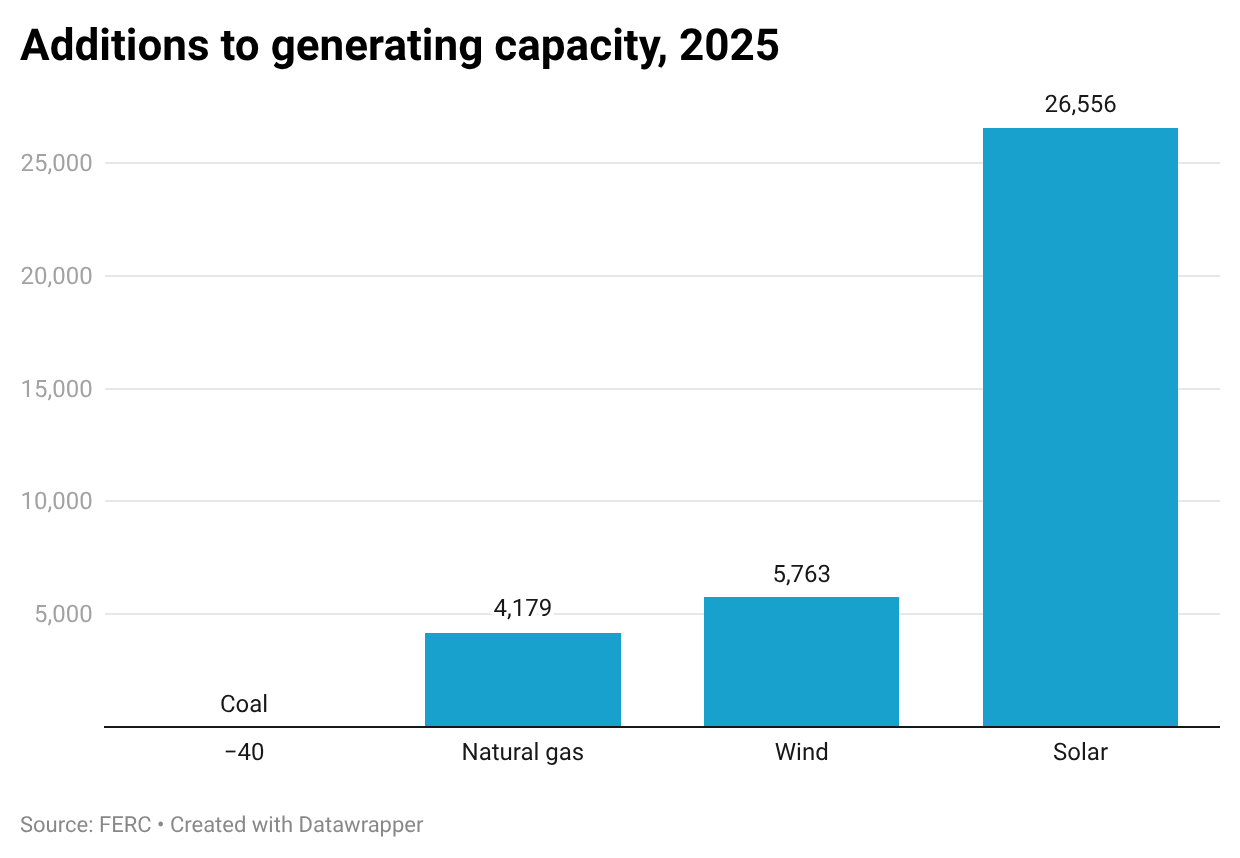
There was a time when “drill, baby, drill” could be portrayed as a realistic, hard-headed position. Does anyone remember the Cheney Energy Task Force? However, in the past few years, radical declines in the cost of solar power, wind power, and batteries — which solve the problem that the sun doesn’t always shine and the wind doesn’t always blow — have made renewables the most cost-effective way to generate electricity. By contrast, coal is completely unviable. Here are the Federal Energy Regulatory Commission’s estimates for utility capacity additions in 2025:


Yet Trump is trying to block renewable energy projects any way he can and has just invoked wartime authority to spend $700 million subsidizing new power plants using “clean, beautiful” coal.

Why? Part of the answer is big money. Fossil fuel interests were huge supporters of Trump in 2024. In fact, the Trump presidency is itself the result of billions of dollars spent by the Koch Brothers and others to corrupt and undermine U.S. political institutions -- the Supreme Court very much included. Anti-renewable, pro-fossil fuel policy is their reward, along with the destruction of the Voting Rights Act and the adoption of Project 2025.

What’s the other part? Clean energy has become a bogeyman in the culture wars: mining and burning coal are considered “manly” activities, while renewable energy is portrayed as woke and effeminate. Real men don’t worry about black lung and airborne particulates, let alone climate change.

So a combination of big money and fragile male egos drives Green Derangement Syndrome. And the same is true for both the Iran debacle and the refusal to learn from the catastrophe by turning to Ukraine.

Why was the United States so unprepared for the Iranian drone threat, despite the obvious successes of Ukrainian drones against Russia? Well, as investigative reporters delve into the story, I would urge them to follow the money.

America has a huge, highly profitable defense industry, dedicated to a suite of technologies that are rapidly being rendered obsolete, as $4 million Patriot missiles, that take years to build, are being used to shoot down $35,000 Shahed drones that can be manufactured in months.

So it wouldn’t be surprising if defense-industry interests are playing a significant role in the Trump administration’s refusal to admit that the rules of war have changed — the same way that fossil fuel companies have campaigned against the new realities of energy technology. After all, a deal with drone-savvy Ukrainians would mean less money going to US defense contractors.

While this is speculative, we do know that recognition of the drone revolution in warfare by Trump and his inner circle would require that they abandon their fantasy of macho military power. Pete Hegseth has been purging the military of capable officers — especially Blacks and women — he considers insufficiently loyal to Donald Trump. Beyond loyalty tests, however, he has exalted the importance of “warrior ethos” and physical fitness, as if he were leading the 300 Spartans rather than a high-tech military in an age of drones and electronic warfare.

It’s true that Hegseth, perhaps chastened by his abject failure in Iran — why does he still have a job? — recently admitted that the U.S. has learned from Ukraine. But an admission that his entire conception of war was wrongheaded will be a step too far for him.

Likewise, Trump himself is in love with big, expensive weapons as symbols of virility and power. He’s still pushing for giant “Trump-class” battleships, even though they would be sitting ducks in a modern war. Just ask the Ukrainians, who have used missiles and naval drones to force Russia’s once-vaunted Black Sea Fleet to cower in a fortified refuge. But Trump doesn’t want to give up his fantasies.

And he’s especially unwilling to learn from Ukraine. After all, he cut off aid to Ukraine in a hissy fit over Zelenskyy’s well-deserved reputation for heroism, only to he humiliated by Ukraine’s refusal to lose its war. Admitting that he needs Ukrainian help would be a further humiliation.

As I said earlier, there is no mystery about why Trump refuses to make a drone deal with Ukraine. Never mind the national interest. In military strategy as in energy policy, Trump is betraying America in the service of money and machismo.

domingo, 7 de junho de 2026

Vergonha do Dia D! Pete, do Pentágono, envergonha os nossos heróis caídos da Segunda Guerra Mundial na cerimónia da Normandia ao comparar os barcos dos migrantes à invasão aliada contra os nazis!


O secretário para os Crimes de Guerra, Pete Hegseth, teve um comportamento extremamente desrespeitoso na comemoração do Dia D, hoje, na Normandia, aproveitando o evento solene para promover uma retórica anti-imigrante.

Enquanto se encontrava nas praias sagradas onde as forças aliadas lançaram a maior invasão da história para libertar a Europa da ocupação nazi, Hegseth afirmou:

«Hoje, diferentes praias europeias são invadidas por diferentes ideologias perigosas. Em Espanha, Itália, Grécia e Bulgária, chegam barcos e homens. Quando é que as capitais europeias farão algo em relação a essa invasão? Ou será que já é tarde demais?» [aqui]

Meu Deus. O Dia D foi o momento em que as tropas americanas, britânicas, canadianas e outras forças aliadas arriscaram tudo para invadir aquelas praias e derrotar o fascismo. Um dia em que parecia realmente que o futuro do mundo estava por um fio.

Desvalorizar a 82.ª comemoração desse dia com posturas políticas xenófobas e sem sentido sobre a migração é simplesmente inconcebível.

Em nome do punhado de jovens heróis que ainda estão entre nós com 100 anos ou mais, pedimos desculpa em nome do povo americano.

Num dos locais mais sagrados e históricos do mundo, o trumpista Hegseth nem sequer conseguiu mostrar algum respeito básico pelos que morreram, deixando a política de fora, por uma vez.

Que vergonha, Pete. Cala-te, porco.

Testemunho de Robert Reich
Toda Verdade aqui

quarta-feira, 29 de abril de 2026

A advertência subtil, mas marcante, do rei Carlos III à América


Monarca britânico discursou perante o Congresso norte-americano, numa abordagem direta e contundente, suavizada pelo profundo respeito pelos anfitriões e pelas relações históricas entre os dois países

Numa nova era de revolta, foi preciso um rei para lembrar à América os seus valores republicanos: o Estado de direito, a democracia e o poder do seu exemplo internacional.

O rei Carlos III escolhe as suas palavras com precisão - tal como fazia a sua falecida mãe, a rainha Isabel II. O significado real tem frequentemente de ser inferido.

Mas, para os padrões reais, o seu discurso numa sessão conjunta do Congresso na terça-feira foi surpreendentemente direto.

Carlos não repreendeu nem criticou a administração Trump. Mas o monarca desaprovou implicitamente a atual direção política dos Estados Unidos e defendeu os pilares da democracia ocidental: freios e contrapesos internos, alianças e tolerância inter-religiosa.

Carlos apelou ainda à defesa firme da Ucrânia. E a “natureza”, disse ele, deve ser protegida, num apelo velado para combater as alterações climáticas, que o presidente Donald Trump chamou de “burla”.

E o rei salientou que os amigos podem discordar sem romper laços eternos, uma referência velada à “relação especial”, que tem sido abalada pela recusa do Reino Unido em aderir à guerra contra o Irão.

“As palavras da América têm peso e significado, tal como têm desde a independência”, disse Carlos, no hemiciclo da Câmara dos Representantes. “As ações desta grande nação importam ainda mais”.

A versão do rei sobre os valores dos Estados Unidos provavelmente agradou mais aos democratas “No Kings” do que ao vice-presidente JD Vance, que tem opiniões sobre o declínio civilizacional do Reino Unido e da Europa e que se sentou atrás dele na Câmara dos Representantes.

Mas Carlos amenizou a sua crítica demonstrando profundo respeito pelos anfitriões. Citou Trump, afirmando que o “laço de parentesco” entre os EUA e o Reino Unido é “inestimável e eterno”. E o seu discurso esteve repleto de elogios às conquistas históricas americanas.

E os pontos mais contundentes foram suavizados pela pompa coreografada de uma visita de Estado que retribui uma viagem de Trump no ano passado. Parafraseando o presidente Theodore Roosevelt, o rei falava suavemente enquanto empunhava um grande cetro.

O presidente não mostrou sinais de se sentir ofendido pelas observações de Carlos III. Donald Trump orgulha-se das suas relações pessoais com os líderes mais famosos do mundo. O rei também condenou por duas vezes a alegada tentativa frustrada de assassinato contra o presidente numa gala para a imprensa no sábado.

“The Firm”, como a família real é frequentemente conhecida, já passou por tudo isto antes. O rei Carlos III mencionou, num raro jantar de Estado de gala na Casa Branca na terça-feira à noite, que a sua mãe tinha vindo a Washington em 1957 para reparar as divisões entre os EUA e o Reino Unido provocadas pela crise de Suez.

“É difícil imaginar algo assim a acontecer hoje, mas não é difícil ver como a relação continua a ser importante, em assuntos visíveis e invisíveis”, disse o rei.

E Carlos III ofereceu ao presidente um presente único - o sino original da torre de comando do HMS Trump, um submarino da Marinha Real que esteve em serviço no Pacífico durante a Segunda Guerra Mundial.

“Se alguma vez precisar de nos contactar, basta dar-nos um toque!”, afirmou Carlos.

Esta forma cerimonial de abordar as divisões ideológicas de uma forma não ideológica destacou um paradoxo: os monarcas britânicos estão vinculados por convenção constitucional a serem apolíticos, mas a sua contenção confere-lhes um enorme poder simbólico quando optam, com moderação, pelo contrário.

sexta-feira, 17 de abril de 2026

Hegseth Says Climate Change Is ‘Crap.’ The Military Is Still Bracing for It


When Hurricane Michael, a Category 5 storm, tore through Florida’s Tyndall Air Force Base in 2018, it battered F-22 stealth fighter jets, destroyed hundreds of buildings and churned up 700,000 cubic yards of debris. The total cost of the damage approached $5 billion.

Now, Tyndall is being rebuilt as a super-resilient “installation of the future.” New buildings sit more than a foot above the ground, to remain dry through 75 years of sea-level rise. Their roofs are designed to withstand winds of up to 165 miles per hour. Manmade oyster reefs will protect coasts by breaking up waves.

The massive project will be 70% complete next year, said the officer leading it, Col. Robert Bartlow, chief of the US Air Force Civil Engineer Center Natural Disaster Recovery Division. “This is a first for the Air Force,” he said, with large-scale, cutting-edge construction taking place “on top of an existing base, while there was a continued flying mission.”

Storms like Michael are becoming more powerful and damaging as the world warms, and many military installations are exposed to them and other climate hazards. Still, Secretary of Defense Pete Hegseth vowed last year that the Pentagon wouldn’t do any “climate change crap” on his watch. Biden-era climate action plans were scrapped, and the 2025 National Security Strategy invoked climate change only to label it a “disastrous” ideology. Hegseth canceled nearly 100 research studies related to global warming and security, which experts say will compound the loss of climate knowledge across the federal government under President Donald Trump.

“Because ‘climate’ is a dirty word, we’re not investing in that predictive capability,” said Sherri Goodman, secretary general of the non-governmental International Military Council on Climate and Security and, from 1993 to 2001, the US deputy undersecretary of defense for environmental security.

But as Tyndall shows, the Defense Department is still engaged on one front of the climate fight: steeling its bases against the effects of a warming atmosphere, such as higher seas, fiercer storms and deadlier fires. A new flood wall is rising at the US Naval Academy in Maryland; a low-lying Air Force runway is being elevated in Virginia; and projects are underway to reduce wildfire risk around various military sites in Hawaii.

Work that was previously described as confronting the climate threat is now touted for ensuring “resilience” and “readiness.” The semantics are a nod to necessity: At stake are hundreds of billions of dollars of assets and the ability to launch missions quickly and smoothly.

“Ultimately, the military is a very pragmatic institution,” said John Conger, a past director of the nonprofit Center for Climate and Security and a senior Defense Department official during the Obama administration. “It wants to maintain mission capability. Whether we’re going to call it ‘climate,’ not ‘climate,’ whatever — if I can’t get to the base because the road is flooded, that’s a problem.”

Representatives of the Defense Department declined to comment.
Global warming impinges on American security and military operations in numerous ways. More climate-driven disasters means more deployments to respond to them. Extreme heat makes it harder for jets to lift off and sickens soldiers during training exercises. Climate change also acts as a “threat multiplier” – a term that Goodman coined – around the world. It can exacerbate drought conditions, which may limit water or food in regions already primed for conflict.

Much of the military’s resilience work began years ago; construction timelines are long. The $900 billion 2026 National Defense Authorization Act, which Trump signed into law in December, includes measures that could be said to come under the umbrella of climate adaptation. The law bolsters the military’s ability to respond to wildfires; raises the cost limit for replacing structures destroyed by disasters; and requires military leaders to identify the biggest risks to water security on bases.

Congress has given the military “decades-long, bipartisan direction” to prepare for climate change, even at times when the term itself was out of political favor, noted Will Rogers, a principal of Converge Strategies and the senior climate advisor to the secretary of the Army from 2022 to January 2025.

If climate preparedness is another term for environmental assessment, “the Army’s been doing this regularly now since World War II,” said Frank Galgano, a geographer at Villanova University who retired from the Army as a lieutenant colonel in 2007.

The approach may not have shifted, but the atmosphere has. Extreme weather and disasters have caused $15 billion of damage to defense facilities over the past decade. In 2023 alone, Typhoon Marwar ravaged two bases on Guam, heavy rains swamped the campus of West Point in New York and a landslide blocked the main road at Camp Pendleton in California.

Close to $400 billion of federal government assets, most of them belonging to the Defense Department, are at high risk of being hit by a major coastal flood or storm in coming years, according to a Bloomberg Law analysis.

The Pentagon explicitly recognized the warming climate as a danger for many years. The 2008 National Defense Strategy flagged climate change as an emerging risk, and two years later it was named a national security threat in the Pentagon’s Quadrennial Defense Review. After that, the Defense Department and the individual armed forces put out a stream of climate and sustainability plans. (Some have now been removed from government websites.)

James Mattis, who served as defense secretary during President Donald Trump’s first term, described climate change as a destabilizing force in 2017. His Biden-era successor Lloyd Austin said in 2021, “We face all kinds of threats in our line of work, but few of them truly deserve to be called existential. The climate crisis does.”

Trump and Hegseth have made a sharp pivot. In a March 2025 memo to military leaders, Hegseth called climate change a “distraction” from fighting wars, ordered that references to it be removed from mission statements and barred any environmental initiatives from being included in the Future Years Defense Program, a strategic plan.

Hegseth also included a caveat big enough to steer an aircraft carrier through. “Nothing in this memorandum,” he wrote, “shall be construed to prevent the department from assessing weather-related impacts on operations, mitigating weather-related risks, conducting environmental assessments, as appropriate, and improving the resilience of military installations.”

Days after Hegseth issued his memo, the Pentagon’s guidance on master planning for bases was updated. (By law, every major military installation must have a master plan.) In the older version from 2022, the word “climate” was used 54 times. It doesn’t appear once in the new version, which still directs planners to identify and mitigate risks from extreme weather.

Bartlow, at Tyndall, sees no contradiction between that project and Hegseth’s guidance.

The overarching goal at Tyndall, he said, is “preserving lethality in a high-end combat capability. When we talk about resilience, it’s focused on preserving that combat capability.” If another Category 5 hurricane hits, “there’ll be some interruptions, but the idea is you’ll be able to recover this installation quickly,” Bartlow said. “You can make that direct link back to readiness.”

Hardening efforts continue elsewhere but are falling short. A February Government Accountability Office report found that the military has failed to track all the costs from disaster damage and hasn’t fully incorporated climate-change projections into facility designs, and that many of its master plans still haven’t been updated to promote greater resilience.

One constraint is funding. “Our installations are funded at about 80% of what they need on a day-to-day basis,” said Rogers, the former Army climate adviser.

The Iran war could apply more pressure. Defense officials “could use their reprogramming authority to pay for contingency operations in Iran” with money meant for fortifying bases, said Rogers. “I would be worried about that, depending on how long this goes.”

Although the Pentagon has maintained a focus on resilience, under Hegseth it has backed off efforts to lower its emissions — the US military is the single biggest climate polluter in the country — and develop green ships and tanks. The armed forces have in recent years explored using hybrid and electric tanks for tactical, not just environmental reasons: They reduce reliance on diesel supply lines, are quieter and are less detectable to heat radar. While the Army is moving ahead with its hybrid M1E3 tank, funding for such initiatives has declined, said Rogers.

Of the studies that Hegseth canceled, some focused on the Indo-Pacific, where China has ambitions, noted Goodman. She said the lost knowledge and reduced funding for climate and weather research – not just in the military but in agencies like the National Oceanic and Atmospheric Administration – could set back defense planning.

She offered a hypothetical example: With AI pushing the envelope in forecasting, an adversary could anticipate and take advantage of a weather event to launch a cyberattack on the US. “And if we’re not understanding that,” she said, “then we have become more vulnerable.”

Pete Hegseth quis orar por soldado mas acabou a citar monólogo de "Pulp Fiction"


Um dos momentos mais recentes protagonizado pelo secretário da Defesa dos Estados Unidos está a gerar polémica. Durante uma oração por um soldado norte-americano resgatado depois de a sua aeronave ter sido abatida pelo Irão, Pete Hegseth acabou por recitar um discurso muito semelhante a um monólogo do filme "Pulp Fiction", de Quentin Tarantino, em vez de um versículo bíblico.

O mais recente discurso do secretário da Defesa dos Estados Unidos está a dar que falar pelas razões mais insólitas. Num momento em que fazia uma oração por um soldado norte-americano resgatado após a sua aeronave ter sido abatida pelo Irão, Pete Hegseth tentou recitar um versículo bíblico, mas acabou por proferir um dos monólogos mais icónicos da obra cinematográfica de Quentin Tarantino.

O momento que está a dar que falar na imprensa internacional aconteceu na quarta-feira, no Pentágono, perante militares e familiares. Antes de proferir o “falso” trecho bíblico, Pete Hegseth explicou que a oração era recitada pela missão de Busca e Salvamento em Combate “Sandy One”, no Irão: “Chamam-lhe CSAR 25:17, o que penso ser uma referência a Ezequiel 25:17”, afirmou.

“O caminho do aviador abatido está cercado por todos os lados pelas iniquidades dos egoístas e pela tirania dos homens maus. Bendito aquele que, em nome da camaradagem e do dever, guia os perdidos pelo vale da escuridão, pois é verdadeiramente o guardião do seu irmão e o protetor dos que se perderam. E abaterei sobre ti grande vingança e ira furiosa aqueles que tentarem capturar e destruir o meu irmão, e saberás que o meu indicativo é Sandy 1 quando exercer a minha vingança sobre ti. Ámen", proferiu.

No entanto, Pete Hegseth acabou por denunciar-se, devido às evidentes semelhanças com o monólogo de “Jules Winnfield”, o assassino contratado interpretado por Samuel L. Jackson em “Pulp Fiction” (1994), proferido antes de executar as suas vítimas, apesar de ter adaptado o versículo ao contexto militar e à operação de resgate.

Na altura, Quentin Tarantino adaptou-o a partir de um filme japonês de artes marciais, intitulado "Karate Kiba" (1973), protagonizado por Sonny Chiba.

“O caminho do homem justo está cercado por todos os lados pelas iniquidades dos egoístas e pela tirania dos homens maus. Bendito aquele que, em nome da caridade e da boa vontade, guia os mais fracos pelo vale da escuridão, pois é verdadeiramente o guardião do seu irmão e o protetor dos que se perderam. E abaterei sobre ti grande vingança e ira furiosa aqueles que tentarem envenenar e destruir os meus irmãos. E saberás que o meu nome é o Senhor quando exercer a minha vingança sobre ti", cita.

Já o verdadeiro versículo de Ezequiel 25:17, que consiste numa declaração de vingança divina contra os filisteus (povo marítimo da Idade do Bronze), diz apenas: “E executarei grande vingança contra eles com severas repreensões; e saberão que eu sou o Senhor, quando eu exercer a minha vingança sobre eles.”

Segundo os relatos, este foi o segundo culto consecutivo em que Hegseth usou versículos e mensagens violentas ao discutir a guerra no Irão: "Concedam a esta força-tarefa alvos claros e justos para a violência", orou no mês passado.

terça-feira, 7 de abril de 2026

Who's the Biggest Money Behind the Throne?

Para ver com mais detalhe e ampliação aqui

It’s important that we demonstrated against Trump’s assertion of royal powers.

It’s at least as important to follow the money — and learn the identities of America’s billionaire royalty who crowned Trump in the first place. They’re now spending another regal fortune to keep Congress under his control.

Today I’m going to name names.

As of March 1, according to a new report from Americans for Tax Fairness, the 50 biggest-spending billionaires in American politics had already contributed over $433 million to the upcoming midterm political campaigns.

Not surprisingly, 80 percent of this haul is in support of Republican candidates or conservative issue groups.

Given how early we are in the process, and how contributions tend to accelerate closer to Election Day, 2026 will almost surely set a new record for billionaire money in midterm elections. (Because of our current pathetically weak campaign finance laws, courtesy of the Supreme Court, fat-cat contributors are funneling huge sums through super PACs. While such spending is supposed to be independent of the campaign being supported, rules against coordination are now going largely unenforced.)

Who they are
1. Elon Musk
The single biggest contributor is, of course, Elon Musk — the world’s richest person — who has plunked down almost $71 million into Republican midterm campaigns so far.

Musk contributed a total of $278 million in the 2024 election cycle, mostly for getting Trump reelected. His “investment” has paid off nicely. Musk’s net worth has grown 220 percent since Trump won in 2024.

Musk’s latest cash infusion to Republicans came after his short destructive stint as head of the “Department of Government Efficiency,” where he helped place his cronies into high-level positions throughout the federal government.

Yes, I know. Musk and Trump had a falling out. But since then both have realized they have more to gain as political partners. And now that Musk’s SpaceX satellite system is integral to Pete Hegseth’s Department of “War,” Musk has filed for an initial public offering, seeking a valuation over $2 trillion and potentially raising $75 billion, which would make it the largest IPO in history.

The New York Times reports that Musk participated in a phone call on Tuesday with Trump and Prime Minister Narendra Modi of India. Musk’s companies have taken on significant investment from sovereign wealth funds from Middle Eastern countries, including Saudi Arabia and Qatar, and he has long coveted a greater commercial presence in India.

2. Jeff Yass
Musk is followed in the billionaire-spending-on-politics sweepstakes by Wall Street financier Jeff Yass, who has contributed more than $55 million so far in this midterm election cycle. He’s donated $16 million to MAGA, Inc., Trump’s super PAC, dedicated to supporting candidates he backs.

The Yass donations came as Trump was deciding whether to delay the forced sale of the social media app TikTok, in which Yass was a major investor. Trump repeatedly delayed the sale, saving Yass’s lucrative investment.

In addition, Yass has donated $10 million apiece to the anti-tax Club for Growth PAC; to another PAC that wants to drain funds from public schools to support private ones; and to a PAC that supports the political ambitions of former Republican presidential candidate Vivek Ramaswamy. Yass has also donated $7.5 million to a PAC dedicated to supporting House members of (and House candidates aspiring to belong to) the radical-right Freedom Caucus.

3.Greg Brockman
In third place is San Francisco AI tech mogul Greg Brockman, who has given $25 million in midterm money so far — mostly to Trump’s super PAC, presumably because Brockman wants to dismantle state-level AI regulations through federal preemptive action and thinks Trump will help him.

As president of OpenAI, Brockman recently agreed to let the Pentagon use his company’s AI technology — which his competitor Anthropic publicly refused to do over concerns about mass surveillance and autonomous weapons.

4. Dick Uihlein
Packaging titan Dick Uihlein has long been a major donor to right-wing candidates and causes. (Among the beneficiaries of his largesse have been many politicians who denied Donald Trump’s loss to Joe Biden in the 2020 presidential election.)

The biggest recipients of Uihlein midterm money so far are two super PACs for which Uihlein and his wife are the principal backers: $5 million to Restoration of America, supporting conservative political candidates; and $3.5 million to Fair Courts America, which the Uihleins founded to support conservative candidates for judicial office.

5. Stephen Schwarzman
Private equity mogul Stephen Schwarzman has long been a major Republican Party megadonor. As CEO of the giant investment management company Blackstone, Schwarzman has built a career on predatory business practices and disregard for the public good, while leveraging his immense wealth to rig the system in his favor.

So far in the midterms, Schwarzman has spent: $5 million for Trump’s super PAC; $5 million for the Republican Senate Leadership Fund; $1 million for the Republican Congressional Leadership Fund; and $1 million to a super PAC exclusively backing Republican Senate Whip John Cornyn.

***

As we approach the 250th anniversary of our independence from the British monarchy, it’s more important than ever to commit ourselves to getting big money out of American politics.

As I’ve noted, here’s a potential way to do this without waiting for the Supreme Court to reverse its Citizens United decision or amending the Constitution. Another is through small-donor financing. The two aren’t mutually exclusive; indeed, we should push for both.

Billionaires are not singularly responsible for corrupting our system of government, of course — and not all billionaires are doing this.

But as wealth continues to concentrate at the top, America finds itself in a doom loop in which giant campaign donations from the super-rich buy political decisions that make them even richer.

This doom loop is the power behind the throne on which Trump shits sits.

domingo, 5 de abril de 2026

As Team Trump wage unceasing war on Iran, evangelical nationalists are destroying any moral world order we once had


The brutalisation of global norms by figures like Pete Hegseth must be seen as an ethical issue. It’s a fight against chaos, and all major religions must play a role

That combative old hymn, Onward Christian Soldiers, is not much heard these days, though it was once a favourite with church congregations and school assemblies. Written in 1865 by Sabine Baring-Gould, an English clergyman and religious scholar, its belligerent refrain urges the faithful on to battle, victory and conquest: “Onward, Christian soldiers / Marching as to war / With the cross of Jesus / Going on before!” Its martial tone suited the Victorian zeitgeist but it made succeeding generations uneasy (though it was still sung in my primary school in the early 1960s). Nowadays, this sort of triumphalism gives religion a bad name.

Pete Hegseth, US defence secretary, and a leading Christian soldier, would certainly disagree. He probably hums it on his way to work. At a recent Christian worship service in the Pentagon – an irregular event, given the constitution’s dislike of anything smacking of state religion – Hegseth, referencing Iran, prayed for “overwhelming violence of action against those who deserve no mercy”. Hegseth’s creed is killing. He describes Iranians as “religious fanatics”. And he should know. His intolerant brand of evangelical Christian nationalism is extreme even by US standards – yet has Donald Trump’s backing. Trump was a Presbyterian until 2020, when he abruptly declared he wasn’t. God knows what he is now.

Exploitation of Christian belief for political and military ends is a long-established, shabby US practice. Yet there’s a darkly obnoxious underside. Implicit in the official demonisation and dehumanisation of the Iranian nation is fear and loathing of otherness, in this case Shia Muslims. In one of his first acts as president in 2017, Trump banned immigrants from several Muslim-majority countries, and has continued in that hateful vein.

For most practising Christians, the misappropriation, distortion and weaponisation of faith to justify death and destruction, sow divisions, excuse war crimes and bomb Iran “back to the stone ages” is deeply saddening. Christians – who celebrate Easter on Sunday – believe Jesus was crucified for the sake of all mankind, for the forgiveness of sins, not for vindictive vengeance, pride and domination. Pope Leo spoke for many beyond the Catholic church at a Palm Sunday mass in Rome in forcefully rejecting attempts by zealots such as Hegseth to conscript Christianity. “No one can use [Jesus] to justify war,” he said, quoting Isaiah. War-makers’ prayers would go unanswered. “Your hands are full of blood.”

Not all Christians oppose Trump’s and Benjamin Netanyahu’s war of choice in Iran. Yet Leo’s outrage is shared in Britain by, among others, Rowan Williams, a former archbishop of Canterbury, and is echoed across the Islamic world and by Jews around the world. It reflects a much bigger battle – over the way today’s authoritarian leaders ignore international law and encourage and exploit the disintegration of the post-1945 “global rules-based order”. The cost of this breakdown is usually counted in terms of geopolitical and economic disruption, fractured alliances and unilateral acts of impunity, such as the invasion of Ukraine and genocide in Gaza. But the brutalisation and demoralisation of the global order must be counted an ethical issue, too. Its collapse constitutes a fundamental, universal crisis of morality.

More than ever, perhaps, a conflicted world needs independent, apolitical voices willing, and sufficiently courageous, to speak truth to power, stand up to autocratic bullies, defend the weakest and most vulnerable, and call out injustice and state lawlessness. When temporal leadership fails, when trust and confidence in secular governments and politicians are lacking, when belief in democracy is fading and when people’s basic security, physical and financial, is threatened by forces beyond their control, who then will challenge tyranny? With growing desperation, nailed to a cross of their own making, broken societies cry out for spiritual rescue.

In this global struggle against chaos, all religions must play a role. Yet over Iran, its latest manifestation, the response has often seemed cautious and divided. In the UK, Sarah Mullally, installed last month as archbishop of Canterbury and head of the worldwide Anglican communion, sidestepped the war in her first sermon. In contrast, Guli Francis-Dehqani, the Iranian-born bishop of Chelmsford, denounced it as illegal, as neither moral nor just.

The assassination by Israel of Ayatollah Ali Khamenei, Iran’s supreme leader, who was also a senior clerical authority for Shia Muslims everywhere, was exceptionally provocative (and illegal). Yet regional reactions have divided along sectarian lines. In Syria, some Sunni Muslims celebrated his death. The war is popular among Jewish Israelis but a majority of Jewish Americans is opposed, with 77% saying Trump has no plan – according to a J Street poll. Similar divides exist over Ukraine, where religious organisations linked to the slavishly pro-Putin, pro-war Russian Orthodox church are banned by Kyiv.

Such schisms and splits are nothing new. Yet facing global geopolitical meltdown, Christian leaders of every stripe have a clearcut moral responsibility to unite in championing a more militant, voluble, specifically anti-war, pro-justice ecumenicalism. In truth, all faith leaders, not just Christians, could and should act together. Mosque worshippers in Tehran, Beirut and Gaza, synagogue members in Tel Aviv, Jerusalem and north London, churchgoers from Canterbury to Cincinnati and their children – children like those incinerated by a Tomahawk missile in Minab – all share a common interest in upholding the basic human freedom to live, work and follow the god of their conscience without being blown up, terrorised, persecuted and cynically misled by reckless politicians.

Ler mais:

quinta-feira, 19 de março de 2026

Rallying for the Future of Humanity and a Safe AI


Let me stipulate five things:

First, Artificial Intelligence is a tsunami bearing down on human beings at a remarkable speed.

Second, AI has the potential to make life on this planet better in many ways, but if unregulated, it could do terrible things, including ending human life altogether.

Third, huge sums are being spent on AI by governments (especially the U.S. and China) and by private tech corporations.

Fourth, the incipient AI industry has already become a major political force in the U.S., supporting candidates who pledge not to regulate it and opposing candidates who intend to regulate it.

Finally, the Trump regime and its puppets in Congress don’t want to regulate it. That’s partly because the regime and its puppets are rife with corruption and conflicts of interest. Several key officials have personal investments in AI and want it to be as profitable as possible.

Now, given all this, I think we should all be grateful that at least one prominent AI corporation — which has developed one of the most successful AI systems — is requiring that any purchaser of it agree not to use it for doing bad things. Specifically, it is prohibiting users from utilizing its AI to surveil American citizens or create automated weapons uncontrolled by human beings.

I’m referring, of course, to Anthropic and its CEO and founder, Dario Amodei.

Enter Pete Hegseth, Trump’s “Secretary of War” and one of the most incompetent people ever to become a member of a president’s Cabinet.

He and the Trump regime have come to rely on Anthropic’s AI. As Trump’s war has entered its third week, the U.S. military is using it to help analyze intelligence.

But Hegseth and the regime hate the fact that Anthropic has put the two above-mentioned conditions on its use.

So they blacklisted Anthropic from future defense contracts, calling it a “supply-chain risk” (a label previously used only to bar foreign companies that posed risks to national security). Because the U.S. government is such a huge purchaser of AI, that blacklisting is almost a kiss of death for Anthropic.

What did Anthropic then do? It didn’t back down. Instead, it sued the regime, accusing the Pentagon of punishing it on ideological grounds and arguing that the regime is violating its First Amendment rights.

Yesterday, the Trump regime defended its decision in court — calling Anthropic an unacceptable risk to national security because it could disable or alter its technology to suit its “own interests” in a time of war.

The regime also argued that it has the authority to choose vendors and that Anthropic has no right to “unilaterally impose contract terms on the government.”

So who has the best argument here?

When we’re dealing with a gigantic force (AI) that must have guardrails to ensure it’s used in ways consistent with the common good, and the government refuses to supply such guardrails, a courageous private AI corporation and CEO should have the right to impose them as a condition for using its product.

As nearly 150 retired federal and state judges wrote in their amicus brief supporting Anthropic: “No one is trying to force the Department to contract with Anthropic. Instead, Anthropic is asking only that it not be punished on its way out the door.”

Exactly.

By the way, when did you last hear of former judges, appointed by both Republicans and Democrats, submitting an amicus brief on behalf of a private company against the government?

Tech companies and their employees have also filed legal briefs in support of Anthropic. Even Microsoft, a major investor in Anthropic competitor OpenAI, filed a friend-of-the-court brief. Thirty-seven engineers and researchers from OpenAI and Google, including Jeff Dean, Google’s chief scientist, have also filed a brief supporting Anthropic.

The American Civil Liberties Union and the Center for Democracy and Technology filed a brief, arguing that Anthropic was protected by the First Amendment in speaking up against the Pentagon about its AI technology.

What we have here is one the clearest examples so far of countervailing powers — a leading corporation, a federal court, former federal judges, other tech companies and their engineers, and civil society nonprofits — joining together to confront a rogue and corrupt regime on an issue of extraordinary importance to the future.

It should be a comfort to us all that even when the normal processes of democracy are taken over by a tyrannous regime, such countervailing powers are still able and willing to rally for the common good.

Granted, it is a small comfort. But in these dark days, even small comforts must be celebrated. Tyranny cannot succeed where people refuse to submit to it.

segunda-feira, 16 de março de 2026

Pete Hegseth - Trump’s Stupidest Cabinet Member


At a press briefing on Friday, Defense Secretary Pete Hegseth complained about a CNN report that the Trump administration had underestimated Iran’s ability to disrupt global oil traffic by closing the Strait of Hormuz.

“Patently ridiculous,” Hegseth told reporters, adding — even as the strait’s blockage was proving to be Iran’s most powerful leverage in the war — we “don’t need to worry about it.” He also denied that the U.S. bombed the school where some 175 children were killed. Hegseth added that, as to CNN, “the sooner David Ellison takes over that network, the better.”

These remarks are remarkably stupid, on several levels.

First, CNN got it absolutely right in reporting that Trump’s national security team had underestimated Iran’s ability to disrupt global oil traffic. CNN cited “multiple sources familiar with the matter.”

The New York Times published a similar story, reporting that in the lead-up to the U.S.-Israeli attack, “Trump downplayed the risks to the energy markets.”

Even The Wall Street Journal, hardly a New York Times or CNN clone, substantiated the story on Friday, reporting that Trump rejected warnings that Iran would likely retaliate by closing the strait because he believed Iran would capitulate before doing so, and he assumed that even if Iran tried to close it, the U.S. military could handle it.

Second, Hegseth’s comment that we “don’t need to worry about” the blockage of the strait is not only false but flippantly insulting to an American public that deserves to know what the Trump regime is planning to do about soaring prices at the gas pump, directly due to that blockage.

Third, even if Hegseth believes that David Ellison’s ownership of CNN will silence CNN’s critical coverage of Trump, it’s remarkably stupid of Hegseth to say it out loud. “The sooner David Ellison takes over CNN, the better” is an open admission that Trump backed Ellison’s bid to acquire Warner Bros. Discovery, CNN’s parent, to silence criticism.

That deal is still pending, so Hegseth’s admission is likely to fuel even more opposition to it. California’s attorney general has already suggested he’ll go to court to block it. Now other attorneys general, the ACLU, and Democrats in Congress may join the case as co-plaintiffs.

Hegseth’s admission also confirms CNN’s worst fears that Ellison will throttle criticism of Trump - a fear that’s already caused several leading lights to exit. As Variety put it, “Anderson, cooped. Jake, tapped. Erin, burnt. Kasie, hunted. Wolf, blitzed.”

Ellison has already proven himself an unreliable steward of journalistic independence at CBS News. One departing producer there explained in a farewell memo to colleagues that she could no longer work where stories are “evaluated not just on their journalistic merit, but on whether they conform to a shifting set of ideological expectations — a dynamic that pressures producers and reporters to self-censor or avoid challenging narratives that might trigger backlash or unfavorable headlines.”

Finally, Hegseth’s denial that the U.S. is responsible for the deaths of nearly 200 schoolchildren in Iran is belied by mounting evidence that the U.S. did bomb the school. Hegseth’s further insistence that the U.S. “never targets civilians” is refuted by the U.S. military’s killing of at least 157 people on 40 small boats in the Caribbean without evidence they were “narcoterrorists” rather than civilians.

And, friends, this was just one news conference.

Pete Hegseth’s job is so far over his head that he can’t even see it. He evidently believes it’s to cheerlead and defend Trump with bonkers claims like “We didn't start this war, but under President Trump we’re finishing it” and “America is winning decisively, devastatingly, and without mercy” and “we will show no quarter for our enemies.” (“No quarter” means kill everyone and take no prisoners, which is a war crime.)

In the days leading up to the U.S. attack on Iran, Hegseth spent his time criticizing “wokeness” at American universities, feuding with Anthropic over safeguards for AI, and, in the day before the war began, forcing Scouting America to abandon programs aimed at promoting diversity.

He dismisses war crimes, pooh-poohs the rules of engagement, and projects unequivocal belligerence at a time when the United States is rapidly losing whatever moral standing it had in the world.

Granted, it’s difficult to select one of Trump’s Cabinet members as the stupidest. But Pete Hegseth stands out for sheer boneheaded ignorance.

domingo, 15 de março de 2026

Who’s Winning from Trump’s War? Follow the Money


Today I want to talk about who’s getting the most out of Trump’s war.

That war is costing the U.S. about $1 billion a day. The Pentagon’s budget is around $1 trillion this year, and Trump wants an additional $500 billion. Because of the war, the cost of oil has topped $100 a barrel, and the price of a gallon of gas at the U.S. pump now averages $3.67 — up from $2.92 before the war.

The strain on the federal budget has given Republicans an excuse to demand further cuts in federal assistance to people in need. JD Vance recently kicked off a “war on waste and fraud” by announcing suspension of Medicaid payments to Minnesota, charging that the program is rife with fraud perpetrated by “bad actors in our society … [who] decide to make themselves rich.”

But if you want to find real waste and fraud, look no further than Pete Hegseth’s “Department of War.”

A new analysis by government watchdog Open the Books found that as the 2025 fiscal year was ending, Hegseth’s Pentagon spent: nearly $100,000 on a Steinway grand piano to outfit the home of the Air Force chief of staff; $60,719 on premium office furniture, including at least one luxurious $1,844 Aeron Chair; $12,540 for three-tiered fruit basket stands; $2 million on Alaskan king crab, $6.9 million on lobster tail, $15.1 million on ribeye steak, and $1 million on salmon; $124,000 for ice cream machines; and $26,000 for sushi preparation tables.


The ballooning profits of military contractors are helped by their near monopoly on defense production. Since the 1990s, the number of prime contractors for the Defense Department has shrunk from 55 to five.

Keep following the money.
These giants have been spending more on enriching their investors than expanding production. Between 2020 and 2025, top military contractors devoted $110 billion to stock buybacks and dividends — more than double what they spent on capital expenditures — which boosted their stock values and the pay packages of their CEOs.

And who are their biggest investors and CEOs? Trump loyalists.

Larry Ellison’s Oracle provides Hegseth’s war machine with cloud infrastructure and enterprise software. (Reminder: Ellison is the second-richest person in America and a Trump loyalist on the verge of owning a media empire comprised of CBS, CNN, TikTok, Comedy Central, and HBO.)

Elon Musk’s SpaceX has secured billions in contracts for launching sensitive satellites and space surveillance. Musk’s xAI has received a Pentagon contract to develop advanced AI tools. (Reminder: Musk is the richest person in the world and spent a quarter of a billion dollars getting Trump reelected in 2024.)

Peter Thiel’s Palantir Technologies has landed multibillion-dollar defense contracts, including a $10 billion agreement with the U.S. Army to provide AI-driven data analytics and software to integrate AI, surveillance, and battlefield management systems. (Reminder: Thiel is a billionaire who contributed $1.25 million to Trump’s 2016 presidential campaign, including $1 million to a pro-Trump super PAC, and then $10 million to getting JD Vance elected to the U.S. Senate in 2022.)

Not to forget Big Oil, now enjoying windfall profits as global oil prices soar. (Recall Trump asking oil company executives for $1 billion for his 2024 campaign, in return for undisclosed favors.)

Among others benefitting from the turmoil is Jared Kushner, Trump’s son-in-law and one of the U.S. government’s chief negotiators in the Middle East, who’s busily raising at least $5 billion or more for his private-equity investment firm from governments in the Middle East, including Saudi Arabia’s Public Investment Fund.

Finally, there’s Trump’s on-again, off-again ally Vladimir Putin. In just two weeks of war, Russia has reaped an estimated $6.9 billion from the increase in oil prices and the easing of sanctions.

What to do? At the very least, Congress should:
  1. Prohibit defense contractors from making campaign donations or lobbying Congress. Why should taxpayers subsidize these activities?
  2. Tax windfall profits from Trump’s war (or from any war). America has had windfall profits taxes during wartime before. Given the size of current windfalls, we need it again.
  3. Cut the defense budget. Start by cutting it 10 percent each year it fails audits. This is particularly important during the Trump-Hegseth era of defense bloat.
As long as Trump and his Republicans control Congress and the executive branch, these reforms don’t have a prayer. Still, Democrats should introduce them and push for them. Let Trump and his Republicans go on record voting against them.