Mostrar mensagens com a etiqueta Pentágono. Mostrar todas as mensagens

quinta-feira, 25 de junho de 2026

Perdeu tudo: Musk não é mais trilionário após ações da SpaceX caírem

Menos de duas semanas depois da estreia da SpaceX na Bolsa de Nova Iorque, as ações da empresa afundaram, numa altura em que os mercados recuam nas grandes tecnológicas. Elon Musk viu 350 mil milhões de dólares, cerca de 306 mil milhões de euros, desaparecerem do seu património líquido.

As ações da SpaceX dispararam depois da Oferta Pública Inicial de 12 de junho, subindo de um preço de abertura de 150 dólares para um máximo histórico ligeiramente acima dos 225 dólares — o que levou a capitalização bolsista da empresa a aproximar-se dos 3 biliões de dólares, e tornou Elon Musk o primeiro trilionário da História.

Segundo análise da ONG humanitária Oxfam, ele será mais rico do que os 46% mais pobres da população mundial juntos, cerca de 3,8 bilhões de pessoas.

Se Musk gastasse 1 milhão de dólares por dia, levaria 2.740 anos para gastar 1 trilhão de dólares, supondo que esse valor não rendesse nenhum juro.

"Essa concentração extrema de riqueza é sintomática de décadas de políticas pró-bilionários que lhes permitiram ditar as regras econômicas a seu favor", afirmou a Oxfam em nota.

Nabil Ahmed, diretor sénior de justiça económica da Oxfam América, disse que a ascensão do magnata ao status de trilionário "é um novo marco para a oligarquia e um dia sombrio para a democracia".

Mas, nos dias seguintes, muitos investidores começaram a perder confiança, dissipando centenas de milhares de milhões de dólares em valor à medida que as ações desciam - primeiro lentamente, depois com uma aceleração cada vez mais acentuada.

Só na segunda-feira, as ações afundaram quase 17%, o pior desempenho diário da empresa até à data, nota o Futurism.

Na manhã de terça-feira, a viagem inaugural de 11 dias da SpaceX em bolsa ficava simbolicamente encerrada com as ações a caírem abaixo do preço de abertura, atingindo um mínimo histórico pouco acima dos 147 dólares.

Por outras palavras, a SpaceX perdeu oficialmente todos os ganhos registados desde a entrada em bolsa. Mais tarde, as ações recuperaram para valores intermédios da casa dos 150 dólares, um nível que teria sido impensável apenas alguns dias antes.

Com a queda das ações da SpaceX, 350 mil milhões de dólares desapareceram do património líquido de Elon Musk — que a Forbes estima que tenha atingido, após a OPI e a valorização inicial, os 1,4 biliões de dólares.

Saber mais:

Análise
A recente queda da SpaceX, que perdeu mais de 600 mil milhões de dólares em valor de mercado num espaço de três dias, representa um evento de proporções históricas que cruza a volatilidade financeira com a alta geopolítica. Apesar do impacto numérico impressionante, que equivale à economia inteira de vários países, a empresa ainda retém uma capitalização superior a dois biliões de dólares, mantendo-se acima do preço da sua recente OPI. Para compreender este fenómeno, é necessário analisar o cenário através de duas lentes interligadas: a económica e a política.

Do ponto de vista económico, este recuo acentuado reflete uma forte correção de mercado após a euforia inicial da OPI. Um dos principais fatores técnicos para esta oscilação foi a baixa flutuação de ações no mercado, uma vez que apenas uma pequena percentagem do capital total da empresa foi disponibilizada para negociação pública. Quando a oferta é muito reduzida e a procura por parte de pequenos investidores é maciça, o preço sobe de forma artificialmente rápida, mas o reverso da medalha é que qualquer movimento de venda em massa faz o valor desabar com o mesmo impacto. Além disso, o grande gatilho para a desconfiança dos investidores foi o anúncio de que a SpaceX irá emitir títulos de dívida para angariar pelo menos 20 mil milhões de dólares, com o objetivo de refinanciar empréstimos de curto prazo associados à aquisição e integração da xAI, a empresa de inteligência artificial de Elon Musk. Como a SpaceX passou a ser avaliada também como um conglomerado de inteligência artificial, a empresa acabou por ser severamente castigada pelo ceticismo geral que atualmente afeta o setor tecnológico global, onde persistem receios de uma bolha tecnológica e de potenciais subidas de juros.

No plano político, o tombo financeiro ganha contornos ainda mais complexos devido ao papel estratégico que a SpaceX desempenha na infraestrutura de segurança e exploração espacial dos Estados Unidos. Em primeiro lugar, esta perda afetou diretamente a fortuna pessoal de Elon Musk, retirando-lhe o estatuto temporário de trilionário, o que tem impacto na sua capacidade de autofinanciamento e na sua influência geopolítica direta, frequentemente exercida através de tecnologias como a rede Starlink. Em segundo lugar, o governo norte-americano, através da NASA e do Pentágono, depende quase exclusivamente da SpaceX para missões críticas de Defesa e exploração espacial. Uma volatilidade financeira desta magnitude numa empresa que detém um monopólio de infraestrutura vital gera apreensão em Washington, levantando dúvidas sobre se o endividamento para financiar projetos de inteligência artificial poderá, a longo prazo, desviar o foco dos programas espaciais essenciais. Por fim, ao misturar a atividade aeroespacial fortemente regulada com investimentos de alto risco em inteligência artificial, Musk atrai um escrutínio redobrado por parte de reguladores e opositores políticos, que questionam a enorme concentração de contratos estatais nas mãos de uma entidade privada exposta a tanta volatilidade. Em suma, esta perda bilionária não sinaliza a falência da SpaceX, mas sim um ajuste drástico de expectativas que prova como as finanças privadas, a inteligência artificial e a segurança nacional estão hoje indissociavelmente ligadas.

terça-feira, 9 de junho de 2026

Money and Machismo are Undermining America


Drones have rapidly transformed modern war. The U.S. military, the most sophisticated, best supplied force in history, has been humiliated by Iran, largely thanks to Iran’s effective use of inexpensive drones to menace shipping, energy production, and even U.S. bases. Meanwhile, Ukraine’s growing superiority in drone warfare is increasingly giving it the upper hand over Russia. Remember, not so long ago the American far right celebrated Putin’s macho posturing and his supposed military invincibility.

Given this radical turn of events, shouldn’t the United States be eager to make a drone deal with Ukraine, benefiting from its technology and expertise?

Apparently not. The Hill reports that Donald Trump has been dragging his feet on such a deal, quoting U.S. military analysts who say that they don’t understand the delay and that they are “mystified.” But I assume that they’re being disingenuous and prefer to avoid saying the obvious. In fact, Trump’s unwillingness to make a deal that would clearly benefit America’s national interest is no mystery at all.

I’ll get to the obvious in a moment. First, let me take a slight detour into something that seems unrelated but in fact helps explain drone aversion: this administration’s hostility to renewable energy and its desperate, doomed and wasteful effort to revive the coal industry.

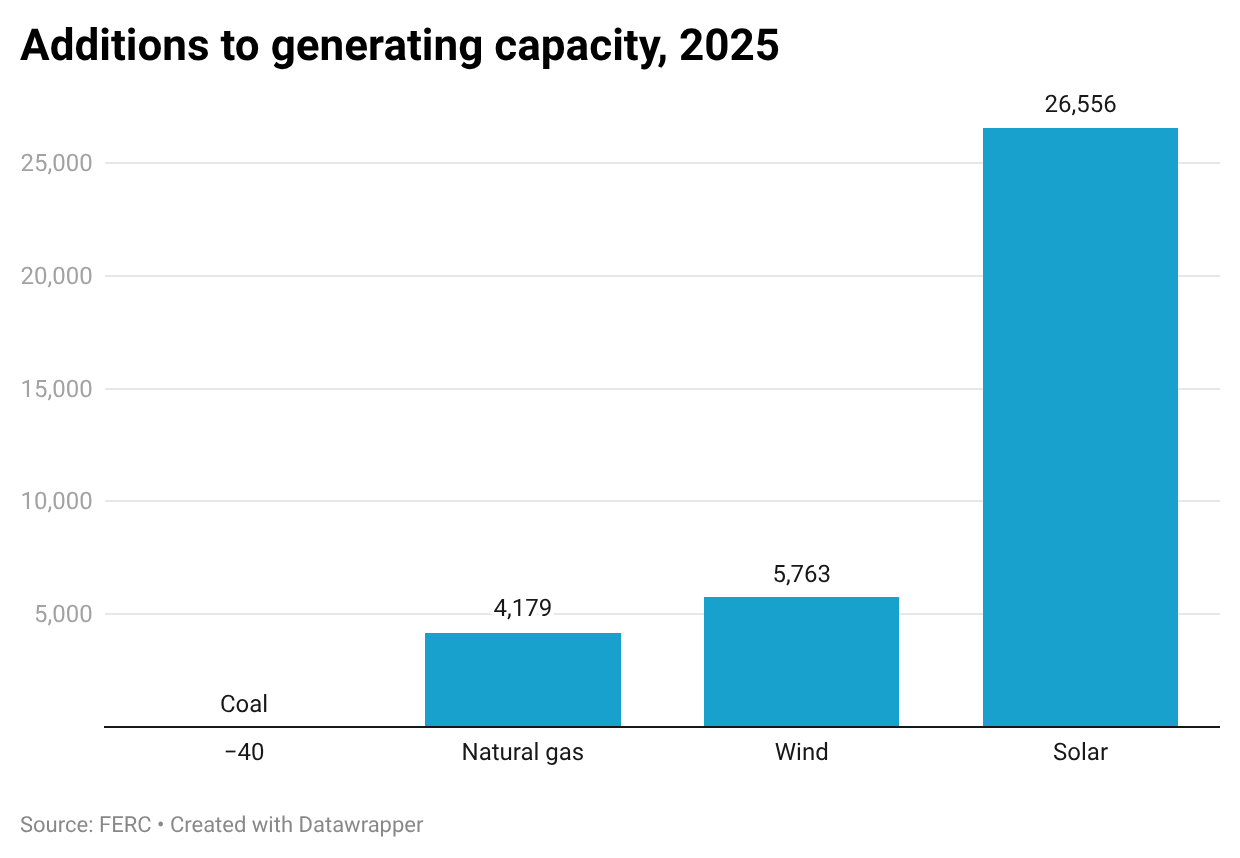
There was a time when “drill, baby, drill” could be portrayed as a realistic, hard-headed position. Does anyone remember the Cheney Energy Task Force? However, in the past few years, radical declines in the cost of solar power, wind power, and batteries — which solve the problem that the sun doesn’t always shine and the wind doesn’t always blow — have made renewables the most cost-effective way to generate electricity. By contrast, coal is completely unviable. Here are the Federal Energy Regulatory Commission’s estimates for utility capacity additions in 2025:


Yet Trump is trying to block renewable energy projects any way he can and has just invoked wartime authority to spend $700 million subsidizing new power plants using “clean, beautiful” coal.

Why? Part of the answer is big money. Fossil fuel interests were huge supporters of Trump in 2024. In fact, the Trump presidency is itself the result of billions of dollars spent by the Koch Brothers and others to corrupt and undermine U.S. political institutions -- the Supreme Court very much included. Anti-renewable, pro-fossil fuel policy is their reward, along with the destruction of the Voting Rights Act and the adoption of Project 2025.

What’s the other part? Clean energy has become a bogeyman in the culture wars: mining and burning coal are considered “manly” activities, while renewable energy is portrayed as woke and effeminate. Real men don’t worry about black lung and airborne particulates, let alone climate change.

So a combination of big money and fragile male egos drives Green Derangement Syndrome. And the same is true for both the Iran debacle and the refusal to learn from the catastrophe by turning to Ukraine.

Why was the United States so unprepared for the Iranian drone threat, despite the obvious successes of Ukrainian drones against Russia? Well, as investigative reporters delve into the story, I would urge them to follow the money.

America has a huge, highly profitable defense industry, dedicated to a suite of technologies that are rapidly being rendered obsolete, as $4 million Patriot missiles, that take years to build, are being used to shoot down $35,000 Shahed drones that can be manufactured in months.

So it wouldn’t be surprising if defense-industry interests are playing a significant role in the Trump administration’s refusal to admit that the rules of war have changed — the same way that fossil fuel companies have campaigned against the new realities of energy technology. After all, a deal with drone-savvy Ukrainians would mean less money going to US defense contractors.

While this is speculative, we do know that recognition of the drone revolution in warfare by Trump and his inner circle would require that they abandon their fantasy of macho military power. Pete Hegseth has been purging the military of capable officers — especially Blacks and women — he considers insufficiently loyal to Donald Trump. Beyond loyalty tests, however, he has exalted the importance of “warrior ethos” and physical fitness, as if he were leading the 300 Spartans rather than a high-tech military in an age of drones and electronic warfare.

It’s true that Hegseth, perhaps chastened by his abject failure in Iran — why does he still have a job? — recently admitted that the U.S. has learned from Ukraine. But an admission that his entire conception of war was wrongheaded will be a step too far for him.

Likewise, Trump himself is in love with big, expensive weapons as symbols of virility and power. He’s still pushing for giant “Trump-class” battleships, even though they would be sitting ducks in a modern war. Just ask the Ukrainians, who have used missiles and naval drones to force Russia’s once-vaunted Black Sea Fleet to cower in a fortified refuge. But Trump doesn’t want to give up his fantasies.

And he’s especially unwilling to learn from Ukraine. After all, he cut off aid to Ukraine in a hissy fit over Zelenskyy’s well-deserved reputation for heroism, only to he humiliated by Ukraine’s refusal to lose its war. Admitting that he needs Ukrainian help would be a further humiliation.

As I said earlier, there is no mystery about why Trump refuses to make a drone deal with Ukraine. Never mind the national interest. In military strategy as in energy policy, Trump is betraying America in the service of money and machismo.

domingo, 7 de junho de 2026

Vergonha do Dia D! Pete, do Pentágono, envergonha os nossos heróis caídos da Segunda Guerra Mundial na cerimónia da Normandia ao comparar os barcos dos migrantes à invasão aliada contra os nazis!


O secretário para os Crimes de Guerra, Pete Hegseth, teve um comportamento extremamente desrespeitoso na comemoração do Dia D, hoje, na Normandia, aproveitando o evento solene para promover uma retórica anti-imigrante.

Enquanto se encontrava nas praias sagradas onde as forças aliadas lançaram a maior invasão da história para libertar a Europa da ocupação nazi, Hegseth afirmou:

«Hoje, diferentes praias europeias são invadidas por diferentes ideologias perigosas. Em Espanha, Itália, Grécia e Bulgária, chegam barcos e homens. Quando é que as capitais europeias farão algo em relação a essa invasão? Ou será que já é tarde demais?» [aqui]

Meu Deus. O Dia D foi o momento em que as tropas americanas, britânicas, canadianas e outras forças aliadas arriscaram tudo para invadir aquelas praias e derrotar o fascismo. Um dia em que parecia realmente que o futuro do mundo estava por um fio.

Desvalorizar a 82.ª comemoração desse dia com posturas políticas xenófobas e sem sentido sobre a migração é simplesmente inconcebível.

Em nome do punhado de jovens heróis que ainda estão entre nós com 100 anos ou mais, pedimos desculpa em nome do povo americano.

Num dos locais mais sagrados e históricos do mundo, o trumpista Hegseth nem sequer conseguiu mostrar algum respeito básico pelos que morreram, deixando a política de fora, por uma vez.

Que vergonha, Pete. Cala-te, porco.

Testemunho de Robert Reich
Toda Verdade aqui

sábado, 25 de abril de 2026

The Worst Neo Robber Baron of Them All


I’m tempted to give Elon Musk that title. But when it comes to greedy and irresponsible corporate behavior, one CEO is outdoing even Musk.

When the history of this sordid second Gilded Age is written, the list of neo robber barons will obviously include Musk as well as Meta’s (Facebook’s) Mark Zuckerberg, Palantir’s Alex Karp, Palantir’s co-founder and board chair Peter Thiel, Oracle’s Larry Ellison (and his son, David), Google’s Sundar Pichai, Blackstone’s Stephen Schwarzman, and the Trump Organization’s monumentally corrupt Donald Trump, Donald Trump Jr., and Eric Trump.

But one greedy, public-be-damned CEO stands out even above Musk, Trump, and the rest. His name: Jeff Bezos. His corporation: Amazon.

It is difficult for the human mind to comprehend all the ways Bezos is shafting Americans.

Start with prices. According to a newly unsealed filing released Monday in an antitrust lawsuit brought by California Attorney General Rob Bonta, Amazon has pressured major brands like Levi’s and Hanes to demand that competing retailers raise prices on their products.

The New York Times’s David McCabe reports on unsealed evidence that Amazon punishes sellers on its marketplace for offering lower prices on other websites, like those of Walmart or Target. When it spots a competitor’s lower price, Amazon tells the brands to demand that rival sites raise their prices for the products.

The filing includes an email to Hanes from Amazon, with links to Target’s and Walmart’s lower prices, along with Hanes’s apologetic response that it “reached out to Target and Walmart to have the prices increased.” And an email to Levi’s from Amazon, with links to lower-priced khakis on Walmart’s website, along with Levi’s response that Walmart had agreed to raise its price.

According to the lawsuit, Amazon has been able to exert pressure on different brands to raise their prices because of Amazon’s power and reach.

At a time when most Americans are having trouble making ends meet, Amazon’s push to raise prices — to enlarge its profits (and put more money into Jeff Bezos’s pockets) — is beyond unconscionable.

This is hardly Bezos’s and Amazon’s first brush with antitrust law. In 2023, the Federal Trade Commission and 17 states accused Amazon of illegally maintaining a monopoly in online retail by squeezing merchants who sell on its site and prioritizing its own products, resulting in “artificially higher prices.”

In September, the FTC agreed to settle another lawsuit against Amazon that accused it of making it difficult for consumers to cancel its Prime subscription service. Amazon agreed to pay up to $2.5 billion — including $1 billion in penalties and additional payouts to consumers — but didn’t admit or deny wrongdoing.

Meanwhile, The American Prospect’s Harold Meyerson reports that Virginia is subsidizing Amazon’s “second headquarters” in Crystal City, Virginia — just across the Potomac from Washington, D.C. — with $750 million in taxpayer funds, yet the corporation is wildly behind its job-creation pledge. Having promised to create 25,000 new jobs by 2038, it created a mere 1,600 jobs last year and is up to just 29 percent of the number of jobs it promised by now.

Speaking of Amazon jobs: Until earlier this month, attorneys for the National Labor Relations Board were prosecuting Amazon for firing employees that make Amazon deliveries because they’d voted to join the Teamsters, a clear violation of labor laws.

But then, a few weeks ago, the NLRB attorneys — now firmly under control of Trump’s NLRB general counsel — announced they’d reached a “settlement” with Amazon in which Amazon agreed to pay the workers who’d been laid off for more than two years, two weeks’ worth of wages. Two weeks.

Amazon’s workers are among the worst-treated in America.

Ryan Haas of The Western Edge reports that on April 6, an Amazon warehouse worker collapsed and died on the floor of Amazon’s warehouse in Troutdale, Oregon. A co-worker trained in CPR tried to help but was told by a manager to turn around. For more than an hour, employees said, they were instructed to continue picking items and loading trucks as the man lay dead. One manager reportedly told workers to “just turn around and not look” and get back to work.

Jeff Bezos couldn’t care less. As of April 2026, his net worth is estimated to be between $259 billion and $269 billion, making him one of the three richest people in the world.

Like the robber barons of the first Gilded Age, Bezos’s consumption is of the conspicuous kind.

He celebrated his wedding last year to Lauren Sánchez with a multi-day star-studded event in Venice, Italy, estimated to cost more than $50 million, featuring guests like Oprah Winfrey and Kim Kardashian, and including a ceremony on the island of San Giorgio Maggiore and a pajama-themed afterparty at the Arsenal.

His “homes” include three adjacent properties on Indian Creek Island in Florida, costing over $230 million; the former Warner estate in Beverly Hills, California, which features a 13,600-square-foot mansion and a golf course, which he purchased for $165 million; a 14-acre compound on Maui with a 4,500-square-foot main house and 700-square-foot pool; a $23 million mansion in Washington, D.C.; and a massive multi-lot compound with waterfront frontage in Medina, Washington.

But what puts Bezos at the head of all the other robber barons in this second Gilded Age is his slavish sycophancy toward the worst president in American history.

Bezos bought the legendary Washington Post for $250 million in October 2013 and has turned it into a Trump cheerleader — prohibiting its editorial page from endorsing Kamala Harris in 2024 and barring it from writing anything critical about American capitalism or Trump.

(That’s not all Bezos has done to ruin the Post. In February, he fired more than 300 Post journalists, about a third of its staff.)

Then he shamelessly paid $40 million to license the documentary “Melania” plus $35 million to market it — and earned back a tiny percentage. It was a blatant bribe of Trump.

And he does whatever Trump asks. After Trump complained to Bezos about a report that Amazon planned to display for consumers the costs of Trump’s tariffs, Bezos immediately canceled the plan.

Bezos has sucked up to Trump presumably to secure Pentagon contracts for his Blue Origin rocket company, which landed a $2.3 billion NASA contract early in Trump's second term. And to avoid further antitrust lawsuits or labor law scrutiny.

That he has zero scruples does not necessarily distinguish Bezos from the other robber barons of this despicable era.

But his public-be-damned business practices, his especially conspicuous consumption, and his excessive sucking up to Trump make Jeff Bezos the worst CEO of them all.

What can you do? You might share this post and boycott Amazon.

sexta-feira, 17 de abril de 2026

Hegseth Says Climate Change Is ‘Crap.’ The Military Is Still Bracing for It


When Hurricane Michael, a Category 5 storm, tore through Florida’s Tyndall Air Force Base in 2018, it battered F-22 stealth fighter jets, destroyed hundreds of buildings and churned up 700,000 cubic yards of debris. The total cost of the damage approached $5 billion.

Now, Tyndall is being rebuilt as a super-resilient “installation of the future.” New buildings sit more than a foot above the ground, to remain dry through 75 years of sea-level rise. Their roofs are designed to withstand winds of up to 165 miles per hour. Manmade oyster reefs will protect coasts by breaking up waves.

The massive project will be 70% complete next year, said the officer leading it, Col. Robert Bartlow, chief of the US Air Force Civil Engineer Center Natural Disaster Recovery Division. “This is a first for the Air Force,” he said, with large-scale, cutting-edge construction taking place “on top of an existing base, while there was a continued flying mission.”

Storms like Michael are becoming more powerful and damaging as the world warms, and many military installations are exposed to them and other climate hazards. Still, Secretary of Defense Pete Hegseth vowed last year that the Pentagon wouldn’t do any “climate change crap” on his watch. Biden-era climate action plans were scrapped, and the 2025 National Security Strategy invoked climate change only to label it a “disastrous” ideology. Hegseth canceled nearly 100 research studies related to global warming and security, which experts say will compound the loss of climate knowledge across the federal government under President Donald Trump.

“Because ‘climate’ is a dirty word, we’re not investing in that predictive capability,” said Sherri Goodman, secretary general of the non-governmental International Military Council on Climate and Security and, from 1993 to 2001, the US deputy undersecretary of defense for environmental security.

But as Tyndall shows, the Defense Department is still engaged on one front of the climate fight: steeling its bases against the effects of a warming atmosphere, such as higher seas, fiercer storms and deadlier fires. A new flood wall is rising at the US Naval Academy in Maryland; a low-lying Air Force runway is being elevated in Virginia; and projects are underway to reduce wildfire risk around various military sites in Hawaii.

Work that was previously described as confronting the climate threat is now touted for ensuring “resilience” and “readiness.” The semantics are a nod to necessity: At stake are hundreds of billions of dollars of assets and the ability to launch missions quickly and smoothly.

“Ultimately, the military is a very pragmatic institution,” said John Conger, a past director of the nonprofit Center for Climate and Security and a senior Defense Department official during the Obama administration. “It wants to maintain mission capability. Whether we’re going to call it ‘climate,’ not ‘climate,’ whatever — if I can’t get to the base because the road is flooded, that’s a problem.”

Representatives of the Defense Department declined to comment.
Global warming impinges on American security and military operations in numerous ways. More climate-driven disasters means more deployments to respond to them. Extreme heat makes it harder for jets to lift off and sickens soldiers during training exercises. Climate change also acts as a “threat multiplier” – a term that Goodman coined – around the world. It can exacerbate drought conditions, which may limit water or food in regions already primed for conflict.

Much of the military’s resilience work began years ago; construction timelines are long. The $900 billion 2026 National Defense Authorization Act, which Trump signed into law in December, includes measures that could be said to come under the umbrella of climate adaptation. The law bolsters the military’s ability to respond to wildfires; raises the cost limit for replacing structures destroyed by disasters; and requires military leaders to identify the biggest risks to water security on bases.

Congress has given the military “decades-long, bipartisan direction” to prepare for climate change, even at times when the term itself was out of political favor, noted Will Rogers, a principal of Converge Strategies and the senior climate advisor to the secretary of the Army from 2022 to January 2025.

If climate preparedness is another term for environmental assessment, “the Army’s been doing this regularly now since World War II,” said Frank Galgano, a geographer at Villanova University who retired from the Army as a lieutenant colonel in 2007.

The approach may not have shifted, but the atmosphere has. Extreme weather and disasters have caused $15 billion of damage to defense facilities over the past decade. In 2023 alone, Typhoon Marwar ravaged two bases on Guam, heavy rains swamped the campus of West Point in New York and a landslide blocked the main road at Camp Pendleton in California.

Close to $400 billion of federal government assets, most of them belonging to the Defense Department, are at high risk of being hit by a major coastal flood or storm in coming years, according to a Bloomberg Law analysis.

The Pentagon explicitly recognized the warming climate as a danger for many years. The 2008 National Defense Strategy flagged climate change as an emerging risk, and two years later it was named a national security threat in the Pentagon’s Quadrennial Defense Review. After that, the Defense Department and the individual armed forces put out a stream of climate and sustainability plans. (Some have now been removed from government websites.)

James Mattis, who served as defense secretary during President Donald Trump’s first term, described climate change as a destabilizing force in 2017. His Biden-era successor Lloyd Austin said in 2021, “We face all kinds of threats in our line of work, but few of them truly deserve to be called existential. The climate crisis does.”

Trump and Hegseth have made a sharp pivot. In a March 2025 memo to military leaders, Hegseth called climate change a “distraction” from fighting wars, ordered that references to it be removed from mission statements and barred any environmental initiatives from being included in the Future Years Defense Program, a strategic plan.

Hegseth also included a caveat big enough to steer an aircraft carrier through. “Nothing in this memorandum,” he wrote, “shall be construed to prevent the department from assessing weather-related impacts on operations, mitigating weather-related risks, conducting environmental assessments, as appropriate, and improving the resilience of military installations.”

Days after Hegseth issued his memo, the Pentagon’s guidance on master planning for bases was updated. (By law, every major military installation must have a master plan.) In the older version from 2022, the word “climate” was used 54 times. It doesn’t appear once in the new version, which still directs planners to identify and mitigate risks from extreme weather.

Bartlow, at Tyndall, sees no contradiction between that project and Hegseth’s guidance.

The overarching goal at Tyndall, he said, is “preserving lethality in a high-end combat capability. When we talk about resilience, it’s focused on preserving that combat capability.” If another Category 5 hurricane hits, “there’ll be some interruptions, but the idea is you’ll be able to recover this installation quickly,” Bartlow said. “You can make that direct link back to readiness.”

Hardening efforts continue elsewhere but are falling short. A February Government Accountability Office report found that the military has failed to track all the costs from disaster damage and hasn’t fully incorporated climate-change projections into facility designs, and that many of its master plans still haven’t been updated to promote greater resilience.

One constraint is funding. “Our installations are funded at about 80% of what they need on a day-to-day basis,” said Rogers, the former Army climate adviser.

The Iran war could apply more pressure. Defense officials “could use their reprogramming authority to pay for contingency operations in Iran” with money meant for fortifying bases, said Rogers. “I would be worried about that, depending on how long this goes.”

Although the Pentagon has maintained a focus on resilience, under Hegseth it has backed off efforts to lower its emissions — the US military is the single biggest climate polluter in the country — and develop green ships and tanks. The armed forces have in recent years explored using hybrid and electric tanks for tactical, not just environmental reasons: They reduce reliance on diesel supply lines, are quieter and are less detectable to heat radar. While the Army is moving ahead with its hybrid M1E3 tank, funding for such initiatives has declined, said Rogers.

Of the studies that Hegseth canceled, some focused on the Indo-Pacific, where China has ambitions, noted Goodman. She said the lost knowledge and reduced funding for climate and weather research – not just in the military but in agencies like the National Oceanic and Atmospheric Administration – could set back defense planning.

She offered a hypothetical example: With AI pushing the envelope in forecasting, an adversary could anticipate and take advantage of a weather event to launch a cyberattack on the US. “And if we’re not understanding that,” she said, “then we have become more vulnerable.”

Pete Hegseth quis orar por soldado mas acabou a citar monólogo de "Pulp Fiction"


Um dos momentos mais recentes protagonizado pelo secretário da Defesa dos Estados Unidos está a gerar polémica. Durante uma oração por um soldado norte-americano resgatado depois de a sua aeronave ter sido abatida pelo Irão, Pete Hegseth acabou por recitar um discurso muito semelhante a um monólogo do filme "Pulp Fiction", de Quentin Tarantino, em vez de um versículo bíblico.

O mais recente discurso do secretário da Defesa dos Estados Unidos está a dar que falar pelas razões mais insólitas. Num momento em que fazia uma oração por um soldado norte-americano resgatado após a sua aeronave ter sido abatida pelo Irão, Pete Hegseth tentou recitar um versículo bíblico, mas acabou por proferir um dos monólogos mais icónicos da obra cinematográfica de Quentin Tarantino.

O momento que está a dar que falar na imprensa internacional aconteceu na quarta-feira, no Pentágono, perante militares e familiares. Antes de proferir o “falso” trecho bíblico, Pete Hegseth explicou que a oração era recitada pela missão de Busca e Salvamento em Combate “Sandy One”, no Irão: “Chamam-lhe CSAR 25:17, o que penso ser uma referência a Ezequiel 25:17”, afirmou.

“O caminho do aviador abatido está cercado por todos os lados pelas iniquidades dos egoístas e pela tirania dos homens maus. Bendito aquele que, em nome da camaradagem e do dever, guia os perdidos pelo vale da escuridão, pois é verdadeiramente o guardião do seu irmão e o protetor dos que se perderam. E abaterei sobre ti grande vingança e ira furiosa aqueles que tentarem capturar e destruir o meu irmão, e saberás que o meu indicativo é Sandy 1 quando exercer a minha vingança sobre ti. Ámen", proferiu.

No entanto, Pete Hegseth acabou por denunciar-se, devido às evidentes semelhanças com o monólogo de “Jules Winnfield”, o assassino contratado interpretado por Samuel L. Jackson em “Pulp Fiction” (1994), proferido antes de executar as suas vítimas, apesar de ter adaptado o versículo ao contexto militar e à operação de resgate.

Na altura, Quentin Tarantino adaptou-o a partir de um filme japonês de artes marciais, intitulado "Karate Kiba" (1973), protagonizado por Sonny Chiba.

“O caminho do homem justo está cercado por todos os lados pelas iniquidades dos egoístas e pela tirania dos homens maus. Bendito aquele que, em nome da caridade e da boa vontade, guia os mais fracos pelo vale da escuridão, pois é verdadeiramente o guardião do seu irmão e o protetor dos que se perderam. E abaterei sobre ti grande vingança e ira furiosa aqueles que tentarem envenenar e destruir os meus irmãos. E saberás que o meu nome é o Senhor quando exercer a minha vingança sobre ti", cita.

Já o verdadeiro versículo de Ezequiel 25:17, que consiste numa declaração de vingança divina contra os filisteus (povo marítimo da Idade do Bronze), diz apenas: “E executarei grande vingança contra eles com severas repreensões; e saberão que eu sou o Senhor, quando eu exercer a minha vingança sobre eles.”

Segundo os relatos, este foi o segundo culto consecutivo em que Hegseth usou versículos e mensagens violentas ao discutir a guerra no Irão: "Concedam a esta força-tarefa alvos claros e justos para a violência", orou no mês passado.

segunda-feira, 16 de março de 2026

Pete Hegseth - Trump’s Stupidest Cabinet Member


At a press briefing on Friday, Defense Secretary Pete Hegseth complained about a CNN report that the Trump administration had underestimated Iran’s ability to disrupt global oil traffic by closing the Strait of Hormuz.

“Patently ridiculous,” Hegseth told reporters, adding — even as the strait’s blockage was proving to be Iran’s most powerful leverage in the war — we “don’t need to worry about it.” He also denied that the U.S. bombed the school where some 175 children were killed. Hegseth added that, as to CNN, “the sooner David Ellison takes over that network, the better.”

These remarks are remarkably stupid, on several levels.

First, CNN got it absolutely right in reporting that Trump’s national security team had underestimated Iran’s ability to disrupt global oil traffic. CNN cited “multiple sources familiar with the matter.”

The New York Times published a similar story, reporting that in the lead-up to the U.S.-Israeli attack, “Trump downplayed the risks to the energy markets.”

Even The Wall Street Journal, hardly a New York Times or CNN clone, substantiated the story on Friday, reporting that Trump rejected warnings that Iran would likely retaliate by closing the strait because he believed Iran would capitulate before doing so, and he assumed that even if Iran tried to close it, the U.S. military could handle it.

Second, Hegseth’s comment that we “don’t need to worry about” the blockage of the strait is not only false but flippantly insulting to an American public that deserves to know what the Trump regime is planning to do about soaring prices at the gas pump, directly due to that blockage.

Third, even if Hegseth believes that David Ellison’s ownership of CNN will silence CNN’s critical coverage of Trump, it’s remarkably stupid of Hegseth to say it out loud. “The sooner David Ellison takes over CNN, the better” is an open admission that Trump backed Ellison’s bid to acquire Warner Bros. Discovery, CNN’s parent, to silence criticism.

That deal is still pending, so Hegseth’s admission is likely to fuel even more opposition to it. California’s attorney general has already suggested he’ll go to court to block it. Now other attorneys general, the ACLU, and Democrats in Congress may join the case as co-plaintiffs.

Hegseth’s admission also confirms CNN’s worst fears that Ellison will throttle criticism of Trump - a fear that’s already caused several leading lights to exit. As Variety put it, “Anderson, cooped. Jake, tapped. Erin, burnt. Kasie, hunted. Wolf, blitzed.”

Ellison has already proven himself an unreliable steward of journalistic independence at CBS News. One departing producer there explained in a farewell memo to colleagues that she could no longer work where stories are “evaluated not just on their journalistic merit, but on whether they conform to a shifting set of ideological expectations — a dynamic that pressures producers and reporters to self-censor or avoid challenging narratives that might trigger backlash or unfavorable headlines.”

Finally, Hegseth’s denial that the U.S. is responsible for the deaths of nearly 200 schoolchildren in Iran is belied by mounting evidence that the U.S. did bomb the school. Hegseth’s further insistence that the U.S. “never targets civilians” is refuted by the U.S. military’s killing of at least 157 people on 40 small boats in the Caribbean without evidence they were “narcoterrorists” rather than civilians.

And, friends, this was just one news conference.

Pete Hegseth’s job is so far over his head that he can’t even see it. He evidently believes it’s to cheerlead and defend Trump with bonkers claims like “We didn't start this war, but under President Trump we’re finishing it” and “America is winning decisively, devastatingly, and without mercy” and “we will show no quarter for our enemies.” (“No quarter” means kill everyone and take no prisoners, which is a war crime.)

In the days leading up to the U.S. attack on Iran, Hegseth spent his time criticizing “wokeness” at American universities, feuding with Anthropic over safeguards for AI, and, in the day before the war began, forcing Scouting America to abandon programs aimed at promoting diversity.

He dismisses war crimes, pooh-poohs the rules of engagement, and projects unequivocal belligerence at a time when the United States is rapidly losing whatever moral standing it had in the world.

Granted, it’s difficult to select one of Trump’s Cabinet members as the stupidest. But Pete Hegseth stands out for sheer boneheaded ignorance.

domingo, 15 de março de 2026

Who’s Winning from Trump’s War? Follow the Money


Today I want to talk about who’s getting the most out of Trump’s war.

That war is costing the U.S. about $1 billion a day. The Pentagon’s budget is around $1 trillion this year, and Trump wants an additional $500 billion. Because of the war, the cost of oil has topped $100 a barrel, and the price of a gallon of gas at the U.S. pump now averages $3.67 — up from $2.92 before the war.

The strain on the federal budget has given Republicans an excuse to demand further cuts in federal assistance to people in need. JD Vance recently kicked off a “war on waste and fraud” by announcing suspension of Medicaid payments to Minnesota, charging that the program is rife with fraud perpetrated by “bad actors in our society … [who] decide to make themselves rich.”

But if you want to find real waste and fraud, look no further than Pete Hegseth’s “Department of War.”

A new analysis by government watchdog Open the Books found that as the 2025 fiscal year was ending, Hegseth’s Pentagon spent: nearly $100,000 on a Steinway grand piano to outfit the home of the Air Force chief of staff; $60,719 on premium office furniture, including at least one luxurious $1,844 Aeron Chair; $12,540 for three-tiered fruit basket stands; $2 million on Alaskan king crab, $6.9 million on lobster tail, $15.1 million on ribeye steak, and $1 million on salmon; $124,000 for ice cream machines; and $26,000 for sushi preparation tables.


The ballooning profits of military contractors are helped by their near monopoly on defense production. Since the 1990s, the number of prime contractors for the Defense Department has shrunk from 55 to five.

Keep following the money.
These giants have been spending more on enriching their investors than expanding production. Between 2020 and 2025, top military contractors devoted $110 billion to stock buybacks and dividends — more than double what they spent on capital expenditures — which boosted their stock values and the pay packages of their CEOs.

And who are their biggest investors and CEOs? Trump loyalists.

Larry Ellison’s Oracle provides Hegseth’s war machine with cloud infrastructure and enterprise software. (Reminder: Ellison is the second-richest person in America and a Trump loyalist on the verge of owning a media empire comprised of CBS, CNN, TikTok, Comedy Central, and HBO.)

Elon Musk’s SpaceX has secured billions in contracts for launching sensitive satellites and space surveillance. Musk’s xAI has received a Pentagon contract to develop advanced AI tools. (Reminder: Musk is the richest person in the world and spent a quarter of a billion dollars getting Trump reelected in 2024.)

Peter Thiel’s Palantir Technologies has landed multibillion-dollar defense contracts, including a $10 billion agreement with the U.S. Army to provide AI-driven data analytics and software to integrate AI, surveillance, and battlefield management systems. (Reminder: Thiel is a billionaire who contributed $1.25 million to Trump’s 2016 presidential campaign, including $1 million to a pro-Trump super PAC, and then $10 million to getting JD Vance elected to the U.S. Senate in 2022.)

Not to forget Big Oil, now enjoying windfall profits as global oil prices soar. (Recall Trump asking oil company executives for $1 billion for his 2024 campaign, in return for undisclosed favors.)

Among others benefitting from the turmoil is Jared Kushner, Trump’s son-in-law and one of the U.S. government’s chief negotiators in the Middle East, who’s busily raising at least $5 billion or more for his private-equity investment firm from governments in the Middle East, including Saudi Arabia’s Public Investment Fund.

Finally, there’s Trump’s on-again, off-again ally Vladimir Putin. In just two weeks of war, Russia has reaped an estimated $6.9 billion from the increase in oil prices and the easing of sanctions.

What to do? At the very least, Congress should:
  1. Prohibit defense contractors from making campaign donations or lobbying Congress. Why should taxpayers subsidize these activities?
  2. Tax windfall profits from Trump’s war (or from any war). America has had windfall profits taxes during wartime before. Given the size of current windfalls, we need it again.
  3. Cut the defense budget. Start by cutting it 10 percent each year it fails audits. This is particularly important during the Trump-Hegseth era of defense bloat.
As long as Trump and his Republicans control Congress and the executive branch, these reforms don’t have a prayer. Still, Democrats should introduce them and push for them. Let Trump and his Republicans go on record voting against them.

segunda-feira, 9 de março de 2026

‘A very dangerous person’: alarm as Pete Hegseth revels in carnage of Iran war

Not a single senator probed the most dangerous part of Hegseth's background: his support for white Christian nationalism [Fonte]

Critics say brash, bombastic Fox News host out of his depth to guide US military through murky new Middle East conflict


Brash and bellicose, he sounded more like a cartoon bully than a sombre statesman. “Death and destruction from the sky all day long,” Pete Hegseth, wearing a red, white and and blue tie and pocket square, bragged to reporters at the Pentagon near Washington. “This was never meant to be a fair fight, and it is not a fair fight. We are punching them while they’re down, which is exactly how it should be.”

Hegseth, 45, a former Fox News TV host who now commands the world’s most powerful military, has this week become the face of Donald Trump’s war in Iran. That has set off alarm bells for critics who warn that the Secretary of Defense – pointedly rebranded “Secretary of War” – has rapidly transformed the Pentagon into the staging ground for an ideological and religious crusade.

With machismo, Christian nationalism and callousness toward the lives of US troops, they say, Hegseth’s puerile displays on TV are aimed at sating Trump’s desire for a warmonger worthy of the manosphere. This was reinforced by a lurid social media video that intersperses clips from Hollywood blockbusters such as Braveheart, Gladiator, Superman and Top Gun with Hegseth and real kill-shot footage of the attacks in Iran.

Janessa Goldbeck, chief executive of Vet Voice Foundation, a nonprofit advocacy organisation, said: “Pete Hegseth is a very dangerous person. He’s a white Christian nationalist and has the arsenal of the United States government at his disposal and a permission slip from President Trump to deploy carnage wherever he wishes against whomever he wishes.”

Hegseth’s rise would have been unthinkable under any other commander-in-chief. Born in Minneapolis, he studied politics at Princeton University and became publisher and editor of the Princeton Tory, a conservative student journal, where he frequently waded into culture-war issues such as feminism and homosexuality.

After leaving Princeton, Hegseth joined the US army national guard as an infantry officer. His service included deployments to Guantánamo Bay in Cuba and tours of Iraq and Afghanistan. He later revealed in a book that he told soldiers under his command in Iraq to ignore legal advice about when they were permitted to kill enemy combatants under their rules of engagement.

Hegseth became chief executive of Concerned Veterans for America, a conservative advocacy group, but departed in 2016 amid allegations of financial mismanagement, sexual impropriety and personal misconduct.

In 2018 Hegseth’s mother, Penelope, sent him an email that said: “You are an abuser of women – that is the ugly truth and I have no respect for any man that belittles, lies, cheats, sleeps around, and uses women for his own power and ego. You are that man (and have been for years) and as your mother, it pains me and embarrasses me to say that, but it is the sad, sad truth.”

Hegseth subsequently became a familiar face on TV as a contributor and co-host of Fox & Friends on Fox News, frequently interviewing Trump and defending his policies. He once wrote that, in the event of a Democratic election win, “the military and police … will be forced to make a choice” and “Yes, there will be some form of civil war”.

But Trump prevailed in 2024 and nominated Hegseth to serve as secretary of defence. At his confirmation hearing, senators raised serious questions about his record: disparaging remarks about women serving in the armed forces; allegations that he drank while on duty; claims of sexual assault and misconduct; his troubled tenure running two small veterans’ nonprofit organisations; and his lack of experience for a post overseeing the world’s most powerful military.

The Senate ultimately split 50–50, forcing the vice-president, JD Vance, to cast the tie-breaking vote. As defence secretary Hegseth has vowed to “unleash overwhelming and punishing violence” on enemies and promised to dispense with “stupid rules of engagement” – rules designed to restrict attacks on civilian populations.

Now, in his first week guiding the nation through a murky new Middle East conflict, Hegseth has largely forgone the solemnity of a traditional defence secretary in favour of the performative antics of a partisan broadcaster revelling in America’s capacity to inflict violence.

For years he had cultivated a hypermasculine “muscleman” aesthetic designed to play to Trump’s sensibilities and the rightwing media ecosystem. Now, faced with a geopolitical crisis that demands nuance and strategic foresight, he appears to many to be out of his depth.

Goldbeck, a Marine Corps veteran who was deployed overseas as a combat engineer officer, commented: “I wish I could say how cavalier, obtuse and hopeless Secretary Hegseth is at leading the Pentagon. I can’t even muster the words to describe his self-adulation, matched only in scope by his apparent moral depravity.”

She added: “Let’s not forget that Pete Hegseth is a former morning-show Fox News TV host, and has this cartoonish persona, speaking what he thinks is tough-guy language, but sounds to me as a veteran and to many of my peers who served in combat like somebody who is completely inept and pretending to have this macho persona.

“Honestly, it’s embarrassing. We know this guy is incompetent. I wouldn’t feel safe leaving Pete Hegseth in charge of putting together a DoorDash order.”

Hegseth at the International Christian Media Convention in Nashville last month. [Fonte]

Former White House officials share the concerns. Brett Bruen, president of the public affairs agency Global Situation Room and former global engagement director of the Barack Obama administration, said: “Hegseth is ill-suited for the kind of reassurance and strategy that Americans and our allies need to hear from the Pentagon right now.

“They don’t need a bumper sticker. They don’t need the bravado and the brashness that he brings. They need to know that America’s military is in strong, stable hands and what we have seen in his first couple of war press conferences is an inability to move beyond this Fox personality and into the role of leader of our nation’s military at a time of war.”

During his Pentagon briefing on the war on Wednesday, Hegseth adopted a bombastic tone, saying of Iranian leaders: “They are toast and they know it. Or at least soon enough they will know it. America is winning – decisively, devastatingly and without mercy.”

He bashed “fake news” while addressing the six army reservists killed in an Iranian attack on an operations center in Kuwait. “When a few drones get through or tragic things happen, it’s front-page news. I get it. The press only wants to make the president look bad. But try for once to report the reality. The terms of this war will be set by us at every step.”

The comments provoked uproar for their lack of empathy for America’s fallen. Jeremy Varon, a history professor at the New School for Social Research in New York, said: “That’s outrageous. You have a national effort by all media regardless of partisan bent to memorialise and honour the dead and he sees that simply as a tactic to bring down Trump.”

There was another aspect of Hegseth’s personality barely addressed by the Senate: his sympathy for Christian nationalism. Photos have shown him bearing two tattoos associated with crusader imagery. One depicts the Jerusalem cross – a cluster of five crosses long connected to medieval crusader iconography – on his chest.

Nearby is an image of a sword accompanied by the Latin phrase “Deus vult”, meaning “God wills it”, a slogan historically linked to the crusades and revived in recent years by various far-right groups. It appeared on clothing and flags carried by some participants in the January 6 Capitol attack.

Nor are the references merely symbolic. In his 2020 book, American Crusade, Hegseth wrote that those who benefit from “western civilisation” should “thank a crusader”. The book suggests that democratic politics alone may not suffice to achieve the goals of his political allies, declaring: “Voting is a weapon, but it’s not enough. We don’t want to fight, but, like our fellow Christians one thousand years ago, we must.”

There have been reports of more troubling behaviour. The New Yorker reported that a colleague at Concerned Veterans for America complained that he and another man repeatedly shouted “Kill all Muslims!” during a drunken episode at a bar while travelling for work.

Hegseth has previously endorsed the doctrine of “sphere sovereignty”, a worldview derived from the extremist beliefs of Christian reconstructionism (CR). The philosophy calls for capital punishment for homosexuality and strictly patriarchal families and churches.

The defence secretary attends Pilgrim Hill Reformed Fellowship, a church linked to the Communion of Reformed Evangelical Churches, a denomination co-founded by the pastor Doug Wilson, who has openly advocated a theocratic vision of society in which wives should submit to their husbands and women should be denied the vote. Wilson recently led a worship service at the Pentagon at Hegseth’s invitation.

Robert P Jones, president and founder of Public Religion Research Institute thinktank in Washington, said: “This is not one or two comments. It’s not a kind of one-off behaviour. This is like a longstanding publicly demonstrated orientation that Hegseth has. It’s not just a glorification of violence but a glorification of violence in the name of Christianity and civilisation.”

The Military Religious Freedom Foundation (MRFF) says it has received more than 200 complaints from service members about military commanders invoking extremist Christian rhetoric about biblical “end times” to justify involvement in the Iran war. Such language could also be offensive to Arab allies and provide Iran with the fodder it needs to justify its own holy war against the US.

Jones warned: “It casts this not as anything related to the public – is it about a nuclear programme? Is it about sponsoring terrorism? – which are legitimate political concerns. It takes it out of the realm of politics and casts it as a holy war of a supposedly Christian nation against a Muslim nation.”

Doug Pagitt, a pastor and executive director of the progressive Christian group Vote Common Good, compares Hegseth’s worldview to the historical heresy of Constantine, who allegedly painted a cross on his shield to conquer in the name of God – a theology the broader Christian church has spent centuries trying to distance itself from following the horrors of the Crusades.

Pagitt said: “It seems to me that Pete Hegseth has a worldview, which is contorted toward thinking that this administration has a particular divine calling. He believes – because he said it – that God has uniquely ordained Donald Trump and those that he chooses to accomplish very specific purposes in the world.

“Pete Hegseth’s own version of Christianity is one that’s built around a certain Christian advancement that comes through the domination of the governments of nations. He believes that not only is the military at his disposal to use for his purposes but it’s there to fulfill God’s agenda for the world.”

Saber mais

quarta-feira, 25 de junho de 2025

The Pentagon Is Using a Fabricated Chinese Threat to Build Genetically Engineered Soldiers


On April 8, a bipartisan commission chartered by Congress warned that China is rapidly advancing a terrifying new military threat: genetically engineered “super soldiers.”

The report by the National Security Commission on Emerging Biotechnology (NSCEB) urges the U.S. to respond with a sweeping effort to militarize biotechnology. It offers little concrete evidence that such Chinese programs even exist.

In the name of national security, Washington is now pushing for deregulation, massive government investment, and human experimentation. Experts say this effort echoes Cold War-era paranoia and threatens to erode ethical boundaries in science and warfare.

A Congressional Research Service fact sheet on the report claims its contents “describe how biotechnology could potentially revolutionize agricultural production in the U.S., transform U.S. health care, and change the future of computing power.” While that may sound promising, the report’s focus is overwhelmingly on using biotechnology for military purposes, including the creation of “genetically enhanced soldiers.” The report also states that “biotechnology’s impact on surveillance could be … transformative.”

The report argues that biology could revolutionize warfare just as airpower did in the 20th century, promising new advantages in stealth, logistics, and real-time physiological monitoring of soldiers. It calls for “a fundamental rethinking” of how the U.S. uses biotech in combat.

Biotechnology also promises new advantages in stealth and mobility. Dynamic biological camouflage, for instance, could shield warfighters from thermal detection, while wearable biosensors could adjust mission parameters based on real-time physiological data. Taken together, these advances demand a fundamental rethinking of how biology supports sustained, agile military operations, revolutionizing what it means to defend the U.S., including building for, nourishing, and healing forces in the field.”

The report argues that “winning” the global biotech race will “require de-risking the domestic production of defense-related biotechnology products” and changing “military specifications” to enable biotechnology companies to sell their products to the Pentagon more easily. Repeated references are also made to the need to “reduce or remove regulatory hurdles for familiar products.” Although the report never defines “familiar products,” the term may refer to controversial and experimental technologies such as CRISPR gene editing and mRNA therapeutics.

NSCEB also calls for large-scale “biological databases” to be treated as a “strategic resource.” It urges Congress to direct the Pentagon to build commercial facilities across the country to biomanufacture products deemed “critical for DOD needs.” The U.S. government “will need to shoulder some of the risk of early-stage financing for biotechnology and encourage private investment,” such as “[streamlining] regulatory processes to alleviate unnecessary burdens and accelerate the commercialization.”

The report’s tone is urgent, and lawmakers appear eager to act. One day after the report’s publication, NSCEB Chair Todd Young and Commissioners Alex Padilla, Stephanie Bice and Ro Khanna jointly introduced the National Biotechnology Initiative Act in both the House and Senate to “set in motion a whole-of-government approach to advancing biotechnology for U.S. national security, economic productivity, and competitiveness.”

Commissioners are urging “swift action” on militarizing biotech, “to protect U.S. national security.” In an accompanying press release, Vice Chair Michelle Rozo implored lawmakers to take action on the NSCEB report, stating, “Technology is not inherently good or bad, but who uses it matters.”

Independent researcher Jeff Kaye agrees with her statement. The U.S., which recently conducted extensive airstrikes in Yemen and continues to support Israel’s military campaign in Gaza, is, according to Kaye, a dangerous actor.

Independent journalist Peter Byrne tells MintPress News that the report reflects “the rationally untethered paranoid politics driving the ongoing weaponization and monetization of AI” in the U.S.

Byrne says that NSCEB’s speculative and scientifically questionable report “focuses on using so-called artificial intelligence to enhance the biologically violent capacities of government-backed and corporate-supported military forces—so-called “warfighters” who are increasingly being cyberized and treated, alongside targeted civilian masses, as expendable biologically augmented actors within what the report describes as an ‘Internet of Military Things.’

A Biotech Arms Race Built on Fear
The NSCEB’s composition raises additional concerns. The presence of both Democrats and Republicans on the Commission allows it to present itself as a bipartisan body. However, this obscures the fact that most commissioners aren’t neutral experts, but have deep ties to the Pentagon and U.S. intelligence community.

For example, Michelle Rozo serves as vice president of technology at In-Q-Tel, the CIA’s venture capital firm. The firm has invested heavily in biotechnology, almost since its inception.

According to her official NSCEB biography, Commissioner Dawn Meyerriecks “led the iconic CIA Directorate of Science and Technology…defining and delivering global capabilities beyond state-of-the-art.”

She also served on the NSA’s corporate board for over a decade. In that role, she helped the agency transition to the cloud and “[revamped] their approach to encryption.”

It is unclear if she crossed paths in that role with fellow board member Eric Schmidt, founder of Google, whose early development was supported by funding from intelligence agencies, including the CIA and NSA.

Google was a primary beneficiary of the post-9/11 U.S. national security state. A September 2021 report found that 77% of all government contracts awarded to the firm were related to the War on Terror.

This included developing the Maven program, which used AI to improve drone targeting, and counter-terrorism tools that disproportionately targeted Muslims on social media. Income from this program was key to supporting Google’s rise to global dominance.

Another notable member of the Commission is Dov Zakheim. A Pentagon journeyman who, during the Reagan administration, strived to ensure Israel was equipped with U.S.-made weapons and fighter jets at bargain rates, he was also a key member of the Project for the New American Century. In September 2000, the neoconservative think tank published “Rebuilding America’s Defenses.” The report promoted “the belief that America should seek to preserve and extend its position of global leadership by maintaining the preeminence of U.S. military forces.”

The document controversially suggested that ethnic bioweapons could “transform biological warfare from the realm of terror to a politically useful tool.” Zakheim was among its authors, along with fellow PNAC members Jeb Bush, Dick Cheney, Richard Perle, Donald Rumsfeld and Paul Wolfowitz. They later served as key advisers to President George W. Bush during the War on Terror.

“The marriage of biotechnology and U.S. national defense – war – policy harkens back to the U.S. crash program to create a usable germ warfare arsenal during the Korean War,” Jeff Kaye tells MintPress News. “Now the U.S. government wants to whip up a false fear about ‘genetically enhanced PLA super-soldiers’ in order to fund their own unprecedented attempt to create such soldiers themselves.” In the end, Kaye says, such programs primarily benefit military and technology contractors and raise serious ethical and strategic concerns.

The Myth of China’s Super Soldiers
In December 2020, then-U.S. Director of National Intelligence John Ratcliffe directly accused the Chinese government of “[conducting] human testing on members of the People’s Liberation Army in the hope of developing soldiers with biologically enhanced capabilities.” Despite providing no evidence, and the question of whether this is even scientifically possible being an obvious and open one, his comments triggered widespread media coverage, often uncritical, that persists to this day. Multiple outlets have published speculative accounts of Chinese advancements in gene-edited or technologically enhanced “super soldiers.”

Perhaps unsurprisingly, the NSCEB report repeatedly justifies the urgent need for U.S. investment in biotechnology with claims that Beijing is close to outpacing Washington in every aspect of the field. “China’s recent success across core biotechnology capabilities, including AI-driven drug discovery platforms and biomanufacturing, signals that they may soon eclipse us,” the report ominously cautions, “and if that happens, the U.S. may permanently lose its competitive edge. But the biggest threat, naturally, lies in the military sphere.

Nonetheless, the Commission appears uncertain on whether China has already made concrete moves in the direction of biotech weaponization, intends to, or is merely exploring the concept. For example, one passage states “our adversaries could [emphasis added] engineer ‘super soldiers’ with genetically enhanced physical capabilities.” Another speculates, “paired with new technologies like implanted brain-computer interfaces that tap directly into a soldier’s brain chemistry…‘super soldiers’ could [emphasis added] attack our military – before our leaders can even act.”

Elsewhere, though, the Commission firmly declares it has “every reason to believe that the CCP [sic] will weaponize biotechnology,” including the creation of “biotechnology-powered troops,” citing a highly questionable October 2024 State Department report drawn up by arch anti-China hawks as proof. The report speculates that traditional technologies like drone warfare could pale in comparison to “genetically enhanced PLA super-soldiers with fused human and artificial intelligence.”

While super soldiers may sound like science fiction today, in reality the CCP [sic] has long called for ‘population improvement’, and has backed research into topics like the genetic basis of intelligence.”

The conclusion is highly debatable and lacks substantiating evidence.

In March 2003 a then-senior member of the National Committee of the Chinese People’s Political Consultative Conference (CPPCC), a purely advisory body without any legislative power, called for “better protection of the health of baby girls,” and “the need of start [sic] a project to cure deformed baby girls or girls born with slight defects.” Then, the Commission points to a 2022 report from Berlin’s Max Planck Society for the Advancement of Science.

The report notes that while China is a pioneer in the emerging field of Germline Genome Editing, its experiments have exclusively focused on eradicating genetic diseases and hereditary disabilities. These experiments involve changes to DNA in egg, sperm or embryo cells—a still-controversial area of research.

Moreover, the report stresses that other countries – including Britain and the U.S. – have undertaken comparable experiments, and Beijing adheres to a rigorous regulatory framework in all its GGE testing.

The Society notes that in November 2018, a Chinese scientist and two collaborators independently created genetically edited babies without government approval or oversight. As a result, they were jailed for “illegal medical practices” and violating national regulations on biomedical research and medical ethics. The report contains no indication that this research is intended for military use, begging the question of how the Commission concluded from its findings that “super soldiers” are an intended result of China’s GGE experiments.

Human Enhancement and Military Obedience
Although the NSCEB report includes a recommendation for ethical oversight, a leading recommendation in the NSCEB report is for the Pentagon “to consult with stakeholders to define principles for ethical use of biotechnology for the U.S. military.” However, the accompanying text runs to just over 250 words and offers no explanation or definition of ethics in this context, let alone examples or concrete proposals for countering them. It simply states the investment must reflect the U.S. military’s “commitment to American values,” without defining what those values are or how they should be measured in practice.

Nonetheless, the Pentagon is encouraged to consider “Biotechnologies for warfighter performance optimization.” These include performance-enhancing technologies, policies for informed consent, and discussion of potentially heritable genetic treatments.

This raises only a fraction of the broader ethical questions surrounding the militarization of biotechnology.

As Peter Byrne tells MintPress, “the professional China-demonizing ‘authorities’ are calling for diverting the USA’s increasingly diminishing funds for projects aimed at benefiting society at large, for weaponizing disease and genetics with the sole goal of killing millions of people for profit by the very few. There is no ‘ethical’ stance to take in undertaking a fundamentally murderous and technologically stupid project, which is bound to backfire, except to recoil from it as a hot iron.”

The report does urge the Pentagon to ensure soldiers give informed consent to any genetic enhancements. The “reversibility” of ‘enhancements’ to which they are subjected suggests that the NSCEB’s program will – at least publicly – adhere to basic medical standards. Yet, a deeply disturbing May 2021 Britain’s Ministry of Defence report on “human augmentation” raises grave concerns about “consent” in military contexts:

Consent in the military is necessarily different to consent in wider society due to the unique relationship between subordinates and their superiors. It could be difficult for military personnel to give sufficiently voluntary and informed consent due to a tendency to follow orders over individual interest. Would a Service person who refused to be augmented be guilty of disobeying a lawful command?”

The report stressed that “establishing advantage” in human augmentation was urgent. It claimed the role of people in war was “being challenged in three key areas: data, complexity and speed.” Human augmentation, it added, was “the missing part of this puzzle.”

It went on to advocate wearable technologies, psychedelic drugs, gene editing, exoskeletons, sensory augmentation devices, and invasive implants such as “brain interfaces” be considered for administration to soldiers by the British military post-haste. “Adversaries” supposedly outpacing London in the field was a core justification.

That the British M.O.D. published almost identical findings to NSCEB four years ago amply demonstrates how Western governments and military thinkers have been obsessed with weaponizing the human body and mind for some time. Their public pronouncements and formally published, open-source plans offer far more concrete, chilling indications of developments in this field than have ever emerged from China. For example, NATO’s ‘Innovation Hub’ during 2020/21 published a number of bizarre papers and convened several conferences on the subject of “cognitive warfare.”

The Hub’s purpose was to explore “militarisation of brain science” and answers to the burning question of how to overcome perceived biological limits to human performance.

Most of the associated paper trail has suspiciously been removed from the web. However, documents it published outlined numerous ways in which the “human domain” could be added to established spheres of conflict, such as “air, land, sea, space and cyber.”

It resolved for NATO to aim for “cognitive warfare” dominance globally by 2040.

In a surreal twist, the Hub consulted several “futurists” to sketch fictional scenarios, whereby this objective could be achieved. One paper outlined a fictional scenario in which, by 2039, autopsies conducted on Chinese soldiers killed in skirmishes with U.S. and Australian troops over a Silk Road initiative in Zambia would find the corpses were “supra-human,” or genetically augmented beyond typical human capacity, the product of gene-editing in a lab that would give them enhanced muscle capacity, night vision, and “resistance to sleep deprivation, thirst, extreme heat and humidity.”

The incident, the author forecast, would trigger a “cognitive war” under NATO’s Article 5. It was not long after this highly speculative and implausible fiction was published that Ratcliffe made his claims about China developing “super soldiers,” suggesting that Ratcliffe’s remarks may have drawn inspiration from speculative NATO material.

If NSCEB’s report is fully adopted, many of the Innovation Hub’s most alarming proposals could edge closer to reality.

Aaron Good, founder of American Exception, argues the implications of the report are dire and reflect deeper dysfunction in U.S. governance.

This enterprise is so sinister and horrifying, it is not something that should be considered in an advanced civilization. But since we live under a lawless and exploitative oligarchic regime whose only real imperatives are to perpetuate itself and to aggrandize the wealth and power of its oligarch owners, this is what we get.”

“We must hope some constellation of internationalist powers can transcend the regime of the West,” Good says, concluding that the U.S.-led global order is unlikely to yield power without resistance.

As during the Cold War—when exaggerated claims of Soviet nuclear superiority and Chinese brainwashing triggered decades of arms races and human experimentation—U.S. policymakers are again invoking the specter of enemy-state superpowers to justify ethically murky and potentially illegal programs. Echoes of past atrocities like MKULTRA are unmistakable, raising the question of whether some biotech enhancement experiments may already be underway in secret.