Mostrar mensagens com a etiqueta Sensibilidade Climática. Mostrar todas as mensagens

terça-feira, 18 de agosto de 2026

Do Holoceno ao Antropoceno: por que razão a nossa civilização ficou desatualizada?

Se ontem refletíamos sobre por que ter esperança é urgente e revolucionário perante a rutura ecológica, hoje precisamos de olhar de frente para o diagnóstico material que exige essa mesma ação transformadora. A nossa esperança não pode ser passiva, porque a civilização que herdámos foi construída para um planeta que, literalmente, já não existe.
Todas as civilizações humanas surgiram sobre condições climáticas e ecológicas que não criaram. No entanto, na escala de tempo geológico da Terra, toda a história da civilização ocupa pouco mais do que um piscar de olhos.

A Terra tem aproximadamente 4,5 mil milhões de anos, a vida existe há pelo menos 3,7 mil milhões de anos, o Homo sapiens há cerca de 300.000 anos, enquanto o Holoceno - o intervalo climático dentro do qual a agricultura, as cidades e as sociedades complexas se desenvolveram - começou há apenas cerca de 11.700 anos.

Quase toda a história da Terra - e quase toda a história da vida - precede por ordens de grandeza o mundo humano construído na relativa estabilidade do Holoceno. Vistas a partir do tempo profundo, as nossas cidades e infraestruturas já ostentam a aparência de futuras ruínas: monumentais, pesadas e extraordinariamente recentes, erguidas num intervalo climático estreito cuja estabilidade foi tratada como permanente.

Esta estabilidade climática formava uma condição material tácita da civilização humana. A recorrência das estações, a relativa previsibilidade da precipitação e do caudal dos rios, e a persistência de regimes de temperatura familiares tornaram o mundo físico suficientemente previsível para que a agricultura, os povoamentos e as infraestruturas fossem organizados em torno da expectativa de que as suas condições básicas permaneceriam amplamente reconhecíveis ao longo das gerações.

O Holoceno foi uma infraestrutura que nunca tivemos de construir


Ilustração conceptual da janela climática do Holoceno. Informado por Kaufman et al., Scientific Data (2020), e Osman et al., Nature (2021).

E como nenhuma sociedade teve de a construir, o capitalismo pôde tratá-la como se fosse gratuita. O capital herdou talvez a infraestrutura mais valiosa da história humana: um clima relativamente estável.

Não o produziu nem pagou pela sua reprodução. A estabilidade climática não constava de nenhum balanço; o capital simplesmente assumiu que ela continuaria lá amanhã.

Construímos cidades para temperaturas retiradas do passado. Sistemas de drenagem para padrões familiares de precipitação. Agricultura em torno de ciclos de estações relativamente previsíveis. Casas para amplitudes históricas de calor e frio. Portos e povoamentos costeiros em redor de linhas de costa que se assumia moverem-se devagar. Infraestruturas inteiras foram concebidas com base na expectativa de que o dia de ontem permaneceria um guia razoável para o dia de amanhã.

Essa expectativa já não se verifica.

A rutura climática é, portanto, mais radical do que uma sucessão de eventos extremos. Significa que as regularidades ecológicas silenciosamente incorporadas na organização da vida social se estão, elas próprias, a tornar instáveis.

Aquilo que surge como a desestabilização da "natureza" regressa, assim, ao interior da sociedade como a desestabilização das suas fundações materiais.
Esta é a contradição no centro da crise climática: o capital acumulou-se tratando a estabilidade planetária como uma condição gratuita de produção e, no decurso da acumulação, começou a destruir essa própria condição.

O mundo construído sobre esses pressupostos permanece de pé enquanto as condições sob ele se alteram. Neste sentido, o capitalismo assemelha-se cada vez mais ao Wile E. Coyote (Bip Bip e Coiote) depois de correr para além da borda do penhasco: as pernas continuam a mover-se, a maquinaria continua a funcionar e a acumulação prossegue - enquanto o solo que tornava o movimento possível está a desaparecer debaixo dos pés.

Exceto que o capitalismo também tem vindo a dinamitar o penhasco atrás de si.

O Peso de uma Civilização Morta
O planeta muda mais depressa do que a civilização material construída sobre ele.

Cidades, autoestradas, fábricas, portos, centrais elétricas e edifícios não podem simplesmente migrar inalterados para um clima diferente. São imensos depósitos de matéria, energia e trabalho passado, construídos para permanecer no mesmo lugar durante décadas ou séculos. Quanto mais depressa as condições planetárias mudam, mais esta herança material começa a parecer uma civilização construída para o dia de ontem.

Existe agora, literalmente, mais deste mundo construído do que matéria viva na Terra.


Fonte: Elhacham et al., “Global human-made mass exceeds all living biomass,” Nature 588, 442–444 (2020), Fig. 1.

No início do século XX, a massa total de objetos produzidos pelo ser humano correspondia a apenas cerca de três por cento da biomassa do planeta. Por volta de 2020, de acordo com um estudo publicado na Nature, a massa antropogénica - betão, agregados, asfalto, tijolos, metais, plásticos e tudo o mais que os humanos construíram - atingiu cerca de 1,1 biliões de toneladas e ultrapassou a massa seca de todos os organismos vivos na Terra. Tinha vindo a duplicar aproximadamente a cada vinte anos. A humanidade estava a adicionar mais do que o seu próprio peso corporal em massa manufaturada por pessoa, todas as semanas.

A esta escala, o mundo construído já não é apenas um artefacto social; tornou-se um facto planetário. Este é o Antropoceno: a humanidade tornou-se uma força geológica, capaz de alterar o próprio sistema terrestre. Contudo, dizer que a humanidade se tornou uma força geológica não é dizer que a humanidade agiu como um sujeito coletivo único.

Um bilião de toneladas de betão não é a expressão de algum "instinto humano" universal para construir. São o resultado material de relações de classe, hierarquias sociais e distribuições desiguais de poder - a história endurecida em matéria, embutida nas infraestruturas do capital fóssil.

O capitalismo industrial sedimentou as suas relações sociais no mundo físico.
Entre 1900 e 2010, o stock de materiais acumulados em edifícios, infraestruturas e maquinaria aumentou cerca de vinte e três vezes. Uma vez construídos, criam dependências do passado (path dependencies): os investimentos de ontem determinam a procura de energia e materiais de amanhã.

Em termos marxianos, o trabalho passado confronta a sociedade viva sob a forma material - "trabalho morto que, como um vampiro, se alimenta do trabalho vivo, e vive tanto mais quanto mais dele suga" (O Capital, Vol. I, Cap. 15). Sob o capitalismo, máquinas, fábricas e infraestruturas adquirem um poder material de comando sobre o trabalho e a natureza.

Uma vez construída, a infraestrutura começa a exigir a sua continuação. Uma refinaria exige um fluxo contínuo de petróleo. Um sistema de autoestradas exige automóveis. Uma central elétrica a combustível fóssil construída para funcionar durante quarenta anos carrega dentro do seu betão e aço uma expectativa sobre o futuro.

O passado adquire um poder material sobre o futuro.
Esta é uma das razões pelas quais a transição ecológica é muito mais difícil do que "substituir uma fonte de energia por outra". O capitalismo acumulou um enorme mundo material cuja operação contínua reproduz o metabolismo social que, em primeiro lugar, desestabilizou o clima.

A contradição é cada vez mais gritante, uma vez que herdámos uma infraestrutura concebida para um conjunto de condições planetárias enquanto entramos noutro.

A infraestrutura pode permanecer de pé muito depois de o mundo para o qual foi construída ter começado a desaparecer.

Cidades de betão sem sombra, habitações expostas, redes de transporte fóssil e paisagens urbanas que retêm o calor assemelham-se cada vez mais aos vestígios de uma civilização industrial - ruínas futuras de um mundo cujas condições materiais já estão a desaparecer.

A Privatização da Sobrevivência
Se as condições materiais herdadas do Holoceno continuarem a deteriorar-se enquanto as relações de propriedade e riqueza existentes permanecerem intactas, a crise ecológica intensificará as desigualdades que acompanham o capitalismo industrial desde os seus primórdios. A classe social sempre moldou o acesso aos cuidados de saúde, à alimentação nutritiva, à habitação segura, a ambientes limpos e à possibilidade de viver uma vida mais longa e confortável. A rutura climática ameaça transformar estas diferenças de privilégio em diferenças na capacidade de sobreviver.

À medida que as condições básicas de vida se tornam menos fiáveis, a riqueza determinará cada vez mais quem pode comprar proteção contra o colapso ecológico. O que outrora era dado como garantido enquanto condição comum da vida tornar-se-á, cada vez mais, uma mercadoria. Os mais abastados poderão comprar distância em relação ao calor, à escassez e ao deslocamento forçado, enquanto as classes, comunidades e regiões mais pobres serão forçadas a absorver a crise em primeiro lugar e de forma mais violenta.

"Não há Planeta B" tornou-se, e bem, um dos slogans definidores do ambientalismo. No entanto, paradoxalmente, o Planeta B é precisamente o sonho dos tecno-oligarcas milionários: desde enclaves fortificados na Terra ao sonho de Elon Musk de colonizar Marte. A possibilidade de fuga torna-se mais fácil de imaginar do que a transformação das relações sociais que impulsionam o colapso ecológico no nosso planeta partilhado.

A obscenidade mais profunda desta trajetória é que a própria sobrevivência se pode tornar o privilégio supremo daqueles que mais beneficiaram do sistema que tornou o planeta cada vez mais difícil de habitar.

A adaptação climática sem transformação social é a privatização da sobrevivência.

Uma Civilização para o Planeta Que Existe
O problema, então, é como construir a vida social para condições planetárias que já não podem ser dadas como garantidas. Grande parte do mundo que herdámos foi concebida em torno de regularidades climáticas que já estão a escapar-nos.

A adaptação é inevitável, mas a sua direção é política. Prolongar a vida de uma civilização fóssil forçando corpos, cidades e ecossistemas a absorver um calor, instabilidade e perturbação cada vez maiores apenas preservaria a maquinaria do colapso.

Um planeta em mudança exige a transformação da organização material da vida social: a forma como construímos cidades e casas, produzimos e distribuímos energia, organizamos os transportes e a agricultura, gerimos a água, estruturamos o trabalho e reproduzimos a vida quotidiana. Um mundo mais quente força uma questão mais profunda: que tipo de sociedade pode permanecer compatível com as condições de vida?

Mas uma civilização fóssil não se pode tornar habitável simplesmente substituindo combustíveis fósseis por energias renováveis, plantando mais árvores ou adicionando espaços verdes enquanto se mantém intacta a sua organização material subjacente. Temos de repensar as divisões herdadas entre cidade e campo, sociedade e natureza, desenvolvimento humano e os limites biofísicos do planeta.

Nada disto é possível sem ir além do próprio capitalismo.

Este é o horizonte do ecossocialismo: não a gestão ecológica do mundo que herdámos, mas a reorganização democrática das suas fundações materiais em torno das necessidades coletivas, da prosperidade humana e da reprodução da vida na Terra.

O capitalismo passou séculos a adaptar a natureza aos requisitos da acumulação. Hoje, a crise ecológica confronta-nos com a tarefa inversa: reorganizar a vida social em torno dos requisitos materiais de um planeta habitável.

Construímos um mundo para um planeta que já não existe. Agora temos de construir um para o planeta que existe.

quarta-feira, 29 de abril de 2026

RCP8.5 Is Officially Dead

The international committee responsible for the official scenarios that feed into climate modeling that are the basis for most projective climate research and the assessments of the Intergovernmental Panel on Climate Change (IPCC) has just published the next generation of climate scenarios.

Big news: The new framework has eliminated the most extreme scenarios that have dominated climate research over much of the past several decades — specifically, RCP8.5, SSP5-8.5, and SSP3-7.0. This is an absolutely huge development in climate science which will have lasting impacts across research and policy.

The future is not what it used to be.

Today’s post commends the researchers who have brought climate scenarios more in line with current understandings, but also raises some significant continuing issues with the scenarios.

Let’s get started . . .

The new scenarios come from the Coupled Model Intercomparison Project (CMIP) — a project of the World Climate Research Programme (WCRP), co-sponsored by the World Meteorological Organization, the International Science Council, and UNESCO’s Intergovernmental Oceanographic Commission.

Under CMIP, now in its seventh iteration, sits another little-known committee with responsibility for developing the scenarios necessary for earth system models to project future climate.1 That committee — called ScenarioMIP — just published the new scenario framework that will underpin the IPCC’s Seventh Assessment Report (AR7) and much of the research that it will draw upon.

In a paper released earlier this month, Van Vuuren et al. (VVetal26) introduce a new set of seven scenarios. The authors write of the obsolete high end emissions scenarios (emphasis added):

“For the 21st century, this range will be smaller than assessed before: on the high-end of the range, the CMIP6 high emission levels (quantified by SSP5-8.5) have become implausible, based on trends in the costs of renewables, the emergence of climate policy and recent emission trends.”

Read that again — The high end scenarios are Implausible.2

I disagree that the implausibility of the high-end scenarios resulted from the falling costs of renewables or the emergence of climate policy, but that is a debate for another day.

What matters today is that the group with official responsibility for developing climate scenarios for the IPCC and broader research community has now admitted that the scenarios that have dominated climate research, assessment, and policy during the past two cycles of the IPCC assessment process are implausible: They describe impossible futures.

Tens of thousands of research papers have been — and continue to be — published using these scenarios, a similar number of media headlines have amplified their findings, and governments and international organization have built these implausible scenarios into policy and regulation.

We now know that all of this is built on a foundation of sand.

What changed
The new CMIP7 ScenarioMIP framework offers seven scenarios spanning a range from “VERY LOW” through “HIGH.” The current naming convention drops the radiative-forcing target labels of the SSP era — there is no “8.5” scenario, and no “7.0” scenario, but as I’ll show below, each scenario has a radiative forcing level in 2100.

I ran the available new scenarios (HIGH, MEDIUM, LOW, and VERY LOW) through the FaIR calibrated and constrained ensemble that Sanderson and Smith (2025) used to characterize the CMIP7 set (FaIR v. 2.2.0 as described in their README file). I then ran each of the five tier-1 SSPs through the same emulator with identical parameters to ensure that the results are apples-to-apples. The full methodology, data, and code is in the appendix to this post.

The headline results follow.
CO₂ emissions: fossil fuels and industry, 2000–2100

The chart above shows fossil-fuel and industry CO₂ emissions for four CMIP7 scenarios alongside the five tier-1 SSPs and the two main reference scenarios from the 2025 IEA World Energy Outlook.

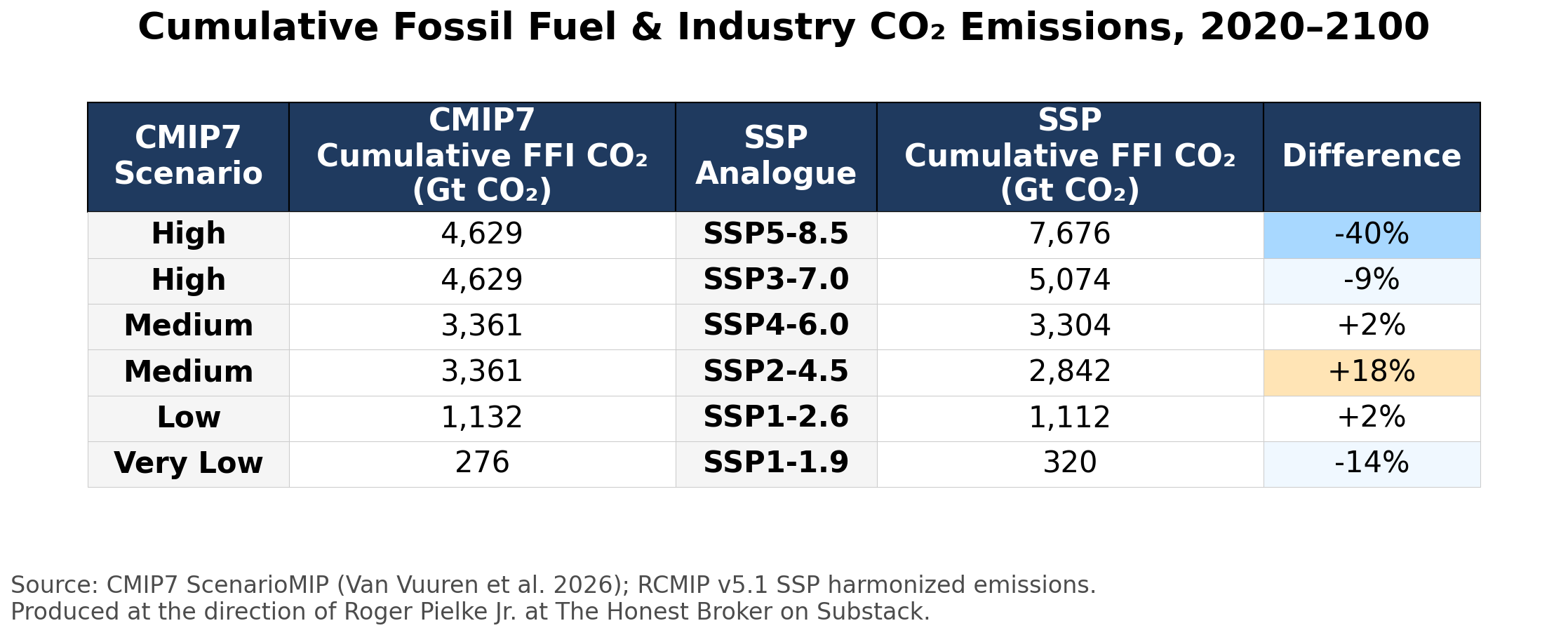
Note the massive gap between the new HIGH and SSP5-8.5. The new HIGH reaches 71 Gt CO₂/yr in 2100 — far below SSP5-8.5 at 128 Gt in 2100. Nothing in the CMIP7 set comes close to SSP5-8.5. The new HIGH also sits below SSP3-7.0 by about 9% in terms of cumulative emissions to 2100. Note also the gap between MEDIUM (solid yellow) and SSP2-4.5 (dashed yellow), which I’ll return to below.

Both of the most recent IEA near term scenarios — which run to 2050 — fall below MEDIUM and SSP2-4.5.

The table below compares the CMIP7 scenarios to their closest AR6 analogues, showing that the overall range has constricted. The higher scenarios have come down and the lower scenarios have come up — except VERY LOW, which moved down.
2100 effective radiative forcing and end-of-century temperature
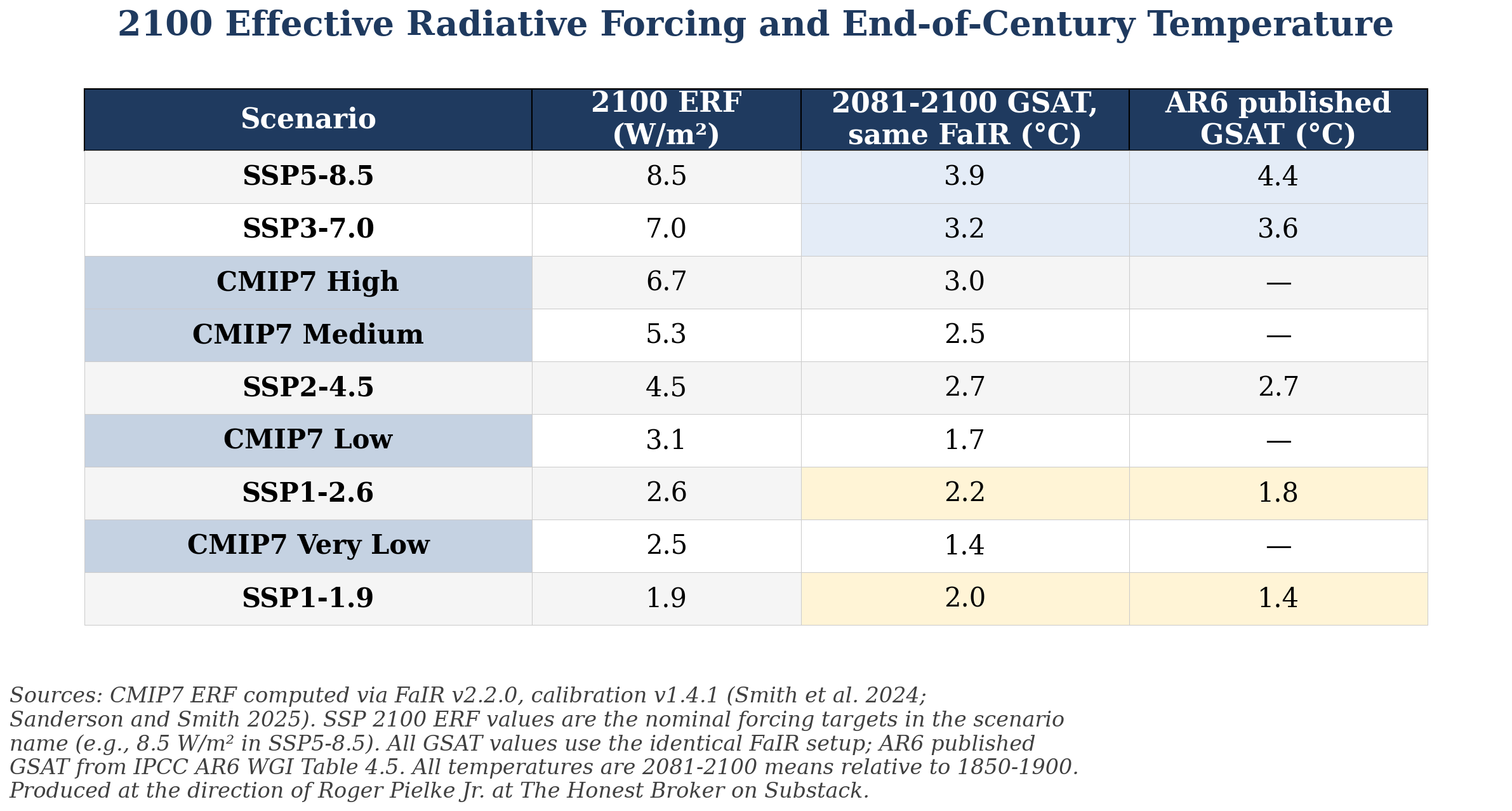
The table below lists AR6 and CMIP7 scenarios from highest to lowest 2100 radiative forcing. The middle column shows the average global temperature change from an 1850-1900 baseline, under the climate emulator used by CMIP7. The right column shows the average temperature change for the SSPs as projected by the IPCC AR6.
Interestingly, the projected 2080-2100 temperatures of the SSPs decreased from their AR6 values based solely on recent updates to the FaIR climate emulator.3 These changes resulted primarily from the updating of emissions trajectories from 2014 (used in AR6) to 2023 (used by CMIP7). The more moderate emissions trajectories resulted in lower projected end-of-century temperature increases.

The new CMIP7 HIGH is 0.9°C cooler than SSP5-8.5 in apples-to-apples terms (and 1.4°C cooler versus IPCC AR6), and 0.2°C cooler than SSP3-7.0 (-0.6°C against IPCC AR6).

The implausibility of upper-end legacy scenarios is now official.
CMIP7 avoided repeating the past with SSP3-7.0

Last April I argued here at THB that the climate science community was on the brink of repeating the RCP8.5 mistake with SSP3-7.0 — which assumed a 2100 global population approaching 13 billion, well above any contemporary demographic projection and a five-fold expansion of global coal use. Neither assumption survives current understandings of demographics or energy systems.

I don’t know if anyone in CMIP or ScenarioMIP reads THB4 — if not they should! — but regardless, they wisely chose not to adopt SSP3-7.0 as the new HIGH scenario.

The new HIGH scenario sits at 6.7 W/m² in 2100 — below the SSP3 baseline 7.0 W/m² — with 9 percent less cumulative fossil CO₂ through 2100. As I’ll discuss below, this is progress; it is partial but real.

But the new HIGH still sits well above the plausibility range that we identified in Pielke, Burgess, and Ritchie (2022). We found that of the >1,000 scenarios in the AR5 database, the plausible subset centered on a median of ~3.4 W/m² in 2100, with an upper end near 6 W/m². The new HIGH scenario is well above that upper end.

The authors of Van Vuuren et al. partially acknowledge that the new HIGH scenario is exploratory — a thought experiment, not a projection:

“Clearly, this scenario is not a “business-as-usual” scenario nor the no-policy reference scenario for the other scenarios. The scenario is intended to explore the upper end of GHG emissions resulting from deep political, technological, and structural deviation from current trends.”

Note that first sentence — It means that any future research that compares the HIGH scenario to lower scenarios in order to characterize the effects of climate policy will be fundamentally flawed. The HIGH scenario is not a projective scenario, but a “what if?” exercise.

Unfortunately, Van Vuuren et al. then engage in some unsupported speculation about the plausibility of the HIGH scenario in the real world:

“The are various reasons why such a scenario could emerge. For instance, a rollback of climate policies could result from a lack of public support for the energy transition. This could be related to, for instance, local opposition to building new wind farms or concerns about impacts on fossil industries related to jobs and national energy security. Also, the rapid cost decrease in renewable energy of the past decade could be discontinued, possibly as a result of regional scarcity and limited tradability in materials for solar and wind technologies and EV batteries . . .”

As discussed below, the new population assumptions of the updated SSP3 are ridiculous, and by themselves render the HIGH scenario implausible. The lack of any systematic effort to evaluate plausibility of scenarios remains a fundamental weakness of the scenario development process.
The new scenarios are SSPs in new clothing

The new CMIP7 framework does not start from a fresh socioeconomic foundation. Van Vuuren et al. explain:

“In practice, the IAM [Integrated Assessment Modeling] teams have based their current scenarios on various SSPs, as it was generally deemed pragmatic as these come with already available, suitably rich quantifications and were implemented by the participating modelling teams within the given timeline.”

The CMIP7 scenarios rely on the same narrative architecture as the IPCC AR6 SSPs. The table below shows how the SSP storylines map onto the new scenarios — Confusion is sure to result, as the old SSPs are not the new SSPs.
The new HIGH inherits the SSP3 storyline directly — the same SSP3 whose enormous 2100 population rendered it implausible when used in the IPCC AR6. Remarkably, the IIASA 2024 update to the SSPs did not bring the population projections down. Instead, it increased them, as you can see in the table below.
The 2024 demographic update (KC et al. 2024, IIASA Working Paper WP-24-003, also referred to as WIC2023) revises SSP 2100 populations upward: SSP3 jumps from 12.6 to 14.5 billion. SSP4 increases from 9.3 to 13.3 billion — an eye-popping 43% increase.

The SSP population update assumes that child mortality declines faster than WIC2013 anticipated, fertility declines slower in sub-Saharan Africa, and Africa’s 2020 base-year population was already 76 million higher than WIC2013 had projected. Africa’s 2100 population alone is now 3.55 billion, up from 2.62 billion in the AR6-era projection — a 35% upward revision.

This puts the CMIP7 HIGH scenario in a strange position: The cumulative fossil CO₂ from energy and industry in CMIP7 HIGH (4,629 Gt 2020-2100) is lower than SSP3-7.0 (5,074 Gt), but it has a 2100 population that is 15 percent larger. That means that the implied per-capita emissions trajectory in the new HIGH has a steeper decline.

How much of the new HIGH scenario’s warming is due to its incredible population projection?

I performed a simple sensitivity analysis:Take HIGH as published: 4,629 Gt cumulative fossil CO₂ over 2020-2100, producing about 3.0°C of 2081-2100 warming.
That means per-capita emissions intensity average about 5.2 tonnes of CO₂ per person per year using 11-billion as the mean population across the century.
Hold that per-capita intensity constant and replace the SSP3 population trajectory with the SSP1/SSP5 population trajectory — peaking at 8.5 billion in 2050, declining to 7.4 billion by 2100, averaging about 8 billion.

Under these assumptions, under HIGH, cumulative fossil CO₂ falls to roughly 3,330 Gt, a 1,300 Gt reduction. The IPCC AR6 central TCRE estimate (0.45°C per 1,000 Gt CO₂) gives about 0.6°C less warming. The HIGH scenario with SSP1/SSP5 population thus would deliver about 2.4°C of 2081-2100 warming — slightly cooler than the new MEDIUM at 2.5°C.

Under this simple method, about 0.6°C of the HIGH scenario’s projected warming traces to the population assumption alone. The HIGH scenario may be much less about carbon and much more about assumed human fecundity.

This is a sensitivity analysis, not a coherent scenario — combining SSP3’s per-capita intensity with the SSP1/SSP5 demographic profile is internally inconsistent. But it suggests that the demographic contribution to the HIGH scenario’s warming is significant.
The plausibility vacuum remains

The deeper problem with the SSP/RCP architecture, as Justin Ritchie has documented at length, is that physical climate modeling became decoupled from the underlying IAM socio-economic scenarios.

Under the RCPs, scenario creators identified concentration pathways and the underlying socio-economic assumptions were expected to be filled in later. Whether the underlying assumptions actually described a coherent picture of the world was never systematically assessed.

Ritchie called this a plausibility vacuum — a situation where any combination of climate model inputs could be used without any assessment of the real-world plausibility of the assumptions.

To be fair, the new CMIP7 framework does address some earlier shortfalls. The new design specifies emission-driven runs as the default, which allows for carbon-cycle feedbacks. The harmonization of emissions to observed 2023 data is an improvement — CMIP6 harmonized to 2014, and that harmonization had become well out-of-date by the time AR6 came out.

However, the plausibility vacuum problem remains. Van Vuuren et al. do not evaluate scenario plausibility against observed energy trends, against IEA projections, or against the body of literature critiquing the SSP set.

The 2023 ScenarioMIP workshop report — which kicked off the process of developing these new scenarios — recognized the plausibility problem and committed to addressing it. Van Vuuren et al. does not deliver on that commitment.

ScenarioMIP produces a better scenario set than those of AR6, but the improvement comes from incorporating more recent emissions data and accepting the undeniable collapse of SSP5-8.5’s credibility — not from any methodological reform of how scenario plausibility is assessed.
The MEDIUM scenario is not “current policy”

The walk-back at the high end is the most important change in the new framework. The story in the middle is more complicated.

Van Vuuren et al. describe the MEDIUM scenario as one that “shows the consequences of the current policy situation (as of 2025) and trends continuing over the century.” They specify that MEDIUM includes only policies “actually officially being implemented” — no NDC pledges, no net-zero announcements, unless backed by explicit policy. The framing implies that MEDIUM tracks where the world is actually headed under current policies.

That framing is not consistent with other approaches to defining a current policy trajectory. The CMIP7 MEDIUM scenario produces fossil-fuel CO₂ emissions that rise from about 38 Gt CO₂/yr today to 41 Gt by 2050 — that part compares well to the scenarios (CPS and STEPS) of IEA’s World Energy Outlook 2025, released last November.

However, it is post-2050 where the new MEDIUM scenario diverges from other current-policy projections, with its emissions slowly rising through the second half of the century.
In contrast, STEPS — the IEA’s standard reference for where current and announced policies actually take us — falls below 30 Gt by 2050 and produces about 2.5°C of 2100 warming.

The CMIP7 MEDIUM is more accurately characterized as a “policy stagnation” scenario rather than a “current policy” scenario. Cumulative fossil CO₂ emissions through the end of the century come in 18% higher than SSP2-4.5 — the AR6-era middle-of-the-road scenario — even though the MEDIUM 2081–2100 mean temperature is slightly cooler (explained below).

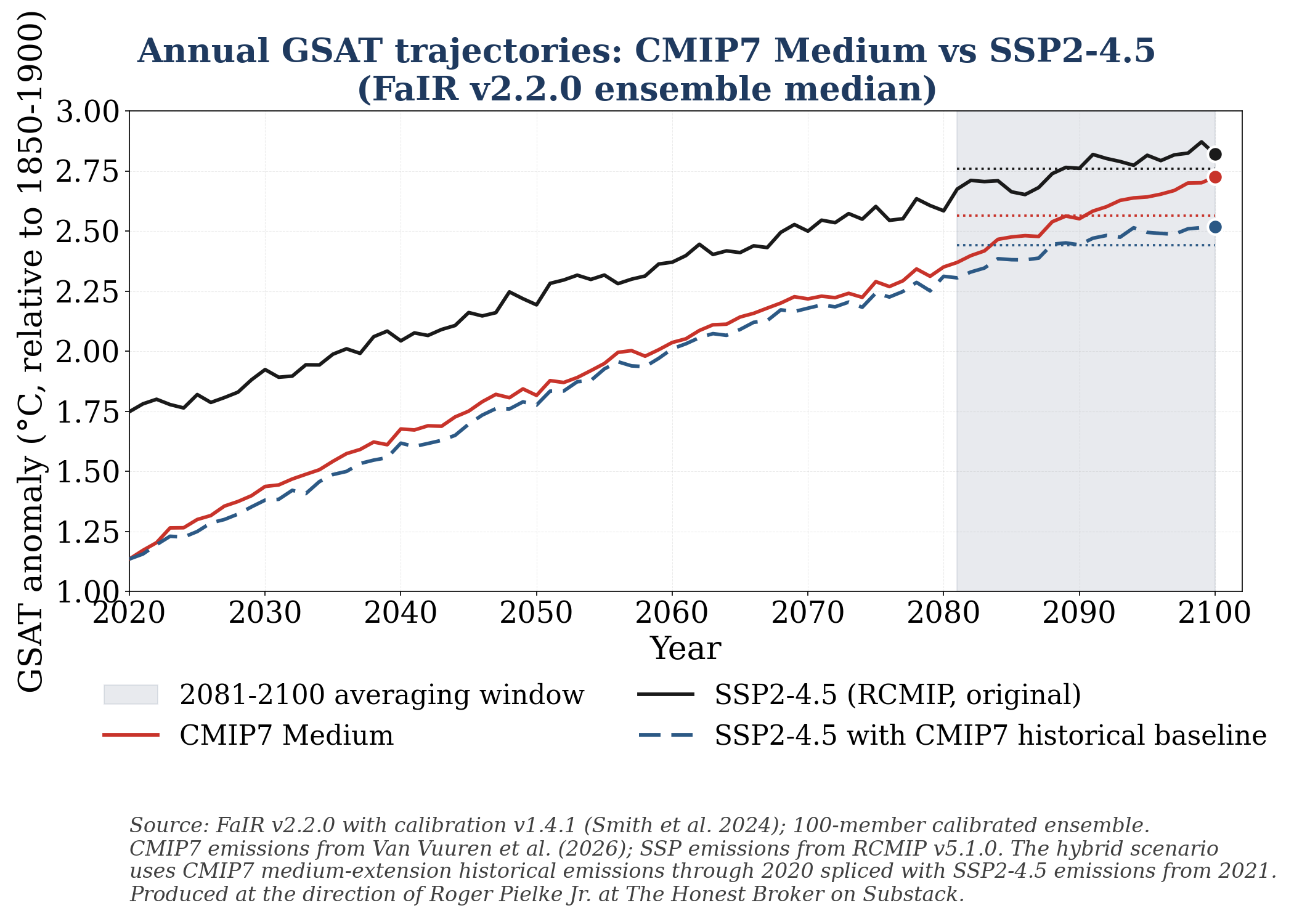
The figure below shows what happens once SSP2-4.5 and MEDIUM are anchored to the same observed 2020 baseline. The original SSP2-4.5 (black) sits roughly 0.6°C above CMIP7 MEDIUM (red) at 2020 — not because the 21st century plays out differently, but because the SSP framework’s historical emissions are harmonized to 2014 while CMIP7’s are harmonized to 2023. That head start propagates through the entire 21st century trajectory.
Running SSP2-4.5 post-2020 emissions through the CMIP7 FaIR emulator with CMIP7’s updated historical baseline (dashed blue), the picture inverts: SSP2-4.5 produces a 2081-2100 mean of 2.44°C against CMIP7 MEDIUM 2.56°C. On an apples-to-apples comparison, the new MEDIUM results in about 0.12-0.20°C more warming than SSP2-4.5 — due to its 520 Gt larger cumulative CO₂ budget over the century.

This connects to the larger argument in Pielke, Burgess, and Ritchie (2022): observed CO₂ emissions from 2005 through 2020 tracked closer to the SSP 3.4 W/m² range than to SSP2-4.5. Today, the gap has widened, not closed. IEA STEPS now has emissions falling to under 30 Gt by 2050 — a trajectory consistent with the SSP 3.4 forcing range. The center of the new CMIP7 scenario set sits well above that range.

The new framework compressed the high end. Good.

The middle did not move far enough. The new MEDIUM might be considered a worst-case scenario rather than a current policy scenario. Interestingly, that would mean that there is no real current-policy scenario in the new CMIP7 scenarios, which would be something like a SSP2-3.4 scenario with updated demographics.

Perhaps, if projected demographic changes continue to trend lower, CMIP7 LOW will come to represent something akin to a current policy trajectory.
Why this matters: these scenarios live in policy

The now-implausible upper-end scenarios — RCP8.5, SSP5-8.5, and SSP3-7.0 — are not just academic constructs used in esoteric research. They are embedded in the policies and regulations of most of the world’s largest economies, found across the world’s most important multilateral institutions, and used in the climate stress tests that govern hundreds of billions of dollars in bank capital.

The table below provides just a few examples.

National climate impact assessments in the United States, United Kingdom, Germany, Canada, Australia, Japan, and the Netherlands all use RCP8.5 or SSP5-8.5 as a reference scenario. The Network for Greening the Financial System framework, used by more than 140 central banks, has utilized a “Hot House World” scenario calibrated to RCP8.5 physical risk into the bank stress tests run by the European Central Bank, the Bank of England, the Reserve Bank of New Zealand, the Banque de France, and the US Federal Reserve. The World Bank’s Climate Change Knowledge Portal, which provides the climate diagnostics that feed into the Country Climate and Development Reports for more than 100 client countries, defaults to SSP5-8.5 and SSP3-7.0.

The abandonment of the high-end legacy scenarios by CMIP7 will need to propagate through this entire infrastructure. The policy machinery built on RCP8.5 and the other implausible scenarios is systemic.
What this means

The new CMIP7 ScenarioMIP framework represents a real course correction, but with more work to do. SSP5-8.5 is gone. SSP3-7.0 has a successor that is less extreme but arguably remains implausible. The middle of the set is more pessimistic than trajectories of current and announced policies. The plausibility vacuum at the heart of the architecture has yet to be addressed.

All this means that users of climate models and model output based on legacy scenarios will now face decisions about if and how they’d like to realign with the latest scientific understandings versus continuing to rely on outdated research.

Furthermore, there are no doubt many — hundreds if not thousands — of studies in the publication pipeline that depend upon the upper end scenarios. Editors and reviewers should ensure that they are properly characterized as exploratory and are not intended to be interpreted as projective.

We’ve known since 2017 that upper end climate scenarios are fatally flawed. Nine years later, that understanding has now become officially recognized. That is good news.

We can debate whether nine years is short or long for the overturning of scientific understandings with massive economic and policy implications. But today, that overturning is undeniable.

Science is self-correcting. What matters now is what happens next.

terça-feira, 30 de janeiro de 2024

I wasn't worried about climate change. Now I am. ECS: Equilibrium Climate Sensitivity


In this video I explain what climate sensitivity is and why it is important. Climate sensitivity is a number that roughly speaking tells us how fast climate change will get worse. A few years ago, after various software improvements, a bunch of climate models began having a much higher climate sensitivity than previously. Climate scientists have come up with reasons for why to ignore this. I think it's a bad idea to ignore this. 
The quiz for this video is here

quarta-feira, 8 de novembro de 2023

“O limite de 1,5 graus Celsius está morto”, diz cientista climático

O planeta deverá ultrapassar o limiar de aquecimento de 1,5 graus Celsius ainda nesta década. Esta é a conclusão de um controverso estudo científico do qual o climatólogo James Hansen é co-autor.


As alterações climáticas estão a acelerar e o mundo deverá ultrapassar o limiar de aquecimento de 1,5 graus Celsius ainda nesta década, de acordo com uma investigação publicada na quinta-feira. Esta conclusão poderá, acreditam os cientistas, fazer soar o alarme nas negociações climáticas da próxima Cimeira do Clima (COP28), que arranca no fim deste mês no Dubai.

Os países comprometeram-se, no Acordo de Paris de 2015, a limitar o aquecimento global a 1,5º C em relação à média das temperaturas pré-industriais, mas o novo artigo elaborado por uma equipa de cientistas, incluindo da agência espacial dos Estados Unidos (NASA) e da Universidade de Colúmbia, apresenta dados que sugerem que este objectivo já está fora de alcance.

A maioria dos cenários de emissões no âmbito do Painel Intergovernamental das Nações Unidas para as Alterações Climáticas (IPCC, na sigla inglesa) prevê que o planeta ultrapasse os 1,5 graus Celsius durante a década de 2020.

O limite de 1,5 graus Celsius está morto e enterrado”, disse o co-autor do estudo James Hansen, do Earth Institute da Universidade de Colúmbia, que foi um dos primeiros cientistas a alertar o mundo na década de 1980 para o impacto dos gases com efeito de estufa no aquecimento global.

Já vamos em 1,2º Celsius
O mundo já aqueceu quase 1,2º C acima das temperaturas pré-industriais.

O estudo suscitou diferentes reacções de outros cientistas climáticos. Alguns questionaram as recentes descobertas, com Michael Mann, da Universidade da Pensilvânia, a dizer num texto publicado num blogue que tais conclusões estavam "muito fora das conclusões da maioria".

O novo relatório surge após meses de choques climáticos extremos em todo o mundo, desde ondas de calor na China até graves inundações na Líbia. Estima-se que 2023 previsto venha a ser o ano mais quente desde que há registos.

A Cimeira do Clima vai reunir representantes de diferentes países, de 30 de Novembro a 12 de Dezembro, no Dubai, para discutir os esforços políticos globais necessários para controlar as emissões de gases com efeito de estufa.

Subestimar a sensibilidade da Terra
As conclusões do estudo, publicado na revista científica Oxford Open Climate Change, baseiam-se em dois factores. O primeiro deles diz respeito à sensibilidade da Terra a um dos gases com efeito de estufa.

Os cientistas subestimaram a sensibilidade do clima planetário ao aumento dos níveis de dióxido de carbono. O IPCC deu uma estimativa aproximada de que duplicar os níveis atmosféricos de dióxido de carbono causaria um aquecimento global de cerca de 3 graus Celsius.

Uma melhor compreensão dos dados climáticos antigos – recolhidos de fontes como núcleos de gelo e anéis de árvores – resultou numa estimativa mais elevada de cerca de 4,8 graus Celsius, de acordo com o mesmo estudo.

Até agora, as concentrações atmosféricas de dióxido de carbono subiram de cerca de 280 partes por milhão (ppm) na época pré-industrial para cerca de 418 ppm hoje.

Outro factor citado pelo relatório é o progresso da China no combate à poluição atmosférica, causada principalmente pelo dióxido de enxofre libertado pelas centrais eléctricas a carvão, juntamente com os esforços globais para reduzir essas emissões provenientes do transporte marítimo.

Limpar os céus, ao mesmo tempo que proporciona benefícios para a saúde e salva vidas, acelera as alterações climáticas. Os aerossóis dispersam e reflectem a radiação solar.

Mann, da Pensilvânia, contestou a ideia de que os modelos subestimassem a sensibilidade climática, bem como o impacto da queda nas emissões de dióxido de enxofre provenientes do transporte marítimo.

Outros especialistas disseram que o estudo era consistente com outras investigações recentes. “Tudo está a acelerar”, disse o climatologista Klaus Hubacek, da Universidade de Groningen, na Holanda.

No início desta semana, um estudo publicado na revista Nature Climate Change sugeriu que o mundo precisaria de atingir zero emissões líquidas até 2034 para ter 50% de hipóteses de conter o aquecimento até 1,5 graus Celsius, muito antes do objectivo global de 2050.

quinta-feira, 12 de outubro de 2023

Steven Koonin on The Limitations of Climate Change Models


Steven Koonin reviews the state of climate science, focusing on data trends, climate models, and the uncertainties involved. He highlights issues with climate models, including their high sensitivity and inability to accurately reproduce historical temperature changes, cautioning against relying on inaccurate model projections.

To learn more about the Hoover Summer Policy Boot camp

segunda-feira, 18 de setembro de 2023

Ondas de calor no mar têm maior impacto entre os 50 e os 250 metros


Os efeitos das ondas de calor marinhas são mais intensos entre os 50 e os 250 metros do que nas águas mais superficiais, concluíram investigadores da Universidade do Algarve, alertando que isso representa um maior risco para a biodiversidade.

Num estudo publicado na revista científica Nature Climate Change, a equipa de trabalho liderada por investigadores do Centro de Ciências do Mar (CCMAR) da Universidade do Algarve (UAlg) sustenta que a duração e intensidade das ondas de calor marinhas “podem persistir durante mais tempo em águas mais profundas” e que “a biodiversidade subsuperficial pode estar sujeita a um maior risco” devido à alteração da temperatura.

“Até agora, as previsões e os impactos destes eventos têm-se centrado na superfície do mar, no entanto, observações localizadas sugerem que as ondas de calor marinhas podem ocorrer abaixo da superfície e persistir durante anos”, alertaram os investigadores, num comunicado em que a UAlg dá conta da publicação do estudo.

A UAlg destaca que a investigadora do CCMAR Eliza Fragkopoulou e a restante equipa recorreram a “observações da temperatura do mar a nível global e dados de reanálise”, de “previsões meteorológicas passadas” com “modelos meteorológicos modernos”, para estimar a duração e a intensidade das ondas de calor marinhas.

A análise abrangeu o período entre 1993 e 2019 e profundidades até 2.000 metros, permitindo aos investigadores descobrir que “a maior intensidade das ondas de calor marinhas não se verifica à superfície, mas sim na subsuperfície, especificamente entre 50 e 250 metros de profundidade”.

“Contra as nossas expectativas iniciais, descobrimos que as ondas de calor marinhas são mais intensas abaixo da superfície e que a sua duração pode duplicar, quando comparadas com a superfície”, constatou Eliza Fragkopoulou.

Os autores do estudo cruzaram depois os dados da temperatura com a distribuição das espécies marinhas e concluíram que “a biodiversidade subsuperficial poderia estar em risco, devido a uma maior intensidade cumulativa (indicador de stresse térmico) das ondas de calor nos primeiros 250 metros” do mar.

“Em todo o mundo, identificámos regiões de maior risco para a biodiversidade marinha, incluindo partes significativas dos oceanos Índico e Atlântico Norte, onde a elevada intensidade cumulativa das ondas de calor coincide com áreas onde se prevê uma elevada sensibilidade das espécies ao stresse térmico”, explicou Jorge Assis, investigador do CCMAR que liderou a investigação.

Os investigadores alertaram para a necessidade de desenvolver mais investigação neste âmbito, devido ao aumento da intensidade e frequência das ondas de calor no mar, causadas pelas alterações climáticas e o aquecimento global.

“Espera-se que os eventos extremos de temperatura redistribuam as espécies marinhas, levando-as da superfície para o oceano profundo. No entanto, existem outros fatores que podem impedir essa redistribuição, com consequências imprevisíveis”, advertiu Miguel Bastos Araújo, do National Museum of Natural Sciences (MNCN-CSIC), que também integrou a equipa de investigadores.

segunda-feira, 11 de julho de 2022

Estudo: metano é quatro vezes mais sensível ao aquecimento do planeta do que o esperado


Um novo estudo publicado dia 6 de Julho mostrou que o gás metano, um dos mais potentes causadores do efeito estufa que contribui para a mudança do clima, é quatro vezes mais sensível ao aquecimento do que o imaginado até agora. Isso significa que o tempo que o gás resiste na atmosfera aumenta na medida em que a temperatura média global aumenta, criando assim um ciclo vicioso de aquecimento.

Essa descoberta sugere uma resposta para uma das dúvidas mais quentes da ciência climática dos últimos anos: a concentração desse gás na atmosfera vinha diminuindo desde meados de 2000 até 2007 e, desde então, vem sofrendo um crescimento acelerado. Nem mesmo a pandemia, que reduziu o ritmo de emissão de gases de efeito estufa em todo o mundo, foi capaz de reverter esse quadro. Segundo os autores do estudo, o aquecimento recente do planeta está retardando o processo de degradação do metano na atmosfera, o que traz implicações bastante sérias para os esforços globais contra a mudança do clima.

“Foi um resultado realmente chocante e destaca que os efeitos das mudanças climáticas podem ser ainda mais extremos e perigosos do que pensávamos”, observou Simon Redfern, da Universidade Tecnológica de Nanyang (Singapura), ao Guardian. Essa conclusão também reforça a importância de que o mundo diminua consideravelmente suas emissões de metano nos próximos anos.

O estudo foi publicado na revista Nature Communications.

Em tempo: Uma análise da Climate Policy Initiative calculou qual é o custo potencial para que os países possam reduzir drasticamente suas emissões de metano: cerca de US$ 110 biliões anuais até o final desta década. Isso representa dez vezes o valor gasto atualmente com medidas para reduzir o metano. Mais grave, no entanto, é que apenas 10% do montante atual está sendo destinado efetivamente para as fontes antrópicas mais problemáticas de metano, como vazamentos e liberações de gás pela indústria fóssil. A Bloomberg deu mais detalhes.

ClimaInfo, 8 de julho de 2022.

terça-feira, 4 de junho de 2019

Há que usar estas palavras: emergência ambiental

Foi muito infeliz que o Parlamento português se tivesse recusado a decretar a emergência ambiental, afirma o prémio Pessoa 2018.

Fonte e notícia (ver o video) aqui


Especialista dos efeitos das alterações climáticas na biodiversidade, prémio Pessoa 2018, Miguel Bastos Araújo é o convidado desta semana do “Hora da Verdade”, uma parceria PÚBLICO/Renascença, que pode ouvir na rádio esta quinta-feira, às 13h. Para o cientista, a emergência climática só se combate com uma superestrutura e dá o exemplo da União Europeia. A ONU, diz, está obsoleta, apesar de António Guterres. E está em causa a sobrevivência da humanidade.

Disse que não vamos a tempo de evitar uma crise climática e biológica no planeta e que temos uma escolha entre impactos graves e menos graves. Mas apesar disto diz-se um optimista...

O que eu quero dizer é que a atitude pessimista não é muito produtiva. É como se alguém nos atirasse no meio de um grande lago e tivéssemos que nadar até à margem, e a margem fosse muito longe e o nosso estado de preparação física não fosse suficiente. O que fazemos? Afundamo-nos ali? Ou apesar de tudo tentamos nadar? Uma atitude pessimista no meio do lago não ajudaria de todo a resolver a situação.

A probabilidade de acerto seria maior tendo uma atitude optimista e pró-activa. É isto que eu quero dizer. E a verdade é que nós somos uma espécie inteligente, temos capacidade de engenho, somos animais de sobrevivência e o meu optimismo também reside nessa capacidade que temos - mas não temos estado a aplicar com todo o empenho que deveríamos estar. É possível que em algum momento o façamos. Não vamos a tempo de voltar ao mundo do século XX em termos ambientais.


O que são os efeitos graves e os menos graves? 
Se olharmos para as tendências demográficas a nível mundial, temos um crescimento exponencial no século XX. Estamos agora a chegar aos oito mil milhões de habitantes no planeta e os cenários futuros são muito incertos. Não sabemos de todo o que é que vai acontecer. Mas a continuar com os padrões actuais chegaremos ao final do século com cerca de 14 mil milhões.

Temos outro facto indiscutível: o consumo per capita de recursos naturais e de energia também tem aumentado. Cada humano consome mais do que consumia antigamente, em média. Temos mais pessoas e mais pessoas a consumir mais. O resultado destas duas variáveis é desastroso para o planeta que tem recursos finitos. 

Mas um dos mantras da Europa é o “temos de ter mais filhos”. Mas, pelo que diz, não precisamos de multiplicar a população na Terra? 
Uma população envelhecida na União Europeia é avessa à inovação...

Mas a Europa não devia “importar” pessoas? 
Em termos humanos, não há nenhuma razão objectiva que seja avessa a que essas correcções se possam fazer, importando pessoas de sítios onde haja excesso de população. Ora, isso gera é depois problemas sociais e políticos porque nós somos uma espécie gregária, tribal e temos alguma dificuldade em integrar o que é diferente, especialmente quando temos um nível de vida médio-alto e vemos este influxo de populações como ameaçadoras desse nível de vida.

É uma percepção baseada em factos errados. Veja-se o Brexit que resulta da percepção de que havia um excesso de fluxos migratórios... Uma coisa é a percepção das pessoas lá em casa, outra a realidade económica dos países e nem sempre elas casam. Há um esforço de educação que é necessário fazer. As pessoas têm de viajar mais, conhecer mais outras culturas... A globalização económica só faz sentido havendo também uma globalização cultural. 

Mas o problema é o consumo? 
Podemos abordar a questão da sustentabilidade com estas duas variáveis. Por um lado, temos um aumento de consumidores, por outro temos um padrão de consumo que tem aumentado per capita. É bom termos uma percepção parcimoniosa de quais são os grandes mecanismos de alteração global porque é sobre esse que temos de actuar.

E quais são? 
Temos de pensar a questão da demografia sem dogmas e com pragmatismo. Este é o grande elefante na sala. Em todos os debates sobre ambiente obviamos a questão demográfica. Se vamos dobrar a população mundial até final do século, temos um problema muito sério. Ou as pessoas passam a ser pobres, muito pobres, e deixam de consumir aquilo que a classe média consome ou se querem consumir o que a classe média consome, não temos planeta que chegue. 

Não estamos a abordar a questão demográfica, porque é difícil, é política, é social, porque mexe com muitas outras variáveis e não sabemos como geri-la. Os chineses tiveram aquela política do filho único, mas na Europa com a nossa cultura seria um desastre. Não há qualquer governo que tenha coragem de implementar uma política dessas. 

Mas na China também estava a causar desastres... 
Exacto. Mas se calhar às vezes é preciso fazer um mal para ter um resultado positivo. Mas é verdade que criou problemas muito graves na China. Existe uma esperança, que tem a ver com os cânones da demografia, que são as chamadas transições demográficas. Quando existe um crescimento económico nas populações e a emergência de uma classe média, a tendência é as pessoas começarem a ter menos filhos. Foi o que se verificou na Europa, nos Estados Unidos. 

E que pode vir a acontecer na Ásia... 
Sim. Uma das razões por que este tema não é abordado é porque há essa esperança. 

Então na Europa estamos a discutir tudo ao contrário. Todos os partidos têm projectos para fazer com que as pessoas tenham mais filhos. 
Pois, se calhar não precisamos de ter mais filhos. Precisamos de repensar a economia que temos, ver se ela é sustentável com menos pessoas, com uma estrutura mais envelhecida. Isto resolve-se com uma política de abertura de fronteiras - seria um grande erro fazer uma abertura de fronteiras cega, porque nós somos Homo sapiens, somos emocionais e reagimos de uma maneira nem sempre objectiva perante as pressões externas e perante as mudanças. Isto tem de ser feito de uma maneira gradual, inteligente e participada. As pessoas têm de entender o que se faz e porque é que se faz. 

Foi o primeiro prémio Pessoa na área do ambiente..
Esperemos que não o último...

Nesta campanha, vários partidos colocaram as alterações climáticas nos seus programas. Acha que está a haver mais consciência dos problemas? 
Acho muito bem que os partidos coloquem não só a questão das alterações climáticas mas a problemática ambiental nos seus programas. A problemática ambiental não é para dividir, não deve servir de arma de arremesso na pequena táctica política. Deve haver um consenso muito grande em torno dessas questões. Em última análise está em causa a sobrevivência da humanidade. Não gosto de ser alarmista, mas em última análise é o que está em causa. Não é uma questão de esquerda/direita, facção A, facção B. Devia haver aqui um consenso muito grande.

Evidentemente, diferentes orientações políticas podem propor diferentes soluções, mas isso faz parte do jogo democrático. É normal haver propostas mais liberais, mais social-democratas. Isso é óptimo. O que não é óptimo é haver pessoas como o Presidente dos Estados Unidos que querem ideologizar uma questão que é de humanidade, uma questão de civilização. Quando Trump vem dizer que os cientistas são de extrema-esquerda, tenta criar uma polarização falsa que apenas serve o propósito de justificar políticas que não são para o benefício comum, como a extracção de petróleo no Alasca e no caso do Brasil a destruição da floresta amazónica. 

Podemos dizer que o Acordo de Paris falhou? 
Não. O Acordo de Paris está vivo. Obviamente quem se preocupa com estas questões gostaria que se fosse mais longe e mais depressa. Mas também é verdade que estamos a lidar com sensibilidades, com um mundo complexo. O Acordo de Paris foi um passo fundamental mas não é o fim da linha. Costumo fazer esta analogia: isto é um comboio em viagem que começou em Quioto, depois teve uma paragem em Paris e que continua o seu caminho, embora haja de vez em quando uns troncos pelo caminho que se têm de tirar, como é o caso de Trump e Bolsonaro. Mas o comboio não vai parar por causa disso. E apesar de tudo o que Trump diz e faz, algumas das políticas mais arrojadas do ponto de vista da adaptação climática que se fazem são nos Estados Unidos. 

Tem-se notado a alteração de comportamentos individuais. Isso chega? 
Não, de modo nenhum. 

Mas o que é que um cidadão pode fazer na sua vida quotidiana para contribuir para a sustentabilidade?
Temos de repensar todos os nossos pequenos actos. Por exemplo, o sabonete líquido com que tomamos banho, toda a gente usa. E tem um dispensador de plástico que vai para o lixo e alguém terá de lidar com isso. Cria-se um problema. Não há nenhuma justificação para que não possamos regressar ao sabonete sólido. Há muitos deles criados com base em matérias renováveis, como o leite de burra, o que implica toda uma economia de criação de burros e os burros são herbívoros, comem a biomassa. Reduzir a biomassa implica a redução de riscos de incêndio. Há toda uma economia associada a esse processo que é virtuosa e que ajudaria a reduzir a pegada ecológica. Mas não chega.

A máxima dos nossos tempos já não é “pensar globalmente, agir localmente”. Temos de pensar globalmente e agir globalmente, que é a solução para a emergência ambiental que temos. Há que usar estas palavras: “emergência ambiental”. Foi muito infeliz que o Parlamento português não tivesse aceitado votar o reconhecimento da emergência ambiental. Precisávamos de deputados que estivessem à altura do momento histórico que vivemos.

Estamos num momento em que precisamos de coordenação de políticas globais. E vamos encalhar naquilo que será a questão mais difícil que temos pela frente. Ainda temos uma ordem mundial determinada pela segunda guerra mundial, uma ONU obsoleta para fazer face a este tipo de problemas, por muito boa vontade que o secretário-geral das Nações Unidas António Guterres tenha. E acredito que tenha, é uma pessoa brilhante e moralmente superior. Tem as pernas cortadas, não pode fazer muito porque a estrutura da ONU não o permite. O que precisamos é de uma ONU mais forte. O modelo da União Europeia é muito interessante porque ensina o que poderá ser no futuro o modelo global. 

Se reconhecermos o papel da ciência nos diagnósticos que estão a ser feitos e os levarmos a sério, a conclusão inevitável é que é necessária mais globalização política. 

Perder soberania?
Sim. E isso colide com pessoas que são contra esse processo. O tribalismo do Homo sapiens que vem do tempo dos cro-magnons ainda existem em nós. Somos cro-magnons que vivem num mundo diferente dos que viviam nas grutas. Mas geneticamente continuamos a ser parecidos com os cro-magnons. Esta atitude de Trump é claramente uma atitude cro-magnon. Isto não é uma crítica. Eu também sou um cro-magnon. Somos todos cro-magnons. 

Como vê os movimentos que estão a ser dinamizados por jovens, as greves climáticas...
Acho muito bem. Eles são os representantes da próxima geração e serão os mais prejudicados por tudo o que nós façamos mal. Acho muito bem que elevem a sua voz e que zelem pelos seus interesses. No caso da geração da Greta Thunberg, está em causa ter o mesmo bem-estar que a nossa geração teve.

Na geração a seguir, o que se prevê em Portugal é um aumento de temperaturas médio a elevado, mas sobretudo a probabilidade de ocorrência de eventos extremos, ondas de calor que serão mais frequentes e durarão mais tempo. E uma onda de calor que seja mais frequente e intensa pode ter consequências extremamente graves na saúde pública e na própria habitabilidade de algumas regiões do país. 

Nos incêndios de 2017 já vivemos essa situação...
Mas se houver um aumento de ondas de calor na região centro do país que seja consistente com o que está previsto, o problema dos incêndios resolve-se porque as árvores desaparecem. Deixam de crescer. Há uma alteração da fisionomia da paisagem.

terça-feira, 19 de junho de 2018

How scientists estimate ‘climate sensitivity’?


The sensitivity of the Earth’s climate to increases in atmospheric CO2 concentration is a question that sits at the heart of climate science.

Essentially, it dictates how much global temperatures will rise in response to human-caused CO2 emissions, but it is a question that does not yet have a clear answer.

For many years, estimates have put climate sensitivity somewhere between 1.5C and 4.5C of warming for a doubling of pre-industrial CO2 levels. This range has remained stubbornly wide, despite many individual studies claiming to narrow it. However, recent work combining multiple lines of evidence may have helped modestly narrow this range.

Here, Carbon Brief examines studies of climate sensitivity published over the past two decades. These studies use climate models, recent observations and palaeoclimate data from the Earth’s more distant past to estimate climate sensitivity.

While narrowing the range of sensitivity will not change the need for rapid decarbonisation, it may help policymakers fine-tune their plans for the future.

Different types of sensitivity
Climate sensitivity refers to the amount of global surface warming that will occur in response to a doubling of atmospheric CO2 concentrations compared to pre-industrial levels.

CO2 has increased from its pre-industrial level of 280 parts per million (ppm) to around 408 ppm today. Without actions to reduce emissions concentrations are likely to reach 560 ppm – double pre-industrial levels – around the year 2060.

There are three main measures of climate sensitivity that scientists use. The first is equilibrium climate sensitivity (ECS). The Earth’s climate takes time to adjust to changes in CO2 concentration. For example, the extra heat trapped by a doubling of CO2 will take decades to disperse down through the deep ocean. ECS is the amount of warming that will occur once all these processes have reached equilibrium.

The second is transient climate response (TCR). This is the amount of warming that might occur at the time when CO2 doubles, having increased gradually by 1% each year. TCR more closely matches the way the CO2 concentration has changed in the past. It differs from ECS because the distribution of heat between the atmosphere and oceans will not yet have reached equilibrium.

A third way of looking at climate sensitivity, Earth system sensitivity (ESS), includes very long-term Earth system feedbacks, such as changes in ice sheets or changes in the distribution of vegetative cover.

TCR tends to be notably lower than ECS. The Intergovernmental Panel on Climate Change (IPCC) fifth assessment report, completed in 2014, gave a likely ECS range of 1.5C to 4.5C of warming for a doubling of atmospheric CO2 concentrations, but a likely TCR of only 1C to 2.5C.
Feedbacks drive uncertainty

The wide range of estimates of climate sensitivity is driven by uncertainties in climate feedbacks, including how water vapour, clouds, surface reflectivity and other factors will change as the Earth warms. Climate feedbacks are processes that may amplify (positive feedbacks) or diminish (negative feedbacks) the effect of warming from increased CO2 concentrations or other climate forcings – factors that initially drive changes in the climate.

Simple physics shows the world will warm by a bit more than 1C once CO2 doubles, if feedbacks are not taken into account. However, there is extremely strong evidence that feedbacks will amplify this warming, based on the Earth’s past and the physical processes involved.

Water vapour – itself a powerful greenhouse gas – is the single largest and one of the best-understood climate feedbacks. As the world warms, the amount of water vapour in the atmosphere is expected to increase and, therefore, so too will the greenhouse effect.

Measurements from satellites confirm that water vapour concentrations have been increasing in step with temperatures in the atmosphere over the past few decades.

A warmer and wetter atmosphere will also affect cloud cover. However, it is much more uncertain how changes in cloud cover will influence climate sensitivity.

An increase in low-altitude clouds would tend to offset some warming by reflecting more sunlight back to space, whereas an increase in the height of high-altitude clouds would trap extra heat. Meanwhile a shift in sun-blocking clouds from the tropics towards the poles, where the incoming sunlight is less intense, would decrease their power to block sunlight.

Changes in the composition of clouds also matter: clouds that contain more water droplets are “optically thicker” and more effective at blocking sunlight than those composed mainly of ice crystals. All this means the global net effect of cloud feedbacks is complex and hard for scientists to model precisely.

A warming world will also have less ice and snow cover. With less ice and snow reflecting the sun’s rays, melting will decrease Earth’s albedo and amplify warming.

The combination of these and other feedbacks converts the ~1C warming from doubled CO2 alone into an uncertain range of possible warming, from around 1.5C to 4.5C.

A remarkably stable range
In 1979, the Charney Report from the US National Academy of Sciences suggested that ECS was likely somewhere between 1.5C and 4.5C per doubling of CO2. Nearly 40 years later, the best estimate of sensitivity is largely the same. This has led some to question why there has been so little progress on estimating climate sensitivity.

However, Prof Andrew Dessler at Texas A&M University pushes back on this suggestion. He tells Carbon Brief:

"I think that the idea that ‘uncertainty has remained the same since the late 1970s’ is wrong. If you look at the Charney report, it’s clear that there were a lot of things they didn’t know about the climate. So their estimate of uncertainty was, in my opinion, way, way too small

Over time, we have learned a lot more about the climate and the expert judgement about how to evaluate uncertainty has also improved. So while it may appear that the uncertainty has remained the same, this reflects that the improvements in our understanding of climate sensitivity have been largely masked by improvements in our understanding of the uncertainty. In fact, I think I could argue that today’s range overestimates the actual uncertainty."

Back in 1979, climate science was much less well understood than today. There were far fewer lines of evidence to use in assessing climate sensitivity. The Charney report range was based on physical intuition and results from only two early climate models.

In contrast, modern sensitivity estimates are based on evidence from many different sources, including models, observations and palaeoclimate estimates. As Dessler suggests, one of the main advances in understanding of climate sensitivity over the past few decades is scientists’ ability to more confidently rule out very high or very low climate sensitivities.

Different ways of estimating sensitivity
So, what are these different lines of evidence that climate scientists use to assess climate sensitivity?

Physics-based climate models of the Earth can be used to run simulations of how much warming will occur once CO2 concentrations have doubled. Climate sensitivity represents an “emergent property” of climate models, rather than something that has been programmed in ahead of time.

Climate models give a wide range of sensitivity estimates, so researchers often examine subsets of climate models – selected based on how well they match different present-day observations of the climate. These are referred to here as “constrained models”.

Sensitivity can also be estimated from instrumental records of surface temperatures and ocean heat content, combined with models of how climate forcings have changed in the past.

Scientists can also look at the more distant past to evaluate the sensitivity of the climate, by comparing palaeoclimate changes in the Earth’s past to estimates of changes in forcings.

Finally, scientists can combine multiple different approaches to try and get a more comprehensive picture.

The figure below, created by Carbon Brief, shows an assessment of climate sensitivity estimates published since the year 2000. It is based on data from a 2017 Nature Geoscience paper by Prof Reto Knutti and colleagues at ETH Zurich and updated through to the present day.

Each dot shows the best estimate of climate sensitivity from an individual study, while the bars show the range of possible sensitivity values assessed by that study. The colour indicates the type of study.

It is worth noting that different studies sometimes use different measures for a “best estimate” as well as for the range of sensitivity and, therefore, are not always directly comparable. As a result, the smoothed average of the best estimates (black line) and range (shaded grey area) should be seen only as illustrative of the spread of uncertainty.

While a number of studies were published in earlier decades, the chart highlights the flurry of research since the early 2000s. Most studies have a best estimate of sensitivity between 1.5C and 4.5C, but there are a few very-high or very-low sensitivity studies as well.

The range of sensitivity across all of these studies has likely narrowed slightly over time, though the average has remained fairly close to 3C. Contrary to claims on a number of climate sceptic websites, there is no evidence of any downward trend in sensitivity in recent years when all studies are considered.

There has, however, been some disagreement in recent years on the lower end of the sensitivity range. Model and palaeoclimate-based approaches (blue and purple lines and dots) rarely provide sensitivity estimates below 2C, whereas approaches that use instrumental data (orange) often have. This contributed to the IPCC broadening its sensitivity range from 2C to 4.5C in its fourth assessment report, published in 2007, to 1.5C to 4.5C in its fifth assessment.

Different methods produce different estimates in part because they are measuring different properties of the climate system. The timescales over which climate sensitivity is inferred – since it cannot be directly measured – matter a lot, so different methods can be expected to give different estimates even if each is accurate.

The figure below illustrates the range of sensitivities found by different types of studies. The coloured bars show the median of high and low estimates of sensitivity for all studies published since the year 2000, with the median of best estimates shown by black dots.

Overall, most approaches generally show sensitivity of around 3C per doubling of CO2. Studies based on instrumental data are something of an outlier, tending to show a considerably lower estimate of around 2C. Palaeoclimate studies show a best estimate of around 3C, but tend to have a larger high-end uncertainty than other approaches. This is because they include some studies that reflect longer-term feedbacks associated with ESS.

Low sensitivity from instrumental records
So, why do some approaches tend to produce higher or lower sensitivity estimates than others?

As noted above, estimates based on instrumental climate records tend to show lower climate sensitivity. There has been intense focus on this apparent anomaly since the publication of an influential 2013 paper by Dr Alexander Otto of the University of Oxford and 16 others, which put ECS at between 1.2C and 3.9C, with a best estimate of 2C.

Some commentators have argued the instrumental approach is preferable as it is based on physical observations. However, estimates from instrumental records still require a conceptual or physical mode of the climate to work.

As Knutti and colleagues suggest: “These methods do rely on models: both to provide forcing estimates, such as aerosol forcing, and to link forcing to climate response through energy balance models. Hence, observational estimates are complementary to methods using comprehensive models, but have their own uncertainties.”

There are several reasons why estimates based on instrumental studies may be lower than other methods.

Substantial uncertainties exist in estimates of forcing from aerosols, as well as estimates of ocean heat content. The choice of instrumental record used in assessing changes in surface temperatures can also have a large impact on the result.

Some instrumental surface temperature records have poor coverage over the fast-warming Arctic and other regions of the world. Relying on incomplete observations misses some of the temperature rise. Surface temperature records also combine sea surface temperatures over the oceans with surface air temperatures over land, while climate sensitivity from models refers to global air temperatures over the land and ocean.

Dr Mark Richardson at NASA’s Jet Propulsion Laboratory and colleagues published a paper in 2016 estimating climate sensitivity in models matching the same things that instrumental records are actually measuring. They found that this results in sensitivity estimates similar to those obtained from instrumental approaches.

The figure below shows the TCR estimate in Otto et al to the left (yellow), that from CMIP5 climate models in the middle (blue), and TCR estimates from CMIP5 climate models that match what instrumental records are measuring to the right (red).

While comparing like with like can reconcile much of the difference in TCR, larger differences remain between instrumental estimates of ECS and model and palaeoclimate approaches.

Researchers have tried to understand these differences in a number of recent papers exploring why instrumental approaches result in notably lower ECS estimates than other lines of evidence.

Instrumental approaches are complicated by the fact that climate forcing over the past century is not purely from CO2 and, thus, the warming has been partly masked by the cooling effect of aerosols.

One important insight is that the strength of climate feedbacks is expected to change over time, with stronger feedbacks taking longer to emerge.

A 2017 paper by Dr Cristian Proistosescu and Prof Peter Huybers at Harvard University found that amplifying feedbacks that play a large role in ECS in climate models have not fully kicked in for current climate conditions. A similar paper by Prof Kyle Armour of the University of Washington suggests feedbacks will increase by about 25% from today’s transient warming as the Earth moves towards equilibrium.

This means that sensitivity estimates based on instrumental warming to date would be on the low side, as they would not capture the larger role of feedbacks in future warming. The authors suggest that “accounting for these…brings historical records into agreement with model-derived ECS estimates”.

This is in part because feedbacks depend strongly on the spatial pattern of warming. Prof Armour elaborates in a discussion on the Climate Lab Book website:

“Nearly all GCMs [global climate models] show global radiative feedbacks changing over time under forcing, with effective climate sensitivity increasing as equilibrium is approached. As a result, climate sensitivity estimated from transient warming appears smaller than the true value of ECS…

As far as we can tell, the physical reason for this effect is that the global feedback depends on the spatial pattern of surface warming, which changes over time…One nice example is the sea-ice albedo feedback in the Southern Ocean: because warming has yet to emerge there, that positive (destabilising) feedback has yet to be activated.

This means that even perfect knowledge of global quantities (surface warming, radiative forcing, heat uptake) is insufficient to accurately estimate ECS; you also have to predict how radiative feedbacks will change in the future.”

Prof Andrew Dessler agrees, telling Carbon Brief that an understanding of how the pattern of surface warming influences sensitivity is one of the major advances in our understanding of climate sensitivity in recent years. He suggest that it “allows us to resolve the discrepancy between the 20th century [instrumental] estimates and other estimates that give higher values”.

A recent paper by NASA’s Dr Kate Marvel and colleagues uses another approach to explore the discrepancy between instrumental and model-based sensitivity estimates. Their results suggest that natural climate variability over the past few decades may have lined up, by pure coincidence, in a way that results in low ECS estimates.

They examine the results obtained from instrumental approaches using data from climate models. Because individual climate models have a climate sensitivity that can be directly measured, this provides a test of how well the historical record can accurately assess ECS. They find that the average ECS inferred from historical simulations is only 2.3C, notably lower than the actual average ECS of 3.1C across all the models.

They find an even lower implied ECS of 1.8C when using variants of the models constrained by actual observed sea surface temperatures. They suggest this means that “the specific…internal variability experienced in recent decades provides an unusually low estimate of ECS”. They point out that this appears to be mostly driven by decadal variations in cloud cover in the tropics. However, cloud cover in the tropics is not necessarily predictive of future climate change and the patterns resulting in low instrumentally-based ECS estimates may have been driven by natural variability.

Challenge of constraining models
Climate models provide a wide range of climate sensitivity estimates. The CMIP5 models featured in the most recent IPCC report have ECS values ranging from 2.1C to 4.7C per doubling, with an average sensitivity of 3.1C.

However, not all models are created equal. Some perform better than others at matching historical temperatures and other climate variables. One idea, called “emergent constraints”, aims to narrow down (“constrain”) model sensitivity estimates using only the best-performing models.

This has been done in a number of different ways. For example, low-altitude cloud cover is strongly related to climate sensitivity. Models with clouds that more closely match observations show an ECS of between 3C and 4.8C – on the high end of the model range – according to a 2014 paper in Nature by Prof Steve Sherwood and colleagues.

Similarly, a second high-profile Nature paper used satellite observations of how much energy is emitted by Earth to space as their “emergent constraint”. They found that models best matching observations showed an ECS of 3C to 4.2C.

Conversely, models that best reproduce observed temperature variability show a lower ECS of 2.2C to 3.4C, according to a 2018 paper, also in Nature, by Prof Peter Cox and colleagues.

This lack of consistency means that across all the studies that Carbon Brief examined, those using constrained models had nearly the same range of sensitivity as estimates using all climate models. One reason is that different models are good at matching different types of observations. For example, those best modelling clouds are not the same as those that are good at reproducing temperature variability.

It is possible to argue that some of these studies or constraints are more compelling or physically realistic than others. This is an area of very active research. For now, it is probably premature to suggest that emergent constraints decisively show sensitivity to be lower or higher than previously thought.

These studies do have one consistent finding, however, which is that a climate sensitivity of less than 2C is very unlikely.

Narrowing the range?
While the best estimate of equilibrium climate sensitivity has stubbornly remained between 1.5C and 4.5C per doubling for nearly three decades, a lot has happened in the last two years to better inform our understanding of likely ECS values.

First, the new generation of climate models – CMIP6 – featured a number of models whose sensitivity was on the high end of the canonical IPCC range. Around 35% of the new models reported ECS values above 4.5C, with 18% of the models having an ECS above 5C. However, some recent studies have suggested that the subset of very-high sensitivity models tend to relatively poorly reproduce historical temperatures – suggesting that the models more consistent with the 1.5C to 4.5C range might be more reliable projections of future warming.

At the same time, a massive multi-year project to produce a better estimate of climate sensitivity was recently completed. It combined independent lines of evidence from physical processes, historical temperatures, and paleoclimate data to narrow the likely range of ECS down to between 2.6C and 4.1C. They found that even if one of the three lines of evidence is completely excluded, the range only expands to 2.3C to 4.5C.

The chart below shows how the likely ECS range from this new study (black box), compares with AR5 (grey) and the full range of estimates from the fifth (blue) and sixth (orange) coupled model intercomparison projects (CMIP). (The CMIP5 model projections fed into AR5, while CMIP6 will underpin the forthcoming sixth assessment report, AR6.)

These conflicting sets of ECS estimates pose a bit of a dilemma for the authors of the upcoming IPCC 6th Assessment Report. While past reports have generally had climate models with ECS values well within the IPCC’s likely ECS uncertainty range, the same may not be true this time around.

Does sensitivity matter?
Climate sensitivity is an important scientific uncertainty, and narrowing the range could have significant consequences. One economic study by Dr Chris Hope at the University of Cambridge suggests that the value of halving the uncertainty may be in the trillions of dollars, as it would allow the amount and speed of emissions reductions needed to be better determined.

Yet the world would still need to decarbonise to meet the goals of the Paris Agreement, even if sensitivity is better understood or even at the low end of current estimates. An ECS of closer to 2C would only extend the deadline for reaching net-zero emissions by a decade or so, according to a study by IIASA’s Dr Joeri Rogelj and colleagues.

The uncertainty also cuts both ways; there are just as many new studies being published today suggesting that sensitivity might be on the high end of the 1.5C to 4.5C range as there on the low end. Knutti and colleagues suggest that the uncertainty in climate sensitivity should not be seen as a roadblock for action today. Dessler tells Carbon Brief:

“Unless climate sensitivity falls outside the IPCC’s range, I don’t see that refinements to the range have a huge impact on what we should be doing from a policy perspective. We should be trying to reduce emissions as fast as we can – but slow enough not to be too disruptive to the economy.”

Ultimately, just how warm the world will be in 2100 depends as much or more on the amount of CO2 and other greenhouse gases emitted into the atmosphere than on the precise value for climate sensitivity.