Mostrar mensagens com a etiqueta ICROA. Mostrar todas as mensagens

segunda-feira, 9 de março de 2026

Mais de metade das empresas quer aumentar participação no mercado voluntário de carbono até 2030


À medida que as regulamentações ambientais, sociais e de governação (ESG) enfrentam novos desafios políticos e económicos, um novo inquérito global da SE Advisory Services — o ramo de consultoria global da Schneider Electric, empresa de tecnologia energética — aponta para uma mudança no posicionamento das empresas: os líderes empresariais e os profissionais de sustentabilidade estão a confiar cada vez mais nos créditos de carbono como instrumentos credíveis de ação climática.

De acordo com o relatório Carbon Credit Outlook 2025, dois terços das empresas já utilizam normas certificadas pela International Carbon Reduction and Offset Alliance (ICROA), enquanto 55% aplicam os Princípios Fundamentais de Carbono (CCPs) do Integrity Council for the Voluntary Carbon Market (ICVCM) para avaliar a qualidade dos projetos. Estes dados indicam que as normas, os sistemas de verificação e as infraestruturas associadas aos créditos de carbono de elevada integridade estão cada vez mais consolidados.

O que anteriormente era visto como um mercado envolto em ceticismo tem vindo a amadurecer, tornando-se mais estruturado e orientado para resultados. Segundo o estudo, 40% dos inquiridos afirma que as suas organizações já participam em atividades relacionadas com créditos de carbono, utilizando-os para gerir o risco climático, reforçar a resiliência das cadeias de abastecimento e criar valor a longo prazo.

A tendência deverá intensificar-se nos próximos anos. Mais de metade das empresas (55%) planeia aumentar a sua participação no mercado voluntário de carbono até 2030, enquanto apenas 12% afirma não integrar estes instrumentos na sua estratégia climática.

“Num contexto em que a descarbonização global exige investimentos sem precedentes — sendo que só os países em desenvolvimento necessitam de um bilião de dólares por ano até 2030 —, os créditos de carbono oferecem um mecanismo comprovado para as organizações apoiarem ações climáticas verificadas, ao mesmo tempo que constroem valor estratégico”, afirma Mathilde Mignot, diretora do grupo de Soluções Baseadas na Natureza e na Tecnologia da SE Advisory Services.

Segundo a responsável, a perceção empresarial está a mudar. “Quando quase um em cada cinco inquiridos está a desenvolver os seus próprios projetos, torna-se claro que o mercado está a ganhar dinamismo. Estas empresas reconhecem que controlar a sua própria estratégia de carbono lhes permite também controlar a sua narrativa climática”, acrescenta.

O estudo revela ainda que as empresas estão a diversificar os seus portefólios de créditos de carbono. Os créditos de remoção baseados na natureza — como projetos de florestação, reflorestação e restauração de ecossistemas — continuam a ser a prioridade para metade dos inquiridos (50%), sobretudo pelo impacto climático imediato e pelos benefícios associados à biodiversidade e às comunidades locais.

Em segundo lugar surgem os créditos de prevenção e redução de emissões, que incluem iniciativas de proteção florestal, energias renováveis e eficiência energética, priorizados por 34% das empresas. Já 16% dos inquiridos dá preferência a soluções tecnológicas ou híbridas de remoção de carbono, como a captura direta de carbono do ar (DAC), a bioenergia com captura e armazenamento de carbono (BECCS) e o biocarvão, refletindo um reconhecimento crescente do papel destas tecnologias nas estratégias climáticas de longo prazo.

Apesar do crescente interesse, persistem obstáculos à expansão do mercado. Quase metade dos participantes no inquérito (46%) identifica a falta de orientações claras sobre a integração dos créditos de carbono nas atuais estruturas climáticas como o principal entrave, enquanto 40% aponta a incerteza nas políticas governamentais.

“Os líderes empresariais estão cada vez mais confiantes na infraestrutura de qualidade que já existe, mas precisam de orientações claras sobre como os créditos de carbono voluntários complementam os sistemas de conformidade”, afirma William Theisen, diretor comercial de Soluções Baseadas na Natureza e na Tecnologia da SE Advisory Services. “Criar caminhos transparentes entre a ação voluntária e a regulamentada ou apoiada pelo governo é o próximo passo para permitir uma ação corporativa credível e em larga escala.”

Atualmente, 37 jurisdições já integram sistemas de créditos ou de fixação de preços de carbono nas suas políticas nacionais. A SE Advisory Services prevê que estes instrumentos assumam um papel cada vez mais central nas estratégias de descarbonização de empresas e governos.

O relatório destaca ainda o surgimento, em 2025, de coligações governamentais destinadas a reforçar os mecanismos do mercado voluntário de carbono e a harmonizar padrões de qualidade. Para transformar a confiança empresarial em impacto real, a consultora defende uma maior coordenação entre governos, entidades reguladoras e investidores, criando estruturas claras que permitam mobilizar capital privado na escala necessária para alcançar os objetivos globais de neutralidade carbónica.

sexta-feira, 5 de dezembro de 2025

Pouring Literal Gasoline on the Flames of Hate


It’s a mug’s game to try and figure out the lowest point of the Trump presidency, because he’s certain to go lower still, often in a matter of hours.

Still, yesterday for me can’t pass without comment, because it so perfectly reflects the hideousness of our moment. The picture above shows a circle of white people gathered around the president, listening to him rant about Somali-Americans. The day before he had called them “garbage,” and he was taking up the theme again, with vigor. Somalis had “destroyed Minnesota” and “destroyed our country.” The “Somalians should be out of here,” he said. I have tried to go back and at least as far as Woodrow Wilson and I don’t think any president has said any thing as clearly racist while in office, and I was not alone. Alvin Tillery, at Northwestern, told Reuters yesterday that Trump is “absolutely unique” among modern presidents in his racism—Richard Nixon and Ronald Reagan made “thinly veiled” racial attacks but Trump has no interest in veils, nor do his supporters. His press secretary Karoline Leavitt called his remarks “amazing” and an “epic moment;” J.D. Vance, when the president was ranting about garbage the day before, banged the cabinet table to show his raucous appreciation. Let me say plainly—this is piggish behavior. One of my my most beloved colleagues is a Somali-American from Minnesota; she has more love, compassion and character in her little finger than our president has in his bloated sack of a body. He is simply a bad man, who—feeling a little cornered—heads for the hate that feeds his soul.

But what about those people gathered around him in the Oval Office? Therein lies a tale.

As it turns out, they were automobile executives, joining Trump for a happy moment where he told them that gasoline would be the fuel of the future. As he explained in his usual thoughtful manner

The greatest scam in American history, the Green New Scam, is a quest to end the gasoline powered car. This is what they wanted to do even though we have more gasoline than any other country by far.

It should surprise no one that these auto executives stood there simpering while the president launched into his racist diatribe. Black workers have, of course, been central to Detroit’s success. They faced discrimination from the start—among other things they were often sent to work in the fume-filled paint rooms of the big plants—but still they persevered. Detroit was eventually home to the country’s biggest branch of the NAACP; Dr. King previewed his I Have a Dream speech in a wild June day in Detroit in 1963, with Rev. C.L. Franklin, best known now as Aretha’s dad, presiding over much of the action. In the wake of George Floyd’s murder, the chairman and CEO of Ford issued a statement saying “we cannot turn a blind eye” to racism, but that’s just what current Ford CEO Jim Farley, and all the other executives in that room, did yesterday.

But perhaps it might surprise some that they were standing there applauding as Trump rolled back fuel economy standards, from 50 miles to the gallon by 2035 under the old rules to about 35 miles a gallon. Those higher mileage standards were the tool the Biden administration was using to help nudge Detroit towards electric vehicles; without them, it will almost certainly backslide towards irrelevance. That’s because they will slow down their process of innovation; as the Times put it, the new policy

“frees automakers to sell more pickups and sport utility vehicles, which are usually much more profitable than smaller cars. It will be difficult for carmakers to resist pressure to sell these gas guzzlers.”

Here’s Lenny LaRocca, who leads the automotive practice at consulting firm KPMG:
“I would anticipate that more focus would be on the larger S.U.V.s and pickup trucks.”

So—more gas for consumers to buy (the cost of owning an EV is far lower than the cost of owning an internal combustion car), more carbon and particulates in the air, more people being run over by absurdly sized vehicles.

And much less chance that Detroit will ever be a leading force in the auto industry again. That was already seeming unlikely: China’s carmakers grow more dominant by the quarter. But the IRA support for EVs was the last real possibility, an infusion of funds to help underwrite the retooling for the world to come. But instead of fighting for that, these executives have truckled to the president, and sold the future of their companies for a few more years of turning out Escalades.

At some level these guys know what they should be doing. Jim Farley , the Ford guy who was making jokes with the president yesterday? In the fall of 2024 he said he’d been driving a Xiaomi Speed Ultra 7 for six months, and that it was “fantastic.” “I don’t want to give it up,” he added. Fourteen months ago he told the Journal that the Chinese automakers were an “existential threat” because their cars were so good. “Executing to a Chinese standard is going to be the most important priority,” Farley said.

But now that won’t happen, because these guys were more cowed by a racist president than by their Chinese competition. By the time another president with more sense makes it to the White House, the Chinese “juggernaut” (Farley’s word) will have had three more years to build up its lead; Detroit will be choking on its dust.

Hey, but at least we can tell ourselves that we’re cool in a retro kind of way. Let’s bring in another man in that picture, Sean Duffy, Trump’s Transportation Secretary, the guy right behind Trump who looks like he’s dressing for his part in Mad Men. (Gotta love the razor thin pocket square). Last month was admonishing airline passengers who dressed too comfortably; the result was the #pajamaresistance movement. Yesterday he was celebrating the new extra-pollution rules with this notion:

“This rule will actually allow you to bring back the 1970s station wagon. Maybe a little wood paneling on the side.”

Duffy’s eager to return to the 70s; Bobby Kennedy wants us back in the pre-vaccine 1940s; Trump wants to talk like a 19th century slave-trader.

The rest of us, who would like to participate in the future with the balance of planet earth, have a lot of work to do in the year ahead. Let us look on the abased truckling of the auto executives and resolve to not stay silent ourselves; we’ve got eleven months to win the midterms and break the political back of this retrograde ugliness. If you’re looking for some ways to join in, check out the work we’re doing at Third Act.

In other energy and climate news:

+ New reporting from Europe on “how a secretive alliance of eleven large multinational enterprises has worked to tear down the EU’s flagship human rights and climate law, the Corporate Sustainability Due Diligence Directive (CSDDD).” As David Ollivier de Leth reports

The companies, most of which are headquartered in the US and operate in the fossil fuel sector, aimed to “divide and conquer in the Council”, sideline “stubborn” European Commission departments, and push the European People’s Party (EPP) in the European Parliament “to side with the right-wing parties as much as possible”.

Chevron and ExxonMobil were in charge of mobilising pressure against the CSDDD from non-EU countries. The Roundtable companies endeavoured to get the CSDDD high on the agenda of the US-EU trade negotiations and also worked on mobilising other countries against the CSDDD, in order to disguise the US influence.

Roundtable companies paid the TEHA Group – a think tank – to write a research report and organise an event on EU competitiveness, which echoed the Roundtable’s position and cast doubt on the European Commission’s assessment of the economic impact of the CSDDD.

quinta-feira, 7 de março de 2024

Que Fazer Com as Árvores – Madeira ou Créditos de Carbono?


A procura de créditos de carbono tornou as florestas mais atrativas para os investidores. Os gestores de investimentos que adquiriram terrenos florestais estão a analisar árvore a árvore para saber se devem ser abatidas para a produção de madeira ou mantidas para a produção de créditos de carbono.

A procura crescente de créditos significa que o investimento em florestas não se resume à produção de madeira, mas pode ser necessário muito trabalho para determinar o papel que cada árvore deve desempenhar numa carteira, bem como para garantir que está a cumprir os benefícios ambientais prometidos se for mantida de pé. Quando se investe numa floresta, a pergunta que fazemos é: "Como é que se gerem os produtos de madeira versus o carbono?", diz Brian Kernohan, diretor de sustentabilidade, mercados privados, na Manulife Investment Management. "A resposta para nós é: 'O que é que os nossos clientes querem?

A Manulife, que tem 5,4 milhões de acres de floresta na sua carteira de investimentos, calcula o valor de cada árvore para informar a sua estratégia de colheita. Cada árvore de uma floresta tem de ser avaliada com base nas taxas de crescimento das espécies e no valor do produto. Se o valor do crédito de carbono for suficientemente elevado, a árvore mantém-se, mesmo que seja apenas por mais alguns anos. Se não for, é cortada para a produção de madeira. As árvores de folha larga, por exemplo, são melhores para o sequestro de carbono, mas demoram mais tempo a crescer, criando até 500 a 600 créditos por hectare, mas levando mais de 100 anos a atingir a maturidade. As árvores coníferas, por outro lado, criam metade do número de créditos por hectare, mas demoram apenas 35 a 40 anos a atingir a maturidade, o que as pode tornar mais úteis para atingir mais rapidamente as emissões líquidas nulas.

Kernohan afirma que, até há pouco tempo, os terrenos florestais não eram suficientemente valiosos para se considerar que valia a pena investir apenas no sequestro de carbono. "Agora podemos perceber esse valor", diz ele.

O mercado voluntário de créditos de carbono poderá valer 40 mil milhões de dólares até 2030, contra 2 mil milhões de dólares em 2021, de acordo com um relatório do Boston Consulting Group e da Shell. Este mercado oferece uma forma de as empresas ajudarem a anular as emissões de carbono que produzem nas suas operações e pode ser especialmente útil para as empresas de sectores difíceis de eliminar, como a produção de energia e a indústria pesada.

A procura de créditos de carbono tem crescido rapidamente, tanto nos EUA como no estrangeiro, mas nos últimos anos começou a abrandar depois de terem sido levantadas questões sobre se os projetos estão a cumprir o que prometem. Uma investigação levada a cabo em 2023 pelo jornal britânico The Guardian, pelo semanário alemão Die Zeit e pela Source Material, uma organização jornalística sem fins lucrativos, revelou que muitos dos créditos de carbono certificados que são comprados e vendidos não representam, de facto, reduções genuínas das emissões de carbono.

"O problema de todo o mercado é a diversidade dos tipos de créditos e das metodologias utilizadas para os calcular", afirma Tom Frith, gestor de investimentos da JustCarbon, uma empresa de financiamento de projetos de créditos de carbono. "Para uma empresa, é muito mais fácil pensar na compra de créditos de carbono como um investimento num projeto individual do que num produto uniforme".

Há diferentes tipos de créditos de carbono. Os créditos de remoção, por exemplo, são gerados pela quantidade de dióxido de carbono que uma empresa remove da atmosfera e são vistos como mais valiosos porque a tonelagem de carbono pode ser calculada mais facilmente. Entretanto, os créditos de evitação podem ser mais difíceis de calcular com precisão, uma vez que são gerados através de uma atividade que não se realiza - por exemplo, não cortar uma árvore. As iniciativas de plantação de árvores também geram créditos de remoção porque removem carbono através da fotossíntese.

Fonte: WSJ

quarta-feira, 19 de abril de 2023

Financiamento para travar a desflorestação está muito aquém do que é preciso


Atualmente, estima-se que o financiamento, a nível mundial, para proteger as florestas da destruição é de entre dois e três mil milhões de dólares por ano. Mas um relatório da organização Energy Transitions Commission revela que, para proteger as florestas da destruição para fins económicos, reduzindo os incentivos à desflorestação, seriam precisos mais de 130 mil milhões de dólares ao ano.

Intitulado ‘Financiando a Transição: O custo de evitar a desflorestação’ (Financing the Transition: The Cost of Avoiding Deforestation, no original), o relatório, divulgado hoje, reconhece que é uma quantia “muito grande”, pelo que, além de ter de vir de pagamentos feitos pelas empresas no âmbito dos mercados voluntários de carbono, da filantropia e de um maior esforço por parte dos países mais ricos, proteger as florestas do mundo implicaria também uma série da ações não-financeiras.

Entre elas, reduzir a procura dos principais produtos que estão fortemente associados à desflorestação, e que a tornam atrativa, como o óleo de palma e a carne, criar modelos de negócio alternativos que permitam tornar lucrativa a conservação das florestas (como o ecoturismo e práticas sustentáveis que juntem a agricultura e a silvicultura), e também reforçar as medidas governamentais que travar a destruição das áreas florestais.

Contudo, os relatores reconhecem que implementar estas ações não-financeiras exige tempo, que podem ser apenas parte da solução e que podem não ser eficazes no curto prazo. Por isso, argumentam que, pelo menos para já, o pagamento de compensações às empresas e negócios que estão dependentes e beneficiam da desflorestação “desempenhará um papel importante” na proteção das florestas mais vulneráveis à destruição humana, pelo menos enquanto as ações não-financeiras não mostraram sinais de maturidade.

E salientam que os incentivos financeiros à proteção das florestas devem andar lado a lado com medidas como a ilegalização da desflorestação e a redução da procura por produtos associados a essa destruição.

Adair Turner, presidente da Energy Transitions Commission e membro da Câmara dos Lordes do Reino Unido, considera que sem um “significativo fluxo” de incentivos financeiros “qualquer redução da desflorestação chegará demasiado tarde para ser possível manter o aquecimento global bem abaixo dos dois graus Celsius”, tal como plasmado no Acordo Climático de Paris de 2015.

O responsável alerta, porém, que os apoios financeiros “por si só não conseguirão travar a desflorestação”, e que para tal são precisas ações para reduzir a procura dos produtos dessa destruição, sendo que, nesse âmbito, os governos, as empresas e os consumidores são inevitavelmente chamados a agir e a fazerem as escolhas necessárias e que são urgentes para assegurar um planeta habitável por muitas mais gerações.

O relatório recorda que quase 15% do total das emissões de dióxido de carbono produzidas pelas ações humanas derivam da desflorestação, pelo que travar e transformar as atividades que dela dependem e beneficiam é fulcral para combater o aquecimento global e a degradação dos ecossistemas.

terça-feira, 10 de maio de 2022

Does wood bioenergy help or harm the climate?


On the 2015 Paris climate accord, 197 countries agreed to limit warming to “well below 2 degrees Celsius,” and to strive for 1.5 degrees Celsius. To have even a roughly 50 percent chance of achieving this goal, net global greenhouse gas emissions must be cut by nearly half from 2010 levels this decade and reach zero by mid-century (UNFCCC 2021). Consequently, at least 140 countries, accounting for about 90 percent of global greenhouse gas emissions, have pledged to reach net zero emissions around the middle of this century (Climate Action Tracker 2021). But few have specified how they will do so. A growing number, including the European Union, the United Kingdom, and the United States, have declared wood bioenergy to be carbon neutral, allowing them to exclude the carbon dioxide generated from wood bioenergy combustion in their greenhouse gas accounting. Many subsidize wood bioenergy to help meet their renewable energy targets (Norton et al. 2019). The appeal is intuitive: burning fossil fuels adds carbon that has been sequestered underground for millions of years to the atmosphere, while forests might regrow, eventually removing carbon dioxide from the atmosphere.

But can burning trees—including not just the trunk, but also the bark, branches, needles or leaves, roots, stumps, mill waste, sawdust, and all the other vegetative materials known as “biomass” that make up a forest—help cut carbon emissions in time to prevent climate catastrophe?

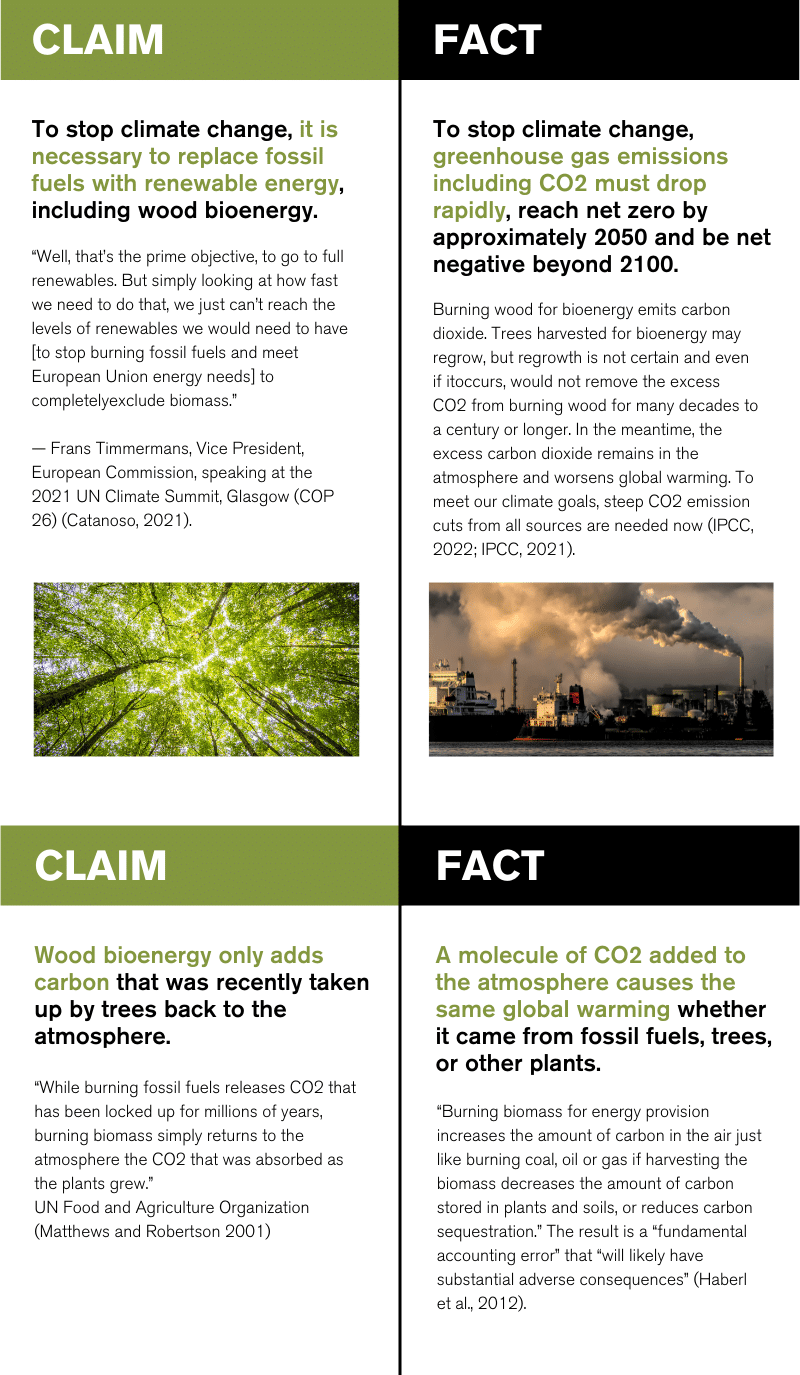
The bioenergy industry and many governments argue that wood bioenergy is carbon neutral. The “Claims and Facts” tables throughout the text below list some of the common claims the industry makes, together with the science showing these claims to be incorrect. For example, the UN Food and Agriculture Organization claims that “While burning fossil fuels releases CO2 that has been locked up for millions of years, burning biomass simply returns to the atmosphere the carbon dioxide that was absorbed as the plants grew” (Matthews and Robertson 2001). But the fact that the carbon in wood was previously removed from the atmosphere as the trees grew is irrelevant: A molecule of carbon dioxide added to the atmosphere today has the same impact on radiative forcing—its contribution to global warming—whether it comes from fossil fuels millions of years old or biomass grown last year. When burned, the carbon in those trees immediately increases atmospheric carbon dioxide above what it would have been had they not been burned.


To illustrate, consider a forest that was harvested for lumber, pulpwood, or energy 50 years ago, and has been regrowing since then. (Few forests in the United States and Europe are mature, “old growth”—most are “working forests” and go through cycles of harvest, regrowth, and reharvest [see US Forest Service 2014]). What happens if that forest is now cut and burned for energy? When the wood is burned, the carbon it contains is emitted as carbon dioxide into the atmosphere. If the forest regrows, after another 50 years it will have removed about the same amount of carbon dioxide it emitted when it was cut and burned for energy. Until then, there’s more carbon dioxide in the atmosphere than if it had not been burned, accelerating climate change.

But the situation is worse: If the forest had not been cut, it would have continued to grow, removing additional carbon from the atmosphere. Compared to allowing the forest to grow, cutting it for bioenergy would increase carbon dioxide emissions and worsen global warming for at least half a century—time we do not have to reach net-zero emissions and avoid the worst harms from climate change.

But what if the wood used to generate electricity reduces the use of fossil fuels? Wouldn’t total carbon dioxide emissions then fall? That depends on how much carbon dioxide is emitted from wood relative to the fuel being displaced. To determine whether wood bioenergy can slow climate change, we therefore need to know answers to a series of questions:

How much carbon dioxide does burning wood for energy add to the atmosphere?

Burning wood to generate electricity emits more carbon dioxide per kilowatt-hour generated than fossil fuels—even coal, the most carbon-intensive fossil fuel. Although wood and coal contain about the same amount of carbon per unit of primary energy—the raw energy in the fuel—(EPA 2018), wood burns less efficiently, in part because it contains more water than coal. The higher the water content, the larger the fraction of the energy of combustion goes into vaporizing that water and up the flue instead of producing the heat needed to make the steam that powers the turbines and generators (Dzurenda and Banski 2017, FAO 2015).

Carbon dioxide emissions from the wood supply chain also exceed those from coal. Wood must be harvested, transported to a mill, dried, processed into chips or pellets, and transported to a power plant (Figure 1). These activities emit carbon dioxide from fossil fuel-powered vehicles and machinery, plus emissions from burning wood or fossil fuels to reduce the water content of chips and pellets from approximately 50 percent for raw wood to about 10 percent for dried pellets. About 27 percent of the harvested biomass is lost in the wood pellet supply chain, of which the largest share—18 percent—arises from burning some of the biomass to generate heat to dry pellets (Röder et al. 2015). In contrast, coal processing adds only about 11 percent to emissions (Sterman et al. 2018a).

The situation is worse if wood displaces other fossil fuels: Wood releases about 25 percent more carbon dioxide per joule of primary energy than fuel oil, and about 75 percent more carbon dioxide than fossil (so-called “natural”) gas (EPA 2018). Wood bioenergy therefore emits more carbon dioxide per kilowatt-hour of power generated than all fossil fuels, including coal (PFPI 2011), incurring a “carbon debt”—an immediate increase in carbon dioxide in the atmosphere, worsening climate change every year, unless and until that carbon debt is repaid later by forest regrowth.
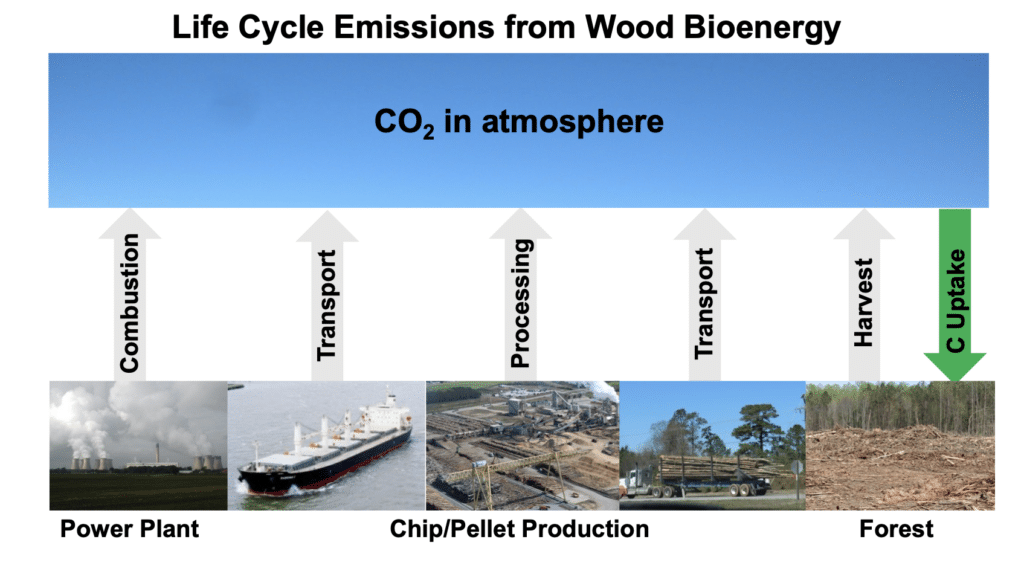
Figure 1. Life cycle emissions from wood bioenergy. Every stage of the supply chain adds CO2 to the atmosphere, from cutting the trees through transport, processing the wood into chips or pellets, transporting them to a power plant, and combustion. CO2 is removed only later, and only if, the harvested land regrows. Photo credits, left to right: Power Plant, courtesy of Paul Glazzard, Creative Commons Attribution-ShareAlike 2.0 license. Transport: Handymax bulk carrier, courtesy of Nsandel/Wikimedia/Public Domain. Pellet mill, Truck Transport, and Forest images all courtesy of Dogwood Alliance, used with permission.

Will the forests harvested for bioenergy regrow? If so, how long will it take?

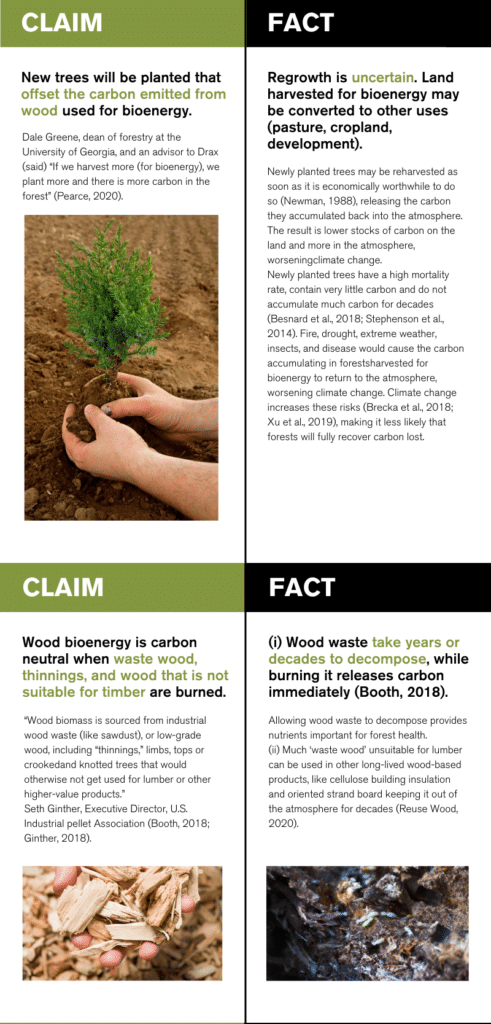
The wood bioenergy industry claims to practice sustainable forestry and be carbon neutral (e.g., Drax 2021, Enviva 2021). The most important claim is that wood bioenergy is carbon neutral because the harvested forests will regrow, removing the carbon they add to the atmosphere when burned (Table 1). However, regrowth is uncertain, and regrowth takes time.

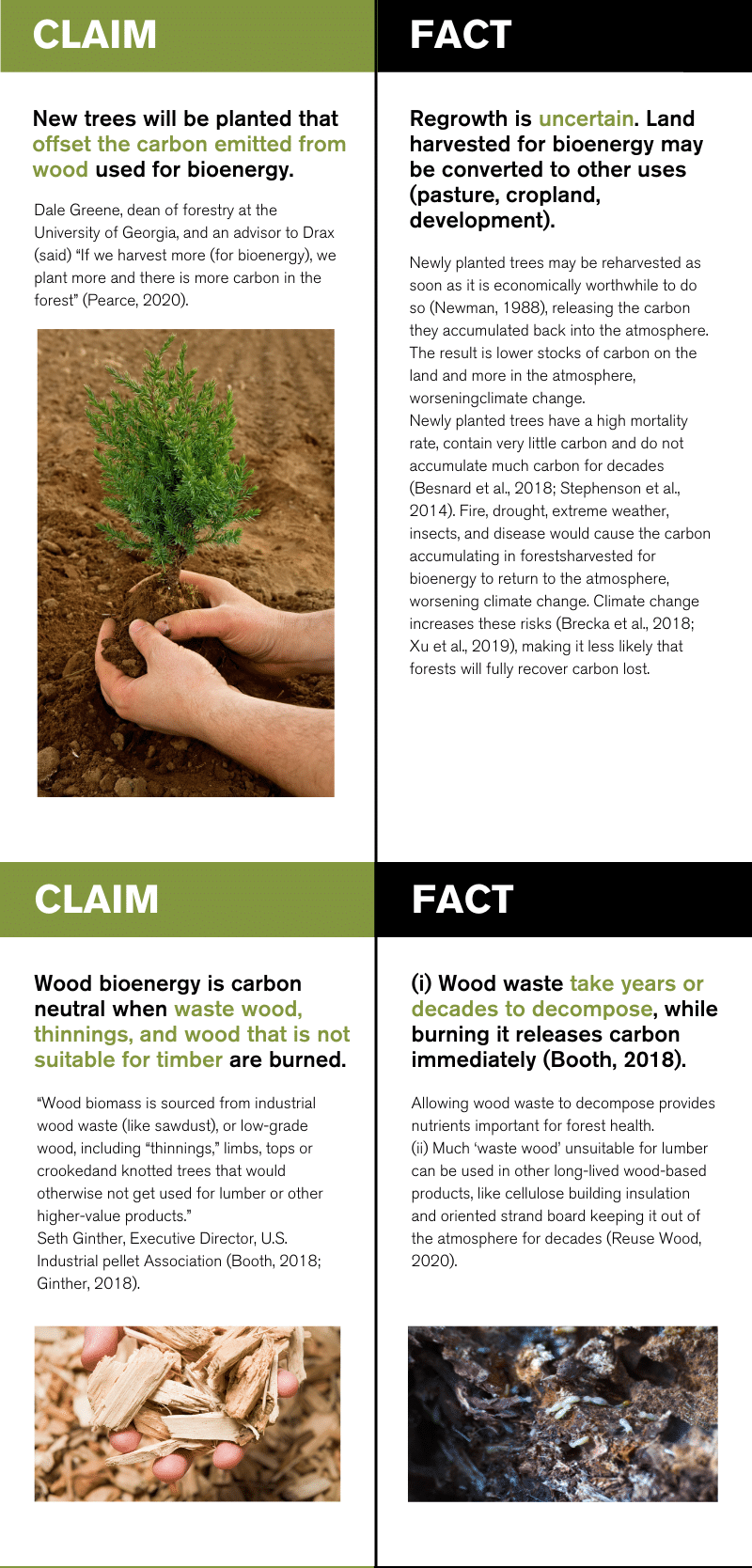
Regrowth is uncertain: Land harvested for bioenergy might be converted to pasture, cropland, or development, preventing regrowth. The carbon dioxide emitted when the trees are burned is then never taken back up by forest regrowth on that land. Even if the harvested land is allowed to regrow, the trees may be harvested again, legally or illegally. The carbon dioxide released in each rotation returns to the atmosphere, where it worsens climate change.

Even if the recovering forest is somehow protected against all future harvest, the trees face risks from wildfire, insects, disease, extreme weather, and drought, all increasing as the climate warms (Brecka et al. 2018; Xu et al. 2019, Boulton, Lenton and Boers 2022). These factors slow or prevent carbon dioxide removal from the atmosphere by forests and may even convert forests from carbon sinks to carbon sources (Gatti et al. 2021). These growing risks to regrowth would limit the future removal of the carbon dioxide emitted by burning wood, permanently worsening climate change.

Regrowth takes time: Even if land conversion, repeated harvests, fire, drought, disease, and other adverse events never arise, regrowth takes time. The time required for regrowth to remove the carbon dioxide emitted when wood is burned for energy is known as the “carbon debt payback time.”


Are the forests harvested for bioenergy growing and removing carbon dioxide now?

The US bioenergy industry uses the fact that many US forests are growing today to claim that wood bioenergy is carbon neutral. For example, Enviva, the largest US pellet producer, with multiple mills in the Southeast United States, falsely argues that “…continued forest carbon gain across the landscape… means that products from the Southeast U.S., including wood bioenergy, are not adding carbon emissions to the atmosphere. As a result, when wood pellets from this region are used to generate energy, we can set stack emissions to zero.” (Enviva, nd; see Table 1).

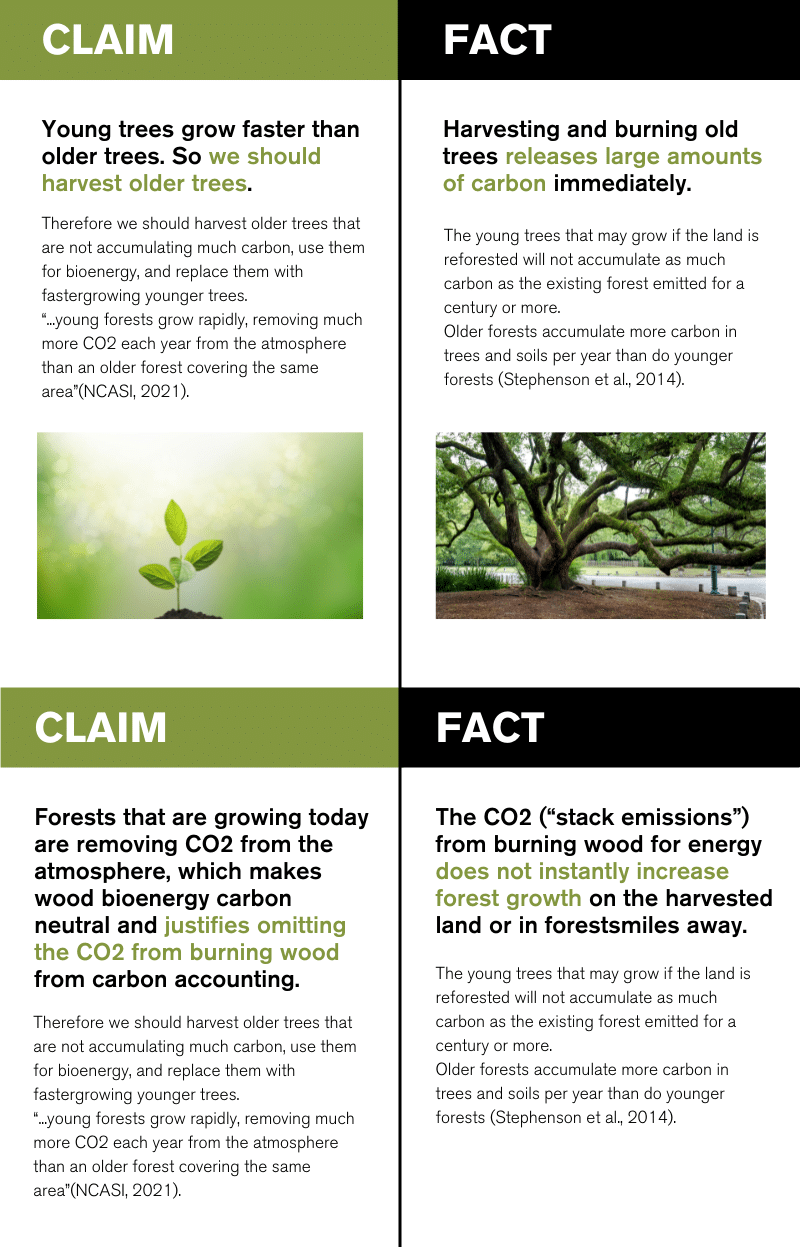
It is true that forests in the Southeast US are acting as carbon sinks today as the result of intensive management and recovery from prior harvests. But these and other forest carbon sinks are already accounted for in the national greenhouse gas emissions inventories required under the United Nations Framework Convention on Climate Change, which sets the rules for greenhouse gas accounting under international agreements (e.g., UNFCCC 2014). Therefore, what counts is what happens to emissions on the margin—that is, the incremental impact of harvesting forests for bioenergy compared to allowing those forests to continue to grow and serve as carbon sinks. Typical rotation periods for working forests are far shorter than the time required for them to reach maturity and maximum carbon storage (Moomaw, Masino, and Faison 2019, Sohngen and Brown 2011, US Forest Service 2014). The younger the forest and faster it is growing when harvested for bioenergy, the more future carbon sequestration is lost.

A dynamic lifecycle assessment of wood bioenergy

To determine the impact of wood bioenergy on carbon dioxide emissions we developed a model for dynamic lifecycle assessment of wood bioenergy (Sterman et al. 2018a; Sterman et al. 2018b). The model includes carbon dioxide emissions from bioenergy, carbon dioxide uptake by regrowth, and carbon dioxide emissions avoided if wood displaces fossil fuels. Supply chain emissions for both wood and fossil fuels are included. Model parameters were estimated from data on forest regrowth in a wide range of forests in the southern and eastern USA, regions increasingly supplying wood for pellets, much of which is exported to Europe and the United Kingdom.
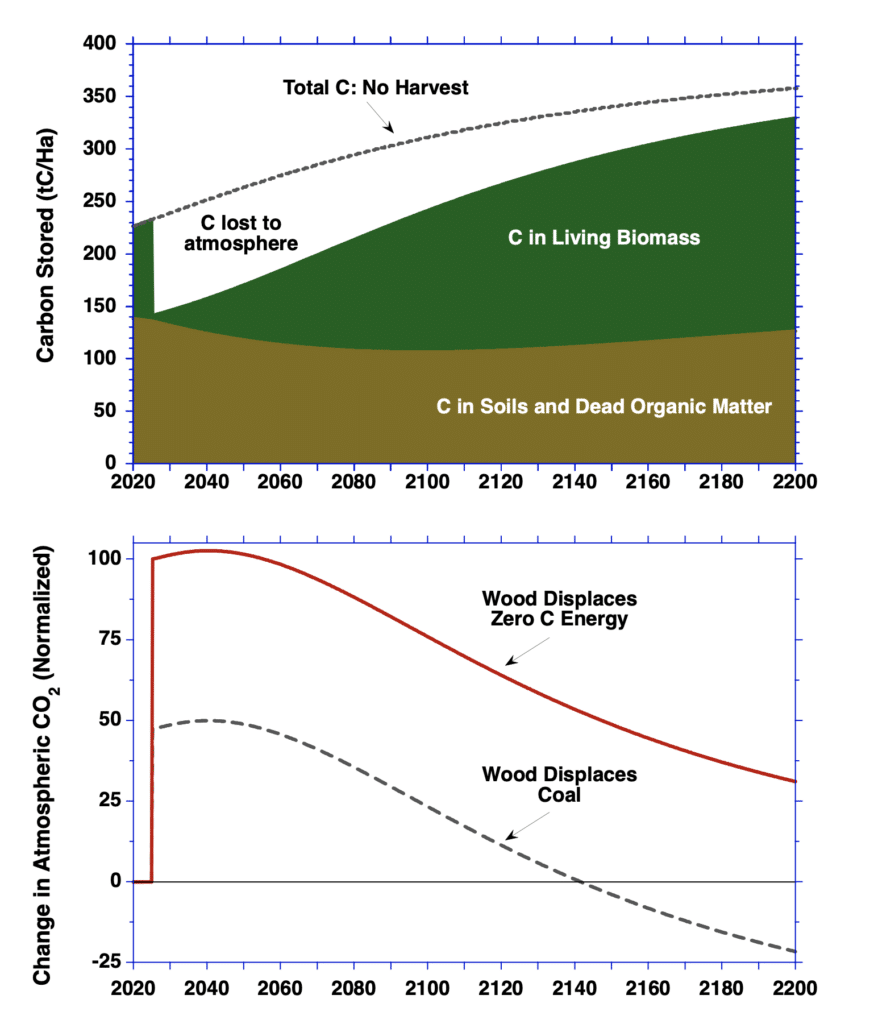
 
Figure 2. Impact of harvesting wood for bioenergy in 2025 from a 50-year-old oak-hickory forest in the south central USA. Top: Change in carbon on the harvested land (tons C per hectare). Brown: carbon in soils and dead organic matter; Green: carbon in living biomass. Dotted line: the total carbon stock (living biomass and soils) if the forest were not harvested in 2025. The forest would have continued to grow and remove carbon from the atmosphere but for being cut for bioenergy. The difference between the dotted no-harvest line and the top of the green band is the carbon emitted into the atmosphere by the harvest. Bottom: Change in atmospheric CO2 resulting from the harvest and combustion of the wood. Solid line: wood displaces a zero-carbon energy source. Dotted line: wood displaces coal. Scale: the initial rise in atmospheric CO2 when wood displaces zero-carbon energy is normalized to 100%. The initial rise in atmospheric CO2 when wood displaces coal is about 50% less due to the emissions avoided by the reduction in coal use.

Figure 2 (above) shows the impact of wood harvested for bioenergy from an oak-hickory forest, “perhaps the most extensive deciduous forest type of eastern North America” (Dick 2016). The simulation parameters are estimated for oak-hickory forests in the south central United States, among the forests used to supply wood pellets for bioenergy, including exports to the United Kingdom (Buchholz & Gunn 2015; Sterman et al. 2018a 2018b report results for other forests in the southern and eastern US). Most forests in the United States have been cut multiple times. We assume the last prior harvest was 50 years ago. To assess the dynamic impact of wood bioenergy use, Figure 2 traces the impact of a single harvest in 2025, showing the stocks of carbon in the biomass and soil and the resulting change in the concentration of carbon dioxide in the atmosphere. We consider two scenarios:The harvested wood is used to generate electric power that replaces an equivalent amount of energy generated from coal, the most carbon-intensive fossil fuel.
The harvested wood is used to generate electric power that replaces an equivalent amount of energy produced by zero-carbon sources (e.g., wind and solar).

The top panel of Figure 2 shows the stock of carbon on the land harvested for bioenergy (metric tons of carbon per hectare), including the carbon in the living biomass and in soils and dead organic matter. The harvest and combustion of wood for energy immediately reduces the stock of carbon in living biomass on the land and increases atmospheric carbon dioxide. The stock of carbon in dead biomass and soil also begins to drop: the wood harvest reduces the flux of carbon from living biomass to soils, while heterotrophic respiration by bacteria, fungi, and other organisms continues to release the carbon in dead biomass and soils into the atmosphere. After the harvest, the forest begins to recover. Soil carbon continues to drop for some time, however, until the flux of carbon transferred to the soils from living biomass exceeds the flux of carbon emitted to the atmosphere from the soil by heterotrophic respiration.

The simulation assumes the land is harvested 50 years after the last rotation. The forest at that time is still recovering. The dotted line in the top panel of Figure 2 shows that the total stock of carbon on that land would have continued to grow through 2200 (and beyond), but for the harvest for bioenergy. The difference between the no-harvest and harvest cases is the quantity of carbon lost to the atmosphere due to the bioenergy harvest. The bioenergy harvest not only adds the carbon extracted and burned to the atmosphere, but prevents the additional growth that would have occurred had the forest not been harvested.

The bottom panel of Figure 2 shows the change in the concentration of carbon dioxide in the atmosphere for the two scenarios above. The figure shows the evolution of atmospheric carbon dioxide relative to the no-harvest case, scaled relative to the magnitude of the initial change in carbon dioxide when the wood displaces zero-carbon energy such as wind and solar (the absolute change in atmospheric carbon dioxide depends on the amount of wood harvested and burned). Cutting and burning trees for bioenergy immediately increases the concentration of carbon dioxide in the atmosphere. The jump in atmospheric carbon dioxide when wood displaces coal is approximately half as much as when the wood displaces zero-carbon energy. The impact of displacing other fossil fuels such as fuel oil or fossil (“natural”) gas lies between the coal and zero-carbon scenarios because these fuels emit less carbon dioxide per kilowatt-hour than coal, but of course more than wind or solar.

Note that, in both cases atmospheric carbon dioxide continues to increase through approximately 2040, 15 years after the assumed harvest in 2025. Although the harvested land begins to regrow immediately, seedlings and saplings have much smaller leaf area for photosynthesis and accumulate carbon slower than older trees. Consequently, the carbon sequestered by regrowth is initially less than the carbon the forest would have stored had it not been harvested.

After approximately the year 2040, the excess carbon dioxide in the atmosphere from the harvest and combustion of the wood begins to fall as regrowth outpaces the growth in carbon in the no-harvest case. However, atmospheric carbon dioxide remains above the level it would have had but for the harvest well beyond the year 2100. Even when wood displaces coal, the excess carbon dioxide is not taken back up by forest regrowth until after the year 2140: The carbon debt payback time in this scenario is approximately 115 years. When the wood displaces zero-carbon energy, atmospheric carbon dioxide remains above its initial level well past the year 2200.

The simulation shows the impact of clearing a stand of forest and using the wood for bioenergy. The bioenergy industry claims that they practice what they call “sustainable” forestry—avoiding clearcutting, taking only residues from lumber and pulpwood harvests, or thinning forests by taking only small or diseased trees. Environmental groups, however, have documented the harvest of large trees and clear-cutting by the industry (Norton et al. 2019; Stashwick et al. 2019; Stashwick et al. 2017). To address this issue, we also simulated the impact of thinning, in which only 25 percent of the living biomass is removed from the harvested forest (Sterman et al. 2018a 2018b). Across all the forests examined, thinning reduces the carbon debt payback times somewhat. For example, in the scenario shown in Figure 2, thinning reduces the carbon debt payback year from 2140 to 2115—still too late.

The simulations favor wood bioenergy. We assume that the land remains forested, that the forest grows back without any subsequent harvest, and that it suffers no losses from wildfire, disease, insects, extreme weather or other threats to regrowth. We do not consider additional carbon loss from soils due to the disturbance caused by the harvest. We do not consider non-climate harms from wood harvest and bioenergy production, including habitat fragmentation, loss of biodiversity, and the health effects of exposure to particulates and other pollutants from wood processing and power plants.

To track the impact of wood bioenergy, the simulation shows the impact of harvesting and burning wood for energy in a single year. But the bioenergy industry is growing rapidly, stimulated by the false declaration that wood is carbon neutral and resulting subsidies in many nations. The International Energy Agency reports primary energy from biomass for electricity generation grew at an average rate of more than 6 percent per year between 1990 and 2018 (IEA 2020). The IEA’s “Net-Zero by 2050” scenario projects modern bioenergy—which includes wood—will grow by more than a factor of four by 2050 (IEA 2021b).

What happens to atmospheric carbon dioxide in the realistic case of growing wood bioenergy use? Each year the carbon dioxide emissions from cutting and burning wood would exceed the removal of carbon dioxide by regrowth, continually increasing the concentration of carbon dioxide in the atmosphere, just as filling your bathtub faster than it drains will continually raise the level of water in the tub (until it overflows and damages your home).

The situation is analogous to a government that runs a continually growing fiscal deficit. The outstanding debt rises every year even if the government fully repays every bond it issues at maturity. In the same way, the growing use of wood bioenergy adds more carbon dioxide to the atmosphere every year, increasing the outstanding carbon debt, even if the forests are managed sustainably and all harvested lands eventually recover enough to fully repay the carbon debt incurred when the wood was extracted and burned.


Eventual carbon neutrality is not climate neutrality
Even under the best case where wood displaces coal, regrowth does not remove the excess carbon dioxide emitted by wood for many decades or more, and far longer if the harvested forests are growing today—as most are—and far more if wood displaces other fossil fuels. At that future time, wood bioenergy can be said to have achieved carbon neutrality. Until then, wood bioenergy increases the level of carbon dioxide in the atmosphere above what it would have been, accelerating global warming.

But is the climate impact of that additional warming reversed if regrowth finally removes the excess carbon dioxide? Is eventual carbon neutrality the same as climate neutrality?

The answer is “No.”
Even temporarily elevated levels of atmospheric carbon dioxide cause irreversible climate damage (IPCC 2022; Solomon et al. 2009). The excess carbon dioxide from wood bioenergy begins warming the climate immediately upon entering the atmosphere. The harms caused by that additional warming are not undone even if the carbon debt from wood energy is eventually repaid: The Greenland and Antarctic ice sheets melt faster, sea level rises higher, wildfires become more likely, permafrost thaws faster, and storms intensify more than if the wood had not been burned. Eventual full forest recovery will not replace lost ice, lower sea level, undo climate disasters, put carbon back into permafrost, or bring back homes lost to floods or wildfires. The excess warming from wood bioenergy increases the chances of going beyond various climate tipping points that could lead to runaway climate change: emissions “pathways that overshoot 1.5°C run a greater risk of passing through ‘tipping points’, thresholds beyond which certain impacts can no longer be avoided even if temperatures are brought back down later on” (IPCC 2018, p. 283). Carbon neutrality is not climate neutrality.

Why does it matter? We have already raised global average surface temperatures about 1.1 degrees Celsius (2 degrees Fahrenheit) above preindustrial levels, and most of humanity already suffers from its effects (Callaghan et al. 2021, IPCC 2022). The consequences of warming beyond 2 degrees Celsius are expected to be devastating. Sea levels could rise by well over a meter by the end of this century, exposing millions of people to coastal flooding (Kulp & Strauss 2019). More than half the world’s people would be exposed to deadly heat waves (Mora et al. 2017). The yields of crops including wheat, maize, rice, and soy would fall even as the United Nations projects that world population will grow by billions (Zhao et al. 2017, United Nations 2019). Droughts, wildfires, and intense storms will become more frequent and extreme (IPCC 2018). Warming could push the Earth beyond various tipping points that could lead to irreversible harm (IPCC 2018). These impacts would intensify hunger, economic disruption, mass migration, civil conflict, and war (Burke et al. 2015; Hsiang & Burke 2014; Koubi 2019; Levy 2019). Scientists and nearly all nations on Earth therefore agree that global greenhouse gas emissions must fall as deeply and quickly as possible, reaching net zero by approximately midcentury.

Wood bioenergy moves the world in the wrong direction.

Policy implications
What can be done? First, policies that treat wood bioenergy as carbon neutral must end. These policies allow power plants and nations to ignore the carbon dioxide they emit by burning wood on the false assumption that those emissions are quickly offset by forest growth somewhere else, creating a “critical climate accounting error” (Searchinger, et al. 2009). The carbon dioxide emitted from wood should be counted the same way emissions from other fuels are: fully, at the point of combustion.

Second, subsidies for wood bioenergy must end. Subsidizing wood bioenergy means taxpayers are paying pellet and power producers to make climate change worse.

Third, the fact that wood bioenergy is worse than coal in no way justifies the continued use of coal or any fossil fuel. To avoid the worst harms from climate change we must not only keep the vast majority of remaining fossilized carbon in the ground, we must also keep the vast majority of the carbon in our forests on the land.

The good news is that existing technologies such as energy efficiency, and the use of renewables such as solar, wind, and geothermal energy, can meet people’s needs for comfort, light, mobility, communication, and other purposes. The costs of these technologies are falling rapidly, and in many places are already lower than fossil fuels (IEA 2021a). Innovations in clean energy, energy storage, smart grids, and other technologies are expanding our ability to meet everyone’s energy needs affordably. Unlike wood bioenergy, these technologies allow forests to continue growing and sequestering atmospheric carbon dioxide. Investments in energy efficiency and clean energy also generate multiple co-benefits including increased community resilience, jobs, and improved health and economic well-being, especially for low-income individuals and households (Belesova et al. 2020; Burke et al. 2018; IEA 2021a; IPCC 2018; Pollin et al. 2014; Shindell et al. 2018). In contrast, particulate emissions and other pollutants from wood bioenergy damage human health (Allergy & Asthma Network et al. 2016).

To keep global warming under 2 degrees Celsius, net greenhouse gas emissions must fall to net zero by approximately mid-century, less than 30 years from now. Wood bioenergy increases greenhouse gas emissions and makes climate change worse during these critical years and beyond, even if the wood displaces coal. More effective ways to cut greenhouse gas emissions and meet human needs are available and affordable now. Ending subsidies and policies that promote wood bioenergy will reduce emissions and allow forests to continue to grow, preserving their vital role as carbon sinks that moderate climate change.

Disclosure Statement

No potential conflict of interest was reported by the authors.

Funding

Authors John Sterman and Lori Siegel received no specific grant from any funding agency in the public, commercial, or not-for-profit sectors for this work. Author William Moomaw was supported by a grant from the Rockefeller Brothers Foundation. Author Juliette N. Rooney-Varga was supported by the National Science Foundation under grant ICER-1701062.


References

Allergy & Asthma Network, American Academy of Pediatrics, American Lung Association, American Public Health Association, Asthma and Allergy Foundation of America, National Association of County & City Health Officials, et al. 2016. Letter to policymakers [Press release]. https://www.naccho.org/uploads/downloadable-resources/Policy-and-Advocacy/Health-organizational-letter-health-impacts-of-biomass.pdf.

Belesova, K., Heymann, D. L., & Haines, A. 2020. “Integrating climate action for health into Covid-19 recovery plans.” BMJ, 370, m3169. https://doi.org/10.1136/bmj.m3169.

Booth, M. 2018. “Not carbon neutral: Assessing the net emissions impact of residues burned for bioenergy.” Environmental Research Letters, 13(3), 035001. http://stacks.iop.org/1748-9326/13/i=3/a=035001.

Boulton, C., Lenton, T., Boers, N. Pronounced loss of Amazon rainforest resilience since the early 2000s. Nature Climate Change 12(271-2378). https://doi.org/10.1038/s41558- 022-01287-8.

Brecka, A. F. J., Shahi, C., & Chen, H. Y. H. 2018. “Climate change impacts on boreal forest timber supply.” Forest Policy and Economics, 92, 11-21. https://doi.org/10.1016/j.forpol.2018.03.010.

Buchholz, T., & Gunn, J. 2015. Carbon emission estimates for Drax biomass powerplants in the UK sourcing from Enviva Pellet Mills in U.S. Southeastern Hardwoods using the BEAC model. https://www.southernenvironment.org/wp-content/uploads/legacy/news-feed/SIG_BEAC_calculations_SE_hardwoods_2015-05-27.pdf.

Burke, M., Davis, W., & Diffenbaugh, N. 2018. “Large potential reduction in economic damages under UN mitigation targets.” Nature, 557(7706), 549-553. https://doi.org/10.1038/s41586-018-0071-9.

Burke, M., Hsiang, S. M., & Miguel, E. 2015. “Climate and Conflict.” Annual Review of Economics, 7(1), 577-617. https://doi.org/10.1146/annurev-economics-080614-115430.

Callaghan, M., Schleussner, C.-F., Nath, S., Lejeune, Q., Knutson, T. R., Reichstein, M., et al. 2021. “Machine-learning-based evidence and attribution mapping of 100,000 climate impact studies.” Nature Climate Change. https://doi.org/10.1038/s41558-021-01168-6.

Catanoso, J. 2021. “COP26: E.U. is committed to forest biomass burning to cut fossil fuel use.” Mongabay: News and Inspiration from Natures Frontline. November 10. https://news.mongabay.com/2021/11/cop26-e-u-is-committed-to-forest-biomass- burning-to-cut-fossil-fuel-use/.


Cubbage, F., & Abt, R. 2020. “Wood pellets offer NC’s best carbon-neutral energy source.” https://www.envivabiomass.com/wood-pellets-offer-ncs-best-carbon- neutral-energy-source/.

D’Amore, D.; Kane, E. 2016. Climate Change and Forest Soil Carbon. US Department of Agriculture, Forest Service, Climate Change Resource Center. www.fs.usda.gov/ccrc/topics/forest-soil-carbon.

Dick, C. 2016. Oak-hickory forest: a vestige of Native American land use? https://sites.lsa.umich.edu/cwdick-lab/2016/03/27/oak-hickory-forest-a-vestige-of-native-american-land-use/.

Drax. 2021. Sustainability. https://www.drax.com/sustainability/.

Dzurenda, L., Banski, A. 2017/ “Influence of moisture content of combusted wood on the thermal efficiency of a boiler.” Archives of Thermodynamics. 38(1), 63-74 https://journals.pan.pl/Content/100834/PDF/04_paper.pdf.

Dzurenda, L., Banski, A. 2019. “The Effect of Firewood Moisture Content on the Atmospheric Thermal Load by Flue Gases Emitted by a Boiler.” Sustainability. 11, 284. https://doi/10.3390/su11010284.

Enviva. 2021. Corporate Sustainability Report https://www.envivabiomass.com/wp- content/uploads/Enviva-2021-CSR.pdf.


EPA. 2018. Emissions Factors for Greenhouse Gas Inventories. https://www.epa.gov/sites/default/files/2018-03/documents/emission- factors_mar_2018_0.pdf.

Food and Agriculture Organization. 2015. Wood Fuels Handbook. UN FAO. http://large.stanford.edu/courses/2017/ph240/timcheck1/docs/fao-krajnc-2015.pdf.

Gatti, L., Basso, L., Miller, J. et al. 2021. “Amazonia as a carbon source linked to deforestation and climate change.” Nature 595, 388–393. https://doi.org/10.1038/s41586-021-03629-6.

Ginther, S. 2018. Opinion: “Climate and Fire, Why Biomass Matters to Both.” Biomass Magazine. December 14. http://biomassmagazine.com/articles/15824/opinion-climate-and-fire-why-biomass- matters-to-both.

Haberl, H., Sprinz, D., Bonazountas, M., et al. 2012. “Correcting a fundamental error in greenhouse gas accounting related to bioenergy.” Energy Policy, 45, 18-23. https://doi.org/10.1016/j.enpol.2012.02.051.

Hsiang, S., & Burke, M. 2014. “Climate, conflict, and social stability: what does the evidence say?” Climatic Change, 123(1), 39-55. https://doi.org/10.1007/s10584-013-0868-3.

IEA. 2020. World Energy Outlook. International Energy Agency. 

IEA. 2021a. World Energy Outlook 2021. International Energy Agency. 

IPCC. 2018. Global Warming of 1.5 ˚C. Intergovernmental Panel on Climate Change, Special Report SR15. 
IPCC. 2022. Summary for Policymakers. In H.-O. Pörtner, D. C. Roberts, E. S. Poloczanska, K. Mintenbeck, M. Tignor, A. Alegría, M. Craig, S. Langsdorf, S. Löschke, V. Möller, & A. Okem (Eds.), Climate Change 2022: Impacts, Adaptation, and Vulnerability. Contribution of Working Group II to the Sixth Assessment Report of the Intergovernmental Panel on Climate Change. Cambridge, UK: Cambridge University Press. .

IPCC. 2021. Summary for Policymakers. In V. Masson-Delmotte, P. Zhai, A. Pirani, S. L. Connors, Péan, S. Berger, N. Caud, Y. Chen, L. Goldfarb, M. I. Gomis, M. Huang, K. Leitzell, K. E. Lonnoy, J. B. R. Matthews, T. K. Maycock, T. Waterfield, O. Yelekçi, O. R. Yu, & B. Zhou (Eds.), Climate Change 2021: The Physical Science Basis. Contribution of Working Group I to the Sixth Assessment Report of the Intergovernmental Panel on Climate Change: Cambridge University Press. 


Kulp, S., Strauss, B. 2019. New elevation data triple estimates of global vulnerability to sea-level rise and coastal flooding. Nature Communications 10, 4844 https://doi.org/10.1038/s41467-019-12808-z.

Levy, B. 2019. “Increasing Risks for Armed Conflict: Climate Change, Food and Water Insecurity, and Forced Displacement.” International Journal of Health Services, 49(4), 682-691. https://doi.org/10.1177/0020731419845249.

Matthews, R., and Robertson, K. 2001. Answers to ten frequently asked questions about bioenergy, carbon sinks and their role in global climate change, prepared by the International Energy Agency (IEA) Bioenergy Task 38, “Greenhouse Gas Balances of Biomass and Bioenergy Systems.” Graz, Austria, Joanneum Research. https://www.fao.org/3/y4450e/y4450e07.htm.

Mora, C., Dousset, B., Caldwell, I. et al. 2017. Global risk of deadly heat. Nature Climate Change 7, 501–506. https://doi.org/10.1038/nclimate3322.

Moomaw, W., Masino, S, Faison, E. 2019. Intact Forests in the United States: Proforestation Mitigates Climate Change and Serves the Greatest Good, Frontiers in Forests and Global Change, 2, https://doi.org/10.3389/ffgc.2019.00027.

NCASI. 2021. “Forest carbon from young vs. old forests.” https://www.ncasi.org/resource/forest-carbon-from-young-vs-old-forests/.

Newman, D. H. 1988. The optimal forest rotation: a discussion and annotated bibliography.


Norton, M., Baldi, A., Buda, V., Carli, B., Cudlin, P., Jones, M. B., et al. 2019. “Serious mismatches continue between science and policy in forest bioenergy.” GCB Bioenergy, 11(11), 1256-1263. https://doi.org/10.1111/gcbb.12643.

Ouzts, E. 2019. “Wood pellets cause more climate pollution than coal when they’re burned. So why does Europe call them ‘carbon neutral’?” Energy News Network. December 2. https://energynews.us/2019/12/02/wood-pellets-cause-more-climate-pollution-than-coal-when-theyre-burned-so-why-does-europe-call-them-carbon-neutral/.

Pearce, F. 2020. “Bioenergy from forests may turn natural landscapes into monocultures.” China Dialogue. November 10. https://chinadialogue.net/en/climate/bioenergy-from-forests-may-turn-natural- landscapes-into-monocultures/.

PFPI, 2011. Carbon emissions from burning biomass for energy. Partnership for Policy Integrity https://www.pfpi.net/wp-content/uploads/2011/04/PFPI-biomass-carbon-accounting- overview_April.pdf

Pollin, R., Garrett-Peltier, H., Heintz, J., & Hendricks, B. 2014. Green Growth: A U.S. Program for Controlling Climate Change and Expanding Job Opportunities. https://www.americanprogress.org/issues/green/reports/2014/09/18/96404/green- growth/.

Reuse Wood. 2020. About oriented stranded board (OSB). https://reusewood.org/guide/oriented-strand-board.

Röder, M., Whittaker, C., & Thornley, P. 2015. “How certain are greenhouse gas reductions from bioenergy? Life cycle assessment and uncertainty analysis of wood pellet-to- electricity supply chains from forest residues.” Biomass and Bioenergy, 79, 50-63. https://doi.org/10.1016/j.biombioe.2015.03.030.

Searchinger, T., Hamburg, S., Melillo, J., et al. 2009. “Fixing a Critical Climate Accounting Error.” Science 326(5952), 527-528. https://doi.org/10.1126/science.1178797.

Shindell, D., Faluvegi, G., Seltzer, K., & Shindell, C. 2018. “Quantified, localized health benefits of accelerated carbon dioxide emissions reductions.” Nature Climate Change, 8(4), 291-295. https://doi.org/10.1038/s41558-018-0108-y.

Sohngen, B., Brown, S. 2011. Extending timber rotations: carbon and cost implications. Climate Policy, 8:5, 435-451, https://doi.org/10.3763/cpol.2007.0396.

Solomon, S., Plattner, G.-K., Knutti, R., & Friedlingstein, P. 2009. “Irreversible climate change due to carbon dioxide emissions.” Proceedings of the National Academy of Sciences, 106(6), 1704-1709. https://doi.org/10.1073/pnas.0812721106.

Stashwick, S., Frost, R., & Carr, D. W. 2019. Global Markets for Biomass Energy Are Devastating US Forests. https://www.nrdc.org/sites/default/files/global-markets-biomass-energy-06172019.pdf.

Stashwick, S., Macon, A., & Carr, D. W. 2017. European Imports of Wood Pellets for “Green Energy” Devastating US Forests. https://www.nrdc.org/sites/default/files/european-imports-wood-pellets-greenenergy- devastating-us-forests.pdf.

Stephenson, N. L., Das, A., Condit, R., Russo, S., Baker, P., Beckman, N., et al. 2014. “Rate of tree carbon accumulation increases continuously with tree size.” Nature, 507(7490), 90- 93. https://doi.org/10.1038/nature12914.

Sterman, J. D., Siegel, L., & Rooney-Varga, J. N. 2018a. “Does replacing coal with wood lower carbon dioxide emissions? Dynamic lifecycle analysis of wood bioenergy.” Environmental Research Letters, 13(1), 015007. http://stacks.iop.org/1748-9326/13/i=1/a=015007.

Sterman, J. D., Siegel, L., & Rooney-Varga, J. N. 2018b. Reply to comment on ‘Does replacing coal with wood lower carbon dioxide emissions? Dynamic lifecycle analysis of wood bioenergy.’ Environmental Research Letters, 13(12), 128003. https://doi.org/10.1088/1748-9326/aaf354.

UNFCCC 2021. Glasgow Climate Pact. Paper presented at the COP26, Glasgow, Scotland, UK. https://unfccc.int/sites/default/files/resource/cop26_auv_2f_cover_decision.pdf.

UNFCCC 2014. Report of the Conference of the Parties on its nineteenth session, held in Warsaw from 11 to 23 November 2013. United Nations Framework Convention on Climate Change. January 2014. https://unfccc.int/resource/docs/2013/cop19/eng/10a03.pdf#page=2.

United Nations 2019. World Population Prospects 2019. https://population.un.org/wpp/.

US EPA. 2018. EPA’s Treatment of Biogenic Carbon Dioxide Emissions from Stationary Sources that Use Forest Biomass for Energy Production. https://www.epa.gov/sites/default/files/2018-04/documents/biomass_policy_statement_2018_04_23.pdf.

US Forest Service 2014. US Forest Research Facts and Trends, Forest Service FS-1035. https://www.fia.fs.fed.us/library/brochures/docs/2012/ForestFacts_1952-2012_English.pdf.

Voegele, E. 2016. “Senate passes Energy Bill with pro-biomass amendment.” Biomass Magazine.http://biomassmagazine.com/articles/13172/senate-passes-energy-bill- with-pro-biomass-amendment.

Xu, C., McDowell, N., Fisher, R., Wei, L., Sevanto, S., Christoffersen, B., et al. 2019. “Increasing impacts of extreme droughts on vegetation productivity under climate change.” Nature Climate Change, 9(12), 948-953. https://doi.org/10.1038/s41558-019- 0630-6.

Zhao, C., Liu, B., Piao, S, et al. 2017. Temperature increase reduces global yields of major crops in four independent estimates. Proceedings of the National Academies of Sciences. 114(35): 9326-9331. https://doi.org/10.1073/pnas.1701762114.

sábado, 7 de dezembro de 2019

A tecnologia realmente “salvará” o planeta?


“Com a crise climática piorando e nenhum contrapoder efetivo no horizonte, o que precisamos desesperadamente é de um imaginário político completamente novo, que finalmente consiga libertar o mundo do domínio das corporações transnacionais”, escreve Carl Boggs, professor de ciências sociais na Universidade Nacional de Los Angeles, em artigo publicado por Rebelión, 06-12-2019. A tradução é do Cepat.

Na medida em que a crise ecológica se aprofunda e nos leva ao famoso “ponto de inflexão” - que nos aproxima de uma catástrofe planetária -, tentam nos convencer de que o “reverdecimento” da economia mundial nos afastará de um futuro muito obscuro. De alguma forma, contra toda lógica, adotamos uma fé coletiva na disposição dos governos e das grandes empresas em fazer a coisa certa. A pegada de carbono será drasticamente reduzida graças a uma combinação de estratégias de mercado e tecnologias mágicas. E, na medida em que progride sem complicações a mitigação do efeito estufa, as forças dominantes serão capazes de fazer o que melhor fazem: entregar-se à religião de acumulação e crescimento sem limites.

Esse cenário lindamente decorado é a mais deprimente e paralisante de todas as grandes ilusões. E em nenhum outro lugar sua influência é mais forte do que onde vivem os maiores vilões ambientais: os Estados Unidos.

O pomposo Acordo de Paris de 2015 foi vendido como a grande esperança, mas seria melhor defini-lo como um exercício bem-intencionado de futilidade, algo que o prestigiado climatologista James Hansen, definiu com desprezo como “uma farsa sem propostas de ação, apenas promessas”. Em Paris, os 200 membros participantes propuseram a fórmula 20/20/20: redução de 20% nas emissões de carbono, aumento de 20% nas fontes de energia renováveis e aumento de 20% na eficiência energética geral. Teoricamente, isso manteria a temperatura global média em menos de 2 graus (idealmente 1,5º) acima do nível pré-industrial.

O problema é que todos os objetivos são voluntários e não há mecanismo que obrigue o seu cumprimento. Segundo o Acordo de Paris, cada nação (atualmente as 187 signatárias) determina seus próprios planos, estabelece seus próprios resultados e relata suas iniciativas de mitigação de carbono. A realidade é que nenhum desses países ainda avançou na implementação de metas consistentes com a prescrição 20/20/20, e a maior parte deles se encontra muito longe desse objetivo. Embora o presidente Trump tenha retirado os Estados Unidos do Acordo, sua pegada de carbono não é pior do que a de outros grandes emissores (China, Índia, Rússia, Japão, Alemanha, Canadá e México).

Apesar de muitas nações terem aumentado sua utilização de energias limpas, o aumento do crescimento econômico global levou a um aumento paralelo das emissões de carbono: 1,6% em 2017, 2,7% em 2018 e se preveem aumentos ainda maiores para 2019. A economia fóssil se move a toda velocidade: as extrações de petróleo e gás atingiram recordes históricos e não se espera que diminuam. Mesmo com um aumento significativo das renováveis, como está ocorrendo na China, Índia, Estados Unidos e Europa, está previsto um aumento constante da pegada de carbono devido ao aumento total do crescimento econômico e do consumo de energia. Atualmente, os 10 países mais poluentes representam 67% do total de emissões de gases do efeito estufa (GEE) e há poucas mudanças à vista.

Recentemente, o Programa das Nações Unidas para o Meio Ambiente (PNUMA), um organismo que dificilmente poderia ser chamado de radical, projetou que até 2030 a produção global de combustíveis fósseis seria mais do que o dobro da quantidade que devemos consumir se quisermos reverter o aquecimento global. Em outras palavras, os acordos de Paris estavam vazios de conteúdo. O relatório do PNUMA concluiu, extrapolando os dados de emissão dos oito países mais poluentes, que a “humanidade” avança por um caminho suicida em direção ao desastre ecológico, marcado por aumentos de temperatura de quatro graus ou mais.

De qualquer forma, mesmo que as principais nações cumprissem os objetivos 20/20/20, pouco mudaria. Na realidade, a soma de todos os compromissos assumidos em Paris não manteria a temperatura abaixo do aumento de dois graus (ou mais) nas próximas décadas. O consumo global de combustíveis fósseis, associado ao aumento do crescimento, anularia esses esforços, de modo que as estratégias existentes de mitigação de carbono seriam ilusórias.

De fato, muitos observadores aplicados acreditam que já é tarde demais e que, carregados com o fardo de uma herança de fracasso político, estamos indo diretamente para um desastre planetário. Ondas de protestos climáticos em todo o mundo estão tentando aumentar a indignação pública, mas esses protestos (e anteriores) ainda não geraram o tipo de oposição política coesa capaz de reverter a crise. Estamos presos em um ciclo de futilidade, uma imobilidade psicológica que David Wallace-Wells chama de “niilismo climático”, em seu livro “A terra inabitável” [1]. Os protestos massivos que ocorrem num ambiente como esse não se traduzem automaticamente em uma mudança no sistema, nem mesmo em grandes reformas, como as associadas aos diferentes Green New Deals.

Na opinião de escritores como Wallace-Wells, estamos presos em um mundo que avança inexoravelmente em direção a um aumento de quatro ou cinco graus no final do século, se não antes. O autor conclui afirmando que “se os próximos 30 anos de atividade industrial traçarem um arco ascendente semelhante ao dos últimos 30 anos, regiões inteiras serão inabitáveis pelos padrões atuais”.

O cataclismo ecológico devastará grandes regiões da Europa, América do Norte e do Sul. Nesse cenário, a economia mundial sofrerá tanta destruição que a famosa teoria da crise de Karl Marx parecerá tíbia. Wallace-Wells acrescenta: “Um aquecimento de três graus desencadeará um sofrimento maior do que os seres humanos experimentaram ao longo de milénios de tensões, conflitos e guerra total”.

Além da “atividade industrial”, Wallace-Wells poderia ter mencionado o âmbito ainda mais problemática da agricultura e da alimentação: esse será o elo mais fraco de um sistema em crise. Atualmente, 80% da água doce é dedicada à agricultura e pecuária, e metade é usada na produção de carne. Vivemos em um mundo onde são necessários cerca de 20.000 litros de água para produzir um quilo de carne bovina e 685 litros por um litro de leite.

A metade de toda a superfície cultivável é dedicada a pastagens, e não parece que esse valor diminua com a industrialização de novos países. A pegada de carbono da agricultura para alimentação animal pode atingir 30% do total, ou até mais, se considerarmos o uso de combustíveis fósseis. Como atualmente mais de 2 bilhões de pessoas estão privadas de água e alimentos adequados, seria necessário considerar seriamente a insustentabilidade da agroindústria capitalista.

Apesar dos apelos para “salvar o planeta” e do recente aumento do “ativismo climático”, poucos países lançaram um programa para reduzir radicalmente as emissões de carbono. Para governos e elites empresariais, tudo permanece igual. No livro “Leviatán climático” [2], os escritores britânicos marxistas Geoff Man e Jonathan Wainwright lamentam: “A possibilidade de conseguir uma rápida redução do carbono global que mitigue a mudança climática já passou. As elites mundiais, ao menos, parecem tê-la abandonado, se alguma vez a levaram a sério”. Em vez disso, parece que optaram por uma política de adaptação a um planeta em aquecimento contínuo.

Os mesmos gigantes corporativos que dominam a economia mundial são os que tomam as decisões que afetam o futuro ecológico. Na atualidade, e de acordo com Peter Phillips em “Gigantes. Os senhores do Mundo” [3], as 385 transnacionais que dominam o sistema mundial estão avaliadas em 255 trilhões de dólares e grande parte desse dinheiro é investido no setor de combustíveis fósseis.

Os Estados Unidos e a Europa possuem quase dois terços dessa quantia. Não mais de 100 empresas são responsáveis por pelo menos 70% de todas as emissões de GEE. No topo desta pirâmide, 17 gigantes financeiros dirigem a economia do mundo capitalista. Até o momento, não há sinais de que os chefes do capitalismo fóssil estejam dispostos a se desviar de seu curso historicamente destrutivo.

Atualmente, as elites tecnológicas nos Estados Unidos falam muito sobre reduzir sua pegada de carbono, um movimento que obviamente beneficiaria sua imagem corporativa. Os executivos da Amazon, Google, Microsoft e Facebook parecem ansiosos para lançar suas próprias cruzadas verdes. Ritualmente, pregam que a tecnologia verde é a maneira para mitigar a emissão de carbono. Jeff Bezos afirmou que a Amazon receberá 100% da energia que precisa de fontes alternativas em 2030. Outros oligarcas tecnológicos parecem prometer uma economia livre de carbono em resposta, pelo menos parcialmente, à escalada dos protestos dos trabalhadores.

Outra bela ilusão: os gigantes tecnológicos e os gigantes do petróleo decidiram, de fato, avançar estreitamente associados. Aparentemente, a ideia de “reverdecer” não impede que Google, Amazon, Microsoft e outros tirem proveito de sua contribuição para que esses outros gigantes (Shell, ExxonMobil, Chevron, BP etc.) possam encontrar locais melhores, mais baratos e mais eficientes para perfurar e fazer fracking.

As grandes empresas de tecnologia podem fornecer o que mais precisam: espaços na nuvem, inteligência artificial, robótica e informações geológicas e meteorológicas. Essas ferramentas foram especialmente úteis na exploração de reservas de petróleo de xisto betuminoso no Canadá e nos Estados Unidos. Referindo-se especificamente à ExxonMobil, Bezos disse que “precisamos ajudá-los, em vez de vilipendiá-los”. O que significa 50.000 barris diários a mais de petróleo de xisto apenas para uma das empresas destruidoras do clima.

Enquanto os negócios do Google, Microsoft e Amazon estão indo de vento em poupa, flui o descontentamento dos trabalhadores, que se manifestam através de protestos e greves direcionadas não apenas contra a hipocrisia do clima, mas também contra outras “colaborações” com os corpos policiais, os organismos de segurança nas fronteiras, as operações de inteligência e, claro, o Pentágono. Outra fantasia das grandes empresas de tecnologia é a captura e armazenamento de carbono, um projeto considerado muito problemático tanto técnica, quanto economicamente.

A obstinada realidade é que, até 2040, o mundo consumirá um terço a mais de energia do que atualmente e que provavelmente 85% dessa energia virá de gás, petróleo e carvão. O subsolo contém combustíveis fósseis no valor de muitos trilhões de dólares. A lógica empresarial determina que essa incrível fonte de riqueza seja utilizada ao máximo, independentemente dos objetivos “verdes” que possam surgir em Paris e na COP de Madri.

Ao mesmo tempo, reputadas projeções econômicas indicam que em 2040 a China liderará a economia mundial, com um PIB de 50 trilhões de dólares, seguida pelos Estados Unidos, com 34 trilhões de dólares, e pela Índia, com 28 trilhões. Presumivelmente, essas nações terão mais riqueza do que o resto do mundo como um todo. E, o que é mais impressionante, as duas principais nações possuirão mais riqueza (e controlarão mais recursos) do que o total do que existe atualmente no planeta.

Que implicações esse cenário aterrorizante terá para o consumo de energia? E para a alteração do clima? E para a miséria social? Para a agricultura e a escassez de alimentos? Para as guerras por recursos e o militarismo que se supõe ser a causa e o efeito dessas guerras? Podem o Acordo de Paris, a COP de Madri e outras cúpulas que acontecem - ou qualquer New Green Deal - mudar substancialmente a trajetória de um sistema tão insustentável?

Com a crise climática piorando e nenhum contrapoder efetivo no horizonte, o que precisamos desesperadamente é de um imaginário político completamente novo, que finalmente consiga libertar o mundo do domínio das corporações transnacionais.
Notas:

[1] A terra inabitável: Uma história do futuro. Wallace-Wells, David. Companhia da Letras, 2019.

[2] Leviatán climático. Mann, Geoff e Jonathan Mainwright. Editorial Biblioteca Nueva, 2018.

[3] Gigantes: Os Senhores do Mundo. Phillips, Peter. Desassossego, 2019.