Mostrar mensagens com a etiqueta Lixo Espacial. Mostrar todas as mensagens

quinta-feira, 21 de maio de 2026

Starlink de Elon Musk duplica preço do plano de emergência em Portugal. Conheça o outro lado da moeda - os seus impactos ambientais


A Starlink, que fornece internet via satélite, incluindo no território português, está a comunicar aos clientes uma subida de preços que chega aos 100% no plano mais básico para situações de emergência, apurou o ECO. O agravamento ocorre numa altura em que várias famílias adquiriram nos últimos meses equipamentos da marca da SpaceX para se precaverem, depois do apagão do ano passado e das tempestades de fevereiro, e em que o Governo planeia entregar um kit de conectividade desta empresa às juntas de freguesia no âmbito do PTRR. Mas coincide também com o histórico IPO da ‘casa-mãe’, a SpaceX, do multimilionário Elon Musk.

A mensalidade do “Modo Standby”, que permite manter um equipamento Starlink ativo, com serviços mínimos — para que esteja pronto a reativar em caso de necessidade ou emergência –, irá passar de cinco para dez euros por mês. O preço duplicará já em meados do próximo mês de junho, segundo o comunicado enviado aos clientes consultado pelo ECO.

O email obtido não detalha as subidas que serão aplicadas aos restantes pacotes e não foi possível encontrar informação agregada no site da empresa. Nesse sentido, o ECO contactou a Starlink para solicitar a tabela comparativa dos preços, mas ainda não obteve resposta.

Portugal não é o único mercado a assistir a aumentos de preços da Starlink. Nos Estados Unidos, o agravamento das mensalidades varia entre os cinco e os dez dólares, conforme o plano, de acordo com o portal de tecnologia Cnet: 
  1. O plano Residencial 100 Mbps (velocidade máxima de download) vai aumentar de 50 para 55 dólares nos EUA, uma subida de cinco dólares mensais. Em Portugal o mesmo plano custa, atualmente, 29 euros por mês.
  2. Já o Residencial 200 Mbps, que custava 80 dólares nos EUA, irá subir para 85 dólares mensais, o que também representa um aumento de cinco dólares. Em Portugal, a mensalidade atual é de 45 euros.
  3. O Residencial Max irá aumentar nos EUA de 120 para 130 dólares, um agravamento de dez dólares por mês. Em Portugal, custa 65 euros.
Estes planos permitem aceder à internet numa morada fixa definida pelo cliente. Mas os planos Roam, que permitem aceder à internet em qualquer local onde se coloque a antena — incluindo em viagem — também irão sofrer agravamentos:
  1. Nos EUA, o Roam 100 Mbps passará de 50 para 55 dólares, custando atualmente 45 euros por mês em Portugal.
  2. O Roam Ilimitado subirá no mercado norte-americano de 165 para 175 dólares, quando em Portugal custa 95 euros por mês.
“A Starlink está a aumentar rapidamente a capacidade da rede, a expandir a cobertura e a melhorar a fiabilidade para os clientes. A forte procura da Starlink reflete o valor que os clientes continuam a ver no serviço, e os preços podem mudar à medida que continuamos a investir em produtos e serviços acessíveis e de alto desempenho”, justifica a empresa, num conjunto de perguntas e respostas disponibilizado aos clientes.

Este aumento de preços surge cerca de três meses depois de a Starlink ter promovido outras alterações nas suas assinaturas. Em meados de março, a empresa comunicou o fim do plano Residencial Lite, cujo tráfego não era considerado prioritário, passando a limitar a velocidade de download a 100 Mbps e cobrando o mesmo preço. Na prática, tratou-se de um downgrade do serviço, mantendo o preço e a oferta de tráfego ilimitado.

Startlink conquista clientes após Kristin e apagão
A nova política de preços da empresa do homem mais rico do mundo acontece depois de um período de grande expansão da base de clientes em Portugal, sobretudo depois de a operadora ter promovido uma campanha de descontos agressiva no preço dos equipamentos, logo após o grande apagão energético de 28 de abril de 2025, que afetou toda a Península Ibérica.

Ademais, coincide com um momento em que o Governo tem em cima da mesa, no âmbito do plano PTRR (Portugal Transformação, Recuperação e Resiliência), uma proposta para distribuir uma ligação de dados Starlink por cada uma das mais de três mil freguesias do país.

A ideia é que estes equipamentos sirvam de redundância no acesso à internet numa situação em que as redes de comunicações eletrónicas tradicionais estejam indisponíveis, bastando, para tal, a ligação da antena e do router (se necessário) a uma fonte de corrente elétrica — por exemplo, um gerador. A proposta está associada às tempestades que no início do ano afetaram a zona centro do país.

Starlink é a galinha dos ovos de ouro da SpaceX
O aumento dos preços ocorre também num momento de grande importância para a Starlink, mais propriamente a sua ‘casa-mãe’: a SpaceX vai realizar a maior Oferta Pública Inicial (IPO) de sempre, com a qual espera arrecadar 75 mil milhões de dólares a uma avaliação de 1,75 biliões (ou trillions, como se diz em inglês).

Nesta mesma quarta-feira, 20 de março, a SpaceX entregou ao regulador norte-americano dos mercados financeiros o muito aguardado prospeto com os resultados financeiros. O documento coloca a descoberto que a SpaceX perdeu 4,94 mil milhões de dólares em 2025 e revela que dois terços dos 18,7 mil milhões em receitas foram obtidos através da Starlink.

O documento consultado pelo ECO mostra também que a Starlink chegou ao fim de março de 2026 com 10,3 milhões de clientes, número que compara com os 2,3 milhões de clientes que tinha no final de 2023. A empresa fechou 2025 com uma receita média por cliente de 86 dólares.

Segundo as agências internacionais, é esperado que o IPO da SpaceX arranque por volta do dia 4 de junho, com as ações da empresa a chegarem à bolsa a 11 ou 12 de junho. Poucos dias depois, entrará em vigor o aumento das mensalidades.

Impactos ambientais

quarta-feira, 13 de maio de 2026

Quem detém mais satélites? Fica claro quem manda na órbita da Terra


O mundo mudou muito nesta última década. E as disputas pelo controlo da informação passaram para o fundo do mar, mas, sobretudo, para a órbita da Terra. Hoje, os satélites tornaram-se a espinha dorsal da moderna economia espacial. Desde a internet de banda larga à observação da Terra, a infraestrutura orbital suporta agora indústrias muito para além do setor aeroespacial. Então, quem tem mais satélites no espaço?

Não há dúvidas que os EUA lideram não só a corrida espacial, mas também o espaço em volta da Terra. Como tal, e na preparação do próximo grande comércio global, são empresas americanas que estão na liderança deste segmento.

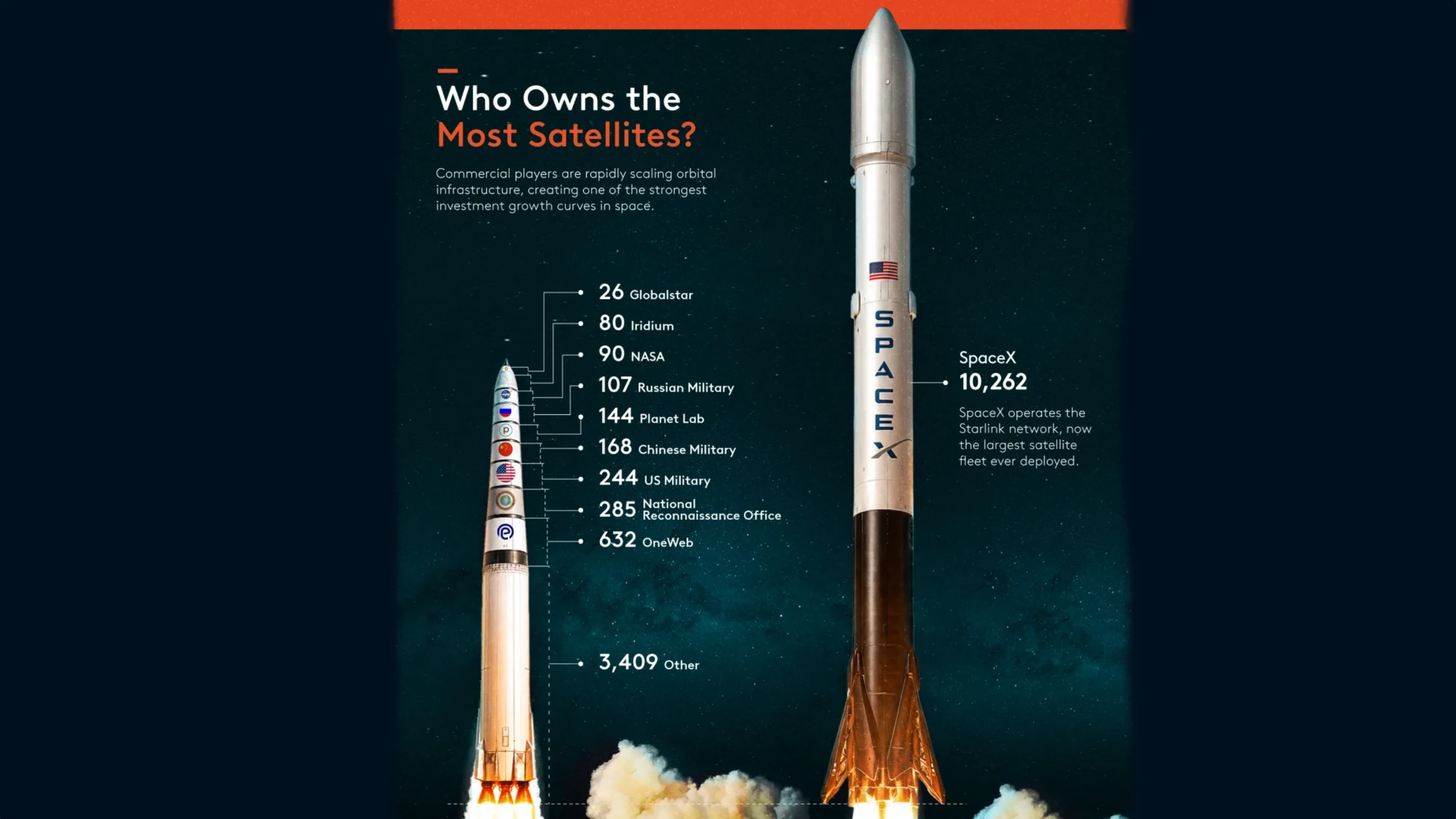
Para percebermos, de forma mais concreta, quem domina a órbita do planeta, um gráfico, de autoria da Global X Canada, permite perceber quem detém mais satélites. A informação tira partido de dados da AEI Space Data Navigator.


Que operadores detêm mais satélites?
A SpaceX domina claramente a contagem global de satélites, com 10.262 satélites operacionais. Isso representa mais de 16 vezes os 632 satélites da OneWeb, o segundo maior operador identificado.

Posição Operador de satélites Número de satélitesSpaceX - 10.262 satélites
OneWeb - 632 satélites
National Reconnaissance Office - 285 satélites
Forças Armadas dos EUA - 244 satélites
Forças Armadas da China - 168 satélites
Planet Lab - 144 satélites
Forças Armadas da Rússia - 107 satélites
NASA - 90 satélites
Iridium - 80 satélites
Globalstar - 26 satélites
Outros - 3.409 satélites


O ranking mostra a rapidez com que as redes privadas cresceram desde o início da corrida espacial.

Organizações públicas como a NASA e forças militares nacionais operam agora apenas uma pequena parcela, com apenas 894 satélites entre os proprietários identificados na base de dados.

A vantagem de escala da Starlink

A SpaceX opera a Starlink, a maior frota de satélites alguma vez colocada em órbita. Só a sua dimensão representa cerca de dois terços dos 15.447 satélites apresentados na base de dados.

Em vez de lançar apenas alguns satélites de elevado valor, a Starlink aposta na escala. Como resultado, a rede tornou-se num exemplo marcante da infraestrutura orbital comercial.

Redes comerciais entram em órbita
A diferença entre a SpaceX e os operadores tradicionais assinala um importante ponto de viragem. As empresas passaram a deter e operar redes de satélites numa escala que anteriormente estava reservada aos governos.

Isto é relevante porque os satélites deixaram de ser apenas ativos de investigação governamental de nicho. Estão agora a tornar-se infraestrutura crítica para conectividade, dados e resiliência nacional.

A China já tem mais de 1.300 satélites ativos em órbita e continua a expandir rapidamente a sua presença espacial. Entre eles estão satélites militares, sistemas de navegação BeiDou, observação da Terra, comunicações e futuras redes de internet via satélite para competir com a Starlink. O objetivo de Pequim é claro: transformar o espaço numa infraestrutura estratégica para defesa, tecnologia e influência global.

Investir no espaço
À medida que as redes comerciais crescem, a infraestrutura orbital poderá tornar-se um tema de investimento cada vez mais relevante. Satélites, sistemas de lançamento e serviços espaciais fazem todos parte deste ecossistema em expansão.

A economia espacial já está a avançar para áreas como logística, agricultura, defesa e comunicações. Como resultado, os investidores poderão procurar cada vez mais exposição a empresas que impulsionam estas tendências.

domingo, 30 de novembro de 2025

A silent catastrophe: 600 dead while the world looks away


Did you know that more than 4 million people have been affected by catastrophic floods in Southeast Asia this week and more than 600 have already died?

While much of the Western world went about its normal routines, a climate-charged humanitarian disaster was unfolding across Indonesia, Thailand and Malaysia. According to a recent report from Reuters, over 4 million people have now been directly impacted. Entire communities vanished under water. Families were swept away in the night. Roads crumbled. Landslides buried homes with people still inside. Survivors clung to rooftops as rivers exploded out of their banks and swallowed everything in their path. More than 600 lives lost in a few days and yet Western media attention remains fleeting.

“Research published in 2025 found that global media coverage of natural disasters is heavily skewed toward events in countries with close social or genetic ties to the reporting country meaning that catastrophes in many climate-vulnerable regions are largely ignored.”

A week of unimaginable human suffering
In the hardest-hit areas of Indonesia, the death toll climbed to at least 303. Rescue agencies report many missing, entire villages unreachable because roads and communications infrastructure washed away. In southern Thailand, flooding and landslides pushed fatalities into the high hundreds; in some provinces morgues became overwhelmed. Across the region, tens of thousands have been displaced, homes destroyed beyond repair, farmland submerged or swept away, and local economies devastated. Villages remain cut off inside debris-filled flood zones even as relief efforts struggle to reach them.
Behind every statistic there is a human reality:
⚠️ Children wading through waist-deep muddy water after schools collapsed.
⚠️ Parents carrying their children on their backs through flooded roads, uncertain if home still stands.
⚠️ Families living on damp floors or makeshift shelters, hungry, cold, and terrified as rain continues to fall.
⚠️ Farmers staring at drowned fields, their harvests ruined, livelihoods destroyed, futures uncertain.

This is not a disaster. It is collective trauma. This is not “just monsoon season” — this is climate disruption in real time The scale, intensity, and unpredictability of the flooding are not random. Scientists have long warned that a warming world brings heavier rainfall, more volatile storm systems, and increased risk of extreme floods. Warmer air can hold more moisture; warmer seas feed storms; the result is more frequent and more intense rainfall events. Many experts say that what Southeast Asia is enduring now; unusual, catastrophic floods across multiple countries at once is precisely the kind of climate-driven extreme weather that belongs to the future. Today it is the present. This horrific upheaval should not be dismissed as “just bad luck.” It must be seen as a warning, evidence of a planet growing increasingly unstable under human-induced climate change.

Why the world’s silence is so dangerous
When more than 4 million people are affected and 600+ die in a few days — and yet global attention remains shallow — something fundamental is broken. If tragedies in the Global South are treated as distant background noise. If the suffering of millions remains largely invisible to the world’s richest and most powerful countries.If disasters fueled by climate disruption are not met with sustained global solidarity — then we are not just failing in empathy. We are failing in foresight.

Selective attention kills urgency
And without urgency, we will never mount the global response such a crisis demands. And while Asia drowned, something else happened in London This same week, the UK hosted the first-ever National Emergency Briefing at Westminster Central Hall — gathering more than a thousand politicians, business leaders, media figures, faith and community voices, all briefed by a panel of top scientists, health-, food- and security-experts.

The message delivered behind closed doors was unambiguous: the climate and nature crisis is already a national security threat. The same forces tearing apart lives in Southeast Asia — extreme rainfall, destabilized weather patterns, overwhelmed infrastructure — can strike any country.

What climate-driven disasters trigger there, they can trigger here. The flooding in Asia is not a distant regional catastrophe. It is a front-line preview of what could happen anywhere including countries in the Global North. This is not a regional crisis. This is a national emergency everywhere. The floods decimating lives across Southeast Asia are not “somebody else’s problem.” They are a warning — raw, unfiltered, urgent. If we cannot look at the suffering of 4 million people today.If we cannot grant their lives the dignity of our attention.

Then how will we protect our own tomorrow?
Because geography will not protect us from climate collapse. Borders will not stop rising waters. Storms will not ask permission. The question is not if it will happen here — But when. If we stay asleep, the water will open our eyes but that will be too late. One powerful way to wake up the people in charge is to do what a group of courageous scientists and civil-society leaders just did in the UK: host a National Emergency Briefing and put political leaders directly in front of the facts. Bringing politicians into the same room as independent experts without spin, without filters, without delay, is one of the most effective tools we have to cut through denial and inertia. We Don’t Have Time is proud to be the official media partner for this groundbreaking initiative. On this page, you can rewatch the full briefing, hear from the scientists themselves, and learn how the model works:


segunda-feira, 10 de março de 2025

Study: Climate change will reduce the number of satellites that can safely orbit in space


MIT aerospace engineers have found that greenhouse gas emissions are changing the environment of near-Earth space in ways that, over time, will reduce the number of satellites that can sustainably operate there.

In a study appearing today in Nature Sustainability, the researchers report that carbon dioxide and other greenhouse gases can cause the upper atmosphere to shrink. An atmospheric layer of special interest is the thermosphere, where the International Space Station and most satellites orbit today. When the thermosphere contracts, the decreasing density reduces atmospheric drag — a force that pulls old satellites and other debris down to altitudes where they will encounter air molecules and burn up.

Less drag therefore means extended lifetimes for space junk, which will litter sought-after regions for decades and increase the potential for collisions in orbit.

The team carried out simulations of how carbon emissions affect the upper atmosphere and orbital dynamics, in order to estimate the “satellite carrying capacity” of low Earth orbit. These simulations predict that by the year 2100, the carrying capacity of the most popular regions could be reduced by 50-66 percent due to the effects of greenhouse gases.

“Our behavior with greenhouse gases here on Earth over the past 100 years is having an effect on how we operate satellites over the next 100 years,” says study author Richard Linares, associate professor in MIT’s Department of Aeronautics and Astronautics (AeroAstro).

“The upper atmosphere is in a fragile state as climate change disrupts the status quo,” adds lead author William Parker, a graduate student in AeroAstro. “At the same time, there’s been a massive increase in the number of satellites launched, especially for delivering broadband internet from space. If we don’t manage this activity carefully and work to reduce our emissions, space could become too crowded, leading to more collisions and debris.”

The study includes co-author Matthew Brown of the University of Birmingham.

Sky fall
The thermosphere naturally contracts and expands every 11 years in response to the sun’s regular activity cycle. When the sun’s activity is low, the Earth receives less radiation, and its outermost atmosphere temporarily cools and contracts before expanding again during solar maximum.

In the 1990s, scientists wondered what response the thermosphere might have to greenhouse gases. Their preliminary modeling showed that, while the gases trap heat in the lower atmosphere, where we experience global warming and weather, the same gases radiate heat at much higher altitudes, effectively cooling the thermosphere. With this cooling, the researchers predicted that the thermosphere should shrink, reducing atmospheric density at high altitudes.

In the last decade, scientists have been able to measure changes in drag on satellites, which has provided some evidence that the thermosphere is contracting in response to something more than the sun’s natural, 11-year cycle.

“The sky is quite literally falling — just at a rate that’s on the scale of decades,” Parker says. “And we can see this by how the drag on our satellites is changing.”

The MIT team wondered how that response will affect the number of satellites that can safely operate in Earth’s orbit. Today, there are over 10,000 satellites drifting through low Earth orbit, which describes the region of space up to 1,200 miles (2,000 kilometers), from Earth’s surface. These satellites deliver essential services, including internet, communications, navigation, weather forecasting, and banking. The satellite population has ballooned in recent years, requiring operators to perform regular collision-avoidance maneuvers to keep safe. Any collisions that do occur can generate debris that remains in orbit for decades or centuries, increasing the chance for follow-on collisions with satellites, both old and new.

“More satellites have been launched in the last five years than in the preceding 60 years combined,” Parker says. “One of key things we’re trying to understand is whether the path we’re on today is sustainable.”

Crowded shells
In their new study, the researchers simulated different greenhouse gas emissions scenarios over the next century to investigate impacts on atmospheric density and drag. For each “shell,” or altitude range of interest, they then modeled the orbital dynamics and the risk of satellite collisions based on the number of objects within the shell. They used this approach to identify each shell’s “carrying capacity” — a term that is typically used in studies of ecology to describe the number of individuals that an ecosystem can support.

“We’re taking that carrying capacity idea and translating it to this space sustainability problem, to understand how many satellites low Earth orbit can sustain,” Parker explains.

The team compared several scenarios: one in which greenhouse gas concentrations remain at their level from the year 2000 and others where emissions change according to the Intergovernmental Panel on Climate Change (IPCC) Shared Socioeconomic Pathways (SSPs). They found that scenarios with continuing increases in emissions would lead to a significantly reduced carrying capacity throughout low Earth orbit.

In particular, the team estimates that by the end of this century, the number of satellites safely accommodated within the altitudes of 200 and 1,000 kilometers could be reduced by 50 to 66 percent compared with a scenario in which emissions remain at year-2000 levels. If satellite capacity is exceeded, even in a local region, the researchers predict that the region will experience a “runaway instability,” or a cascade of collisions that would create so much debris that satellites could no longer safely operate there.

Their predictions forecast out to the year 2100, but the team says that certain shells in the atmosphere today are already crowding up with satellites, particularly from recent “megaconstellations” such as SpaceX’s Starlink, which comprises fleets of thousands of small internet satellites.

“The megaconstellation is a new trend, and we’re showing that because of climate change, we’re going to have a reduced capacity in orbit,” Linares says. “And in local regions, we’re close to approaching this capacity value today.”

“We rely on the atmosphere to clean up our debris. If the atmosphere is changing, then the debris environment will change too,” Parker adds. “We show the long-term outlook on orbital debris is critically dependent on curbing our greenhouse gas emissions.”

This research is supported, in part, by the U.S. National Science Foundation, the U.S. Air Force, and the U.K. Natural Environment Research Council.

sábado, 20 de maio de 2023

Climate change and space debris, a vicious cycle


Just when we thought it couldn’t get worse, the satellite constellations threatening our night sky and the climate crisis impacting every aspect of our lives have joined forces. It is now established that numerous and largely unregulated swarms of satellites in low Earth orbit (LEO) have a direct impact on ground-based astronomy, as discussed in this Astrobite. Now, researchers have determined that the decreasing density of the upper atmosphere due to climate change is only worsening the space debris issue, increasing the orbital lifetimes of active satellites and space trash alike and creating an environment of debris cloaking the Earth.
Changes in the thermosphere

The effects of climate change extend beyond the surface of the Earth out to all levels of the atmosphere. A few teams set out to understand the consequences of climate change through a specific lens: how do CO2 emissions impact the upper atmosphere and the space debris environment? In today’s bite, we cover two papers that independently model global conditions and make projections for the future of the upper atmosphere given a changing climate.

Human-induced climate change leads to a global warming at ground level, but if we move up in the atmosphere by 15-500 km, this same increased concentration of greenhouse gasses causes a global cooling in the middle to upper atmosphere. A decrease in temperature causes this part of the atmosphere to effectively shrink, which in turn reduces the air density in the thermosphere (~90−500 km above the ground). While there are a few variables that impact the density of the thermosphere, increasing CO2 concentration at the ground plays a main role in global cooling and contraction of the upper atmosphere.
The thermosphere is home to thousands of LEO satellites, including the International Space Station, and while it hosts satellites, it also naturally pulls them back down to Earth over time. But the rate at which the atmosphere sends satellites back down to the ground is affected when the density of the atmosphere changes – the question is, by how much?

BRAD and other models
The teams validate and then project models of global circulation into the future to make predictions for the state of the thermosphere out multiple decades. Both studies find similar projections of climate change in the upper atmosphere, with Cnossen (2022) predicting a global mean cooling and a decline in thermosphere density for 2015–2070 that is about twice as strong as that of the past.

In Brown et al. (2021), the authors use a method called BRAD, or the Binned Representative Atmospheric Decay debris model. BRAD essentially makes a few clever assumptions to handle the motions and collisions of objects in LEO statistically, working to distill a pretty messy system and figure out how the objects in LEO will decay in their orbits when the density changes. Given a global temperature increase of 1.5ºC, Brown et al. predict a 15-32% decrease from the year 2000 to now in the thermospheric density at 400 km, a reduction that will speed up with any further increases to CO2 concentration. While BRAD inherently doesn’t model effects of large constellations of satellites, their results imply that the thermospheric density will greatly impact lone and constellations of satellites alike, at least doubling (and possibly increasing by 10-20x) the number of trackable objects (meaning both active instruments and the trash left behind).
An atmospheric drag

Why exactly does climate change in the upper atmosphere lead to a doubling of trackable objects in LEO? With density decreased, atmospheric drag is reduced, so orbital lifetimes of satellites increase: reducing atmospheric drag makes it easier for satellites to whiz around the Earth. With easier travels, they can live in their orbits longer, and lead to the accumulation of space debris. For example, Cnossen (2022) find that a decrease in thermospheric density of ~30% maps to an increase in orbital lifetimes by ~30% as well.

Increased space debris poses risk to other spacecraft, which is relevant to – as Cnossen (2022) put it – the “future exploitation” of the LEO environment. Objects that remain in orbit longer are given more chances to collide with other debris or active satellites. Fragmented space debris can quickly trigger a cascade of more collisions, as by introducing more objects in orbit, the potential for two objects to hit each other rises dramatically. From there, the fragments from such an impact increases the number of objects in LEO, and increases the probability of more collisions. This scenario, called the Kessler Syndrome, could mean trouble for future space activities, and in an extreme case space activities could even be made impossible for decades. And, beyond the potential collisions and resulting trash cloud, staying in orbit longer also impacts long-term effectiveness of satellite-based measurements that need to be stable like precise measurements of sea level.

This vicious cycle of satellite population growth worsening climate change, which in turn negatively impacts the satellite debris environment is well-established and exemplifies how our human impacts on Earth are not limited to the ground. Faced with the reality of climate change advancing and satellite megaconstellations continuing to be launched, this Astrobite lists ways to help preserve the global commons that is our night sky. Space trash doesn’t have to be a permanent fixture of our night skies, but we do have to take significant steps in taking satellites down, which primarily depends on action from the two companies (SpaceX and OneWeb) that own nearly half of all LEO satellites. With the satellite population booming and catastrophic collisions becoming more and more common, we may have already reached a point of instability in terms of space trash, and action to mitigate both climate change and satellite overpopulation is more and more critical.

sábado, 19 de fevereiro de 2022

International Appeal to Stop 5G on Earth and in Space


Sign and share here!

To the UN, WHO, EU, Council of Europe
and governments of all nations

We the undersigned scientists, doctors, environmental organizations and citizens from (__) countries, urgently call for a halt to the deployment of the 5G (fifth generation) wireless network, including 5G from space satellites. 5G will massively increase exposure to radio frequency (RF) radiation on top of the 2G, 3G and 4G networks for telecommunications already in place. RF radiation has been proven harmful for humans and the environment. The deployment of 5G constitutes an experiment on humanity and the environment that is defined as a crime under international law.

Executive summary

Telecommunications companies worldwide, with the support of governments, are poised within the next two years to roll out the fifth-generation wireless network (5G). This is set to deliver what is acknowledged to be unprecedented societal change on a global scale. We will have “smart” homes, “smart” businesses, “smart” highways, “smart” cities and self-driving cars. Virtually everything we own and buy, from refrigerators and washing machines to milk cartons, hairbrushes and infants’ diapers, will contain antennas and microchips and will be connected wirelessly to the Internet. Every person on Earth will have instant access to super-high-speed, low- latency wireless communications from any point on the planet, even in rainforests, mid-ocean and the Antarctic.

What is not widely acknowledged is that this will also result in unprecedented environmental change on a global scale. The planned density of radio frequency transmitters is impossible to envisage. In addition to millions of new 5G base stations on Earth and 20,000 new satellites in space, 200 billion transmitting objects, according to estimates, will be part of the Internet of Things by 2020, and one trillion objects a few years later. Commercial 5G at lower frequencies and slower speeds was deployed in Qatar, Finland and Estonia in mid-2018. The rollout of 5G at extremely high (millimetre wave) frequencies is planned to begin at the end of 2018.

Despite widespread denial, the evidence that radio frequency (RF) radiation is harmful to life is already overwhelming. The accumulated clinical evidence of sick and injured human beings, experimental evidence of damage to DNA, cells and organ systems in a wide variety of plants and animals, and epidemiological evidence that the major diseases of modern civilization—cancer, heart disease and diabetes—are in large part caused by electromagnetic pollution, forms a literature base of well over 10,000 peer-reviewed studies.

If the telecommunications industry’s plans for 5G come to fruition, no person, no animal, no bird, no insect and no plant on Earth will be able to avoid exposure, 24 hours a day, 365 days a year, to levels of RF radiation that are tens to hundreds of times greater than what exists today, without any possibility of escape anywhere on the planet. These 5G plans threaten to provoke serious, irreversible effects on humans and permanent damage to all of the Earth’s ecosystems.

Immediate measures must be taken to protect humanity and the environment, in accordance with ethical imperatives and international agreements.

5G will result in a massive increase in inescapable, involuntary exposure to wireless radiation

Ground-based 5G

In order to transmit the enormous amounts of data required for the Internet of Things (IoT), 5G technology, when fully deployed, will use millimetre waves, which are poorly transmitted through solid material. This will require every carrier to install base stations every 100 metres[1] in every urban area in the world. Unlike previous generations of wireless technology, in which a single antenna broadcasts over a wide area, 5G base stations and 5G devices will have multiple antennas arranged in “phased arrays” [2],[3] that work together to emit focused, steerable, laser-like beams that track each other.

Each 5G phone will contain dozens of tiny antennas, all working together to track and aim a narrowly focused beam at the nearest cell tower. The US Federal Communications Commission (FCC) has adopted rules [4] permitting the effective power of those beams to be as much as 20 watts, ten times more powerful than the levels permitted for current phones.

Each 5G base station will contain hundreds or thousands of antennas aiming multiple laser-like beams simultaneously at all cell phones and user devices in its service area. This technology is called “multiple input multiple output” or MIMO. FCC rules permit the effective radiated power of a 5G base station’s beams to be as much as 30,000 watts per 100 MHz of spectrum,[2] or equivalently 300,000 watts per GHz of spectrum, tens to hundreds of times more powerful than the levels permitted for current base stations.

Space-based 5G

At least five companies[5] are proposing to provide 5G from space from a combined 20,000 satellites in low- and medium-Earth orbit that will blanket the Earth with powerful, focused, steerable beams. Each satellite will emit millimetre waves with an effective radiated power of up to 5 million watts[6] from thousands of antennas arranged in a phased array. Although the energy reaching the ground from satellites will be less than that from ground-based antennas, it will irradiate areas of the Earth not reached by other transmitters and will be additional to ground-based 5G transmissions from billions of IoT objects. Even more importantly, the satellites will be located in the Earth’s magnetosphere, which exerts a significant influence over the electrical properties of the atmosphere. The alteration of the Earth’s electromagnetic environment may be an even greater threat to life than the radiation from ground-based antennas (see below).

Harmful effects of radio frequency radiation are already proven

Even before 5G was proposed, dozens of petitions and appeals[7] by international scientists, including the Freiburger Appeal signed by over 3,000 physicians, called for a halt to the expansion of wireless technology and a moratorium on new base stations.[8]

In 2015, 215 scientists from 41 countries communicated their alarm to the United Nations (UN) and World Health Organization (WHO).[9] They stated that “numerous recent scientific publications have shown that EMF [electromagnetic fields] affects living organisms at levels well below most international and national guidelines”. More than 10,000 peer-reviewed scientific studies demonstrate harm to human health from RF radiation.[10] [11] Effects include:


Effects in children include autism,[28] attention deficit hyperactivity disorder (ADHD)[29][30] and asthma.[31]

Damage goes well beyond the human race, as there is abundant evidence of harm to diverse plant- and wildlife[32][33] and laboratory animals, including:

Ants[34]
Birds[35][36]
Forests[37]
Frogs[38]
Fruit flies[39]
Honey bees[40]

Insects[41]
Mammals[42]
Mice[43][44]
Plants[45]
Rats[46]
Trees[47]


Negative microbiological effects[48] have also been recorded.

The WHO’s International Agency for Research on Cancer (IARC) concluded in 2011 that RF radiation of frequencies 30 kHz - 300 GHz are possibly carcinogenic to humans (Group 2B).[49] However, recent evidence, including the latest studies on cell phone use and brain cancer risks, indicate that RF radiation is proven carcinogenic to humans[50] and should now be classified as a “Group 1 carcinogen” along with tobacco smoke and asbestos.

Most contemporary wireless signals are pulse-modulated. Harm is caused by both the high-frequency carrier wave and the low-frequency pulsations.[51]

quarta-feira, 7 de julho de 2010

As alterações climáticas criam mais lixo orbital


There are lots of consequences of a warming world, a lot of them easy to infer and understand (i.e. melting glaciers), but some consequences have come to light that weren't so expected, like a reduction in crop nutritional value and, now, an increase in space junk orbiting the earth.

Scientists at the University of Southampton have studied the orbits of 30 satellites over the past 40 years and discovered that they're taking longer to drop out of orbit and burn up. The scientists think that increased CO2 in the upper atmosphere is causing it to cool and become less dense, slowing the braking effect and allowing satellites and spent rockets to circle for longer.

The researchers measured a five percent reduction in density every decade at an altitude or 300 kilometers, leading to an increase in orbit time of up to 25 percent.

More space junk does pose a danger for spacecraft launches and will require more debris removal by space agencies, but with the scaling back of our nation's space program and bigger problems down here on the ground, it's not likely to become a major issue.