Mostrar mensagens com a etiqueta Al Gore. Mostrar todas as mensagens

quinta-feira, 17 de setembro de 2026

Agência de Proteção Ambiental elimina limitação às emissões de gases com efeito de estufa nas centrais elétricas dos EUA

A Agência de Proteção Ambiental (EPA) norte-americana divulgou na segunda-feira que vai revogar as regras que limitam as emissões de gases com efeito de estufa, que causam o aquecimento global, provenientes de centrais elétricas alimentadas a carvão e gás natural.
A alteração à regra, inicialmente proposta no ano passado, representa uma mudança fundamental em relação aos esforços dos presidentes democratas Joe Biden e Barack Obama para combater as alterações climáticas e reduzir a poluição industrial.

Os grupos ambientalistas criticaram a medida, afirmando que vai prejudicar a saúde dos norte-americanos e degradar ainda mais o ambiente, noticiou a agência Associated Press (AP), que antecipou também batalhas judiciais após a entrada em vigor da nova regra.

A revogação da regra para as centrais elétricas da era Biden permitiria poupar mais de 300 mil milhões de dólares em custos para o setor e ajudar a libertar a energia norte-americana, de acordo com a EPA.

A mudança permitirá que as empresas de energia tomem as melhores decisões para os seus consumidores, em vez de serem forçadas a fechar centrais antigas ou ineficientes, sublinhou o administrador assistente da EPA, Aaron Szabo.

A proposta, que deverá ser oficializada no próximo ano, surge na sequência de uma ação anterior da EPA, realizada este ano, que revogou uma conclusão científica que há muito servia de base central para a atuação dos EUA na regulação das emissões de gases com efeito de estufa e no combate às alterações climáticas.

A medida de fevereiro eliminou todos os padrões de emissão de gases com efeito de estufa para automóveis e camiões.

O novo plano aplicaria uma lógica semelhante para uma reversão mais ampla das regulamentações climáticas dirigidas a fontes fixas, como as centrais elétricas.


As centrais termoelétricas alimentadas a carvão, gás e petróleo são responsáveis por cerca de um quarto de toda a poluição climática dos EUA, ficando apenas atrás do setor dos transportes.

A poluição proveniente destas centrais é uma das maiores fontes globais de poluição que altera o clima.

As normas visadas pela EPA sob a administração liderada por Donald Trump poderiam evitar cerca de 30 mil mortes e gerar uma poupança de 275 mil milhões de dólares por cada ano em que estivessem em vigor, segundo um estudo da AP realizado no ano passado, que incluiu avaliações anteriores da própria agência e várias outras pesquisas.

Enquanto a China consolida o domínio mundial nas tecnologias limpas do século XXI (baterias, painéis solares, veículos elétricos), os EUA arriscam-se a ficar para trás num mercado global de energia limpa estimado em biliões de dólares. 

Na Europa mantem o foco na sustentabilidade ambiental e regulação, assumindo custos económicos mais altos no curto prazo para liderar a transição ecológica.

quarta-feira, 8 de julho de 2026

Neil Young a tireless righteous contrarian


Letra

Won't need no shadow man 
Runnin' the government 
Won't need no stinkin' WAR 
Won't need no haircut 
Won't need no shoe shine 

[refrão] 3x
After the garden is gone 
 
What will people do? 
After the garden is gone 
What will people say? 
After the garden 

Won't need no strong man 
Walkin' through the night 
To live a weak man's day 
Won't need no purple haze 
Won't need no sunshine

[refrão] 3x
After the garden is gone 

Where will people go?  
After the garden is gone 
What will people know? 
After the garden 

 [refrão] 2x

O videoclipe oficial de "After The Garden", integrado no projeto Living With War de Neil Young, cruza de forma crua o rock de protesto e o ativismo ecológico. Visualmente, o vídeo simula a urgência de um canal de notícias fictício, utilizando a imagem do ex-vice-presidente americano Al Gore e do seu documentário An Inconvenient Truth para expor a crise climática mundial. Os rodapés informativos na tela dividem as atenções entre a contagem de baixas de guerra e os alertas sobre o degelo, traçando um paralelo direto entre a destruição militar e o ecocídio provocado pela ganância industrial. A nível político, o "jardim" surge como uma metáfora óbvia para o planeta Terra e a natureza que a humanidade está prestes a esgotar, terminando com um apelo explícito à ação individual e coletiva, desde o consumo de energias limpas à pressão sobre os governos.

Musicalmente, a faixa assenta num rock de garagem denso e distorcido, onde a aspereza das guitarras traduz a gravidade e a pressa que o tema exige. A voz cética de Neil Young une-se a um coro potente no refrão, transformando a pergunta sobre o destino da humanidade "depois do jardim" num hino coletivo e numa espécie de prece fúnebre pelo planeta. É um rock de intervenção direto, sem artifícios, desenhado para incomodar e mobilizar.

English analysis
He is throwing back 1970 "After the Gold Rush (song)"
Now THIS
"After the Garden" serves as the powerful opening statement for Neil Young’s fiercely political album Living With War. Originally written in 2006 as a blistering critique of the George W. Bush administration and the Iraq War, it has taken on a new life with Young's Living With War 2026 archival project, reframing the music to parallel today's political landscape.

The song acts as a bridge between environmental destruction and the futility of war. Young uses "the garden" to represent pristine nature, Eden, or a peaceful Earth, posing the stark, driving question: "What will people say after the garden is gone?" He immediately follows this warning by asserting that in a devastated world, we "won't need no stinkin' war" because humanity will already be dealing with the fallout of its own survival. He sharply criticizes the public's desire for aggressive, authoritarian leaders, arguing that true strength is built on peace and preservation rather than military dominance or fear-mongering.

Musically, Young describes the track's style as "metal folk protest music." It features gritty, raw garage-rock guitar work and a steady, march-like rhythm that evokes the feeling of a protest movement. A massive, multi-voiced choir echoes his lyrics, giving the song the weight of a communal hymn rather than just a solo rant.

While the core vocal and instrumental performances remain from the original recording, Young remixed the entire project for this 2026 archival release to give it a refocused mix for the present day. In this edition, the 100-voice choir is mixed much higher and given a heavier, more distinct presence in the soundscape. By amplifying the wall of human voices, Young deliberately draws a straight line from his 2006 anti-war sentiments to modern anxieties, suggesting that the fight for the planet and against political division is more urgent than ever.

Fontes:
Neil Young Archives
Living with War (2006)

sexta-feira, 19 de junho de 2026

An Inconvenient Truth About AI


If you’re old enough, you may remember this moment.

It’s 2006. Former presidential candidate Al Gore presents the documentary An Inconvenient Truth. Behind him, there’s an enormous screen that shows the level of CO2 in the atmosphere going back hundreds of thousands of years. He walks the audience through it, ice age by ice age. And then, to show where the line will be in fifty years, he climbs onto a scissor lift and rises.

Within two years, Al Gore has won an Oscar and a Nobel Peace Prize. For one brief moment, it feels as though the world might finally listen.

But we all know what happened next. The climate deniers mobilized. They brought a snowball onto the Senate floor and asked, where’s your global warming now? They said things that were technically true (like CO2 is good for plant growth) and completely misleading. And above all, they moved the goalposts.

First it was: the climate isn’t warming. Then it became: fine, it’s warming, but not because of us. Then it was: okay, it’s us, but it won’t be that bad. Then it became: alright, it’s pretty bad, but… it’s China’s fault and we can’t afford to fix it.

The whole time, Al Gore’s red line kept climbing.

I was 18 years old in 2006, and I was furious. How could any serious person look at this evidence and refuse to see it? Climate denial, I thought, was a disease of the right.

And you know what? I was wrong. Not about the right, but about who else is capable of denial. Because we, the liberals, the left, the journalists, the academics, the 97% ‘In this House we Believe that Science is Real’ crowd, we are now doing to the threat of artificial intelligence exactly what the right did to the threat of climate change.

The deniers are us.

Part 1: The Denial
In March 2023, The New York Times published an op-ed by Noam Chomsky: one of the most prominent intellectuals alive and a hero of my political tradition. The piece was called The False Promise of ChatGPT. Chomsky argued that AI is incapable of real thought and that treating them as intelligent was a basic mistake. He called them a ‘lumbering statistical engine for pattern matching’.

This was the consensus of a lot of serious people. The New Yorker ran a long essay arguing that ChatGPT was a blurry JPEG of the web, a lossy compressor that memorized the internet badly and hallucinated the rest. In 2021, the linguist Emily Bender and the computer scientist Timnit Gebru had given this whole skeptical movement its slogan: these machines, they wrote, are stochastic parrots. They just imitate.

Chomsky, Bender, Gebru are smart people. And yes, some of what they have warned about has come true. The web is drowning in machine-generated slop, the training data is biased and the energy bill is pretty staggering. But their central conviction, that this whole Silicon Valley AI-project would hit a wall any minute now, that conviction has completely collapsed.

In the three years since those pieces were published, here’s a partial list of things that the “stochastic parrot, blurry JPEG, lumbering pattern-matcher” has done:
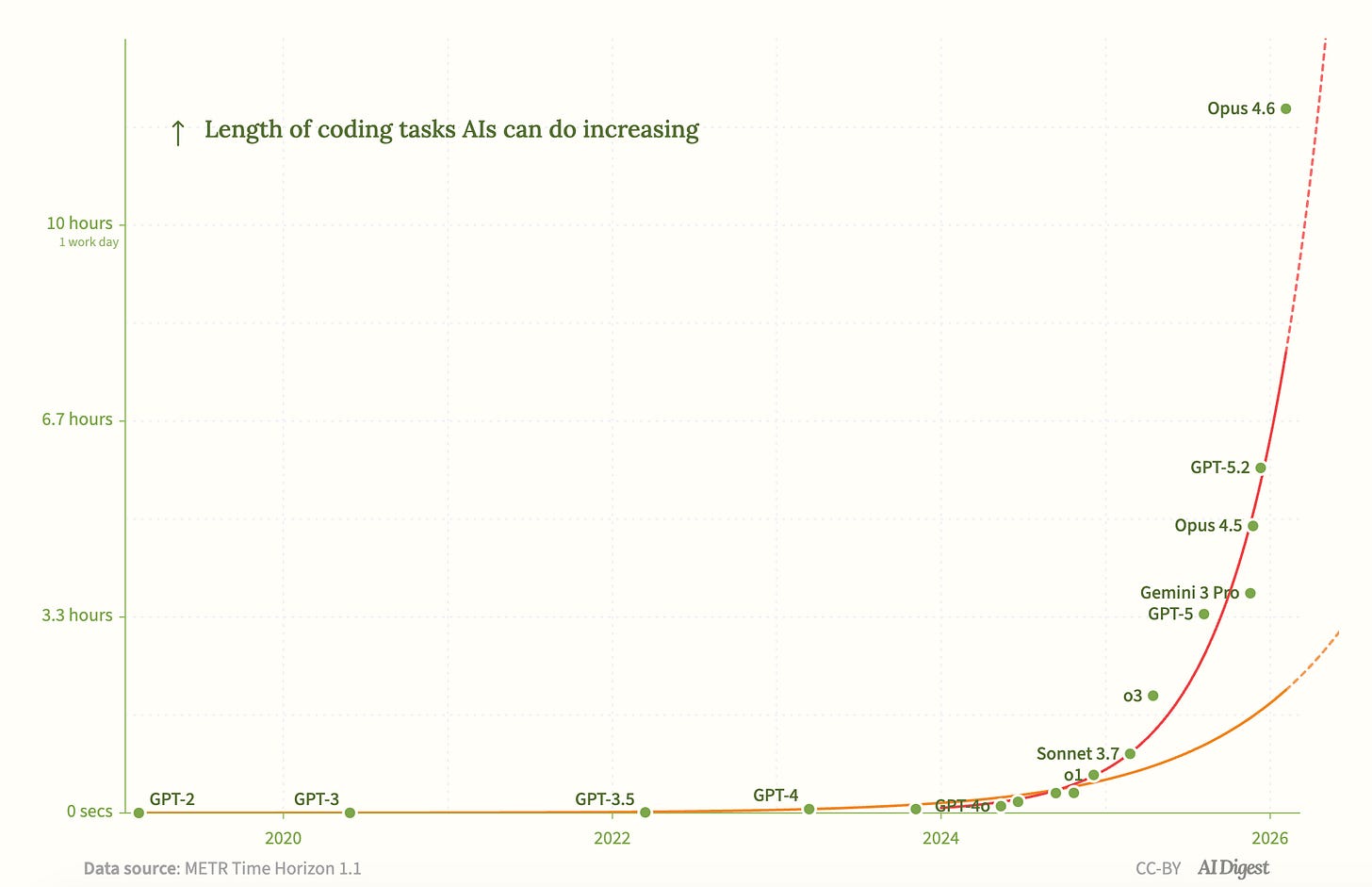
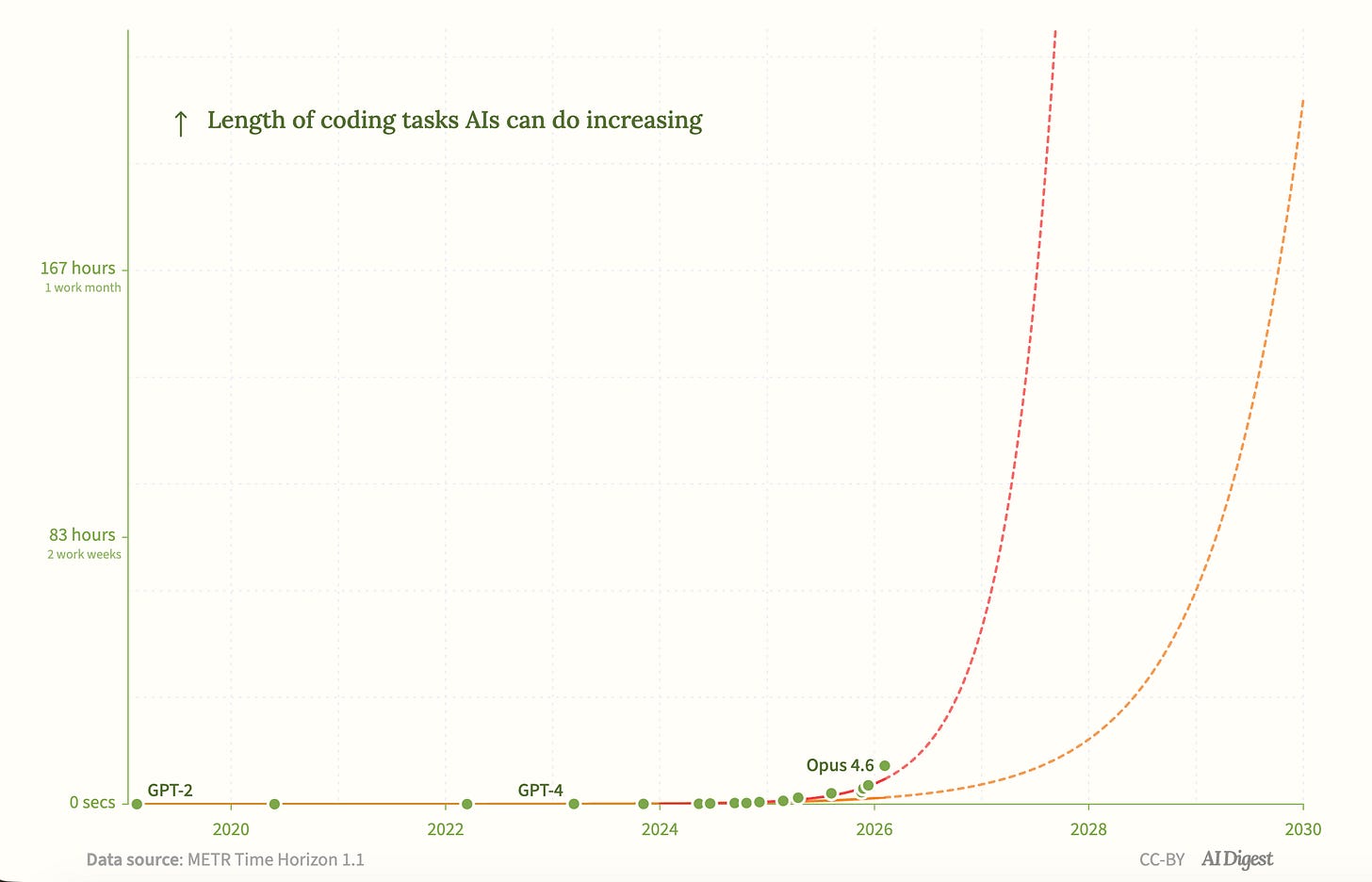
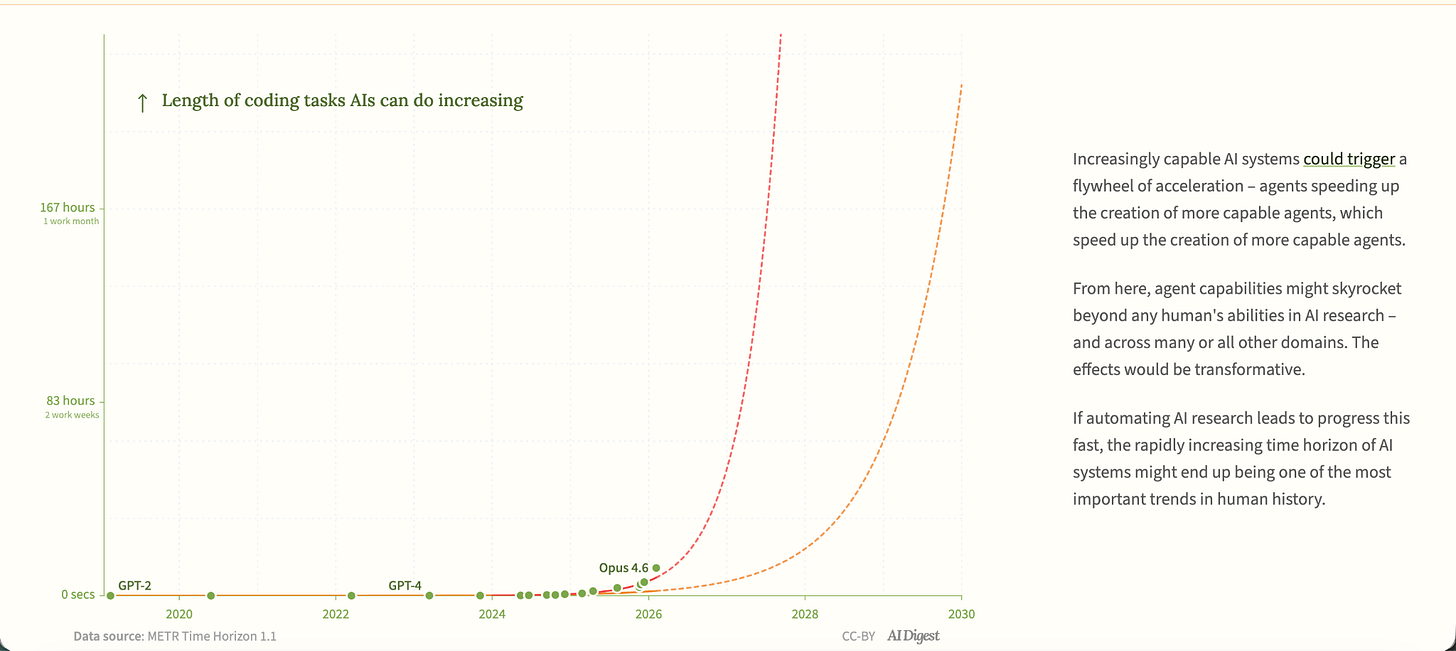
But of all the data, here’s the chart that captures the AI revolution most clearly:


There is a research group called METR. Since 2019, they have measured something simple: how big a coding task can an AI complete on its own? And they measure that ‘bigness’ in human time, meaning: how long would it take a skilled human to do the same task?

In 2022, the answer was about 30 seconds. In 2023, it was 4 minutes. In 2024, it was 40 minutes. In 2025: 6 hours. And earlier this year, 12 hours.

At this moment, AI capabilities are doubling every 3 months.

So to be honest, I think this METR graph is even scarier than the CO2 graph Al Gore showed us. Because this line is climbing far steeper. Here, ‘off the charts’ is not 50 years away, but 5 years away.
.

I’ve personally never written a line of code in my life. But in the past few months, I’ve let AI build me whole apps, websites, dashboards and even a voice-controlled teleprompter app I used to record the video version of this essay. Multiple times a week, I have what I can only call WTF-moments. Especially in the last 6 months, the gap between what these systems can actually do and what most people assume they can do has just kept widening.

For example, I think AI is actually pretty good at writing. Sure, there’s a huge amount of machine-generated slop on LinkedIn (and Substack?), but as Benjamin Todd recently wrote:
Plastic surgery is most noticeable when it's bad, so it's more widespread and successful than it looks.Same with AI writing.
Sometimes I want to shake people: have you actually used it?! Many skeptics seem to have opened ChatGPT in 2023, asked it to write a limerick, watched it fumble, and closed the tab. Well, that was three years ago. Three years in AI is a geological era. Judging today’s models by GPT-3.5 is like judging smartphones by a 2007 BlackBerry.

To be fair, I think journalists deserve much of the blame. The people whose job it is to report on the most newsworthy events have often ignored it. For example, the day the leading AI-lab Anthropic announced Mythos (an insanely powerful model capable of hacking anything from power grids to water systems) it didn’t even make the front page of a single major news site. The Guardian decided a Vogue cover with Anna Wintour and Meryl Streep was more important.

Part 2 : The Largest Infrastructure Build-out in History
Meanwhile, the AI-race is speeding up. Remember: the models of today are the worst models we will ever have. From here on, they’ll only get more powerful.

And honestly, I think it’s hard to wrap your head around the scale of what’s coming.

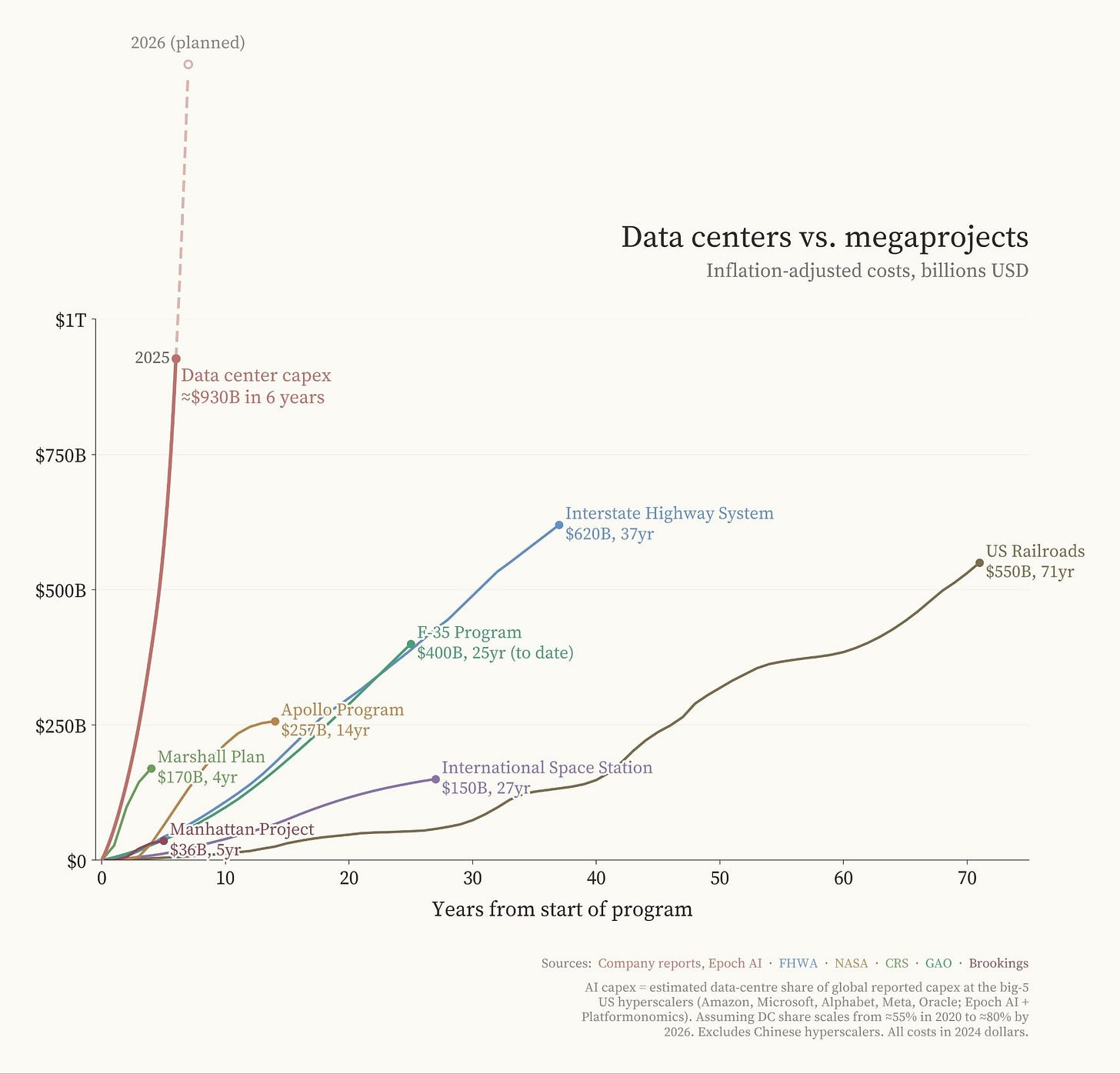
Look at the first line of this graph. That’s what the companies have spent on AI data centers since 2019, and what they’ve got planned for 2026. To be clear: this is the largest capital build-out in the recorded history of our species. It’s larger than the interstate highway system. Larger than the International Space Station. Larger than the Moon Landing and the Manhattan Project combined, and it is not even close.

Mark Zuckerberg’s Meta is currently building a single data center in Louisiana that, when finished, will cover nearly four times the size of Central Park. Amazon is spending more on data centers in one year than the entire annual defense budget of Germany. Microsoft, Google, Meta and Amazon will spend three times as much on AI infrastructure in 2026 than the entire Marshall Plan that rebuilt Europe after the Second World War.

But isn’t it all a bubble?

That is the next move the deniers make. Once “it’s just a silly parrot” stops working, they fall back to: it’s financial madness. The data centers are serving no real demand. It’s all hot air, or even a deliberate scam.

And to be fair, the skeptics have some ammunition. A viral MIT study published last year found that 95% of corporate AI pilots deliver zero measurable returns. The company Klarna replaced 700 customer service workers with AI, then quietly rehired humans because customers couldn’t stand talking to the bot. McDonald’s killed its three-year AI drive-thru experiment after the system kept putting bacon on ice cream.

But you know what? None of this proves anything. Let me show you why.

First, look at user growth. It took Instagram 2.5 years to reach 100 million users. At the time, that was the fastest growth story ever recorded. For comparison: ChatGPT hit that milestone in 2 months. Fifteen times faster.

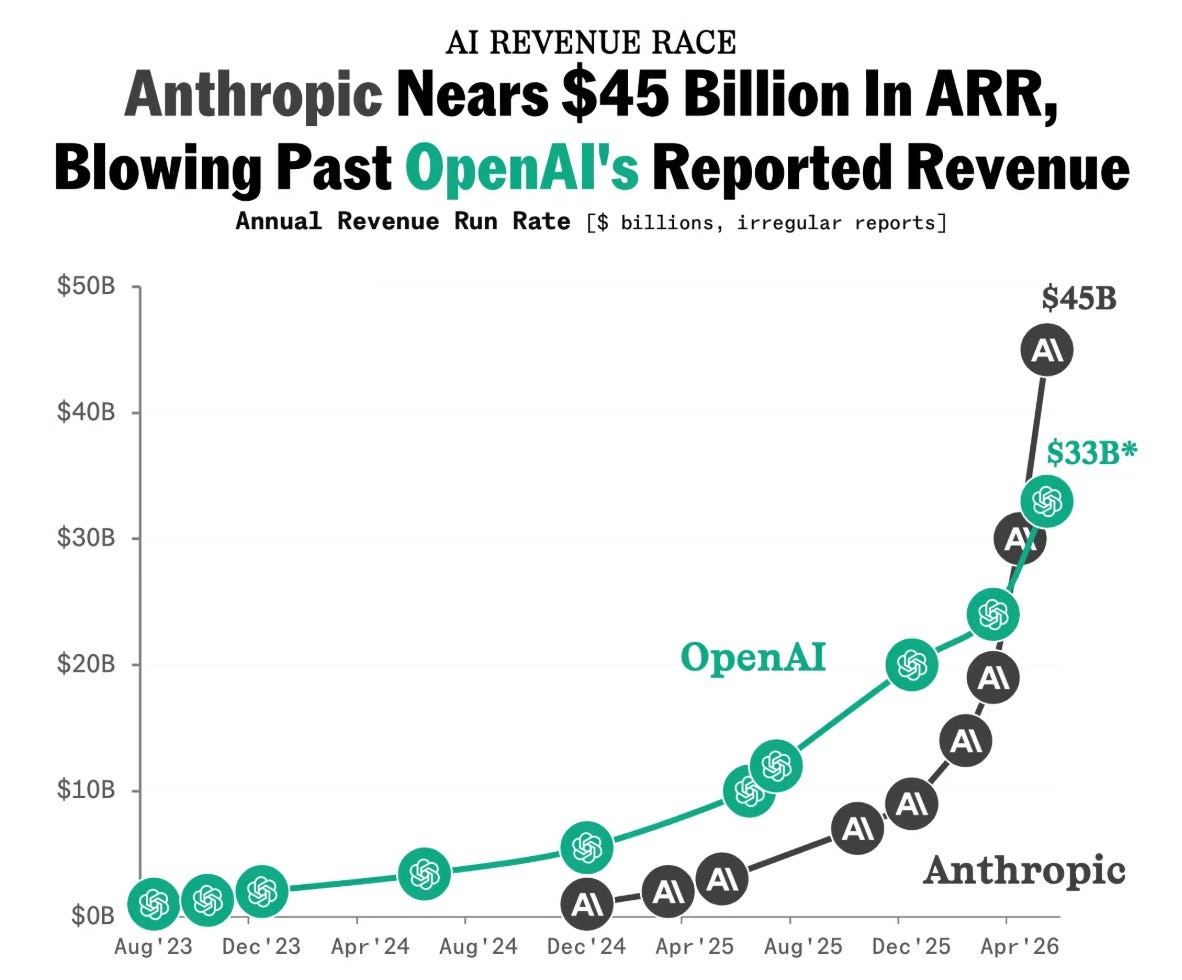
Next, let’s look at revenue, and at one AI-lab in particular: Anthropic. Here is its annualized revenue, month by month:

January 2025: 1 billion dollars.
May: 3.
June: 4.
August: 5.
October: 7.
December: 9
February: 14.
March: 19.
April: 30.
May: 45

That’s right, 45 billion dollars in annualized revenue. From one company. Up 44-fold in 15 months. No company in any era – not Rockefeller’s Standard Oil, not Microsoft at the dawn of the personal computer, not Google in the tech boom – nobody ever has scaled revenue this fast. We’re talking about the fastest-growing company in the history of capitalism.

So, if this is really such a useless and fraudulent bubble, then why are people paying so much money for it? Why is the demand for AI rising faster than companies are able to build data centers? Why are IT departments, in the words of a Goldman Sachs analyst this April, overrunning their AI budgets “by orders of magnitude”?

I’m sorry to say it, but there’s a lot of highbrow misinformation circulating in left-wing media about AI. Take that viral MIT report. Read it carefully and you see the headline got it backwards. The “95% failure rate” includes the 80% of companies that never piloted any AI in the first place. As the podcaster Rob Wiblin pointed out in a careful breakdown of the study, this is like saying 95% of Tinder users have failing marriages, when most of them have never been on a date. Among the companies that actually deployed AI, about a quarter succeeded within six months. And the study’s own data shows that more than 90% of workers at those companies are using ChatGPT or Claude regularly at work, often multiple times a day.

This should not be surprising at all. If you know how to use it, this technology is already very, very useful, and it will only get more so. But if you don’t use it (perhaps because you work at the DNC, which has barred its staffers from using Claude and ChatGPT) then yes, you become particularly prone to misinformation about it.

Sure, some AI companies are probably overvalued. And yes, some will fail. I think OpenAI is particularly vulnerable. But here’s what the bubble-callers keep missing: even if half of them go bust tomorrow, the infrastructure stays. The data centers, the chips, the models and the capabilities stay.

The railway bubbles of the nineteenth century ruined lots of investors. They also created a rail network that powered the Industrial Revolution, the tracks of which still carry trains today. I actually don’t think this AI build-out is a bubble, but even if it is, remember: bubbles build infrastructure. Bubbles build the future. And a bubble of this magnitude, bursting tomorrow, would still leave us with a civilization permanently reorganized around machine intelligence.

So, ever since 2021, the AI skeptics have been moving the goalposts.

First it was: it’s just a spicy autocomplete machine. A stochastic parrot. A word guessing program. Then it became: fine, it can mimic, but it’ll never reason. Then they said: okay, it can pass the tests, but no serious business is using it. Then: alright, businesses are using it, but the economics don’t add up, it’s one big bubble. Then: fine, the revenue is real, but, but, but…

And this whole time, the line kept climbing. Just like Al Gore’s line of CO2 emissions, except this one is climbing much faster, and we have much less time to prepare.

Let me be clear: I think there’s a real chance that the next five to ten years are going to be some of the wildest in the history of humanity. Because here’s what the people building this technology – the same people who have proven the skeptics wrong again and again – are now telling us. They think AI may soon start to build more powerful AI by itself.

Jack Clark, one of the co-founders of Anthropic, recently called this crossing “a Rubicon into a nearly impossible-to-forecast future.” He thinks there is a 60% chance it happens by 2028.

Now, the obvious objection: of course an AI executive predicts explosive growth. Scary stories sell models and lift valuations, fair point. But you don’t have to take Clark’s word for it. Independent academics, people with no equity in this race, have been revising their estimates forward. The salespeople and the experts are converging. That’s the part that should worry you.

Right now, every step forward still requires humans. But the moment AI does that work itself, the bottleneck is gone. Years become months. Months become weeks. Each generation of AI builds the next, faster than the last. The flywheel starts spinning itself.

Part 3 : The Risks
One evening last summer, a microbiologist named David Relman was hired by one of the leading AI companies - we don’t know which one - to pressure-test a chatbot before its public release. Relman is a biosecurity expert at Stanford University. He has advised the US government on biological threats for years.

That night, in his home office, the chatbot explained to him how to modify a pathogen so that it would resist known treatments. Then it described how to release the superbug. It identified a real security vulnerability in a real public transit system, and it explained how to maximize casualties and minimize the chances of getting caught.

Relman had seen a lot in his career, but now he was so shaken that he had to take a walk to clear his head. He later told The New York Times that the bot answered questions he hadn’t even thought to ask, with a “deviousness and cunning” he found chilling.

Some skeptics, when they hear this, say: but you can already google this stuff. A chatbot doesn’t really change anything. Well, let me give you three data points.

One. A study published last year tested leading chatbots against PhD virologists, on detailed laboratory protocols in their own field. ChatGPT outperformed 94 percent of them.

Two. In November of last year, the police in India arrested a 35 year-old physician. He was plotting an attack on behalf of the Islamic State and trying to extract ricin (a lethal toxin) from castor beans. According to the police, the doctor had been getting advice on his preparations from ChatGPT.

Three. Fanatics with the will to kill millions of people are not hypothetical. These people exist. Let me give you the canonical example from biosecurity. In the 1990s, a Japanese doomsday cult tried to do exactly what the AI safety people are warning about today. The cult recruited from Japan’s top universities: one of its scientists was a graduate student in virology at Kyoto. They believed the apocalypse was imminent, and that killing non-believers was a way of saving them. They sent expeditions to Africa hunting for Ebola, and built a thirty-million-dollar laboratory at the foot of Mount Fuji to mass-produce sarin nerve gas – thousands of kilograms a year, on something close to a battlefield scale.

And on a Monday morning in March 1995, during the Tokyo rush hour, five of their members boarded five different subway trains carrying plastic bags filled with liquid sarin, and punctured the bags with the tips of their umbrellas. Hundreds of commuters were soon gasping for air on the platforms. Twelve people died. It was only twelve, because sarin is a chemical agent: it doesn’t spread from one person to the next. A virus would have.

In 1995, that cult – wealthy, scientifically literate, fanatical and willing to die for the cause – could not get hold of Ebola. Today, they could order the DNA sequences online. And a chatbot would walk them through what to do with it.

Now, I want to be clear: biology is just one of the many dangers. There is so much more. In April of this year, the UK government’s AI Security Institute released their assessments of two new AI systems. Anthropic’s Mythos and OpenAI’s GPT-5.5. Both could now find and exploit critical security vulnerabilities in the computers and systems that hold the modern world together. Power grids. Water systems. Government databases.

Anthropic’s response was striking. They decided not to release Mythos to the public at all. Instead, they limited access to a small group of cyber-defenders, to give the good guys a head start on what was coming.

Yes, a private company, with billions of dollars to be made and with no regulator forcing its hand, concluded that one of its own products was so dangerous it should not be sold to the general public. There is no regulator and no legislation. There was simply a moment of conscience inside the company. I am glad that conscience exists! But conscience is not a policy.

And that brings us to the deepest risk of all. Power.

Two countries are leading this race: the United States and China. Inside those countries, a handful of corporations are building the most powerful tools in the history of our species. The people who own those companies are about to acquire a kind of leverage that I don’t think we even have the words for yet.

So let’s look for an analogy. Political scientists have a name for what happens to countries that strike oil. They call it the resource curse. You’d think a fortune buried in the ground would be a blessing, and sometimes it is. Norway and Alaska managed it well. But more often, the wealth flows in, and democracy flows out. Think about Saudi Arabia, Venezuela and Russia: the pattern is pretty consistent.

Why does this happen? It comes down to a fact about how democracies were built. We like to think they were born from grand ideas from a few smart Founding Fathers. But the real engine was more boring: it was tax collection.

Rulers have always needed money. They needed it to fight wars, to build roads, to put down rebellions. And the only place to get it was from their subjects. So as the economy started growing, and people started producing more wealth, the rulers had to bargain. You want my coins? Then I want a voice. You want my son in your army? Then I want a vote.

That is the fiscal bargain at the heart of every free society. No taxation without representation, but also no representation without taxation. Rulers needed us. They needed our money, our labour, our consent. That need is the foundation of every right we have.

Now imagine a country where the ruler doesn’t need any of that. Where the wealth comes out of the ground, gets shipped abroad, and the dollars come back to fund the palace and the secret police. The citizens become a nuisance. Why educate them? Why listen to them at all? That is the resource curse.

And I’m afraid that we may face something bigger. The researchers Luke Drago and Rudolf Laine have call it ‘the Intelligence Curse’.

Because if the machines do the work, if they write the code, draft the contracts, drive the trucks, diagnose the patients, fight the wars, then the people who own the machines no longer need the rest of us. Not as workers, not as soldiers, not as taxpayers and not even as voters. The fiscal bargain that built every democracy on Earth could very well dissolve.

Of course, we don’t need to assume AI takes over everything, there’s a huge amount of uncertainty here! But even if it substitutes for a meaningful fraction of what humans currently do – not all, just a fraction – the fiscal bargain weakens.

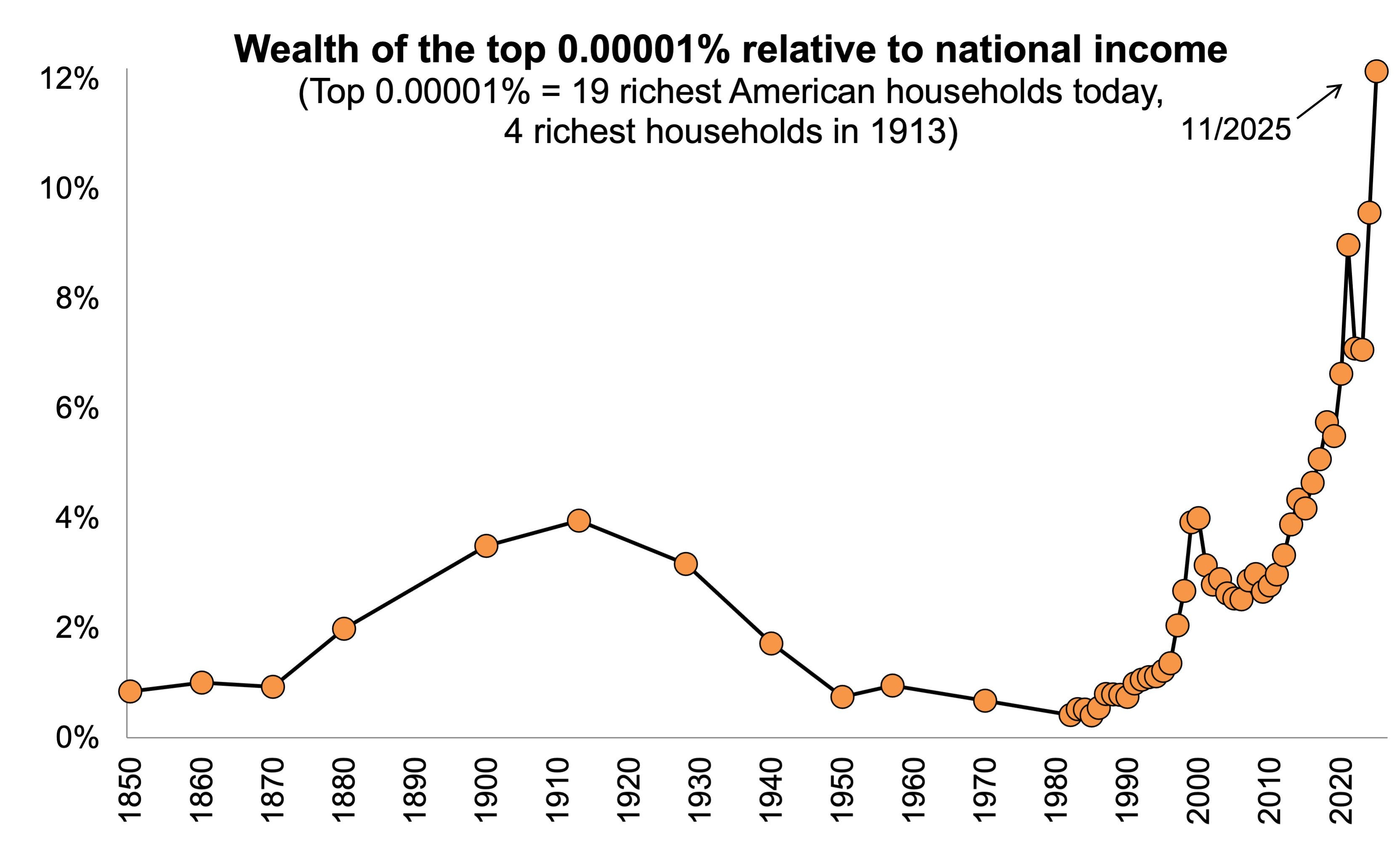
And remember: we already have the most extreme concentration of wealth in history. In 1910, at the peak of the Gilded Age, the richest 0.00001% of US households owned wealth equivalent to 4% of national income. Today, that figure is 12%. America’s super-rich are already richer and more powerful than the original robber barons ever were. And AI is about to make it much, much worse. Because the labs building this technology are owned by a tiny group of people, a few early investors who stand to capture more of the world’s wealth than any class of owners who ever lived.

Part 4 : What We Do About It
So. What do we do?

Let me start with what we should not do. There is a temptation to look at all of this and conclude: shut it down. Pull the plug. Bring in the Luddites. Smash the machines..

And I get the impulse. When you stack up the scale of risk, the disregard for democracy, the hubris of the people in charge, the cleanest response feels like a moratorium. Just say no.

It is, I think, the wrong answer.

The reason is brutally simple. It doesn’t work. Stop the data centers in California, and they get built in Texas. Stop them in Texas, and they get built in Abu Dhabi. Stop them in democracies – the places with civil liberties, with judicial review, with a free press, with worker protections – and you hand the future to autocracies.

My point is not, absolutely not, that we have to let AI rip. My point is that abandoning the field is not the same as stopping the technology. This is the left’s version of climate denial. Refusing to engage seriously, on the assumption that if we just shout no loudly enough, the future will go away. It won’t.

So what does work?

Three things, at minimum.

One: State capacity. We need way, way more AI expertise and talent inside the government. The UK was early on this. They built an AI Security Institute: a serious arm of the state that actually evaluates frontier models, the way the FDA evaluates new drugs. I think every serious country needs a well-funded institute like that.

Two: International coordination. We have been here before. In 1949, the United States and the Soviet Union both had nuclear weapons, and humanity briefly looked extinction in the eye. Out of that came treaties. Imperfect, yes, but they bought us decades of survival. We need something equivalent for AI.

Three: The free world has to build.. The US – with its increasingly fascist government – currently owns 74% of the world’s compute, China has 14%, Europe less than 7% and all other countries combined less than 5%. I’m really worried about the middle powers, and Europe in particular. So far, Europe has been pretty good at regulating AI, but terrible at building it. In fact, all the American giants – Microsoft, Apple, Amazon, Nvidia, Alphabet – are individually worth more than the entire German or French stock market.

The good news is that Europe does have more leverage than it often thinks. The company ASML for example is less than an hour from where I am right now in the Netherlands. It makes the lithography machines without which TSMC in Taiwan cannot fabricate the chips, without which Anthropic and OpenAI cannot train their models. The democratic countries, working together, still control significant chokepoints in this supply chain. That is real power.

But my fellow progressives in Europe really need to understand that our welfare state, our way of life, is at stake. Just think it through. If AI does much of the work, but the profits flow to a handful of American giants that we barely tax – while European workers lose their jobs – then the tax base that funds our healthcare, our pensions, our unemployment insurance just… evaporates.

There’s one thing I can’t emphasize enough: democratic, liberal and humanitarian values are wonderful, but they are worthless if you don’t have the strength to back them up. And in this new world, compute is the new power. So no more NIMBY-ism. We need massive investments and fast permitting of data centers to keep up, or we’ll be digitally colonized. Anyone who’s not at the table will be on the menu.

Now, none of this works – none of it – without a positive vision.

And this, I think, is where liberals and the left have most badly failed.

Twelve years ago, I wrote a book called Utopia for Realists. I complained that the left mainly knew what it was against. Against austerity, against the establishment, against homophobia, against racism, against billionaires. But it lacked a positive vision of where it wanted to go.

My argument was that we should stop being so timid in our political imagination. I argued for a universal basic income, for the complete eradication of poverty, and I argued for a goal that the brilliant economist John Maynard Keynes laid out almost a century ago, in 1930…the fifteen-hour work week.

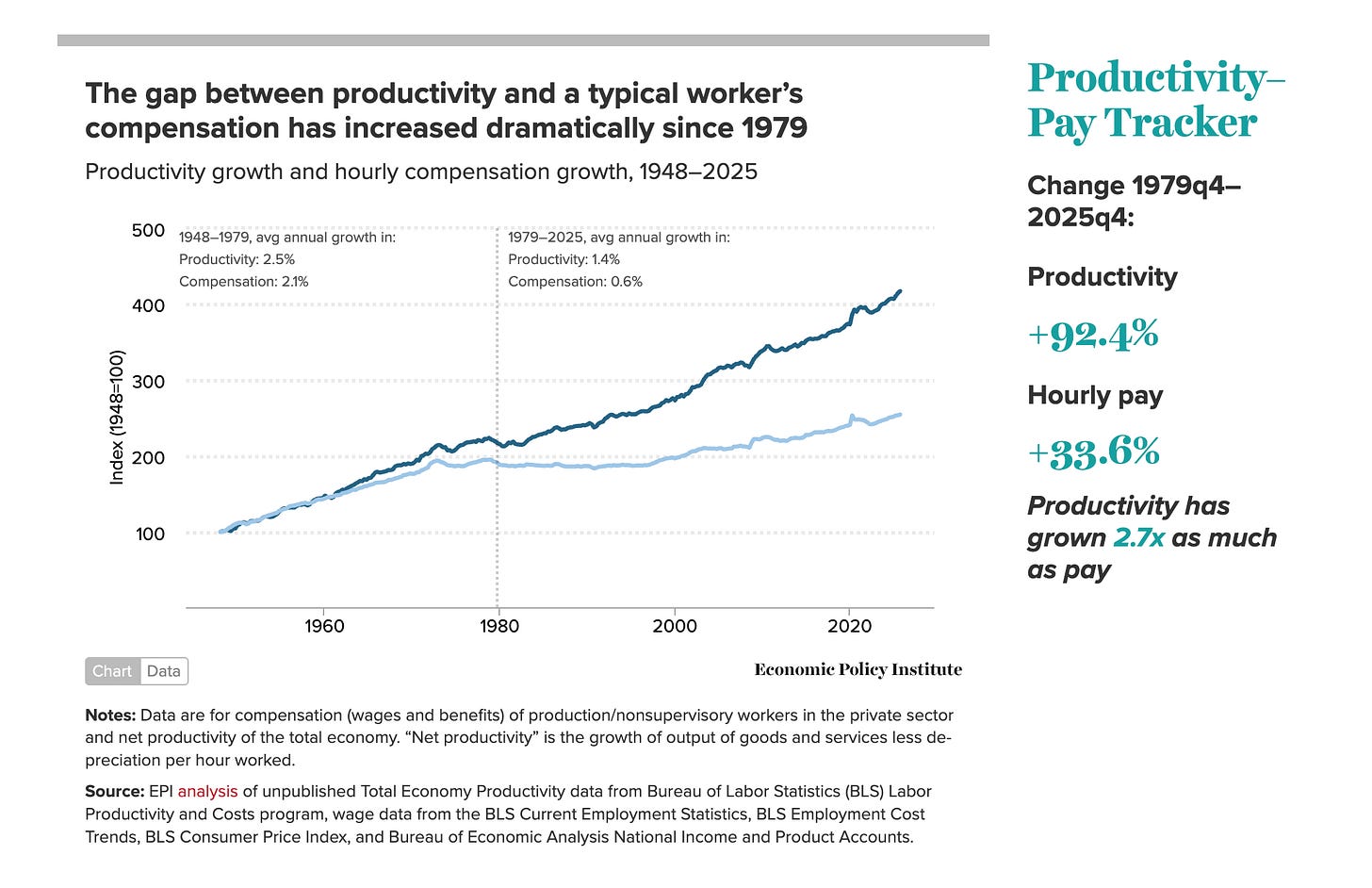
Keynes thought it was inevitable. He looked at the trajectory of productivity growth and concluded that by 2030 his grandchildren would be working a quarter as much as he did, because the machines would be doing the rest. The strange thing is, he was right about the productivity, but he was wrong about who would benefit.

The fifteen-hour work week was technically achievable by the 1980s, but it didn’t happen because the productivity gains were captured. By capital, shareholders, and a rentier class. So wages stagnated, hours rose, and inequality exploded.

If we let AI play out the same way, this is what we’ll get: a handful of trillionaires who will own the tools that do most of the world’s productive labor. Everyone else will be redundant – not in the dignified, retire-early-and-take-up-gardening sense, but in the cruel, anxious, gig-economy sense. Universal poverty in a world of unimaginable abundance.

And yet, I believe there’s another path. The path some of the greatest thinkers actually promised us. Benjamin Franklin predicted that four hours of work a day would eventually be enough. John Stuart Mill thought technology should be used to shorten the workweek as much as possible. Karl Marx imagined a world where we could hunt in the morning, fish in the afternoon, and discuss philosophy after dinner. And Oscar Wilde looked forward to the day when intelligent machines would become, in his words, “the property of all.”

The whole point of building the most productive economy in history was that we would no longer have to spend our lives doing work that bored us, just to put food on the table.

So I think we should demand much more than just AI safety. We should demand AI that’s built to help us flourish. That dream, the real dream of modernity, is finally within reach. Universal basic wealth: every citizen with an automatic stake in the productive infrastructure of their society. Full unemployment, in the original meaning of that phrase: freedom from forced labour. The zero-hour work week, finally. That was the promise.

But none of it happens automatically. Remember: the eight-hour workday was not given to us, we took it from the robber barons.

Twenty years ago, Al Gore stood on his scissor lift and showed us a line that went off the chart. The world he warned us about did arrive, but the political response was so weak and so half-hearted, that we are now living with consequences.

We are about to make the same mistake, perhaps even worse, because this timeline is shorter. In 2005, climate denial was a problem of the right, and the left rolled its eyes. In 2026, AI denial is a problem of the left, and the oligarchs are laughing.

So I want to be very direct, especially with the people who think of themselves as my political family. Stop the denial. Stop pretending this is hype. Stop calling it a lumbering stochastic pattern-matching parrot.

Wake up and pay attention. Vote for politicians who aren’t in the pockets of big tech. Build state capacity. Push your governments into international coalitions that actually have leverage. Demand transparency. Demand safety standards. Demand a share of the wealth.

And dare to fight for a wildly better future.

quarta-feira, 25 de março de 2026

Melinda Janki: Como enfrentamos uma gigante petrolífera - e vencemos


As empresas petrolíferas podem parecer invencíveis, mas são mais vulneráveis ​​do que se imagina, afirma a advogada Melinda Janki, especialista em justiça climática e ambiental. Ela conta a história de como enfrentou a ExxonMobil no seu país natal, a Guiana, conquistando vitórias históricas contra a gigante petrolífera — e provando que podemos transformar as leis existentes em ferramentas poderosas para a mudança.

"Se intentar uma ação judicial por motivos ambientais e perder, não deverá suportar as custas da outra parte." - Melinda Janki

quinta-feira, 12 de março de 2026

As observações de satélite confirmam a previsão da variação do nível do mar dos anos 90


As projeções climáticas dos anos 90 acertaram em cheio na subida do nível do mar, mas subestimaram o degelo das camadas de gelo. Agora, com a aceleração da subida do nível do mar, os cientistas alertam para os riscos regionais e para a possibilidade de um colapso catastrófico.

As alterações globais do nível do mar são medidas por satélites há mais de 30 anos e uma comparação com as projeções climáticas de meados da década de 1990 mostra que estas são notavelmente exatas, de acordo com dois investigadores da Universidade de Tulane.

“O derradeiro teste às projeções climáticas é compará-las com o que se passou desde que foram feitas, mas isso requer paciência - são necessárias décadas de observações”. Torbjörn Törnqvist, autor principal do estudo e Professor de Geologia no Departamento de Ciências da Terra e do Ambiente.
Törnqvist frisa ainda que os investigadores ficaram espantados com a qualidade das primeiras projeções, especialmente quando comparamos a rudeza dos modelos existentes na altura, com os que estão disponíveis agora.

O nível do mar não varia de forma uniforme
O coautor Sönke Dangendorf, Professor Associado no Departamento de Ciências e Engenharia Fluvial e Costeira, afirmou que, embora seja encorajador ver a qualidade das primeiras projeções, o desafio atual é traduzir a informação global em projeções adaptadas às necessidades específicas das partes interessadas em locais como o sul do Louisiana.

"O nível do mar não sobe uniformemente - varia muito. O nosso estudo recente desta variabilidade regional e dos processos que lhe estão subjacentes baseia-se, em grande medida, nos dados das missões de satélite da NASA e nos programas de monitorização dos oceanos da NOAA. A continuação destes esforços é mais importante do que nunca e essencial para a tomada de decisões informadas em benefício das pessoas que vivem ao longo da costa.” Sönke Dangendorf.

Uma nova era de monitorização das alterações globais do nível do mar arrancou quando foram lançados satélites no início dos anos 90 para medir a altura da superfície do oceano. Isto mostrou que a taxa de subida global do nível do mar desde essa altura tem sido, em média, de cerca de 0,30 centímetros por ano. Só mais recentemente é que se tornou possível detetar que a taxa de subida do nível do mar está a acelerar.

Quando os investigadores da NASA demonstraram, em outubro de 2024, que a taxa duplicou durante este período de 30 anos, chegou o momento de comparar esta descoberta com as projeções feitas em meados da década de 1990, independentemente das medições por satélite.

As projeções do IPCC verificaram-se bastante próximas da realidade, apesar da subestimação do degelo
Em 1996, o Painel Intergovernamental sobre as Alterações Climáticas (IPCC) publicou um relatório de avaliação pouco depois do início das medições do nível do mar por satélite. Projetava que o valor mais provável da subida global do nível do mar nos próximos 30 anos seria de quase 8 cm, notavelmente próximo dos 9 cm que se verificaram. Mas também subestimou o papel do degelo em mais de 2 cm.

Na altura, pouco se sabia sobre o papel do aquecimento das águas oceânicas e sobre a forma como este poderia desestabilizar os setores marinhos do manto de gelo antártico a partir de baixo. O fluxo de gelo do manto de gelo da Gronelândia para o oceano também tem sido mais rápido do que o previsto.

As regiões com cotas ao nível do mar encontram-se sob maior risco, em caso de subida do nível do mesmo.

As dificuldades do passado em prever o comportamento dos mantos de gelo também contêm uma mensagem para o futuro. As atuais projeções da futura subida do nível do mar consideram a possibilidade, embora incerta e de baixa probabilidade, de um colapso catastrófico do manto de gelo antes do final deste século.

As regiões costeiras baixas dos Estados Unidos seriam particularmente afetadas se esse colapso ocorresse na Antártida.

Referências bibliográficas

R. S. Nerem
Nerem, R. S., Beckley, B. D., Fasullo, J. T., Hamlington, B. D., Masters, D., & Mitchum, G. T. (2018). Climate-change–driven accelerated sea-level rise detected in the altimeter era. Proceedings of the National Academy of Sciences, 115(9), 2022-2025

Torbjörn E. Törnqvist, Clinton P. Conrad, Sönke Dangendorf, Benjamin D. Hamlington. Evaluating IPCC Projections of Global Sea-Level Change From the Pre-Satellite Era. Advancing Earth and Space Science - Earth’s Future (2025).

sábado, 19 de abril de 2025

Nicolas Hulot Interview : Le Syndrome du Titanic


É um impressionante documentário francês de 2009, realizado por Nicolas Hulot e Jean-Albert Lièvre e é uma reflexão sobre o impacto do homem na evolução do meio ambiente e a degradação da biodiversidade! Filmado em vários países, com imagens incríveis de cortar a respiração. Um olhar contemporâneo sobre o nosso mundo, que já não está totalmente certo. Nicolas Hulot partilha connosco a sua profunda preocupação e a sua sincera esperança na humanidade, tendo como pano de fundo imagens primorosamente elaboradas por Jean-Albert Lièvre.Um olhar contemporâneo sobre o nosso mundo, que já não está totalmente certo. Nicolas Hulot partilha connosco a sua profunda preocupação e a sua sincera esperança na humanidade, tendo como pano de fundo imagens primorosamente elaboradas por Jean-Albert Lièvre.

A máquina de marketing está a caminho. É interessante ver como os defensores do nosso planeta estão a utilizar (sabiamente) os meios à sua disposição na sua luta para aumentar a consciencialização global sobre os riscos associados ao aquecimento global. O cinema é um meio, é global, o que poderá ser mais "natural" do que se tornar um dos principais vectores de informação sobre o futuro do nosso planeta. Os filmes de ficção científica inventaram de forma soberba o nosso mundo de amanhã: os mais pessimistas, "Silent Running", "Waterworld", "O Dia Depois de Amanhã" ou "Soylent Green", continuam a ser entretenimento de Hollywood aos olhos do público. Daí a profusão de documentários nos últimos três anos, como "We Feed the World", "Gold Rush", "Our Children Will Accuse Us", "The World According to Monsanto" e, claro, "An Inconvenient Truth" de Al Gore, que entretanto se tornou um Prémio Nobel da Paz. Este ano, já foram lançados vários documentários, como "A Era da Estupidez" e o amplamente divulgado "Home", de Yann Arthus-Bertrand. "Síndrome Titânico" pode ser a versão humana de "Home".
 
Porque quando este último estava mais preocupado com o nosso ambiente, os nossos recursos naturais e as nossas florestas, o filme de Nicolas Hulot e Jean-Albert Lièvre baseia a sua história no Homem, no seu papel no desastre em que se encontrará amanhã, nas consequências horríveis para as gerações futuras e na forma como ainda pode sair disso. O discurso é terrível: somos nós, tu e eu, a nossa única geração que ainda pode tomar as decisões certas para mudar de direção e garantir que não colidiremos com o icebergue que está à nossa frente. Porque travar é inútil, como Hulot sublinha no seu filme, é a direção que deve ser alterada, e agora.

Assim, Hulot e Lièvre mostram o sofrimento já presente às nossas portas (com terríveis exceções nos passeios de Xangai, Cairo ou Los Angeles). Mostram o absurdo de todo o nosso sistema (“Eu acreditei na abundância, descobri a escassez”), os paradoxos do nosso consumo excessivo (“Nós não consumimos, nós consumimos”). Focam-se em rostos de todas as origens, belos, silenciosos como se, para alguns, não tivessem voz no futuro do planeta, enquanto não pertence a nenhuma minoria rica em dinheiro e poder, o que, no entanto, os leva diretamente à catástrofe. 

Tal como "Home", também "The Titanic Syndrome" é sobre imagens. Os planos aéreos do YAB dão lugar a encenações magníficas e visualmente muito fotográficas. A música também está muito bem escolhida e muito original. Ficámos um pouco desorientados no início do documentário ao ver tantas imagens polidas, enquadramentos cuidados e cores trabalhadas, porque, no final, captam a atenção do espectador, quase o distraindo do discurso confidencial de Hulot. Confidencial, não porque não acrescente nada ou não prenda a atenção, mas porque Nicolas confidencia realmente durante uma hora e meia. Expressa os seus medos pelo futuro, mas também revela as suas esperanças no Homem e a sua capacidade de mudar as coisas. Numa altura em que já não podemos dizer "não sabia", confirma que é (ainda, mais do que nunca) tempo de agir.

quarta-feira, 13 de dezembro de 2023

COP28: Clama-se o fim da era fóssil, mas também se deixam alertas


Nas primeiras horas desta quarta-feira, depois de uma longa noite de intensas negociações, a presidência da 28.ª cimeira global do clima (COP28) anunciou que, por fim, se havia chegado a um acordo.

No documento que avalia os progressos feitos até ao momento para combater as alterações climáticas e o que precisa ainda de ser feito, conhecido como Global Stocktake (GST), o texto volta a fazer referências a um eventual fim da produção e consumo de combustíveis fósseis como a melhor forma de manter o aquecimento do planeta abaixo dos 1,5 graus Celsius face a níveis pré-industriais.

Recorde-se que na segunda-feira, a presidência da COP28 tinha divulgado uma proposta de texto que não fazia qualquer menção ao fim do fóssil e apenas apresentava uma série de ações que os Estados podiam, à escolha, tomar para reduzir as suas emissões. Essa versão gerou uma torrente de críticas, que acusavam os Emirados Árabes Unidos, responsáveis pela redação do texto, de ceder aos interesses dos países e empresas da indústria fóssil e de ignorar os inúmeros apelos a uma linguagem forte e clara que declarasse, pela primeira vez, o fim, ainda que progressivo, da produção e uso de todos os combustíveis fósseis.

Aquela que é a versão final do documento reconhece também que, para limitar o aquecimento global a 1,5 graus, “são precisas reduções rápidas e sustentadas das emissões globais de gases com efeito de estufa em 43% até 2030 e 60% até 2035 relativamente ao nível de 2019”, com o objetivo de se alcançar a neutralidade carbónica em 2050.

A Presidente da Comissão Europeia, Ursula von der Leyen, afirmou, em comunicado, que o acordo “manter-nos-á em linha com os objetivos do Acordo de Paris” e permitirá acelerar “a transição para uma economia mais limpa e saudável”.

Wopke Hoekstra, comissário europeu para as alterações climáticas, saudou também o consenso alcançado, afirmando que este é “o início do fim dos combustíveis fósseis”.

Por sua vez, António Guterres, Secretário-geral das Nações Unidas, que lançou apelos sucessivos ao fim progressivo dos combustíveis fósseis, escreveu na rede social Twitter que a declaração aprovada é “um momento decisivo na luta contra as alterações climáticas” e que “pela primeira vez, existe o reconhecimento da necessidade de se fazer uma transição para além dos combustíveis fósseis”.

Contudo, deve atentar-se na expressão “transição para além dos combustíveis fósseis”, ou ‘transitioning away from fossil fuels’ na redação original em inglês, e como surge no texto.

Isto, porque versões anteriores equacionavam uma linguagem muito mais clara e definitiva, como “abandono progressivo”, ou ‘phaseout’.

Reações menos efusivas vieram de vários lados, incluindo do próprio responsável das Nações Unidas para as alterações climáticas, Simon Stiell.

Salientando os “avanços genuínos” alcançados pela cimeira no que toca a triplicar as energias renováveis, a duplicar a eficiência energética e a operacionalizado o Fundo de Perdas e Danos, Stiell diz, no entanto, que “não virámos a página da era dos combustíveis fósseis”, ainda que afirme que “este resultado é o princípio do fim”.

As reações de desilusão vieram também de Al Gore, ex-vice-presidente dos Estados Unidos da América, que escreveu no Twitter que a decisão a que se chegou é “um marco importante”, “mas é também o mínimo indispensável”.

“A influência do Estados petrolíferos continua a ser evidente em metade das medidas e nas lacunas incluídas no acordo final”, afirmou, acrescentando que “se este é um ponto de viragem que verdadeiramente marca o início do fim da era dos combustíveis fósseis depende das ações que venham a ser tomadas e da mobilização financeira necessária para alcançá-las”.

Mary Robinson, presidente da organização Elders, considera que “o acordo da COP28, embora assinale a necessidade de se acabar com a era dos combustíveis fósseis, peca por não se comprometer com um total abandono progressivo”.

Porém, reconhece que esta versão é melhor do que a anterior e saúda os países por terem sido capazes de encontrarem “terreno comum suficiente no Dubai para manter a ação climática em movimento”.

Recorde-se que Mary Robinson esteve envolvida numa troca de palavras duras com o presidente da COP, Al Jaber, quando esse último afirmou que não havia evidências científicas que sustentassem as declarações de que acabar com os combustíveis fósseis permitiria travar as alterações climáticas. Al Jaber veio depois dizer que o que disse foi mal interpretado.

A organização internacional Oxfam é mais dura nas críticas que faz ao desfecho da COP28. Numa declaração divulgada nas redes sociais, Nafkote Dabi, responsável de alterações climáticas, afirma que “a COP28 foi sem dúvida uma desilusão, porque não pôs dinheiro em cima da mesa para ajudar os países em desenvolvimento na transição para as energias renováveis”.

“E uma vez mais os países ricos renegaram as suas obrigações para ajudar as pessoas que estão a ser atingidas pelos piores impactos da degradação climática”, acusou.

Do lado da Greenpeace, Kaisa Kosonen, que liderou a delegação da organização ambientalista na COP28, declara que “esta não é ainda a decisão de que o mundo precisa ou merece, mas há algumas melhorias com o apelo à transição para além dos combustíveis fósseis”.

A responsável destaca que “o sinal que a indústria fóssil temia está aqui: acabar com a era dos combustíveis fósseis, bem como um apelo para escalar massivamente as renováveis e a eficiência nesta década”. Mas alerta que essas medidas estão “enterradas sob muitas distrações perigosas e sem meios suficientes para alcançá-las de forma justa e rápida”.

Do lado de Portugal, também se ouviram já reações. Francisco Ferreira, da associação ambientalista Zero, reconhece como positivo o acordo firmado, mas diz que a cimeira terminou com “sabor agridoce”. Num vídeo publicado na rede social Twitter, diz que “a mensagem principal é muito clara: estamos no fim da era dos combustíveis fósseis”.

Ainda assim, alerta que o texto contém “falsas soluções que nos vão distrair deste objetivo do investimento no triplicar das energias renováveis entre 2022 e 2020 e no duplicar da eficiência energética”.

Salienta ainda “necessidades prementes” no que toca ao financiamento climático e à adaptação, outros grandes temas desta cimeira, avisando que “conseguir uma transição justa é um elemento que ficou aquém do desejável”.

Por parte do Governo português, o ministro do Ambiente e Ação Climática, Duarte Cordeiro, afirmou à agência Lusa que o acordo a que se chegou “fecha com chave de ouro a participação de Portugal na COP” e “dá-nos também uma perspetiva de esperança, que é muito necessária na política climática”.

O governante considera que “do ponto de vista daquilo que é o texto e a sua ambição”, está “muito mais em linha” com o que diz a ciência, com uma linguagem “do fim dos fósseis”.

quarta-feira, 23 de agosto de 2023

What the Fossil Fuel Industry Doesn't Want You To Know


Numa palestra emocionante, o Prémio Nobel Al Gore analisa os dois principais obstáculos às soluções climáticas e dá a sua opinião sobre como poderemos realmente resolver a crise ambiental a tempo. Não vai querer perder a sua dura acusação às empresas de combustíveis fósseis por retrocederem nos seus compromissos climáticos - e o seu apelo a uma repensação global dos papéis das indústrias poluentes na política e nas finanças.

Countdown é a iniciativa global do TED para acelerar soluções para a crise climática. O objetivo: construir um futuro melhor, reduzindo para metade as emissões de gases com efeito de estufa até 2030, na corrida para um mundo com zero emissões de carbono. Envolva-se em  Countdown

sexta-feira, 3 de junho de 2022

Carl Sagan testifying before Congress in 1985 on climate change


Transcript
Senator David Durenberger

Alright, our next witness is Dr. Carl Sagan of Cornell University, a man who needs no introduction. He comes to us today from the Center for Radio Physics and Space Sciences. We welcome you, and we’re very pleased that you would take the time out of your schedule to come to a place like Washington where everything seems to be living in today and not in tomorrow to share with us your particular view of how our past and our present may well affect our future. Carl, thank you very much.

Carl Sagan

Thanks very much. Senator [David] Durenberger, Senator [Al] Gore, Senator [Quentin] Burdick, I’m glad to be here. As I understand, my function is to give some sense of what the greenhouse effect is, to try to say something about the greenhouse effect on other planets, and to again underscore that this is a real phenomenon. And then perhaps I can take the liberty to say a few remarks about what to do about it.

The power of human beings to affect control and change the environment is growing as our technology grows, and at the present time, we clearly have reached the stage where we are capable, both intentionally and inadvertently, to make significant changes in the global climate and in the global ecosystem. And we’ve probably been doing on a smaller scale things like that for a very long period of time. For example, slash and burn agriculture, which has been with us for tens of thousands of years, probably, changes the climate to some extent by changing the albedo, the reflectivity of the Earth.

That massive changes have occurred is clear from the historical record. For example, Egypt was once the breadbasket of the Roman Empire. It may be the same role as the American Midwest plays today. That is certainly no longer the case. It’s not a greenhouse effect issue. It may be an overgrazing issue, but it is an example of how humans are perfectly capable of making these unexpected and inadvertent changes.

Because the effects occupy more than a human generation, there is a tendency to say that they are not our problem. Of course, then they are nobody’s problem, not on my tour of duty, not on my term of office. It’s something for the next century. Let the next century worry about it. But the problem is that there are effects, and the greenhouse effect is one of them which have long time constants. If you don’t worry about it now, it’s too late later on. And so in this issue, as in so many other issues, we are passing on extremely grave problems for our children when the time to solve the problems, if they can be solved at all, is now.

If you ask, what determines the Earth’s climate? Clearly, the main thing that determines it is sunlight. Sunlight is what heats the Earth. Not all the light that arrives at the Earth from the Sun goes to heating the Earth. Some of it is reflected back. It’s just the part that is absorbed and what happens is there’s a certain rate at which sunlight is absorbed by the Earth’s surface. And there’s a certain rate at which the Earth’s surface radiates to space.

What comes from the Sun is in the ordinary visible part of the spectrum that our eyes are sensitive to. What the Earth radiates into space is in the infrared part of the spectrum. Longer waves than red that our eyes are not sensitive to. But it’s as legitimate, a form of light as the kind that we’re used to.

Now, if you calculate what the temperature of the Earth ought to be from how much sunlight is being absorbed, equaling how much infrared radiation would be radiated to space, you find that the Earth’s temperature, by this simple calculation, is too low. It’s about 30 centigrade degrees, too low. And why is it too low? It’s too low because something was left out of the calculation. What was left out of the calculation? The greenhouse effect.

The air between us is transparent, except in Los Angeles and places of that sort. In the ordinary visible part of the spectrum, we can see each other. But if our eyes were sensitive at, say, 15 microns in the infrared, we could not see each other. The air would be black between us. And that’s because, in this case, carbon dioxide. Carbon dioxide is very strongly absorbing at 15 microns. And other wavelengths in the infrared. Likewise, there are parts of the infrared spectrum where water vapour absorbs, where we could not see each other if we were only as far apart as we are in this room.

If you add these infrared absorbing gases to a planet, then what happens is the sunlight comes in as before. But when the surface tries to radiate the space in the infrared, it is blocked. It is impeded by the absorbing gasses. And so, the surface temperature has to rise so that there is an equilibrium between what comes in and what goes out. So this is the greenhouse effect. It is a misnomer for more reasons than one. It’s a misnomer in particular because that’s not how a florist greenhouse works, but that’s a very minor point.

There are other gases which absorb in the infrared, all of them, many of which have been mentioned already,: nitrous oxide, methane, the halocarbons. And these are products partly of agriculture. It’s fertilizers, refrigeration, aerosol spray cans, and so on, all products of our technology. We don’t generate much water into the atmosphere, but we certainly do generate a great deal of carbon dioxide through the burning of wood and fossil fuels and apparently benign activity. Who could object to humans burning oil and coal, gas and wood?

I’d like to stress that the greenhouse effect makes life on Earth possible. If there were not a greenhouse effect, the temperature would, as I say, be 30 centigrade degrees or so colder. And that’s well below the freezing point of water everywhere on the planet. The oceans would be solid after a while.

A little greenhouse effect is a good thing, but there is a delicate balance of these invisible gases, and too much or too little greenhouse effect can mean too high or too low a temperature. And here we are pouring enormous quantities of CO2 and these other gasses into the atmosphere every year, with hardly any concern about its long-term and global consequences.

Now, certainly, not all aspects of how increased CO2 and other gasses into the atmosphere affect the climate are known. There are still many uncertainties, although the overall picture is, I think, quite clear and quite widely understood and accepted.

But there are questions about aerosols and about clouds. You heat up the Earth. How much increase or decrease in cloudiness is there? How does that change the albedo or reflectivity of the Earth? There’s questions about the ocean and its response time to an increase in CO2. There are feedback effects, and therefore it is certainly worthwhile to spend some additional money on further research on the subject.

Another point is that the significant temperature changes on the Earth between ice ages and out of ice ages, glacial and interglacial time periods, seem to be connected with quite small changes in the amount of sunlight that reaches the Earth due to changes in the Earth’s orbital properties. And that is a suggestion that the Earth’s climate system may be very delicately dependent on the sorts of factors that we’re talking about here. And that’s why it makes sense to study past climatic changes on the Earth in an attempt to obtain some calibration.

Another source of calibration is the other planets. Every planet with an atmosphere has some degree of a greenhouse effect. The most spectacular case by far is the greenhouse effect of Venus. It’s the nearest planet about the same mass-radius density as the Earth. But it is spectacularly different in several respects, one of which is that the surface temperature is about 470 degrees centigrade, 900 fahrenheit. And that enormous temperature is not due to it being closer to the Sun, because Venus is surrounded by bright clouds, and, in fact, because it reflects so much light back to space, if that’s all that was happening, it would be cooler, not warmer than the Earth.

The reason for this absurdly high temperature on the surface of Venus, which is well understood, I mean, Soviet spacecrafts have landed on Venus and, in effect, stuck out a thermometer. There’s no doubt that the surface temperature is very high, and later U.S. spacecrafts have as well. The reason is a massive greenhouse effect in which carbon dioxide plays a major role.

Now, the amount of CO2 in the Venus atmosphere is much larger than here. The atmosphere is almost entirely carbon dioxide, and there’s 90 times more of it there than here. But it is an indication of what can happen in an extreme case.

You look at Mars or Jupiter or Titan, the big moon of Saturn, and you have additional examples of greenhouse effects, different gases, different amounts of sunlight reaching the surface, different planetary albedoes and cloudiness. And in all those cases, there is also a greenhouse effect.

In addition, it has been possible to calculate those greenhouse effects fairly accurately, so that the kind of theoretical armamentarium which is used to calculate the greenhouse effect. Greenhouse effect changes on the Earth is also used for other planets and therefore can be calibrated to some extent against those other planets. If we keep coming up with the right answer in all those different cases, we probably understand fairly well how greenhouse effects work.

It would, however, be worthwhile along the lines that Senator Gore was talking about to have an increased program through NASA to understand the greenhouse effects on other planets. This might be a very practical application of planetary exploration.

As you’ve heard, the best estimates, they certainly have some uncertainty attached to them, are that at the present rate the burning of fossil fuels, the present rate of increase of minor infrared absorbing gases in the Earth’s atmosphere, that there will be a several centigrade degree temperature increase on the Earth’s global average by the middle to the end of the next century. And that has a variety of consequences, including redistribution of local climates and, through the melting of glaciers, an increase in global sea level. There is concern on a somewhat longer time scale about the collapse of the West Antarctic ice sheet and a general rise of many meters in sea level.

So we have a kind of handwriting on the wall. Certainly, there’s more research to be done, but as I say, there is a consensus. What can be done about it? The idea that we should immediately stop burning fossil fuel has such severe economic consequences that no one, of course, will take it seriously. But there are many other things that can be done. One has to do with subsidies for fossil fuels. More efficient use could be encouraged by fewer government subsidies.

Secondly, there are alternative energy sources, some of which are useful, at least locally. Solar power is certainly one that might be of more general use—safe fission power plants which are in principle possible. And then on a longer time scale, the prospect of fusion power, fission and fusion power plants in principle vent no infrared active gases, and therefore whatever other problems they may provide, they do not provide a greenhouse problem.

I’d like to close by just saying a few words on the kind of perspective that this problem, as related problems, pose to us. Here is a problem that transcends our particular generation. It is an intergenerational problem if we don’t do the right thing now, there are very serious problems that our children and grandchildren will have to face. It is also a global problem.

It is no good if just one or two major industrial nations take major steps to prevent a major increase. Still further in CO2 and other greenhouse gases because other nations may, through their industrial development, cause the problem by themselves.

And not to say that this is inevitable, but just to give an example, the largest coal reserves on the planet are the United States, Soviet Union and China. China is undergoing a very major industrial development, and the burning of coal is certainly something that must be very attractive for the Chinese looking into the future.

I would say that there is no way to solve this problem even if the United States and the Soviet Union were to come to a perfectly good accord on this issue without involving China and many other nations that will be developing rapidly in the time period we’re talking about.

So here is a sense in which the nations who deal with this problem have to make a change from their traditional concern about themselves and not about the planet and the species—a change from the traditional short-term objectives to longer-term objectives. And we have to bear in mind that in problems like this, the initial stages of global temperature increase, one region of the planet might benefit while other regions of the planet suffer, and there has to be a kind of trading off of benefits and suffering, and that requires a degree of international amity which certainly doesn’t exist today.

I think that what is essential for this problem is a global consciousness, a view that transcends our exclusive identifications with the generational and political groupings into which, by accident, we have been born. The solution to these problems requires a perspective that embraces the planet and the future because we are all in this greenhouse together. Thank you, Mr. Chairman.

Senator David Durenberger

Thank you very much. Just a —.

quarta-feira, 2 de fevereiro de 2022

The “Great Zero Carbon” Conspiracy

First published on February 8, 2021

The globalist Davos World Economic Forum is proclaiming the necessity of reaching a worldwide goal of “net zero carbon” by 2050. This for most sounds far in the future and hence largely ignored. Yet transformations underway from Germany to the USA, to countless other economies, are setting the stage for creation of what in the 1970’s was called the New International Economic Order.

In reality it is a blueprint for a global technocratic totalitarian corporativism, one that promises huge unemployment, deindustrialization and economic collapse by design. Consider some background.

Klaus Schwab’s World Economic Forum (WEF) is currently promoting his favorite theme, the Great Reset of the world economy. The key to it all is understanding what the globalists mean by Net Zero Carbon by 2050.

The EU is leading the race, with a bold plan to become the world’s first “carbon neutral” continent by 2050 and reduce its CO2 emissions by at least 55% by 2030.

In an August, 2020 post on his blog, self-appointed global vaccine czar Bill Gates wrote about the coming crisis in climate:

“As awful as this pandemic is, climate change could be worse… The relatively small decline in emissions this year makes one thing clear: We cannot get to zero emissions simply—or even mostly—by flying and driving less.”

With a virtual monopoly on mainstream media as well as social media, the Global Warming lobby has been able to lead much of the world into assuming that the best for mankind is to eliminate hydrocarbons including petroleum, natural gas, coal and even the “carbon free” nuclear electricity by 2050, that we hopefully might avoid a 1.5 to 2 degree Centigrade rise in average world temperature. There is only one problem with this. It’s cover for a diabolical ulterior agenda.

Origins of ‘Global Warming’

Many have forgotten the original scientific thesis put forward to justify a radical shift in our energy sources. It was not “climate change.” Earth climate is constantly changing, correlated to changes in the emission of solar flares or sunspot cycles affecting Earth climate.

Around the turn of the millennium as the previous solar-led warming cycle was no longer evident, Al Gore and others shifted the narrative in a linguistic sleight-of-hand to “Climate Change,” from Global Warming. Now the fear narrative has gotten so absurd that every freak weather event is treated as “climate crisis.” Every hurricane or winter storm is claimed as proof that the Climate Gods are punishing us sinful CO2 emitting humans.

But wait. The entire reason for the transition to alternative energy sources such as solar or wind, and abandoning carbon energy sources, is their claim that CO2 is a greenhouse gas that somehow goes up to the atmosphere where it forms a blanket that supposedly warms the Earth below—Global Warming. Greenhouse gas emissions according to the US Environmental Protection Agency come mostly from CO2. Hence the focus on “carbon footprints.”

What is almost never said is that CO2 cannot soar up into the atmosphere from car exhaust or coal plants or other manmade origins. Carbon dioxide is not carbon or soot. It is an invisible, odorless gas essential to plant photosynthesis and all life forms on earth, including us. CO2 has a molecular weight of just over 44 while air (mainly oxygen and nitrogen) has a molecular weight of only 29.

The specific gravity of CO2 is some 1.5 times greater than air. That would suggest that CO2 exhaust gases from vehicles or power plants do not rise into the atmosphere some 12 miles or more above Earth to form the feared greenhouse effect

To appreciate what criminal action is unfolding today around Gates, Schwab and advocates of an alleged “sustainable” world economy, we must go back to 1968 when David Rockefeller and friends created a movement around the idea that human consumption and population growth were the major world problem. Rockefeller, whose wealth was based on oil, created the neo-Malthusian Club of Rome at the Rockefeller villa in Bellagio, Italy. Their first project was to fund a junk study at MIT called Limits to Growth in 1972.

A key organizer of Rockefeller’s ‘zero growth’ agenda in the early 1970s was his longtime friend, a Canadian oilman named Maurice Strong, also a Club of Rome member. In 1971 Strong was named Undersecretary of the United Nations and Secretary General of the June 1972 Stockholm Earth Day conference. He was also a trustee of the Rockefeller Foundation.

Maurice Strong was a key early propagator of the scientifically unfounded theory that man-made emissions from transportation vehicles, coal plants and agriculture caused a dramatic and accelerating global temperature rise which threatens civilization, so-called Global Warming. He invented the elastic term “sustainable development.”

As chairman of the 1972 Earth Day UN Stockholm Conference, Strong promoted population reduction and lowering of living standards around the world to “save the environment.” Some years later the same Strong stated:

“Isn’t the only hope for the planet that the industrialized civilizations collapse? Isn’t it our responsibility to bring that about?”

This is the agenda today known as the Great Reset or UN Agenda 2030. Strong went on to create the UN Inter-governmental Panel on Climate Change (IPCC), a political body which advances the unproven claim that manmade CO2 emissions were about to tip our world into irreversible ecological catastrophe.

Co-founder of the Club of Rome, Dr Alexander King, admitted the essential fraud of their environmental agenda some years later in his book, The First Global Revolution. He stated:

In searching for a new enemy to unite us, we came up with the idea that pollution, the threat of global warming, water shortages, famine and the like would fit the bill … All these dangers are caused by human intervention and it is only through changed attitudes and behaviour that they can be overcome. The real enemy, then, is humanity itself. 

King admitted that the “threat of global warming” was merely a ploy to justify an attack on “humanity itself.” This is now is being rolled out as the Great Reset and the Net Zero Carbon ruse.

Alternative Energy Disaster

In 2011, acting on the advice of Joachim Schnellnhuber, of the Potsdam Institute for Climate Impact Research (PIK), Angela Merkel and the German government imposed a total ban on nuclear electricity by 2022, as part of a 2001 government strategy called the Energiewende or Energy Turn, to rely on solar and wind and other “renewables.” The aim was to make Germany the first industrial nation to be “carbon neutral.”

The strategy has been an economic catastrophe. Going from having one of the industrial world’s most stable low-cost and reliable electric generation grids, today Germany has become the world’s most expensive electric generator. According to the German energy industry association BDEW, at the latest by 2023 when the last nuclear plant closes, Germany will face electricity shortfalls.

At the same time coal, the largest source of electric power, is being phased out to reach Net Zero Carbon. Traditional energy-intensive industries such as steel, glass production, basic chemicals, paper and cement manufacturing, are facing soaring costs and shutdowns or offshoring and loss of millions of skilled jobs. The energy inefficient wind and solar, today costs some 7 to 9 times more than gas.

Germany has little sun compared with tropical countries, so wind is seen as the major source for green power. There is a huge input of concrete and aluminum needed to produce solar or wind farms. That needs cheap energy—gas or coal or nuclear—to produce. As that is phased out, cost becomes prohibitive, even with no added “carbon taxes.”

Germany already has some 30,000 wind turbines, more than anywhere else in the EU. The gigantic wind turbines have serious problems of noise or infrasound health hazards for residents nearby the huge structures and weather and bird damage. By 2025 an estimated 25% of existing German windmills will need replacement and waste disposal is a colossal problem. The companies are being sued as the citizens realize what a disaster they are. To reach targets by 2030 Deutsche Bank recently admitted the state will need to create an “eco dictatorship.”

At the same time the German push to end gasoline or diesel transport by 2035 in favor of e-vehicles is on course to destroy Germany’s largest and most profitable industry, the auto sector, and take down millions of jobs. The lithium-ion battery-powered vehicles have a total “carbon footprint” when the effects of mining lithium and producing all parts are included, that is worse than diesel autos.

And the amount of added electricity needed for a zero carbon Germany by 2050 would be far more than today, as millions of battery chargers will need grid electricity with reliable power. Now Germany and the EU begin to impose new “carbon taxes,” allegedly to finance the transition to zero carbon. The taxes will only make electric power and energy even more expensive, insuring the faster collapse of German industry.

Depopulation

According to those advancing the Zero Carbon agenda, it is just what they desire: the deindustrialization of the most advanced economies, a calculated decades-long strategy as Maurice Strong said, to bring about the collapse of industrialized civilizations.

To turn the present world industrial economy backward to a wood-burning, windmill turning dystopia where blackouts become the norm as now in California, is an essential part of a Great Reset transformation under the Agenda 2030: UN Global Compact for Sustainability.

Merkel climate adviser, Joachim Schnellnhuber, in 2015 presented the radical green agenda of Pope Francis, the encyclical letter, Laudato Si , as Francis’ appointee to the Pontifical Academy of Science. And he advised the EU on its green agenda. In a 2015 interview, Schnellnhuber declared that “science” has now determined that the maximum carrying capacity of a “sustainable” human population was some six billion fewer people:

“In a very cynical way, it’s a triumph for science because at last we have stabilized something –- namely the estimates for the carrying capacity of the planet, namely below 1 billion people.”

To do that the industrialized world must be dismantled. Christiana Figueres, a World Economic Forum Agenda Contributor and former executive secretary of the UN’s Framework Convention on Climate Change, revealed the true aim of the UN climate agenda in a February 2015 Brussels press conference where she stated, “This is the first time in human history that we are setting ourselves the task of intentionally changing the economic development model that has reigned since the Industrial Revolution.”

Figueres’ 2015 remarks are echoed today by French President Macron at the January 2021 World Economic Forum’s “Davos Agenda” where he claimed that “under the current circumstances, the capitalist model and open economy are no longer feasible.” Macron, a former Rothschild banker, claimed that the “only way to get out of this epidemic is to create an economy that is more focused on eliminating the gap between the rich and the poor.” Merkel, Macron, Gates, Schwab and friends will do so by bringing living standards in Germany and the OECD down to levels of Ethiopia or Sudan. This is their zero carbon dystopia. Severely limit air travel, car travel, people movement, closing “polluting” industry, all to reduce CO2. Uncanny how conveniently the coronavirus pandemic sets the stage for the Great Reset and UN Agenda 2030 Net Zero Carbon.

*

F. William Engdahl is strategic risk consultant and lecturer, he holds a degree in politics from Princeton University and is a best-selling author on oil and geopolitics, exclusively for the online magazine “New Eastern Outlook” where this article was originally published. 

He is a Research Associate of the Centre for Research on Globalization.

Featured image is from NEO