You didn't have to listen to
Pete Seeger's music to feel his effect on the popular music of the last 70 years. It was his influence that set the moral compass of many great singers and songwriters, ensuring that even in the times when the music industry threatened to be washed away by the tide of its own most bloated, celebrity-worshipping, money-grubbing excess, the voice of a social conscience could still be heard.
Along with Woody Guthrie and Lead Belly, he brought the music of the dirt farms, the sweat shops and the lonesome highways into America's – and later the world's – living room. By refusing to allow traditional forms of musical expression to die, by "sowing the music of the people", as he put it, he ensured its availability for infusion into later developments, serving to keep a sense of moral purpose alive even when that seemingly fragile element appeared to have been asphyxiated.
He was not a crusader on behalf of some academic notion of authenticity; he knew that music had to evolve, but he preferred it to retain a core of accessibility and potential relevance to a mass audience. Yet although his own style of performance – lively but dignified, informal but literal, paying no heed to the devices of showbiz stagecraft – may have been rendered obsolete by the discoveries of those who owed him a great deal, nevertheless everyone knew the lanky, unstylish figure and what he stood for, and that was more than enough.
When
Bruce Springsteen and
Ry Cooder released albums during the run-up to the 2012 US presidential election, using their songs to make strong and unequivocal statements on behalf of those weakened and dispossessed by the activities of the super-rich, they were following the example of Bob Dylan, whose early protest anthems, such as
Blowin' in the Wind and
The Times They Are a Changin', emerged from the scene that Seeger had done much to nurture.
The unknown Dylan had benefited from Seeger's patronage, and all acknowledged his crucial role. When Springsteen recognised the need to drag himself out of a becalmed period at the start of the new millennium, it was to Seeger's music that he turned for inspiration.
The Seeger Sessions, with their joyful singalong versions of
We Shall Overcome and
Jacob's Ladder, would be the catalyst for his artistic regeneration.
It was the perfect example of Seeger's belief in the folk process, the invisible but enduring mechanism by which source material survives being handed on and transformed at the hands of successive eras. Speaking to Alec Wilkinson of the New Yorker,
Springsteen remarked that Seeger "had a real sense of the musician as historical entity – of being a link in the thread of people who sing in others' voices and carry the tradition forward … and a sense that songs were tools, and, without sounding too pretentious, righteous implements when connected to historical consciousness".
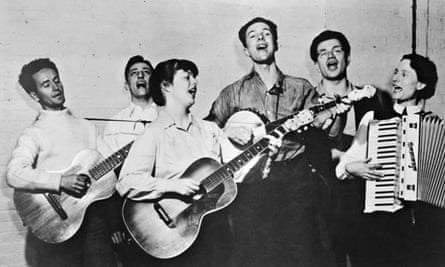
The Almanac Singers in the early 1940, including Pete Seeger (middle) and Woody Gurthrie
Where did the story begin? The day in 1936, perhaps, when the 17-year-old Seeger heard Bascom Lamar Lunsford, the
"Minstrel of the Appalachians", play the banjo at a festival of folk music in North Carolina and took up the instrument with such aptitude and devotion that his own subsequent book,
How to Play the 5-String Banjo, became and remains a standard text for students of the instrument. The son of a composer-violinist mother and a father who was an eminent musicologist, Seeger embarked on a lifelong mission to demonstrate that seemingly archaic forms could be absorbed and recycled by younger performers. They might never have picked a boll of cotton or worked in a turpentine camp or come any closer to a southern prison farm than the dean's office at an Ivy League college (Harvard, in his own case), yet they could achieve a degree of transformative empathy with those who had direct experience of such things.
Or maybe it was when, in 1940, he was introduced to Woody Guthrie by the great musicologist
Alan Lomax, a friend of his father and for whom he was working as an assistant at the Library of Congress, putting his enthusiasm to good use by sorting through and untangling various forms of American vernacular music. Guthrie and Seeger would come to represent different poles of the same world: one a self-mythologising drifter with an outsider's wild charisma, the other a steadfast, reassuring figure amid turbulent times.
A year later, Seeger joined the Almanac Singers, whose repertoire expressed their identification with the struggle of labour unions; within a further 12 months he had become a card-carrying member of the American Communist party. Soon he would be helping to found
the People's Songs organisation, with the aim of spreading the gospel of songs dealing with the lives of real people in the real America, the miners and mill workers and sharecroppers on southern plantations, a world away from the sophisticated classes celebrated in the songs of Broadway and Tin Pan Alley.
He accomplished that with the Weavers, the group he formed in 1950, and who would establish a template for the folk revival of that decade and its transmutation in the early 1960s. Despite maintaining the focus on songs of social relevance, they often wore formal dress in concert and their recordings were lavishly orchestrated by the Broadway arranger Gordon Jenkins. Their hits included Lead Belly's
Goodnight, Irene, the Israel folk song
Tzena, Tzena Tzena and
Kisses Sweeter Than Wine: hardly the anthems of a coming revolution, but in 1952, at the height of the anti-communist witch hunt, their known sympathies got them blacklisted by radio and TV stations and concert promoters. Seeger's refusal to divulge his political beliefs in front of the House Un-American Activities committee that year exposed him to the kind of ordeal unimaginable to any popular singer today, its last echo probably coming in the vendetta waged against John Lennon, an opponent of the Vietnam war and other US-sponsored conflicts, by J Edgar Hoover's FBI.
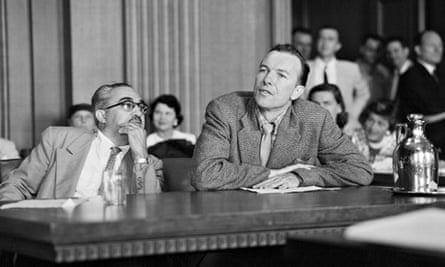
Pete Seeger at the House Un-American Activites committee in 1952.
At a time when the word of the gathering folk revival was spread by magazines, Seeger wrote a column for the influential Sing Out! and co-founded Broadside, which published Dylan's songs. With his own compositions, including
If I Had a Hammer and
Where Have All the Flowers Gone, he and his co-authors gave younger folkies – the Kingston Trio, Trini Lopez, Peter, Paul and Mary and their legions of imitators around the world, at first clean-cut but gradually more picturesquely dishevelled – the cornerstones of a basic repertoire, soon to be augmented by the Dylan songbook. An idea of his standing among his contemporaries at that time could be gauged from Johnny Cash's words when introducing Dylan to the audience at the 1964 Newport Folk Festival: "We think he's the best songwriter of the age since Pete Seeger."
In the eyes of some members of later generations, Seeger assumed the role of a politely tolerated uncle who would seldom be asked about his heroic deeds in past wars. He can be seen in that role in Murray Lerner's film of Dylan at Newport, an event which Seeger co-founded and on whose board he served. In 1963
Seeger is standing discreetly behind Dylan and alongside Joan Baez, the Freedom Singers and Peter, Paul and Mary during the festival's finale, singing Blowin' in the Wind.
A year later he is sitting to one side of Dylan, listening intently and tapping his foot to Mr Tambourine Man, his thoughts only to be imagined as the singer's new visions unfold – "Then take me disappearing through the smoke rings of my mind/ Down the foggy ruins of time" – with no reference to iron-ore miners or civil-rights marchers. In 1965, Seeger is not seen but we know he is behind the scenes, arguing with the sound crew as Dylan's new electric band blasts out Maggie's Farm and Like a Rolling Stone. In the first and most enduring version of the story, Seeger attempted to take a fire-axe to the electric cabling in order to cut the amplification. Thereby, the tale implies, he would restore the music to its prelapsarian state of acoustic purity.
As a foundation stone of that particular hall of the many-mansioned Dylan legend, the incident ranks second only to the enraged fan's cry of "Judas!" at Manchester's Free Trade Hall the following year. But Seeger's own version, told in
No Direction Home, Martin Scorsese's Dylan documentary, was slightly different. "I was the MC that night," he said. "He was singing Maggie's Farm and you couldn't understand a word because the microphone was distorting his voice. I ran to the mixing desk and said: 'Fix the sound, it's terrible!' The guy said: 'No, this is what the young people want.' And I did say that if I had an axe I'd cut the cable. But I wanted to hear the words. I didn't mind him going electric."
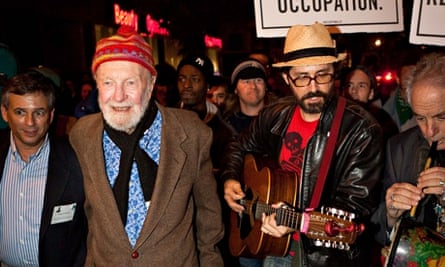
Seeger, aged 92, marching with demonstrators in support of the Occupy Wall Street protests in New York in 2011.
Powerfully affected by the widespread publicity given to the incident, Seeger resigned from the festival board, retreated from music for a while and turned his attention to the environment. Once again he was setting a trend followed by younger performers, such as Jackson Browne, Graham Nash, Bonnie Raitt and their fellow members of Muse – Musicians United for Safe Energy – featured in the No Nukes concert at Madison Square Garden in 1979.
As Lauren Laverne, the BBC6 Music DJ, succinctly put it, it was Seeger's destiny to be "loved and hated by precisely the right people". He was on the side of working people, refugees from fascist regimes, nuclear disarmament and the earth's threatened natural resources, and against segregationists, Stalinists and the military-industrial complex. Nor, despite advancing age, did he cease from mental fight.
He and Springsteen sang Guthrie's This Land is Your Land together at Barack Obama's inauguration in 2009, and four years later, aged 92, he recorded Dylan's
Forever Young with the Rivertown Choir, a group of deprived kids he had been mentoring for the previous five years. And when thousands of
Norwegians gathered in Oslo in 2012 to mourn the victims of the mass murder on Utoya island, they sang
My Rainbow Race which he had written in 1972, when his country was engaged in criminally murderous activity in south-east Asia: "Some want to take the easy way/ Poison, bombs – they think we need 'em/ Don't they know you can't kill all the unbelievers/ There's no short cut to freedom".
Pete Seeger took the long road, a road that never ends, and which he lit so that others might find their own way along a righteous path.
.jfif)