Mostrar mensagens com a etiqueta Manipulação Climática. Mostrar todas as mensagens
Mostrar mensagens com a etiqueta Manipulação Climática. Mostrar todas as mensagens
sexta-feira, 10 de julho de 2026
Desinformação climática evolui: da inteligência artificial ao 'greenlash'

domingo, 5 de julho de 2026
Europe to redefine oil as “sustainable”

The Council's Sustainable Finance Disclosure Regulation (SFDR) revision drops the exclusion that kept fossil fuel expansion out of Europe's transition funds. The decision landed in the middle of the continent's most severe heatwave on record.
In the same week that France logged its hottest day since national records began in 1947, the European Union moved to loosen what the word “sustainable” is allowed to mean on a fund label.
The two events were not connected by design. They were connected by date. On June 24, as a heatwave that the World Weather Attribution group of scientists described as the most severe ever recorded in the region gripped Western Europe, the Council of the European Union adopted its negotiating position on a revision of the SFDR, the EU's rulebook for sustainable financial products. The same group of scientists concluded that June heat of this intensity would have been virtually impossible fifty years ago without human-caused warming. By the end of that week, the World Health Organization's director-general said more than 1,300 excess deaths had been recorded across Europe since June 21.
That was the backdrop against which Europe decided to make room for oil in its sustainable investment rules.
The Council removed the one line that kept oil expansion out of sustainable funds
SFDR was built in 2021 to do two things: steer capital toward the low-carbon transition, and make greenwashing harder. The current revision, often called SFDR 2.0, sorts products into three new categories: sustainable, transition, and ESG basics.
The European Commission's own proposal would have excluded companies expanding their fossil fuel activities from the transition category altogether. The Council deleted that exclusion. In its place, a company opening new oil and gas fields can still qualify for a transition label, provided that around 20% of its capital expenditure is aligned with the EU taxonomy of green activities, and that it adopts a time-bound plan to reduce its operational emissions.
Consider a company that pours the bulk of its capital into expanding oil production and a fifth into wind and solar. Under the Council's proposal, it could still carry a transition label. That label is not cosmetic. Transition and sustainable funds shape how pension funds, insurers, and asset managers allocate trillions of euros, so what the word certifies is not a technicality.
A 20% test on the wrong emissions cannot capture an oil company's real footprint
Here is the detail the headline number hides. The requirement to cut emissions covers a company's Scope 1 and Scope 2, the pollution from running its own operations. It does not touch Scope 3, the emissions released when customers burn the oil and gas the company sells. For a fossil fuel producer, Scope 3 is the overwhelming majority of the harm, by many estimates 80% to 95% of the total. The rule scores the small share and ignores the rest.
The scale of the mismatch is easy to miss. Global clean energy investment is on track to reach around $2.2 trillion in 2026, close to double the money flowing into fossil fuels, according to the International Energy Agency. Yet oil and gas companies account for less than 5% of that clean energy spending. A rule that rewards a 20% capex slice, while ignoring the product itself, measures the smallest part of the story.
A few billion invested in renewables does not cancel out billions spent locking in new fossil production for decades. One reduces future emissions; the other commits them. They are not equivalent, financially or scientifically.
The new definition mirrors the position of a company a court has already faulted
The Council did not invent these criteria in a vacuum. They closely resemble arguments long advanced by parts of the oil industry, which has pressed for a transition category broad enough to take in continued fossil production. TotalEnergies is the most visible example. Between January and June 2026, according to European Parliament transparency records, the company held around 35 meetings with members of the Parliament, several referencing SFDR directly, and its own strategy targets putting 20% of its portfolio into power and low-carbon energy by 2030, the same one-fifth threshold the Council settled on. That is not proof that one produced the other. It is a striking convergence between what an oil major asked for and what member states agreed.
There is a sharper irony in the timing. In October 2025, the Paris Judicial Tribunal found that TotalEnergies had misled consumers with claims about its ambition to reach carbon neutrality by 2050, made while it continued to expand oil and gas production, and ordered the offending statements removed. The company said it would not appeal, and the judgment became final. Less than a year later, the Council is proposing a definition of transition that would let a company doing what the court described, expanding fossil fuels while investing a minority share in cleaner energy, carry a transition label across Europe.
The court's reasoning lands on the same point the fund rule misses. What made the claim misleading was the gap between a transition image and continued fossil expansion. The Council's 20% test widens that gap and stamps it as compliant.
I put these questions to TotalEnergies before publication of this article. In response, a company spokesperson said:
“TotalEnergies' position on the SFDR is well known and has been publicly expressed by the Company in its response to the European Commission's consultation dated 6 April 2026. It is available on the European Commission's website.”
On the court ruling, the spokesperson referred me to a company clarification.
In that clarification, TotalEnergies stresses that the tribunal dismissed most of the claims against it, that the decision concerned three paragraphs about its carbon-neutrality ambition on a French affiliate's customer website rather than its advertising, and that no advertising by its French affiliates was condemned. The company rejects the charge of greenwashing and sets out its record at length: more than €20 billion invested in low-carbon energy worldwide since 2020, €4 billion of it in France; 32 gigawatts of installed renewable capacity producing 50 terawatt-hours of electricity in 2025, up from close to zero in 2020; selection to build France's largest ever renewables project, a €4.5 billion offshore wind farm; and cuts of 36% in emissions from its operated oil and gas facilities between 2015 and 2024, and 55% in methane between 2020 and 2024.
Those last figures, though, are reductions on the company's own operations, the Scope 1 and 2 the fund rule already counts, not on the far larger emissions released when the oil and gas it sells are burned.
The Council says fossil fuel companies still have a role to play
Asked about the greenwashing criticism, a Council spokesperson said companies active in the fossil fuel sector can still contribute to the transition, for example by developing low-carbon fuels or building electric vehicle charging infrastructure.
Campaigners see it differently. Reclaim Finance argued that governments had given in to lobbying from oil majors and opened the door to greenwashing of fossil fuel investment, framing the coming parliamentary vote as a choice between a fossil future and the wellbeing of European citizens.
A weaker label still has to point in the right direction
The Council's defenders make a real argument, and it deserves a fair hearing. The transition category was never meant to be the strictest tier. It exists to finance messy, real-world decarbonization rather than a handful of already-clean companies, and drawing the line too hard, they warn, would only push capital out of Europe into markets with weaker disclosure, or starve the hard-to-abate sectors that most need it.
The argument holds until you look at what the test actually rewards. A transition label, however lenient, has to certify one thing, that a company is moving away from fossil fuels. The Council's version does not require even that. A company can raise its oil output year after year and still qualify, as long as a fifth of its spending points elsewhere. That is not a permissive standard for transition. It is the absence of one, on the single variable that decides whether a transition is happening at all.
There is also a cleaner way to do the thing the rule claims to enable. An oil company that wants to raise money for a wind farm can already issue a green bond, where the proceeds are ring-fenced to that named project and reported on. The capital reaches the clean asset without the parent company's oil expansion borrowing the "sustainable" label. That is the honest instrument, and it exists. What the Council's change adds is not access to green finance but permission to badge the whole enterprise, oil growth included, as transition.
And the fear of capital fleeing Europe cuts the other way. A label that certifies expansion in order to keep money onshore has not kept the money honest. It has moved the greenwashing inside the rulebook.
The decision is not final, and that is where the leverage sits
The Council has agreed only its negotiating position. The European Parliament's economic affairs committee is due to vote on its amendments on July 15, with the full Parliament expected to adopt its position after the summer, before trilogue negotiations with the Council and the Commission later in the year. The direction can still change.
The exclusion the Council stripped out was the Commission’s own. Under the Commission’s proposal, companies expanding their fossil fuel activities are barred from the transition category outright. But the Commission is not a bystander here. It opened the SFDR up in the name of simplification, a drive to cut reporting burdens on the financial industry, and the Council followed that logic a step further. A revision the Commission sold as a remedy for greenwashing is turning into a license for it.
I asked the European Commission directly whether it stands by that exclusion and will defend it in the negotiations. Its full, on-the-record reply was this:
“The Commission remains fully committed to engaging constructively with the co-legislators to achieve a balanced and timely agreement on the proposal.”
A spokesperson also referred me to the Commission's published reasoning, which sets out the exclusion in its own text.
The response leaves the Commission's position open to interpretation. While it does not say the Commission has abandoned its original proposal, it also does not explicitly reaffirm that it will defend this particular safeguard during the negotiations. The stronger rule still exists on paper. Whether it survives the legislative process will depend on the negotiations ahead, and particularly on the outcome in the European Parliament.
The problem was never the oil. It is the label.
Here the argument is easily misread, so it is worth stating plainly. The world will keep burning oil for years while it builds the alternatives. Reasonable people can debate whether Europe is better off pumping some of its own rather than importing every barrel, and amid a run of Middle East supply shocks, that energy-security case is not frivolous. But it is a different question from the one the Council has answered.
Nobody has to call a new oil field clean in order to keep the lights on. Oil can be produced, taxed, regulated, and wound down on a schedule, without being sold to a saver as a contribution to the energy transition. The decision in front of Europe is not whether the oil comes out of the ground. It is whether pulling it out counts as sustainable investment. That is the smaller question, and the far more dangerous one.
If oil is green, nothing is
A sustainable label is not a badge of virtue. It is a piece of information. Markets run on information. A pension fund, an insurer, or a saver moving money into a green product cannot audit a company's drilling plans. They trust the label to tell them what their capital is doing. Europe's sustainably labeled fund market, worth around €10 trillion, exists because that one word is assumed to mean something specific.
Stretch the word to cover a company opening new oil fields, and it stops carrying information. If the same label sits on a wind developer and on an oil major with a 20% side project, it no longer tells them apart. The investor who wanted the real thing can no longer find it. And the company doing the genuine, expensive work of transition loses the one advantage the label was meant to confer, cheaper capital and patient shareholders who believe the plan. Economists have a plain description for markets where buyers cannot separate quality from imitation. The honest product gets crowded out, and in time nobody pays a premium for the label at all.
The damage does not stop at oil. Once extraction qualifies as transition on a one-fifth capex test, every hard-to-abate sector arrives with the same claim, coal with a capture pilot, an airline with a fuel pledge, until the category describes almost everyone, which is another way of saying it describes no one. If oil extraction is green, the honest answer to what is not green becomes very little.
The timing sharpens the risk. Sustainable investing is already on the back foot, worn down by years of greenwashing scandals, funds quietly stripped of their green labels, and a political backlash that treats ESG as an insult. The SFDR move is not an isolated event. In the same days, under pressure from the Trump administration, the World Bank retired its headline target to steer 45% of lending toward projects with climate benefits, and the International Monetary Fund’s own watchdog reported a fading focus on climate, even as the underlying programs survived. That survival was not a gift: at the World Bank, a coalition of nearly 100 countries held the line and forced the plan to continue over Washington's objection, a reminder that the pressure runs both ways. Trust in the category is the scarce resource, and the SFDR revision was written to rebuild it with clearer and stricter definitions. On this one provision, it would do the reverse. It would take the reform meant to restore the meaning of sustainable finance and spend it dissolving the meaning of the word at its center.
Europe does not have to choose between energy security and climate credibility. It can pursue both. What it cannot do is tell investors that new oil production is sustainable without changing the meaning of the word itself. The July vote decides more than the fate of one regulation. It decides whether a green label still carries information an investor can trust, and with it the integrity of the market built on that single word.
quarta-feira, 1 de julho de 2026
O milagre dos eucaliptos de Melres
.png)
Por Ricardo Meireles
A 28 de Junho, o jornal Nascer do Sol publicou uma peça com um título que vale por si: “Eucaliptos resistem onde ardeu tudo”. O ponto de partida é real. Dois povoamentos de eucalipto ficaram intactos no meio de um incêndio que, em 2024, queimou cerca de quatro mil hectares em Penafiel, Paredes e Gondomar. Quem sobe ao miradouro de Melres vê hoje duas ilhas verdes numa encosta carbonizada. A imagem é forte e a pergunta que ela levanta é legítima. A resposta que o jornal lhe dá é que o problema do fogo está na gestão e não na espécie, e o título dá um salto que o resto do texto não sustenta.
A rubrica #areiaparaosolhos existe também para separar as frases que seduzem daquilo que as frases escondem. Vamos por partes.
O que o título promete e o que o próprio texto admite
O título diz “eucaliptos resistem”. Sugere que a espécie tem uma qualidade de resistência ao fogo. A explicação que o jornal apresenta aponta para o contrário. Segundo a peça jornalística, aquele povoamento aguentou porque foi plantado em terraços, porque as máquinas conseguem entrar para controlar a vegetação, e porque beneficiou de preparação do terreno e de redução de combustível. Por outras palavras, o que ali resistiu foi um regime de gestão intensiva, assente no uso de petróleo como energia barata, com solo trabalhado e biomassa retirada à mão e à máquina.
A própria peça responde, portanto, ao seu título. Aquelas árvores não pararam o fogo por serem eucaliptos. Pararam o fogo apesar de o serem, graças a um esforço de limpeza que removeu quase tudo o que era inflamável à volta delas. Atribuir esse mérito à espécie é o primeiro grão de areia para os olhos de quem lê. O mérito é do trabalho, e o trabalho foi feito precisamente porque o eucalipto, sozinho e em quantidade, arde com violência.
A frase que viaja sem o seu contexto
O artigo cita um investigador da Universidade de Lisboa para sustentar a ideia de que a espécie não é o problema e que o que conta é a quantidade de biomassa disponível para as chamas. A frase é defensável em termos estritos de comportamento do fogo. A carga de combustível pesa, e muito, na forma como um incêndio se propaga. O investigador é uma fonte independente e o reparo que aqui se faz não é sobre ele. É sobre o uso que o artigo faz das suas palavras.
A frase chega ao leitor decapada do contexto. “A espécie não é o problema” é verdade quando se fala apenas de física da combustão num talhão específico. Deixa de ser verdade quando se usa essa meia-ideia para ilibar um modelo inteiro de ocupação do território. Já o escrevi noutro texto neste site: o que desertifica o solo não é a árvore em si, é o regime de monocultura em que é plantada e explorada. A reportagem do Nascer do Sol fica-se pela primeira metade dessa frase, a que tira o foco do eucalipto, e descarta a segunda, a que devolve o foco ao regime que o multiplica em talhões de idade igual, sem estratos, sem sombra e sem água retida no solo.
O que a montra esconde: água, solo, microclima
Ao fixar todo o problema na quantidade de combustível e na limpeza do chão, o artigo apaga a dimensão que mais importa quando se fala de paisagens que ardem. Uma floresta biodiversa e estratificada, com plantas a ocupar diferentes alturas, funciona como um condensador. A atividade fotossintética arrefece o ar à sua volta, atrai humidade da atmosfera, condensa-a e prende-a no primeiro palmo de terra. Esse solo húmido e sombreado abranda o fogo. Um eucaliptal em monocultura faz o oposto. Deixa o vento seco correr, aquece, evapora e prepara o terreno para arder.
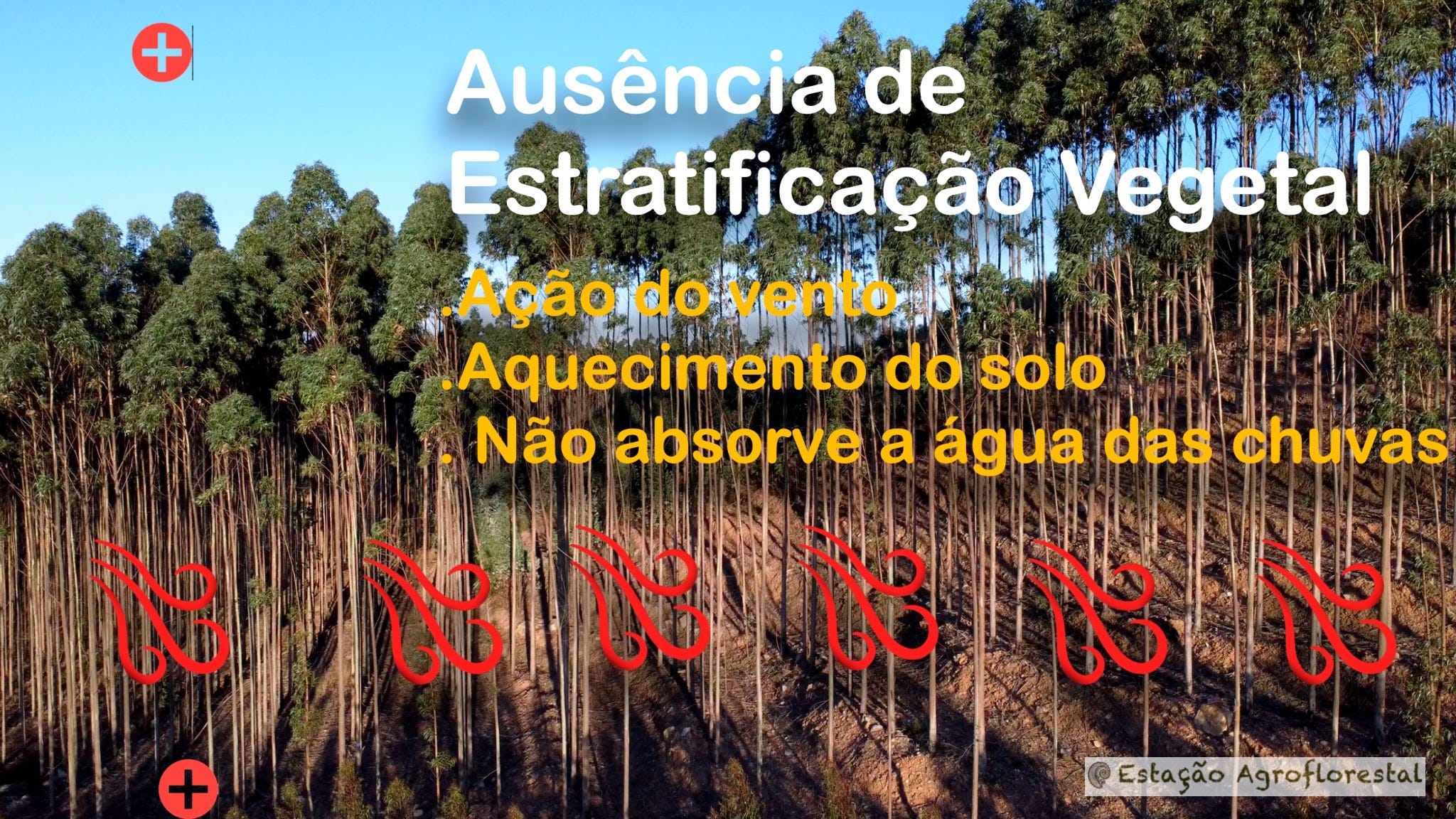

A ciência feita em Portugal já mediu estes factos. O investigador Joaquim Sande Silva ordenou, num estudo de 2009, as formações florestais por propensão para arder, e colocou o pinheiro-bravo e o eucalipto no topo, com o sobreiro, o castanheiro, a azinheira e o pinheiro-manso no fundo da lista. Vale a pena reter que o pinheiro-manso, também ele uma resinosa, fica entre os menos inflamáveis, sinal de que a etiqueta da espécie não decide tudo. Trabalho posterior da equipa de Jordi Garcia-Gonzalo, no mesmo Instituto Superior de Agronomia, mostrou que os povoamentos mistos e de folhosas reduzem o risco de fogo face ao pinheiro-bravo e ao eucalipto. O risco mora na monocultura densa e contínua de espécies inflamáveis, e a diversidade trabalha como corta-fogo.
E há uma razão económica para que estas espécies menos inflamáveis ocupem hoje tão pouco terreno. O carvalho, o castanheiro e o sobreiro são de crescimento lento, próprios das fases maduras da floresta, daquilo a que se chama o regime de abundância, e que podem levar décadas ou séculos a instalar-se. Esse tempo longo não serve o modelo da indústria da pasta de papel, que vive de cortar depressa e em grande quantidade. A própria Navigator descreve o eucalipto globulus como a espécie que está na origem dos seus papéis e valoriza-o justamente por ser de crescimento rápido, com ciclos de plantação e corte de cerca de doze anos, em povoamentos plantados exclusivamente para esse fim. Uma floresta que arde menos é, quase sempre, uma floresta que amadurece devagar, e uma floresta que amadurece devagar é tudo o que um modelo da indústria da celulose não pode permitir.
A “limpeza” que a reportagem celebra é, vista por este ângulo, parte do problema e não a solução. Um chão raspado até ao osso é um chão que perde água por evaporação, que regride na sucessão ecológica e que precisa de recomeçar do zero o trabalho de se cobrir. A peça apresenta o solo exposto como virtude. Em rigor, é a assinatura de um ecossistema mantido em estado de adolescência permanente, ao serviço da extracção, sempre pronto a recomeçar e nunca autorizado a amadurecer até à fase em que a paisagem se torna húmida e pouco inflamável.
A escala que falta à fotografia
A reportagem mostra dois talhões. O país tem outra dimensão. Portugal tem perto de oitocentos mil hectares de eucalipto e mais de um milhão de hectares de plantações industriais de espécies de crescimento rápido. As áreas onde o eucalipto não arde de forma explosiva são as parcelas bem geridas e protegidas pelas celuloses, uma minoria do total. A larga maioria, a que alimenta a indústria, é onde se exprimem as características mais combustíveis da espécie, a biomassa que se acumula depressa e o material incandescente que salta a quilómetros de distância e abre novas frentes.
Há ainda um problema de método na própria escolha do caso. Mostrar dois povoamentos que sobreviveram dentro de quatro mil hectares ardidos é seleccionar pelo resultado. Falta a pergunta que daria sentido ao número: quantos talhões de eucalipto, geridos ou não, arderam naquele mesmo incêndio? Sem essa conta, dois sobreviventes são uma anedota fotogénica e não uma prova.
Quem explica o “milagre”
A fonte que explica a resistência daqueles povoamentos é um engenheiro florestal da Navigator, a empresa proprietária dos eucaliptais. O perito que elogia a gestão dos talhões trabalha para a dona dos talhões. A reportagem apresenta-o entre especialistas, sem uma palavra sobre o conflito de interesse evidente. Não é preciso supor má-fé de ninguém para reconhecer o óbvio. Quem tem o ativo a defender não é uma fonte neutra sobre o valor ou risco desse ativo.
O desvio para os quatrocentos mil proprietários
No fim, a peça empurra a culpa. Diz que o problema da floresta portuguesa está nos mais de quatrocentos mil proprietários com parcelas minúsculas, sem escala para oferecerem rentabilidade. Repare o leitor neste movimento. Um problema de água, de solo e de modelo ecológico é convertido num problema de escala empresarial. E a solução implícita nesse diagnóstico é concentrar a terra em explorações grandes e geridas, ou seja, mais do mesmo modelo que produziu a paisagem inflamável e influenciou o clima seco. A pergunta que falta é simples. A floresta serve para dar rentabilidade a um sector que a quer tornar num chão de fábrica, ou serve para segurar água, sombra e comunidades? A reportagem responde à primeira e finge que é a única.
Veredito
O mais difícil de desmontar num texto destes não são as mentiras. São os factos verdadeiros postos ao serviço de uma conclusão falsa.
O facto de base é verdadeiro. Dois povoamentos de eucalipto sobreviveram ao incêndio em Melres, e sobreviveram por terem sido geridos, com terraços, acessos e remoção de combustível. Isso aconteceu e está correctamente descrito.
O título é falso. “Eucaliptos resistem onde ardeu tudo” generaliza dois talhões geridos para a espécie inteira e afirma quase o contrário do que a ciência e o próprio corpo do artigo dizem. O que resistiu foi a gestão do deserto verde.
A tese geral é descontextualizada. Constrói-se a partir de uma frase verdadeira retirada do seu contexto técnico, ilustra-se com um caso escolhido pelo resultado, sustenta-se numa fonte com interesse directo no assunto, e omite a água, o solo, a estratificação e a escala real do eucaliptal português. Cada peça, isolada, quase se defende. O conjunto conduz o leitor a uma conclusão que os factos não autorizam.
Por tudo isto esta notícia, tendo em conta a disposição dos factos e a falta de independência da fonte é Areia Para Os Olhos.
Relacionados:
domingo, 14 de junho de 2026
The most polluting FIFA world cup ever has begun!

As the Men's 2026 World Cup kicks off, FIFA continues to present itself as a champion of sustainability, "particularly in relation to climate-related aspects."
But the tournament itself tells a different story.
FIFA is one of the most powerful non-state organizations in the world. Football's global governing body has 211 member associations, more than the United Nations has member states, and oversees one of the most watched sporting events on the planet: the FIFA World Cup. Its financial power is enormous, and rapidly growing. During the 2023–2026 cycle FIFA expects approximately $13 billion in revenue, largely driven by the expanded 2026 World Cup. This is almost twice the revenue of the previous cycle.
Countries compete fiercely to host FIFA tournaments and often change laws, spending priorities, and security arrangements to meet FIFA requirements. Academic analyses of FIFA governance note that FIFA has substantial influence over host-country decision-making and negotiations.
Commitment vs reality
So from a climate and environmental perspective, how is FIFA using all this power? On its website, the organization says it is "committed to enabling sustainable development, particularly in relation to climate-related aspects."
Sounds promising. But how is this commitment playing out in reality?
Let’s look at some stats and research.
According to researchers at the University of Manchester, the 2026 World Cup could become the most polluting in the tournament's history. FIFA has expanded the competition to 48 teams and 104 matches, spread across 16 host cities in three countries spanning an entire continent.
Even before the knockout rounds, some supporters are being pushed into multi-thousand-kilometre itineraries by FIFA’s continent-wide format.
If you, for instance, want to follow Bosnia and Herzegovina in the group stage, the first game is in Toronto; the second in Los Angeles and the third in Seattle. A total distance of more than 5,000 km. Most of these trips will be done by air travel.
Extreme heat
Climate and health are interconnected, and the FIFA World Cup is no exception.
Researchers from Queen's University Belfast have warned that the 2026 World Cup could become one of the hottest ever staged. Their analysis found that 14 of the tournament's 16 venues exceed safety thresholds associated with extreme heat, flooding or heavy rainfall. The researchers warned that dangerous heat conditions could pose serious risks to players, officials and supporters.
The hotter conditions could also affect the individual game. Climate Central has just released an information hub where you can explore how heat could slow down player performance across all of the 2026 World Cup matches — and how climate change is increasing the odds of heat.
As an example, the Japan-Sweden game, to be played in Dallas Stadium on June 24, has a 98% change of performance-imparing heat.
The irony is difficult to ignore. Football's biggest event is helping drive the climate crisis while simultaneously becoming increasingly vulnerable to its consequences.
The host nation amplifies the contradiction. Since the return of the Trump administration, the United States has (again) withdrawn from the Paris Agreement and accelerated support for fossil fuel development while cutting climate research and support for renewable energy. The country hosting the world's largest sporting event is moving in the opposite direction of what climate scientists say is necessary to avoid the worst impacts of global warming.
An oily deal
FIFA's commercial partnerships raise even more questions. In 2024, FIFA signed a four-year partnership agreement with Saudi Aramco, one of the world's largest oil companies and among the biggest corporate contributors to greenhouse gas emissions. Just a few weeks before the agreement was signed, Saudi Aramco's CEO Amin Nasser said the current energy transition strategy is failing, and that the world should abandon ”the fantasy” of phasing out oil.
Research from Scientists for Global Responsibility (SGR) indicates that FIFA’s sponsorship deal with Aramco, the Saudi state-owned oil company, could induce an additional 30 million tonnes of CO2e in 2026 alone.
Climate campaigners condemned the deal as a clear example of sportswashing, arguing that football's global popularity is being used to improve the image of an industry at the heart of the climate crisis.
“FIFA has made elite men’s football the primary target of Petrostate sportswashing. This World Cup, with the ridiculous Trump Peace Prize and having Saudi Aramco, the world’s largest polluter, as its main sponsor, reaches new levels”, said Dr Oscar Berglund, Senior Lecturer in International Public and Social Policy at the University of Bristol, and one of the researchers behind the "Football and Climate Change" study.
And the relationship between FIFA and the fossil fuel industry is only set to deepen. The previous Men’s World Cup was held in Qatar, and in 2034, it will be hosted by Saudi Arabia, a country that has repeatedly been obstructing progress at the annual United Nations Climate conferences while continuing to expand oil production.
Taken together, these decisions paint a troubling picture. FIFA speaks the language of sustainability while embracing business models, sponsors and tournament formats that push emissions in the opposite direction.
In the long run, this will affect the sport as well. In a hotter world, extreme weather events will be more frequent, more fierce, and harder to predict.
In fact, this is evident already today.´
Pitches under water
Across Great Britain, an increasing number of matches are being cancelled because of extreme weather, particularly flooding. According to reporting by the BBC, clubs at all levels of the game are struggling to adapt to more frequent and severe weather events. And this is only the beginning. The UK's Met Office projects that, under a high-emissions scenario, winters could become up to 30% wetter by 2070.
Football is often described as the world's game and a uniting force. It has a unique ability to influence billions of people and billions of dollars. FIFA could use that influence to accelerate climate action, reduce emissions and distance itself from fossil fuel interests.
Instead, the organization is preparing to launch a tournament that may become a symbol of the opposite: a World Cup played in increasingly dangerous heat, sponsored by one of the world's largest oil companies, hosted across a continent in a format that researchers warn could be the most polluting ever.
The games are about to begin.
The climate bill will arrive later.
Saber mais
Subscrever:
Mensagens (Atom)