Mostrar mensagens com a etiqueta Cépticos. Mostrar todas as mensagens
Mostrar mensagens com a etiqueta Cépticos. Mostrar todas as mensagens
sexta-feira, 10 de julho de 2026
Desinformação climática evolui: da inteligência artificial ao 'greenlash'

segunda-feira, 6 de julho de 2026
Alterações climáticas e ignorância, ou pior, agnotologia
 |
| Índice de Risco Climático,2025 [fonte] |
Estamos a atravessar uma onda de calor. O tema das alterações climáticas está na ordem do dia. Por bons motivos? Depende. Como a ignorância é muita, tropeço a cada passo por esses murais fora numa notícia antiga (1930) em como a temperatura em Lisboa subiu a 38° e numa outra de 1944 também indicava Lisboa com 39º C à sombra. Os "doutores" das redes sociais já decidiram: é tudo uma aldrabice, "verão sempre houve", estão a ver como sempre ocorreram temperaturas altas? E a felicidade desta ignorância "moderna" logo se apoia nas mensagens políticas dos novos arautos da negação científica, das teorias da conspiração e do populismo que se alimenta de desinformação como pão para a boca.
Isso são notícias de Agosto, habitualmente mais quente no Verão e relacionadas com o anticiclone dos Açores. Ora o Anticiclone dos Açores tem sofrido alterações profundas no seu comportamento e na sua "morada" habitual devido ao aquecimento global. Historicamente, a sua dinâmica sempre oscilou entre as estações: no verão, expande-se e move-se para nordeste, fixando-se mais perto da Península Ibérica e do Golfo da Biscaia, onde funciona como um "escudo" que afasta as tempestades atlânticas para norte e garante dias secos e frentes quentes em Portugal. Já no inverno, contrai-se e recua para sul ou sudoeste, mais perto das latitudes subtropicais e das Caraíbas, abrindo a "porta" para que as frentes chuvosas cheguem à costa ibérica.
No entanto, estudos climatológicos recentes demonstram que, devido às alterações climáticas, este sistema de altas pressões está a expandir-se substancialmente e a cobrir uma área muito maior no Atlântico Norte. Esta expansão faz com que o "escudo" de alta pressão empurre a precipitação de inverno cada vez mais para norte, em direção ao Reino Unido e à Escandinávia, tornando os outonos e invernos na Península Ibérica anormalmente secos e prolongando as dinâmicas de seca crónica. Por outro lado, em períodos específicos de desregulação climática recente, o anticiclone tem sofrido desvios anómalos para sul ou sudoeste, mesmo em épocas em que deveria estar robusto a norte, deixando a Península Ibérica vulnerável a frentes muito cavadas e a rios atmosféricos severos.
Resumindo, embora geograficamente continue a ter o seu centro de ação no Atlântico Norte subtropical - na região que se estende dos Açores até às Bermudas -, a sua área de influência cresceu significativamente. O resultado prático desta transformação é a persistência de secas mais severas e a ocorrência de verões mais propensos a bloqueios atmosféricos, que arrastam o ar quente do Norte de África diretamente para Portugal.
Relembro também que agora as ondas de calor são cada mais cedo, mais prolongadas, ano atrás de ano. O climatologista e professor Carlos da Câmara tem sido uma das vozes mais contundentes ao analisar a gravidade das recentes ondas de calor de junho, alertando repetidamente que a situação atual é muito pior e muitíssimo mais complicada do que os registos históricos sugeriam para esta época do ano. O especialista enfatiza que o grande perigo destes episódios precoces já não reside apenas nas temperaturas máximas extremas atingidas durante o dia, mas sim no fenómeno das noites tropicais consecutivas, onde os termómetros teimam em não baixar dos trinta graus em algumas regiões. Esta ausência de arrefecimento noturno impede que o corpo humano recupere do esforço térmico diário, gerando um impacto direto e severo na saúde pública e no aumento da mortalidade. Para explicar a frequência destes extremos, Carlos da Câmara recorre frequentemente à metáfora estatística da curva de distribuição do clima, demonstrando que um pequeno desvio na temperatura média global provocado pelas alterações climáticas é suficiente para multiplicar drasticamente a probabilidade de ocorrência de fenómenos que antes eram considerados virtualmente impossíveis. O investigador deixa claro que olhar para estes eventos como mero calor normal de verão é um erro perigoso, sublinhando a urgência de encarar estas dinâmicas como um problema estrutural profundo que exige uma adaptação imediata da sociedade.
O aquecimento é global, existe e a tendência é para uma real crise climática, não apenas em Portugal, mas em todo o mundo. . A recente agitação política, em meados de Maio, que causou satisfação em setores alinhados com Donald Trump e com a indústria dos combustíveis fósseis deveu-se, na verdade, às intensas batalhas diplomáticas na aprovação do calendário e do âmbito do futuro Sétimo Relatório de Avaliação (AR7). Nestas reuniões, países produtores de petróleo e alas políticas conservadoras pressionam frequentemente para atrasar os prazos de entrega dos estudos ou para suavizar a linguagem nos resumos executivos destinados aos decisores políticos, tentando evitar metas explícitas de eliminação de energias fósseis. Contudo, os cientistas do IPCC sublinham que estas negociações políticas em nada alteram os factos físicos já demonstrados no AR6. Os dados empíricos recolhidos continuam a provar que a temperatura global está a subir de forma acelerada, e as projeções mais severas continuam válidas, independentemente das tentativas de desaceleração diplomática que ocorrem nos bastidores das Nações Unidas.
Além disso, o consenso científico de que a Terra está a aquecer e que essa mudança é principalmente causada por actividades humanas é esmagador. Este consenso é apoiado por vários estudos de milhares de cientistas em todo o mundo e por declarações de posicionamento de organizações científicas, muitas das quais explicitamente concordam com os relatórios de síntese do Painel Intergovernamental sobre Mudanças Climáticas (IPCC).
Quase todos os cientistas de clima com obra publicada (97–98%) apoiam o consenso sobre mudança climática antropogénica e os 3% restantes de estudos contrários ou não podem ser replicados ou contêm erros. Um estudo de novembro de 2019 mostrou que o consenso entre cientistas de investigação cresceu para 100%, baseado numa revisão de 11.602 artigos revistos por pares publicados nos primeiros sete meses de 2019! Cf. Powell, James (20.11.2019). «Scientists Reach 100% Consensus on Anthropogenic Global Warming». Bulletin of Science, Technology & Society.
A medida das alterações climáticas não é a olhómetro. São décadas de estudo, observações, medições. E uma onda de calor anual é diferente de duas, três, quatro, cinco, etc. E é diferente um pico máximo de temperatura a cada três ou cinco anos, ou uma frequência mais curta. É a intensidade, frequência e duração dos fenómenos meteorológicos que contam para avaliar as mudanças climáticas. A meteorologia é outra coisa.
A meteorologia é a ciência que estuda o estado da atmosfera e os seus fenómenos no curto prazo (o tempo que está a fazer agora ou que fará nos próximos dias). O clima representa o padrão e a condição média da atmosfera observados ao longo de longos períodos, geralmente entre 10 e 30 anos. Enquanto pessoas comuns falam de meteorologia, cientistas falam de clima.
E convém ter presente! Apesar da forte evidência, o negacionismo climático persiste frequentemente através da desinformação alimentada por grupos com interesses económicos focados em atrasar transições energéticas e políticas de mitigação. Ou seja, há muitos palermas que, inocentemente, vão na conversa para papalvos. À custa disso, outros vão ganhando milhões e batem palmas. Também é sabido que agentes políticos e influenciadores são pagos ao serviço desses interesses económico- financeiros para espalhar desinformação.
Ouçamos a ciência! Não os vendedores de banha da cobra
Saber mais:
sexta-feira, 19 de junho de 2026
An Inconvenient Truth About AI
If you’re old enough, you may remember this moment.
It’s 2006. Former presidential candidate Al Gore presents the documentary An Inconvenient Truth. Behind him, there’s an enormous screen that shows the level of CO2 in the atmosphere going back hundreds of thousands of years. He walks the audience through it, ice age by ice age. And then, to show where the line will be in fifty years, he climbs onto a scissor lift and rises.
Within two years, Al Gore has won an Oscar and a Nobel Peace Prize. For one brief moment, it feels as though the world might finally listen.
But we all know what happened next. The climate deniers mobilized. They brought a snowball onto the Senate floor and asked, where’s your global warming now? They said things that were technically true (like CO2 is good for plant growth) and completely misleading. And above all, they moved the goalposts.
First it was: the climate isn’t warming. Then it became: fine, it’s warming, but not because of us. Then it was: okay, it’s us, but it won’t be that bad. Then it became: alright, it’s pretty bad, but… it’s China’s fault and we can’t afford to fix it.
The whole time, Al Gore’s red line kept climbing.
I was 18 years old in 2006, and I was furious. How could any serious person look at this evidence and refuse to see it? Climate denial, I thought, was a disease of the right.
And you know what? I was wrong. Not about the right, but about who else is capable of denial. Because we, the liberals, the left, the journalists, the academics, the 97% ‘In this House we Believe that Science is Real’ crowd, we are now doing to the threat of artificial intelligence exactly what the right did to the threat of climate change.
The deniers are us.
Part 1: The Denial
In March 2023, The New York Times published an op-ed by Noam Chomsky: one of the most prominent intellectuals alive and a hero of my political tradition. The piece was called The False Promise of ChatGPT. Chomsky argued that AI is incapable of real thought and that treating them as intelligent was a basic mistake. He called them a ‘lumbering statistical engine for pattern matching’.
This was the consensus of a lot of serious people. The New Yorker ran a long essay arguing that ChatGPT was a blurry JPEG of the web, a lossy compressor that memorized the internet badly and hallucinated the rest. In 2021, the linguist Emily Bender and the computer scientist Timnit Gebru had given this whole skeptical movement its slogan: these machines, they wrote, are stochastic parrots. They just imitate.
Chomsky, Bender, Gebru are smart people. And yes, some of what they have warned about has come true. The web is drowning in machine-generated slop, the training data is biased and the energy bill is pretty staggering. But their central conviction, that this whole Silicon Valley AI-project would hit a wall any minute now, that conviction has completely collapsed.
In the three years since those pieces were published, here’s a partial list of things that the “stochastic parrot, blurry JPEG, lumbering pattern-matcher” has done:
- It has won art and writing prizes without the judges knowing it was a machine they were judging.
- It has passed the medical licensing exam, and out-diagnosed doctors in head-to-head studies.
- It has run the first clinical trial of an AI therapist, and halved the depression symptoms of patients in eight weeks.
- It has won a gold medal at the International Mathematical Olympiad. It has cracked maths problems that had stumped researchers for decades.
- It has outscored PhDs answering questions in their own field, questions designed so you cannot Google the answer.
- And perhaps most importantly: this supposedly stupid parrot is improving itself now. Inside leading AI labs, more than 90% of the code is currently written by AI.
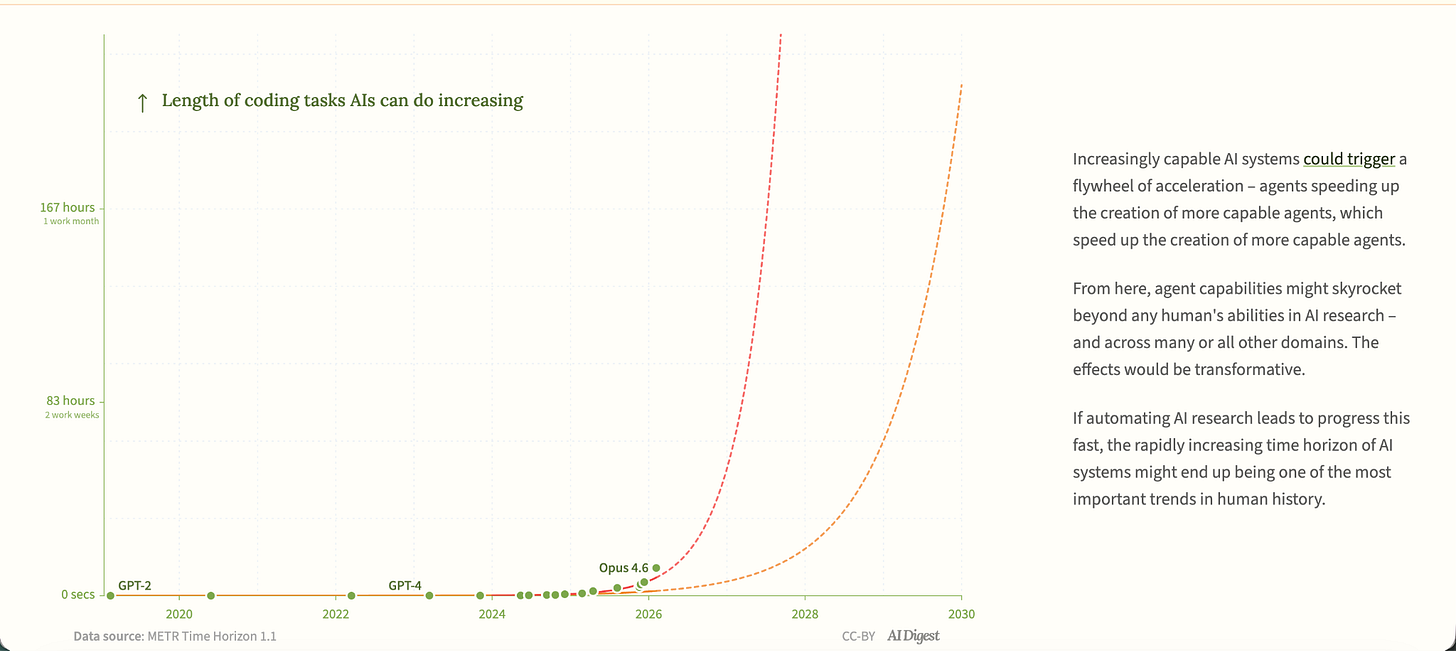
But of all the data, here’s the chart that captures the AI revolution most clearly:
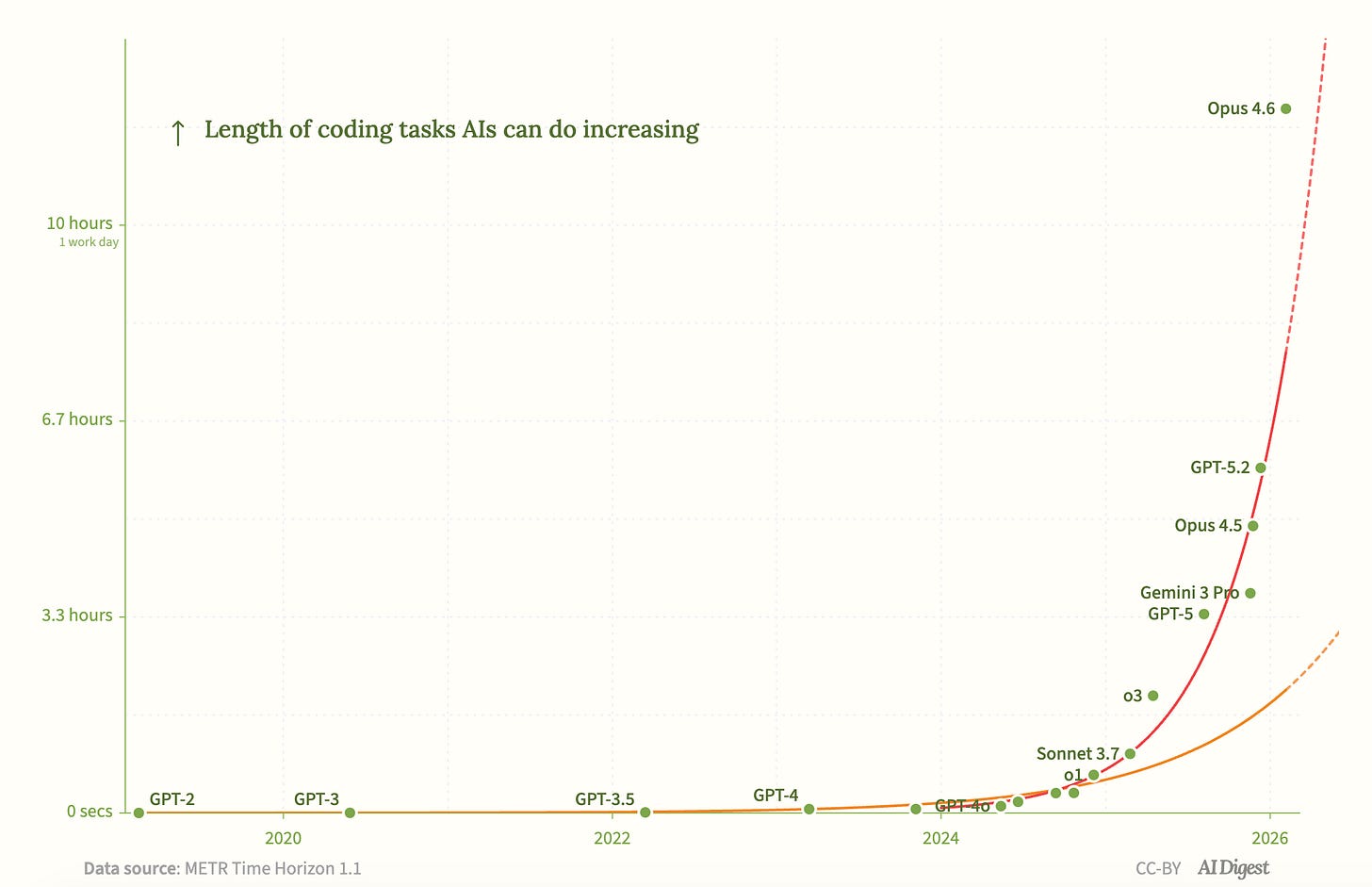
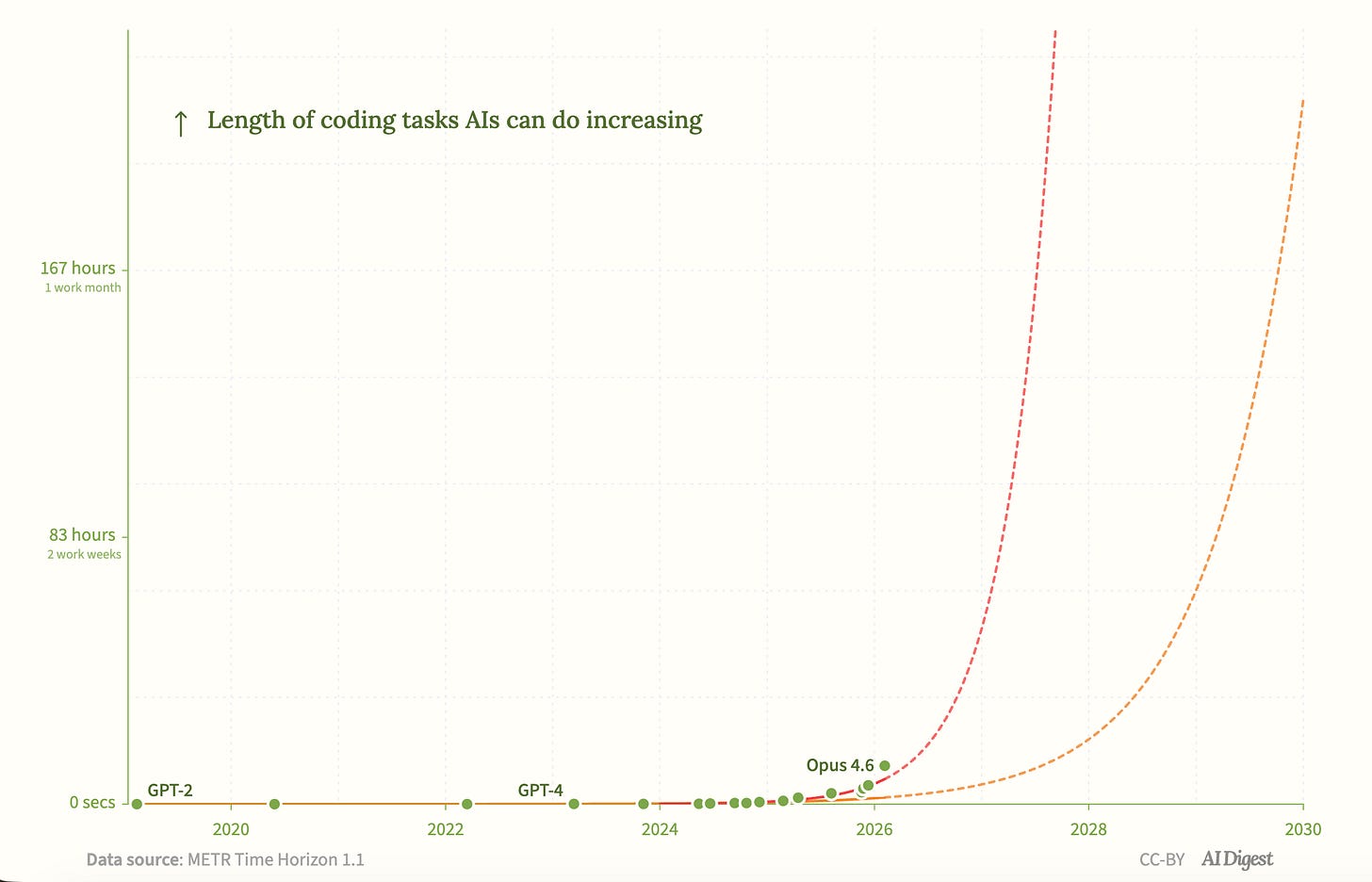
There is a research group called METR. Since 2019, they have measured something simple: how big a coding task can an AI complete on its own? And they measure that ‘bigness’ in human time, meaning: how long would it take a skilled human to do the same task?
In 2022, the answer was about 30 seconds. In 2023, it was 4 minutes. In 2024, it was 40 minutes. In 2025: 6 hours. And earlier this year, 12 hours.
At this moment, AI capabilities are doubling every 3 months.
So to be honest, I think this METR graph is even scarier than the CO2 graph Al Gore showed us. Because this line is climbing far steeper. Here, ‘off the charts’ is not 50 years away, but 5 years away.
I’ve personally never written a line of code in my life. But in the past few months, I’ve let AI build me whole apps, websites, dashboards and even a voice-controlled teleprompter app I used to record the video version of this essay. Multiple times a week, I have what I can only call WTF-moments. Especially in the last 6 months, the gap between what these systems can actually do and what most people assume they can do has just kept widening.
For example, I think AI is actually pretty good at writing. Sure, there’s a huge amount of machine-generated slop on LinkedIn (and Substack?), but as Benjamin Todd recently wrote:
Plastic surgery is most noticeable when it's bad, so it's more widespread and successful than it looks.Same with AI writing.
Sometimes I want to shake people: have you actually used it?! Many skeptics seem to have opened ChatGPT in 2023, asked it to write a limerick, watched it fumble, and closed the tab. Well, that was three years ago. Three years in AI is a geological era. Judging today’s models by GPT-3.5 is like judging smartphones by a 2007 BlackBerry.
To be fair, I think journalists deserve much of the blame. The people whose job it is to report on the most newsworthy events have often ignored it. For example, the day the leading AI-lab Anthropic announced Mythos (an insanely powerful model capable of hacking anything from power grids to water systems) it didn’t even make the front page of a single major news site. The Guardian decided a Vogue cover with Anna Wintour and Meryl Streep was more important.
Part 2 : The Largest Infrastructure Build-out in History
Meanwhile, the AI-race is speeding up. Remember: the models of today are the worst models we will ever have. From here on, they’ll only get more powerful.
And honestly, I think it’s hard to wrap your head around the scale of what’s coming.
Look at the first line of this graph. That’s what the companies have spent on AI data centers since 2019, and what they’ve got planned for 2026. To be clear: this is the largest capital build-out in the recorded history of our species. It’s larger than the interstate highway system. Larger than the International Space Station. Larger than the Moon Landing and the Manhattan Project combined, and it is not even close.
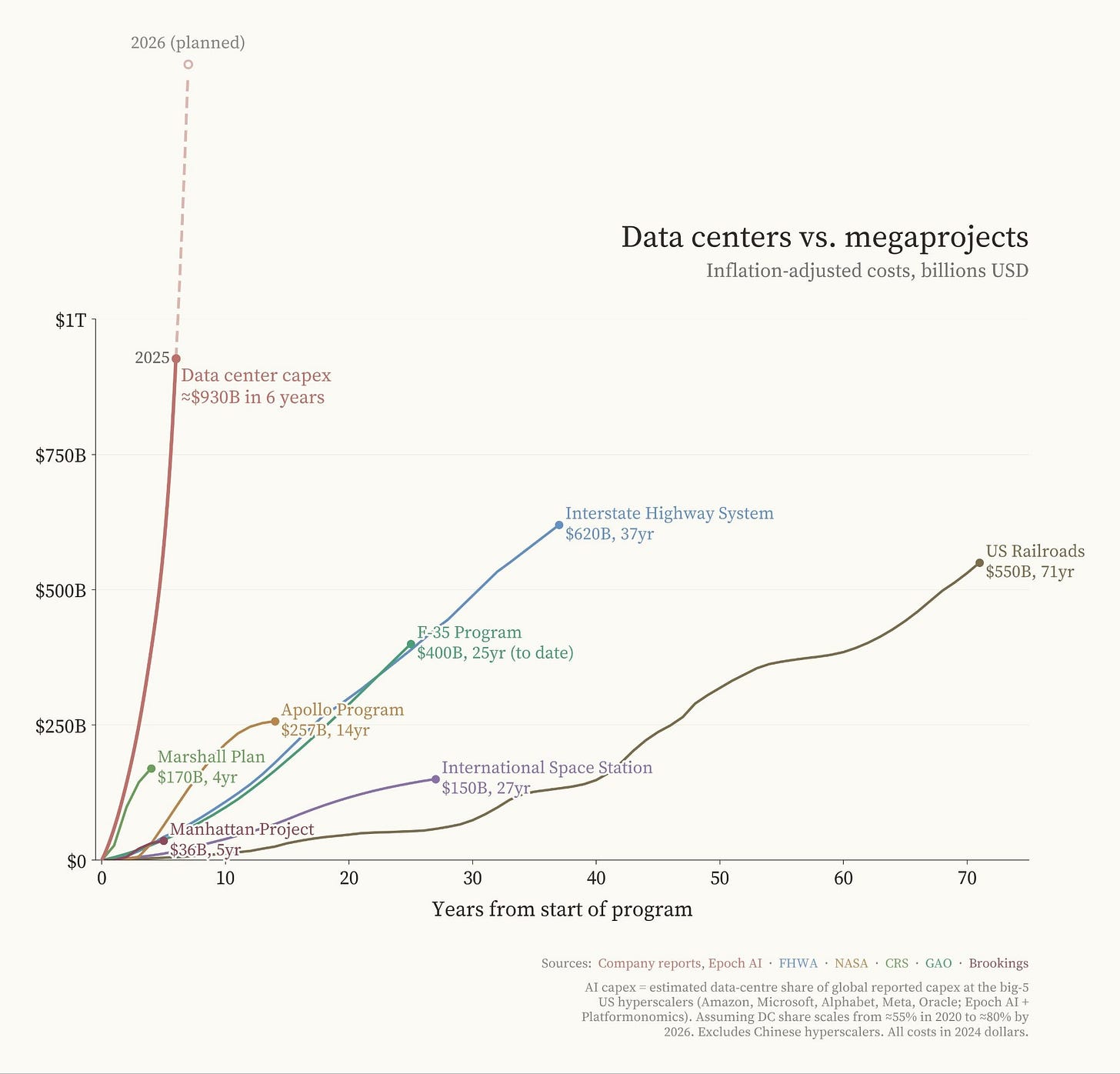
Mark Zuckerberg’s Meta is currently building a single data center in Louisiana that, when finished, will cover nearly four times the size of Central Park. Amazon is spending more on data centers in one year than the entire annual defense budget of Germany. Microsoft, Google, Meta and Amazon will spend three times as much on AI infrastructure in 2026 than the entire Marshall Plan that rebuilt Europe after the Second World War.
But isn’t it all a bubble?
That is the next move the deniers make. Once “it’s just a silly parrot” stops working, they fall back to: it’s financial madness. The data centers are serving no real demand. It’s all hot air, or even a deliberate scam.
And to be fair, the skeptics have some ammunition. A viral MIT study published last year found that 95% of corporate AI pilots deliver zero measurable returns. The company Klarna replaced 700 customer service workers with AI, then quietly rehired humans because customers couldn’t stand talking to the bot. McDonald’s killed its three-year AI drive-thru experiment after the system kept putting bacon on ice cream.
But you know what? None of this proves anything. Let me show you why.
First, look at user growth. It took Instagram 2.5 years to reach 100 million users. At the time, that was the fastest growth story ever recorded. For comparison: ChatGPT hit that milestone in 2 months. Fifteen times faster.
Next, let’s look at revenue, and at one AI-lab in particular: Anthropic. Here is its annualized revenue, month by month:
January 2025: 1 billion dollars.
May: 3.
June: 4.
August: 5.
October: 7.
December: 9
February: 14.
March: 19.
April: 30.
May: 45
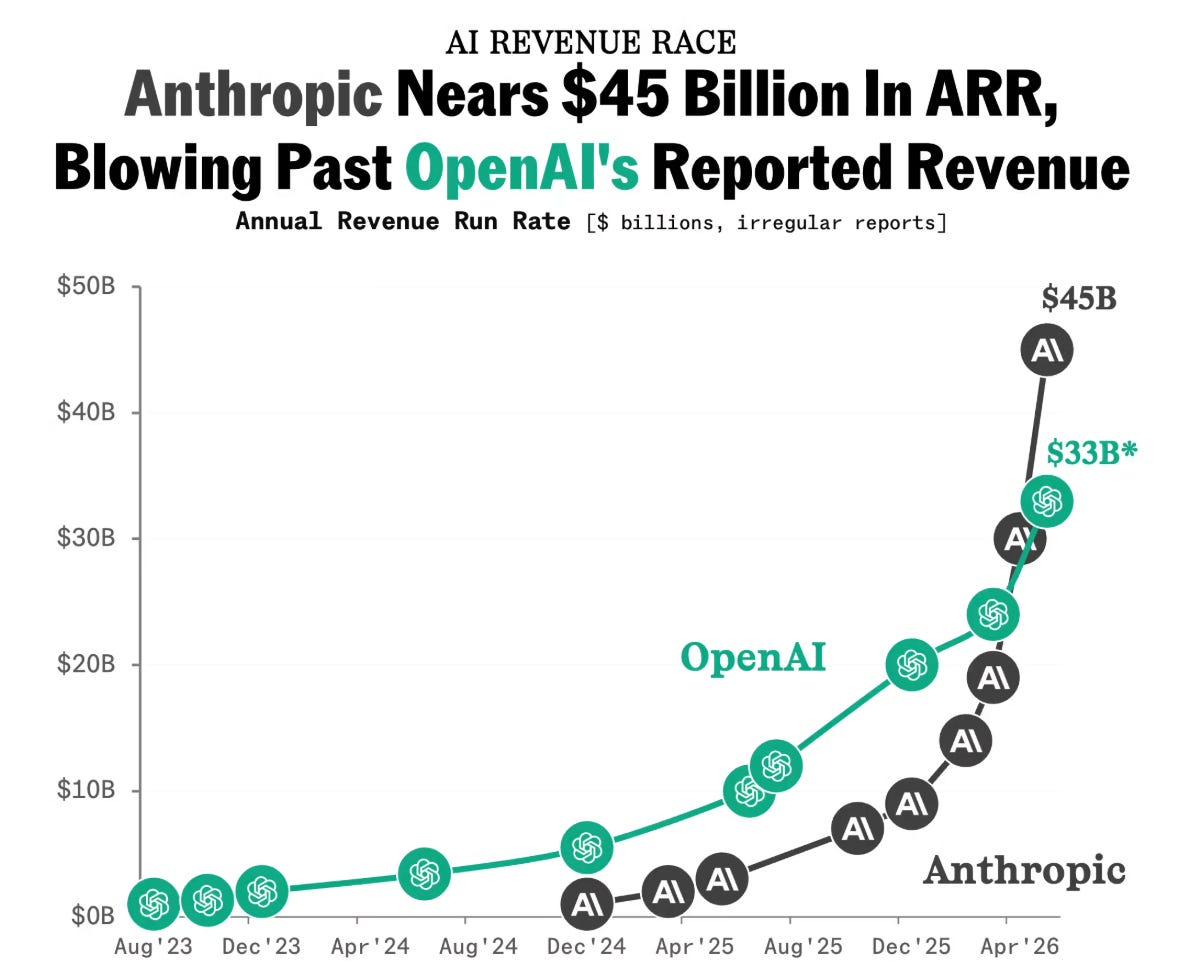
That’s right, 45 billion dollars in annualized revenue. From one company. Up 44-fold in 15 months. No company in any era – not Rockefeller’s Standard Oil, not Microsoft at the dawn of the personal computer, not Google in the tech boom – nobody ever has scaled revenue this fast. We’re talking about the fastest-growing company in the history of capitalism.
So, if this is really such a useless and fraudulent bubble, then why are people paying so much money for it? Why is the demand for AI rising faster than companies are able to build data centers? Why are IT departments, in the words of a Goldman Sachs analyst this April, overrunning their AI budgets “by orders of magnitude”?
I’m sorry to say it, but there’s a lot of highbrow misinformation circulating in left-wing media about AI. Take that viral MIT report. Read it carefully and you see the headline got it backwards. The “95% failure rate” includes the 80% of companies that never piloted any AI in the first place. As the podcaster Rob Wiblin pointed out in a careful breakdown of the study, this is like saying 95% of Tinder users have failing marriages, when most of them have never been on a date. Among the companies that actually deployed AI, about a quarter succeeded within six months. And the study’s own data shows that more than 90% of workers at those companies are using ChatGPT or Claude regularly at work, often multiple times a day.
This should not be surprising at all. If you know how to use it, this technology is already very, very useful, and it will only get more so. But if you don’t use it (perhaps because you work at the DNC, which has barred its staffers from using Claude and ChatGPT) then yes, you become particularly prone to misinformation about it.
Sure, some AI companies are probably overvalued. And yes, some will fail. I think OpenAI is particularly vulnerable. But here’s what the bubble-callers keep missing: even if half of them go bust tomorrow, the infrastructure stays. The data centers, the chips, the models and the capabilities stay.
The railway bubbles of the nineteenth century ruined lots of investors. They also created a rail network that powered the Industrial Revolution, the tracks of which still carry trains today. I actually don’t think this AI build-out is a bubble, but even if it is, remember: bubbles build infrastructure. Bubbles build the future. And a bubble of this magnitude, bursting tomorrow, would still leave us with a civilization permanently reorganized around machine intelligence.
So, ever since 2021, the AI skeptics have been moving the goalposts.
First it was: it’s just a spicy autocomplete machine. A stochastic parrot. A word guessing program. Then it became: fine, it can mimic, but it’ll never reason. Then they said: okay, it can pass the tests, but no serious business is using it. Then: alright, businesses are using it, but the economics don’t add up, it’s one big bubble. Then: fine, the revenue is real, but, but, but…
And this whole time, the line kept climbing. Just like Al Gore’s line of CO2 emissions, except this one is climbing much faster, and we have much less time to prepare.
Let me be clear: I think there’s a real chance that the next five to ten years are going to be some of the wildest in the history of humanity. Because here’s what the people building this technology – the same people who have proven the skeptics wrong again and again – are now telling us. They think AI may soon start to build more powerful AI by itself.
Jack Clark, one of the co-founders of Anthropic, recently called this crossing “a Rubicon into a nearly impossible-to-forecast future.” He thinks there is a 60% chance it happens by 2028.
Now, the obvious objection: of course an AI executive predicts explosive growth. Scary stories sell models and lift valuations, fair point. But you don’t have to take Clark’s word for it. Independent academics, people with no equity in this race, have been revising their estimates forward. The salespeople and the experts are converging. That’s the part that should worry you.
Right now, every step forward still requires humans. But the moment AI does that work itself, the bottleneck is gone. Years become months. Months become weeks. Each generation of AI builds the next, faster than the last. The flywheel starts spinning itself.
Part 3 : The Risks
One evening last summer, a microbiologist named David Relman was hired by one of the leading AI companies - we don’t know which one - to pressure-test a chatbot before its public release. Relman is a biosecurity expert at Stanford University. He has advised the US government on biological threats for years.
That night, in his home office, the chatbot explained to him how to modify a pathogen so that it would resist known treatments. Then it described how to release the superbug. It identified a real security vulnerability in a real public transit system, and it explained how to maximize casualties and minimize the chances of getting caught.
Relman had seen a lot in his career, but now he was so shaken that he had to take a walk to clear his head. He later told The New York Times that the bot answered questions he hadn’t even thought to ask, with a “deviousness and cunning” he found chilling.
Some skeptics, when they hear this, say: but you can already google this stuff. A chatbot doesn’t really change anything. Well, let me give you three data points.
One. A study published last year tested leading chatbots against PhD virologists, on detailed laboratory protocols in their own field. ChatGPT outperformed 94 percent of them.
Two. In November of last year, the police in India arrested a 35 year-old physician. He was plotting an attack on behalf of the Islamic State and trying to extract ricin (a lethal toxin) from castor beans. According to the police, the doctor had been getting advice on his preparations from ChatGPT.
Three. Fanatics with the will to kill millions of people are not hypothetical. These people exist. Let me give you the canonical example from biosecurity. In the 1990s, a Japanese doomsday cult tried to do exactly what the AI safety people are warning about today. The cult recruited from Japan’s top universities: one of its scientists was a graduate student in virology at Kyoto. They believed the apocalypse was imminent, and that killing non-believers was a way of saving them. They sent expeditions to Africa hunting for Ebola, and built a thirty-million-dollar laboratory at the foot of Mount Fuji to mass-produce sarin nerve gas – thousands of kilograms a year, on something close to a battlefield scale.
And on a Monday morning in March 1995, during the Tokyo rush hour, five of their members boarded five different subway trains carrying plastic bags filled with liquid sarin, and punctured the bags with the tips of their umbrellas. Hundreds of commuters were soon gasping for air on the platforms. Twelve people died. It was only twelve, because sarin is a chemical agent: it doesn’t spread from one person to the next. A virus would have.
In 1995, that cult – wealthy, scientifically literate, fanatical and willing to die for the cause – could not get hold of Ebola. Today, they could order the DNA sequences online. And a chatbot would walk them through what to do with it.
Now, I want to be clear: biology is just one of the many dangers. There is so much more. In April of this year, the UK government’s AI Security Institute released their assessments of two new AI systems. Anthropic’s Mythos and OpenAI’s GPT-5.5. Both could now find and exploit critical security vulnerabilities in the computers and systems that hold the modern world together. Power grids. Water systems. Government databases.
Anthropic’s response was striking. They decided not to release Mythos to the public at all. Instead, they limited access to a small group of cyber-defenders, to give the good guys a head start on what was coming.
Yes, a private company, with billions of dollars to be made and with no regulator forcing its hand, concluded that one of its own products was so dangerous it should not be sold to the general public. There is no regulator and no legislation. There was simply a moment of conscience inside the company. I am glad that conscience exists! But conscience is not a policy.
And that brings us to the deepest risk of all. Power.
Two countries are leading this race: the United States and China. Inside those countries, a handful of corporations are building the most powerful tools in the history of our species. The people who own those companies are about to acquire a kind of leverage that I don’t think we even have the words for yet.
So let’s look for an analogy. Political scientists have a name for what happens to countries that strike oil. They call it the resource curse. You’d think a fortune buried in the ground would be a blessing, and sometimes it is. Norway and Alaska managed it well. But more often, the wealth flows in, and democracy flows out. Think about Saudi Arabia, Venezuela and Russia: the pattern is pretty consistent.
Why does this happen? It comes down to a fact about how democracies were built. We like to think they were born from grand ideas from a few smart Founding Fathers. But the real engine was more boring: it was tax collection.
Rulers have always needed money. They needed it to fight wars, to build roads, to put down rebellions. And the only place to get it was from their subjects. So as the economy started growing, and people started producing more wealth, the rulers had to bargain. You want my coins? Then I want a voice. You want my son in your army? Then I want a vote.
That is the fiscal bargain at the heart of every free society. No taxation without representation, but also no representation without taxation. Rulers needed us. They needed our money, our labour, our consent. That need is the foundation of every right we have.
Now imagine a country where the ruler doesn’t need any of that. Where the wealth comes out of the ground, gets shipped abroad, and the dollars come back to fund the palace and the secret police. The citizens become a nuisance. Why educate them? Why listen to them at all? That is the resource curse.
And I’m afraid that we may face something bigger. The researchers Luke Drago and Rudolf Laine have call it ‘the Intelligence Curse’.
Because if the machines do the work, if they write the code, draft the contracts, drive the trucks, diagnose the patients, fight the wars, then the people who own the machines no longer need the rest of us. Not as workers, not as soldiers, not as taxpayers and not even as voters. The fiscal bargain that built every democracy on Earth could very well dissolve.
Of course, we don’t need to assume AI takes over everything, there’s a huge amount of uncertainty here! But even if it substitutes for a meaningful fraction of what humans currently do – not all, just a fraction – the fiscal bargain weakens.
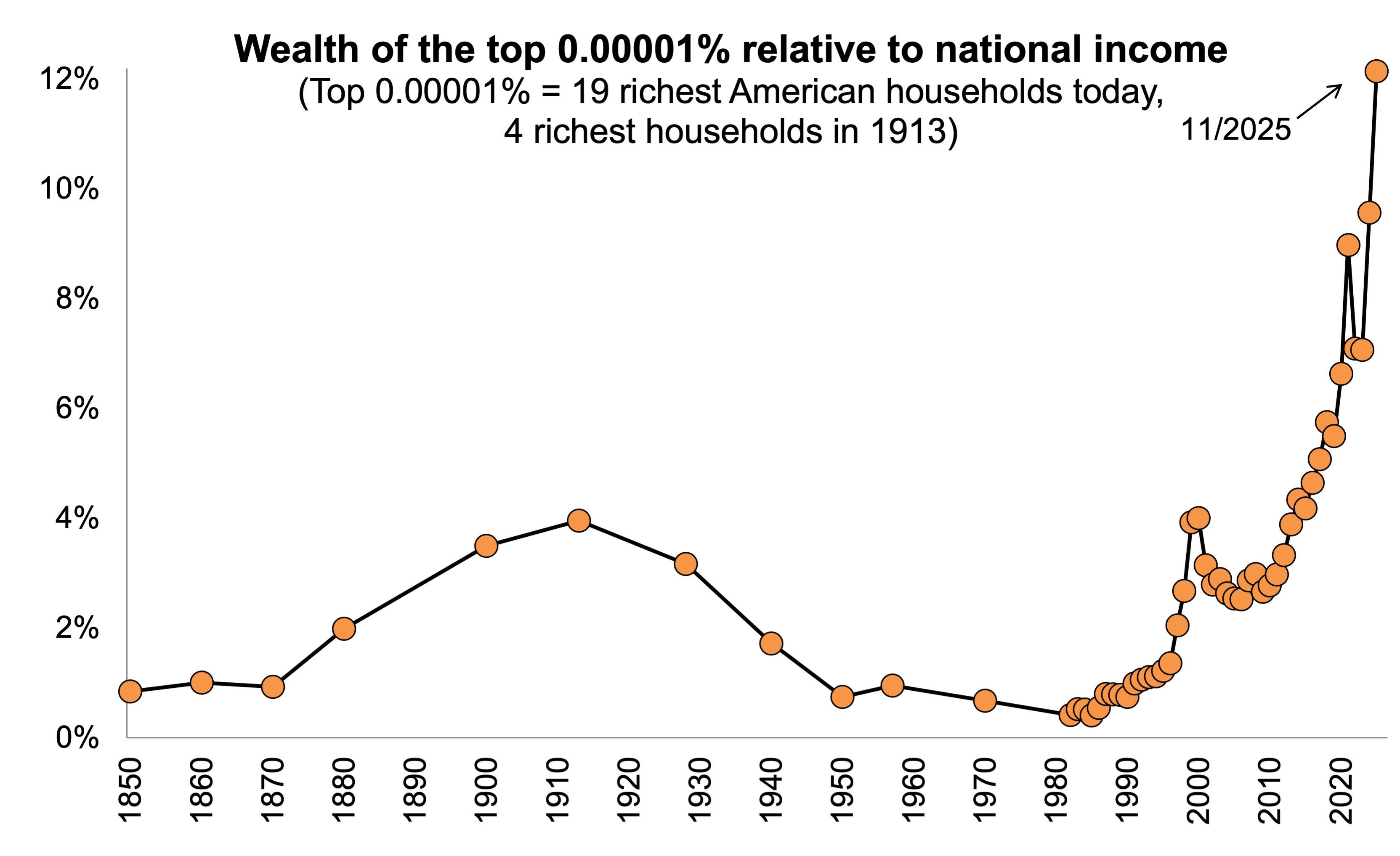
And remember: we already have the most extreme concentration of wealth in history. In 1910, at the peak of the Gilded Age, the richest 0.00001% of US households owned wealth equivalent to 4% of national income. Today, that figure is 12%. America’s super-rich are already richer and more powerful than the original robber barons ever were. And AI is about to make it much, much worse. Because the labs building this technology are owned by a tiny group of people, a few early investors who stand to capture more of the world’s wealth than any class of owners who ever lived.
Part 4 : What We Do About It
So. What do we do?
Let me start with what we should not do. There is a temptation to look at all of this and conclude: shut it down. Pull the plug. Bring in the Luddites. Smash the machines..
And I get the impulse. When you stack up the scale of risk, the disregard for democracy, the hubris of the people in charge, the cleanest response feels like a moratorium. Just say no.
It is, I think, the wrong answer.
The reason is brutally simple. It doesn’t work. Stop the data centers in California, and they get built in Texas. Stop them in Texas, and they get built in Abu Dhabi. Stop them in democracies – the places with civil liberties, with judicial review, with a free press, with worker protections – and you hand the future to autocracies.
My point is not, absolutely not, that we have to let AI rip. My point is that abandoning the field is not the same as stopping the technology. This is the left’s version of climate denial. Refusing to engage seriously, on the assumption that if we just shout no loudly enough, the future will go away. It won’t.
So what does work?
Three things, at minimum.
One: State capacity. We need way, way more AI expertise and talent inside the government. The UK was early on this. They built an AI Security Institute: a serious arm of the state that actually evaluates frontier models, the way the FDA evaluates new drugs. I think every serious country needs a well-funded institute like that.
Two: International coordination. We have been here before. In 1949, the United States and the Soviet Union both had nuclear weapons, and humanity briefly looked extinction in the eye. Out of that came treaties. Imperfect, yes, but they bought us decades of survival. We need something equivalent for AI.
Three: The free world has to build.. The US – with its increasingly fascist government – currently owns 74% of the world’s compute, China has 14%, Europe less than 7% and all other countries combined less than 5%. I’m really worried about the middle powers, and Europe in particular. So far, Europe has been pretty good at regulating AI, but terrible at building it. In fact, all the American giants – Microsoft, Apple, Amazon, Nvidia, Alphabet – are individually worth more than the entire German or French stock market.
The good news is that Europe does have more leverage than it often thinks. The company ASML for example is less than an hour from where I am right now in the Netherlands. It makes the lithography machines without which TSMC in Taiwan cannot fabricate the chips, without which Anthropic and OpenAI cannot train their models. The democratic countries, working together, still control significant chokepoints in this supply chain. That is real power.
But my fellow progressives in Europe really need to understand that our welfare state, our way of life, is at stake. Just think it through. If AI does much of the work, but the profits flow to a handful of American giants that we barely tax – while European workers lose their jobs – then the tax base that funds our healthcare, our pensions, our unemployment insurance just… evaporates.
There’s one thing I can’t emphasize enough: democratic, liberal and humanitarian values are wonderful, but they are worthless if you don’t have the strength to back them up. And in this new world, compute is the new power. So no more NIMBY-ism. We need massive investments and fast permitting of data centers to keep up, or we’ll be digitally colonized. Anyone who’s not at the table will be on the menu.
Now, none of this works – none of it – without a positive vision.
And this, I think, is where liberals and the left have most badly failed.
Twelve years ago, I wrote a book called Utopia for Realists. I complained that the left mainly knew what it was against. Against austerity, against the establishment, against homophobia, against racism, against billionaires. But it lacked a positive vision of where it wanted to go.
My argument was that we should stop being so timid in our political imagination. I argued for a universal basic income, for the complete eradication of poverty, and I argued for a goal that the brilliant economist John Maynard Keynes laid out almost a century ago, in 1930…the fifteen-hour work week.
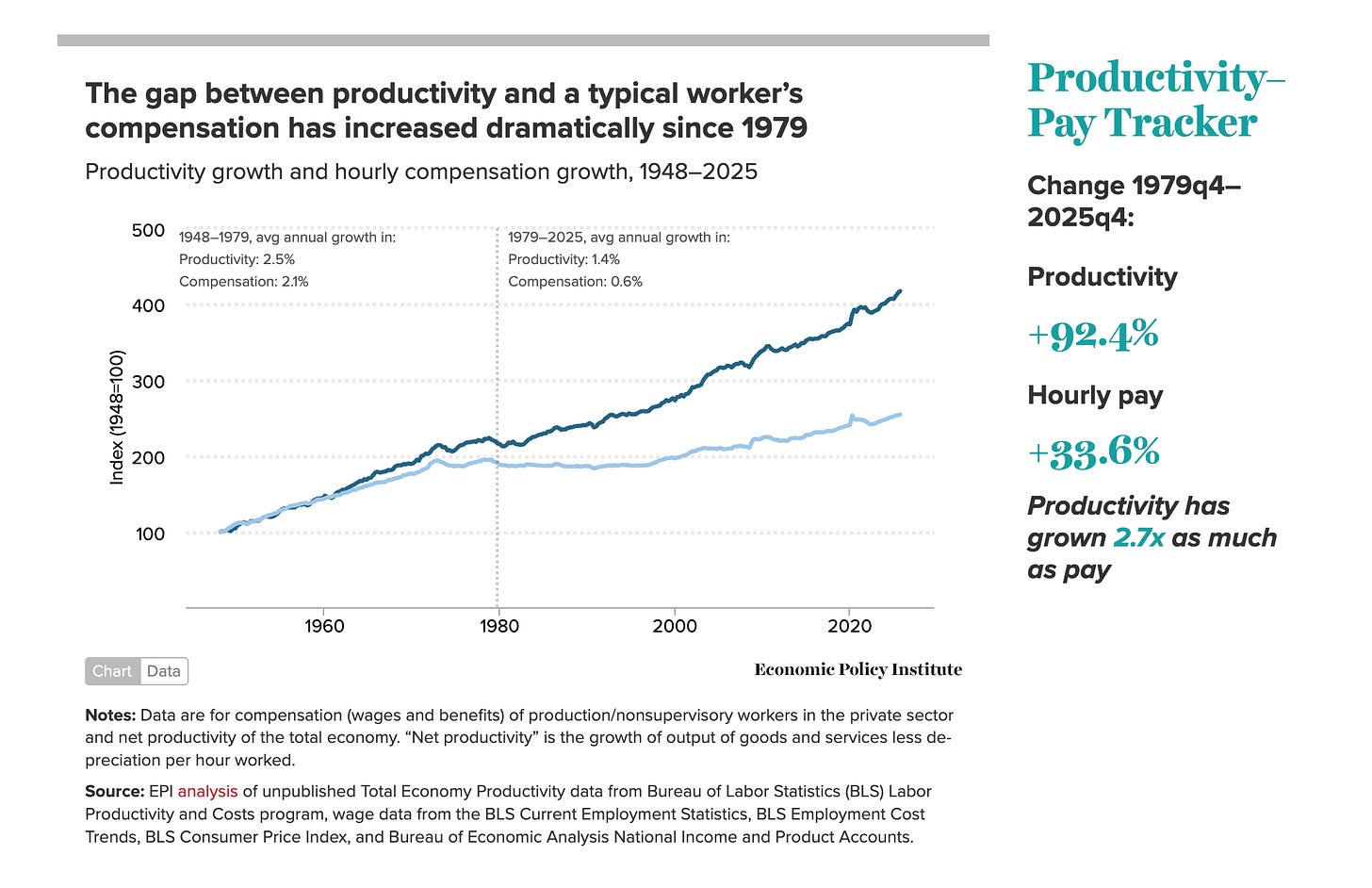
Keynes thought it was inevitable. He looked at the trajectory of productivity growth and concluded that by 2030 his grandchildren would be working a quarter as much as he did, because the machines would be doing the rest. The strange thing is, he was right about the productivity, but he was wrong about who would benefit.
The fifteen-hour work week was technically achievable by the 1980s, but it didn’t happen because the productivity gains were captured. By capital, shareholders, and a rentier class. So wages stagnated, hours rose, and inequality exploded.
If we let AI play out the same way, this is what we’ll get: a handful of trillionaires who will own the tools that do most of the world’s productive labor. Everyone else will be redundant – not in the dignified, retire-early-and-take-up-gardening sense, but in the cruel, anxious, gig-economy sense. Universal poverty in a world of unimaginable abundance.
And yet, I believe there’s another path. The path some of the greatest thinkers actually promised us. Benjamin Franklin predicted that four hours of work a day would eventually be enough. John Stuart Mill thought technology should be used to shorten the workweek as much as possible. Karl Marx imagined a world where we could hunt in the morning, fish in the afternoon, and discuss philosophy after dinner. And Oscar Wilde looked forward to the day when intelligent machines would become, in his words, “the property of all.”
The whole point of building the most productive economy in history was that we would no longer have to spend our lives doing work that bored us, just to put food on the table.
So I think we should demand much more than just AI safety. We should demand AI that’s built to help us flourish. That dream, the real dream of modernity, is finally within reach. Universal basic wealth: every citizen with an automatic stake in the productive infrastructure of their society. Full unemployment, in the original meaning of that phrase: freedom from forced labour. The zero-hour work week, finally. That was the promise.
But none of it happens automatically. Remember: the eight-hour workday was not given to us, we took it from the robber barons.
Twenty years ago, Al Gore stood on his scissor lift and showed us a line that went off the chart. The world he warned us about did arrive, but the political response was so weak and so half-hearted, that we are now living with consequences.
We are about to make the same mistake, perhaps even worse, because this timeline is shorter. In 2005, climate denial was a problem of the right, and the left rolled its eyes. In 2026, AI denial is a problem of the left, and the oligarchs are laughing.
So I want to be very direct, especially with the people who think of themselves as my political family. Stop the denial. Stop pretending this is hype. Stop calling it a lumbering stochastic pattern-matching parrot.
Wake up and pay attention. Vote for politicians who aren’t in the pockets of big tech. Build state capacity. Push your governments into international coalitions that actually have leverage. Demand transparency. Demand safety standards. Demand a share of the wealth.
And dare to fight for a wildly better future.
quarta-feira, 10 de junho de 2026
Património dos super-ricos causa danos climáticos desproporcionados, diz estudo
 |
| Stargate Datacenter (Texas) |
A Greenpeace calcula que os mais abastados contribuem com quase um bilião de dólares de prejuízos por ano através de emissões associadas à propriedade de ativos.
As pessoas ultra ricas que cruzam os céus mundiais nos seus jatos privados, relaxam em iates e se destacam pelo seu consumo ostensivo no Instagram estão entre os culpados individuais mais facilmente identificáveis na crise climática. No entanto, uma nova investigação defende que a culpa não reside apenas nos seus estilos de vida exuberantes, mas também nas suas contas bancárias.
Através da detenção de empresas e de ativos financeiros e físicos privados — que vão desde produtores de petróleo a empreendimentos imobiliários —, os super-ricos são responsáveis por uma fatia desproporcionada dos gases com efeito de estufa que estão a sobreaquecer o planeta. O 1% do topo da população mundial em termos de riqueza controla, através das suas participações acionistas e investimentos, cerca de um quarto do total das emissões anuais globais.
A Greenpeace calculou a "dívida climática" destes indivíduos com elevado património líquido, atribuindo-lhes a respetiva quota-parte dos danos causados ao clima pelos ativos de que são proprietários. Segundo estas contas, os mais ricos do mundo provocam quase um bilião de dólares ($1tn) por ano em prejuízos climáticos.
Clara Thompson, responsável global de campanhas sobre sistemas socioeconómicos na Greenpeace International, afirmou: "Numa altura em que as pessoas enfrentam faturas de energia cada vez mais altas, o aumento do custo de vida e impactos climáticos crescentes, muitos questionam-se por que razão os agregados familiares comuns devem carregar com uma parte tão grande do fardo, enquanto algumas das pessoas mais ricas do mundo continuam a lucrar com as indústrias que alimentam a crise."
A Greenpeace estima que o 1% mais rico da população seja responsável por cerca de 40% de todas as emissões baseadas na "propriedade" — ou seja, as emissões produzidas por empresas e associadas a ativos financeiros e físicos privados —, as quais representam, por si só, 60% da produção global de carbono. Dentro desse grupo, os 0,1% do topo respondem por cerca de 17% das emissões baseadas na propriedade, e os 0,01% mais ricos por cerca de 9%.
O escalão do 1% do topo é composto por indivíduos com um património superior a cerca de 2 milhões de dólares; os 0,1% detêm uma riqueza acima dos 7 milhões de dólares; e os 0,01% correspondem a pessoas com fortunas superiores a cerca de 38 milhões de dólares. Em contrapartida, a metade mais pobre da população mundial detém apenas 3% das emissões associadas à propriedade de ativos.
Thompson sublinhou que é fundamental pensar em termos de emissões baseadas na propriedade porque, embora sejam menos visíveis do que as emissões associadas ao consumo, são mais difíceis de combater.
"Isto não é apenas uma história sobre jatos privados e estilos de vida luxuosos. Quando se trata da poluição dos ultra-ricos, a propriedade importa ainda mais do que o consumo. Uma grande parte das emissões está associada à detenção de ativos e investimentos com elevada intensidade de carbono", explicou. "Durante anos, a política climática focou-se nos consumidores. Mas as nossas conclusões sugerem que deveríamos prestar muito mais atenção àquilo que as pessoas possuem e onde investem."
Uma forma de corrigir este desequilíbrio poderia passar pela aplicação de impostos sobre a riqueza. "A dívida climática tem a ver com responsabilidade", referiu Thompson. "Se concordamos que aqueles que mais contribuíram para o problema devem contribuir mais para o resolver, é perfeitamente razoável perguntar se esse princípio também se deve aplicar à riqueza extrema."
Dados independentes revelaram que os grandes bancos e outros investidores financeiros canalizaram 900 mil milhões de dólares para combustíveis fósseis no ano passado, apesar das promessas feitas por muitos deles há cinco anos para reduzir tais investimentos.
As disparidades gritantes entre o impacto ambiental dos super-ricos e o dos cidadãos comuns estão cada vez mais no centro das atenções, à medida que a desigualdade de riqueza dispara em todo o mundo. Recentemente, um relatório liderado pelo economista Thomas Piketty demonstrou que o mundo poderia viver de forma equitativa dentro dos recursos finitos do planeta, caso os excessos de riqueza fossem travados por impostos e os mais pobres pudessem reter uma maior fatia daquilo que o seu trabalho produz.
Governos de todo o mundo, com exceção dos EUA, estão reunidos em Bona, na Alemanha, para duas semanas de conversações que antecedem a cimeira do clima da ONU (Cop31) em novembro. Um dos temas que deverá receber maior atenção prende-se com os mecanismos para uma "transição justa", que ajude os trabalhadores afetados pelo abandono dos combustíveis fósseis a integrarem-se na economia de baixo carbono.
terça-feira, 26 de maio de 2026
Cenário climático RCP 8.5 - é assim que funciona a publicidade aos combustíveis fósseis hoje em dia
 |
| Fonte: Stefan Rahmstorf (clique na imagem para ampliar) |
Leu em algum lugar esta semana que a crise climática está a ser cancelada? Infelizmente, isso é mentira. A forma como esta mensagem chegou ao público alemão é um exemplo clássico de propaganda do século XXI.
 A notícia algo animadora é que é altamente improvável que a humanidade continue a utilizar o carvão para a geração de eletricidade a uma escala cada vez maior, principalmente porque as energias renováveis estão a crescer muito rapidamente e a tornar-se cada vez mais baratas. O chamado cenário RCP8.5 , que pressupõe a escalada máxima da crise climática, tem sido considerado inverosímil pelos especialistas há anos . Um cenário de "baixa probabilidade e alto risco" já está descrito no relatório de avaliação de 2021 do Painel Intergovernamental sobre Alterações Climáticas (IPCC) .

Imagine que sofre de uma doença grave e progressiva que lhe causará dores e limitações cada vez maiores ao longo dos próximos anos e décadas. Os médicos prescreveram medicamentos. Agora, parecem estar a surtir efeito: a dor já não está a aumentar tão rapidamente como antes. Qual seria a sua reação? Deixaria de tomar a medicação o mais rapidamente possível?
Foi basicamente isso que a ex-ministra da Família, Kristina Schröder (CDU), exigiu esta semana. Num artigo para o jornal "Die Welt", pertencente ao grupo Springer, Schröder escreveu: "A Alemanha está a mergulhar cada vez mais na desindustrialização. O culpado é um cenário catastrófico climático que os cientistas já desmascararam como falso."
Isto está duplamente errado: um "cenário de horror climático" não é o culpado pela ampla absorção da indústria alemã pela China – o que precisamos é finalmente de uma política energética e climática coerente, afirmam tanto o Conselho de Peritos Económicos como o conselho independente de peritos em questões climáticas . Nem um "cenário de horror climático" foi "desmascarado como falso".
Infelizmente, isto não é absolutamente motivo para tranquilização.
Para se perceber como é que este absurdo artigo de opinião foi parar a um jornal alemão supostamente respeitável, é preciso recuar algumas semanas. No início de abril, um artigo assinado por dezenas de investigadores climáticos foi publicado numa revista científica , contendo uma notícia relativamente boa e uma notícia muito má. A notícia muito má é que a meta acordada em Paris por 195 países e pela União Europeia — limitar o aquecimento global a menos de 1,5 graus Celsius em comparação com os níveis pré-industriais — está, para já, fora de alcance. Os detalhes científicos são explicados, por exemplo, por Stefan Schmitt no jornal "Die Zeit " .
A notícia algo animadora é que é altamente improvável que a humanidade continue a utilizar o carvão para a geração de eletricidade a uma escala cada vez maior, principalmente porque as energias renováveis estão a crescer muito rapidamente e a tornar-se cada vez mais baratas. O chamado cenário RCP8.5 , que pressupõe a escalada máxima da crise climática, tem sido considerado inverosímil pelos especialistas há anos . Um cenário de "baixa probabilidade e alto risco" já está descrito no relatório de avaliação de 2021 do Painel Intergovernamental sobre Alterações Climáticas (IPCC) .Vai aquecer ainda mais rápido
Infelizmente, isto não é nada tranquilizador, e os especialistas concordam : ainda estamos a caminhar para um mundo que pode ser mais de três graus mais quente do que era há 200 anos. E já está mais quente do que em qualquer outro momento da história da humanidade. O Acordo de Paris sobre o Clima, como é sabido, estabelece uma meta flexível de 1,5 graus e uma meta rígida de 2 graus. E por uma boa razão: mesmo com um aumento de dois graus na temperatura, por exemplo, os corais de água quente do planeta provavelmente morrerão em todo o mundo. O que isto significa para os ecossistemas marinhos e, consequentemente, para o abastecimento alimentar de parcelas significativas da humanidade é sistematicamente ignorado por aqueles que dizem "não é assim tão mau". Para citar apenas um exemplo.
A publicação de Detlef Van Vuuren e dos seus colegas em "Geoscientific Model Development" está, por isso, longe de ser motivo de complacência; muito pelo contrário. Apenas confirma o que já era óbvio: os combustíveis fósseis são, sobretudo por razões económicas, um modelo de negócio (lentamente) em declínio . Isto significa que as emissões aumentarão a um ritmo mais lento. Mas a temperatura continuará a subir. De acordo com as descobertas atuais, até mais rápido do que antes .
Um grupo de reflexão financiado por combustíveis fósseis está a moldar a narrativa.
O que aconteceu após a publicação é um exemplo clássico de desinformação climática. Poucas semanas depois do artigo científico de Van Vuuren et al., Roger Pielke Jr., um notório negacionista das alterações climáticas (de segunda geração ) há anos, publicou um artigo no blog do American Enterprise Institute (AEI) intitulado "RCP8.5 is officially dead". O texto contém muitas afirmações aparentemente enganadoras e uma peculiaridade reveladora: Pielke Jr. escreve repetidamente que agora é provável que fique "mais frio" do que o previsto nos piores cenários (o adjetivo "mais frio" aparece cinco vezes no texto ). No entanto, definitivamente não ficará "mais frio", mas sim continuará a aquecer.
O que precisa de saber: O AEI é um daqueles think tanks neoliberais que há anos fomenta agressivamente o sentimento contra qualquer forma de proteção climática. De acordo com o site de investigação "Desmog", o AEI recebeu milhões de dólares em donativos ao longo dos anos dos suspeitos do costume na disseminação organizada de desinformação climática: de várias fundações do bilionário do petróleo americano Charles Koch, incluindo a Fundação de Caridade Charles G. Koch e o "Instituto Charles Koch", e, em grande medida, das instituições de caridade associadas aos Koch, "Donors Trust" e "Donors Capital Foundation". O AEI recebeu também donativos da ExxonMobil, da Shell, da organização de lobby "American Petroleum Institute" e assim por diante. Em síntese: o AEI é um pilar fundamental na rede de propaganda da indústria do petróleo e do gás.
Não houve absolutamente nada de "repentino" nisto.
A 11 de maio, um antigo colega, que também poderia ser descrito como um antigo jornalista científico, repercutiu a distorção da AEI no jornal "Die Welt". Este autor chamou recentemente a atenção sobretudo por uma decisão judicial e uma reprimenda do Conselho de Imprensa por reportagens agressivas, mas imprecisas, sobre "ONGs ambientalistas". O título do artigo afirmava que os cientistas climáticos estavam a "abandonar subitamente o seu cenário mais dramático". Como disse: não há absolutamente nada de "repentino" nisto. Nem aconteceu "secretamente", como alegaram vários órgãos de comunicação social de direita dos EUA , inspirados pelo presidente norte-americano. Mentiu no "TruthSocial", afirmando que o IPCC tinha "admitido" que "as suas próprias projecções" eram "FALSAS! FALSAS! FALSAS!"
segunda-feira, 18 de maio de 2026
Trump cuts to weather data could make forecasts less reliable, warn experts

As the US prepares for hurricane season and a summer of record-breaking heat, experts fear the Trump administration’s cuts to climate and weather data programming could make the federal government’s weather forecasts less reliable when they are needed most.
The National Oceanic and Atmospheric Administration (Noaa) late last year launched a suite of artificial intelligence-powered global weather forecast models which it said would improve “speed, efficiency, and accuracy”. In March, an agency official said those models were being trained with centuries of weather data.
Artificial intelligence is a valuable tool for weather prediction, but only when it is well-trained with ample data, said Monica Medina, who served as Noaa’s principal deputy undersecretary of commerce for oceans and atmosphere from 2009 to 2012.
Under Trump, climate and weather data collection has declined, said Medina. This year, the Trump administration proposed a modest budget increase for the National Weather Service, but a 40% cut to Noaa overall.
“We absolutely need AI to help us crunch the data faster and to make sense of more and more data that we can collect,” said Medina, who under Joe Biden also served as assistant secretary of state for oceans. “But right now, what we’re doing is cutting back the data collection … we’re going in the wrong direction.”
In an emailed comment, Erica Grow Cei, a National Weather Service spokesperson said: “Despite the misinformation circulating about missing weather and climate data, there is, in fact, a wealth of weather data collected each day, from satellites in space, to a network of weather balloons, to buoys in the ocean, and land-based sensors.”
But widespread reports show staffing cuts have forced Noaa’s National Weather Service to scale back satellites and balloon launches, key parts of the country’s data collection system. And shrunken climate programs threaten ocean buoy networks and other observation systems, experts say. Research into effects of the climate crisis on Earth’s systems is also being slashed, along with funding for researchers who analyze data and identify new sources.
“Weather times time equals climate,” said Craig McLean, Noaa’s former acting chief scientist and head of Noaa Research. “Cutting climate research impacts the skill of our weather forecast, and it arrests our advancement of weather forecasts.”
Those impediments are coming as the US is preparing for more extreme weather. A “super El Niño” is expected to spike temperatures, smash heat records nationwide and may boost hurricane activity in some regions.
Noaa will issue its outlook for the 2026 Atlantic hurricane season on Thursday.
‘A climate that no longer exists’
For decades, scientists used traditional physics-based models to predict future weather conditions, using complex mathematical equations to simulate the dynamics at work in the atmosphere. New AI-based models instead identify patterns in decades of historical data to forecast weather outcomes.
That new technology uses less computing power than traditional models – which must run thousands of mathematical equations to work – and has been found to outperform traditional models for some aspects of weather forecasting. But it also seems to have major shortcomings, experts have found.
Crucially, when it comes to predicting extreme weather events, new models still “underperform”, according to an April study published in Science Advances. Because their forecasts are based on past weather events, the authors found, they seem to have trouble simulating the record-breaking weather events that are becoming increasingly common amid the climate crisis, instead tending to predict weather more similar to historical events.
Traditional physics-based models don’t have this problem, because they assess and predict the weather outcomes that certain physical conditions yield.
“They don’t really care if there’s a different situation than we’ve seen before, because they can understand based on a rules-based [analysis] what will happen tomorrow,” said Sebastian Engelke, a professor at the University of Geneva who co-authored the study.
Chris Gloninger, a forensic meteorologist who in 2023 received death threats after speaking about the climate crisis on television, likened the problems with AI-powered models to the ways other kinds of infrastructure struggles to manage a world experiencing global warming.
“You have infrastructure systems in this country that are built on having a steady or static climate, and we know that that’s not the case as extremes are increasing,” he said.
Like stormwater systems that were not designed to keep up with climate-fueled heavy rainfall events or roads that were not designed to withstand climate-fueled extreme heat, “the AI weather models were trained on a climate that no longer exists”, Gloninger said.
This problem already has real-world implications, said Gloninger, noting that conventional models outperformed AI-based ones when forecasting a historic February 2026 blizzard in the north-eastern US.
If the government scales up its reliance on AI-powered models while reducing the amount of data that powers them, that problem could compromise federal forecasts, said Gloninger.
“It’s kind of a snowball effect,” he said. “You need accurate data for inputs for our forecast models, but we’re running on less data currently with this current administration.”
Long before Trump re-entered office, the National Weather Service had faced decades of understaffing. Recent cuts have exacerbated the problem, Gloninger said.
Noaa has not wholesale switched to AI forecasting. Instead, it says it is employing more artificial intelligence in its ensemble models, which blend multiple techniques to produce a range of probable outcomes. Cei said Noaa’s new AI-powered model suite is “an addition to our stable of weather models, not a replacement”, adding that it was “built on data” from the agency’s flagship physics-based Global Forecast System model.
But Gloninger said he was still concerned that rolling any AI technology into federal models could raise problems, particularly amid cuts to weather data collection and climate research.
“There could still very much be issues when you have a component of artificial intelligence that isn’t really trained when it comes to extreme weather and climate,” he said.
Neil Jacobs, current Noaa administrator, is “probably one of the pre-eminent modeling scientists”, said John Sokich, a former director of congressional affairs for the National Weather Service.
“I don’t believe he would rush implement something that has not been tested,” said Sokich.
But though Jacobs is “committed to advancing weather forecasting”, Jacobs is also “a Trump appointee who must back the Trump budget or leave his job”, said McLean. The administrator defended Trump’s Noaa cuts at a House environment subcommittee hearing in April, McLean noted.
“I don’t think Dr Jacobs would be in a rush to be replacing capacity with AI that’s not ready yet,” he said. “But at the same time, the man has demonstrated his willingness to be obedient to the president who appointed him [and who is] destroying the National Oceanic and Atmospheric Administration.”
Weather forecasts serve “indispensable” practical functions, powering early disaster warnings, enabling safe aviation and shipping, and helping officials optimize sectors of the economy from energy production to agriculture, said Medina. Less accurate forecasting could pose dangers to Americans, she said.
“Weather forecasts are vital to our economy, to our health, and to public safety,” she said.
sexta-feira, 17 de abril de 2026
Hegseth Says Climate Change Is ‘Crap.’ The Military Is Still Bracing for It

When Hurricane Michael, a Category 5 storm, tore through Florida’s Tyndall Air Force Base in 2018, it battered F-22 stealth fighter jets, destroyed hundreds of buildings and churned up 700,000 cubic yards of debris. The total cost of the damage approached $5 billion.
Now, Tyndall is being rebuilt as a super-resilient “installation of the future.” New buildings sit more than a foot above the ground, to remain dry through 75 years of sea-level rise. Their roofs are designed to withstand winds of up to 165 miles per hour. Manmade oyster reefs will protect coasts by breaking up waves.
The massive project will be 70% complete next year, said the officer leading it, Col. Robert Bartlow, chief of the US Air Force Civil Engineer Center Natural Disaster Recovery Division. “This is a first for the Air Force,” he said, with large-scale, cutting-edge construction taking place “on top of an existing base, while there was a continued flying mission.”
Storms like Michael are becoming more powerful and damaging as the world warms, and many military installations are exposed to them and other climate hazards. Still, Secretary of Defense Pete Hegseth vowed last year that the Pentagon wouldn’t do any “climate change crap” on his watch. Biden-era climate action plans were scrapped, and the 2025 National Security Strategy invoked climate change only to label it a “disastrous” ideology. Hegseth canceled nearly 100 research studies related to global warming and security, which experts say will compound the loss of climate knowledge across the federal government under President Donald Trump.
“Because ‘climate’ is a dirty word, we’re not investing in that predictive capability,” said Sherri Goodman, secretary general of the non-governmental International Military Council on Climate and Security and, from 1993 to 2001, the US deputy undersecretary of defense for environmental security.
But as Tyndall shows, the Defense Department is still engaged on one front of the climate fight: steeling its bases against the effects of a warming atmosphere, such as higher seas, fiercer storms and deadlier fires. A new flood wall is rising at the US Naval Academy in Maryland; a low-lying Air Force runway is being elevated in Virginia; and projects are underway to reduce wildfire risk around various military sites in Hawaii.
Work that was previously described as confronting the climate threat is now touted for ensuring “resilience” and “readiness.” The semantics are a nod to necessity: At stake are hundreds of billions of dollars of assets and the ability to launch missions quickly and smoothly.
“Ultimately, the military is a very pragmatic institution,” said John Conger, a past director of the nonprofit Center for Climate and Security and a senior Defense Department official during the Obama administration. “It wants to maintain mission capability. Whether we’re going to call it ‘climate,’ not ‘climate,’ whatever — if I can’t get to the base because the road is flooded, that’s a problem.”
Representatives of the Defense Department declined to comment.
Global warming impinges on American security and military operations in numerous ways. More climate-driven disasters means more deployments to respond to them. Extreme heat makes it harder for jets to lift off and sickens soldiers during training exercises. Climate change also acts as a “threat multiplier” – a term that Goodman coined – around the world. It can exacerbate drought conditions, which may limit water or food in regions already primed for conflict.
Much of the military’s resilience work began years ago; construction timelines are long. The $900 billion 2026 National Defense Authorization Act, which Trump signed into law in December, includes measures that could be said to come under the umbrella of climate adaptation. The law bolsters the military’s ability to respond to wildfires; raises the cost limit for replacing structures destroyed by disasters; and requires military leaders to identify the biggest risks to water security on bases.
Congress has given the military “decades-long, bipartisan direction” to prepare for climate change, even at times when the term itself was out of political favor, noted Will Rogers, a principal of Converge Strategies and the senior climate advisor to the secretary of the Army from 2022 to January 2025.
If climate preparedness is another term for environmental assessment, “the Army’s been doing this regularly now since World War II,” said Frank Galgano, a geographer at Villanova University who retired from the Army as a lieutenant colonel in 2007.
The approach may not have shifted, but the atmosphere has. Extreme weather and disasters have caused $15 billion of damage to defense facilities over the past decade. In 2023 alone, Typhoon Marwar ravaged two bases on Guam, heavy rains swamped the campus of West Point in New York and a landslide blocked the main road at Camp Pendleton in California.
Close to $400 billion of federal government assets, most of them belonging to the Defense Department, are at high risk of being hit by a major coastal flood or storm in coming years, according to a Bloomberg Law analysis.
The Pentagon explicitly recognized the warming climate as a danger for many years. The 2008 National Defense Strategy flagged climate change as an emerging risk, and two years later it was named a national security threat in the Pentagon’s Quadrennial Defense Review. After that, the Defense Department and the individual armed forces put out a stream of climate and sustainability plans. (Some have now been removed from government websites.)
James Mattis, who served as defense secretary during President Donald Trump’s first term, described climate change as a destabilizing force in 2017. His Biden-era successor Lloyd Austin said in 2021, “We face all kinds of threats in our line of work, but few of them truly deserve to be called existential. The climate crisis does.”
Trump and Hegseth have made a sharp pivot. In a March 2025 memo to military leaders, Hegseth called climate change a “distraction” from fighting wars, ordered that references to it be removed from mission statements and barred any environmental initiatives from being included in the Future Years Defense Program, a strategic plan.
Hegseth also included a caveat big enough to steer an aircraft carrier through. “Nothing in this memorandum,” he wrote, “shall be construed to prevent the department from assessing weather-related impacts on operations, mitigating weather-related risks, conducting environmental assessments, as appropriate, and improving the resilience of military installations.”
Days after Hegseth issued his memo, the Pentagon’s guidance on master planning for bases was updated. (By law, every major military installation must have a master plan.) In the older version from 2022, the word “climate” was used 54 times. It doesn’t appear once in the new version, which still directs planners to identify and mitigate risks from extreme weather.
Bartlow, at Tyndall, sees no contradiction between that project and Hegseth’s guidance.
The overarching goal at Tyndall, he said, is “preserving lethality in a high-end combat capability. When we talk about resilience, it’s focused on preserving that combat capability.” If another Category 5 hurricane hits, “there’ll be some interruptions, but the idea is you’ll be able to recover this installation quickly,” Bartlow said. “You can make that direct link back to readiness.”
Hardening efforts continue elsewhere but are falling short. A February Government Accountability Office report found that the military has failed to track all the costs from disaster damage and hasn’t fully incorporated climate-change projections into facility designs, and that many of its master plans still haven’t been updated to promote greater resilience.
One constraint is funding. “Our installations are funded at about 80% of what they need on a day-to-day basis,” said Rogers, the former Army climate adviser.
The Iran war could apply more pressure. Defense officials “could use their reprogramming authority to pay for contingency operations in Iran” with money meant for fortifying bases, said Rogers. “I would be worried about that, depending on how long this goes.”
Although the Pentagon has maintained a focus on resilience, under Hegseth it has backed off efforts to lower its emissions — the US military is the single biggest climate polluter in the country — and develop green ships and tanks. The armed forces have in recent years explored using hybrid and electric tanks for tactical, not just environmental reasons: They reduce reliance on diesel supply lines, are quieter and are less detectable to heat radar. While the Army is moving ahead with its hybrid M1E3 tank, funding for such initiatives has declined, said Rogers.
Of the studies that Hegseth canceled, some focused on the Indo-Pacific, where China has ambitions, noted Goodman. She said the lost knowledge and reduced funding for climate and weather research – not just in the military but in agencies like the National Oceanic and Atmospheric Administration – could set back defense planning.
She offered a hypothetical example: With AI pushing the envelope in forecasting, an adversary could anticipate and take advantage of a weather event to launch a cyberattack on the US. “And if we’re not understanding that,” she said, “then we have become more vulnerable.”
Subscrever:
Mensagens (Atom)