Mostrar mensagens com a etiqueta Ocidente. Mostrar todas as mensagens
Mostrar mensagens com a etiqueta Ocidente. Mostrar todas as mensagens
sábado, 23 de maio de 2026
Katerina Papadopoulou - Notio Toxo ft. Chariton Charitonidis

sábado, 28 de fevereiro de 2026
Entrevista a Gary Snyder - aos 92 anos
Rússia, Ucrânia e a Europa

Por Luís Vicente
Putin tem de compreender que não é a reencarnação de Alexandre Nevsky, nem o guardião mítico de uma fortaleza sitiada por inimigos medievais. A história não se repete sob a forma de epopeia defensiva permanente, e o século XXI não é um campo de batalha contra mongóis, suecos ou hordas napoleónicas. O terror nazi pertence ao passado histórico europeu, por mais traumático que tenha sido, e a Pátria russa não está hoje sob ameaça existencial.
Os russos têm de reconhecer que existe algo chamado direito internacional, construído precisamente para impedir que os traumas históricos se transformem em guerras preventivas. As fronteiras reconhecidas dos Estados não são sugestões geográficas: são garantias jurídicas da estabilidade global. A sua violação não é acto defensivo; é ruptura da ordem internacional.
Mas também os europeus têm responsabilidades. Devem compreender que os povos da grande mãe Rússia carregam traumas históricos profundos — invasões, cercos, devastação — que moldaram uma cultura estratégica de suspeita e defesa. Ignorar essa memória colectiva é um erro político. A estabilidade exige não apenas firmeza jurídica, mas também inteligência estratégica e capacidade de reduzir percepções de ameaça.
Nesse sentido, a Europa deve agir com prudência, evitando transformar a segurança do continente numa escalada permanente de blocos militares. Segurança não se constrói apenas com expansão de alianças, mas com arquitectura de confiança e previsibilidade.
Por fim, importa sublinhar que eventuais problemas internos da Ucrânia — incluindo fenómenos políticos extremistas — pertencem à esfera soberana dos ucranianos. Nenhum país pode invocar fragilidades internas de outro como pretexto para intervenção armada. A autodeterminação não é selectiva.
Seria tão simples — se a história não fosse permanentemente instrumentalizada, e se o medo deixasse de ser argumento.
domingo, 30 de novembro de 2025
A silent catastrophe: 600 dead while the world looks away

Did you know that more than 4 million people have been affected by catastrophic floods in Southeast Asia this week and more than 600 have already died?
While much of the Western world went about its normal routines, a climate-charged humanitarian disaster was unfolding across Indonesia, Thailand and Malaysia. According to a recent report from Reuters, over 4 million people have now been directly impacted. Entire communities vanished under water. Families were swept away in the night. Roads crumbled. Landslides buried homes with people still inside. Survivors clung to rooftops as rivers exploded out of their banks and swallowed everything in their path. More than 600 lives lost in a few days and yet Western media attention remains fleeting.
“Research published in 2025 found that global media coverage of natural disasters is heavily skewed toward events in countries with close social or genetic ties to the reporting country meaning that catastrophes in many climate-vulnerable regions are largely ignored.”
A week of unimaginable human suffering
In the hardest-hit areas of Indonesia, the death toll climbed to at least 303. Rescue agencies report many missing, entire villages unreachable because roads and communications infrastructure washed away. In southern Thailand, flooding and landslides pushed fatalities into the high hundreds; in some provinces morgues became overwhelmed. Across the region, tens of thousands have been displaced, homes destroyed beyond repair, farmland submerged or swept away, and local economies devastated. Villages remain cut off inside debris-filled flood zones even as relief efforts struggle to reach them.
Behind every statistic there is a human reality:
⚠️ Children wading through waist-deep muddy water after schools collapsed.
⚠️ Parents carrying their children on their backs through flooded roads, uncertain if home still stands.
⚠️ Families living on damp floors or makeshift shelters, hungry, cold, and terrified as rain continues to fall.
⚠️ Farmers staring at drowned fields, their harvests ruined, livelihoods destroyed, futures uncertain.
This is not a disaster. It is collective trauma. This is not “just monsoon season” — this is climate disruption in real time The scale, intensity, and unpredictability of the flooding are not random. Scientists have long warned that a warming world brings heavier rainfall, more volatile storm systems, and increased risk of extreme floods. Warmer air can hold more moisture; warmer seas feed storms; the result is more frequent and more intense rainfall events. Many experts say that what Southeast Asia is enduring now; unusual, catastrophic floods across multiple countries at once is precisely the kind of climate-driven extreme weather that belongs to the future. Today it is the present. This horrific upheaval should not be dismissed as “just bad luck.” It must be seen as a warning, evidence of a planet growing increasingly unstable under human-induced climate change.
Why the world’s silence is so dangerous
When more than 4 million people are affected and 600+ die in a few days — and yet global attention remains shallow — something fundamental is broken. If tragedies in the Global South are treated as distant background noise. If the suffering of millions remains largely invisible to the world’s richest and most powerful countries.If disasters fueled by climate disruption are not met with sustained global solidarity — then we are not just failing in empathy. We are failing in foresight.
Selective attention kills urgency
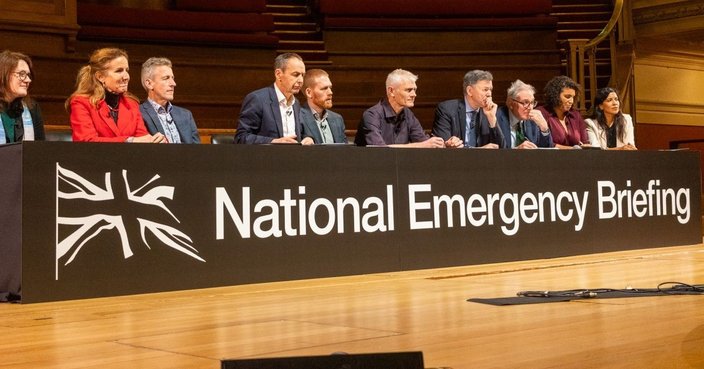
And without urgency, we will never mount the global response such a crisis demands. And while Asia drowned, something else happened in London This same week, the UK hosted the first-ever National Emergency Briefing at Westminster Central Hall — gathering more than a thousand politicians, business leaders, media figures, faith and community voices, all briefed by a panel of top scientists, health-, food- and security-experts.
The message delivered behind closed doors was unambiguous: the climate and nature crisis is already a national security threat. The same forces tearing apart lives in Southeast Asia — extreme rainfall, destabilized weather patterns, overwhelmed infrastructure — can strike any country.
What climate-driven disasters trigger there, they can trigger here. The flooding in Asia is not a distant regional catastrophe. It is a front-line preview of what could happen anywhere including countries in the Global North. This is not a regional crisis. This is a national emergency everywhere. The floods decimating lives across Southeast Asia are not “somebody else’s problem.” They are a warning — raw, unfiltered, urgent. If we cannot look at the suffering of 4 million people today.If we cannot grant their lives the dignity of our attention.
Then how will we protect our own tomorrow?
Because geography will not protect us from climate collapse. Borders will not stop rising waters. Storms will not ask permission. The question is not if it will happen here — But when. If we stay asleep, the water will open our eyes but that will be too late. One powerful way to wake up the people in charge is to do what a group of courageous scientists and civil-society leaders just did in the UK: host a National Emergency Briefing and put political leaders directly in front of the facts. Bringing politicians into the same room as independent experts without spin, without filters, without delay, is one of the most effective tools we have to cut through denial and inertia. We Don’t Have Time is proud to be the official media partner for this groundbreaking initiative. On this page, you can rewatch the full briefing, hear from the scientists themselves, and learn how the model works:
quarta-feira, 5 de junho de 2024
Música do BioTerra: Death in June - Death of the West
terça-feira, 20 de fevereiro de 2024
Alexei Navalny e Gonzalo Lira


A hipocrisia da União Europeia e EUA à volta da morte Navalny, menosprezando a morte de Gonzalo Lira. Navalny não era comunista, era liberal e nacionalista, anti-imigração. Lira fez propaganda para o governo russo, pro-Putin e era muito crítico da invasão Rússia-Ucrânia.
Em 19 de setembro de 2007, o famoso opositor russo Navalny fez um dos seus vídeos mais polémicos. Estava ainda no partido nacionalista Narod. Nele, compara imigrantes muçulmanos a insetos e defende o porte de armas de civis para resolverem o problema.
A hipocrisia do Ocidente e a indignação totalmente falsa pela morte do dissidente russo Alexei Navalny são de cortar a respiração. Enquanto torturavam até à morte Julian Assange numa prisão do Reino Unido – um cidadão australiano que trabalhava no Reino Unido e cujo único “crime” é ter revelado verdades sobre os crimes de guerra dos EUA – e praticamente ignoravam a morte de Gonzalo Lira na Ucrânia, estes as pessoas se balançam no cavalo mais alto que conseguem encontrar para culpar a Rússia por ser um regime assassino de injustiça.
O enquadramento da morte de Navalny e a falta de opções que os EUA têm para exercer mais pressão sobre a Rússia são novamente reveladores não só em termos de propaganda, mas também de como os russos conseguiram realmente dissociar com sucesso a sua economia e destino no mundo dos EUA e da UE – enquanto o Ocidente, claro, ainda finge que “desferiu um golpe” na economia da Rússia. Bem, bom para Moscovo. Esperemos que a maioria dos países fora do Ocidente Coletivo fique claro que a dependência do império dos EUA é uma bomba-relógio.
sábado, 26 de novembro de 2022
A Etiópia, onde o Ocidente mantem os olhos
Lindíssimo este tema. Zazou adaptou esta canção tradicional etíope, em memória de Arthur Rimbaud. Sublime e sedutora.
Aqui com a participação do cantor e nómada etíope Ketema Mekonnen . conhecido pelos seus temas no estilo tradicional e moderno, incluindo faixas populares como "Fano", "Bati", "Tizita" e "Shemonmuana". Com uma carreira que abrange vários sucessos, lançou recentemente o álbum Arada em 2025, com músicas como "Arada", "Ney Ney" e "Birtukane".
A Etiópia, onde o Ocidente mantem os olhos. Uma civilização muito antiga. Apaixonante.
domingo, 23 de outubro de 2022
Música do BioTerra: Azam Ali - O Vis Aeternitatis (12th century by Hildegard Von Bingen)
O Vis Aeternitatis
R. O vis eternitatis
que omnia ordinasti in corde tuo,
per Verbum tuum omnia creata sunt
sicut voluisti,
et ipsum Verbum tuum
induit carnem
in formatione illa
que educta est de Adam.
R. Et sic indumenta ipsius
a maximo dolore
abstersa sunt.
V. O quam magna est benignitas Salvatoris,
qui omnia liberavit
per incarnationem suam,
quam divinitas exspiravit
sine vinculo peccati.
R. Et sic indumenta ipsius
a maximo dolore
abstersa sunt.
Gloria Patri et Filio
et Spiritui sancto.
R. Et sic indumenta ipsius
a maximo dolore
abstersa sunt.
Tradução para Português
Ó força eterna
R. Ó força eterna,
que tudo ordenaste em teu coração,
por teu Verbo tudo foi criado,
como quiseste,
e o próprio Verbo
se revestiu de carne
naquela forma,
de que Adão foi gerado,
R. E assim sua veste
foi poupada
à máxima dor.
V. Ó grande é a benignidade do Salvador,
Que tudo libertou
por incarnação sua,
e a Divindade expirou
sem vínculo de pecado.
R. E assim sua veste
foi poupada
à máxima dor.
Glória ao Pai e ao Filho
e ao Espirito Santo.
R. E assim sua veste
foi poupada
à máxima dor.
quinta-feira, 22 de maio de 2014
Essential Teachings of Helena Blavatsky and Rudolf Steiner
sexta-feira, 9 de setembro de 2011
Música do BioTerra: Death in June - She Say Destroy
Subscrever:
Mensagens (Atom)