terça-feira, 31 de janeiro de 2012

Cartoon- As mulheres e o mundo


Desafio-te a contribuíres para alterar a condição das raparigas e das mulheres em Portugal e no Mundo. Sabias que:
- as mulheres e as raparigas correspondem a 3/5 dos 1.2 mil milhões de população pobre do mundo;
- as mulheres são 2/3 dos 960 milhões de adultos do mundo que não sabem ler;
- as raparigas representam 70% das 130 milhões de crianças que não vão à escola;
- as mulheres constituem a maioria da mão-de-obra agrícola a nível mundial;
- 60% das mulheres do planeta efectuam trabalho não remunerado ou mal pago na economia informal, o que as torna vulneráveis em termos financeiros e jurídicos.


Consulta ainda o Dossiê Ecofeminismo Actualizado

segunda-feira, 30 de janeiro de 2012

Nuclear power plant accidents: listed and ranked since 1952

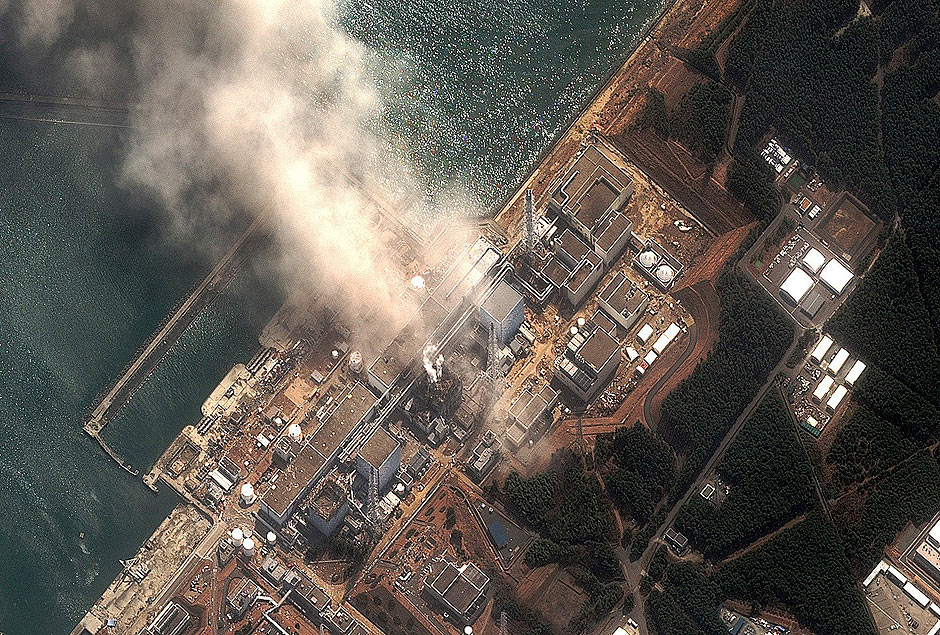
Satellite image of Fukushima Daiichi nuclear plant View larger picture
Nuclear power plant accidents: Number three reactor of the Fukushima nuclear plant is seen burning after a blast following an earthquake and tsunami Photograph: Ho/DigitalGlobe
How often do nuclear power plants go wrong? How many accidents and incidents are there?
The explosions and nuclear fuel rods melting at Japan's Fukushima nuclear power plant, following the Sendai earthquake and tsunami last week, have caused fears of what will happen next. Today Japan's nuclear safety agency has raised the nuclear alert level for Japan from four to five - making it two levels lower than the Chernobyl disaster in 1986.
So far, the Japanese authorities have maintained that there is "no cause to fear a major nuclear accident".
We have identified 33 serious incidents and accidents at nuclear power stations since the first recorded one in 1952 at Chalk River in Ontario, Canada.
The information is partially from the International Atomic Energy Authority - which, astonishingly, fails to keep a complete historical database - and partially from reports. Of those we have identified, six happened in the US and five in Japan. The UK and Russia have had three apiece.
Using Google Fusion tables, we've put these on a map, so you can see how they're spread around the globe:
Get the fullscreen version
But how serious are they? The International Atomic Energy Authority ranks them using a special International Nuclear Events Scale (INES) - ranging from 'anomaly' to 'major accident', numbered from 1 to 7.
The events at Fukushima are level 5, so far and there has only been one 7 in history: Chernobyl in 1986. You can see the full ranking system below and on the attached spreadsheet
What can you do with the data?

Data summary

Nuclear power station accidents and incidents

Click heading to sort table. Download this data
Year
Incident
INES level
Country
IAEA description
2011 Fukushima 5 Japan Reactor shutdown after the 2011 Sendai earthquake and tsunami; failure of emergency cooling caused an explosion
2011 Onagawa   Japan Reactor shutdown after the 2011 Sendai earthquake and tsunami caused a fire
2006 Fleurus 4 Belgium Severe health effects for a worker at a commercial irradiation facility as a result of high doses of radiation
2006 Forsmark 2 Sweden Degraded safety functions for common cause failure in the emergency power supply system at nuclear power plant
2006 Erwin   US Thirty-five litres of a highly enriched uranium solution leaked during transfer
2005 Sellafield 3 UK Release of large quantity of radioactive material, contained within the installation
2005 Atucha 2 Argentina Overexposure of a worker at a power reactor exceeding the annual limit
2005 Braidwood   US Nuclear material leak
2003 Paks 3 Hungary Partially spent fuel rods undergoing cleaning in a tank of heavy water ruptured and spilled fuel pellets
1999 Tokaimura 4 Japan Fatal overexposures of workers following a criticality event at a nuclear facility
1999 Yanangio 3 Peru Incident with radiography source resulting in severe radiation burns
1999 Ikitelli 3 Turkey Loss of a highly radioactive Co-60 source
1999 Ishikawa 2 Japan Control rod malfunction
1993 Tomsk 4 Russia Pressure buildup led to an explosive mechanical failure
1993 Cadarache 2 France Spread of contamination to an area not expected by design
1989 Vandellos 3 Spain Near accident caused by fire resulting in loss of safety systems at the nuclear power station
1989 Greifswald   Germany Excessive heating which damaged ten fuel rods
1986 Chernobyl 7 Ukraine (USSR) Widespread health and environmental effects. External release of a significant fraction of reactor core inventory
1986 Hamm-Uentrop   Germany Spherical fuel pebble became lodged in the pipe used to deliver fuel elements to the reactor
1981 Tsuraga 2 Japan More than 100 workers were exposed to doses of up to 155 millirem per day radiation
1980 Saint Laurent des Eaux 4 France Melting of one channel of fuel in the reactor with no release outside the site
1979 Three Mile Island 5 US Severe damage to the reactor core
1977 Jaslovské Bohunice 4 Czechoslovakia Damaged fuel integrity, extensive corrosion damage of fuel cladding and release of radioactivity
1969 Lucens   Switzerland Total loss of coolant led to a power excursion and explosion of experimental reactor
1967 Chapelcross   UK Graphite debris partially blocked a fuel channel causing a fuel element to melt and catch fire
1966 Monroe   US Sodium cooling system malfunction
1964 Charlestown   US Error by a worker at a United Nuclear Corporation fuel facility led to an accidental criticality
1959 Santa Susana Field Laboratory   US Partial core meltdown
1958 Chalk River   Canada Due to inadequate cooling a damaged uranium fuel rod caught fire and was torn in two
1958 Vinča   Yugoslavia During a subcritical counting experiment a power buildup went undetected - six scientists received high doses
1957 Kyshtym 6 Russia Significant release of radioactive material to the environment from explosion of a high activity waste tank.
1957 Windscale Pile 5 UK Release of radioactive material to the environment following a fire in a reactor core
1952 Chalk River 5 Canada A reactor shutoff rod failure, combined with several operator errors, led to a major power excursion of more than double the reactor's rated output at AECL's NRX reactor


International Nuclear Events Scale (INES)

Click heading to sort table. Download this data
Level
Definition
People and environment
Radiological barriers & control
Defence in depth
Example
7 Major accident Major release of radio active material with widespread health and environmental effects requiring implementation of planned and extended countermeasures    Chernobyl, Ukraine, 1986
6 Serious accident Significant release of radioactive material likely to require implementation of planned countermeasures.    Kyshtym, Russia, 1957
5 Accident with wider consequences Limited release of radioactive material likely to require implementation of • Severe damage to reactor core.   Windscale, UK, 1957; Three Mile Island, 1979
   some planned countermeasures • Several deaths from radiation • Release of large quantities of radioactive material within an installation   
    with a high probability of   
    significant public exposure. This   
    could arise from a major criticality accident or fire   
4 Accident with local consequences • Minor release of radioactive material unlikely to result in implementation of planned countermeasures other than • Fuel melt or damage to fuel resulting in more than 0.1% release of core inventory.   FUKUSHIMA 1, 2011
   local food controls. • Release of significant quantities of radioactive   
   • At least one death from radiation. material within an installation with a high probability of significant   
    public exposure.   
3 Serious incident • Exposure in excess of ten times the statutory annual limit for workers. • Exposure rates of more than 1 Sv/h in an operating area. • Near accident at a nuclear power plant Sellafield, UK, 2005
   • Non-lethal deterministic health effect (e.g., burns) from radiation. • Severe contamination in an area not expected by design, with a with no safety provisions remaining.  
    low probability • Lost or stolen highly radioactive sealed source.  
    of significant public exposure. • Misdelivered highly radioactive sealed source without adequate procedures in place to handle it.  
2 Incident • Exposure of a member of the public • Radiation levels in an operating area • Significant failures in safety provisions Atucha, Argentina, 2005
   in excess of 10 mSv. of more than 50 mSv/h. but with no actual consequences.  
   • Exposure of a worker in excess of the • Significant contamination within the • Found highly radioactive sealed  
   statutory annual limits facility into an area not expected by orphan source, device or transport  
    design package with safety provisions intact.  
     • Inadequate packaging of a highly  
     radioactive sealed source.  
1 Anomaly    • Overexposure of a member of the  
     public in excess of statutory annual  
     limits.  
     • Minor problems with safety  
     components with significant  
     defence-in-depth remaining.  
     • Low activity lost or stolen radioactive  
     source, device or transport package  


Download the data


DATA: download the full spreadsheet

More data

Data journalism and data visualisations from the Guardian

World government data

Search the world's government data with our gateway

Development and aid data

Search the world's global development data with our gateway

Rubem Alves e a Ciência: o que realmente é científico?

As pessoas normais brincam com muitos jogos de linguagem: jogos de amor, jogos de poder, jogos de saber, jogos de prazer, jogos de fazer, jogos de brincar. Porque a vida não é uma coisa só. A vida é uma multidão de jogos a acontecer ao mesmo tempo, uns a colidir com os outros, e dessas colisões surgem faíscas. Uma cabeça ligada à vida é um festival de jogos. E é isso que faz a inteligência. Mas o nosso herói, coitado, era cabeça de um jogo só. Jogava o tal jogo de forma fantástica. Especializou-se. Sabia tudo sobre o assunto. E, de facto, sabia tudo sobre o mundo do xadrez. Mas o preço que pagou foi ter perdido tudo sobre o mundo da vida. Virou um computador ambulante, computador de uma disquete só. As disquetes são linguagens. O corpo humano, muito mais inteligente do que os computadores, é capaz de usar muitas disquetes ao mesmo tempo. Passa de um programa para outro sem pedir licença e sem pensar. Simplesmente salta.

A inteligência é isso: a capacidade de saltar de um programa para outro, de dançar muitas danças ao mesmo tempo. O humor nutre-se desses saltos. O riso surge no momento exato em que a piada faz a inteligência saltar de uma lógica para outra. Há a piada dos dois velhinhos que foram ao gerontologista e que, depois de os examinar, prescreveu uma dieta de alimentos e remédios para ser seguida durante duas semanas. Passadas as duas semanas, voltaram. O resultado deixou o médico estupefacto. A velhinha estava linda: sorridente, saltitante, toda maquilhada. O velhinho, um caco, trémulo, de pernas bambas, dentadura frouxa, apoiado na mulher. Como explicar que uma mesma receita tivesse produzido resultados tão diferentes? Depois de muito investigar, o médico percebeu o que tinha acontecido: - Mas eu mandei o senhor comer aveia três vezes por dia, e o senhor comeu a veia três vezes por dia?

O riso surge no jogo de ambiguidade entre aveia e a véia [a velha]. O nosso herói nunca me ria de piadas porque só conhecia a lógica do xadrez, e o riso não está previsto no xadrez. A inteligência do nosso herói não sabia saltar. Ela só marchava. Há muitos anos, um filósofo chamado Herbert Marcuse escreveu um livro ao qual deu o título de O Homem Unidimensional. O homem unidimensional é o homem que se especializou numa única linguagem e vê o mundo apenas através dela. Para ele, o mundo é só aquilo que as redes da sua linguagem apanham. O resto é irreal. [e-livro em Inglês]

A ciência é um jogo. Um jogo com as suas regras precisas. Como o xadrez. No jogo do xadrez não se admite o uso das regras do jogo da dama. Nem do xadrez chinês. Ou da sueca/truco. Uma vez escolhido um jogo e as suas regras, todos os demais são excluídos. As regras do jogo da ciência definem uma linguagem. Definem, primeiro, as entidades que existem dentro dele. As entidades do jogo de xadrez são um tabuleiro quadriculado e as peças. As entidades que existem dentro do jogo linguístico da ciência são, segundo Carnap, "coisas-físicas", isto é, entidades que podem ser expressas por meio de números. Esses são os objetos do léxico da ciência. Mas a linguagem define também uma sintaxe, isto é, a forma como as suas entidades se movem. Os movimentos das peças do xadrez são definidos com rigor. E assim também são definidos os movimentos das coisas físicas do jogo da ciência.

Kuhn, no seu livro A Estrutura das Revoluções Científicas, diz que os cientistas fazem ciência pelos mesmos motivos que os jogadores de xadrez jogam xadrez: querem todos provar ser "grandes mestres". Para atingir o nível de "grande mestre" no xadrez ou na ciência, é necessária uma dedicação total. Conselho ao cientista que pretende ser "grande mestre": lembre-se de que, enquanto gasta tempo com literatura, poesia, namoro, em conversas no bar, há sempre um japonês a trabalhar no laboratório noite dentro. É possível que ele esteja a pesquisar o mesmo problema que você. Se ele publicar os resultados da investigação antes de si, ele, e não você, será o "grande mestre".

O candidato ao título de "grande mestre" deve dedicar-se de corpo e alma ao jogo da ciência. O cientista que assim procede ficará com conhecimentos cada vez mais refinados na sua área de especialização: conhecerá cada vez mais sobre cada vez menos. Mas, à medida que o seu software de linguagem científica se expande, os outros softwares vão-se atrofiando. Por inatividade. O cientista transforma-se num "homem unidimensional": vista apurada para explorar a sua caverna, denominada "área de especialização", mas cego em relação a tudo o que não seja aquilo que está previsto pelo jogo da ciência. A sua linguagem é extremamente eficaz para capturar objetos físicos, mas totalmente incapaz de capturar relações afetivas. Se não houvesse homens no mundo, se o mundo fosse constituído apenas por objetos, então a linguagem da ciência seria completa. Acontece que os seres humanos amam, riem, têm medo, esperanças, sentem a beleza, apaixonam-se por ideais. Os meteoros são objetos físicos. Podem ser expressos com a linguagem da ciência. A ciência estuda-os e examina a possibilidade de, eventualmente, um deles vir a colidir com a Terra. Dizem, inclusive, que foi um evento desses que pôs fim aos dinossauros.

A paixão dos homens pelos ideais não é um objeto físico. Não pode ser expressa com a linguagem da ciência. No entanto, é um não-objeto que tem o poder de se apossar dos homens que, por causa dela, se tornam heróis ou vilões, fazem a guerra e fazem a paz. Mas um projeto de investigação sobre a paixão dos homens pelos ideais não é admissível na linguagem da ciência. Não seria aceite para publicação numa revista científica internacional indexada. Não é científico. A ciência é muito boa — dentro dos seus precisos limites. Quando transformada na única linguagem para conhecer o mundo, no entanto, pode produzir dogmatismo, cegueira e, eventualmente, emburrecimento.

Fonte

Ler mais
Alves, Rubem (1981) - Filosofia da Ciência

Foto do Dia- Pássaro equilibra-se para enganar um lanche


Onde encontrar trabalhos de Edwin Kats
Edwin Kats (sítio)

domingo, 29 de janeiro de 2012

Documentário - Punk in Africa (2012)

Encontros Improváveis- Hans Werner Henze e Walt Whitman


Darest Thou Now O Soul

Darest thou now O soul,
Walk out with me toward the unknown region,
Where neither ground is for the feet nor any path to follow?

No map there, nor guide,
Nor voice sounding, nor touch of human hand,
Nor face with blooming flesh, nor lips, nor eyes, are in that land.

I know it not O soul,
Nor dost thou, all is a blank before us,
All waits undream'd of in that region, that inaccessible land.

Till when the ties loosen,
All but the ties eternal, Time and Space,
Nor darkness, gravitation, sense, nor any bounds bounding us.

Then we burst forth, we float,
In Time and Space O soul, prepared for them,
Equal, equipt at last, (O joy! O fruit of all!) them to fulfil O
soul.

Whispers of heavenly death

Whispers of heavenly death murmur'd I hear,
Labial gossip of night, sibilant chorals,
Footsteps gently ascending, mystical breezes wafted soft and low,
Ripples of unseen rivers, tides of a current flowing, forever flowing,
(Or is it the plashing of tears? the measureless waters of human
tears?)

I see, just see skyward, great cloud-masses,
Mournfully slowly they roll, silently swelling and mixing,
With at times a half-dimm'd sadden'd far-off star,
Appearing and disappearing.

(Some parturition rather, some solemn immortal birth;
On the frontiers to eyes impenetrable,
Some soul is passing over.)

Estes dois poemas de Walt Whitman, integrados na secção Whispers of Heavenly Death de "Folhas de Erva", representam uma das explorações mais sublimes e metafísicas da transição entre a vida e o que lhe sucede. Para Whitman, a morte não é um evento lúgubre ou um fim absoluto, mas sim uma expansão da consciência e uma libertação definitiva das amarras materiais.

No primeiro poema, "Darest Thou Now O Soul", o poeta estabelece um diálogo íntimo com a sua própria alma, desafiando-a a caminhar em direção ao "desconhecido". Esta região é descrita pela ausência de tudo o que nos é familiar: não há solo, nem guias, nem sentidos físicos como o toque ou a visão. Whitman utiliza a metáfora do "afrouxar dos laços" para descrever o momento em que as limitações humanas — a gravidade, o tempo linear e o espaço físico — deixam de exercer força sobre o indivíduo. O poema culmina numa nota de triunfo e alegria absoluta, sugerindo que, ao morrer, a alma atinge finalmente o seu estado pleno, tornando-se igual ao Universo e pronta para o preencher.

Já em "Whispers of Heavenly Death", o tom torna-se mais atmosférico e sensorial. O poeta escuta a morte como se fosse um murmúrio, uma "fofoca labial da noite" ou brisas místicas. Ele utiliza elementos da natureza, como rios invisíveis e massas de nuvens, para pintar o cenário desta fronteira espiritual. Há um momento de profunda humanidade quando ele questiona se o som que ouve é o fluxo da eternidade ou o "respingar de lágrimas humanas", reconhecendo o luto que acompanha a partida. No entanto, a conclusão é reveladora: Whitman descreve a morte como uma "parturition" (um parto). Para o autor, o que parece ser o fim de uma vida é, na verdade, um nascimento solene e imortal; a alma não está a desaparecer, mas sim a atravessar uma fronteira em direção a uma existência superior.

Em conjunto, estes textos refletem a crença transcendentalista de que a alma é eterna e que a morte é apenas a última grande aventura do ser humano — um passo necessário para que o "eu" se liberte da sua casca finita e se funda com o infinito.

Biografia: Hans Werner Henze

sexta-feira, 27 de janeiro de 2012

E-Livro: The Ecologist January 1972: a blueprint for survival


Ecologist-1972 by João Soares


Quarenta anos atrás, o Ecologista publicou sua edição histórica 'A Blueprint for Survival', descrevendo a necessidade de uma séria revisão económica e ambiental.

'Blueprint for Survival' é tão oportuno que parece ter sido tirado de uma banca de jornais moderna. Uma questão radical e influente, foi tanto um catalisador para mudanças políticas quanto um esboço assustadoramente preciso de questões globais que ainda enfrentamos hoje. Publicada antes da Conferência das Nações Unidas sobre o Meio Ambiente Humano de 1972, em Estocolmo, a edição “Blueprint” era tão popular que supostamente vendeu cerca de 500.000 cópias, e mais tarde foi publicada em formato de livro.

“A mudança radical é necessária e inevitável porque os atuais aumentos no número de humanos e no consumo per capita, perturbando os ecossistemas e esgotando os recursos, estão minando os próprios fundamentos da sobrevivência”, escreveram o fundador da Ecologist Edward Goldsmith, Robert Allen e uma equipa de colegas, que nomearam comunidades menores autossuficientes, como as de sociedades nativas, como um modelo de vida sustentável.

Como parte de uma estratégia para o futuro, essa equipe com visão de futuro delineou “O Movimento pela Sobrevivência”, que seria liderado por “uma coalizão de organizações preocupadas com questões ambientais”.

Hoje seria fácil sugerir que nada mudou, que continuamos a travar uma batalha perdida quando se trata de sustentabilidade e estabilidade econômica. Afinal, com o desemprego em 8,4%, o Reino Unido está na exata posição econômica desagradável que o ‘Blueprint’ previu se a confiança no mercado de ações despencar. "Se a confiança caísse, os valores das ações cairiam, reduzindo drasticamente a disponibilidade de capital para investimento e, portanto, mais crescimento, o que levaria a mais desemprego."

Quando o Ecologist publicou seu controverso pedido de mudança, há 40 anos, as pessoas apenas começaram a examinar o aquecimento global e a considerar os perigos das mudanças climáticas. E os escritores reconheceram que uma transformação não viria da noite para o dia.

“Estamos suficientemente conscientes da “realidade política” para perceber que muitas das propostas que faremos no próximo capítulo serão consideradas impraticáveis”, escreveram. "No entanto, acreditamos que para que uma estratégia de sobrevivência tenha alguma chance de sucesso, as soluções devem ser formuladas não a partir de uma compreensão tímida e superficial do que pode ou não ser imediatamente viável."

Mas estamos aprendendo, ainda que lentamente. Podemos estar enfrentando os mesmos problemas, mas houve progresso. Quatro das cinco organizações (Friends of the Earth, The Soil Association, Survival International e The Henry Doubleday Research Foundation, agora chamada Garden Organic) que formaram a coalizão original ainda estão ativas. As emissões de gases de efeito estufa diminuíram 42% desde os anos 90 devido à mudança do carvão para o gás natural para geração de eletricidade, de acordo com o ONS. E com os mercados de agricultores encontrando casas em toda a cidade e parte “ecologicamente correta” do vocabulário convencional, há esperança para o futuro. E a esperança era um ingrediente essencial aos olhos de Goldsmith e seus colegas.

“De fato, se formos capazes de garantir uma transição relativamente suave, podemos ser otimistas em fornecer aos nossos filhos um modo de vida psicologicamente, intelectual e esteticamente mais satisfatório do que o atual”, escreveram eles. 'E podemos estar confiantes de que será sustentável como o nosso não pode ser, para que o legado de desespero que estamos prestes a deixá-los possa no último minuto ser transformado em esperança.'

Tradução do original: The Ecologist

Saber mais sobre a Conferência de Estocolmo

quarta-feira, 25 de janeiro de 2012

Pico Petrolífero foi ultrapassado em 2012

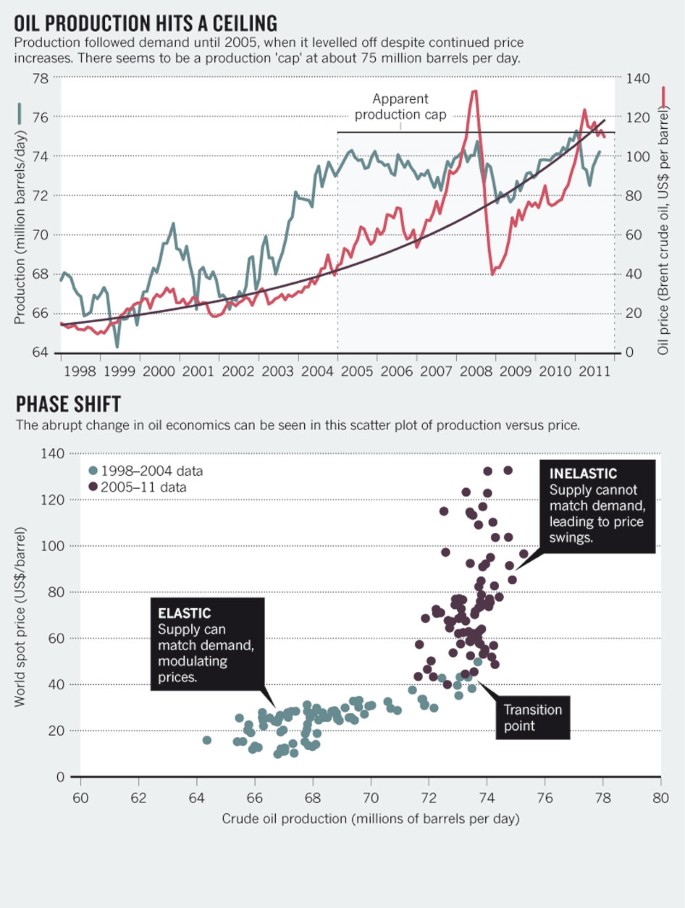
figure 1

The economic pain of a flattening supply will trump the environment as a reason to curb the use of fossil fuels, say James Murray and David King.

In many parts of the world, particularly the United States, continuing debates about the quality of climate-change science and doubts about the scale of negative environmental impacts have held back political action against rising greenhouse-gas emissions. But there is a potentially more persuasive argument for lowering global emissions: the impact of dwindling oil supplies on the economy.

There is less fossil-fuel production available to us than many people believe. From 2005 onwards, conventional crude-oil production has not risen to match increasing demand. We argue that the oil market has tipped into a new state, similar to a phase transition in physics: production is now 'inelastic', unable to respond to rising demand, and this is leading to wild price swings. Other fossil-fuel resources don't seem capable of making up the difference.
Production at oil fields globally, including at the Kern River oil field in Bakersfield, California, is declining at about 4–6% a year. Credit: K. James/Bloomberg/Getty

Such major spikes in fuel price can cause economic crises, and contributed to the one the world is recovering from now. The future economy is unlikely to be able to bear what oil prices have in store. Only by moving away from fossil fuels can we both ensure a more robust economic outlook and address the challenges of climate change. This will be a decades-long transformation1 that needs to start immediately.

Production of crude oil increased along with demand from 1988 to 2005. But then something changed. Production has been roughly constant for the past seven years, despite an increase in price of around 15% per year2 (at Brent crude (London) prices) from about US$15 per barrel in 1998 to more than $140 per barrel in 2008 (see 'Oil production hits a ceiling'). The price still reflects demand: it declined to about $35 per barrel in 2009 thanks to the 2008–09 recession, and recovered along with the upturn in the global economy to $120 per barrel before declining to its value today of $111. But the supply chain has been unable to keep pace with rising demand and prices.

The idea of 'peak oil' — that global production will reach a peak and then decline — has been around for decades, with academics arguing about whether this peak has already passed or is yet to come. The typical industry response is to point to increasing assessments of global reserves — the amount known to be in the ground that can be produced commercially. But this is misleading. The true volume of proven global reserves is clouded by secrecy; forecasts by state oil companies are not audited and seem to be exaggerated3. More importantly, reserves often take 6–10 years to drill and develop before they become part of supply, by which time older fields have become depleted. It is far more sensible to look instead at actual production records, which are less encouraging. Even while reserves are apparently increasing, the percentage available for production is going down. In the United States, for example, production as a percentage of reserves has steadily decreased from 9% in 1980 to 6% today2. Production at existing oil fields around the world is declining at rates of about 4.5% (ref. 4) to 6.7% per year5. Only by adding in production from new wells is overall global production holding steady.

In 2005, global production of regular crude oil reached about 72 million barrels per day. From then on, production capacity seems to have hit a ceiling at 75 million barrels per day. A plot of prices against production from 1998 to today2 shows this dramatic transition, from a time when supply could respond elastically to rising prices caused by increased demand, to when it could not (see 'Phase shift'). As a result, prices swing wildly in response to small changes in demand. Other people have remarked on this step change in the economics of oil around the year 2005, but the point needs to be lodged more firmly in the minds of policy-makers.

Easy access

We are not running out of oil, but we are running out of oil that can be produced easily and cheaply. The US Energy Information Administration optimistically projects a 30% increase in oil production between now and 2030 (ref. 2). All of that increase is in the form of unidentified projects — in other words, oil yet to be discovered. Even if production at existing fields miraculously stopped declining, such an increase would require 22 million barrels per day of new oil production by 2030. If realistic declines of 5% per year continue, we would need new fields yielding more than 64 million barrels per day — roughly equivalent to today's total production. In our view, this is very unlikely to happen.

Non-conventional oil won't make up the difference. Production of oil derived from Canada's tar sands — sometimes called the 'oil junkie's last fix' — is expected to reach just 4.7 million barrels per day by 2035 (ref. 6). Production from Venezuela's tar sands is currently less than 2 million barrels per day7, with little prospect of a dramatic increase.

Many believe that coal will be the solution to our energy needs, and will stay cheap for decades. But several recent studies suggest that available coal is less abundant than has been assumed. US coal production peaked in 2002, and world coal-energy production is projected to peak as early as 2025 (ref. 8). Whenever coal-reserve figures are updated, the estimates are usually revised downwards: estimates of world reserves (79% of which are held in the United States, Russia, India, China, Australia and South Africa) were decreased by more than 50% in 2005, to 861 gigatonnes (ref. 9). That study put the ultimate production of coal (the total amount that humanity will be able to extract from the ground) at 1,163 gigatonnes. A 2011 independent estimate of ultimate production came to just 680 gigatonnes (ref. 10), some 40% lower than the 2005 figure and about five times less than assumed by some older, high-coal-consumption scenarios of the Intergovernmental Panel on Climate Change. The US National Research Council's Committee on Coal Research, Technology, and Resource Assessments to Inform Energy Policy noted in 2007 that “present estimates of coal reserves are based upon methods that have not been reviewed or revised since their inception in 1974 ... updated methods indicate that only a small fraction of previously estimated reserves are actually mineable reserves.”11

Natural gas is still abundant and large discoveries have been made recently, notably in Israel and Mozambique last year. Power plants using natural gas provide 25%, and rising, of electricity generation in the United States. Production of conventional natural gas in North America peaked in 2001 (ref. 2), but energy companies have worked hard to promote the idea that hydraulic fracturing of shale rock will lead to 'the age of natural gas'. There is no doubt that US shale-gas resources are immense, but recent reports suggest that both reserves and future production rates have been substantially overstated12. For sites such as the Barnett and Fayetteville shales, where a long production history can be studied, there has been an extremely large annual decline in production rates. Geological consultant Arthur Berman, director of Labyrinth Consulting Services in Sugar Land, Texas, and a world expert on shale gas, has put this decline in the range of 60–90%. For shale-gas wells that are more than five years old, about 30% are sub-commercial because of rapid decline combined with the low price of gas.

Stunted growth

What does this mean for the global economy, which is so closely tied to physical resources? Of the 11 recessions in the United States since the Second World War, 10, including the most recent, were preceded by a spike in oil prices13. It seems clear that it wasn't just the 'credit crunch' that triggered the 2008 recession, but the rarely-talked-about 'oil-price crunch' as well. High energy prices erode family budgets and act as a head wind against economic recovery.

The United States and Europe each spends $1 billion per day on oil imports. The average price of petrol in the United States increased from 75 cents per litre in 2010 to 95 cents per litre in 2011. Because the United States consumes about 1.4 billion litres per day, the nation spent about $280 million a day more on petrol in 2011, leaving less for discretionary items.

The price of oil is likely to have been a large contributor to the euro crisis in southern Europe.

Another powerful example of the effect of increasing oil prices can be seen in Italy. In 1999, when Italy adopted the euro, the country's annual trade surplus was $22 billion. Since then, Italy's trade balance has altered dramatically and the country now has a deficit of $36 billion. Although this shift has many causes, including the rise of imports from China, the increase in oil price was the most important. Despite a decrease in imports of 388,000 barrels per day compared with 1999, Italy now spends about $55 billion a year on imported oil, up from $12 billion in 1999. That difference is close to the current annual trade deficit. The price of oil is likely to have been a large contributor to the euro crisis in southern Europe, where countries are completely dependent on foreign oil.

The International Energy Agency has made it very clear that the global economy is at risk when oil prices are greater than $100 per barrel — as they have been in recent years, and will surely continue to be, given the inelastic response of global production.

Historically, there has been a tight link between oil production and global economic growth. If oil production can't grow, the implication is that the economy can't grow either. This is such a frightening prospect that many have simply avoided considering it. The International Monetary Fund, for example, still projects economic growth of 4% of gross domestic product for the next five years: near the top of the historical range since 1980. Yet to achieve that will require either a heroic increase in oil production of 3% per year, increased efficiency of oil use, more energy-efficient growth or rapid substitution of other fuel sources. Economists and politicians continually debate policies that will lead to a return to economic growth. But because they have failed to recognize that the high price of energy is a central problem, they haven't identified the necessary solution: weaning society off fossil fuel.

The UK Industry Taskforce on Peak Oil and Energy Security and the UK government's Department of Energy and Climate Change are very aware of these risks, and have made a commitment to work together to protect the United Kingdom and its economy from rising oil prices. The task force, formed in 2008, warned that Britain must not be caught out by the oil crunch, and said that policies to address 'peak oil' must be made a priority. In 2011, its chairman, John Miles of architects and design engineers Arup in London, said: “We must define the risks and develop sensible contingency plans. This means thinking critically about what we should be doing now if we knew that the oil price would soar over the next five years.” Such joint industry/federal government recognition of the problem does not exist in the United States, where action has largely been at the state or city level. The UK government has embedded by parliamentary statute a commitment to decrease carbon dioxide emissions by 80% by 2050 compared with 1990 levels. The US Congress has rejected any such commitment.

Faster action

Climate change and changes in fossil-fuel production are generally seen as separate phenomena. But they are closely linked. The risk of fossil-fuel supply limitation should be included when considering the uncertainties of future climate change. The approaches needed for tackling the economic impacts of resource scarcity and climate change are the same: moving away from a dependence on fossil-fuel energy sources. Whereas the implications of climate change have driven only slow policy responses, economic consequences tend to drive shorter-term action. We know from the historical record that when there are oil-price spikes, the economy begins to respond within a year. Governments that fail to plan for the decline in fossil-fuel production will be faced with potentially major blows to their economies even before rising sea levels flood their coasts or crops begin to fail catastrophically.

The solutions are not secret or mysterious. Globally we get 55 × 1018 joules of useful energy from 475 × 1018 joules of primary energy from fossil fuels, biomass and nuclear power plants. The difference is due to energy losses and inefficiencies in the conversion and transmission processes. By increasing the efficiency, we could get the same useful energy by burning less fuel. We need to specify conservation goals for improving the efficiency of use of fossil-fuel energy. These include taxing oil to keep prices high and to encourage a reduction in energy use; encouraging nuclear energy; questioning if and how economic growth can continue without an increase in fossil fuels; lowering speed limits on roads and encouraging public transport; or redirecting tax credits towards renewable-energy development. The transformation will take decades, so we must begin as soon as possible. Emphasizing the short-term economic imperative from oil prices must be enough to push governments into action now.
Referências aqui