Mostrar mensagens com a etiqueta Paul Ehrlich. Mostrar todas as mensagens

quinta-feira, 16 de abril de 2026

Measuring Ecological Limits: The United States and the World


The science is clear: Our rate of economic activity is having disastrous impacts on the environment, starting with the climate so crucial to our survival. Economic activities require the use of natural resources and systematically entail pollution. Resources eventually get used up, as does the capacity of the planet to assimilate waste. We are reminded of Herman Daly’s long-running emphasis that the economy is a subsystem of the environment, not the other way around.

Expanding on this, steady-state economists and other post-growth advocates argue that economic growth cannot be decoupled from material throughput. This can be explained with the trophic theory of money, which follows from the trophic structure of the economy of nature. Agriculture and extraction comprise the trophic foundation of the economy, and all other sectors rely on that trophic base. Therefore, we cannot rely on “dematerialized” sectors to grow the economy while decreasing its disastrous impacts on the environment.

Therefore, consumption must be reduced, particularly in high-income countries that consume more natural resources and release more waste. But just how much do high-income countries need to reduce their economic activity to be sustainable? Two metrics help us understand sustainable limits by quantifying the relationship between the environment and the economy: ecological footprint and biocapacity.

The Conceptual Framing of Ecological Footprint and Biocapacity
The ecological footprint is a measure of the area needed to support the demands of economic activity. Biocapacity is a measure of the area available to supply natural resources and absorb waste at a sustainable rate. When the ecological footprint exceeds biocapacity, that indicates ecological overshoot. The Ecological Footprint Initiative has been measuring global ecological footprint and biocapacity since 1961. We have been in overshoot since 1971.

The ecological footprint and biocapacity are made up of comparable components, including cropland, grazing land, forest land, fishing grounds, and built-up land. In addition, ecological footprint includes a carbon component.

Scientists measure ecological footprint and biocapacity with a unit called the global hectare. They convert the productivity of different ecosystems to global hectares based on the world average productivity of a hectare. This enables comparisons between different land types, places, and years.
Ecological Footprint and Biocapacity of the United States

The United States has a high ecological footprint that is larger than its biocapacity. In 2022, there were roughly one billion hectares across the United States. When categorized into the biocapacity components and compared to global average productivity, this equates to 1.25 billion global hectares (gha) of biocapacity.

In other words, U.S. land, most notably cropland and forest land, was more productive than the global average. The average biocapacity of one hectare of U.S. cropland was 3.7 gha. One hectare of forest land provided an average of 1.6 gha of forest land biocapacity. However, this above-average biocapacity of cropland and forest land does not indicate sustainability. The country’s total ecological footprint is far higher than its total biocapacity.

In 2022, the U.S. ecological footprint of production was over 2.5 billion gha. This was similar to the ecological footprint of consumption, because the footprints of imports and exports were nearly equal. However, there were differences among the footprint components of imports and exports. The carbon component was more prominent in the ecological footprint of imports, whereas the cropland component was more prominent in exports. This means the United States imported more carbon-intensive goods and services than it exported, and exported more cropland-intensive harvests than it imported.
U.S. Trends: Better or Worse?

One good sign is that total U.S. biocapacity has been increasing over time. In 1961, total biocapacity was just over 1 billion gha, and by 2024, biocapacity had grown to 1.3 billion gha (2023 and 2024 data were forecasted).1 This is because of increases in agricultural productivity. Biocapacity is a measure of what the environment can provide for human use, not of biodiversity or ecosystem health. In fact, it has a negative correlation with biodiversity indicators. Cropland illustrates this tension well, as using fertilizers and chemicals can increase agricultural productivity at the expense of ecosystem health.

The U.S. population has also been increasing over time, which has decreased biocapacity per person. In 1961 biocapacity was 5.7 gha/person, and in 2022 was 3.8 gha/person.

Meanwhile, the U.S. ecological footprint of consumption has been increasing. In 1961 it was 1.6 billion gha, and by 2024 it reached 2.5 billion gha. Counteracting that increase to some degree is the per-person ecological footprint of consumption, which has decreased in recent years. In 1961, it was 8.9 gha/person, and in 2022, it was 7.9 gha/person. Although this is not a huge reduction, it provides a glimmer of hope that the country can reduce its footprint per person to offset population growth. However, it would need a very sizeable reduction to retreat to the safe operating space of its biocapacity.

In summary, the best available ecological footprint and biocapacity science reveals that the United States is exceeding a sustainable level of resource use for the production and consumption of goods and services. In 2022, the ecological footprint of consumption was 7.9 gha/person, and biocapacity was 3.8 gha/person. Ecological footprint is more than double biocapacity, meaning that economic activity is (over) two times the amount the United States can sustain. And with its outsized carbon footprint, the American economy is impacting the biocapacity of ecosystems on Earth.
Diving Into the Footprint Details

The carbon component makes up 64 percent of the ecological footprint embodied in the consumption of goods and services in the United States. Almost all of this carbon component (95 percent) comes from fossil fuel emissions. The largest share of these emissions (37 percent) comes from transport, of which road transport constitutes the majority. The next-largest share of U.S. carbon emissions (34 percent) comes from public and private utility companies producing electricity and heat for sale to third parties.

For many people, these details highlight the importance of decarbonizing electricity and heat generation and shifting transportation to less emissions-intensive modalities, such as rail. However, the emissions reductions needed to bring the United States back within its biocapacity are so immense that “green” alternatives aren’t sufficient. Americans must also reduce consumption of electricity and heat, as well as the distance they travel, because “green growth” is not possible.

In 2022, cropland made up 18 percent of the U.S. ecological footprint of consumption. Of the cropland ecological footprint, 84 percent was used for crops consumed by people and pets, 15 percent was used to feed livestock, and less than 0.5 percent was used to feed fish. Almost 700 million metric tons of crops were harvested, and just over half was maize. The second most harvested crop was soybeans at 17 percent of total harvests.

Yet the proportion of ecological impact does not equal the proportion of total harvests. For instance, maize made up 52 percent of crop harvests (metric tons) and 43 percent of the cropland ecological footprint of production (gha) in 2022. On the other hand, soybeans accounted for 17 percent of harvests (metric tons) and 32 percent of cropland ecological footprint of production (gha). Therefore, soybeans had almost double the ecological impact per metric ton of harvest in the United States.
The United States in the Global Context

The United States consumes far more than its share of the Earth’s natural resources. The global average ecological footprint of consumption was 2.7 gha/person in 2022. The United States crushed that benchmark at 7.9 gha/person. The average U.S. citizen consumed resources at almost three times the rate of the average global citizen.

Here’s another way of thinking about this: The United States is responsible for twelve percent of the world’s ecological footprint of consumption. Yet the U.S. population only amounts to four percent of the world population. This represents a highly disproportionate environmental impact.

The U.S. ecological footprint per person is even higher than that of most other high-income countries. The average ecological footprint of consumption in high-income countries is 6.1 gha/person.

There are important debates about best practices for presenting ecological footprint and biocapacity data. Often, the ecological footprint of a territory is compared to the biocapacity of that territory. For example, U.S. ecological footprint is compared to U.S. biocapacity. This implies that a country achieves sustainability if its ecological footprint is lower than its biocapacity.

Many criticize this approach as an unfair representation of sustainability, because some countries are blessed with exceptionally high biocapacity. For instance, in 2022, the ecological footprint in Canada was 8.4 gha/person, and the biocapacity was 14.4 gha/person. Canada’s biocapacity was clearly higher than its ecological footprint. However, its ecological footprint per person was in the top ten highest in the world. Therefore, perhaps it is also important to compare a country’s ecological footprint to world average biocapacity (global ecological balance) in addition to the country’s biocapacity (local ecological balance).

In 2022, global biocapacity was 1.5 gha/person, significantly lower than the U.S. ecological footprint of 7.9 gha/person. In other words, U.S. citizens consume resources and emit carbon at five times the global average sustainable rate.

Ecological footprint and biocapacity data illustrate that we are using natural resources and releasing waste at unsustainable rates, in the United States and around the world. It shows that this has been happening for decades. The United States and other high-income countries are disproportionately responsible for this state of overshoot. They must pump the brakes on resource consumption and waste emissions if we are to exist within local and global sustainable limits. They must pump the brakes, in other words, on the economy.


Saber mais: 
Vídeomensagem de Brian Czech explicando o conceito Trophic Theory of Money

segunda-feira, 30 de março de 2026

Earth's Population Has Surpassed The Planet's Capacity


The Earth has already exceeded its ability to support the global population sustainably, with new research warning of increasing pressure on food security, climate stability, and human wellbeing. However, slowing population growth and raising global awareness could still offer humanity some hope.

Published in Environmental Research Letters, the study shows that humans have pushed well beyond the planet’s long-term capacity and that continued growth under current patterns of consumption will intensify environmental and social challenges for communities worldwide.

The research examined more than two centuries of global population data and uncovered a major shift in human population dynamics that began in the mid-twentieth century.

Lead author, Matthew Flinders Professor of Global Ecology Corey Bradshaw, from Flinders University says the trend reveals a clear biological signal that humanity is living far beyond what the Earth can support.

“Earth cannot keep up with the way in which we are using resources. It cannot support even today’s demand without major changes, with our findings showing that we are pushing the planet harder than it can possibly cope,” says Professor Bradshaw from the Global Ecology Laboratory in the College of Science and Engineering.

The researchers, including distinguished Professor Paul Ehrlich who recently passed away, analysed more than two hundred years of global population records and used ecological growth models to track how population size and growth rates have changed over time.

They tested the direction of these trends and compared results across world regions. They also measured how population size has historically aligned with changes in climate, emissions, and the ecological footprint to understand how human numbers cause environmental stress.

The study found that before the 1950s, global population growth actually sped up as human abundance increased. More people meant more innovation, more energy use, and more rapid technological development that supported further expansion.

However, this pattern broke down in the early 1960s when the global growth rate began to fall even as the population continued to rise.

“This shift marked the beginning of what we call ‘a negative demographic phase,” says Professor Bradshaw.

“It means that adding more people no longer translates into faster growth. When we examined this phase, we found the global population is likely to peak somewhere between 11.7 and 12.4 billion people by the late 2060s or 2070s if current trends hold.”

Professor Bradshaw says this upper limit is dangerous and has only been possible to date because human societies have relied on fossil fuels and drained natural resources faster than nature can replace them.

“The truly sustainable population is much lower and closer to what the world supported in the mid-twentieth century. Our calculations show a sustainable global population closer to about 2.5 billion people if everyone were to live within ecological limits and comfortable, economically secure living standards,” he says.

The researchers say the enormous gap between that sustainable number and today’s population of now 8.3 billion highlights the scale of global overconsumption. They argue that this overshoot has been hidden for decades by heavy reliance on fossil fuels, which boosted food production, energy supply, and industry, but also accelerated climate change and pollution.

The study shows a strong link between increasing population size and rising global temperatures, larger ecological footprints, and higher carbon emissions during the negative phase. Total population size explained more variation in these environmental indicators than per-capita consumption.

Professor Bradshaw says this highlights how both human numbers and consumption patterns jointly intensify environmental stress. “Humanity’s current path will push societies into deeper crises unless we make major changes,” he says.

“The planet’s life support systems are already under strain and without rapid shifts in how we use energy, land, and food, billions of people will face increasing instability. Our study shows these limits are not theoretical but unfolding right now.”

The researchers stress that the study does not predict sudden collapse, but instead offers a realistic assessment of the long-term pressures shaping humanity’s future. The consequences of overshooting Earth’s ‘biocapacity’ include stronger climate impacts, declining biodiversity, reduced food and water security, and widening inequality.

Professor Bradshaw says society must rethink how it uses land, water, energy, and materials if future generations are to live safe and stable lives.

“Smaller populations with lower consumption create better outcomes for both people and the planet,” he says. “The window to act is narrowing, but meaningful change is still achievable if nations work together.”

The team hopes the findings encourage governments, organisations, and communities to plan for the long term, recognise Earth’s environmental limits, and focus on strategies that reduce consumption, stabilise population, and protect natural systems.

“The choices we make over the coming decades will determine the wellbeing of future generations and the resilience of the natural world that supports all life,” concludes Professor Bradshaw.

Acknowledgements:

The Kids Research Institute Australia and Population Matters supported various aspects of the project.

The paper, ‘‘Global human population has surpassed Earth’s sustainable carrying capacity’ by Corey J.A. Bradshaw, Melinda A. Judge (University of Western Australia), Daniel T. Blumstein (University of California, USA), Paul R. Ehrlich (Stanford University, USA), Aisha N. Dasgupta (University of Cambridge, UK), Mathis Wackernagel (University of California, USA), Lewis J.Z. Weeda (University of Western Australia) and Peter N. Le Souëf (University of Western Australia) was published in Environmental Research Letters. DOI: 10.1088/1748-9326/ae51aa

sexta-feira, 14 de novembro de 2025

E.O.Wison e a renaturalização

"There can be no purpose more enspiriting than to begin the age of restoration, reweaving the wondrous diversity of life that still surrounds us." We have ancient and new born trees, according to old registrations.
A walk in our preserved forest makes us feel quite proud, and it's all thanks to nature. Finally : the true meaning of life is to plant native trees, under whose shade you do not expect to sit. Hope our legacy will continue for next generations!

Últimas Novidades

domingo, 14 de abril de 2024

Ted Trainer - A (Friendly) Critique of the Degrowth Movement

Over many years I have put forward a vision of The Simpler Way, and introduced visiting groups to it at Pigface Point.


The above video includes models of a typical suburb before and after such changes have been made.

The explosion of interest in degrowth since 2000 has seen the development of a large literature, international conferences, and many active groups spread around the world.

This is astounding, given that pioneers such as Georgescu-Roegen, Paul Ehrlich, Serge Latouche, and Herman Daly worked for decades to draw attention to the possibility that the pursuit of limitless growth and affluence might be problematic — and they were largely ignored. In the early 1970s, The Limits to Growth made quite an impact, but did not go into possible alternative social goals or forms. My book, Abandon Affluence and Growth (1985), summarized the case and argued that the only solution has to be transition to a Simpler Way. For the following 20 years these few works had almost no impact on mainstream thinking about the commitment to growth.

The recent spread of degrowth is encouraging — however, the movement is founded on a number of confusions and mistaken initiatives. This is understandable given its early stage, and can be regarded as a healthy exploring of possibilities. The literature welcomes ‘pluralism’, but we should be trying to find unifying directions.
The current focus of the degrowth movement

The focus within the degrowth movement has (understandably) been on why the pursuit of growth is a huge mistake, and little attention has been given to two crucial themes. One is strategy: this lack is recognised within the movement, and I discuss it at length in the current edition of Environmental Values. The other, which has received almost no attention, is the concept of simplicity. The defining principle of a society that has undergone degrowth to a sustainable and just state must be transition to far simpler lifestyles and systems.

First, the issue of definition; what is degrowth about, and what should it be about? The term is not a good descriptor for the movement that has emerged. The movement is asserting a wild variety of criticisms of and alternatives to the present globalized, industrialized, urbanized, financialized, neo-liberal, sexist, grotesquely unequal, extractivist, imperialist etc. world order. The expressed goals include all manner of social criticisms, ideals, and policies, ranging from mildly reformist to ultra radical. Many of these — such as monetary reform, making trade more equitable, housing justice, patriarchy, curbing advertising, fairer taxes, reducing debt, indigenous rights, and decolonization — actually have nothing to do with the reduction of economic growth, or could easily be implemented within an economy that continues to be about growth.

Degrowth should, instead, be seen in terms of a concern to reduce resource consumption and environmental impact, which means it is essentially about one thing, which is reducing GDP. It is in order for many sub-goals and domains to be seen as existing under this umbrella, as fields of endeavor relevant to the general quest or for which it has implications.

Thus the term degrowth has become ‘… a rag-bag of utopian dreams’. A more accurate title might be the ‘Finally Fed Up With Capitalism’ movement. All manner of ideals, dreams, alternate policies in a wide variety of fields have been put forward as degrowth proposals. This is highly desirable because it shows that discontent with consumer-capitalist society is finally boiling over. For 70 years its legitimacy and desirability have been largely unquestionable. But now the dominant paradigm is crumbling, evident in the weakening capacity of the rich countries to control the global geo-physical imperial system, the emergence of intractable resource scarcities and environmental problems, accelerating rates of inequality generating hardship and ‘cost of living’ difficulties, rising levels of debt etc. There is increasing realization that the system is causing the big global problems, notably climate change, that it can’t solve them and that it needs to be replaced.

Probably even more serious is the social situation, the loss of cohesion being caused by the inevitable march of capitalism, the deprivation and discontent accompanying rising inequality, and the decreasing capacity of governments to meet demands or provide for people. Large numbers in even the richest countries are poor or homeless. Thirty percent of Australians are reported to be going without sufficient food. The number one health problem in rich countries now is likely to be depression. The UK government recently established a ministry for loneliness. Large proportions of people are losing respect for ‘democracy’ and turning towards authoritarian and fascist options.

These many and varied discontents can be welcomed as undermining the complacency that characterized previous decades. But the scene is quite confused and chaotic, especially with respect to causes and solutions, and this is reflected within the degrowth movement. Even among degrowth advocates there is little realization that the multifactored global predicament cannot be resolved unless there is an extremely big and difficult revolution whereby most of the elements within our present economic, political, and cultural systems are scrapped and replaced by radically different systems. The crucial point here is that the new lifestyles and systems must be materially very simple. Little of the degrowth literature recognizes this, let alone focuses on it. Most of it proceeds as if we can all go on living more or less as we do now, with more or less the same kinds of ways and institutions that we have now, via reformed institutions and better policies. The degrowth movement does not recognize that the magnitude of the overshoot, the degree of unsustainability, of present society, totally prohibits that. To recognize this would decisively focus thinking about goals and strategies, and rule out many currently popular options.

The global situation
Most people do not grasp the extent to which this society has become unsustainable. We have far exceeded the limits to growth. There is no possibility that the per capita levels of resource consumption in rich countries can be kept up for long. Only a few of the world’s people have these ‘living standards’ and the rest can never rise to anything like them. This is the basic cause of the big global problems, including resource depletion, environmental damage, the deprivation of billions in the poor countries, and resource struggles.

There is a strong case that if we are to live in sustainable ways that all could share then rich world per capita rates of consumption must be reduced by 90 percent. The common response is the ‘tech-fix’ claim that technical advance will enable GDP growth to be ‘decoupled’ from resource and environmental impact. But there is now overwhelming evidence that apart from in some limited areas this is not happening and is not going to happen. (Haberle’s review examined over 800 studies.) If GDP is increased, impacts increase. It is not possible to solve the big problems if we are determined to maintain present levels of consumption and production — the solution can only be found on the demand side; that is, by greatly reducing production and consumption.

A major cause of our predicament is the fact that we have an economic system which must have growth and which allows the market and profit to determine what happens. As a result, what is produced, who gets it and what is developed, is determined by what is most profitable to the few who own most of the capital. The outcome is not determined by what is most needed. That is why the one percent now own about half the world’s wealth, and the poor countries have been ‘developed’ into a form which ships their resources out to enrich the corporations and rich world shoppers, while most people in even the richest countries struggle to get by.

The crucial point is that we have to try to shift to values and ways that enable all to live well on a very small fraction of the per capita resource and environmental impacts we in rich countries have now. We cannot achieve a sustainable way of life which all could share unless there is an enormous degrowth transition to far simpler lifestyles and systems. The magnitude of the required Degrowth is not sufficiently recognised within the movement. Nor are the implications for social change; because the over-shoot is so big that only change to extremely different lifestyles and systems can solve the big global problems.

segunda-feira, 25 de setembro de 2023

Ações humanas estão a eliminar “ramos inteiros da árvore da vida”

Um par de lobos-da-tasmânia no Zoológico de Hobart antes de 1921

A extinção em massa provocada pelo ser humano está a eliminar espécies, mas também “ramos inteiros da árvore da vida”, alertam os autores de um estudo da Universidade norte-americana de Stanford.

Uma análise feita em conjunto com a Universidade Nacional Autónoma do México, publicada na revista científica Proceedings of the National Academy of Sciences, mostra que os humanos estão a fazer desaparecer espécies, mas também géneros, a categoria superior em que os taxonomistas classificam os seres vivos.

Os cientistas dão como exemplo três vítimas recentes do que muitos consideram ser a sexta extinção, uma vez que as ações humanas estão a eliminar espécies de animais vertebrados centenas de vezes mais depressa do que se não existissem essas ações.

Falam do pombo-passageiro, uma espécie extinta no início do século passado e que era endémica da América do Norte, falam do lobo da Tasmânia, um marsupial da Austrália também extinto no século passado, e falam do Baiji, o golfinho do rio Yang-tze, na China, uma das espécies de golfinho de água doce e também extinto. Cada uma destas espécies foi também o último membro do seu género.

Até agora, o interesse público e científico tem incidido na extinção das espécies. Mas no estudo agora divulgado, Gerardo Ceballos, da universidade mexicana, e Paul Ehrlich, de Stanford, descobriram que géneros inteiros também estão a desaparecer, naquilo a que chamam uma “mutilação da árvore da vida”.

“A longo prazo, estamos a fazer uma grande mossa na evolução da vida no planeta”, diz Gerardo Ceballos, alertando que por isso, neste século, se vai causar “muito sofrimento à humanidade”.

Paul Ehrlich, noutra abordagem, salienta que as ações do Homem estão a fazer com que este perca os únicos companheiros vivos conhecidos em todo o universo.

Os dois investigadores usaram bases de dados de entidades como a União Internacional para a Conservação da Natureza ou a “Birdlife International” e examinaram 5.400 géneros de animais vertebrados terrestres, abrangendo 34.600 espécies.

E concluíram que desde o século XV foram extintos 73 géneros de vertebrados terrestres, com as aves a sofrerem as maiores perdas, com 44 géneros extintos, seguindo-se os mamíferos e depois os anfíbios e depois os répteis.

Com base na taxa histórica de extinção de géneros entre os mamíferos, estimam os responsáveis que a atual taxa de extinção de géneros de vertebrados exceda em 35 vezes a do último milhão de anos.

Ou seja, sem a influência humana, a Terra teria perdido apenas dois géneros nesse período. Em cinco séculos as ações humanas extinguiram géneros que sem elas levariam 18.000 anos a desaparecer.

“Como cientistas, temos de ter cuidado para não sermos alarmistas”, afirma Gerardo Ceballos, acrescentando que a gravidade das descobertas exige “uma linguagem mais forte do que o habitual”.

“Não seria ético não explicar a magnitude do problema, uma vez que nós e outros cientistas estamos alarmados”.

O responsável explica que a muitos níveis as extinções de géneros são mais graves do que as extinções de espécies, porque quando uma espécie se extingue outra do mesmo género pode preencher esse papel no ecossistema. Em termos de árvore da vida é como se um único galho caísse e à sua volta outros se ramificassem.

O pior, acrescenta, é quando ramos inteiros (géneros) caem, o que “deixa um enorme buraco na copa das árvores” que pode demorar milhões de anos a ser tapado.

“A humanidade não pode esperar tanto tempo pela recuperação dos seus sistemas de suporte de vida”, já que “a estabilidade da nossa civilização depende dos serviços prestados pela biodiversidade da Terra”, frisa.

Gerardo Ceballos dá o exemplo da doença de Lime (transmitida por carrapatos), que está a aumentar: os ratos de patas brancas, principais portadores da doença, costumavam competir com os pombos-passageiros por alimentos e com o desaparecimento destes as populações de ratos aumentaram e com eles os casos da doença.

Neste caso, está envolvido o desaparecimento de um único género, mas uma extinção em massa de géneros pode significar uma explosão proporcional de desastres para a humanidade, avisa o responsável.

Para se evitarem novas extinções e consequentes crises sociais, os dois investigadores apelam a uma ação política, económica e social imediata e a uma escala sem precedentes.

Os esforços de conservação, dizem, devem ser prioritários nas regiões tropicais, uma vez que estas apresentam a maior concentração de extinções de géneros e de géneros com apenas uma espécie remanescente.

De acordo com o sistema que organiza os seres vivos, a espécie é definida como um grupo de organismos que se podem reproduzir e originar novos seres e o género é um conjunto de espécies.

segunda-feira, 29 de maio de 2023

Problemas modernos requerem perspetivas antigas


Por João Abegão
Aqueles que buscam uma educação ecológica olham para as vozes do passado e não desprezam as suas perceções da realidade, por mais deslocadas que estas estejam das inclinações sociopolíticas da época. Se as ignorarmos acabaremos seguramente mais sós, num mundo repleto de cicatrizes, cravadas justamente pelas nossas próprias mãos.

“Uma das consequências de uma educação ecológica é que se vive sozinho num mundo de cicatrizes.”

Um ano após a sua morte em 1948, estas palavras viriam a fazer parte do grande êxito póstumo de Aldo Leopold, ‘A Sand County Almanac and Sketches Here and There’ (1949).

Para um homem que começou carreira como responsável pela gestão de predadores que ameaçavam o gado (eufemismo para “diminuição ou extermínio de populações locais”), a epifania de Leopold continua a proporcionar um caso dramático de redenção.

Leopold reconheceu o papel fundamental das espécies de predadores, que deveria caçar, desempenhavam nas comunidades bióticas, o que o levou a desafiar a ortodoxia da época. Um dos exemplos mais célebres é a aniquilação de carnívoros, como o lobo ou o urso, o que levou ao aumento do número de herbívoros que, por sua vez, alterou a vegetação, através do sobrepastoreio.

Aquilo que era naturalmente ‘selvagem’ deveria permanecer intacto
Palavras como as que abrem este artigo ecoavam uma narrativa recalcada pelo silêncio, na sequência da perda de outras espécies, e de uma pegada humana cada vez mais dominante. Leopold percebeu que aquilo que era naturalmente ‘selvagem’ deveria permanecer intacto de forma a desempenhar o seu papel num todo interligado e complexo.

O problema agravava-se com o cerco perene que a humanidade mantinha numa biosfera que, manifestamente, estava a fracassar na sua resistência contra esta força em contínua expansão. Porém, através das suas observações (e do trabalho de outros cientistas da época), uma nova ética ambiental, bem como um movimento de conservação do meio selvagem, emergiram, influenciando profundamente ambientalistas da época e de gerações futuras.

Considero-me entre aqueles que foram não só influenciados por Leopold, mas por outros nomes da velha guarda conservacionista, como John Muir, Henry David Thoreau ou George Perkins Marsh. Todos eles, em alguma altura da sua vida, se pronunciaram contra a narrativa antropocentrista e do avanço implacável da civilização humana sob a égide do progresso, em detrimento daquilo que é natural e selvagem. As suas visões vieram a moldar a insurreição ambientalista do pós-guerra, que contava agora com outros contributos teóricos como os de Rachel Carson, Paul R. Ehrlich, William Vogt, Garrett Hardin, Herman Daly, Kenneth Bouding e o Clube de Roma.

Entre eles, estes autores chamaram à atenção para um manancial de questões. A fragilidade do meio natural face à atividade humana crescente, o efeito multiplicativo de todos os problemas ambientais subjacentes a uma população em crescimento e o dilema de providenciar um estilo de vida mais abastado a toda a população, que por sua vez gera maior impacto ambiental per-capita. Também foi destacado o movimento de populações de países com economias em desenvolvimento para outras sobre desenvolvidas, tendendo a adquirir os seus padrões de consumo mais elevados, e os limites intrínsecos dos sistemas planetários, que serão ultrapassados enquanto se mantiver o crescimento tanto da economia como da população.

O movimento ambiental nas décadas de 70 e 80
Em poucas palavras, nas décadas de 70 e 80, era perfeitamente normal para o movimento ambiental advogar a contração da população mundial, restrições migratórias para países sobre desenvolvidos, a necessidade de um novo sistema económico baseado num modelo estacionário e a consciência que não poderia existir tal coisa como crescimento perpétuo num sistema finito e interligado como o nosso planeta.


Uma das equações que sustentava este movimento ambiental era a avançada por Ehrlich & Holdren, em 1971. Esta descrevia, claramente, que o Impacto ambiental (I) era o resultado do tamanho de uma População (P), que teria um certo nível de consumo ou Afluência (A), que por sua vez era determinado pela intensidade de produção aliada à Tecnologia (T), ou I = PAT.

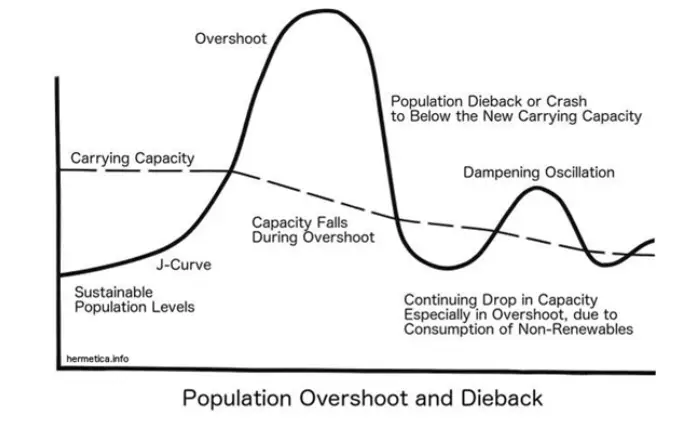
Quando o impacto ultrapassasse a capacidade de carga (‘carrying capacity’, outro tema popularizado por Leopold) dar-se-ia uma sobrecarga (overshoot), um estado de degradação ecológica que não só leva a um reequilíbrio no tamanho da população, mas também a uma redução da capacidade de carga total, para um nível inferior ao inicial.

A questão que se coloca aqui é: quando é que foi a última vez que o movimento ambiental moderno se pronunciou relativamente a estes pilares da ecologia e sustentabilidade? É sabido que o Sierra Club - uma das primeiras organizações não governamentais dedicadas ao ambiente e fundada por John Muir no final do século XIX – manteve uma posição de restrição migratória para os Estados Unidos, em prol da conservação, durante a maior parte da sua história. Em 1980 a organização defendia:

“É óbvio que o número de imigrantes que os Estados Unidos aceitam afeta o tamanho da sua população e rapidez de crescimento. É possivelmente menos conhecido que uma política migratória, ainda mais que o número de crianças por família, é determinante para o número futuro de americanos.”

Esta posição manteve-se até 1996, quando pressões por parte de ativistas e disputas internas levaram a uma reforma total e ao abandono da mesma, a favor de convicções que geravam menos reprovação e repúdio por parte de membros e da sociedade em geral (o que também principiou um fenómeno de aumento de doações, que veio a determinar que tipo de projetos estas organizações estavam dispostas a manter).

O discurso ambiental sofreu uma metamorfose profunda e vincada nas alterações climáticas
O que se está a verificar com o Sierra Club é apenas um exemplo de um problema mais disseminado. São raros os casos em que organizações não governamentais ligadas ao ambiente se pronunciam sobre os temas acima descritos, preferindo, em alternativa, outros mais paroquiais e, aparentemente exequíveis, como a responsabilidade ambiental através da conservação de água, da triagem de resíduos domésticos ou a mobilidade responsável - tudo em nome das alterações climáticas.

De facto, o discurso ambiental sofreu uma metamorfose tão profunda e vincada nas alterações climáticas que, já em 2018, uma investigação reportava que por cada 20 notícias sobre a crise climática, somente uma era sobre a perda de biodiversidade. Da minha perspetiva, estes resultados são demasiado conservadores, e a realidade deverá ser um ratio muito mais divergente, visto que os ativistas dos nossos dias que continuam o legado de Leopold ou Muir, parecem ser uma espécie em vias de extinção.

É visível que o movimento ambiental aparenta ter-se reinventado, tendo tornado a luta climática como a sua missão cardinal. Se considerarmos as prioridades deste ativismo moderno, percebemos que este se transformou numa série de exigências destinadas a ‘resolver’ (em inglês usa-se o termo ‘fix’) o clima, convertendo-o num desafio de engenho e inovação.

Os exemplos mais familiares incluem a descarbonização das economias através da eletrificação das frotas automóveis, a integração de sistemas energéticos alimentados por fontes renováveis e a eficiência energética das habitações e eletrodomésticos. Contudo, existem muitas outras propostas tecnológicas como o vertical farming, o sequestro de carbono, uso de inteligência artificial e data centres para criar smart cities, ou mesmo a geoengenharia, que têm vindo progressivamente a ser acomodadas por fações mais tecno-otimistas.

Adicionalmente, uma grande parte do ativismo climático/ambiental tem vindo a adotar questões de índole social como a criação de empregos climáticos, transições justas e desenvolvimento sustentável. Muitas vezes, em simultâneo com questões de afirmação pessoal e sexual, e políticas identitárias e raciais.

Independentemente do valor intrínseco destas e outras causas, teremos certamente de admitir que as mesmas são, no mínimo, distintas, e no máximo, contraditórias à mensagem que acompanhou o advento do movimento ambiental de há meio século - a necessidade de contração de tudo o que era associado com o projeto humano, devido a limites biofísicos do planeta.

Ficaremos reféns de abordagens que têm de explorar e monopolizar o mundo natural
Não será aqui que se fará um escrutínio dos prós e contras destas ‘soluções’. Irei unicamente frisar que aquelas que estão dependentes de desenvolvimento económico e tecnológico, ou que se baseiam em melhorias de eficiência, não poderão resolver crise climática nenhuma enquanto o paradigma de crescimento da economia e da população não for desafiado. Caso contrário, ficaremos reféns de abordagens que têm de explorar e monopolizar o mundo natural de forma a providenciarem as necessidades de uma população em crescimento, que deseja subir na hierarquia de consumo e riqueza material.

A título de exemplo, as energias renováveis estão profundamente dependentes de processos industriais que não operam sem combustíveis fósseis, com cadeias de produção globais, e extração de recursos e ocupação/destruição do meio natural para sua instalação, levando a uma perda gradual do estado íntegro que Leopold favorecia.

Como o ambientalista Max Wilbert comenta num artigo recente do New York Times:
“Explodir uma montanha não é ‘verde’, por mais marketing que lhe tentem dar”.

Por outro lado, parecemos ignorar o facto que qualquer redução de custos provenientes de aumentos de eficiência não resulta em ganhos para o ambiente. A verdade é que quando as pessoas adquirem um eletrodoméstico ou umas lâmpadas mais eficientes, o dinheiro resultante dessas poupanças é investido ou gasto noutro lado, invariavelmente contribuindo para o crescimento económico e como tal, para a emissão de mais gases de efeito de estufa.

Outro processo semelhante, e que é descrito pelo Paradoxo de Jevons, revela que, quando, por exemplo, o preço da eletricidade baixa, as pessoas não tendem a reduzir o seu uso, mas sim a ser menos diligentes com a sua poupança – o que aumenta o consumo num todo.

O projeto civilizacional que a humanidade conheceu nos últimos 70 anos tem de ser abandonado
É notório que as temáticas defendidas nos primórdios do movimento ambiental, e que continuam a ser pilares da sustentabilidade, encontram-se excessivamente em falta nos nossos dias. É preciso dizer que as mesmas caíram fora de moda porque o movimento ambiental deixou de querer apregoar teses profundamente politizadas, e a deixar claro que existem sempre trade-offs em todas as nossas escolhas.

É obviamente mais fácil transmitir uma mensagem que tudo ficará bem se eliminarmos os subsídios aos combustíveis fósseis, se fizermos as maiores empresas responsáveis pagarem por uma transição “verde”, e se todos começarmos a conduzir um Tesla e a obter a nossa eletricidade de fontes renováveis. Tudo isso é mais fácil do que é dizer às pessoas que o projeto civilizacional que a humanidade ergueu e que conheceu nos últimos 70 anos, é não só prejudicial para o meio natural, como é totalmente insustentável, pelo que tem de ser abandonado (seguramente de forma involuntária).

Concisamente, os ambientalistas modernos assimilaram uma narrativa de mudança, que está profundamente dependente de tecnologias que requerem a invasão e monopolização do meio natural para que possam ser proporcionadas a uma população que não para de aumentar, e que busca, naturalmente, um estilo de vida mais confortável e abastado. De forma a distanciar-se de verdades inconvenientes, este movimento moderno pactua com ficções de desenvolvimento e progresso intermináveis, menosprezando a realidade de que habitamos um astro circunscrito por limites biofísicos.

Porém, para aqueles que decretam que a sua lealdade está para com o meio natural, este caminho só poderá resultar num cerco que não será levantado, independentemente de quantos painéis solares e eólicas forem instaladas. Aqueles que buscam uma educação ecológica olham para as vozes do passado e não desprezam as suas perceções da realidade, por mais deslocadas que estas estejam das inclinações sociopolíticas da época. Se as ignorarmos acabaremos seguramente mais sós, num mundo repleto de cicatrizes, cravadas justamente pelas nossas próprias mãos.

segunda-feira, 30 de janeiro de 2023

Sexta extinção em massa já começou e foi engatilhada por atitudes humanas

Peixes mortos no maior lago Ho Tay de Hanói em 3 de outubro de 2016

Um artigo publicado na Biological Reviews, Janeiro de 2022, alerta para a possibilidade de que a sexta extinção em massa já tenha começado. Analisando dados de crustáceos e outros invertebrados, os cientistas afirmam que não é possível encarar a extinção em massa com ceticismo.

Os pesquisadores catalogaram a extinção de diversas espécies de moluscos, incluindo caracóis, lesmas e mexilhões. O foco nesses invertebrados entra em conflito com a informação recolhida pela lista vermelha de espécies ameaçadas da União Internacional para a Conservação da Natureza (UICN).

Estudos anteriores usaram dados da UICN para refutar a noção de que estamos a entrar numa sexta extinção em massa. Robert Cowie e os seus colegas refutaram esta suposição compilando as taxas de extinção de caracóis terrestres e lesmas. O estudo comprovou que, desde 1500, é estimado que 7,5% a 13% de vertebrados tenham sido extintos. Esse nível de extinção é considerado catastrófico, e é maior do que já foi visto no passado.

De acordo com os pesquisadores envolvidos na pesquisa, a UICN não tem dados da maioria dos invertebrados, que constituem cerca de 95% da biodiversidade terrestre.

A mudança e ameaças à biodiversidade terrestre, de acordo com o artigo, foi impulsionada pela ação humana sob essas espécies.

Anteriormente, o planeta já passou por cinco extinções em massa. Porém, nenhuma tinha sido categorizada pelas mãos humanas. As extinções em massa são categorizadas como catástrofes naturais que têm a capacidade de eliminar cerca de 75% de espécies em pouco tempo. Agora, com os avanços da tecnologia que possibilitam a exploração do meio ambiente, os resultados são ainda mais catastróficos.

Embora os resultados da pesquisa indiquem que a extinção é pior em terra do que no mar, as espécies marinhas também estão sendo ameaçadas pela ação humana. É possível, também, que a extinção em ecossistemas de ilhas aconteça mais rapidamente.

Além de alertar sobre uma possível extinção em massa, Cowie e os seus colegas abordam uma série de contra-argumentos que, segundo eles, minimizam a gravidade das pressões humanas sobre as espécies do mundo, ou até mesmo sugerem que os humanos deveriam aproveitar essas mudanças ecológicas para nosso próprio benefício.

A equipa de pesquisadores não vê os resultados como reversíveis, ou que a extinção em massa possa ser evitada. Ela já começou e não há muito o que fazer, porém agir despreocupadamente em frente ao colapso da biodiversidade ainda é errado.

Uma das soluções analisadas é a de reunir e preservar a maior quantidade possível de espécies em centros de reprodução, antes que elas sejam perdidas para sempre.

Referências

domingo, 13 de novembro de 2022

Cinco Judeus que mudaram a forma de ver o mundo


Houve 5 Judeus que mudaram a forma de ver o Mundo:

- Moisés, quando disse: "a Lei é Tudo";
- Jesus, quando disse: "o Amor é Tudo";
- Marx, quando disse: "o Capital é Tudo";
- Freud, quando disse: "O Sexo é Tudo".

Depois, veio Einstein e colocou Tudo em causa, quando disse:
"Tudo é relativo".

Scholar explores how a handful of Jews changed the course of history


So what makes you Jews so damn smart? That is a question asked through the centuries by people who admire the Jews as well as by anti-Semites. British historian Norman Lebrecht, an admired author of several award-winning non-fiction books, takes on that perplexing question in his superbly crafted and meticulously researched tome, “Genius & Anxiety: How Jews Changed the World, 1847-1947.” 

Lebrecht confronts the daunting challenge of trying to pinpoint a source or common denominator that gives genius-level Jews the ability to see things ordinary people miss, with his credentials as a serious historian on full display. His book is not a simplistic “bragging rights” compilation of Jewish achievement. He emphatically rejects a “genetic” explanation for Jewish genius.

He delves deep into the rigorous study of the Talmud for clues as to why such a tiny fraction of humanity has accomplished so much despite virulent anti-Semitism.

Rather than attempting to survey the entire 4,000 years of Jewish history as other authors have done, Lebrecht book-ends his time frame between 1847, when Karl Marx published “The Communist Manifesto” and 1947, when the United Nations approved the Partition Plan, which made possible the establishment of the State of Israel after 2,000 years of persecution culminating in the Holocaust. Ironically, Marx, who descends from a long line of rabbis, was a strident hater of Jews.

Lebrecht points out the inherent irony in trying to define the impact of Jews on history — and history’s impact on the Jews, and strives to “address the story from both aspects.” Overall, Lebrecht succeeds admirably with serious scholarship infused with good-natured humor.

He writes, “Folk wisdom has it that five Jews wrote the rules of society:

Moses said, ‘The Law is Everything.’
Jesus said, ‘Love is Everything ‘
Marx said, ‘Money is Everything.’
Freud said, ‘Sex is Everything.’
Einstein said, “Everything is relative.’ ”

Ha-ha, says Lebrecht. “But more than half true. And Jews have a half truism for many things.”

He adds: “The Jewish mindset behind the wave of genius has not been successfully explored. How much do Jewish elements in their background inform Mahler, Modigliani, Marcel Proust? How does Freud know sex is the source of most unhappiness? What makes Marx hate the Jews?”

The above and other questions are explored in depth, with superb scholarship and engaging style by Lebrecht. With just a few words Marx encapsulated his Communist theories: “Workers of the world unite. You have nothing to lose but your chains.” Einstein wrote the formula E equals MC squared and upended the world of physics.

Proust recalled the aroma of his beloved Madeleine teacakes and transformed world literature. Einstein wrote to Freud to ask if mankind was by nature violent and warlike.

David Ben-Gurion, the genius of the Zionists who helped create Israel, tried to persuade Einstein to become President of Israel, which he politely declined, not wanting to become an “ornament.”

Einstein and Freud possessed the wisdom to know that no matter how many Nobel Prizes were won by Jews, anti-Semitism would not just whither away.

In his impressive and significant book, Lebrecht proves how the anxiety over being Jewish in such a hate-filled world contributed to the positive changes Jewish geniuses have made and continue to make.

“Genius and Anxiety” should grace the shelves of both scholars and general readers who enjoy history told with verve, accuracy and wit.

Saber mais
Book review in New York Times

O livro que Hitler mandaria para a fogueira 


Norman Lebrecht O autor de Génio e Ansiedade fez contas ao número de judeus que mudaram a face do mundo entre 1847 e 1947. O resultado é surpreendente e bem defendido.

O título do livro, Génio e Ansiedade, só se compreende com a leitura do subtítulo: Como os judeus mudaram o mundo - 1847-1947. É disso que se trata, desses homens e mulheres que se impuseram nesse século entre séculos devido à importância do seu trabalho. O autor, Norman Lebrecht, justifica esta odisseia intelectual com a seguinte afirmação: "Eles não esperavam ser aceites. Pelo contrário, sabendo que as suas ideias iriam ser rejeitadas, sentiam-se livres para pensar o impensável."

Daí que em mais de 500 páginas arrole muitas das figuras que conhecemos e em que, na maior parte, se esquece a questão da "proveniência" religiosa: Freud, Einstein, Kafka, Sarah Bernhardt, Proust, Marx, entre mais umas dezenas de famosos que Lebrecht encaixa numa espécie de gueto para justificar o mote do volume. Olhando com distanciamento, podia ver-se o volume como propaganda, no entanto o génio do autor, aliado à ansiedade em se libertar de tal rótulo, resulta numa obra não questionável a esse respeito. Nada que obstasse Hitler a enviá-lo para a fogueira nazi noutros tempos.

O livro que Hitler mandaria para a fogueira 
Não se pode deixar de começar por lhe perguntar na entrevista a propósito da tradução em Portugal se só um judeu poderia escrever este livro. "Provavelmente" é o que responde de imediato. Acrescenta: "Contudo, só quem pensou nisto durante metade da vida é que o faria, afinal não é uma proposta fácil e terá sempre de vir do interior do autor. Além disso, é necessário ter um conhecimento do que se poderia chamar de uma "cultura coletiva inconsciente" e do passado dos judeus de forma a perceber certas implicações." Dá um exemplo: "Admiro Freud desde sempre, mas não desconfiava que os princípios da psicanálise teriam algo em comum com explicações que estão no texto da Bíblia. Quando os ponho lado a lado, confirmo isso. Freud recusaria esse legado da cultura judia e diria que não era verdade, mas creio que desconhecia certos princípios que existem na Bíblia em que sustento a minha opinião e tê-lo-á feito de forma inconsciente."

Génio e Ansiedade não é o tipo de livros que Norman Lebrecht tenha escrito ao longo da vida e que lhe deram sucesso mundial, pois a dúzia de edições já publicadas são mais na área da música clássica e só três dos mais recentes são romances. Esta viragem foi uma decisão tardia mas consciente, diz: "Quando entrei nos 60 prometi que só iria escrever livros que estivessem na minha cabeça há muito tempo. Foi o caso de Porquê Mahler?, em que descrevo as razões por que é considerado importante nos nossos dias enquanto no seu tempo de vida foi menos valorizado. Foi assim que cheguei a esta investigação, ao reparar que desde metade do século XIX e o mesmo período do XX existiam dezenas de indivíduos que mudaram a forma como se via o mundo e que permitiram viver como se o faz atualmente. Ao fazer as contas vi que metade eram judeus e perguntei: como é possível se são uma percentagem ínfima da população mundial? O que une Marx, Sarah Bernhardt e Einstein neste século?"

Encontrar as personalidades da lista final que preenchem os capítulos obrigaram Lebrecht a fugir aos suspeitos do costume, como os que acaba de referir: "O grande problema foi excluir nomes e encontrar um equilíbrio entre os mais famosos e os completamente esquecidos, apesar de o seu trabalho ter os efeitos que destaco. É o caso de quem possibilitou as transfusões de sangue ao descobrir que existiam diferentes tipos de sangue e que é completamente ignorado até por especialistas: Karl Landsteiner. É certo que se converteu ao cristianismo, mas decerto que no seu inconsciente existiam várias narrativas inscritas no Talmude que referem que o sangue não é igual em todas os seres humanos."

Para Norman Lebrecht era preciso interromper o livro num ano e escolheu o de 1947. Primeira razão: "Tinha de parar em algum ano!" Segunda razão: "1948 foi o ano em que tem início o Estado de Israel e é tanto o fim de uma história como o princípio de outra. Os judeus deixaram de estar como nos anteriores dois mil anos e começaram um novo capítulo." Admite: "Poderia ter continuado pois houve vários contributos de judeus para a civilização até aos dias de hoje, contudo a concentração, que é o propósito do livro, seria difícil de encontrar."

"Para alguém que nasceu após a Segunda Guerra Mundial, posso dizer que nunca vi durante a maior parte da minha vida tanto antissemitismo como nos últimos sete anos."

A data de início, 1847, foi devido à publicação do Manifesto Comunista por Karl Marx: "Foi fácil, mesmo que a maioria dos historiadores optasse pelo ano seguinte, de várias revoluções." Questiona-se a escolha de Marx porque, refere no livro, "via-se a si próprio como um falhanço". Teriam na sua época noção do trabalho feito? Concorda, ressalvando a herança judia: "Alguns deles sim, mesmo que Marx negasse em público qualquer ligação ao judaísmo, até atacava os judeus como sendo a fonte do capitalismo, mas sabe-se que em cartas às filhas pedia-lhes para quando se dirigiam aos trabalhadores, como muitos eram judeus, dizerem-lhes que eram comunistas e judias."

Uma afirmação inicial no livro descreve muitas destas figuras com a faculdade de "pensarem rápido". O que significa? "Eles trabalhavam sob uma grande ansiedade por serem judeus e não terem segurança no emprego, poderem ser expulsos e até mesmo mortos. O génio neste tempo é temperado por ameaças e sabiam que estavam vivos devido à graça de Deus", explica.

Para defender a tese do livro, Lebrecht recupera ataques a judeus, como o de Wagner a Mendelssohn: "Sim, Wagner foi o primeiro indivíduo que quis a legitimação cultural antissemita. É um grande compositor, mas detestava judeus e queria que fossem removidos da civilização europeia, o que era um passo para chegar ao que Hitler fez. Não creio que eu o faça como ataque, é apenas a descrição de como era e do que Mendelssohn sofreu."

Génio e Ansiedade não escapa ao regresso de um antissemitismo muito forte nos dias que correm e Lebrecht prefere dar um testemunho pessoal: "Para alguém que nasceu após a Segunda Guerra Mundial, posso dizer que nunca vi durante a maior parte da minha vida tanto antissemitismo como nos últimos sete anos. É uma situação que parece impossível após o Holocausto a de alguém manter este tipo de comportamento, mas regressou. Essa foi uma sombra sobre mim enquanto escrevia e fez-me lembrar o que teriam sentido Mendelssohn e Mahler, por exemplo, criando em mim uma grande afinidade para com eles. Felizmente, em Portugal isso não se vê, também por os judeus serem minoria."

O livro que Hitler mandaria para a fogueira 
Ao referir essa sombra, questiona-se Lebrecht porque quase passa ao lado do Holocausto no livro? "Tenho um capítulo que trata do Holocausto, no entanto este é um assunto demasiado grande para um livro deste género - já o tratei num romance - e distorceria a temática. Olho apenas para a questão teológica de onde estava Deus em Auschwitz e de como cada judeu interpretou a sua existência ou não existência durante esse tempo terrível", explica.

Para Norman Lebrecht, essa foi uma situação que moldou os milhões de judeus que sobreviveram: "Mais do que moldar, fez desaparecer muitos valores. Um dia em conversa com um amigo do mundo da música, ele disse-me que faltavam novos violinistas nas orquestras porque duas gerações tinha desaparecido em Auschwitz e quase eliminado a grande tradição de violinistas entre os judeus. Tal como se matou ainda em criança futuros médicos, cientistas, pensadores."

Será que a versão final do livro foi a que Lebrecht imaginava? "Não, fui conduzido para direções inesperadas e em Einstein, por exemplo, foi difícil encontrar o foco." Se tivesse de eleger uma destas personalidades qual seria? "Teria muito para conversar com Mahler e queria conhecer melhor Modigliani. Ou Max Brod, de quem vivi perto e não conversei sobre Kafka - de que me arrependo muito."

Leitura curiosa

domingo, 23 de janeiro de 2022

Sexta Extinção em Massa está em curso: planeta já perdeu até 13% das espécies


A sexta extinção em massa da biodiversidade do planeta está em curso, de acordo com um novo estudo que confirma alertas anteriores de que as espécies da Terra estão a morrer em ritmo acelerado nos últimos séculos, nomeadamente o relatório IPBES (2019).

Até agora, o planeta passou por cinco grandes eventos de extinção marcados pela perda de biodiversidade em massa devido a fenómenos naturais extremos. Mas o atual é inteiramente causado por atividades humanas, segundo o estudo.

Até agora, o planeta passou por cinco grandes eventos de extinção marcados pela perda de biodiversidade em massa devido a fenómenos naturais extremos. Mas o atual é inteiramente causado por atividades humanas, segundo o estudo. Embora os registos oficiais sugiram que cerca de 900 espécies estão extintas, os investigadores disseram que o verdadeiro número de mortes excede em muito a taxa normal de extinções no planeta, estimando que entre 150 mil a 260 mil dos quase dois milhões de espécies conhecidas já tenham sido extintas desde por volta do ano 1500.

“Taxas de extinção de espécies a subir drasticamente e um abundante declínio de muitas populações de animais e plantas estão bem documentados, mas alguns negam que esses fenómenos representem uma extinção em massa”, disse Robert Cowie, principal autor do estudo da Universidade do Havaí em Manoa.
Segundo a equipa de investigação, essa negação deve-se a uma visão tendenciosa da crise que se desenrola, que se concentra apenas em mamíferos e aves, ignorando a taxa de mortalidade de invertebrados, que constituem cerca de 95% das espécies animais conhecidas. 

Saber mais:

sexta-feira, 8 de outubro de 2021

Biliões de abelhas, borboletas e escaravelhos estão a morrer

Caros amigos e amigas por toda a UE,

O apocalipse dos insetos continua a desenrolar-se -- silenciosamente, bilhões de abelhas, borboletas e outras criaturas extraordinariamente pequenas estão a morrer, e as consequências podem em breve ser catastróficas para as nossas culturas e ecossistemas frágeis em todo o mundo.

Os pesticidas agrícolas estão entre os principais culpados. Mas agora a União Europeia está a considerar uma proposta para reduzir o uso de pesticidas até 2030, o que poderia então abrir caminho para uma eliminação total em toda a Europa dentro de 15 anos.

Mas primeiro temos de impedir que o grupo de químicas e sua poderosa pressão destrua o plano. É por isso que nos estamos a juntar a uma incrível coligação de grupos ambientalistas, agricultores, apicultores e cientistas para trazer as vozes de 1 milhão de cidadãos necessárias para assegurar que as instituições da UE, respondam às nossas exigências.

Já funcionou antes -- os membros da Avaaz utilizaram esta ferramenta para ajudar a colocar questões importantes desde o glifosato aos OGMs (Organismos Geneticamente Modificados) na agenda da Comissão Europeia e do Parlamento. Vamos fazê-lo novamente, e ajudar a salvar as nossas abelhas e preciosos polinizadores, de pesticidas mortíferos, e transformar o futuro da agricultura. Só nos restam 5 dias para chegar ao milhão. Acrescente o seu nome agora e partilhe com todos -- todas as assinaturas contam.


Estudos recentes sugerem que mais de 40% das espécies de insetos estão em declínio, um terço estão em perigo de extinção -- e em geral têm uma taxa de extinção oito vezes mais rápida que a dos mamíferos, aves e répteis! Este número inclui abelhas, borboletas e besouros e outros lindos polinizadores que sustentam uma parte importante de nossa cadeia de alimentação e delicados ecossistemas.

A proteção dos habitats da vida selvagem continua a ser uma parte crucial da luta para parar o colapso das nossas populações de insetos, mas é igualmente importante enfrentar a inundação de pesticidas que vai para os nossos campos, parques e parques infantis -- 2,5 milhões de toneladas por ano! Há provas crescentes de que os produtos químicos agrícolas não só causam poluição da água e do solo, como também são mortais para as abelhas e outros polinizadores.

Três anos após a Avaaz ter ajudado a vencer a proibição dos neonicotinoides que matam abelhas, estes venenos perigosos continuam a ser permitidos nos nossos campos através de autorizações de emergência controversas.

Mas agora temos uma enorme oportunidade de impulsionar um novo modelo agrícola sem pesticidas que permite à natureza e aos agricultores prosperar em harmonia. Os principais legisladores estão prontos para enfrentar as grandes empresas de pesticidas, e lutam pelo acordo mais ambicioso da história para transformar os nossos sistemas alimentares e agrícolas, mas precisam de todo o nosso apoio.

Se ganharmos, estaremos um passo mais perto de salvar as nossas abelhas e polinizadores da extinção, enquanto ajudamos os pequenos agricultores sustentáveis a florescer. Junte-se agora, e partilhe com todos. Mais de 800 mil cidadãos da UE já assinaram -- vamos ajudar a alcançar 1 milhão e forçar a UE a agir ao nosso apelo.

Os membros da Avaaz preocupam-se profundamente com as abelhas e a biodiversidade. Mais de 2 milhões de nós apelam aos líderes mundiais para que protejam metade do nosso planeta e parem a crise de extinção, e com mais de 5 milhões de assinaturas, o nosso apelo para salvar as abelhas, é um dos maiores da história da Avaaz. Mas só venceremos estas campanhas se transformarmos a forma como produzimos alimentos. Esta é a nossa oportunidade de garantir que a UE avança firmemente para um futuro sem pesticidas.

Com esperança e determinação,

Anneke, Luis, Antonia, Aloys, Adela, Elisabete e toda a equipa da Avaaz

Mais informações:
  1. Aumento de 50 vezes no uso de agrotóxicos pode levar a apocalipse de insetos (National Geographic)
  2. ONU quer um “Acordo de Paris” para reverter perda de biodiversidade (Climainfo)
  3. Por que o Brasil deveria se importar com a morte de abelhas (DW)
  4. Plummeting insect numbers 'threaten collapse of nature'
  5. Insect decline will cause serious ecological harm
  6. Politicians are complicit in the killing of our insects – we will be next
  7. Buy organic food to help curb global insect collapse, say scientists

terça-feira, 27 de novembro de 2018

The Insect Apocalypse Is Here


Sune Boye Riis was on a bike ride with his youngest son, enjoying the sun slanting over the fields and woodlands near their home north of Copenhagen, when it suddenly occurred to him that something about the experience was amiss. Specifically, something was missing.

It was summer. He was out in the country, moving fast. But strangely, he wasn’t eating any bugs.

For a moment, Riis was transported to his childhood on the Danish island of Lolland, in the Baltic Sea. Back then, summer bike rides meant closing his mouth to cruise through thick clouds of insects, but inevitably he swallowed some anyway. When his parents took him driving, he remembered, the car’s windshield was frequently so smeared with insect carcasses that you almost couldn’t see through it. But all that seemed distant now. He couldn’t recall the last time he needed to wash bugs from his windshield; he even wondered, vaguely, whether car manufacturers had invented some fancy new coating to keep off insects. But this absence, he now realized with some alarm, seemed to be all around him. Where had all those insects gone? And when? And why hadn’t he noticed?

Riis watched his son, flying through the beautiful day, not eating bugs, and was struck by the melancholy thought that his son’s childhood would lack this particular bug-eating experience of his own. It was, he granted, an odd thing to feel nostalgic about. But he couldn’t shake a feeling of loss. “I guess it’s pretty human to think that everything was better when you were a kid,” he said. “Maybe I didn’t like it when I was on my bike and I ate all the bugs, but looking back on it, I think it’s something everybody should experience.”

I met Riis, a lanky high school science and math teacher, on a hot day in June. He was anxious about not having yet written his address for the school’s graduation ceremony that evening, but first, he had a job to do. From his garage, he retrieved a large insect net, drove to a nearby intersection and stopped to strap the net to the car’s roof. Made of white mesh, the net ran the length of his car and was held up by a tent pole at the front, tapering to a small, removable bag in back. Drivers whizzing past twisted their heads to stare. Riis eyed his parking spot nervously as he adjusted the straps of the contraption. “This is not 100 percent legal,” he said, “but I guess, for the sake of science.”

Riis had not been able to stop thinking about the missing bugs. The more he learned, the more his nostalgia gave way to worry. Insects are the vital pollinators and recyclers of ecosystems and the base of food webs everywhere. Riis was not alone in noticing their decline. In the United States, scientists recently found the population of monarch butterflies fell by 90 percent in the last 20 years, a loss of 900 million individuals; the rusty-patched bumblebee, which once lived in 28 states, dropped by 87 percent over the same period. With other, less-studied insect species, one butterfly researcher told me, “all we can do is wave our arms and say, ‘It’s not here anymore!’ ” Still, the most disquieting thing wasn’t the disappearance of certain species of insects; it was the deeper worry, shared by Riis and many others, that a whole insect world might be quietly going missing, a loss of abundance that could alter the planet in unknowable ways. “We notice the losses,” says David Wagner, an entomologist at the University of Connecticut. “It’s the diminishment that we don’t see.”

Because insects are legion, inconspicuous and hard to meaningfully track, the fear that there might be far fewer than before was more felt than documented. People noticed it by canals or in backyards or under streetlights at night — familiar places that had become unfamiliarly empty. The feeling was so common that entomologists developed a shorthand for it, named for the way many people first began to notice that they weren’t seeing as many bugs. They called it the windshield phenomenon.

To test what had been primarily a loose suspicion of wrongness, Riis and 200 other Danes were spending the month of June roaming their country’s back roads in their outfitted cars. They were part of a study conducted by the Natural History Museum of Denmark, a joint effort of the University of Copenhagen, Aarhus University and North Carolina State University. The nets would stand in for windshields as Riis and the other volunteers drove through various habitats — urban areas, forests, agricultural tracts, uncultivated open land and wetlands — hoping to quantify the disorienting sense that, as one of the study’s designers put it, “something from the past is missing from the present.”

When the investigators began planning the study in 2016, they weren’t sure if anyone would sign up. But by the time the nets were ready, a paper by an obscure German entomological society had brought the problem of insect decline into sharp focus. The German study found that, measured simply by weight, the overall abundance of flying insects in German nature reserves had decreased by 75 percent over just 27 years. If you looked at midsummer population peaks, the drop was 82 percent.

Riis learned about the study from a group of his students in one of their class projects. They must have made some kind of mistake in their citation, he thought. But they hadn’t. The study would quickly become, according to the website Altmetric, the sixth-most-discussed scientific paper of 2017. Headlines around the world warned of an “insect Armageddon.”

Within days of announcing the insect-collection project, the Natural History Museum of Denmark was turning away eager volunteers by the dozens. It seemed there were people like Riis everywhere, people who had noticed a change but didn’t know what to make of it. How could something as fundamental as the bugs in the sky just disappear? And what would become of the world without them?

Anyone who has returned to a childhood haunt to find that everything somehow got smaller knows that humans are not great at remembering the past accurately. This is especially true when it comes to changes to the natural world. It is impossible to maintain a fixed perspective, as Heraclitus observed 2,500 years ago: It is not the same river, but we are also not the same people.

A 1995 study, by Peter H. Kahn and Batya Friedman, of the way some children in Houston experienced pollution summed up our blindness this way: “With each generation, the amount of environmental degradation increases, but each generation takes that amount as the norm.” In decades of photos of fishermen holding up their catch in the Florida Keys, the marine biologist Loren McClenachan found a perfect illustration of this phenomenon, which is often called “shifting baseline syndrome.” The fish got smaller and smaller, to the point where the prize catches were dwarfed by fish that in years past were piled up and ignored. But the smiles on the fishermen’s faces stayed the same size. The world never feels fallen, because we grow accustomed to the fall.

By one measure, bugs are the wildlife we know best, the nondomesticated animals whose lives intersect most intimately with our own: spiders in the shower, ants at the picnic, ticks buried in the skin. We sometimes feel that we know them rather too well. In another sense, though, they are one of our planet’s greatest mysteries, a reminder of how little we know about what’s happening in the world around us.

We’ve named and described a million species of insects, a stupefying array of thrips and firebrats and antlions and caddis flies and froghoppers and other enormous families of bugs that most of us can’t even name. (Technically, the word “bug” applies only to the order Hemiptera, also known as true bugs, species that have tubelike mouths for piercing and sucking — and there are as many as 80,000 named varieties of those.) The ones we think we do know well, we don’t: There are 12,000 types of ants, nearly 20,000 varieties of bees, almost 400,000 species of beetles, so many that the geneticist J.B.S. Haldane reportedly quipped that God must have an inordinate fondness for them. A bit of healthy soil a foot square and two inches deep might easily be home to 200 unique species of mites, each, presumably, with a subtly different job to do. And yet entomologists estimate that all this amazing, absurd and understudied variety represents perhaps only 20 percent of the actual diversity of insects on our planet — that there are millions and millions of species that are entirely unknown to science.

With so much abundance, it very likely never occurred to most entomologists of the past that their multitudinous subjects might dwindle away. As they poured themselves into studies of the life cycles and taxonomies of the species that fascinated them, few thought to measure or record something as boring as their number. Besides, tracking quantity is slow, tedious and unglamorous work: setting and checking traps, waiting years or decades for your data to be meaningful, grappling with blunt baseline questions instead of more sophisticated ones. And who would pay for it? Most academic funding is short-term, but when what you’re interested in is invisible, generational change, says Dave Goulson, an entomologist at the University of Sussex, “a three-year monitoring program is no good to anybody.” This is especially true of insect populations, which are naturally variable, with wide, trend-obscuring fluctuations from one year to the next.

When entomologists began noticing and investigating insect declines, they lamented the absence of solid information from the past in which to ground their experiences of the present. “We see a hundred of something, and we think we’re fine,” Wagner says, “but what if there were 100,000 two generations ago?” Rob Dunn, an ecologist at North Carolina State University who helped design the net experiment in Denmark, recently searched for studies showing the effect of pesticide spraying on the quantity of insects living in nearby forests. He was surprised to find that no such studies existed. “We ignored really basic questions,” he said. “It feels like we’ve dropped the ball in some giant collective way.”

If entomologists lacked data, what they did have were some very worrying clues. Along with the impression that they were seeing fewer bugs in their own jars and nets while out doing experiments — a windshield phenomenon specific to the sorts of people who have bug jars and nets — there were documented downward slides of well-studied bugs, including various kinds of bees, moths, butterflies and beetles. In Britain, as many as 30 to 60 percent of species were found to have diminishing ranges. Larger trends were harder to pin down, though a 2014 review in Science tried to quantify these declines by synthesizing the findings of existing studies and found that a majority of monitored species were declining, on average by 45 percent.

Entomologists also knew that climate change and the overall degradation of global habitat are bad news for biodiversity in general, and that insects are dealing with the particular challenges posed by herbicides and pesticides, along with the effects of losing meadows, forests and even weedy patches to the relentless expansion of human spaces. There were studies of other, better-understood species that suggested that the insects associated with them might be declining, too. People who studied fish found that the fish had fewer mayflies to eat. Ornithologists kept finding that birds that rely on insects for food were in trouble: eight in 10 partridges gone from French farmlands; 50 and 80 percent drops, respectively, for nightingales and turtledoves. Half of all farmland birds in Europe disappeared in just three decades. At first, many scientists assumed the familiar culprit of habitat destruction was at work, but then they began to wonder if the birds might simply be starving. In Denmark, an ornithologist named Anders Tottrup was the one who came up with the idea of turning cars into insect trackers for the windshield-effect study after he noticed that rollers, little owls, Eurasian hobbies and bee-eaters — all birds that subsist on large insects such as beetles and dragonflies — had abruptly disappeared from the landscape.

The signs were certainly alarming, but they were also just signs, not enough to justify grand pronouncements about the health of insects as a whole or about what might be driving a widespread, cross-species decline. “There are no quantitative data on insects, so this is just a hypothesis,” Hans de Kroon, an ecologist at Radboud University in the Netherlands, explained to me — not the sort of language that sends people to the barricades.

Then came the German study. Scientists are still cautious about what the findings might imply about other regions of the world. But the study brought forth exactly the kind of longitudinal data they had been seeking, and it wasn’t specific to just one type of insect. The numbers were stark, indicating a vast impoverishment of an entire insect universe, even in protected areas where insects ought to be under less stress. The speed and scale of the drop were shocking even to entomologists who were already anxious about bees or fireflies or the cleanliness of car windshields.

The results were surprising in another way too. The long-term details about insect abundance, the kind that no one really thought existed, hadn’t appeared in a particularly prestigious journal and didn’t come from university-affiliated scientists, but from a small society of insect enthusiasts based in the modest German city Krefeld.

Krefeld sits a half-hour drive outside Düsseldorf, near the western bank of the Rhine. It’s a city of brick houses and bright flower gardens and a stadtwald — a municipal forest and park — where paddle boats float on a lake, umbrellas shade a beer garden and (I couldn’t help noticing) the afternoon light through the trees illuminates small swarms of dancing insects.

Near the center of the old city, a paper sign, not much larger than a business card, identifies the stolid headquarters of the society whose research caused so much commotion. When it was founded, in 1905, the society operated out of another building, one that was destroyed when Britain bombed the city during World War II. (By the time the bombs fell, members had moved their precious records and collections of insects, some of which dated back to the 1860s, to an underground bunker.) Nowadays, the society uses more than 6,000 square feet of an old three-story school as storage space. Ask for a tour of the collections, and you will hear such sentences as “This whole room is Lepidoptera,” referring to a former classroom stuffed with what I at first took to be shelves of books but which are in fact innumerable wooden frames containing pinned butterflies and moths; and, in an even larger room, “every bumblebee here was collected before the Second World War, 1880 to 1930”; and, upon opening a drawer full of sweat bees, “It’s a new collection, 30 years only.”

On the shelves that do hold books, I counted 31 clearly well-loved volumes in the series “Beetles of Middle Europe.” A 395-page book that cataloged specimens of spider wasps — where they were collected; where they were stored — of the western Palearctic said “1948-2008” on the cover. I asked my guide, a society member named Martin Sorg, who was one of the lead authors of the paper, whether those dates reflected when the specimens were collected. “No,” Sorg replied, “that was the time the author needed for this work.”

Sorg, who rolls his own cigarettes and wears John Lennon glasses and whose gray hair grows long past his shoulders, is not a freewheeling type when it comes to his insect work. And his insect work is really all he wants to talk about. “We think details about nature and biodiversity declines are important, not details about life histories of entomologists,” Sorg explained after he and Werner Stenmans, a society member whose name appeared alongside Sorg’s on the 2017 paper, dismissed my questions about their day jobs. Leery of an article that focused on him as a person, Sorg also didn’t want to talk about what drew him to entomology as a child or even what it was about certain types of wasps that had made him want to devote so much of his life to studying them. “We normally give life histories when someone is dead,” he said.

There was a reason for the wariness. Society members dislike seeing themselves described, over and over in news stories, as “amateurs.” It’s a framing that reflects, they believe, a too-narrow understanding of what it means to be an expert or even a scientist — what it means to be a student of the natural world.

Amateurs have long provided much of the patchy knowledge we have about nature. Those bee and butterfly studies? Most depend on mass mobilizations of volunteers willing to walk transects and count insects, every two weeks or every year, year after year. The scary numbers about bird declines were gathered this way, too, though because birds can be hard to spot, volunteers often must learn to identify them by their sounds. Britain, which has a particularly strong tradition of amateur naturalism, has the best-studied bugs in the world. As technologically advanced as we are, the natural world is still a very big and complex place, and the best way to learn what’s going on is for a lot of people to spend a lot of time observing it. The Latin root of the word “amateur” is, after all, the word “lover.”

Some of these citizen-scientists are true beginners clutching field guides; others, driven by their own passion and following in a long tradition of “amateur” naturalism, are far from novices. Think of Victorians with their butterfly nets and curiosity cabinets; of Vladimir Nabokov, whose theories about the evolution of Polyommatus blue butterflies were ignored until proved correct by DNA testing more than 30 years after his death; of young Charles Darwin, cutting his classes at Cambridge to collect beetles at Wicken Fen and once putting a live beetle in his mouth because his hands were already full of other bugs.

The Krefeld society is volunteer-run, and many members have other jobs in unrelated fields, but they also have an enormous depth of knowledge about insects, accumulated through years of what other people might consider obsessive attention. Some study the ecology or evolutionary taxonomy of their favorite species or map their populations or breed them to study their life histories. All hone their identification skills across species by amassing their own collections of carefully pinned and labeled insects like those that fill the society’s storage rooms. Sorg estimated that of the society’s 63 members, a third are university-trained in subjects such as biology or earth science. Another third, he said, are “highly specialized and highly qualified but they never visited the university,” while the remaining third are actual amateurs who are still in the process of becoming “real” entomologists: “Some of them may also have a degree from the university, but in our view, they are beginners.”

The society members’ projects often involved setting up what are called malaise traps, nets that look like tents and drive insects flying by into bottles of ethanol. Because of the scientific standards of the society, members followed certain procedures: They always employed identical traps, sewn from a template they first used in 1982. (Sorg showed me the original rolled-up craft paper with great solemnity.) They always put them in the same places. (Before GPS, that meant a painstaking process of triangulating with surveying equipment. “We are not sure about a few centimeters,” Sorg granted.) They saved everything they caught, regardless of what the main purpose of the experiment was. (The society bought so much ethanol that it attracted the attention of a narcotics unit.)

Those bottles of insects were gathered into thousands of boxes, which are now crammed into what were once offices in the upper reaches of the school. When the society members, like entomologists elsewhere, began to notice that they were seeing fewer insects, they had something against which to measure their worries.

“We don’t throw away anything, we store everything,” Sorg explained. “That gives us today the possibility to go back in time.”

In 2013, Krefeld entomologists confirmed that the total number of insects caught in one nature reserve was nearly 80 percent lower than the same spot in 1989. They had sampled other sites, analyzed old data sets and found similar declines: Where 30 years earlier, they often needed a liter bottle for a week of trapping, now a half-liter bottle usually sufficed. But it would have taken even highly trained entomologists years of painstaking work to identify all the insects in the bottles. So the society used a standardized method for weighing insects in alcohol, which told a powerful story simply by showing how much the overall mass of insects dropped over time. “A decline of this mixture,” Sorg said, “is a very different thing than the decline of only a few species.”

The society collaborated with de Kroon and other scientists at Radboud University in the Netherlands, who did a trend analysis of the data that Krefeld provided, controlling for things like the effects of nearby plants, weather and forest cover on fluctuations in insect populations. The final study looked at 63 nature preserves, representing almost 17,000 sampling days, and found consistent declines in every kind of habitat they sampled. This suggested, the authors wrote, “that it is not only the vulnerable species but the flying-insect community as a whole that has been decimated over the last few decades.”

For some scientists, the study created a moment of reckoning. “Scientists thought this data was too boring,” Dunn says. “But these people found it beautiful, and they loved it. They were the ones paying attention to Earth for all the rest of us.”

The current worldwide loss of biodiversity is popularly known as the sixth extinction: the sixth time in world history that a large number of species have disappeared in unusually rapid succession, caused this time not by asteroids or ice ages but by humans. When we think about losing biodiversity, we tend to think of the last northern white rhinos protected by armed guards, of polar bears on dwindling ice floes. Extinction is a visceral tragedy, universally understood: There is no coming back from it. The guilt of letting a unique species vanish is eternal.

But extinction is not the only tragedy through which we’re living. What about the species that still exist, but as a shadow of what they once were? In “The Once and Future World,” the journalist J.B. MacKinnon cites records from recent centuries that hint at what has only just been lost: “In the North Atlantic, a school of cod stalls a tall ship in midocean; off Sydney, Australia, a ship’s captain sails from noon until sunset through pods of sperm whales as far as the eye can see. ... Pacific pioneers complain to the authorities that splashing salmon threaten to swamp their canoes.” There were reports of lions in the south of France, walruses at the mouth of the Thames, flocks of birds that took three days to fly overhead, as many as 100 blue whales in the Southern Ocean for every one that’s there now. “These are not sights from some ancient age of fire and ice,” MacKinnon writes. “We are talking about things seen by human eyes, recalled in human memory.”

What we’re losing is not just the diversity part of biodiversity, but the bio part: life in sheer quantity. While I was writing this article, scientists learned that the world’s largest king penguin colony shrank by 88 percent in 35 years, that more than 97 percent of the bluefin tuna that once lived in the ocean are gone. The number of Sophie the Giraffe toys sold in France in a single year is nine times the number of all the giraffes that still live in Africa.

Finding reassurance in the survival of a few symbolic standard-bearers ignores the value of abundance, of a natural world that thrives on richness and complexity and interaction. Tigers still exist, for example, but that doesn’t change the fact that 93 percent of the land where they used to live is now tigerless. This matters for more than romantic reasons: Large animals, especially top predators like tigers, connect ecosystems to one another and move energy and resources among them simply by walking and eating and defecating and dying. (In the deep ocean, sunken whale carcasses form the basis of entire ecosystems in nutrient-poor places.) One result of their loss is what’s known as trophic cascade, the unraveling of an ecosystem’s fabric as prey populations boom and crash and the various levels of the food web no longer keep each other in check. These places are emptier, impoverished in a thousand subtle ways.

Scientists have begun to speak of functional extinction (as opposed to the more familiar kind, numerical extinction). Functionally extinct animals and plants are still present but no longer prevalent enough to affect how an ecosystem works. Some phrase this as the extinction not of a species but of all its former interactions with its environment — an extinction of seed dispersal and predation and pollination and all the other ecological functions an animal once had, which can be devastating even if some individuals still persist. The more interactions are lost, the more disordered the ecosystem becomes. A 2013 paper in Nature, which modeled both natural and computer-generated food webs, suggested that a loss of even 30 percent of a species’ abundance can be so destabilizing that other species start going fully, numerically extinct — in fact, 80 percent of the time it was a secondarily affected creature that was the first to disappear. A famous real-world example of this type of cascade concerns sea otters. When they were nearly wiped out in the northern Pacific, their prey, sea urchins, ballooned in number and decimated kelp forests, turning a rich environment into a barren one and also possibly contributing to numerical extinctions, notably of the Steller’s sea cow.

Conservationists tend to focus on rare and endangered species, but it is common ones, because of their abundance, that power the living systems of our planet. Most species are not common, but within many animal groups most individuals — some 80 percent of them — belong to common species. Like the slow approach of twilight, their declines can be hard to see. White-rumped vultures were nearly gone from India before there was widespread awareness of their disappearance. Describing this phenomenon in the journal BioScience, Kevin Gaston, a professor of biodiversity and conservation at the University of Exeter, wrote: “Humans seem innately better able to detect the complete loss of an environmental feature than its progressive change.”

In addition to extinction (the complete loss of a species) and extirpation (a localized extinction), scientists now speak of defaunation: the loss of individuals, the loss of abundance, the loss of a place’s absolute animalness. In a 2014 article in Science, researchers argued that the word should become as familiar, and influential, as the concept of deforestation. In 2017 another paper reported that major population and range losses extended even to species considered to be at low risk for extinction. They predicted “negative cascading consequences on ecosystem functioning and services vital to sustaining civilization” and the authors offered another term for the widespread loss of the world’s wild fauna: “biological annihilation.”

It is estimated that, since 1970, Earth’s various populations of wild land animals have lost, on average, 60 percent of their members. Zeroing in on the category we most relate to, mammals, scientists believe that for every six wild creatures that once ate and burrowed and raised young, only one remains. What we have instead is ourselves. A study published this year in the Proceedings of the National Academy of Sciences found that if you look at the world’s mammals by weight, 96 percent of that biomass is humans and livestock; just 4 percent is wild animals.

We’ve begun to talk about living in the Anthropocene, a world shaped by humans. But E.O. Wilson, the naturalist and prophet of environmental degradation, has suggested another name: the Eremocine, the age of loneliness.

Wilson began his career as a taxonomic entomologist, studying ants. Insects — about as far as you can get from charismatic megafauna — are not what we’re usually imagining when we talk about biodiversity. Yet they are, in Wilson’s words, “the little things that run the natural world.” He means it literally. Insects are a case study in the invisible importance of the common.

Scientists have tried to calculate the benefits that insects provide simply by going about their business in large numbers. Trillions of bugs flitting from flower to flower pollinate some three-quarters of our food crops, a service worth as much as $500 billion every year. (This doesn’t count the 80 percent of wild flowering plants, the foundation blocks of life everywhere, that rely on insects for pollination.) If monetary calculations like that sound strange, consider the Maoxian Valley in China, where shortages of insect pollinators have led farmers to hire human workers, at a cost of up to $19 per worker per day, to replace bees. Each person covers five to 10 trees a day, pollinating apple blossoms by hand.

By eating and being eaten, insects turn plants into protein and power the growth of all the uncountable species — including freshwater fish and a majority of birds — that rely on them for food, not to mention all the creatures that eat those creatures. We worry about saving the grizzly bear, says the insect ecologist Scott Hoffman Black, but where is the grizzly without the bee that pollinates the berries it eats or the flies that sustain baby salmon? Where, for that matter, are we?

Bugs are vital to the decomposition that keeps nutrients cycling, soil healthy, plants growing and ecosystems running. This role is mostly invisible, until suddenly it’s not. After introducing cattle to Australia at the turn of the 19th century, settlers soon found themselves overwhelmed by the problem of their feces: For some reason, cow pies there were taking months or even years to decompose. Cows refused to eat near the stink, requiring more and more land for grazing, and so many flies bred in the piles that the country became famous for the funny hats that stockmen wore to keep them at bay. It wasn’t until 1951 that a visiting entomologist realized what was wrong: The local insects, evolved to eat the more fibrous waste of marsupials, couldn’t handle cow excrement. For the next 25 years, the importation, quarantine and release of dozens of species of dung beetles became a national priority. And that was just one unfilled niche. (In the United States, dung beetles save ranchers an estimated $380 million a year.) We simply don’t know everything that insects do. Only about 2 percent of invertebrate species have been studied enough for us to estimate whether they are in danger of extinction, never mind what dangers that extinction might pose.

When asked to imagine what would happen if insects were to disappear completely, scientists find words like chaos, collapse, Armageddon. Wagner, the University of Connecticut entomologist, describes a flowerless world with silent forests, a world of dung and old leaves and rotting carcasses accumulating in cities and roadsides, a world of “collapse or decay and erosion and loss that would spread through ecosystems” — spiraling from predators to plants. E.O. Wilson has written of an insect-free world, a place where most plants and land animals become extinct; where fungi explodes, for a while, thriving on death and rot; and where “the human species survives, able to fall back on wind-pollinated grains and marine fishing” despite mass starvation and resource wars. “Clinging to survival in a devastated world, and trapped in an ecological dark age,” he adds, “the survivors would offer prayers for the return of weeds and bugs.”

But the crux of the windshield phenomenon, the reason that the creeping suspicion of change is so creepy, is that insects wouldn’t have to disappear altogether for us to find ourselves missing them for reasons far beyond nostalgia. In October, an entomologist sent me an email with the subject line, “Holy [expletive]!” and an attachment: a study just out from Proceedings of the National Academy of Sciences that he labeled, “Krefeld comes to Puerto Rico.” The study included data from the 1970s and from the early 2010s, when a tropical ecologist named Brad Lister returned to the rain forest where he had studied lizards — and, crucially, their prey — 40 years earlier. Lister set out sticky traps and swept nets across foliage in the same places he had in the 1970s, but this time he and his co-author, Andres Garcia, caught much, much less: 10 to 60 times less arthropod biomass than before. (It’s easy to read that number as 60 percent less, but it’s sixtyfold less: Where once he caught 473 milligrams of bugs, Lister was now catching just eight milligrams.) “It was, you know, devastating,” Lister told me. But even scarier were the ways the losses were already moving through the ecosystem, with serious declines in the numbers of lizards, birds and frogs. The paper reported “a bottom-up trophic cascade and consequent collapse of the forest food web.” Lister’s inbox quickly filled with messages from other scientists, especially people who study soil invertebrates, telling him they were seeing similarly frightening declines. Even after his dire findings, Lister found the losses shocking: “I didn’t even know about the earthworm crisis!”

The strange thing, Lister said, is that, as staggering as they are, all the declines he documented would still be basically invisible to the average person walking through the Luquillo rain forest. On his last visit, the forest still felt “timeless” and “phantasmagorical,” with “cascading waterfalls and carpets of flowers.” You would have to be an expert to notice what was missing. But he expects the losses to push the forest toward a tipping point, after which “there is a sudden and dramatic loss of the rain-forest system,” and the changes will become obvious to anyone. The place he loves will become unrecognizable.

The insects in the forest that Lister studied haven’t been contending with pesticides or habitat loss, the two problems to which the Krefeld paper pointed. Instead, Lister chalks up their decline to climate change, which has already increased temperatures in Luquillo by two degrees Celsius since Lister first sampled there. Previous research suggested that tropical bugs will be unusually sensitive to temperature changes; in November, scientists who subjected laboratory beetles to a heat wave reported that the increased temperatures made them significantly less fertile. Other scientists wonder if it might be climate-induced drought or possibly invasive rats or simply “death by a thousand cuts” — a confluence of many kinds of changes to the places where insects once thrived.

Like other species, insects are responding to what Chris Thomas, an insect ecologist at the University of York, has called “the transformation of the world”: not just a changing climate but also the widespread conversion, via urbanization, agricultural intensification and so on, of natural spaces into human ones, with fewer and fewer resources “left over” for nonhuman creatures to live on. What resources remain are often contaminated. Hans de Kroon characterizes the life of many modern insects as trying to survive from one dwindling oasis to the next but with “a desert in between, and at worst it’s a poisonous desert.” Of particular concern are neonicotinoids, neurotoxins that were thought to affect only treated crops but turned out to accumulate in the landscape and to be consumed by all kinds of nontargeted bugs. People talk about the “loss” of bees to colony collapse disorder, and that appears to be the right word: Affected hives aren’t full of dead bees, but simply mysteriously empty. A leading theory is that exposure to neurotoxins leaves bees unable to find their way home. Even hives exposed to low levels of neonicotinoids have been shown to collect less pollen and produce fewer eggs and far fewer queens. Some recent studies found bees doing better in cities than in the supposed countryside.

The diversity of insects means that some will manage to make do in new environments, some will thrive (abundance cuts both ways: agricultural monocultures, places where only one kind of plant grows, allow some pests to reach population levels they would never achieve in nature) and some, searching for food and shelter in a world nothing like the one they were meant for, will fail. While we need much more data to better understand the reasons or mechanisms behind the ups and downs, Thomas says, “the average across all species is still a decline.”

Since the Krefeld study came out, researchers have begun searching for other forgotten repositories of information that might offer windows into the past. Some of the Radboud researchers have analyzed long-term data, belonging to Dutch entomological societies, about beetles and moths in certain reserves; they found significant drops (72 percent, 54 percent) that mirrored the Krefeld ones. Roel van Klink, a researcher at the German Center for Integrative Biodiversity Research, told me that before Krefeld, he, like most entomologists, had never been interested in biomass. Now he is looking for historical data sets — many of which began as studies of agricultural pests, like a decades-long study of grasshoppers in Kansas — that could help create a more thorough picture of what’s happening to creatures that are at once abundant and imperiled. So far he has found forgotten data from 140 old data sets for 1,500 locations that could be resampled.

In the United States, one of the few long-term data sets about insect abundance comes from the work of Arthur Shapiro, an entomologist at the University of California, Davis. In 1972, he began walking transects in the Central Valley and the Sierras, counting butterflies. He planned to do a study on how short-term weather variations affected butterfly populations. But the longer he sampled, the more valuable his data became, offering a signal through the noise of seasonal ups and downs. “And so here I am in Year 46,” he said, nearly half a century of spending five days a week, from late spring to the end of autumn, observing butterflies. In that time he has watched overall numbers decline and seen some species that used to be everywhere — even species that “everyone regarded as a junk species” only a few decades ago — all but disappear. Shapiro believes that Krefeld-level declines are likely to be happening all over the globe. “But, of course, I don’t cover the entire globe,” he added. “I cover I-80.”

There are also new efforts to set up more of the kind of insect-monitoring schemes researchers wish had existed decades ago, so that our current level of fallenness, at least, is captured. One is a pilot project in Germany similar to the Danish car study. To analyze what is caught, the researchers turned to volunteer naturalists, hobbyists similar to the ones in Krefeld, with the necessary breadth of knowledge to know what they’re looking at. “These are not easy species to identify,” says Aletta Bonn, of the German Center for Integrative Biodiversity Research, who is overseeing the project. (The skills required for such work “are really extreme,” Dunn says. “These people train for decades with other amateurs to be able to identify beetles based on their genitalia.”) Bond would like to pay the volunteers for their expertise, she says, but funding hasn’t caught up to the crisis. That didn’t stop the “amateurs” from being willing to help: “They said, ‘We’re just curious what’s in there, we would like to have samples.’ ”

Goulson says that Europe’s tradition of amateur naturalism may account for why so many of the clues to the falloff in insect biodiversity originate there. (Tottrup’s design for the car net in Denmark, for example, was itself adapted from the invention of a dedicated beetle-collecting hobbyist.) As little as we know about the status of European bugs, we know significantly less about other parts of the world. “We wouldn’t know anything if it weren’t for them,” the so-called amateurs, Goulson told me. “We’d be entirely relying on the fact that there’s no bugs on the windshield.”

Thomas believes that this naturalist tradition is also why Europe is acting much faster than other places — for example, the United States — to address the decline of insects: Interest leads to tracking, which leads to awareness, which leads to concern, which leads to action. Since the Krefeld data emerged, there have been hearings about protecting insect biodiversity in the German Bundestag and the European Parliament. European Union member states voted to extend a ban on neonicotinoid pesticides and have begun to put money toward further studies of how abundance is changing, what is causing those changes and what can be done. When I knocked on the door of de Kroon’s office, at Radboud University in the Dutch city Nijmegen, he was looking at some photos from another meeting he had that day: Willem-Alexander, the king of the Netherlands, had taken a tour of the city’s efforts to make its riverside a friendlier habitat for bugs.

Stemming insect declines will require much more than this, however. The European Union already had some measures in place to help pollinators — including more strictly regulating pesticides than the United States does and paying farmers to create insect habitats by leaving fields fallow and allowing for wild edges alongside cultivation — but insect populations dropped anyway. New reports call for national governments to collaborate; for more creative approaches such as integrating insect habitats into the design of roads, power lines, railroads and other infrastructure; and, as always, for more studies. The necessary changes, like the causes, may be profound. “It’s just another indication that we’re destroying the life-support system of the planet,” Lister says of the Puerto Rico study. “Nature’s resilient, but we’re pushing her to such extremes that eventually it will cause a collapse of the system.”

Scientists hope that insects will have a chance to embody that resilience. While tigers tend to give birth to three or four cubs at a time, a ghost moth in Australia was once recorded laying 29,100 eggs, and she still had 15,000 in her ovaries. The fecund abundance that is insects’ singular trait should enable them to recover, but only if they are given the space and the opportunity to do so.

“It’s a debate we need to have urgently,” Goulson says. “If we lose insects, life on earth will. ...” He trailed off, pausing for what felt like a long time.

In Denmark, Sune Boye Riis’s transect with his car net took him past a bit of woods, some suburban lawns, some hedges, a Christmas-tree farm. The closest thing to a meadow that we passed was a large military property, on which the grass had been allowed to grow tall and golden. Riis had received instructions not to drive too fast, so traffic backed up behind us, and some people began to honk. “Well,” Riis said, “so much for science.” After three miles, he turned around and drove back toward the start. His windshield stayed mockingly clean.

Riis had four friends who were also participating in the study. They had a bet going among them: Who would net the biggest bug? “I’m way behind,” Riis said. “A bumblebee is in the lead.” His biggest catch? “A fly. Not even a big one.”

At the end of the transect, Riis stopped at another parlous roadside spot, unfastened the net and removed the small bag at its tip. Some volunteers, captivated by what the study revealed about the world around them, asked the organizers for extra specimen bags, so they could do more sampling on their own. Some even asked if they could buy the entire car-net apparatus. Riis, though, was content to peer through the mesh, inside of which he could make out a number of black specks of varying tininess.

There was also a single butterfly, white-winged and delicate. Riis thought of the bet with his friends, for which the meaning of bigness had not been defined. He wondered how it might be reckoned. What gave a creature value?

“Is it weight?” he asked, staring down at the butterfly. In the big bag, it looked small and sad and alone. “Or is it grace?”