Mostrar mensagens com a etiqueta WHOI. Mostrar todas as mensagens

sábado, 10 de janeiro de 2026

Experts say oceans soaked up record heat levels in 2025


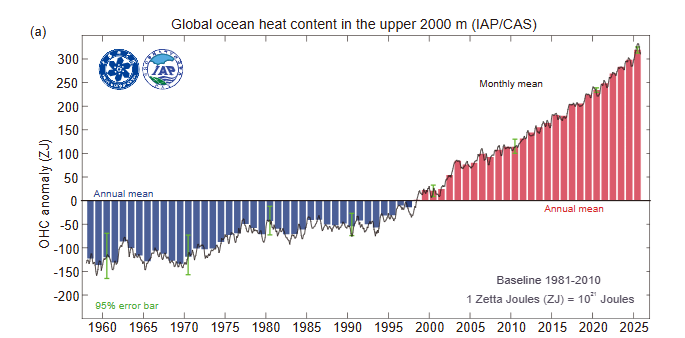
A new study published in Advances in Atmospheric Sciences on 6 January 2026 shows that ocean temperatures in 2025 reached another record, as the ocean absorbed more heat last year than in any year since measurements began in the 1960s.

The study provides an updated assessment of global sea surface temperatures (SST) and upper-ocean heat content (OHC) for 2025. According to the Institute of Atmospheric Physics at the Chinese Academy of Sciences (IAP/CAS), in 2025, the heat accumulated in the oceans increased by around 23 ZJ (zettajoules), a large increase from the 16 ZJ absorbed in 2024.

This finding is confirmed by three additional independent research groups: the CIGAR-RT, the National Centers for Environmental Information at the National Oceanic and Atmospheric Administration (NCEI/NOAA), and Copernicus Marine.

A single zettajoule is equivalent to 1,000,000,000,000,000,000,000 joules. Twenty-three zettajoules in one year is equivalent to the energy of 12 Hiroshima bombs exploding in the ocean every second.

The study focused on the upper 2,000 meters of the ocean to measure the ocean’s heat content, where most heat accumulation occurs, and measurement coverage is most reliable.

The global OHC estimates are based on three gridded observational products from IAP/CAS, Copernicus Marine, NCEI/NOAA, and an ocean reanalysis dataset, CIGAR, a product from CNR ISMAR (Italian National Research Council’s Institute of Marine Sciences) that combines actual ocean measurements with computer model simulations to fill in gaps.

The ocean absorbs approximately 90% of the excess heat trapped by greenhouse gas emissions in Earth’s climate system. The atmosphere, despite being what we most directly experience, only retains about 1% of this excess heat. The remaining heat goes into melting ice and warming land.

Ocean heat content (OHC) changes are less affected by short-term weather and El Niño events than global mean surface temperature (GMST), making them a reliable sign of long-term climate change. Observations show that OHC has steadily increased over time, highlighting a continuous buildup of extra heat in the Earth’s system.

Higher OHC leads to more frequent and intense marine heatwaves, changes in atmospheric circulation, greater evaporation and moisture in the air, and stronger extreme rainfall, all of which help tropical cyclones intensify rapidly. The ongoing, unusually warm ocean conditions in 2025 have played a significant role in driving extreme weather and climate events worldwide.

The study notes that ocean warming is not uniform, with some areas warming faster than others. “Regionally, about 33% of the global ocean area ranked among its historical (1958–2025) top three warmest conditions, while about 57% fell within the top five, including the tropical and South Atlantic Ocean, Mediterranean Sea, North Indian Ocean, and Southern Oceans, underscoring the broad ocean warming across basins”.

Ocean warming has major effects on our planet. Rising ocean heat content (OHC) is the main driver of sea level rise, intensifies marine heatwaves, and contributes to more extreme weather by adding heat and moisture to the atmosphere.

Continuous GHG emissions will increase OHC. Monitoring of OHC will inform the pace of climate change.

This will entail strengthening space-based observation and ocean monitoring to support climate adaptation planning and to better respond to climate change.


quinta-feira, 25 de julho de 2019

Charney Report- 40 years ago, scientists predicted climate change. And hey, they were right

Fonte: aqui

This month the world has been celebrating the 50th anniversary of Neil Armstrong setting foot on the Moon. But this week sees another scientific anniversary, perhaps just as important for the future of civilisation.

Forty years ago, a group of climate scientists sat down at Woods Hole Oceanographic Institution in Massachusetts for the first meeting of the “Ad Hoc Group on Carbon Dioxide and Climate”. It led to the preparation of what became known as the Charney Report – the first comprehensive assessment of global climate change due to carbon dioxide.

It doesn’t sound as impressive as landing on the Moon, and there certainly weren’t millions waiting with bated breath for the deliberations of the meeting.

But the Charney Report is an exemplar of good science, and the success of its predictions over the past 40 years has firmly established the science of global warming.

What is this ‘greenhouse gas’ you speak of?

Other scientists, starting in the 19th century, had already demonstrated that carbon dioxide was what we now call a “greenhouse gas”. By the 1950s, scientists were predicting warming of several degrees from the burning of fossil fuels. In 1972 John Sawyer, the head of research at the UK Meteorological Office, wrote a four-page paper published in Nature summarising what was known at the time, and predicting warming of about 0.6℃ by the end of the 20th century.

But these predictions were still controversial in the 1970s. The world had, if anything, cooled since the middle of the 20th century, and there was even some speculation in the media that perhaps we were headed for an ice age.

The meeting at Woods Hole gathered together about 10 distinguished climate scientists, who also sought advice from other scientists from across the world. The group was led by Jule Charney from the Massachusetts Institute of Technology, one of the most respected atmospheric scientists of the 20th century.

The Report lays out clearly what was known about the likely effects of increasing carbon dioxide on the climate, as well as the uncertainties. The main conclusion of the Report was direct:

We estimate the most probable warming for a doubling of CO₂ to be near 3℃ with a probable error of 1.5℃.

In the 40 years since their meeting, the annual average CO₂ concentration in the atmosphere, as measured at Mauna Loa in Hawaii, has increased by about 21%. Over the same period, global average surface temperature has increased by about 0.66℃, almost exactly what could have been expected if a doubling of CO₂ produces about 2.5℃ warming – just a bit below their best estimate. A remarkably prescient prediction.

Reception of the article

Despite the high regard in which the authors of the Charney Report were held by their scientific peers at the time, the report certainly didn’t lead to immediate changes in behaviour, by the public or politicians.

But over time, as the world has continued to warm as they predicted, the report has become accepted as a major milestone in our understanding of the consequences our actions have for the climate. The current crop of climate scientists revere Charney and his co-authors for their insight and clarity.

Strong science

The report exemplifies how good science works: establish an hypothesis after examining the physics and chemistry, then based on your assessment of the science make strong predictions. Here, “strong predictions” means something that would be unlikely to come true if your hypothesis and science were incorrect.

In this case, their very specific prediction was that warming of between 1.5℃ and 4.5℃ would accompany a doubling of atmospheric CO₂. At the time, global temperatures, in the absence of their hypothesis and science, might have been expected to stay pretty much the same over the ensuing 40 years, cooled a bit, possibly even cooled a lot, or warmed a lot (or a little).

In the absence of global warming science any of these outcomes could have been feasible, so their very specific prediction made for a very stringent test of their science.

The Charney Report’s authors didn’t just uncritically summarise the science. They also acted sceptically, trying to find factors that might invalidate their conclusions. They concluded:

We have tried but have been unable to find any overlooked or underestimated physical effects that could reduce the currently estimated global warmings due to a doubling of atmospheric CO₂ to negligible proportions or to reverse them altogether.

The report, and the successful verification of its prediction, provides a firm scientific basis for the discussion of what we should do about global warming.

Over the ensuing 40 years, as the world warmed pretty much as Charney and his colleagues expected, climate change science improved, with better models that included some of the factors missing from their 1979 deliberations.

This subsequent science has, however, only confirmed the conclusions of the Charney Report, although much more detailed predictions of climate change are now possible.

terça-feira, 23 de julho de 2019

The Charney Report: 40 years ago, scientists accurately predicted climate change


This month the world has been celebrating the 50th anniversary of Neil Armstrong setting foot on the Moon. But this week sees another scientific anniversary, perhaps just as important for the future of civilisation.

Forty years ago, a group of climate scientists sat down at Woods Hole Oceanographic Institution in Massachusetts for the first meeting of the "Ad Hoc Group on Carbon Dioxide and Climate". It led to the preparation of what became known as the Charney Report—the first comprehensive assessment of global climate change due to carbon dioxide.

It doesn't sound as impressive as landing on the Moon, and there certainly weren't millions waiting with bated breath for the deliberations of the meeting.

But the Charney Report is an exemplar of good science, and the success of its predictions over the past 40 years has firmly established the science of global warming.

What is this 'greenhouse gas' you speak of?

Other scientists, starting in the 19th century, had already demonstrated that carbon dioxide was what we now call a "greenhouse gas". By the 1950s, scientists were predicting warming of several degrees from the burning of fossil fuels. In 1972 John Sawyer, the head of research at the UK Meteorological Office, wrote a four-page paper published in Nature summarizing what was known at the time, and predicting warming of about 0.6℃ by the end of the 20th century.

But these predictions were still controversial in the 1970s. The world had, if anything, cooled since the middle of the 20th century, and there was even some speculation in the media that perhaps we were headed for an ice age.

The meeting at Woods Hole gathered together about 10 distinguished climate scientists, who also sought advice from other scientists from across the world. The group was led by Jule Charney from the Massachusetts Institute of Technology, one of the most respected atmospheric scientists of the 20th century.

The Report lays out clearly what was known about the likely effects of increasing carbon dioxide on the climate, as well as the uncertainties. The main conclusion of the Report was direct: "We estimate the most probable warming for a doubling of CO₂ to be near 3℃ with a probable error of 1.5℃."


In the 40 years since their meeting, the annual average CO₂ concentration in the atmosphere, as measured at Mauna Loa in Hawaii, has increased by about 21%. Over the same period, global average surface temperature has increased by about 0.66℃, almost exactly what could have been expected if a doubling of CO₂ produces about 2.5℃ warming—just a bit below their best estimate. A remarkably prescient prediction.


Reception of the article

Despite the high regard in which the authors of the Charney Report were held by their scientific peers at the time, the report certainly didn't lead to immediate changes in behavior, by the public or politicians.

But over time, as the world has continued to warm as they predicted, the report has become accepted as a major milestone in our understanding of the consequences our actions have for the climate. The current crop of climate scientists revere Charney and his co-authors for their insight and clarity.

Strong science

The report exemplifies how good science works: establish an hypothesis after examining the physics and chemistry, then based on your assessment of the science make strong predictions. Here, "strong predictions" means something that would be unlikely to come true if your hypothesis and science were incorrect.

In this case, their very specific prediction was that warming of between 1.5℃ and 4.5℃ would accompany a doubling of atmospheric CO₂. At the time, global temperatures, in the absence of their hypothesis and science, might have been expected to stay pretty much the same over the ensuing 40 years, cooled a bit, possibly even cooled a lot, or warmed a lot (or a little).

In the absence of global warming science any of these outcomes could have been feasible, so their very specific prediction made for a very stringent test of their science.

The Charney Report's authors didn't just uncritically summarize the science. They also acted sceptically, trying to find factors that might invalidate their conclusions. They concluded: "We have tried but have been unable to find any overlooked or underestimated physical effects that could reduce the currently estimated global warmings due to a doubling of atmospheric CO₂ to negligible proportions or to reverse them altogether."

The report, and the successful verification of its prediction, provides a firm scientific basis for the discussion of what we should do about global warming.

Over the ensuing 40 years, as the world warmed pretty much as Charney and his colleagues expected, climate change science improved, with better models that included some of the factors missing from their 1979 deliberations.

This subsequent science has, however, only confirmed the conclusions of the Charney Report, although much more detailed predictions of climate change are now possible.

Fonte: Phys.org

domingo, 7 de agosto de 2016

"It is during the night in the ocean when the greatest migration on earth occurs" by Russ George


Feeding The Greatest Migration On Earth - Russ George
Fonte: RUSS GEORGE


The greatest migration on Earth.
Each day and night the sonars and other instruments reveal a rapid change in the bloom. As the phytoplankton bloom grows tiny zooplankton that graze upon those ocean plants respond both in number and behaviour.
These tiny ocean zooplankton, mixatrophs, will be seen and eaten if they are near the surface during daylight (or moonlight). To remain safe they hide in the deep dark waters and migrate to the surface only in the dark of night.

During daylight hours the zooplankton are 300+ meters down resting on the “deep thermocline” layer. As daylight wanes each evening their nightly migration to the surface pastures begins. There they engorge themselves with the blooms “fresh greens.” By morning light they swim back to the dark depths and safety where like bucolic cows they rest and digest.
The team is here to watch, measure, and captures samples of this ‘greatest migration’ on Earth. Russ George the chief scientist describes the spectacle, “It is as if we are perched in a tree on the great plains of Africa privileged to witness the great herds of beasts as they run past. Here there are animals of every size and shape albeit in mostly miniature planktonic forms. We see the salps, jellies, copepods, amphipods, krill, and more.” Mysteriously rare and missing are the pteropods but that’s another story.
Sea life from near and far are drawn to an ocean oasis.

That this wondrous plankton growth is beneficial is perfectly clear as is seen in the immediate shift from scarcity to abundance in sea life of all kinds. Spouting plumes of misty breath from the great whales, Fins, Seis, Sperms, and Orcas reveal the most obvious herds attracted to and now thriving on this renewed pasture. Two months ago, before the bloom, whale sightings were so few that not more than five or six were seen during weeks at sea. Now every day shows at least that many, some days whales are counted by the score.

Do or Do Naught
Ocean Pastures that sustain the greatest migration on earth have been turning into ever bluer ‘blue deserts’ for decades. Each year 1% of the plant-life of the oceans is lost due to our neglect of these vital pastures. To put that in context in every five year span of time the oceans lose the equivalent plant life to the entire Amazon Rainforest. We are all concerned about the fate of the Amazon which has lost 20% of its plant life. But since the 1950’s when records clearly show the loss of ocean pasture plant life at 1% per year we’ve lost 10 entire Amazon Rainforest’s of our vital ocean plant life. We can and must restore the ocean pastures! Join me.

quarta-feira, 31 de março de 2010

Acidificação dos Oceanos - Acidic Oceans

posted by: Jasmine Greene 14.03.10
Acidic Oceans
The climate change issue has been a major topic among politicians and civilians alike. But while we spend much of our time looking to the skies, we've neglected our oceans. With the increase of CO2 in the atmosphere, acid levels in the oceans have been rising, which in turn could harm many marine animals including shellfish and corals. 
 
Ocean acidification occurs when the ocean takes up extra CO2 from the atmosphere. When CO2 dissolves in water it increases the amount of hydrogen ions, when then decreased the pH levels. Since the industrial revolution, the ocean's pH level has lowered by 0.1 [Source: Yale]. While this might not seem like a huge drop, the truth is, the pH scale is logarithmic, each step up or down increases the amount of hydrogen ions tenfold. This roughly translates to a 30% decreased in pH levels in the ocean. [Source: Ocean Acidification]. with half of the anthropogenic CO2 stored in the upper 10% of the oceans [Source: NOAA]. 

Increase in acidity is particularly harmful to organisms that require calcium bicarbonate to build shells. If the water is too acidic, it can dissolve the shells, sometimes faster than organisms can rebuild them. The impact of this change has been seen in the US northwest, most notably Washington, where there has been a significant decrease in oysters along the coast. Other areas that would be highly sensitive to changing pH are the continental shelves since many marine organisms either live or spawn there. In 2008 a University of Chicago report stated that these changes were happening much faster than predicted and that "This increase will have a severe impact on marine food webs and suggests that ocean acidification may be a more urgent issue than previously thought..." [Source: Science Daily] 

The growing urgency to halt the change in pH has forced the EPA to step in and "consider ways the states can address rising acidity levels in oceans" [Source: Seattle P.I.] in accordance with the Clean Water Act. This was brought on by a lawsuit from the Center for Biological Diversity, who wanted the EPA to address the acidity level of Washington's ocean. Many view this victory as another way for the federal government to put restrictions on greenhouse gases that also affect the oceans (only CO2 increases the acidity level of the oceans [Source: Treehugger]). 

There are, of course, organizations that argue that the increase acidity could be beneficial. While mollusks are growing thinner shells, other crustaceans (namely crab, lobster and shrimp) are forming thicker shells. This might sound beneficial, scientists from the Woods Hole Oceanographic Institution, state that "...any possible ramifications are complex. For example, the crab exhibited improved shell-building capacity, and its prey, the clams, showed reduced calcification. 'This may initially suggest that crabs could benefit from this shift in predator-pray dynamics. But without shells, clams may not be able to sustain their populations, and this could ultimately impact crabs in a negative way, as well..." [Source: WHOI]. It is difficult to say what exactly the long-reaching effects will have on all of the life forms in the oceans, however, it has become serious enough that the EPA, NOAA and various other organizations have begun taking action against ocean acidification.

sexta-feira, 30 de março de 2007

Dossiê Mar e Oceanos

ATENÇÃO © Copyleft - É permitida a partilha do dossiê exclusivamente para fins não comerciais e desde que o autor e o BioTerra sejam citados.


Não esqueças de visitar regularmente este espaço para manteres-te actualizado

Prémios
Earthshot Prize

ONG || Activismo
Dolphin Project
DSM - Deutsche Stiftung Meeresschutz

Fundações || Projectos
A Última Arca de Noé
JASON Foundation

Universidades || Institutos || Centros
Academy of Natural Sciences Research Opportunities
Base de Dados


Artigos || Textos || Relatórios


Youtube

Pescas || Aquacultura || Frota


Dossiês BioTerra Relacionados

NOVA ATENÇÃO COPYRIGHT - Ao partilhar este Dossiê, agradeço atempadamente a indicação do  autor e do meu blogue Bioterra. Estes dossiês resultam de um apurado trabalho de pesquisa, selecção de qualidade e organização. Obrigado.Oceanography