Mostrar mensagens com a etiqueta Amory Lovins. Mostrar todas as mensagens
Mostrar mensagens com a etiqueta Amory Lovins. Mostrar todas as mensagens
quinta-feira, 19 de novembro de 2020
Seminário: Integrative design for radical energy efficiency por Amory Lovins and Holmes Hummel

quarta-feira, 25 de março de 2020
Natural Capitalism

Somewhere along the way to free-market capitalism, the United States became the most wasteful society on the planet. Most of us know it. There is the waste we can see: traffic jams, irreparable VCRs, Styrofoam coffee cups, landfills; the waste we can’t see: Superfund sites, greenhouse gases, radioactive waste, vagrant chemicals; and the social waste we don’t want to think about: homelessness, crime, drug addiction, our forgotten infirm and elderly.
Nationally and globally, we perceive social and environmental decay as distinct and unconnected. In fact, a humbling design flaw deeply embedded in industrial logic links the two problems. Toto, pull back the curtain: The efficient dynamo of industrialism isn’t there. Even by its own standards, industrialism is extraordinarily inefficient.
Modern industrialism came into being in a world very different from the one we live in today: fewer people, less material well-being, plentiful natural resources. As a result of the successes of industry and capitalism, these conditions have now reversed. Today, more people are chasing fewer natural resources.
But industry still operates by the same rules, using more resources to make fewer people more productive. The consequence: massive waste — of both resources and people.
Decades from now, we may look back at the end of the 20th century and ponder why business and society ignored these trends for so long — how one species thought it could flourish while nature ebbed. Historians will show, perhaps, how politics, the media, economics, and commerce created an industrial regime that wasted our social and natural environment and called it growth. As author Bill McKibben put it, “The laws of Congress and the laws of physics have grown increasingly divergent, and the laws of physics are not likely to yield.”
The laws we’re ignoring determine how life sustains itself. Commerce requires living systems for its welfare — it is emblematic of the times that this even needs to be said. Because of our industrial prowess, we emphasize what people can do but tend to ignore what nature does. Commercial institutions, proud of their achievements, do not see that healthy living systems — clean air and water, healthy soil, stable climates — are integral to a functioning economy. As our living systems deteriorate, traditional forecasting and business economics become the equivalent of house rules on a sinking cruise ship.
One is tempted to say that there is nothing wrong with capitalism except that it has never been tried. Our current industrial system is based on accounting principles that would bankrupt any company.
Conventional economic theories will not guide our future for a simple reason: They have never placed “natural capital” on the balance sheet. When it is included, not as a free amenity or as a putative infinite supply, but as an integral and valuable part of the production process, everything changes. Prices, costs, and what is and isn’t economically sound change dramatically.
Industries destroy natural capital because they have historically benefited from doing so. As businesses successfully created more goods and jobs, consumer demand soared, compounding the destruction of natural capital. All that is about to change.
Natural Capital
Natural systems provide trillions of dollars in services that have no man-made substitutes, as Biosphere II’s failure shows.
Everyone is familiar with the traditional definition of capital as accumulated wealth in the form of investments, factories, and equipment. “Natural capital,” on the other hand, comprises the resources we use, both nonrenewable (oil, coal, metal ore) and renewable (forests, fisheries, grasslands). Although we usually think of renewable resources in terms of desired materials, such as wood, their most important value lies in the services they provide. These services are related to, but distinct from, the resources themselves. They are not pulpwood but forest cover, not food but topsoil. Living systems feed us, protect us, heal us, clean the nest, let us breathe. They are the “income” derived from a healthy environment: clean air and water, climate stabilization, rainfall, ocean productivity, fertile soil, watersheds, and the less-appreciated functions of the environment, such as processing waste — both natural and industrial. Nature’s Services, a book due out this spring edited by Stanford University biologist Gretchen C. Daily, identifies trillions of dollars of critical ecosystem services received annually by commerce.
For anyone who doubts the innate value of ecosystem services, the $200 million Biosphere II experiment stands as a reality check. In 1991, eight people entered a sealed, glass-enclosed, 3-acre living system, where they expected to remain alive and healthy for two years. Instead, air quality plummeted, carbon dioxide levels rose, and oxygen had to be pumped in from the outside to keep the inhabitants healthy. Nitrous oxide levels inhibited brain function. Cockroaches flourished while insect pollinators died, vines choked out crops and trees, and nutrients polluted the water so much that the residents had to filter it by hand before they could drink it. Of the original 25 small animal species in Biosphere II, 19 became extinct.
At the end of 17 months, the humans showed signs of oxygen starvation from living at the equivalent of an altitude of 17,500 feet. Of course, design flaws are inherent in any prototype, but the fact remains that $200 million could not maintain a functioning ecosystem for eight people for 17 months. We add eight people to the planet every three seconds.
The lesson of Biosphere II is that there are no man-made substitutes for essential natural services. We have not come up with an economical way to manufacture watersheds, gene pools, topsoil, wetlands, river systems, pollinators, or fisheries. Technological fixes can’t solve problems with soil fertility or guarantee clean air, biological diversity, pure water, and climatic stability; nor can they increase the capacity of the environment to absorb 25 billion tons of waste created annually in America alone.
Natural Capital as a Limiting Factor
The new limits to prosperity are natural systems — not boats, but fisheries; not sawmills, but forests.
Until the 1970s, the concept of natural capital was largely irrelevant to business planning, and it still is in most companies. Throughout the industrial era, economists considered manufactured capital — money, factories, etc. — the principal factor in industrial production, and perceived natural capital as a marginal contributor. The exclusion of natural capital from balance sheets was an understandable omission. There was so much of it, it didn’t seem worth counting. Not any longer.
Historically, economic development has faced a number of limiting factors, including the availability of labor, energy resources, machinery, and financial capital. The absence or depletion of a limiting factor can prevent a system from growing. If marooned in a snowstorm, you need water, food, and warmth to survive. Having more of one factor cannot compensate for the absence of the other. Drinking more water will not make up for lack of clothing if you are freezing.
In the past, by increasing the limiting factor, industrial societies continued to develop economically. It wasn’t always pretty: Slavery “satisfied” labor shortages, as did immigration and high birthrates. Mining companies exploited coal, oil, and gas to meet increased energy demands. The need for labor-saving devices provoked the invention of steam engines, spinning jennies, cotton gins, and telegraphs. Financial capital became universally accessible through central banks, credit, stock exchanges, and currency exchange mechanisms.
Because economies grow and change, new limiting factors occasionally emerge. When they do, massive restructuring occurs. Nothing works as before. Behavior that used to be economically sound becomes unsound, even destructive.
Economist Herman E. Daly cautions that we are facing a historic juncture in which, for the first time, the limits to increased prosperity are not the lack of man-made capital but the lack of natural capital. The limits to increased fish harvests are not boats, but productive fisheries; the limits to irrigation are not pumps or electricity, but viable aquifers; the limits to pulp and lumber production are not sawmills, but plentiful forests.
Like all previous limiting factors, the emergence of natural capital as an economic force will pose a problem for reactionary institutions. For those willing to embrace the challenges of a new era, however, it presents an enormous opportunity.
segunda-feira, 2 de dezembro de 2019
Lovins: Nuclear Makes Climate Crisis Worse by Blocking Faster Uptake of Cheaper Options

Contrary to industry propaganda, nuclear power plants are not an essential tool in the fight against climate change, but an increasingly dangerous drag on the deployment of more practical renewables and energy efficiency, Rocky Mountain Institute Chair and Chief Scientist Amory Lovins declares in a recent post for Forbes.
Though the recent World Nuclear Industry Status Report 2019 shows the global nuclear industry clearly “dying of an incurable attack of market forces,” writes Lovins, American support for the technology remains tenacious, with proponents across the political spectrum promoting nuclear as indispensable in the effort to lower carbon emissions.
And yet, “building new reactors, or operating most existing ones, makes climate change worse compared with spending the same money on more climate-effective ways to deliver the same energy services,” Lovins says.
The critical mistake among climate-focused supporters of nuclear generation is to look solely at the matter of carbon, he explains. The problem with that approach is that, with so much ground to catch up in so little time, “we must save the most carbon at the least cost and in the least time, counting all three variables—carbon and cost and time. Costly options save less carbon per dollar than cheaper options. Slow options save less carbon per year than faster options. Thus even a low- or no-carbon option that is too costly or too slow will reduce and retard achievable climate protection.”
Lovins makes clear that nuclear fails resoundingly on both cost and turnaround time: “Being carbon-free does not establish climate-effectiveness,” he declares.
Well-intentioned nuclear proponents aside, Lovins writes scathingly of industry magnates who “milk” the system, taking “multi-billion-dollar bailouts from malleable state legislatures for about a tenth of the nuclear fleet so far, postponing the economic reckoning by shooting the market messenger.” He warns that “such replacement of market choices with political logrolling distorts prices, crowds out competitors, slows innovation, reduces transparency, rewards undue influence, introduces bias, picks winners, invites corruption, and even threatens to destroy the competitive regional power markets where renewables and efficiency win.”
Lovins cautions against accepting the findings of a late May report by the International Energy Agency, which claimed that abandoning nuclear power would make climate action “drastically harder and more costly,” as well as the still widely-held assumption that the climate emergency “demands every option, including preserving nuclear power at any cost”. Invoking the “bedrock economic principle of ‘opportunity cost’,” he notes that “you can’t spend the same money on two different things at the same time. Each purchase foregoes others. Buying nuclear power displaces buying some mixture of fossil-fueled generation, renewable generation, and efficient use.”
At an estimated cost of US$118 to $192 per megawatt-hour in 2019, he adds, nuclear stands no competitive chance whatsoever against utility-scale solar power at $32 to 42/MWh, onshore wind power at $28 to 54/MWh, or energy efficiency at $0 to $50, but typically around $25/MWh. “Efficiency, being already delivered to your meter, also avoids roughly $42/MWh of average delivery cost that all remote generators incur,” he adds.
With new U.S. nuclear development off the table, Lovins adds, “today’s hot question” concerns the fate of “the 96 existing reactors, already averaging about a decade beyond their nominal original design life.” Operating costs exceed $40/MWh for the costlier half of the grouping, and $50/MWh for the “costliest quartile”, while wind farm maintenance costs come in “as low as $11/MWh” in 2018.
All the operating cost data swirling around the energy marketplace points to “an important climate opportunity”, Lovins observes. “Customer efficiency costs utilities only $20 to 30/MWh on average—less if they shop carefully. Therefore, closing a top-quartile-cost nuclear plant and buying efficiency instead, as utilities could volunteer or regulators require, would save considerably more carbon than continuing to run the nuclear plant.”
Those calculations show that “while we close coal plants to save carbon directly, we should also close distressed nuclear plants and reinvest their large saved operating cost in cheaper options to save carbon indirectly. These two climate-protecting steps are not alternatives; they are complements.”
And that doesn’t even address the glacially slow pace at which conventional nuclear plants are sited, approved, and built.
Even as the World Nuclear Association touts its product as “the fast track to decarbonization”, real-life experience shows that “nuclear plants take many years to build, typically around a decade, while renewable projects can take a year or less—even months or weeks,” he writes. “Further, national nuclear power programs need three times as much lead time for institutional preparations as modern renewables need. For both reasons, renewables can start saving carbon many years sooner.”
None of which has stopped the U.S. nuclear industry from pushing a new federal tax subsidy on nuclear fuel and maintenance costs, in a bid to “help level the playing field with other clean energy sources”. The legislation would cost $22 to $26 billion in the first decade, or $33 billion “counting the crowding-out of cheaper competitors,” Lovins notes. And “every billion dollars thus bilked from taxpayers is unavailable to provide more electrical services and save more carbon by cheaper means.”
Meanwhile, “unlike renewable credits that have helped to mature important new technologies, the nuclear credit would elicit no new production, capacity, or innovation,” but rather “simply transfer tens of billions of dollars to the owners of uncompetitive nuclear assets bought decades ago.”
This kind of “anti-market monkey business cannot indefinitely forestall the victory of cheaper competitors,” Lovins concludes. “But it can delay and diminish climate protection, while transferring tens of billions of unearned dollars from taxpayers and customers to nuclear owners.”
Which means the climate emergency and market health both demands vigilant attention, “not only to carbon but also to cost and time,” in tandem with a vigorous defence of “markets’ ability to choose climate solutions that can save the most carbon per dollar and per year.” Ultimately, Lovins says, “our best climate strategy would be to start taking economics seriously.”
quinta-feira, 31 de janeiro de 2019
Amory Lovins - Radical Energy Efficiency Through Integrative Design
By Amory B. Lovins
Note: This article is adapted and excerpted from an invited talk by the author at the APS April Meeting in Denver in 2019 in a session organized by the APS Forum on Physics and Society (APS News, October 2019). The full presentation, with the slides to which the remarks refer, can be viewed on the APS YouTube channel.
Around 1975 our government and industry all said that the energy needed to make a dollar of gross domestic product (GDP) could never drop. A year later, I heretically suggested it could drop 72 percent in 50 years [1]. So far, it's dropped 58 percent in 43 years, but just the innovations already added by 2010 can save another threefold, or twice what I originally thought, at a third of the cost. Today that looks conservative because optimizing buildings, vehicles, and factories as whole systems—not as piles of parts—can often make very large energy savings cost less than small or no savings, turning diminishing returns into increasing returns.
Depleting Only Stupidity
Economic geologists know that a mineral's reserves—the identified deposits profitably extractable with current technology—are only a small part of the resource base. Most energy analysts also narrowly define reserves of energy efficiency like mineral resources, but the actual energy efficiency reserves are several-fold larger than those now typically recognized and captured.
The "missing majority" is hiding in plain view and is exploitable by integrative design, as I will describe. But this geological analogy breaks down on cost: orebodies are finite assemblages of atoms, while energy efficiency resources are infinitely expandable assemblages of ideas. Exploiting ideas depletes only stupidity, a very abundant resource. All of this is documented in a peer-reviewed paper [2] called "How Big is the Energy Efficiency Resource?"
The evidence across all sectors shows that unlike oil or copper, most new energy efficiency reserves cost less because they come not from adding more or fancier widgets but from using fewer and simpler widgets—more artfully chosen, combined, and timed and sequenced.
An Example—My House
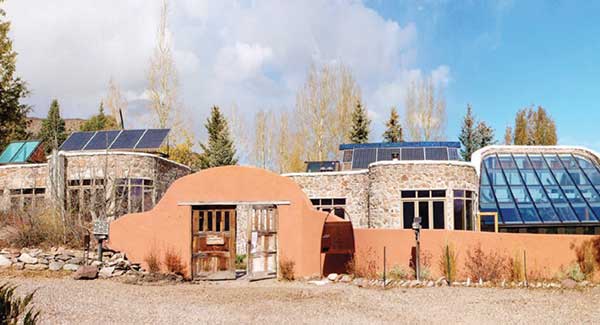
I'd never built a house before, so I didn't know what was impossible. My wife Judy and I live near Aspen, Colorado, at 2200 meters elevation. Temperatures there used to dip as low as minus 44 degrees Celsius. We saw up to 39 days of continuous midwinter cloud, but our house uses no combustion. (That's so 20th century.) Instead, we use superinsulation, ventilation, heat recovery, and superwindows that insulate like 16 or even 22 sheets of glass but look like two and cost less than three, making the house 99 percent passive solar heated and 1 percent active solar.
Eliminating the heating system more than paid up front for the efficiency that displaced the heating system, slightly reducing total construction costs and then saving also 90 percent of electricity and 99 percent of the water heating. It was all paid back in 10 months with 1983 technologies, which are not nearly as good or cheap as those we have now.
Integrative design in the author's residence in Colorado means that no combustion energy sources are needed for heating and cooling.
Rocky Mountain Institute
Our house helped inspire more than 160,000 European passive buildings that likewise have no heating and roughly normal construction costs. An analogous approach also works fine in Bangkok; practically everyone on earth lives in a climate somewhere between Bangkok and Old Snowmass, Colorado. Integrative design gives many benefits from each expenditure. For example, the arch that holds up the middle of my house has 12 different functions, but it has only one cost.
Transportation
What about our biggest oil burner—automobiles? Well, the propulsion system or powertrain uses 4/5 of the fuel energy before it reaches the wheels, but our savings should start downstream, at the wheels. Here's why. Just a fifth of a modern car's fuel energy reaches the wheels and moves the car. Of that, nearly half heats the air that the car pushes aside (a loss that rises as the cube of speed). Most of the rest heats the tires and road. So only the last ~6 percent of the fuel energy accelerates the car and then heats the brakes when you stop. But 19/20 of the mass you're accelerating is the heavy steel car, not you. So just 1/20 of that 6 percent or about 0.3 percent of the fuel energy ultimately moves the driver. That’s not very gratifying after one and a third centuries of devoted engineering effort.
Both acceleration and rolling resistance depend on mass, which therefore causes most of the tractive load. Reducing losses in the powertrain is harder than reducing tractive load, and it's also less rewarding, because saving one unit of energy in the powertrain saves only one unit of fuel in the tank. But saving one unit of energy at the wheels avoids four or five more units now lost in getting that energy to the wheels. So we should first reduce tractive load, then improve the powertrain, which then shrinks for the same acceleration, saving more weight, and also saving capital cost to help pay for the lightweighting. This is integrative design.
Ultralight carbon-fiber autos can save far more oil than Saudi Arabia pumps and, with simpler designs, can be made at normal cost. How do we know that? Well, because BMW did it six years ago with the carbon-fiber electric car that I drive, the i3. The i3 reportedly made money from the first unit off the assembly line. Its carbon fiber is paid for by the smaller batteries that its lightness saves, and fewer batteries also means faster recharging. Its integrative design decreases mass a lot more than normally assumed. Its manufacturing is radically frugal, eliminating conventional body and paint shops, which are the two hardest and most costly steps in making a normal car. Making the i3 needs one-third the normal capital and water, and one-half the normal energy, space, and cost.
You can keep going around the design spiral, making components smaller as their structural loads shrink, because the less weight you have, the less weight you need. Lightness begets lightness. Many big parts then disappear. A good hybrid design, for example, can eliminate transmission, clutch, flywheel, driveshaft, U-joints, axles, differentials, starter, and alternator. That's nine things, each saving even more mass and then you go around the cycle some more and take out more mass.
At first it might seem like the special materials and powertrain and design may raise your manufacturing costs, but after more mass removal, you need less carbon fiber and powertrain. The advanced composite structures can get so much simpler that these savings pay for the carbon fiber, making the ultralighting roughly free, as BMW proved.
Start Downstream
My team's latest ~$40 billion dollars of industrial retrofit designs typically found about 30 to 60 percent energy savings, paying back in a few years on retrofits. And then in newbuilds, we find savings of typically 40 to 90 percent with generally lower than normal capital costs. These results come largely from rethinking industrial processes and redesigning basic elements like pump, fan, and motor systems.
For example, in both buildings and industry, better pipe and duct design can save about 80 or 90 percent of the flow friction. And if everybody did this, it could save roughly half the world's coal-fired electricity, typically paying back in less than a year in industrial retrofits and instantly in newbuilds. But this is not yet in any official study or industry forecast or climate model or government assessment, because it's not a technology; it's a design method. And most people don't yet think of design as a scaling vector—a way to make things big, fast.
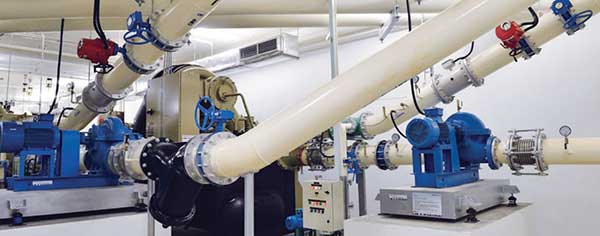
Better pipe and pump design (eg, use large pipes with gentle curves and small pumps, rather than sharply bent small pipes and large pumps) can reduce flow friction by 80-90%.
And the methods are simple—it's just physics. Use big pipes and small pumps, not small pipes and big pumps. Friction drops as nearly the fifth power of diameter. Yet in practically every new building or factory, the piping is normally laid out so the flow always goes through right-angle elbows—friction. But why not lay it out so that the main flow has no bends and fewer valves? The only obstacle is force of habit. We should bend minds, not pipes.
What do such savings mean for the motors that use over half the world's electricity? From the fuel burned in the power plant to the end use, there are so many compounding losses that only a tenth of the fuel energy comes out the pipe as flow. But every unit of lower friction you save at the pipe leverages back to 10 units of fuel cost, emissions, and global warming saved at the power plant. And as you go back upstream, the components get smaller and cheaper, so the total capital cost goes down. If you know an engineering textbook that mentions this "start downstream" principle, I would love to see it.
The Big Picture
What can integrative design do for a big economy? Well, seven years ago our business and design synthesis, Reinventing Fire [3], rigorously showed how to triple US energy efficiency and quintuple renewables by 2050 needing no oil or coal or nuclear energy and at least a third less natural gas, while saving 5 trillion, growing the economy 2.6-fold, strengthening national security, and cutting fossil carbon emissions 82 to 86 percent. This needed no new inventions nor Acts of Congress, but instead, with smart city and state policies, could be led by business for profit. The first eight years of this 40-year journey are nicely on track, because the private sector smells the 5 trillion on the table.
That's exactly what should be happening. I hope these examples will encourage you to rethink why our end-use efficiency is so far from Second Law limits—and how better design, not only better technology, can help close that gap if we turn integrative design from rare to common.
The author is Cofounder and Chairman Emeritus of Rocky Mountain Institute
References
A. B. Lovins, "Energy strategy: the road not taken," Foreign Affairs, October 1976.
A. B. Lovins, "How big is the energy efficiency resource?," Environ. Res. Lett. 13 090401 (2018).
A. B. Lovins, Reinventing Fire (Rocky Mountain Institute, 2014).
quarta-feira, 23 de março de 2016
sexta-feira, 4 de abril de 2014
Ted Talk- Amory Lovins: Um plano energético a 40 anos
Nesta palestra intimista filmada nos escritórios da TED, o teórico da energia Amory Lovins descreve os passos necessários para acabar com a dependência global do petróleo (antes que acabe). Algumas mudanças já estão em curso - tais como automóveis peso-pluma e camiões mais inteligentes - mas outras requerem uma visão mais abrangente.
segunda-feira, 14 de outubro de 2013
Documentário imperdível- Carbon Nation

Consulte todas as informações no sítio Carbon Nation- The Movie
Carbon Nation is a 2010 documentary film by Peter Byck about technological- and community-based energy solutions to the growing worldwide carbon footprint. The film is narrated by Bill Kurtis.
Rather than highlighting the problems with use of fossil fuels, Carbon Nation presents a series of ways in which the 16 terawatts of energy the world consumes can be met while reducing or eliminating carbon-based sources. It contains optimistic interviews with experts in various fields, business CEOs, and sustainable energy supporters to present a compelling case for change while having a neutral, matter-of-fact explanation.
Among those interviewed are Richard Branson, former CIA Director R. James Woolsey, Earth Day founder Denis Hayes and environmental advocate Van Jones.
segunda-feira, 4 de abril de 2011
O mercado, o nuclear e a segurança - Tudo no excelente texto de Amory Lowins
Learning From Japan's Nuclear Disaster

An earthquake-and-tsunami zone crowded with 127 million people is an unwise place for 54 reactors. The 1960s design of five Fukushima-I reactors has the smallest safety margin and probably can't contain 90% of meltdowns. The U.S. has 6 identical and 17 very similar plants.
Every currently operating light-water reactor, if deprived of power and cooling water, can melt down. Fukushima had eight-hour battery reserves, but fuel has melted in three reactors. Most U.S. reactors get in trouble after four hours. Some have had shorter blackouts. Much longer ones could happen.
Overheated fuel risks hydrogen or steam explosions that damage equipment and contaminate the whole site--so clustering many reactors together (to save money) can make failure at one reactor cascade to the rest.
Nuclear power is uniquely unforgiving: as Swedish Nobel physicist Hannes Alfvén said, "No acts of God can be permitted." Fallible people have created its half-century history of a few calamities, a steady stream of worrying incidents, and many near-misses. America has been lucky so far. Had Three Mile Island's containment dome not been built double-strength because it was under an airport landing path, it may not have withstood the 1979 accident's hydrogen explosion. In 2002, Ohio's Davis-Besse reactor was luckily caught just before its massive pressure-vessel lid rusted through.
Regulators haven't resolved these or other key safety issues, such as terrorist threats to reactors, lest they disrupt a powerful industry. U.S. regulation is not clearly better than Japanese regulation, nor more transparent: industry-friendly rules bar the American public from meaningful participation. Many presidents' nuclear boosterism also discourages inquiry and dissent.
Nuclear-promoting regulators inspire even less confidence. The International Atomic Energy Agency's 2005 estimate of about 4,000 Chernobyl deaths contrasts with a rigorous 2009 review of 5,000 mainly Slavic-language scientific papers the IAEA overlooked. It found deaths approaching a million through 2004, nearly 170,000 of them in North America. The total toll now exceeds a million, plus a half-trillion dollars' economic damage. The fallout reached four continents, just as the jet stream could swiftly carry Fukushima fallout.
Fukushima I-4's spent fuel alone, while in the reactor, had produced (over years, not in an instant) more than a hundred times more fission energy and hence radioactivity than both 1945 atomic bombs. If that already-damaged fuel keeps overheating, it may melt or burn, releasing into the air things like cesium-137 and strontium-90, which take several centuries to decay a millionfold. Unit 3's fuel is spiked with plutonium, which takes 482,000 years.
Nuclear power is the only energy source where mishap or malice can kill so many people so far away; the only one whose ingredients can help make and hide nuclear bombs; the only climate solution that substitutes proliferation, accident, and high-level radioactive waste dangers. Indeed, nuclear plants are so slow and costly to build that they reduce and retard climate protection.
Here's how. Each dollar spent on a new reactor buys about 2-10 times less carbon savings, 20-40 times slower, than spending that dollar on the cheaper, faster, safer solutions that make nuclear power unnecessary and uneconomic: efficient use of electricity, making heat and power together in factories or buildings ("cogeneration"), and renewable energy. The last two made 18% of the world's 2009 electricity (while nuclear made 13%, reversing their 2000 shares)--and made over 90% of the 2007-08 increase in global electricity production.
Those smarter choices are sweeping the global energy market. Half the world's new generating capacity in 2008 and 2009 was renewable. In 2010, renewables, excluding big hydro dams, won $151 billion of private investment and added over 50 billion watts (70% the total capacity of all 23 Fukushima-style U.S. reactors) while nuclear got zero private investment and kept losing capacity. Supposedly unreliable windpower made 43-52% of four German states' total 2010 electricity. Non-nuclear Denmark, 21% windpowered, plans to get entirely off fossil fuels. Hawai'i plans 70% renewables by 2025.
In contrast, of the 66 nuclear units worldwide officially listed as "under construction" at the end of 2010, 12 had been so listed for over 20 years, 45 had no official startup date, half were late, all 66 were in centrally planned power systems--50 of those in just four (China, India, Russia, South Korea)- and zero were free-market purchases. Since 2007, nuclear growth has added less annual output than just the costliest renewable--solar power --and will probably never catch up. While inherently safe renewable competitors are walloping both nuclear and coal plants in the marketplace and keep getting dramatically cheaper, nuclear costs keep soaring, and with greater safety precautions would go even higher. Tokyo Electric Co., just recovering from $10-20 billion in 2007 earthquake costs at its other big nuclear complex, now faces an even more ruinous Fukushima bill.
Since 2005, new U.S. reactors (if any) have been 100+% subsidized--yet they couldn't raise a cent of private capital, because they have no business case. They cost 2-3 times as much as new windpower, and by the time you could build a reactor, it couldn't even beat solar power. Competitive renewables, cogeneration, and efficient use can displace all U.S. coal power more than 23 times over--leaving ample room to replace nuclear power's half-as-big-as-coal contribution too--but we need to do it just once. Yet the nuclear industry demands ever more lavish subsidies, and its lobbyists hold all other energy efforts hostage for tens of billions in added ransom, with no limit.
Japan, for its size, is even richer than America in benign, ample, but long-neglected energy choices. Perhaps this tragedy will call Japan to global leadership into a post-nuclear world. And before America suffers its own Fukushima, it too should ask, not whether unfinanceably costly new reactors are safe, but why build any more, and why keep running unsafe ones. China has suspended reactor approvals. Germany just shut down the oldest 41% of its nuclear capacity for study. America's nuclear lobby says it can't happen here, so pile on lavish new subsidies.
A durable myth claims Three Mile Island halted U.S. nuclear orders. Actually they stopped over a year before--dead of an incurable attack of market forces. No doubt when nuclear power's collapse in the global marketplace, already years old, is finally acknowledged, it will be blamed on Fukushima. While we pray for the best in Japan today, let us hope its people's sacrifice will help speed the world to a safer, more competitive energy future.
© 2011 Rocky Mountain Institute
Physicist Amory Lovins consults on energy to business and government leaders worldwide. His books include, Winning Oil Endgame, Natural Capitalism (with Paul Hawken and L. Hunter Lovins), and The Essential Amory Lovins: Selected Writings. He's written 31 books and over 450 papers, and received the Blue Planet, Volvo, Onassis, Nissan, Shingo, Zayed, and Mitchell Prizes, MacArthur and Ashoka Fellowships, 11 honorary doctorates, and the Heinz, Lindbergh, Right Livelihood, National Design, and World Technology Awards. He's an honorary U.S. architect, a Swedish engineering academician, and a former Oxford don, and has taught at nine universities, most recently Stanford. His RMI team's autumn 2011 book Reinventing Fire describes business-led pathways for a vibrant U.S. economy that by 2050 needs no oil, coal, or nuclear power to provide clean and resilient energy with superior economics.
quarta-feira, 9 de janeiro de 2008
Subscrever:
Mensagens (Atom)