Mostrar mensagens com a etiqueta Política Económica. Mostrar todas as mensagens

segunda-feira, 13 de julho de 2026

Entrevista. Clara E. Mattei: “A austeridade é muito eficaz a produzir individualismo, alienação, ódio aos mais pobres, vergonha de ser pobre”


No imaginário comum, o economista é uma figura formal, absorvida por cálculos, gráficos e fórmulas, entregue a um labor inevitavelmente chato. Contudo, uma nova geração de profissionais tem desafiado este estereótipo: são um sucesso nas redes sociais, participam em debates que mobilizam grandes audiências, publicam em várias línguas. Thomas Piketty, Mariana Mazzucato, Gabriel Zucman [recorda a entrevista] ou Kate Raworth são alguns exemplos desta constelação. Mas Clara E. Mattei talvez seja a estrela que melhor desmonta o cliché do economista enfadonho. Além da sua simpatia, é divertida. Parece movida a pilhas, tal é a energia e a vitalidade que irradia.

Esta entrevista devia ter acontecido horas antes da conferência organizada pelo FREE - Forum for Real Economic Emancipation [Fórum para a Emancipação Económica Real, em tradução livre] - organização que Clara fundou e à qual preside -, numa escola secundária em Bishop’s Stortford, no leste de Inglaterra, a 50 minutos de comboio do centro de Londres. Ia debater-se o impacto das guerras no custo de vida e as alternativas económicas e políticas à austeridade. Mas, à última hora, os planos mudaram. Mattei tinha uma reunião na London School of Economics and Political Science (universidade londrina especializada em ciências sociais), e só seria possível conversar durante a viagem entre a capital britânica e o local do evento.

Uma entrevista on the road, dentro de um táxi, no para-arranca do trânsito. Entre perguntas e respostas, apartes para a comitiva que seguia connosco, a economista ainda recebia ou fazia chamadas com a equipa de voluntários que a estava a ajudar: “Salvatore, temos de comprar comida para o lanche. Qualquer coisa: uns snacks, fruta, legumes crus, húmus, queijos… Sim, vão ao supermercado mais próximo. Deixem lá panfletos!”

Chegámos à escola quinze minutos antes do início do debate. Clara saiu do carro à pressa e desapareceu por momentos. Tinha ido acertar os últimos detalhes com a organização, mas pouco depois já estava de volta: “Ainda temos dez minutos para recrutar pessoas. Venham!” E lá foi ela, de passo apressado, distribuir mais uns folhetos promocionais a quem passava. Para usar um termo do país onde vive e dá aulas, é uma mulher cheia de stamina.

Clara Elisabetta Mattei é professora de Economia na Universidade de Tulsa, no Oklahoma, Estados Unidos da América, e tem licenciatura e mestrado em Filosofia, antes de se doutorar em Economia. O seu livro mais conhecido, A Ordem do Capital - Como os economistas inventaram a austeridade e abriram o caminho ao fascismo (ed. Temas e Debates, 2024), nasceu de uma investigação nos arquivos do Banco de Itália e do Banco de Inglaterra sobre o período que se seguiu à Primeira Guerra Mundial. Entre centenas de cartas, memorandos e textos técnicos, encontrou documentos, muitos deles traduzidos pela primeira vez e nunca antes divulgados, que sustentam a sua tese de que as políticas de austeridade do pós-guerra prepararam o terreno para a ascensão dos fascismos que conduziriam à Segunda Guerra Mundial.

Em janeiro, publicou Escape from Capitalism - Economics is Political, and Other Liberating Truths [ainda sem tradução em português], livro em que questiona a ideia de que a economia é uma ciência neutra e apolítica. Parte de conceitos como a austeridade, o desemprego ou a inflação para mostrar como são habitualmente mobilizados para preservar o status quo e apresentar o capitalismo como inevitável. É um manifesto contra a resignação: recusa tratar a pobreza e a desigualdade como acidentes, ou a ordem económica atual como algo natural ou eterno.

Clara acredita que essa ordem pode ser mudada. Uma convicção que lhe corre no sangue, como mostra a história dos seus tios-avós, Gianfranco e Teresa Mattei, duas figuras da resistência antifascista italiana a quem dedica os seus escritos. Gianfranco, químico e militante clandestino, suicidou-se em 1944, depois de ser preso e torturado, para não denunciar os companheiros. Teresa, conhecida como “Chicci”, foi eleita para a Assembleia Constituinte italiana, em 1946, e contribuiu para inscrever no artigo 3.º da Constituição uma ideia fundamental: não há igualdade efetiva enquanto obstáculos económicos e sociais continuarem a limitar a liberdade das pessoas.

Clara Mattei estará em Lisboa, a 15 de julho, na Lisbon Praxis Summer School 2026, organizada pelo Centro de Filosofia da Universidade de Lisboa, sob o tema “Teorias Críticas do Fascismo”.

quarta-feira, 17 de junho de 2026

OVO - © 2012, Manel Cruz featuring Retimbrar, Sopa de Pedra, Renato Oliveira e Eduardo Silva


Da ideia antiga de fazer um concerto para pintainhos, em que estes eram o único público, e da ideia de assinalar o descontentamento social aquando da época do resgate financeiro a Portugal pela Troika, surgiu esta combinação. Eu tinha a música e a letra, como hino de contestação, e a hipótese de colocar 300 pintainhos a assistir à execução ao vivo da música. 
Os pintainhos ganharam este  significado metafórico do povo que apanha os grãos, e os músicos o de uma espécie de resistência secreta, que no vídeo oculta a identidade atrás de máscaras que fiz com materiais pobres e lixo. 
O áudio do videoclipe é do take original dessa atuação.

Letra
[verso 1]
Um é bom para fumar
Dois é bom para lamber
Três para dizer
Quatro é bom para falar
Cinco para ouvir
Seis para ir lá para trás
Sete eles sentem-se mais
Oito eles sabem que o são
Nove não cabem na cela
Dez rebentam com ela

[verso 2]
Vê se me deitas ouvidos
Enquanto o lume está brando
Não queremos a tua cabeça
Teus ouvidos e é tudo
O nosso povo aguenta
Mas eu não sei até quando

[verso 1]

[verso 3]
Ninguém tem a cara lavada
Todos brincamos na merda
Mas eu estou disposto a mudá-lo
Não estou disposto a comê-la

[verso 1]

Minha Análise
Este tema musical e a sua respetiva componente visual apresentam uma forte carga conceptual e etnográfica, típica dos projetos nos quais o músico português Manel Cruz, conhecido por projetos como Ornatos Violeta, Foge Foge Bandido e Pluto, se envolve. OVO é um tema originalmente concebido em 2012, reeditado nesta versão em parceria com vários nomes sonantes da música de matriz tradicional e experimental da cidade do Porto, como o Retimbrar, um coletivo portuense dedicado à exploração dos ritmos e da percussão tradicional portuguesa, como os bombos e as caixas, e o Sopa de Pedra, um grupo vocal dedicado ao canto polifónico a cappella que reinterpreta o cancioneiro popular com arranjos contemporâneos. A estes juntam-se os músicos Renato Oliveira e Eduardo Silva, que acrescentam densidade instrumental através de cordas e sopros.

A análise da letra e simbologia revela que esta assenta numa contagem progressiva e satírica do quotidiano social e das funções atribuídas a cada indivíduo numa célula ou sociedade. Cada número dita um comportamento pré-definido, visível em trechos como "Um é bom para fumar, dois é bom para lamber..." e "Nove não cabem na cela, dez rebentam com ela." A repetição do mantra final denota uma crítica à inércia e à resignação perante as dificuldades socioeconómicas, contrapondo a resiliência do povo com o limite das suas capacidades através da frase "O nosso povo aguenta, mas eu não sei até quando."

Em termos de videoclipe e estética visual, o vídeo decorre num pátio interior fechado, um típico ilhéu ou logradouro de um prédio antigo do Porto, filmado com perspetivas geométricas acentuadas que transmitem uma sensação de claustrofobia. Entre os elementos visuais chave destacam-se os intérpretes mascarados, com os músicos a surgirem vestidos com sacos de sarapilheira, máscaras de cartão, funis de plástico na cabeça e fatos pretos e cinzentos, uma escolha estética que remete tanto para rituais pagãos do solstício e do entrudo, como os caretos, como para uma desumanização e anonimato provocados pelo isolamento urbano. Outro elemento central são as galinhas e os pintainhos, mostrando o fundo do pátio repleto de aves que debicam o chão, cercadas por tijolos partidos e aparas de madeira, simbolizando um ambiente de capoeira onde todos os seres vivos estão enclausurados e à mercê de forças externas. Assiste-se ainda à chuva de notas, onde a meio da performance começam a cair notas falsas das janelas superiores que as aves pisam sem compreender o seu valor, funcionando esta imagem como uma alegoria explícita ao sistema monetário, à crise e à desvalorização da dignidade humana. Em resumo, a fusão da percussão estridente do Retimbrar com as harmonias vocais das Sopa de Pedra transforma OVO num manifesto cénico poderoso, misturando o folclore rural com a decadência e a contestação urbana.

quarta-feira, 20 de maio de 2026

Os Comentadores - Não queres o pacote laboral, faz a greve geral


O programa "Os Comentadores", transmitido pelo canal AbrilAbril, realizou uma emissão ao vivo no espaço cultural "A Bota", contando com os comentadores residentes Nuno Ramos Almeida, Paula Cardoso e Pedro Tadeu, e com a participação especial de Tiago Oliveira, Secretário-Geral da CGTP-IN. O debate teve como foco central a contestação ao novo pacote laboral proposto pelo governo e a consequente mobilização para a Greve Geral.

A discussão começou com a análise do discurso da direita, ilustrado por declarações de Cecília Meireles, que defende a flexibilização das leis laborais como uma ferramenta de competitividade e um travão à emigração jovem. Em resposta, Tiago Oliveira desmontou esta tese, classificando-a como uma retórica fácil do capital. O líder sindical relembrou que as sucessivas reformas laborais desde 2003, incluindo o código de Bagão Félix e as medidas do período da Troika, retiraram direitos fundamentais aos trabalhadores sob a promessa ilusória de uma valorização salarial futura. Contudo, os dados demonstram que esse cenário nunca se concretizou, resultando, pelo contrário, numa transferência de 70 mil milhões de euros do rendimento do trabalho para o capital nos últimos anos.

No que toca ao setor privado e à pressão pela produtividade, Paula Cardoso partilhou a sua experiência nas redações jornalísticas para exemplificar como as exigências recaem sempre sobre os ombros dos trabalhadores. A comentadora sublinhou que, em momentos de crise, o esforço suplementar exigido nunca evitou despedimentos nem reduções salariais. O painel concordou que a política de baixos salários praticada em Portugal serve, na verdade, para subsidiar a falta de investimento tecnológico por parte do patronato, o que acaba por impedir o país de crescer com base em atividades de valor acrescentado.

Outro dos pontos críticos abordados foi a defesa do banco de horas individual por acordo, preconizada por Hugo Soares do PSD. Tiago Oliveira explicou que o patronato rejeita o banco de horas grupal precisamente porque este exige um referendo coletivo, onde os trabalhadores unidos tendem a recusá-lo. Ao individualizar a negociação, o trabalhador fica desprotegido perante a pressão direta da entidade patronal. Na prática, as 150 horas anuais extraordinárias previstas e não pagas representam uma transferência massiva de riqueza dos bolsos de quem trabalha para os grandes grupos económicos.

O impacto deste pacote laboral estende-se também aos serviços públicos e ao direito à greve. Respondendo a questões do público, os intervenientes esclareceram que a administração pública será gravemente afetada, uma vez que milhares de enfermeiros, médicos e professores se encontram sob Contratos Individuais de Trabalho (CIT), sendo regidos pela Lei Geral do Trabalho. Foi ainda alertado que a degradação das condições no setor privado acaba sempre por contaminar o setor público. Paralelamente, denunciou-se a tentativa do governo de alargar os serviços mínimos a setores sociais como creches e lares, uma manobra que visa esvaziar a eficácia do direito à greve, embora o convidado tenha recordado que os trabalhadores são sempre os primeiros a assegurar a proteção dos utentes mais vulneráveis.

A fechar o debate, foram analisadas a baixa taxa de sindicalização em Portugal — muito associada ao assédio moral e à pressão nos locais de trabalho — e a eficácia da Concertação Social. Tiago Oliveira criticou o papel atual deste órgão, acusando-o de servir para legitimar as políticas anti-laborais dos sucessivos governos em vez de defender as condições de vida da população. Apesar disso, justificou a permanência da CGTP na Concertação Social como uma forma necessária de confrontar e antecipar os planos do patronato. Em jeito de conclusão, Nuno Ramos Almeida e Tiago Oliveira reforçaram que uma sondagem recente aponta para que 77% dos portugueses rejeitem este pacote laboral, deixando claro que a única forma eficaz de travar a sua aprovação na Assembleia da República passa pela mobilização massiva na Greve Geral.

Ler mais:
Vamos rebentar o Pacote Laboral do Luís?
Chegou a hora de uma revolução populista?

sábado, 16 de maio de 2026

A mercantilização da vida: onde a poesia de Zeca Afonso enfrenta a frieza do "Trabalho XXI"


Rendido a esta interpretação de Gisela João.  E revoltado (ou não, já imaginava a posição do IL que defende flexibilização laboral e aponta rigidez como travão aos salários!!) e enfrentando a desumanização e a máquina trituradora, sem chão, do neoliberalismo, plutocracia, nepotismo,tecnofeudalismo e cleptocracia.

A desumanização das relações e a mercantilização do afeto vertidas em "Que Amor Não Me Engana" espelham de forma crua as dinâmicas socioeconómicas contemporâneas, encontrando um eco surpreendente nas discussões em torno da nova proposta de reforma laboral do Governo — o pacote "Trabalho XXI". 

Quando José Afonso canta sobre a urgência de um amor que não atraiçoe e a amargura de quem olha em redor e, "à porta do muro", não vê ninguém, ele traduz liricamente o isolamento do indivíduo perante estruturas que priorizam a métrica e a eficiência em detrimento da dignidade humana. 

Essa mesma tensão entre a necessidade de conexão genuína e a frieza dos sistemas reflete-se diretamente na flexibilização proposta pelo novo quadro legislativo, nomeadamente através do regresso do banco de horas por acordo individual e do alargamento dos contratos a termo para cinco anos no caso de termos incertos. 

Estas medidas, embora desenhadas sob a premissa de dotar o mercado de maior agilidade e produtividade, correm o risco de aprofundar a precariedade existencial do trabalhador, transformando o tempo de vida e de descanso numa mercadoria transacionável e adiável, onde a segurança psicológica é sacrificada em nome da sobrevivência económica. 

O "engano" de que Zeca falava materializa-se hoje na ilusão de autonomia individual perante plataformas digitais e algoritmos de inteligência artificial que passam a gerir recursos humanos e a ditar despedimentos e avaliações; uma realidade tão desprovida de empatia que a nova lei se vê obrigada a legislar para garantir um controlo humano mínimo sobre as decisões das máquinas. 

No fundo, ao cruzar a poesia de resistência com a nova legislação laboral, percebe-se que a busca por um "amor que não engana" continua a ser a busca por um ecossistema social e profissional que reconheça o trabalhador não como uma ferramenta de rendimento descartável, mas como um ser humano que necessita de amparo, tempo e verdade nas suas relações.

sexta-feira, 8 de maio de 2026

Churra da Terra Quente - A Aliança Antiga

Fonte

As ovelhas da raça Churra da Terra Quente atuam como bombeiras naturais ao consumirem a erva seca e os arbustos que, habitualmente, servem de combustível aos incêndios de verão nas montanhas da Terra Quente Transmontana e do Douro Superior. Este processo, conhecido como pastoreio dirigido, cria aceiros naturais em zonas declivosas ou rochosas onde a limpeza mecânica é impossível. Além de reduzirem a carga de combustível, estes rebanhos promovem a biodiversidade ao impedirem que o mato agressivo sufoque espécies vegetais de menor porte. Também regeneram o solo através da fertilização natural e da dispersão de sementes à medida que se deslocam pela paisagem. Ao manterem estes espaços abertos, as ovelhas representam uma alternativa sustentável e neutra em carbono face à utilização de maquinaria pesada. Esta prática tradicional não só protege a floresta, como também sustenta a economia rural, prestando um serviço ecológico vital para a região.

Foto de Carlos Aguiar

A Aliança Antiga
"Guardiãs das profundezas de esmeralda,
os seus passos suaves são uma canção silenciosa
sobre a terra.

Através do sol e da chuva, elas tecem
a tapeçaria do prado vivo,
uma dança harmoniosa de casco e erva.

Nesta aliança antiga, que possamos honrar
o seu fôlego, a sua lã, a sua natureza selvagem,
deixando-as pastar sob o céu vasto,
arquitetas eternas de um amanhã sustentável."
— João Soares, 08-05-2026

Fonte

A raça Churra da Terra Quente tem as suas origens genéticas no final do século XIX, mas apenas foi oficialmente reconhecida e caraterizada como raça independente em 1987

quarta-feira, 29 de abril de 2026

RCP8.5 Is Officially Dead

The international committee responsible for the official scenarios that feed into climate modeling that are the basis for most projective climate research and the assessments of the Intergovernmental Panel on Climate Change (IPCC) has just published the next generation of climate scenarios.

Big news: The new framework has eliminated the most extreme scenarios that have dominated climate research over much of the past several decades — specifically, RCP8.5, SSP5-8.5, and SSP3-7.0. This is an absolutely huge development in climate science which will have lasting impacts across research and policy.

The future is not what it used to be.

Today’s post commends the researchers who have brought climate scenarios more in line with current understandings, but also raises some significant continuing issues with the scenarios.

Let’s get started . . .

The new scenarios come from the Coupled Model Intercomparison Project (CMIP) — a project of the World Climate Research Programme (WCRP), co-sponsored by the World Meteorological Organization, the International Science Council, and UNESCO’s Intergovernmental Oceanographic Commission.

Under CMIP, now in its seventh iteration, sits another little-known committee with responsibility for developing the scenarios necessary for earth system models to project future climate.1 That committee — called ScenarioMIP — just published the new scenario framework that will underpin the IPCC’s Seventh Assessment Report (AR7) and much of the research that it will draw upon.

In a paper released earlier this month, Van Vuuren et al. (VVetal26) introduce a new set of seven scenarios. The authors write of the obsolete high end emissions scenarios (emphasis added):

“For the 21st century, this range will be smaller than assessed before: on the high-end of the range, the CMIP6 high emission levels (quantified by SSP5-8.5) have become implausible, based on trends in the costs of renewables, the emergence of climate policy and recent emission trends.”

Read that again — The high end scenarios are Implausible.2

I disagree that the implausibility of the high-end scenarios resulted from the falling costs of renewables or the emergence of climate policy, but that is a debate for another day.

What matters today is that the group with official responsibility for developing climate scenarios for the IPCC and broader research community has now admitted that the scenarios that have dominated climate research, assessment, and policy during the past two cycles of the IPCC assessment process are implausible: They describe impossible futures.

Tens of thousands of research papers have been — and continue to be — published using these scenarios, a similar number of media headlines have amplified their findings, and governments and international organization have built these implausible scenarios into policy and regulation.

We now know that all of this is built on a foundation of sand.

What changed
The new CMIP7 ScenarioMIP framework offers seven scenarios spanning a range from “VERY LOW” through “HIGH.” The current naming convention drops the radiative-forcing target labels of the SSP era — there is no “8.5” scenario, and no “7.0” scenario, but as I’ll show below, each scenario has a radiative forcing level in 2100.

I ran the available new scenarios (HIGH, MEDIUM, LOW, and VERY LOW) through the FaIR calibrated and constrained ensemble that Sanderson and Smith (2025) used to characterize the CMIP7 set (FaIR v. 2.2.0 as described in their README file). I then ran each of the five tier-1 SSPs through the same emulator with identical parameters to ensure that the results are apples-to-apples. The full methodology, data, and code is in the appendix to this post.

The headline results follow.
CO₂ emissions: fossil fuels and industry, 2000–2100

The chart above shows fossil-fuel and industry CO₂ emissions for four CMIP7 scenarios alongside the five tier-1 SSPs and the two main reference scenarios from the 2025 IEA World Energy Outlook.

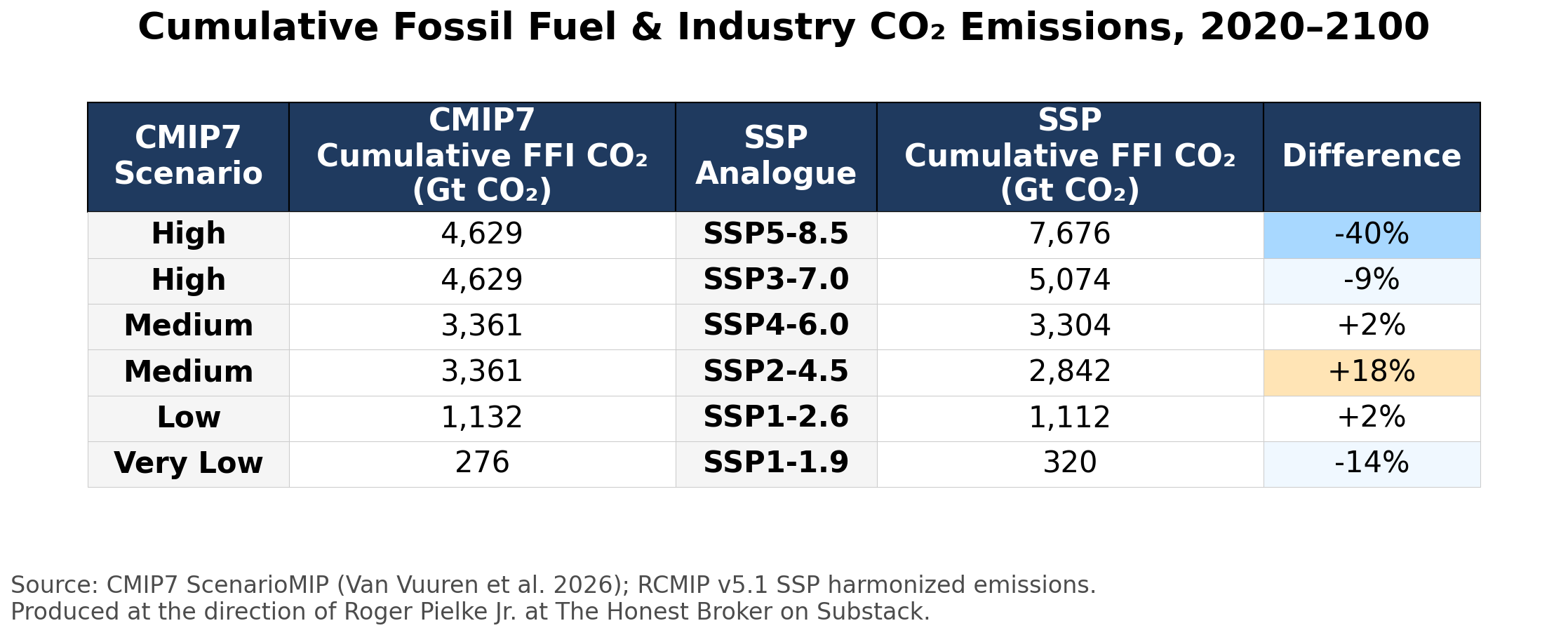
Note the massive gap between the new HIGH and SSP5-8.5. The new HIGH reaches 71 Gt CO₂/yr in 2100 — far below SSP5-8.5 at 128 Gt in 2100. Nothing in the CMIP7 set comes close to SSP5-8.5. The new HIGH also sits below SSP3-7.0 by about 9% in terms of cumulative emissions to 2100. Note also the gap between MEDIUM (solid yellow) and SSP2-4.5 (dashed yellow), which I’ll return to below.

Both of the most recent IEA near term scenarios — which run to 2050 — fall below MEDIUM and SSP2-4.5.

The table below compares the CMIP7 scenarios to their closest AR6 analogues, showing that the overall range has constricted. The higher scenarios have come down and the lower scenarios have come up — except VERY LOW, which moved down.
2100 effective radiative forcing and end-of-century temperature
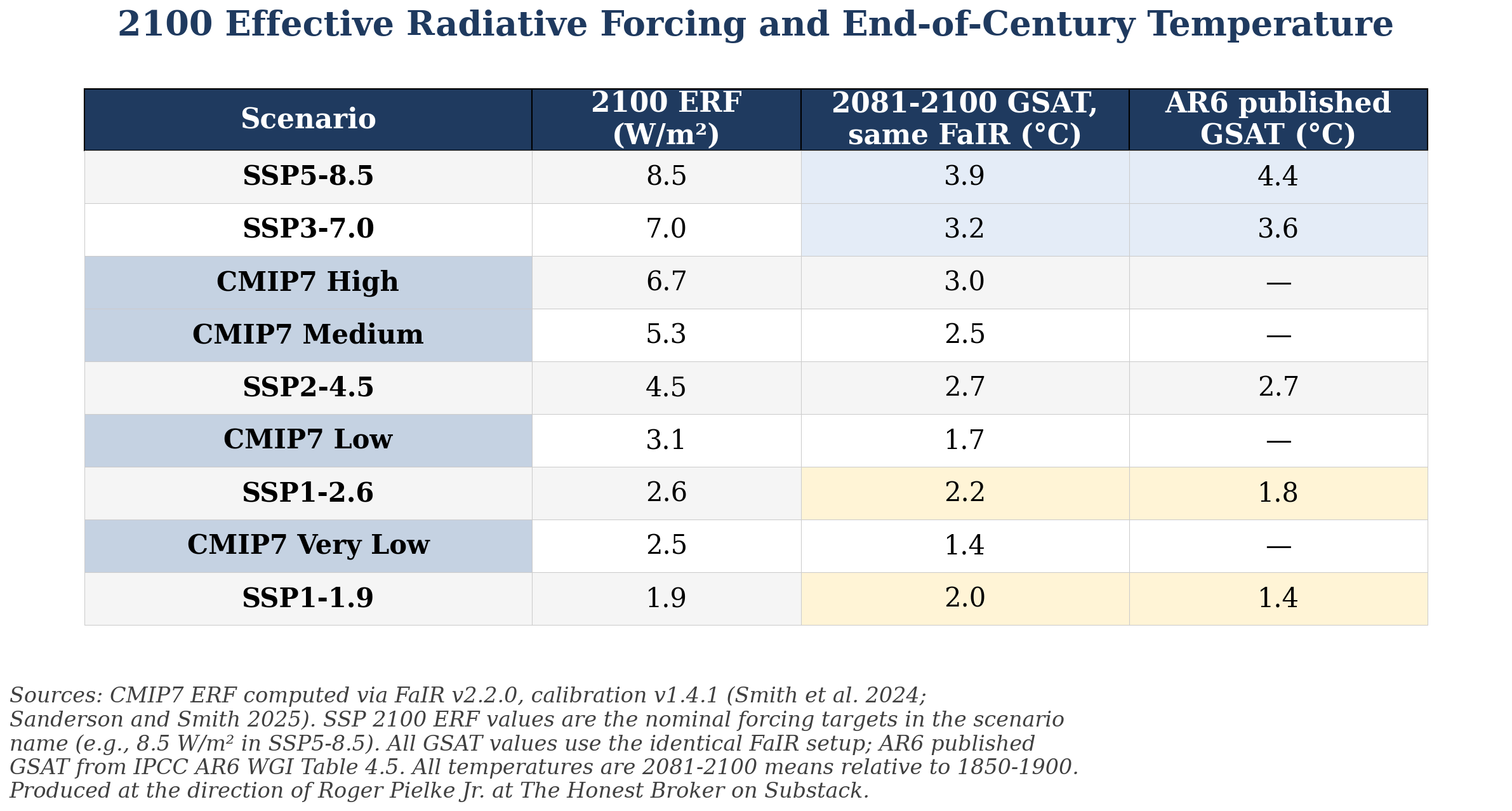
The table below lists AR6 and CMIP7 scenarios from highest to lowest 2100 radiative forcing. The middle column shows the average global temperature change from an 1850-1900 baseline, under the climate emulator used by CMIP7. The right column shows the average temperature change for the SSPs as projected by the IPCC AR6.
Interestingly, the projected 2080-2100 temperatures of the SSPs decreased from their AR6 values based solely on recent updates to the FaIR climate emulator.3 These changes resulted primarily from the updating of emissions trajectories from 2014 (used in AR6) to 2023 (used by CMIP7). The more moderate emissions trajectories resulted in lower projected end-of-century temperature increases.

The new CMIP7 HIGH is 0.9°C cooler than SSP5-8.5 in apples-to-apples terms (and 1.4°C cooler versus IPCC AR6), and 0.2°C cooler than SSP3-7.0 (-0.6°C against IPCC AR6).

The implausibility of upper-end legacy scenarios is now official.
CMIP7 avoided repeating the past with SSP3-7.0

Last April I argued here at THB that the climate science community was on the brink of repeating the RCP8.5 mistake with SSP3-7.0 — which assumed a 2100 global population approaching 13 billion, well above any contemporary demographic projection and a five-fold expansion of global coal use. Neither assumption survives current understandings of demographics or energy systems.

I don’t know if anyone in CMIP or ScenarioMIP reads THB4 — if not they should! — but regardless, they wisely chose not to adopt SSP3-7.0 as the new HIGH scenario.

The new HIGH scenario sits at 6.7 W/m² in 2100 — below the SSP3 baseline 7.0 W/m² — with 9 percent less cumulative fossil CO₂ through 2100. As I’ll discuss below, this is progress; it is partial but real.

But the new HIGH still sits well above the plausibility range that we identified in Pielke, Burgess, and Ritchie (2022). We found that of the >1,000 scenarios in the AR5 database, the plausible subset centered on a median of ~3.4 W/m² in 2100, with an upper end near 6 W/m². The new HIGH scenario is well above that upper end.

The authors of Van Vuuren et al. partially acknowledge that the new HIGH scenario is exploratory — a thought experiment, not a projection:

“Clearly, this scenario is not a “business-as-usual” scenario nor the no-policy reference scenario for the other scenarios. The scenario is intended to explore the upper end of GHG emissions resulting from deep political, technological, and structural deviation from current trends.”

Note that first sentence — It means that any future research that compares the HIGH scenario to lower scenarios in order to characterize the effects of climate policy will be fundamentally flawed. The HIGH scenario is not a projective scenario, but a “what if?” exercise.

Unfortunately, Van Vuuren et al. then engage in some unsupported speculation about the plausibility of the HIGH scenario in the real world:

“The are various reasons why such a scenario could emerge. For instance, a rollback of climate policies could result from a lack of public support for the energy transition. This could be related to, for instance, local opposition to building new wind farms or concerns about impacts on fossil industries related to jobs and national energy security. Also, the rapid cost decrease in renewable energy of the past decade could be discontinued, possibly as a result of regional scarcity and limited tradability in materials for solar and wind technologies and EV batteries . . .”

As discussed below, the new population assumptions of the updated SSP3 are ridiculous, and by themselves render the HIGH scenario implausible. The lack of any systematic effort to evaluate plausibility of scenarios remains a fundamental weakness of the scenario development process.
The new scenarios are SSPs in new clothing

The new CMIP7 framework does not start from a fresh socioeconomic foundation. Van Vuuren et al. explain:

“In practice, the IAM [Integrated Assessment Modeling] teams have based their current scenarios on various SSPs, as it was generally deemed pragmatic as these come with already available, suitably rich quantifications and were implemented by the participating modelling teams within the given timeline.”

The CMIP7 scenarios rely on the same narrative architecture as the IPCC AR6 SSPs. The table below shows how the SSP storylines map onto the new scenarios — Confusion is sure to result, as the old SSPs are not the new SSPs.
The new HIGH inherits the SSP3 storyline directly — the same SSP3 whose enormous 2100 population rendered it implausible when used in the IPCC AR6. Remarkably, the IIASA 2024 update to the SSPs did not bring the population projections down. Instead, it increased them, as you can see in the table below.
The 2024 demographic update (KC et al. 2024, IIASA Working Paper WP-24-003, also referred to as WIC2023) revises SSP 2100 populations upward: SSP3 jumps from 12.6 to 14.5 billion. SSP4 increases from 9.3 to 13.3 billion — an eye-popping 43% increase.

The SSP population update assumes that child mortality declines faster than WIC2013 anticipated, fertility declines slower in sub-Saharan Africa, and Africa’s 2020 base-year population was already 76 million higher than WIC2013 had projected. Africa’s 2100 population alone is now 3.55 billion, up from 2.62 billion in the AR6-era projection — a 35% upward revision.

This puts the CMIP7 HIGH scenario in a strange position: The cumulative fossil CO₂ from energy and industry in CMIP7 HIGH (4,629 Gt 2020-2100) is lower than SSP3-7.0 (5,074 Gt), but it has a 2100 population that is 15 percent larger. That means that the implied per-capita emissions trajectory in the new HIGH has a steeper decline.

How much of the new HIGH scenario’s warming is due to its incredible population projection?

I performed a simple sensitivity analysis:Take HIGH as published: 4,629 Gt cumulative fossil CO₂ over 2020-2100, producing about 3.0°C of 2081-2100 warming.
That means per-capita emissions intensity average about 5.2 tonnes of CO₂ per person per year using 11-billion as the mean population across the century.
Hold that per-capita intensity constant and replace the SSP3 population trajectory with the SSP1/SSP5 population trajectory — peaking at 8.5 billion in 2050, declining to 7.4 billion by 2100, averaging about 8 billion.

Under these assumptions, under HIGH, cumulative fossil CO₂ falls to roughly 3,330 Gt, a 1,300 Gt reduction. The IPCC AR6 central TCRE estimate (0.45°C per 1,000 Gt CO₂) gives about 0.6°C less warming. The HIGH scenario with SSP1/SSP5 population thus would deliver about 2.4°C of 2081-2100 warming — slightly cooler than the new MEDIUM at 2.5°C.

Under this simple method, about 0.6°C of the HIGH scenario’s projected warming traces to the population assumption alone. The HIGH scenario may be much less about carbon and much more about assumed human fecundity.

This is a sensitivity analysis, not a coherent scenario — combining SSP3’s per-capita intensity with the SSP1/SSP5 demographic profile is internally inconsistent. But it suggests that the demographic contribution to the HIGH scenario’s warming is significant.
The plausibility vacuum remains

The deeper problem with the SSP/RCP architecture, as Justin Ritchie has documented at length, is that physical climate modeling became decoupled from the underlying IAM socio-economic scenarios.

Under the RCPs, scenario creators identified concentration pathways and the underlying socio-economic assumptions were expected to be filled in later. Whether the underlying assumptions actually described a coherent picture of the world was never systematically assessed.

Ritchie called this a plausibility vacuum — a situation where any combination of climate model inputs could be used without any assessment of the real-world plausibility of the assumptions.

To be fair, the new CMIP7 framework does address some earlier shortfalls. The new design specifies emission-driven runs as the default, which allows for carbon-cycle feedbacks. The harmonization of emissions to observed 2023 data is an improvement — CMIP6 harmonized to 2014, and that harmonization had become well out-of-date by the time AR6 came out.

However, the plausibility vacuum problem remains. Van Vuuren et al. do not evaluate scenario plausibility against observed energy trends, against IEA projections, or against the body of literature critiquing the SSP set.

The 2023 ScenarioMIP workshop report — which kicked off the process of developing these new scenarios — recognized the plausibility problem and committed to addressing it. Van Vuuren et al. does not deliver on that commitment.

ScenarioMIP produces a better scenario set than those of AR6, but the improvement comes from incorporating more recent emissions data and accepting the undeniable collapse of SSP5-8.5’s credibility — not from any methodological reform of how scenario plausibility is assessed.
The MEDIUM scenario is not “current policy”

The walk-back at the high end is the most important change in the new framework. The story in the middle is more complicated.

Van Vuuren et al. describe the MEDIUM scenario as one that “shows the consequences of the current policy situation (as of 2025) and trends continuing over the century.” They specify that MEDIUM includes only policies “actually officially being implemented” — no NDC pledges, no net-zero announcements, unless backed by explicit policy. The framing implies that MEDIUM tracks where the world is actually headed under current policies.

That framing is not consistent with other approaches to defining a current policy trajectory. The CMIP7 MEDIUM scenario produces fossil-fuel CO₂ emissions that rise from about 38 Gt CO₂/yr today to 41 Gt by 2050 — that part compares well to the scenarios (CPS and STEPS) of IEA’s World Energy Outlook 2025, released last November.

However, it is post-2050 where the new MEDIUM scenario diverges from other current-policy projections, with its emissions slowly rising through the second half of the century.
In contrast, STEPS — the IEA’s standard reference for where current and announced policies actually take us — falls below 30 Gt by 2050 and produces about 2.5°C of 2100 warming.

The CMIP7 MEDIUM is more accurately characterized as a “policy stagnation” scenario rather than a “current policy” scenario. Cumulative fossil CO₂ emissions through the end of the century come in 18% higher than SSP2-4.5 — the AR6-era middle-of-the-road scenario — even though the MEDIUM 2081–2100 mean temperature is slightly cooler (explained below).

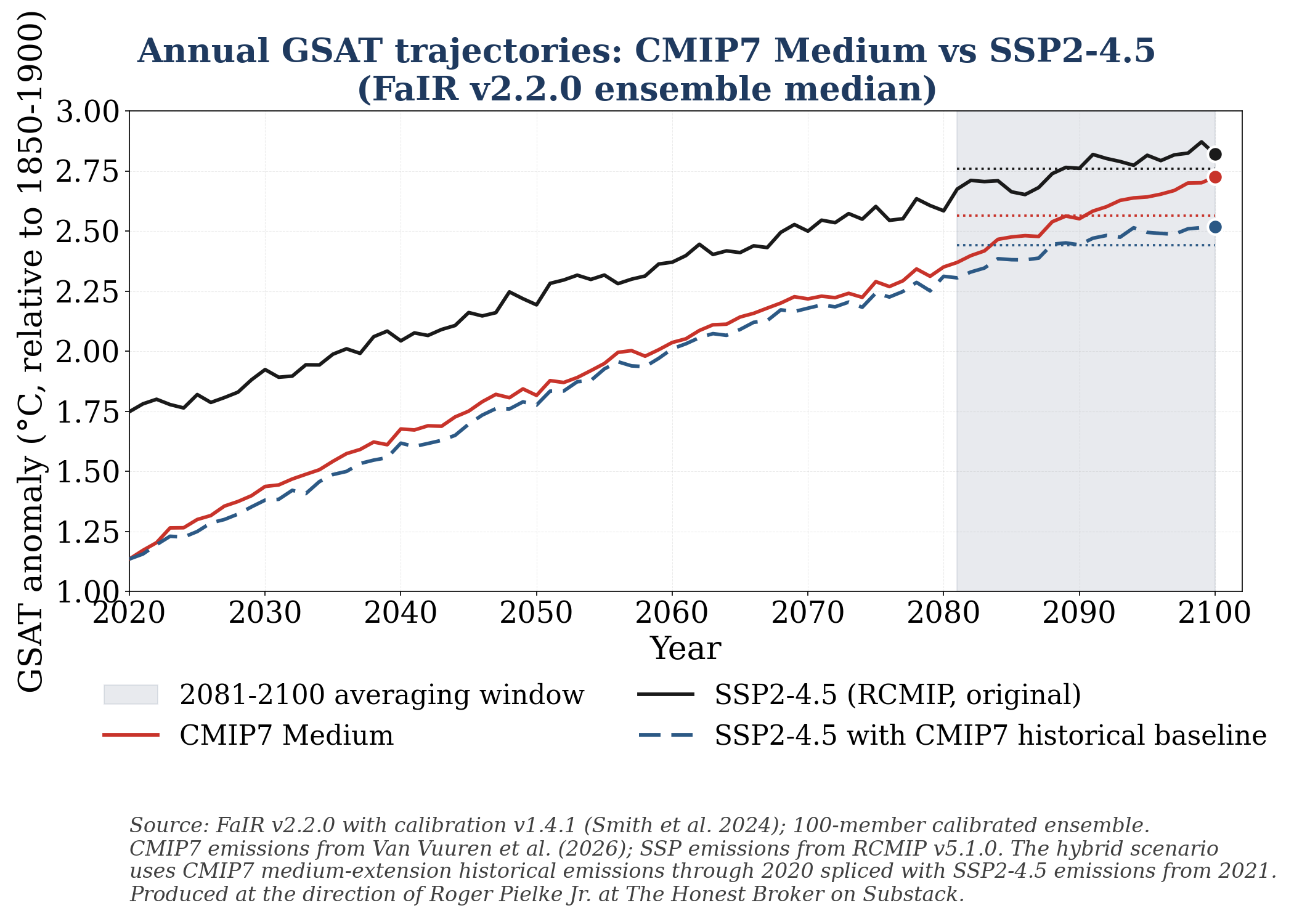
The figure below shows what happens once SSP2-4.5 and MEDIUM are anchored to the same observed 2020 baseline. The original SSP2-4.5 (black) sits roughly 0.6°C above CMIP7 MEDIUM (red) at 2020 — not because the 21st century plays out differently, but because the SSP framework’s historical emissions are harmonized to 2014 while CMIP7’s are harmonized to 2023. That head start propagates through the entire 21st century trajectory.
Running SSP2-4.5 post-2020 emissions through the CMIP7 FaIR emulator with CMIP7’s updated historical baseline (dashed blue), the picture inverts: SSP2-4.5 produces a 2081-2100 mean of 2.44°C against CMIP7 MEDIUM 2.56°C. On an apples-to-apples comparison, the new MEDIUM results in about 0.12-0.20°C more warming than SSP2-4.5 — due to its 520 Gt larger cumulative CO₂ budget over the century.

This connects to the larger argument in Pielke, Burgess, and Ritchie (2022): observed CO₂ emissions from 2005 through 2020 tracked closer to the SSP 3.4 W/m² range than to SSP2-4.5. Today, the gap has widened, not closed. IEA STEPS now has emissions falling to under 30 Gt by 2050 — a trajectory consistent with the SSP 3.4 forcing range. The center of the new CMIP7 scenario set sits well above that range.

The new framework compressed the high end. Good.

The middle did not move far enough. The new MEDIUM might be considered a worst-case scenario rather than a current policy scenario. Interestingly, that would mean that there is no real current-policy scenario in the new CMIP7 scenarios, which would be something like a SSP2-3.4 scenario with updated demographics.

Perhaps, if projected demographic changes continue to trend lower, CMIP7 LOW will come to represent something akin to a current policy trajectory.
Why this matters: these scenarios live in policy

The now-implausible upper-end scenarios — RCP8.5, SSP5-8.5, and SSP3-7.0 — are not just academic constructs used in esoteric research. They are embedded in the policies and regulations of most of the world’s largest economies, found across the world’s most important multilateral institutions, and used in the climate stress tests that govern hundreds of billions of dollars in bank capital.

The table below provides just a few examples.

National climate impact assessments in the United States, United Kingdom, Germany, Canada, Australia, Japan, and the Netherlands all use RCP8.5 or SSP5-8.5 as a reference scenario. The Network for Greening the Financial System framework, used by more than 140 central banks, has utilized a “Hot House World” scenario calibrated to RCP8.5 physical risk into the bank stress tests run by the European Central Bank, the Bank of England, the Reserve Bank of New Zealand, the Banque de France, and the US Federal Reserve. The World Bank’s Climate Change Knowledge Portal, which provides the climate diagnostics that feed into the Country Climate and Development Reports for more than 100 client countries, defaults to SSP5-8.5 and SSP3-7.0.

The abandonment of the high-end legacy scenarios by CMIP7 will need to propagate through this entire infrastructure. The policy machinery built on RCP8.5 and the other implausible scenarios is systemic.
What this means

The new CMIP7 ScenarioMIP framework represents a real course correction, but with more work to do. SSP5-8.5 is gone. SSP3-7.0 has a successor that is less extreme but arguably remains implausible. The middle of the set is more pessimistic than trajectories of current and announced policies. The plausibility vacuum at the heart of the architecture has yet to be addressed.

All this means that users of climate models and model output based on legacy scenarios will now face decisions about if and how they’d like to realign with the latest scientific understandings versus continuing to rely on outdated research.

Furthermore, there are no doubt many — hundreds if not thousands — of studies in the publication pipeline that depend upon the upper end scenarios. Editors and reviewers should ensure that they are properly characterized as exploratory and are not intended to be interpreted as projective.

We’ve known since 2017 that upper end climate scenarios are fatally flawed. Nine years later, that understanding has now become officially recognized. That is good news.

We can debate whether nine years is short or long for the overturning of scientific understandings with massive economic and policy implications. But today, that overturning is undeniable.

Science is self-correcting. What matters now is what happens next.

quinta-feira, 2 de abril de 2026

Energia em Portugal: porque o nuclear não é (ainda) a resposta


Portugal está numa encruzilhada estratégica na energia: ou hesita perante soluções caras, lentas e controversas, como o nuclear, ou consolida a vantagem competitiva que já tem nas renováveis, tornando o sistema mais robusto e previsível. Neste momento, insistir em discutir centrais nucleares em Portugal é, acima de tudo, uma distração política e financeira face às oportunidades reais que temos ao alcance.

A eletricidade portuguesa é hoje, em larga medida, de origem renovável, com um peso crescente da eólica e da solar e um contributo histórico da hídrica. Isto já nos permite ter períodos prolongados em que a quase totalidade da eletricidade consumida é gerada por fontes limpas, ainda que, numa perspetiva anual, continuemos dependentes de térmicas e de importações. O desafio não está em “inventar” uma nova fonte centralizada de produção, mas em gerir melhor a variabilidade das fontes que já temos – algo que se resolve com redes mais inteligentes, flexibilidade e armazenamento, não com um salto para o nuclear.

Defender o nuclear em Portugal, hoje, é ignorar três fatores decisivos. Primeiro, o custo: construir uma central nuclear exige investimentos gigantescos, prazos de execução muito longos e um compromisso de décadas, num país sem tradição nem cadeia industrial nesse domínio. Segundo, a rigidez: num sistema em rápida transformação, uma tecnologia pesada, centralizada e pouco flexível encaixa mal numa rede que caminha para a descentralização e para a gestão ativa da procura. Terceiro, a oportunidade perdida: cada euro canalizado para nuclear é um euro que não é investido em mais solar, mais eólica, mais eficiência, mais armazenamento e em reforço de rede, onde temos retorno mais rápido, impacto ambiental mais positivo e alinhamento direto com as metas europeias.

Há quem argumente que, se houver financiamento europeu, o nuclear passa a ser uma opção “a considerar”. Discordo. A existência de fundos não transforma uma má prioridade numa boa decisão. O verdadeiro debate deveria ser: se temos acesso a financiamento europeu e internacional, onde é que esse dinheiro gera mais segurança energética, mais redução de emissões e mais competitividade económica? Em Portugal, a resposta é clara: reforçar renováveis, investir a sério em armazenamento (baterias, bombagem hidroelétrica, hidrogénio verde onde fizer sentido), modernizar a rede e apostar em eficiência. É aí que cada euro conta mais.

A intermitência das renováveis não é um argumento contra elas; é um desafio de engenharia de sistema. Sabemos que o sol não brilha sempre e que o vento não sopra todos os dias, mas também sabemos que já existem tecnologias maduras para armazenar energia e gerir melhor a procura: centrais de bombagem, grandes baterias, soluções de autoconsumo com storage, contratos de flexibilidade com a indústria, redes digitais que antecipam e suavizam picos de consumo. Em vez de usar a intermitência como pretexto para reabrir o dossier nuclear, devíamos usá‑la como catalisador para acelerar a transição tecnológica do sistema elétrico.

A mobilidade elétrica é outro ponto crítico. Multiplicar postos de carregamento e veículos elétricos sem garantir que a energia que os alimenta é renovável e que a rede aguenta essa nova carga é um erro estratégico. Mas, novamente, a resposta está nas renováveis e na gestão da rede: mais produção descentralizada junto dos pontos de consumo, armazenamento local em hubs de carregamento, tarifários inteligentes que deslocam carregamentos para horas de maior produção solar ou eólica. Tudo isto é mais rápido, mais modular e mais adaptável à realidade portuguesa do que um projeto nuclear que, mesmo decidido hoje, só veria eletrões na rede daqui a 15 ou 20 anos.

Adiar o debate nuclear não é ser ingénuo nem ideológico; é ser pragmático.

Num país com recursos renováveis abundantes, escala limitada e finanças públicas pressionadas, faz pouco sentido apostar numa tecnologia cara, lenta, dependente de cadeias externas e que não resolve os desafios imediatos de integração de renováveis e de modernização da rede. O que faz sentido é concentrar esforços onde o retorno é mais rápido e mais certo: sol, vento, água, armazenamento e eficiência.

Portugal já está no grupo da frente da eletricidade limpa. A pior coisa que poderíamos fazer agora era dispersar-nos numa fuga para a frente nuclear que não se ajusta à nossa realidade. O caminho, pelo menos nesta década, é claro: consolidar e aprofundar a aposta nas renováveis, construir um sistema energético resiliente e flexível e usar o debate nuclear, quando muito, como exercício de prospetiva – não como desculpa para adiar decisões que podemos e devemos tomar já.

sábado, 14 de março de 2026

Now comes the heat

Iam (mostly) going to take a break from writing about the war for a day, because big though it is, it’s not quite the biggest thing happening on our planet. Or rather, its widespread destruction is taking place inside a larger context. Trump’s endless folly (first tariffs, now a desperately stupid war that has closed the Strait of Hormuz) has caused what everyone is beginning to understand is widespread economic damage. As the Times reported today, “this is the big one,” and “the fallout is rattling households and businesses in neighborhoods all over the globe.”

On a stable planet, though, the damage might be contained and repaired; someone as incompetent as Trump (who is now describing his war as a “short excursion” and insisting that the Strait is in “very good shape”) will eventually (please God) burn himself out. Our bigger problem, as we’re about to be reminded, is that the planet is the furthest thing from stable. The backdrop is about to become the foreground, and with that the drama will shift once more.

It’s already hot, all over the world and here in the United States. That’s been a little hidden these past months, because the country’s population and power center—the northeast corridor from Boston to DC—has had a cold winter; until the last few days of rapid-onset mud season it’s felt like an old-school winter in New England (with sublime skiing, which has kept me sane). And Minnesota, the source of much of the year’s news so far, was cold too, at least in bursts. But we’ve been the exception: in fact, it was the second-warmest winter on record in the continental U.S., and that’s because the West broke every possible record, usually by a mile.

Several cities can now claim winter 2025-26 as their warmest on record, including locations with over a century of data, like Salt Lake City (152 years of data), Tucson (130 years of data) and Rapid City, South Dakota (114 years of data).

Phoenix, Arizona, obliterated its previous record (a record that was only a year old, mind you) by almost 3 degrees, a pummeling of a record in the realm of three-month temperature data.

Albuquerque, New Mexico, clobbered its previous record warmest winter by 3 degrees, according to the Southeast Regional Climate Center. Helena, Montana, Las Vegas and Lubbock, Texas, were among the other cities record warm this winter.

I don’t want to brush by those numbers. Phoenix and Albuquerque have temperature records going back more than a century. If they were going to beat the old record for a three-month stretch, something that shouldn’t happen very often, it should be by a tenth of a degree. That’s how statistics work on a set that large—or it’s how they did work on a stable planet. Three degrees is insane. And if that’s insane, then what’s going to happen in the next week is truly bonkers. A giant heat dome is set to settle in over the Southwest, bringing new temperature records. As the Washington Post reported today, Palm Springs California is projected to reach 104 degrees on Monday; the old record for the date is 95 degrees. Again, that’s statistically bizarre in a way that makes my head hurt.

This record-breaking heat dome will contribute to worsening drought conditions across the Intermountain West.

In Utah, snowpack remains at record low levels according to Meyer. He said that it would take a foot of snow in Salt Lake City for the season to catch up with even the second-lowest seasonal snowfall total — and that a storm of that magnitude isn’t expected to come.

“The knockout punch comes in the form of Utah’s reservoirs, which are only at 40 percent of capacity right now,” Meyer said. “All this means we are likely going to see some very tangible water supply cuts and conservation efforts by the state this year.”

The weather forecast and climate outlook community in Utah was “filled with trepidation” because drought relief looked unlikely, added Meyer, stressing that much more meaningful impacts were possible for agricultural communities as water conservation efforts grow.

“Right now, every drop is going to count this year,” he said.

Across the region, New Mexico was also reporting its lowest snowpack on record and Colorado was in a similar situation.

Here’s how Daniel Swain and the good folks at Weather West described the heat dome that is forming as of this morning

In fact: the strongest mid-tropospheric ridge ever observed in the southwestern U.S. in March is expected to develop by Friday, and then will probably go on to break that new record (set this week) when it re-organizes into an even broader and stronger ridge next week.

In case you’re wondering, this heat is in no way confined to land. The oceans, which have soaked up most of the planet’s excess warmth, are crazily warm right now too.

Sea surface temperatures off the coast of Southern California have risen as much as five degrees above average for the time of year, causing a strong, Category 2 marine heat wave to develop.

These unusually warm waters will provide a boost to air temperatures near the coast, especially at night, preventing them from dropping off as much as they otherwise would.

“A strong to severe marine heatwave is ongoing off the coast of California,” wrote Colin McCarthy, a storm chaser affiliated with the University of California at Davis.

In early March, ocean temperatures reached the mid- to upper 60s at Scripps Pier in La Jolla, California.

“That’s the average ocean temperature for mid-June,” McCarthy said.

And here’s the kicker. All this is happening during a La Niña “cool phase” of the Pacific, something that will soon change. I alerted you exactly a month ago to the likelihood we were going to see an El Niño kick off sometime this summer; in the last few weeks the chances of that have grown stronger, and more to the point it looks like it could be an exceptionally strong “super” version of the warming current. The normally cautious-almost-to-a-fault climate scientist Zeke Hausfather came out with his new forecast this afternoon, and it was a doozy.

I’ve collected 11 different models that have been updated since the beginning of March. Each of these in turn features a number of ensemble members, so that we end up with 433 total ENSO forecasts…

These clearly show that a strong El Niño is indeed likely to develop later in the year. While I’d probably discount some of the higher values (much above 3C) as outliers here, the median and mean across all the models still gives an estimate around 2.5C, which would put it notably stronger than the 2023/2024 El Niño and close to if not matching what we saw back in 2015/2016.

So what does this mean for global temperatures this year and in 2027? All things being equal, the lag between peak El Niño conditions and the global surface temperature response would result in the largest impacts on 2027 temperatures (as El Niño events generally peak between November and January). It would still boost 2026, but probably not enough to set a new record this year.

However, I have to be a bit cautious here. Long time readers may remember my post in May 2023 where I deemed it unlikely that 2023 would set a new record (given this historical lag in global temperature response to El Niño) and argued that 2024 would instead. I was partially wrong – 2023 was weird, and the heat came much earlier than expected. We think the extended triple-dip La Niña event between 2020 and 2023 may have primed the system for more rapid heating, something absent this time around. But we don’t know for sure. Fool me once, and all that.

Either way, this means that 2027 looks increasingly likely to set a new record, perhaps by a sizable margin if we end up on the high end of the range of El Niño forecasts.

That Hausfather and the brasher Jim Hansen are in basic agreement here should terrify us. We’re going to see temperatures unlike any that humans have seen before, which means we’re going to see chaotic weather unlike humans have seen before. If you think this is some kind of lefty enviro fantasy, check out this source: “Due to the increasing concentration of greenhouse gases, the climate system cannot effectively exhaust the heat released in a major El Niño event before the next El Niño comes along and pushes the baseline upward again,” Defense Department meteorologist Eric Webb said.

Therefore, a super El Niño in 2026-27 would disperse more heat than other very strong events in 1982-83, 1997-98 and 2015-16.

And were not going to know what hit us, in several ways. The substack Future Earth Catalog published an interview today with veteran Florida weatherman John Morales which was the best account I’ve seen yet of what the Trump cuts to our scientific system mean in real time.

The cuts to NOAA and the National Weather Service have been devastating. If you look at the statistics of forecast accuracy for tropical cyclone tracks and intensities from the National Hurricane Center, they were off in 2025. And anecdotally, I’m not the only meteorologist who will tell you that day-to-day forecasting has become more challenging. The weather models are flip-flopping from one solution to the next.

Think about how many times TV meteorologists in the fall of 2025 had to show you two or three models with different solutions and say, “Well, this is what this model says, but yesterday it was saying something different.” That leads to more confusion among the public — and it makes our job of saving life and property more difficult.

We’ve been missing 15 to 20 percent of our weather balloon data. And those missing balloons are upstream — out West, in the Plains, in the Intermountain West, and especially in Alaska. That’s where our weather comes from. We’re no longer able to really know what’s going on out there. And nothing provides the detail weather balloons can: every 15 feet, all the way up to 100,000 feet.

So we may not know what’s coming, but we can guess it’s going to be bad. For instance, I noted before that the western snowpack is at record low levels. Even in California, which, due to a couple of record-level atmospheric rivers off the warm Pacific saw lots of midwinter snow, the early heat in the Sierras has already led to widespread melt. I do not think it’s fear-mongering to warn that fire may be a serious danger this season in the West.

And what’s happening in the U.S. will be paralleled in places around the planet as El Niño takes us up the escalator. A new study just found that rising temperatures are already taking many humans past the point where they can live with any kind of comfort. As Todd Woody reports, " the number of days where extreme heat makes it too dangerously hot to walk the dog, sweep the porch and engage in other ordinary pursuits has doubled around the world over the past 75 years, according to new research."

Scientists determined that on average, those 65 and older experience a month a year when heat prevents them from routine activities. Parts of Asia, Africa, Australia and North America are becoming unlivable for senior citizens, the researchers said. Younger adults also are losing time as climate-driven heat restricts their lives for 50 hours a year.

Overall, more than a third of the global population resides in regions where heat severely affects daily life, according to the peer-reviewed paper published Tuesday in the journal Environmental Research: Health.

But it may be getting too hot for some key physical systems too. It seems likely that this is the year the Colorado River system may finally have to deal with the fact that it simply can’t provide the water people have been counting on. A new study last week found clear signs that the Gulf Stream is beginning to drift northward, a “clear sign” that worries about the collapse of the Atlantic Meridional Overturning Current (AMOC) are no mere phantasm.

The findings indicate that the movement of the Gulf Stream could be a “canary in the coal mine” for the AMOC’s collapse. According to their analysis of satellite data, the Gulf Stream has already been nudged northwards from the coast near Cape Hatteras, North Carolina, since the early 1990s. This is likely to be the result of the AMOC dwindling and losing its grip.

We don’t know for sure how the Iran war will play out, nor the El Niño; at the moment, though, things look ominous. All I’m saying is, the next six months could be the ultimate in teachable moments, with rapidly rising prices for oil, and rapidly rising temperatures. And what do you know, we have a midterm exam coming up on November 3.

Soberania alimentar e autossuficiência em crise no Reino-Unido


O primeiro Relatório de Segurança Alimentar do Reino Unido, de dezembro de 2021, constatou que o país era 54% autossuficiente em termos alimentares. Outros países ricos, como os EUA, a França e a Austrália, são todos autossuficientes em termos alimentares, o que significa que produzem alimentos suficientes para alimentar as suas populações sem necessidade de importações.

O Reino Unido é um dos países menos autossuficientes em termos alimentares na Europa. A Holanda, por exemplo, que é densamente povoada, tem 80% de autossuficiência, e a Espanha, 75%.

“Não estamos a pensar nisso adequadamente. Estamos a fugir do problema”, disse Lang, falando na conferência da União Nacional dos Agricultores em Birmingham.

“A ideia de que os outros nos podem alimentar está enraizada no sistema estatal britânico e, de facto, na própria natureza do capitalismo agroalimentar na Grã-Bretanha. Outros países são mais sábios. Outros países estão a armazenar alimentos”, disse. “Os outros países têm muito mais flexibilidade nos seus sistemas do que nós. O que glorificamos como eficiência agora é a vulnerabilidade.”

Outros países possuem reservas de emergência para casos de guerra, contaminação alimentar ou choques climáticos. A Suíça ainda possui reservas suficientes para alimentar toda a sua população durante três meses e está a aumentá-las para um ano. A recomendação do governo do Reino Unido para as famílias é que mantenham nos seus armários alimentos suficientes para três dias.

Agora um novo relatório revela algo preocupante do Reino Unido, onde um painel de peritos concluiu que uma guerra, um choque climático ou uma combinação de ambos poderia desencadear uma verdadeira crise alimentar nas Ilhas Britânicas.

Notícia completa no Guardian

sábado, 14 de fevereiro de 2026

A epidemia invisível dos ultraprocessados


Nas prateleiras dos supermercados, embalagens coloridas prometem conveniência, sabor imediato e preços acessíveis. Mas por detrás dessa sedução industrial esconde-se uma ameaça que a ciência tem vindo a estudar e não permite ignorar. Um estudo internacional publicado na The Lancet, assinado por 43 especialistas de vários países, revela que os alimentos ultraprocessados não são apenas "menos saudáveis” são agentes ativos de doença, com impacto mensurável em praticamente todos os órgãos humanos.

Os números impressionam. Em países como EUA, Reino Unido e Austrália, metade das calorias ingeridas diariamente provém de ultraprocessados. Snacks embalados, refrigerantes, refeições prontas e cereais artificiais tornaram-se rotina, substituindo alimentos frescos e minimamente processados. O estudo identificou mais de 30 associações distintas entre o consumo destes produtos e doenças crónicas: obesidade, diabetes tipo 2, hipertensão, problemas cardiovasculares, depressão e mortalidade precoce.

Mas o alerta vai mais longe. Não se trata apenas de calorias vazias ou excesso de açúcar. Os investigadores descrevem um efeito sistémico: fígado, rins, coração e cérebro mostram sinais de impacto direto. A combinação de aditivos, emulsionantes e processos industriais altera a forma como o corpo metaboliza os alimentos, criando uma espécie de “nova biologia alimentar” que fragiliza o organismo.

Esperar por "provas perfeitas" é repetir erro histórico
A comparação com o tabaco é inevitável. Tal como aconteceu no século XX, as empresas recorrem a marketing agressivo, lobbying político e estratégias de influência para atrasar regulamentações. A The Lancet avisa: esperar por “provas perfeitas” seria repetir o erro histórico de deixar que um produto nocivo se enraizasse ainda mais nas dietas globais.

O estudo não se limita à ciência. Aponta também para a política e para a desigualdade social. Os ultraprocessados são mais consumidos em comunidades vulneráveis, onde o preço e a conveniência pesam mais do que a qualidade nutricional. A crise é, portanto, dupla: sanitária e social.

​​De acordo com os inquéritos nacionais analisados pelos investigadores da série publicada na The Lancet, a presença destes produtos na dieta das famílias aumentou de forma expressiva nas últimas décadas. Em Espanha, por exemplo, a proporção de energia proveniente de ultraprocessados nas compras alimentares quase triplicou, passando de cerca de 11% para 32%. Na China, o salto foi igualmente significativo, de 4% para 10% em apenas 30 anos. A tendência repete-se na América Latina: no México e no Brasil, a contribuição energética dos ultraprocessados duplicou em 40 anos, evoluindo de 10% para 23%.

A análise mostra ainda que a proporção destes produtos na ingestão energética total varia de acordo com fatores económicos e culturais. Nos países do Sul da Europa com maior rendimento, como Portugal, Itália, Chipre e Grécia, e em algumas economias asiáticas, como Taiwan e Coreia do Sul, os ultraprocessados representam menos de um quarto da dieta. Já em nações como Austrália e Canadá, essa percentagem ultrapassa os 40%, enquanto no Reino Unido e nos EUA chega a superar metade da energia diária consumida.

Desafio não é só individual
Os especialistas pedem medidas urgentes: legislação forte, rotulagem clara com alertas visíveis, promoção ativa de dietas frescas e acessíveis e políticas públicas que enfrentam desigualdades. Para além da transparência informativa, defendem também regras mais apertadas no campo do marketing, sobretudo no que toca à publicidade dirigida a crianças e à difusão em plataformas digitais. Entre as medidas propostas está ainda a exclusão de alimentos ultraprocessados de instituições públicas, como escolas e hospitais, e a definição de limites tanto para a sua comercialização como para o espaço que ocupam nas prateleiras dos supermercados.

O desafio é global e não pode ser resolvido apenas com escolhas individuais. No fundo, o que este estudo revela é uma verdade desconfortável: os ultraprocessados são um motor silencioso da crise de saúde contemporânea. A sua omnipresença nas mesas e prateleiras representa uma ameaça comparável às epidemias de tabaco e álcool do século passado. A diferença é que, desta vez, a ciência chega cedo e clara. Falta saber se a política terá coragem de colocar a saúde antes do lucro.

quinta-feira, 29 de janeiro de 2026

Robert Reich - Trump cumpriu as suas promessas?


A administração Trump começou a semana a contar mentiras sobre o assassinato de Alex Pretti. Agora, Trump voltou a mentir sobre a economia para mudar de assunto. Trump mente como qualquer outro ser humano respira.

O primeiro ano de Trump no cargo tem sido repleto de mentiras e promessas quebradas. Estamos no auge das eleições intercalares, pelo que não é demasiado cedo para examinar o que prometeu e como cumpriu as suas promessas.

No vídeo desta semana, analiso as 10 maiores promessas de campanha de Trump e o que aconteceu desde que assumiu o cargo.

Duvido que precise de ser convencido, mas talvez queira partilhar o vídeo com o seu "Tio Bob" trumpista ou com qualquer outra pessoa que ainda acredite que ele está a fazer o que prometeu.

Está a sentir a "Nova Era de Ouro"? Está a gostar dos preços dos imóveis e da energia "reduzidos para metade"? E a satisfação de ter paz em todo o mundo? E quanto à promessa de divulgar TODOS os arquivos de Epstein?

São tantas as promessas para referir que nunca adivinharia qual é que ele de facto cumpriu.

quarta-feira, 31 de dezembro de 2025

Contracto de Arrendamento da Alma: Actualização 2026

Feliz 2026

Cláusula 1ª (Da Sobrevivência): O presente contrato não garante que o Utilizador chegará a 2027. O serviço é fornecido "tal como está", com bugs graves no sistema de saúde e falhas críticas na conta bancária.

Cláusula 2ª (Das Desilusões Obrigatórias):
• §1º: O Utilizador aceita que 70% das suas novas "metas" serão abandonadas até ao dia 15 de janeiro. Os restantes 30% serão ignorados por pura falta de vontade de viver.
• §2º: Fica estabelecido que qualquer tentativa de "encontrar o amor da sua vida" resultará apenas em novos traumas, despesas em terapia e subscrições inúteis no Tinder.

Cláusula 3ª (Da Obsolescência Programada):
• O seu corpo continuará a degradar-se. Ao aceitar 2026, o Utilizador concorda em sentir dores nas costas por ter dormido "mal" e em ter ressacas de três dias após beber dois copos de vinho barato.

Cláusula 4ª (Do Apocalipse e Outros Eventos Sociais):
• A Administração de 2026 reserva-se o direito de introduzir novas pandemias, guerras mundiais ou invasões alienígenas apenas para testar se o Utilizador ainda consegue manter a fachada de "está tudo bem" no LinkedIn.

Cláusula 5ª (Política de Terminação):
• Não há botão de "Sair". O tempo passará de forma agonizante durante as reuniões de trabalho e de forma instantânea durante o tempo livre. Se não estiver satisfeito, a reclamação deve ser feita por escrito e enviada diretamente para o vácuo existencial.

[ ] Li e aceito que vou continuar a ser um figurante neste simulador de caos chamado vida, mas assino porque a alternativa é ainda mais aborrecida.