Mostrar mensagens com a etiqueta Relógio do Juízo Final. Mostrar todas as mensagens
Mostrar mensagens com a etiqueta Relógio do Juízo Final. Mostrar todas as mensagens
quarta-feira, 23 de setembro de 2026
Then Comes Silence - Remaker Redeemer

domingo, 16 de agosto de 2026
Then Comes Silence - Judgement Day
A faixa começa inesperadamente por uma piscadela de olhos a uma melodia Euro-techno cativante e vibrante, criando um contraste imediato com a estética sombria a que os ouvintes estão habituados, e depois brilhantemente entramos no mundo da banda, inovadora ao misturar a pulsação do pós-punk e do rock gótico com uma roupagem eletrónica moderna, densa e cheia de atitude.
quinta-feira, 21 de maio de 2026
Omar Doom – Reflections (Feat. Arnaud Rebotini)
terça-feira, 19 de maio de 2026
Projeção máxima de aquecimento global cai 1 ºC por causa das renováveis

As projeções mais pessimistas para a subida da temperatura até ao fim do século foram revistas em baixa, à medida que as medidas de mitigação começam a dar frutos
A queda acentuada do custo da energia solar e eólica tornou um futuro altamente dependente de combustíveis fósseis cada vez mais improvável e as políticas climáticas estão a ajudar a reduzir as emissões, que já ficam abaixo das antigas projeções de pior caso
Alguns dos principais cientistas do clima do mundo consideram agora que o aumento de 4,5 °C até 2100, anteriormente projetado, deixou de ser plausível e reduziram o limite superior do seu cenário mais pessimista de aquecimento global para 3,5 °C acima dos níveis pré-industriais
Os novos modelos resultam do Scenario Model Intercomparison Project (ScenarioMIP), que elaborou projeções climáticas com base em cenários alternativos de futuras emissões e alterações no uso do solo. Liderado por um comité internacional de cientistas de topo, as suas conclusões serão integradas em futuras avaliações do Painel Intergovernamental para as Alterações Climáticas (IPCC) da ONU
Ainda assim, as projeções mais pessimistas ficam muito longe do limite máximo de 2 °C acordado pelos países no Acordo de Paris de 2015 e continuariam a provocar consequências desastrosas para o planeta.
Como foram modeladas as temperaturas futuras mais extremas?
Os cientistas simularam vários cenários para projetar o melhor e o pior caso de aquecimento global até ao ano 2100.
Foram considerados fatores como a futura população mundial, o consumo de energia, as fontes de energia, o investimento na adaptação e mitigação das alterações climáticas, as políticas climáticas e a colaboração entre países.
Os cenários mais pessimistas imaginam um mundo em que as políticas climáticas e os esforços de mitigação são enfraquecidos ou invertidos, e em que o uso de combustíveis fósseis aumenta, a par de tecnologias e estilos de vida muito intensivos em recursos e energia.
Um uso intensivo de combustíveis fósseis ultrapassaria as reservas atuais, o que significaria recorrer a depósitos ainda por descobrir, cuja extração se tornaria viável graças a futuras tecnologias.
Os modelos assumem também o fim da queda, que já dura há uma década, nos custos das energias renováveis, possivelmente porque os minerais necessários para painéis solares, turbinas eólicas e baterias de veículos elétricos se tornam escassos ou ficam presos em disputas comerciais.
A falta de cooperação na resposta às preocupações ambientais globais, incluindo progressos insuficientes em tecnologias de baixas emissões, poderá agravar a situação.
Um forte crescimento económico e a concorrência regional, o ressurgimento do nacionalismo, receios quanto à competitividade e à segurança e conflitos regionais podem levar os países a dar prioridade a questões internas ou regionais face à mitigação das alterações climáticas. Segundo o estudo, isto poderia conduzir ao colapso das políticas climáticas internacionais e nacionais.
Os modelos de pior caso projetam que o consequente pico de emissões provoque alterações irreversíveis nos componentes mais lentos do sistema terrestre, como o oceano profundo ou as calotes e geleiras, que regulam o clima global.
Embora este cenário seja improvável, os seus impactos seriam catastróficos.
Ao longo deste ano serão realizadas novas simulações com Modelos do Sistema Terrestre, que incluirão também os efeitos das retroações do ciclo do carbono, e os seus resultados poderão alterar as projeções.
Quais são os cenários alternativos?
O relatório modela igualmente cenários progressivamente mais moderados, que vão de emissões elevadas até meados do século seguidas de reduções rápidas, a políticas climáticas reforçadas que levam o mundo a atingir a neutralidade carbónica o mais depressa possível, limitando aquilo que o estudo designa como a agora “inevitável” ultrapassagem da meta preferencial de 1,5 °C do Acordo de Paris. Os modelos prolongam-se até ao ano 2500.
Se as políticas climáticas atuais continuarem inalteradas, estimativas preliminares apontam para uma subida da temperatura de cerca de 2,5 °C. Se as medidas de mitigação forem adiadas mas o mundo conseguir alcançar a neutralidade carbónica até ao fim do século, os modelos indicam que a subida da temperatura poderá atingir 2 °C.
Mesmo cenários de baixas emissões podem bloquear alterações catastróficas do nível do mar e dos mantos de gelo que são irreversíveis à escala de tempo humana. Uma ultrapassagem temporária dos 1,5 °C, mesmo que revertida, pode também causar danos duradouros em ecossistemas vitais, como recifes de coral e florestas tropicais.
Desenvolvidos em meados da década de 2010, os cenários anteriores utilizavam dados reais de emissões até 2015. Os novos modelos estendem esse período até 2023 e descrevem melhor a forma como os sistemas da Terra respondem ao aquecimento – por exemplo, quanto CO2 os oceanos e as florestas absorvem à medida que as temperaturas sobem.
quarta-feira, 29 de abril de 2026
RCP8.5 Is Officially Dead

The international committee responsible for the official scenarios that feed into climate modeling that are the basis for most projective climate research and the assessments of the Intergovernmental Panel on Climate Change (IPCC) has just published the next generation of climate scenarios.
Big news: The new framework has eliminated the most extreme scenarios that have dominated climate research over much of the past several decades — specifically, RCP8.5, SSP5-8.5, and SSP3-7.0. This is an absolutely huge development in climate science which will have lasting impacts across research and policy.
The future is not what it used to be.
Today’s post commends the researchers who have brought climate scenarios more in line with current understandings, but also raises some significant continuing issues with the scenarios.
Let’s get started . . .
The new scenarios come from the Coupled Model Intercomparison Project (CMIP) — a project of the World Climate Research Programme (WCRP), co-sponsored by the World Meteorological Organization, the International Science Council, and UNESCO’s Intergovernmental Oceanographic Commission.
Under CMIP, now in its seventh iteration, sits another little-known committee with responsibility for developing the scenarios necessary for earth system models to project future climate.1 That committee — called ScenarioMIP — just published the new scenario framework that will underpin the IPCC’s Seventh Assessment Report (AR7) and much of the research that it will draw upon.
In a paper released earlier this month, Van Vuuren et al. (VVetal26) introduce a new set of seven scenarios. The authors write of the obsolete high end emissions scenarios (emphasis added):
“For the 21st century, this range will be smaller than assessed before: on the high-end of the range, the CMIP6 high emission levels (quantified by SSP5-8.5) have become implausible, based on trends in the costs of renewables, the emergence of climate policy and recent emission trends.”
Read that again — The high end scenarios are Implausible.2
I disagree that the implausibility of the high-end scenarios resulted from the falling costs of renewables or the emergence of climate policy, but that is a debate for another day.
What matters today is that the group with official responsibility for developing climate scenarios for the IPCC and broader research community has now admitted that the scenarios that have dominated climate research, assessment, and policy during the past two cycles of the IPCC assessment process are implausible: They describe impossible futures.
Tens of thousands of research papers have been — and continue to be — published using these scenarios, a similar number of media headlines have amplified their findings, and governments and international organization have built these implausible scenarios into policy and regulation.
We now know that all of this is built on a foundation of sand.
What changed
The new CMIP7 ScenarioMIP framework offers seven scenarios spanning a range from “VERY LOW” through “HIGH.” The current naming convention drops the radiative-forcing target labels of the SSP era — there is no “8.5” scenario, and no “7.0” scenario, but as I’ll show below, each scenario has a radiative forcing level in 2100.
I ran the available new scenarios (HIGH, MEDIUM, LOW, and VERY LOW) through the FaIR calibrated and constrained ensemble that Sanderson and Smith (2025) used to characterize the CMIP7 set (FaIR v. 2.2.0 as described in their README file). I then ran each of the five tier-1 SSPs through the same emulator with identical parameters to ensure that the results are apples-to-apples. The full methodology, data, and code is in the appendix to this post.
The headline results follow.
CO₂ emissions: fossil fuels and industry, 2000–2100

The chart above shows fossil-fuel and industry CO₂ emissions for four CMIP7 scenarios alongside the five tier-1 SSPs and the two main reference scenarios from the 2025 IEA World Energy Outlook.
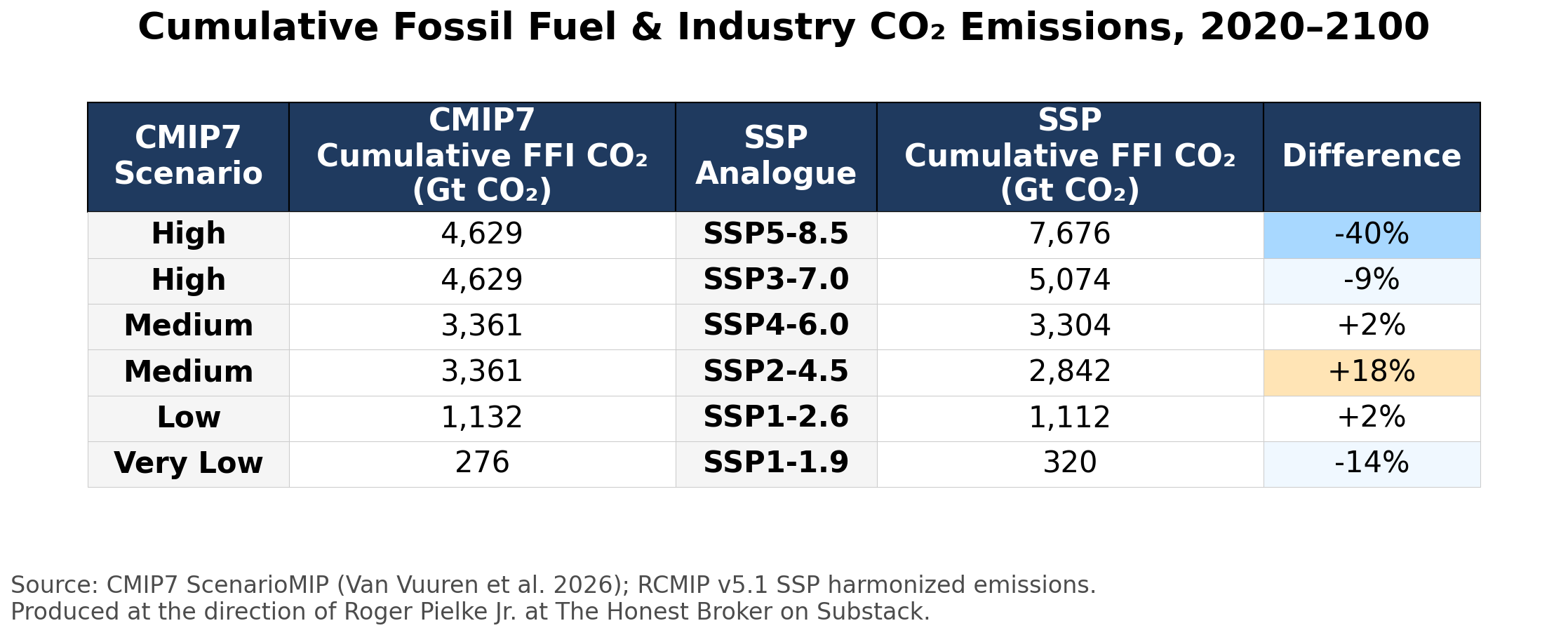
Note the massive gap between the new HIGH and SSP5-8.5. The new HIGH reaches 71 Gt CO₂/yr in 2100 — far below SSP5-8.5 at 128 Gt in 2100. Nothing in the CMIP7 set comes close to SSP5-8.5. The new HIGH also sits below SSP3-7.0 by about 9% in terms of cumulative emissions to 2100. Note also the gap between MEDIUM (solid yellow) and SSP2-4.5 (dashed yellow), which I’ll return to below.
Both of the most recent IEA near term scenarios — which run to 2050 — fall below MEDIUM and SSP2-4.5.
The table below compares the CMIP7 scenarios to their closest AR6 analogues, showing that the overall range has constricted. The higher scenarios have come down and the lower scenarios have come up — except VERY LOW, which moved down.

2100 effective radiative forcing and end-of-century temperature
The table below lists AR6 and CMIP7 scenarios from highest to lowest 2100 radiative forcing. The middle column shows the average global temperature change from an 1850-1900 baseline, under the climate emulator used by CMIP7. The right column shows the average temperature change for the SSPs as projected by the IPCC AR6.

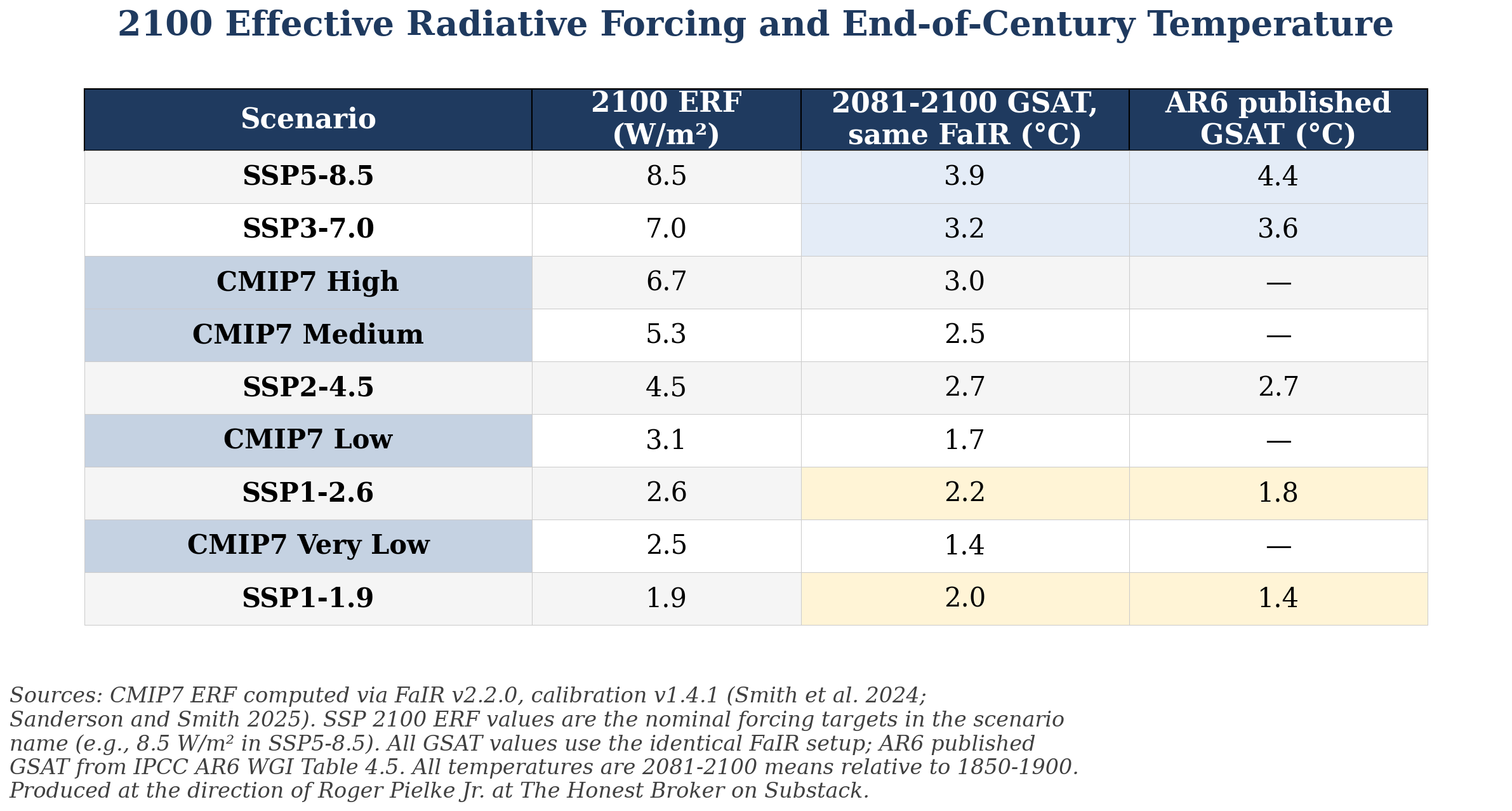
Interestingly, the projected 2080-2100 temperatures of the SSPs decreased from their AR6 values based solely on recent updates to the FaIR climate emulator.3 These changes resulted primarily from the updating of emissions trajectories from 2014 (used in AR6) to 2023 (used by CMIP7). The more moderate emissions trajectories resulted in lower projected end-of-century temperature increases.
The new CMIP7 HIGH is 0.9°C cooler than SSP5-8.5 in apples-to-apples terms (and 1.4°C cooler versus IPCC AR6), and 0.2°C cooler than SSP3-7.0 (-0.6°C against IPCC AR6).
The implausibility of upper-end legacy scenarios is now official.
CMIP7 avoided repeating the past with SSP3-7.0
Last April I argued here at THB that the climate science community was on the brink of repeating the RCP8.5 mistake with SSP3-7.0 — which assumed a 2100 global population approaching 13 billion, well above any contemporary demographic projection and a five-fold expansion of global coal use. Neither assumption survives current understandings of demographics or energy systems.
I don’t know if anyone in CMIP or ScenarioMIP reads THB4 — if not they should! — but regardless, they wisely chose not to adopt SSP3-7.0 as the new HIGH scenario.
The new HIGH scenario sits at 6.7 W/m² in 2100 — below the SSP3 baseline 7.0 W/m² — with 9 percent less cumulative fossil CO₂ through 2100. As I’ll discuss below, this is progress; it is partial but real.
But the new HIGH still sits well above the plausibility range that we identified in Pielke, Burgess, and Ritchie (2022). We found that of the >1,000 scenarios in the AR5 database, the plausible subset centered on a median of ~3.4 W/m² in 2100, with an upper end near 6 W/m². The new HIGH scenario is well above that upper end.
The authors of Van Vuuren et al. partially acknowledge that the new HIGH scenario is exploratory — a thought experiment, not a projection:
“Clearly, this scenario is not a “business-as-usual” scenario nor the no-policy reference scenario for the other scenarios. The scenario is intended to explore the upper end of GHG emissions resulting from deep political, technological, and structural deviation from current trends.”
Note that first sentence — It means that any future research that compares the HIGH scenario to lower scenarios in order to characterize the effects of climate policy will be fundamentally flawed. The HIGH scenario is not a projective scenario, but a “what if?” exercise.
Unfortunately, Van Vuuren et al. then engage in some unsupported speculation about the plausibility of the HIGH scenario in the real world:
“The are various reasons why such a scenario could emerge. For instance, a rollback of climate policies could result from a lack of public support for the energy transition. This could be related to, for instance, local opposition to building new wind farms or concerns about impacts on fossil industries related to jobs and national energy security. Also, the rapid cost decrease in renewable energy of the past decade could be discontinued, possibly as a result of regional scarcity and limited tradability in materials for solar and wind technologies and EV batteries . . .”
As discussed below, the new population assumptions of the updated SSP3 are ridiculous, and by themselves render the HIGH scenario implausible. The lack of any systematic effort to evaluate plausibility of scenarios remains a fundamental weakness of the scenario development process.
The new scenarios are SSPs in new clothing
The new CMIP7 framework does not start from a fresh socioeconomic foundation. Van Vuuren et al. explain:
“In practice, the IAM [Integrated Assessment Modeling] teams have based their current scenarios on various SSPs, as it was generally deemed pragmatic as these come with already available, suitably rich quantifications and were implemented by the participating modelling teams within the given timeline.”
The CMIP7 scenarios rely on the same narrative architecture as the IPCC AR6 SSPs. The table below shows how the SSP storylines map onto the new scenarios — Confusion is sure to result, as the old SSPs are not the new SSPs.
The new HIGH inherits the SSP3 storyline directly — the same SSP3 whose enormous 2100 population rendered it implausible when used in the IPCC AR6. Remarkably, the IIASA 2024 update to the SSPs did not bring the population projections down. Instead, it increased them, as you can see in the table below.

The 2024 demographic update (KC et al. 2024, IIASA Working Paper WP-24-003, also referred to as WIC2023) revises SSP 2100 populations upward: SSP3 jumps from 12.6 to 14.5 billion. SSP4 increases from 9.3 to 13.3 billion — an eye-popping 43% increase.
The SSP population update assumes that child mortality declines faster than WIC2013 anticipated, fertility declines slower in sub-Saharan Africa, and Africa’s 2020 base-year population was already 76 million higher than WIC2013 had projected. Africa’s 2100 population alone is now 3.55 billion, up from 2.62 billion in the AR6-era projection — a 35% upward revision.
This puts the CMIP7 HIGH scenario in a strange position: The cumulative fossil CO₂ from energy and industry in CMIP7 HIGH (4,629 Gt 2020-2100) is lower than SSP3-7.0 (5,074 Gt), but it has a 2100 population that is 15 percent larger. That means that the implied per-capita emissions trajectory in the new HIGH has a steeper decline.
How much of the new HIGH scenario’s warming is due to its incredible population projection?
I performed a simple sensitivity analysis:Take HIGH as published: 4,629 Gt cumulative fossil CO₂ over 2020-2100, producing about 3.0°C of 2081-2100 warming.
That means per-capita emissions intensity average about 5.2 tonnes of CO₂ per person per year using 11-billion as the mean population across the century.
Hold that per-capita intensity constant and replace the SSP3 population trajectory with the SSP1/SSP5 population trajectory — peaking at 8.5 billion in 2050, declining to 7.4 billion by 2100, averaging about 8 billion.
Under these assumptions, under HIGH, cumulative fossil CO₂ falls to roughly 3,330 Gt, a 1,300 Gt reduction. The IPCC AR6 central TCRE estimate (0.45°C per 1,000 Gt CO₂) gives about 0.6°C less warming. The HIGH scenario with SSP1/SSP5 population thus would deliver about 2.4°C of 2081-2100 warming — slightly cooler than the new MEDIUM at 2.5°C.
Under this simple method, about 0.6°C of the HIGH scenario’s projected warming traces to the population assumption alone. The HIGH scenario may be much less about carbon and much more about assumed human fecundity.
This is a sensitivity analysis, not a coherent scenario — combining SSP3’s per-capita intensity with the SSP1/SSP5 demographic profile is internally inconsistent. But it suggests that the demographic contribution to the HIGH scenario’s warming is significant.
The plausibility vacuum remains
The deeper problem with the SSP/RCP architecture, as Justin Ritchie has documented at length, is that physical climate modeling became decoupled from the underlying IAM socio-economic scenarios.
Under the RCPs, scenario creators identified concentration pathways and the underlying socio-economic assumptions were expected to be filled in later. Whether the underlying assumptions actually described a coherent picture of the world was never systematically assessed.
Ritchie called this a plausibility vacuum — a situation where any combination of climate model inputs could be used without any assessment of the real-world plausibility of the assumptions.
To be fair, the new CMIP7 framework does address some earlier shortfalls. The new design specifies emission-driven runs as the default, which allows for carbon-cycle feedbacks. The harmonization of emissions to observed 2023 data is an improvement — CMIP6 harmonized to 2014, and that harmonization had become well out-of-date by the time AR6 came out.
However, the plausibility vacuum problem remains. Van Vuuren et al. do not evaluate scenario plausibility against observed energy trends, against IEA projections, or against the body of literature critiquing the SSP set.
The 2023 ScenarioMIP workshop report — which kicked off the process of developing these new scenarios — recognized the plausibility problem and committed to addressing it. Van Vuuren et al. does not deliver on that commitment.
ScenarioMIP produces a better scenario set than those of AR6, but the improvement comes from incorporating more recent emissions data and accepting the undeniable collapse of SSP5-8.5’s credibility — not from any methodological reform of how scenario plausibility is assessed.
The MEDIUM scenario is not “current policy”
The walk-back at the high end is the most important change in the new framework. The story in the middle is more complicated.
Van Vuuren et al. describe the MEDIUM scenario as one that “shows the consequences of the current policy situation (as of 2025) and trends continuing over the century.” They specify that MEDIUM includes only policies “actually officially being implemented” — no NDC pledges, no net-zero announcements, unless backed by explicit policy. The framing implies that MEDIUM tracks where the world is actually headed under current policies.
That framing is not consistent with other approaches to defining a current policy trajectory. The CMIP7 MEDIUM scenario produces fossil-fuel CO₂ emissions that rise from about 38 Gt CO₂/yr today to 41 Gt by 2050 — that part compares well to the scenarios (CPS and STEPS) of IEA’s World Energy Outlook 2025, released last November.
However, it is post-2050 where the new MEDIUM scenario diverges from other current-policy projections, with its emissions slowly rising through the second half of the century.

In contrast, STEPS — the IEA’s standard reference for where current and announced policies actually take us — falls below 30 Gt by 2050 and produces about 2.5°C of 2100 warming.
The CMIP7 MEDIUM is more accurately characterized as a “policy stagnation” scenario rather than a “current policy” scenario. Cumulative fossil CO₂ emissions through the end of the century come in 18% higher than SSP2-4.5 — the AR6-era middle-of-the-road scenario — even though the MEDIUM 2081–2100 mean temperature is slightly cooler (explained below).
The figure below shows what happens once SSP2-4.5 and MEDIUM are anchored to the same observed 2020 baseline. The original SSP2-4.5 (black) sits roughly 0.6°C above CMIP7 MEDIUM (red) at 2020 — not because the 21st century plays out differently, but because the SSP framework’s historical emissions are harmonized to 2014 while CMIP7’s are harmonized to 2023. That head start propagates through the entire 21st century trajectory.
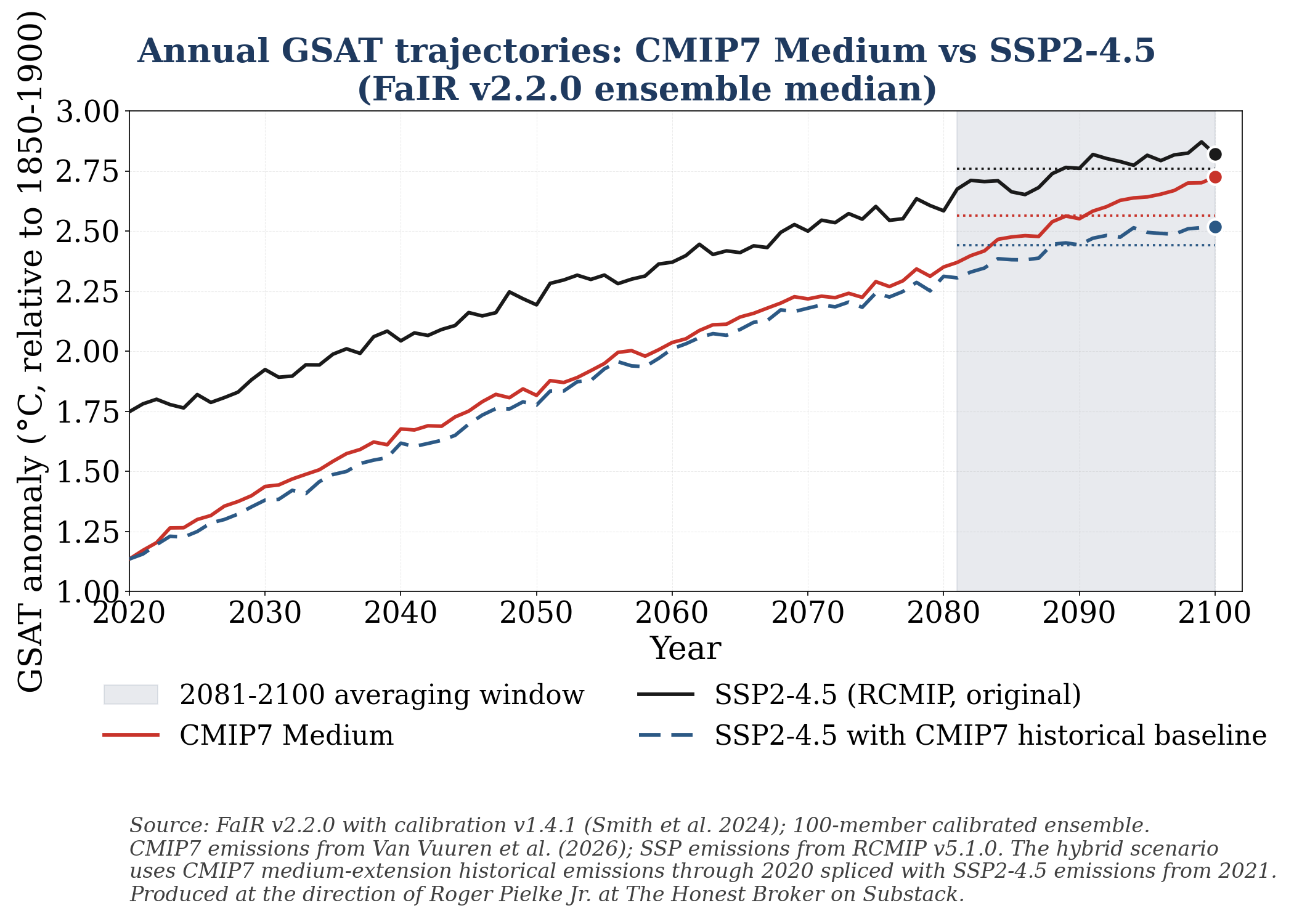
Running SSP2-4.5 post-2020 emissions through the CMIP7 FaIR emulator with CMIP7’s updated historical baseline (dashed blue), the picture inverts: SSP2-4.5 produces a 2081-2100 mean of 2.44°C against CMIP7 MEDIUM 2.56°C. On an apples-to-apples comparison, the new MEDIUM results in about 0.12-0.20°C more warming than SSP2-4.5 — due to its 520 Gt larger cumulative CO₂ budget over the century.

This connects to the larger argument in Pielke, Burgess, and Ritchie (2022): observed CO₂ emissions from 2005 through 2020 tracked closer to the SSP 3.4 W/m² range than to SSP2-4.5. Today, the gap has widened, not closed. IEA STEPS now has emissions falling to under 30 Gt by 2050 — a trajectory consistent with the SSP 3.4 forcing range. The center of the new CMIP7 scenario set sits well above that range.
The new framework compressed the high end. Good.
The middle did not move far enough. The new MEDIUM might be considered a worst-case scenario rather than a current policy scenario. Interestingly, that would mean that there is no real current-policy scenario in the new CMIP7 scenarios, which would be something like a SSP2-3.4 scenario with updated demographics.
Perhaps, if projected demographic changes continue to trend lower, CMIP7 LOW will come to represent something akin to a current policy trajectory.
Why this matters: these scenarios live in policy
The now-implausible upper-end scenarios — RCP8.5, SSP5-8.5, and SSP3-7.0 — are not just academic constructs used in esoteric research. They are embedded in the policies and regulations of most of the world’s largest economies, found across the world’s most important multilateral institutions, and used in the climate stress tests that govern hundreds of billions of dollars in bank capital.
The table below provides just a few examples.
National climate impact assessments in the United States, United Kingdom, Germany, Canada, Australia, Japan, and the Netherlands all use RCP8.5 or SSP5-8.5 as a reference scenario. The Network for Greening the Financial System framework, used by more than 140 central banks, has utilized a “Hot House World” scenario calibrated to RCP8.5 physical risk into the bank stress tests run by the European Central Bank, the Bank of England, the Reserve Bank of New Zealand, the Banque de France, and the US Federal Reserve. The World Bank’s Climate Change Knowledge Portal, which provides the climate diagnostics that feed into the Country Climate and Development Reports for more than 100 client countries, defaults to SSP5-8.5 and SSP3-7.0.
The abandonment of the high-end legacy scenarios by CMIP7 will need to propagate through this entire infrastructure. The policy machinery built on RCP8.5 and the other implausible scenarios is systemic.
What this means
The new CMIP7 ScenarioMIP framework represents a real course correction, but with more work to do. SSP5-8.5 is gone. SSP3-7.0 has a successor that is less extreme but arguably remains implausible. The middle of the set is more pessimistic than trajectories of current and announced policies. The plausibility vacuum at the heart of the architecture has yet to be addressed.
All this means that users of climate models and model output based on legacy scenarios will now face decisions about if and how they’d like to realign with the latest scientific understandings versus continuing to rely on outdated research.
Furthermore, there are no doubt many — hundreds if not thousands — of studies in the publication pipeline that depend upon the upper end scenarios. Editors and reviewers should ensure that they are properly characterized as exploratory and are not intended to be interpreted as projective.
We’ve known since 2017 that upper end climate scenarios are fatally flawed. Nine years later, that understanding has now become officially recognized. That is good news.
We can debate whether nine years is short or long for the overturning of scientific understandings with massive economic and policy implications. But today, that overturning is undeniable.
Science is self-correcting. What matters now is what happens next.
quarta-feira, 31 de dezembro de 2025
Contracto de Arrendamento da Alma: Actualização 2026
 |
| Feliz 2026 |
Cláusula 1ª (Da Sobrevivência): O presente contrato não garante que o Utilizador chegará a 2027. O serviço é fornecido "tal como está", com bugs graves no sistema de saúde e falhas críticas na conta bancária.
Cláusula 2ª (Das Desilusões Obrigatórias):
• §1º: O Utilizador aceita que 70% das suas novas "metas" serão abandonadas até ao dia 15 de janeiro. Os restantes 30% serão ignorados por pura falta de vontade de viver.
• §2º: Fica estabelecido que qualquer tentativa de "encontrar o amor da sua vida" resultará apenas em novos traumas, despesas em terapia e subscrições inúteis no Tinder.
Cláusula 3ª (Da Obsolescência Programada):
• O seu corpo continuará a degradar-se. Ao aceitar 2026, o Utilizador concorda em sentir dores nas costas por ter dormido "mal" e em ter ressacas de três dias após beber dois copos de vinho barato.
Cláusula 4ª (Do Apocalipse e Outros Eventos Sociais):
• A Administração de 2026 reserva-se o direito de introduzir novas pandemias, guerras mundiais ou invasões alienígenas apenas para testar se o Utilizador ainda consegue manter a fachada de "está tudo bem" no LinkedIn.
Cláusula 5ª (Política de Terminação):
• Não há botão de "Sair". O tempo passará de forma agonizante durante as reuniões de trabalho e de forma instantânea durante o tempo livre. Se não estiver satisfeito, a reclamação deve ser feita por escrito e enviada diretamente para o vácuo existencial.
[ ] Li e aceito que vou continuar a ser um figurante neste simulador de caos chamado vida, mas assino porque a alternativa é ainda mais aborrecida.
terça-feira, 23 de janeiro de 2024
Tic tac. Estamos a 90 segundos do fim, continua a marcar Relógio do Apocalipse

O Relógio do Apocalipse diz, de novo, que estamos a 90 segundos da meia-noite, o que significa a destruição da humanidade.
Os especialistas da revista Bulletin of Atomic Scientist acertaram esta terça-feira os ponteiros e, tal como no ano passado, continuamos bem perto do dia do "juízo final", ou seja a 90 segundos da meia-noite, que é como quem diz para a auto-destruição da humanidade.
Pela 77ª vez, o Dooms Day Clock é acertado e representa um alerta que a comunidade científica faz à humanidade, uma chamada de atenção para o dia em que tudo termina.
"A humanidade continua a enfrentar um nível de perigo sem precedentes", refere a Bulletin of Atomic Scientist, responsável por acertar o relógio, que mantém-se a 90 segundos da meia-noite, tal como em 2023, ano em que a proximidade da humanidade ao dia da auto destruição foi justificada pela guerra na Ucrânia, mais concretamente a ameaça nuclear proveniente da Rússia.
Este ano, os ponteiros do relógio voltaram a ser acertados, mas mantemo-nos a 90 segundos, apenas um minuto e meio, da meia-noite. O que não significa estagnação. "A nossa decisão não deve ser tomada como um sinal de que a situação da segurança internacional se atenuou. Em vez disso, os líderes e os cidadãos de todo o mundo devem encarar esta declaração como um aviso severo e reagir com urgência, como se hoje fosse o momento mais perigoso da história moderna. Porque pode muito bem ser", alerta o Conselho de Ciência e Segurança do Boletim.
Aliás, o mundo enfrenta mais uma guerra, agora no Médio Oriente, entre Israel e o grupo extremista palestiniano Hamas.
Além da guerra na Ucrânia, o mundo enfrenta a ameaça das armas nucleares, com a deterioração dos acordos de redução deste tipo de armamento, as alterações climáticas, que levaram a que 2023 fosse considerado como o ano mais quente já registado. Os avanços nas tecnologias de engenharia genética, bem como os registados na área da Inteligência Artificial também preocupam.
"Não se deixem enganar: acertar o relógio a 90 segundos para a meia-noite não é uma indicação de que o mundo está estável. Muito pelo contrário. É urgente que os governos e as comunidades em todo o mundo ajam. E o Boletim continua esperançoso – e inspirado – em ver as gerações mais jovens liderar a luta”, refere Rachel Bronson, presidente e diretora executiva do Bulletin of Atomic Scientist, em comunicado.
Para Jerry Brown, presidente executivo do Boletim, é como se os líderes mundiais "estivessem no Titanic". Afinal, "estão a conduzir o mundo para a catástrofe – mais bombas nucleares, grandes emissões de carbono, patógenos perigosos e inteligência artificial". "Só as grandes potências como a China, a América e a Rússia podem fazer-nos recuar. Apesar dos antagonismos profundos, eles devem cooperar – ou estaremos condenados", conclui o responsável.
Fundado em 1945 por Albert Einstein, J. Robert Oppenheimer e cientistas da Universidade de Chicago que ajudaram a desenvolver as primeiras armas atómicas no âmbito do Projeto Manhattan, o Bulletin of the Atomic Scientists criou o Relógio do Apocalipse dois anos mais tarde, em 1947, "um indicador universalmente reconhecido da vulnerabilidade do mundo a catástrofes globais causadas por tecnologias criadas pelo homem".
Saber mais:
segunda-feira, 15 de janeiro de 2024
Nico - Evening of Light
Midnight winds are landing at the end of time
Midnight winds are landing at the end of time
[Verse 1]
A true story wants to be mine
A true story wants to be mine
The story is telling a true lie
The story is telling a true lie
Mandolins are ringing to his viol singing
Mandolins are ringing to his viol singing
[Chorus]
Midnight winds are landing at the end of time
Midnight winds are landing at the end of time
[Verse 2]
Dungeons sink in to a slumber till the end of time
Dungeons sink in to a slumber till the end of time
Petrel sings, the doorbells pound into the unlit end of time
Petrel sings, the doorbells pound into the unlit end of time
[Chorus]
Midnight winds are landing at the end of time
Midnight winds are landing at the end of time
[Verse 3]
In the morning of my winter
When my eyes are still asleep
In the morning of my winter
When my eyes are still asleep
A dragonfly lady in a coat of snow
I'll send to kiss your heart for me
A dragonfly lady in a coat of snow
I'll send to kiss your heart for me
[Chorus]
Midnight winds are landing at the end of time
Midnight winds are landing at the end of time
[Verse 4]
The children are jumping in the evening of light
The children are jumping in the evening of light
The peasants' hands are heavy in the evening of light
The peasants' hands are heavy in the evening of light
[Chorus]
Midnight winds are landing at the end of time
Midnight winds are landing at the end of time
Significado da Canção
Promo video for Nico’s “Evening of Light” directed by François De Menil in 1969, but probably finished much later. There was a tantalizingly brief clip of this in the Nico: Icon documentary. Not the album version of the song appearing on The Marble Index, this alternate take was released as part of The Frozen Borderline: 1968–1970 compilation in 2007.
The story is told in Richard Witts’ (fantastic) Nico biography, Nico: The Life and Lies of an Icon, that De Menil, heir to the Schlumberger Limited oil-equipment fortune via his mother’s family, who knew Nico via Warhol associate Fred Hughes, had become besotted by the Teutonic ice queen and proposed making a film with her.
At this time Nico was having a brief affair with a 21-year-old Iggy Pop, who she had met through John Cale, then producing the first Stooges album in New York. (Iggy once revealed to a French interviewer that Nico taught him how to “eat pussy.”). Nico told De Menil that he had to follow them to Ann Arbor, Michigan if he wanted to do it. De Menil obliged, shooting the film behind the house where the band lived.
sexta-feira, 31 de março de 2023
O custo real da prevenção do colapso climático
Ninguém sabe ao certo quanto custaria evitar os piores impactos das mudanças climáticas. No entanto, a análise do historiador Yuval Noah Harari, baseada no trabalho de cientistas e economistas, indica que a humanidade pode evitar uma catástrofe investindo o equivalente a apenas 2% do PIB global em soluções climáticas. Ele argumenta que a prevenção do cataclismo ecológico não exigirá as grandes perturbações globais que muitos temem e explica que já temos os recursos de que precisamos - é apenas uma questão de mudar nossas prioridades.
quarta-feira, 12 de outubro de 2022
Noam Chomsky - Cooperação ou extinção
 |
| Clique na imagem para obter o e-livro |
Cooperação ou extinção é a última novidade do linguista, filósofo, politólogo Noam Chomsky, também um dos ativistas mais influentes do mundo. Desta vez, trata-se de uma compilação de textos que nasce de um chamado "Encontro Chomsky" realizado em Boston e dedicado às ameaças à sobrevivência planetária, cujos três temas fundamentais são a emergência climática, a ameaça nuclear e o perigo que o enfraquecimento do sistema democrático representa. em todo o mundo. A solução passa, como indica Chomsky nestas páginas reveladoras, pelo ativismo social e internacional: uma série de movimentos populares que já estão sendo organizados por todo o globo para forçar acordos internacionais e enfrentar este desafio sem precedentes pela sobrevivência da civilização.
Projectos
sexta-feira, 11 de março de 2022
Ucrânia em chamas - Ukraine On Fire 2016 Oliver Stone - Legendas disponíveis em português CC

O documentário que faltava. Diziam que só estava na Netflix. Encontrei-o no Youtube. E em Português. Aconselho vivamente a sua visualização. Atenção: tem imagens chocantes, pode ferir a susceptibilidade dos espectadores.
Já o tinha visto em Inglês. Agora é mais fácil partilhar com os meus amigos que têm dificuldade na compreensão oral da Língua Inglesa e outros que não podem pagar o Netflix.
sexta-feira, 21 de janeiro de 2022
"Mais próximo do que alguma vez esteve do apocalipse". Relógio do Juízo Final a 100 segundos da meia-noite

Os cientistas que gerem o designado Relógio do Juízo Final (‘Doomsday Clock’) decidiram mantê-lo a cem segundos da meia-noite para salientar a gravidade da situação internacional, em função de várias crises existenciais.
Este indicador é usado para ilustrar a vulnerabilidade do mundo a uma catástrofe oriunda das armas nucleares, alterações climáticas e tecnologias disruptivas em outros domínios.
Os autores do documento, publicado pelo Boletim dos Cientistas Atómicos (BCA), salientaram que a alteração da liderança política nos EUA em 2021 alimentou esperanças de que a corrida para a catástrofe pudesse ser interrompida.
Porém, esta mudança, só por si, foi “insuficiente para reverter as tendências negativas na segurança internacional”, que se alongaram e continuaram através do horizonte de ameaças em 2021.
Tensão entre EUA, Rússia e China
Assim, as relações tensas dos EUA com a Rússia e a China estão a ter desenvolvimentos, designadamente, no domínio das armas, que “podem marcar o início de uma nova corrida às armas nucleares”.
Acresce “a imensa distância entre os compromissos para a redução a longo prazo das emissões de gases com efeito de estufa e as ações que estão a ser tomadas no curto e médio prazo".
Depois, a resposta mundial à pandemia do novo coronavírus permanece “inteiramente insuficiente”.
“Os planos para uma rápida distribuição global de vacinas colapsaram, o que deixou os países pobres largamente por vacinar e permitiu que novas variantes do coronavírus ganhassem terreno”.
E, para mais, “além da pandemia, preocupantes lapsos na biossegurança e tornaram claro que a comunidade internacional precisa de dar uma atenção séria à gestão da investigação biológica à escala global”.
Ainda a este propósito, os autores realçam que “o estabelecimento e desenvolvimento de programas de armas biológicas marca o início de uma nova corrida às mesmas”.
Por outro lado, “apesar do novo governo do EUA ter restabelecido o papel da ciência e das provas na política pública, a corrupção do ecossistema de informação manteve-se em 2021”.
Considerando este ambiente de ameaças diversificado, em que alguns desenvolvimentos positivos tiveram por contrapartida tendências negativas, preocupantes e em intensificação, o BCA considerou que o mundo não está mais seguro do que em 2020, o que os levou a manter o ‘Doomsday Clock’ nos 100 segundos para a meia-noite.
Esta decisão, porém, não sugere, “de forma alguma” que a situação na segurança internacional estabilizou. “Pelo contrário”, afirmaram, de forma explícita.
“O Relógio permanece o mais próximo do que alguma esteve do apocalipse terminal da civilização, porque o mundo permanece num momento extremamente perigoso. Em 2019, designámos esta situação como ‘o novo anormal’, o que infelizmente persiste”, alertaram.
Em termos gerais, descreveram a situação da seguinte forma: “No ano passado, apesar de esforços louváveis de alguns líderes e do público, as tendências negativas nas armas nucleares e biológicas, nas alterações climáticas e uma variedade de tecnologias disruptivas – exacerbadas por uma eco esfera de informação corrompida, que mina processos racionais de tomada de decisão – mantiveram o mundo à beira do apocalipse”.
Recuar deste abismo, na sua opinião, requer várias medidas, como que EUA e Federação Russa limitem as armas nucleares, que EUA e outros acelerem a descarbonização, que EUA e outros trabalhem na Organização Mundial de Saúde para reduzir os riscos biológicos de todo os tipos, que os EUA persuadam aliados e rivais assumirem o princípio de não serem os primeiros a usar a arma nuclear, que a Federação Russa regresse ao Conselho NATO-Rússia, que os investidores troquem as aplicações em projetos de combustíveis fósseis por outros amigos do ambiente, que os cidadãos de todo o mundo questionem os seus políticos, a todos os níveis, sobre o que vão fazer para resolver as alterações climáticas.
O BCA foi fundado em 1945 por Albert Einstein e cientistas da Universidade de Chicago que ajudaram a desenvolver as primeiras armas atómicas, no Projeto Manhattan, e criou o ‘Doomsday Clock’ dois anos depois, usando a imagem do apocalipse (meia-noite) e o idioma contemporâneo da explosão nuclear (contagem para zero), para ilustrar a gravidade das ameaças para a humanidade e o planeta.
Saber mais aqui
sexta-feira, 22 de outubro de 2021
Noam Chomsky - "Traímos a juventude do mundo. Estamos a trair os nossos filhos e netos"
Teórico da linguagem, pensador polémico, acaba de publicar "Um guia essencial sobre capitalismo, política e o funcionamento do mundo". Na entrevista à TSF fala de vacinação, clivagens políticas, Afeganistão e alterações climáticas.

Professor Noam Chomsky, acredita que os países ricos estão dispostos a assumir as suas responsabilidades e ajudar a fornecer o que o mundo em desenvolvimento ainda precisa em termos de vacinação?
É um escândalo e também é suicida. Quer dizer, os países ricos praticamente monopolizaram a vacina. Tem havido alguns esforços para distribuí-la aos países que precisam dela desesperadamente. Na África, Ásia, América Latina. O que aconteceu foi que os países ricos não só monopolizaram as vacinas, mas insistem em que as taxas de lucro exorbitantes das empresas farmacêuticas sejam protegidas pelos chamados acordos de livre comércio altamente protecionistas. A Alemanha é um dos piores exemplos. Nesse caso, o que é incomum, pela primeira vez, os Estados Unidos têm um histórico um pouco melhor do que a Europa.
O que está a acontecer não é apenas profundamente imoral, mas também suicida. Até porque todos entendem que quanto mais tempo levar para o resto do mundo ser vacinado, mais tempo há para o vírus se transformar, possivelmente em variantes que serão incontroláveis, que irão, claro, voltar aos próprios países ricos, como foi com a variante Delta. Portanto, é um exemplo de como a ganância e a estupidez superam, não apenas os valores morais elementares, mas até mesmo um sentido de autopreservação.
Prevê alguma mudança fundamental provocada pelo impacto desta pandemia na forma como as sociedades ocidentais se organizam, quer nos EUA quer na UE
Bem, certamente que as sociedades ocidentais podem ser acusadas. Se olhar ao redor do mundo, verá que há países que lidaram com a pandemia de maneira bastante expedita, principalmente na Ásia e principalmente na Oceânia, Nova Zelândia e Austrália. São sociedades onde há um sentido de compromisso, de que devemos aceitar limitações na nossa liberdade a fim de servir o bem comum. Portanto, vejamos a Europa. No início de 2020, tinha o vírus razoavelmente sob controlo. Alguns países melhores do que outros, a Alemanha estava muito bem, mas não a Itália ou sequer a França. Então, os europeus decidiram que queriam ter as suas férias. Partiram para as praias, para o campo, tiveram as suas férias de um mês. E aí veio um grande pico. Nos países da Ásia e da Oceânia, houve uma restrição forte no início e, em seguida, uma subida com poucos casos. A China tem menos casos por ano do que os EUA num dia.
Agora, há um forte movimento antivacinação. Em todo o mundo, até certo ponto, mas nos EUA é localizado. De forma esmagadora, nos estados republicanos, praticamente na velha confederação e em alguns estados do noroeste, estados rurais que estão sob governo republicano, há uma oposição muito forte à vacinação. E os hospitais estão lotados com quase 100% de pacientes não vacinados. As pessoas estão a morrer e dizem "não quero uma vacina, não vou deixar o governo fazer isso comigo". Sabe, é maníaco, doentio, até alguns segmentos da esquerda são apanhados nisso. Mas se olhar para os mapas globais, os EUA estão fora do espetro das sociedades desenvolvidas. E se olhar para partes específicas do país, praticamente a velha confederação, os republicanos administram os estados rurais a noroeste, não totalmente, mas muito perto disso. Nos EUA, a maioria dos republicanos dizem que simplesmente não serão vacinados.
Isso relaciona-se com as clivagens e a polarização na política americana atual. Vê-as como uma ameaça importante para a democracia dos EUA?
Bem, a democracia dos EUA está moribunda, está de partida. Não é só a minha opinião, pode encontrá-la em círculos conservadores muito respeitáveis. Leia o Financial Times de Londres. O maior jornal de negócios do mundo. Têm colunistas importantes, pessoas como Martin Wolf, que alerta que a democracia nos EUA está em grande perigo por causa do que ele chama de um partido radical com uma agenda reacionária. O Partido Republicano. Podemos ver isso no Congresso agora que está a debater a legislação que levaria os Estados Unidos, em alguma medida, na direção de social-democracia que é normal na Europa. Cuidados de saúde universais dificilmente radicais, ensino superior gratuito, creches, isto é, as coisas normais na maior parte do mundo mas que nos Estados Unidos são consideradas radicais. Os republicanos são 100% opostos. Existem também democratas de direita, como Joe Mancini, o principal recetor de financiamento para combustíveis fósseis no Congresso, que também estão a bloquear.
Repare, trata-se de atingir direitos que são normais em toda a parte. São coisas normais no México, que é um país pobre. Bem, esse é um problema antigo nos Estados Unidos, um país muito rico, com vantagens que nenhum outro país tem. Um alto grau de liberdade, os Estados Unidos protegem a liberdade de expressão em um grau incomum, são coisas boas. Mas está muito aquém da maior parte do mundo civilizado em benefícios sociais, bem-estar social e na dedicação ao bem comum. Bem, não que a Europa tenha muito do que se gabar. Mas é a Europa que está a assumir a liderança nas vacinas para os pobres e para os que sofrem em todo o mundo.
terça-feira, 19 de outubro de 2021
Against longtermism

There seems to be a growing recognition that humanity might be approaching the ‘end times’. Dire predictions of catastrophe clutter the news. Social media videos of hellish wildfires, devastating floods and hospitals overflowing with COVID-19 patients dominate our timelines. Extinction Rebellion activists are shutting down cities in a desperate attempt to save the world. One survey even found that more than half of the people asked about humanity’s future ‘rated the risk of our way of life ending within the next 100 years at 50 per cent or greater.’
‘Apocalypticism’, or the belief that the end times are imminent, is of course nothing new: people have warned that the end is nigh for millennia, and in fact many New Testament scholars believe that Jesus himself expected the world to end during his own lifetime. But the situation today is fundamentally different than in the past. The ‘eschatological’ scenarios now being discussed are based not on the revelations of religious prophets, or secular metanarratives of human history (as in the case of Marxism), but on robust scientific conclusions defended by leading experts in fields such as climatology, ecology, epidemiology and so on.
We know, for example, that climate change poses a dire threat to civilisation. We know that biodiversity loss and the sixth mass extinction could precipitate sudden, irreversible, catastrophic shifts in the global ecosystem. A thermonuclear exchange could blot out the Sun for years or decades, bringing about the collapse of global agriculture. And whether or not SARS-CoV-2 came from a Wuhan laboratory or was cooked up in the kitchen of nature (the latter seems more probable right now), synthetic biology will soon enable bad actors to design pathogens far more lethal and contagious than anything Darwinian evolution could possibly invent. Some philosophers and scientists have also begun sounding the alarm about ‘emerging threats’ associated with machine superintelligence, molecular nanotechnology and stratospheric geoengineering, which look no less formidable.
Such considerations have led many scholars to acknowledge that, as Stephen Hawking wrote in The Guardian in 2016, ‘we are at the most dangerous moment in the development of humanity.’ Lord Martin Rees, for example, estimates that civilisation has a 50/50 chance of making it to 2100. Noam Chomsky argues that the risk of annihilation is currently ‘unprecedented in the history of Homo sapiens’. And Max Tegmark contends that ‘it’s probably going to be within our lifetimes … that we’re either going to self-destruct or get our act together.’ Consistent with these dismal declarations, the Bulletin of the Atomic Scientists in 2020 set its iconic Doomsday Clock to a mere 100 seconds before midnight (or doom), the closest it’s been since the clock was created in 1947, and more than 11,000 scientists from around the world signed an article in 2020 stating ‘clearly and unequivocally that planet Earth is facing a climate emergency’, and without ‘an immense increase of scale in endeavours to conserve our biosphere [we risk] untold suffering due to the climate crisis.’ As the young climate activist Xiye Bastida summed up this existential mood in a Teen Vogue interview in 2019, the aim is to ‘make sure that we’re not the last generation’, because this now appears to be a very real possibility.
Given the unprecedented dangers facing humanity today, one might expect philosophers to have spilled a considerable amount of ink on the ethical implications of our extinction, or related scenarios such as the permanent collapse of civilisation. How morally bad (or good) would our disappearance be, and for what reasons? Would it be wrong to prevent future generations from coming into existence? Does the value of past sacrifices, struggles and strivings depend on humanity continuing to exist for as long as Earth, or the Universe more generally, remains habitable?
Yet this is not the case: the topic of our extinction has received little sustained attention from philosophers until recently, and even now remains at the fringe of philosophical discussion and debate. On the whole, they have been preoccupied with other matters. However, there is one notable exception to this rule: over the past two decades, a small group of theorists mostly based in Oxford have been busy working out the details of a new moral worldview called longtermism, which emphasizes how our actions affect the very long-term future of the universe – thousands, millions, billions, and even trillions of years from now. This has roots in the work of Nick Bostrom, who founded the grandiosely named Future of Humanity Institute (FHI) in 2005, and Nick Beckstead, a research associate at FHI and a programme officer at Open Philanthropy. It has been defended most publicly by the FHI philosopher Toby Ord, author of The Precipice: Existential Risk and the Future of Humanity (2020). Longtermism is the primary research focus of both the Global Priorities Institute (GPI), an FHI-linked organisation directed by Hilary Greaves, and the Forethought Foundation, run by William MacAskill, who also holds positions at FHI and GPI. Adding to the tangle of titles, names, institutes and acronyms, longtermism is one of the main ‘cause areas’ of the so-called effective altruism (EA) movement, which was introduced by Ord in around 2011 and now boasts of having a mind-boggling $46 billion in committed funding.
It is difficult to overstate how influential longtermism has become. Karl Marx in 1845 declared that the point of philosophy isn’t merely to interpret the world but change it, and this is exactly what longtermists have been doing, with extraordinary success. Consider that Elon Musk, who has cited and endorsed Bostrom’s work, has donated $1.5 million dollars to FHI through its sister organisation, the even more grandiosely named Future of Life Institute (FLI). This was cofounded by the multimillionaire tech entrepreneur Jaan Tallinn, who, as I recently noted, doesn’t believe that climate change poses an ‘existential risk’ to humanity because of his adherence to the longtermist ideology.
Meanwhile, the billionaire libertarian and Donald Trump supporter Peter Thiel, who once gave the keynote address at an EA conference, has donated large sums of money to the Machine Intelligence Research Institute, whose mission to save humanity from superintelligent machines is deeply intertwined with longtermist values. Other organisations such as GPI and the Forethought Foundation are funding essay contests and scholarships in an effort to draw young people into the community, while it’s an open secret that the Washington, DC-based Center for Security and Emerging Technologies (CSET) aims to place longtermists within high-level US government positions to shape national policy. In fact, CSET was established by Jason Matheny, a former research assistant at FHI who’s now the deputy assistant to US President Joe Biden for technology and national security. Ord himself has, astonishingly for a philosopher, ‘advised the World Health Organization, the World Bank, the World Economic Forum, the US National Intelligence Council, the UK Prime Minister’s Office, Cabinet Office, and Government Office for Science’, and he recently contributed to a report from the Secretary-General of the United Nations that specifically mentions ‘long-termism’.
The point is that longtermism might be one of the most influential ideologies that few people outside of elite universities and Silicon Valley have ever heard about. I believe this needs to change because, as a former longtermist who published an entire book four years ago in defence of the general idea, I have come to see this worldview as quite possibly the most dangerous secular belief system in the world today. But to understand the nature of the beast, we need to first dissect it, examining its anatomical features and physiological functions.
The initial thing to notice is that longtermism, as proposed by Bostrom and Beckstead, is not equivalent to ‘caring about the long term’ or ‘valuing the wellbeing of future generations’. It goes way beyond this. At its core is a simple – albeit flawed, in my opinion – analogy between individual persons and humanity as a whole. To illustrate the idea, consider the case of Frank Ramsey, a scholar at the University of Cambridge widely considered by his peers as among his generation’s most exceptional minds. ‘There was something of Newton about him,’ the belletrist Lytton Strachey once said. G E Moore wrote of Ramsey’s ‘very exceptional brilliance’. And John Maynard Keynes described a paper of Ramsey’s as ‘one of the most remarkable contributions to mathematical economics ever made’.
But Ramsey’s story isn’t a happy one. On 19 January 1930, he died in a London hospital following a surgical procedure, the likely cause of death being a liver infection from swimming in the River Cam, which winds its way through Cambridge. Ramsey was only 26 years old.
One could argue that there are two distinct reasons this outcome was tragic. The first is the most obvious: it cut short Ramsey’s life, depriving him of everything he could have experienced had he survived – the joys and happiness, the love and friendship: all that makes life worth living. In this sense, Ramsey’s early demise was a personal tragedy. But, secondly, his death also robbed the world of an intellectual superstar apparently destined to make even more extraordinary contributions to human knowledge. ‘The number of trails Ramsey laid was remarkable,’ writes Sir Partha Dasgupta. But how many more trails might he have blazed? ‘The loss to your generation is agonising to think of,’ Strachey lamented, ‘what a light has gone out’ – which leaves one wondering how Western intellectual history might have been different if Ramsey hadn’t died so young. From this perspective, one could argue that, although the personal tragedy of Ramsey’s death was truly terrible, the immensity of his potential to have changed the world for the better makes the second tragedy even worse. In other words, the badness of his death stems mostly, perhaps overwhelmingly, from his unfulfilled potential rather than the direct, personal harms that he experienced. Or so the argument goes.
Longtermists would map these claims and conclusions on to humanity itself, as if humanity is an individual with its very own ‘potential’ to squander or fulfil, ruin or realise, over the course of ‘its lifetime’. So, on the one hand, a catastrophe that reduces the human population to zero would be tragic because of all the suffering it would inflict upon those alive at the time. Imagine the horror of starving to death in subfreezing temperatures, under pitch-black skies at noon, for years or decades after a thermonuclear war. This is the first tragedy, a personal tragedy for those directly affected. But there is, longtermists would argue, a second tragedy that is astronomically worse than the first, arising from the fact that our extinction would permanently foreclose what could be an extremely long and prosperous future over the next, say, ~10100 years (at which point the ‘heat death’ will make life impossible). In doing this, it would irreversibly destroy the ‘vast and glorious’ longterm potential of humanity, in Ord’s almost religious language – a ‘potential’ so huge, given the size of the Universe and the time left before reaching thermodynamic equilibrium, that the first tragedy would utterly pale in comparison.
This immediately suggests another parallel between individuals and humanity: death isn’t the only way that someone’s potential could be left unfulfilled. Imagine that Ramsey hadn’t died young but, instead of studying, writing and publishing scholarly papers, he’d spent his days in the local bar playing pool and drinking. Same outcome, different failure mode. Applying this to humanity, longtermists would argue that there are failure modes that could leave our potential unfulfilled without us dying out, which I will return to below.
On this view, a climate catastrophe will be a small blip – like a 90-year-old who stubbed his toe when he was two
To summarise these ideas so far, humanity has a ‘potential’ of its own, one that transcends the potentials of each individual person, and failing to realise this potential would be extremely bad – indeed, as we will see, a moral catastrophe of literally cosmic proportions. This is the central dogma of longtermism: nothing matters more, ethically speaking, than fulfilling our potential as a species of ‘Earth-originating intelligent life’. It matters so much that longtermists have even coined the scary-sounding term ‘existential risk’ for any possibility of our potential being destroyed, and ‘existential catastrophe’ for any event that actually destroys this potential.
Why do I think this ideology is so dangerous? The short answer is that elevating the fulfilment of humanity’s supposed potential above all else could nontrivially increase the probability that actual people – those alive today and in the near future – suffer extreme harms, even death. Consider that, as I noted elsewhere, the longtermist ideology inclines its adherents to take an insouciant attitude towards climate change. Why? Because even if climate change causes island nations to disappear, triggers mass migrations and kills millions of people, it probably isn’t going to compromise our longterm potential over the coming trillions of years. If one takes a cosmic view of the situation, even a climate catastrophe that cuts the human population by 75 per cent for the next two millennia will, in the grand scheme of things, be nothing more than a small blip – the equivalent of a 90-year-old man having stubbed his toe when he was two.
Bostrom’s argument is that ‘a non-existential disaster causing the breakdown of global civilisation is, from the perspective of humanity as a whole, a potentially recoverable setback.’ It might be ‘a giant massacre for man’, he adds, but so long as humanity bounces back to fulfil its potential, it will ultimately register as little more than ‘a small misstep for mankind’. Elsewhere, he writes that the worst natural disasters and devastating atrocities in history become almost imperceptible trivialities when seen from this grand perspective. Referring to the two world wars, AIDS and the Chernobyl nuclear accident, he declares that ‘tragic as such events are to the people immediately affected, in the big picture of things … even the worst of these catastrophes are mere ripples on the surface of the great sea of life.’
This way of seeing the world, of assessing the badness of AIDS and the Holocaust, implies that future disasters of the same (non-existential) scope and intensity should also be categorised as ‘mere ripples’. If they don’t pose a direct existential risk, then we ought not to worry much about them, however tragic they might be to individuals. As Bostrom wrote in 2003, ‘priority number one, two, three and four should … be to reduce existential risk.’ He reiterated this several years later in arguing that we mustn’t ‘fritter … away’ our finite resources on ‘feel-good projects of suboptimal efficacy’ such as alleviating global poverty and reducing animal suffering, since neither threatens our longterm potential, and our longterm potential is what really matters.
Ord echoes these views in arguing that, of all the problems facing humanity, our ‘first great task … is to reach a place of safety – a place where existential risk’ – as he defines it – ‘is low and stays low’, which he dubs ‘existential security’. More than anything else, what matters is doing everything necessary to ‘preserve’ and ‘protect’ our potential by ‘extracting ourselves from immediate danger’ and devising robust ‘safeguards that will defend humanity from dangers over the longterm future, so that it becomes impossible to fail.’ Although Ord gives a nod to climate change, he also claims – based on a dubious methodology – that the chance of climate change causing an existential catastrophe is only ∼1 in 1,000, which is a whole two orders of magnitude lower than the probability of superintelligent machines destroying humanity this century, according to Ord.
What’s really notable here is that the central concern isn’t the effect of the climate catastrophe on actual people around the world (remember, in the grand scheme, this would be, in Bostrom’s words, a ‘small misstep for mankind’) but the slim possibility that, as Ord puts it in The Precipice, this catastrophe ‘poses a risk of an unrecoverable collapse of civilisation or even the complete extinction of humanity’. Again, the harms caused to actual people (especially those in the Global South) might be significant in absolute terms, but when compared to the ‘vastness’ and ‘glory’ of our longterm potential in the cosmos, they hardly even register.
Yet the implications of longtermism are far more worrisome. If our top four priorities are to avoid an existential catastrophe – ie, to fulfil ‘our potential’ – then what’s not on the table for making this happen? Consider Thomas Nagel’s comment about how the notion of what we might call the ‘greater good’ has been used to ‘justify’ certain atrocities (eg, during war). If the ends ‘justify’ the means, he argues, and the ends are thought to be sufficiently large (eg, national security), then this ‘can be brought to bear to ease the consciences of those responsible for a certain number of charred babies’. Now imagine what might be ‘justified’ if the ‘greater good’ isn’t national security but the cosmic potential of Earth-originating intelligent life over the coming trillions of years? During the Second World War, 40 million civilians perished, but compare this number to the 1054 or more people (in Bostrom’s estimate) who could come to exist if we can avoid an existential catastrophe. What shouldn’t we do to ‘protect’ and ‘preserve’ this potential? To ensure that these unborn people come to exist? What means can’t be ‘justified’ by this cosmically significant moral end?
Bostrom himself argued that we should seriously consider establishing a global, invasive surveillance system that monitors every person on the planet in realtime, to amplify the ‘capacities for preventive policing’ (eg, to prevent omnicidal terrorist attacks that could devastate civilisation). Elsewhere, he’s written that states should use preemptive violence/war to avoid existential catastrophes, and argued that saving billions of actual people is the moral equivalent of reducing existential risk by utterly minuscule amounts. In his words, even if there is ‘a mere 1 per cent chance’ of 1054 people existing in the future, then ‘the expected value of reducing existential risk by a mere one billionth of one billionth of one percentage point is worth 100 billion times as much as a billion human lives.’ Such fanaticism – a word that some longtermists embrace – has led a growing number of critics to worry about what might happen if political leaders in the real world were to take Bostrom’s view seriously. To quote the mathematical statistician Olle Häggström, who – perplexingly – tends otherwise to speak favourably of longtermism:
I feel extremely uneasy about the prospect that [the calculations above] might become recognised among politicians and decision-makers as a guide to policy worth taking literally. It is simply too reminiscent of the old saying ‘If you want to make an omelette, you must be willing to break a few eggs,’ which has typically been used to explain that a bit of genocide or so might be a good thing, if it can contribute to the goal of creating a future utopia. Imagine a situation where the head of the CIA explains to the US president that they have credible evidence that somewhere in Germany, there is a lunatic who is working on a doomsday weapon and intends to use it to wipe out humanity, and that this lunatic has a one-in-a-million chance of succeeding. They have no further information on the identity or whereabouts of this lunatic. If the president has taken Bostrom’s argument to heart, and if he knows how to do the arithmetic, he may conclude that it is worthwhile conducting a full-scale nuclear assault on Germany to kill every single person within its borders.
Here, then, are a few reasons I find longtermism to be profoundly dangerous. Yet there are additional, fundamental problems with this worldview that no one, to my knowledge, has previously noted in writing. For example, there’s a good case to make that the underlying commitments of longtermism are a major reason why humanity faces so many unprecedented risks to its survival in the first place. Longtermism might, in other words, be incompatible with the attainment of ‘existential security’, meaning that the only way to genuinely reduce the probability of extinction or collapse in the future might be to abandon the longtermist ideology entirely.
To Bostrom and Ord, failing to become posthuman would prevent us from realising our vast, glorious potential
To understand the argument, let’s first unpack what longtermists mean by our ‘longterm potential’, an expression that I have so far used without defining. We can analyse this concept into three main components: transhumanism, space expansionism, and a moral view closely associated with what philosophers call ‘total utilitarianism’.
The first refers to the idea that we should use advanced technologies to reengineer our bodies and brains to create a ‘superior’ race of radically enhanced posthumans (which, confusingly, longtermists place within the category of ‘humanity’). Although Bostrom is perhaps the most prominent transhumanist today, longtermists have shied away from using the term ‘transhumanism’, probably because of its negative associations. Susan Levin, for example, points out that contemporary transhumanism has its roots in the Anglo-American eugenics movement, and transhumanists such as Julian Savulescu, who co-edited the book Human Enhancement (2009) with Bostrom, have literally argued for the consumption of ‘morality-boosting’ chemicals such as oxytocin to avoid an existential catastrophe (which he calls ‘ultimate harm’). As Savulescu writes with a colleague, ‘it is a matter of such urgency to improve humanity morally … that we should seek whatever means there are to effect this.’ Such claims are not only controversial but for many quite disturbing, and hence longtermists have attempted to distance themselves from such ideas, while nonetheless championing the ideology.
Transhumanism claims that there are various ‘posthuman modes of being’ that are far better than our current human mode. We could, for instance, genetically alter ourselves to gain perfect control over our emotions, or access the internet via neural implants, or maybe even upload our minds to computer hardware to achieve ‘digital immortality’. As Ord urges in The Precipice, think of how awesome it would be to perceive the world via echolocation, like bats and dolphins, or magnetoreception, like red foxes and homing pigeons. ‘Such uncharted experiences,’ Ord writes, ‘exist in minds much less sophisticated than our own. What experiences, possibly of immense value, could be accessible, then, to minds much greater?’ Bostrom’s most fantastical exploration of these possibilities comes from his evocative ‘Letter from Utopia’ (2008), which depicts a techno-Utopian world full of superintelligent posthumans awash in so much ‘pleasure’ that, as the letter’s fictional posthuman writes, ‘we sprinkle it in our tea.’
The connection with longtermism is that, according to Bostrom and Ord, failing to become posthuman would seemingly prevent us from realising our vast and glorious potential, which would be existentially catastrophic. As Bostrom put it in 2012, ‘the permanent foreclosure of any possibility of this kind of transformative change of human biological nature may itself constitute an existential catastrophe.’ Similarly, Ord asserts that ‘forever preserving humanity as it is now may also squander our legacy, relinquishing the greater part of our potential.’
The second component of our potential – space expansionism – refers to the idea that we must colonise as much of our future light cone as possible: that is, the region of spacetime that is theoretically accessible to us. According to longtermists, our future light cone contains a huge quantity of exploitable resources, which they refer to as our ‘cosmic endowment’ of negentropy (or reverse entropy). The Milky Way alone, Ord writes, is ‘150,000 light years across, encompassing more than 100 billion stars, most with their own planets.’ Attaining humanity’s longterm potential, he continues, ‘requires only that [we] eventually travel to a nearby star and establish enough of a foothold to create a new flourishing society from which we could venture further.’ By spreading ‘just six light years at a time’, our posthuman descendants could make ‘almost all the stars of our galaxy … reachable’ since ‘each star system, including our own, would need to settle just the few nearest stars [for] the entire galaxy [to] eventually fill with life.’ The process could be exponential, resulting in ever-more ‘flourishing’ societies with each additional second our descendants hop from star to star.
But why exactly would we want to do this? What’s so important about flooding the Universe with new posthuman civilisations? This leads to the third component: total utilitarianism, which I will refer to as ‘utilitarianism’ for short. Although some longtermists insist that they aren’t utilitarians, we should right away note that this is mostly a smoke-and-mirrors act to deflect criticisms that longtermism – and, more generally, the effective altruism (EA) movement from which it emerged – is nothing more than utilitarianism repackaged. The fact is that the EA movement is deeply utilitarian, at least in practice, and indeed, before it decided upon a name, the movement’s early members, including Ord, seriously considered calling it the ‘effective utilitarian community’.
This being said, utilitarianism is an ethical theory that specifies our sole moral obligation as being to maximise the total amount of ‘intrinsic value’ in the world, as tallied up from a disembodied, impartial, cosmic vantage point called ‘the point of view of the Universe’. From this view, it doesn’t matter how value – which utilitarian hedonists equate with pleasure – is distributed among people across space and time. All that matters is the total net sum. For example, imagine that there are 1 trillion people who have lives of value ‘1’, meaning that they are just barely worth living. This gives a total value of 1 trillion. Now consider an alternative universe in which 1 billion people have lives with a value of ‘999’, meaning that their lives are extremely good. This gives a total value of 999 billion. Since 999 billion is less than 1 trillion, the first world full of lives hardly worth living would be morally better than the second world, and hence, if a utilitarian were forced to choose between these, she would pick the former. (This is called the ‘repugnant conclusion’, which longtermists such as Ord, MacAskill and Greaves recently argued shouldn’t be taken very seriously. For them, the first world really might be better!)
Beckstead argued that we should prioritise the lives of people in rich countries over those in poor countries
The underlying reasoning here is based on the idea that people – you and I – are nothing more than means to an end. We don’t matter in ourselves; we have no inherent value of our own. Instead, people are understood as the ‘containers’ of value, and hence we matter only insofar as we ‘contain’ value, and therefore contribute to the overall net amount of value in the Universe between the Big Bang and the heat death. Since utilitarianism tells us to maximise value, it follows that the more people (value containers) who exist with net-positive amounts of value (pleasure), the better the Universe will become, morally speaking. In a phrase: people exist for the sake of maximising value, rather than value existing for the sake of benefitting people.
This is why longtermists are obsessed with calculating how many people could exist in the future if we were to colonise space and create vast computer simulations around stars in which unfathomably huge numbers of people live net-positive lives in virtual-reality environments. I already mentioned Bostrom’s estimate of 1054 future people, which includes many of these ‘digital people’, but in his bestseller Superintelligence (2014) he puts the number even higher at 1058 people, nearly all of whom would ‘live rich and happy lives while interacting with one another in virtual environments’. Greaves and MacAskill are similarly excited about this possibility, estimating that some 1045 conscious beings in computer simulations could exist within the Milky Way alone.
That is what our ‘vast and glorious’ potential consists of: massive numbers of technologically enhanced digital posthumans inside huge computer simulations spread throughout our future light cone. It is for this goal that, in Häggström’s scenario, a longtermist politician would annihilate Germany. It is for this goal that we must not ‘fritter … away’ our resources on such things as solving global poverty. It is for this goal that we should consider implementing a global surveillance system, keep pre-emptive war on the table, and focus more on superintelligent machines than saving people in the Global South from the devastating effects of climate change (mostly caused by the Global North). In fact, Beckstead has even argued that, for the sake of attaining this goal, we should actually prioritise the lives of people in rich countries over those in poor countries, since influencing the long-term future is of ‘overwhelming importance’, and the former are more likely to influence the long-term future than the latter. To quote a passage from Beckstead’s 2013 PhD dissertation, which Ord enthusiastically praises as one of the most important contributions to the longtermist literature:
Saving lives in poor countries may have significantly smaller ripple effects than saving and improving lives in rich countries. Why? Richer countries have substantially more innovation, and their workers are much more economically productive. [Consequently,] it now seems more plausible to me that saving a life in a rich country is substantially more important than saving a life in a poor country, other things being equal.
This is just the tip of the iceberg. Consider the implications of this conception of ‘our potential’ for the development of technology and creation of new risks. Since realising our potential is the ultimate moral goal for humanity, and since our descendants cannot become posthuman, colonise space and create ~1058 people in computer simulations without technologies far more advanced than those around today, failing to develop more technology would itself constitute an existential catastrophe – a failure mode (comparable to Ramsey neglecting his talents by spending his days playing pool and drinking) that Bostrom calls ‘plateauing’. Indeed, Bostrom places this idea front-and-centre in his canonical definition of ‘existential risk’, which denotes any future event that would prevent humanity from reaching and/or sustaining a state of ‘technological maturity’, meaning ‘the attainment of capabilities affording a level of economic productivity and control over nature close to the maximum that could feasibly be achieved.’ Technological maturity is the linchpin here because controlling nature and increasing economic productivity to the absolute physical limits are ostensibly necessary for creating the maximum quantity of ‘value’ within our future light cone.
But reflect for a moment on how humanity got itself into the current climatic and ecological crisis. Behind the extraction and burning of fossil fuels, decimation of ecosystems and extermination of species has been the notion that nature is something to be controlled, subjugated, exploited, vanquished, plundered, transformed, reconfigured and manipulated. As the technology theorist Langdon Winner writes in Autonomous Technology (1977), since the time of Francis Bacon our view of technology has been ‘inextricably bound to a single conception of the manner in which power is used – the style of absolute mastery, the despotic, one-way control of the master over the slave.’ He adds:
There are seldom any reservations about man’s rightful role in conquering, vanquishing, and subjugating everything natural. This is his power and his glory. What would in other situations seem [to be] rather tawdry and despicable intentions are here the most honourable of virtues. Nature is the universal prey, to manipulate as humans see fit.
This is precisely what we find in Bostrom’s account of existential risks and its associated normative futurology: nature, the entire Universe, our ‘cosmic endowment’ is there for the plundering, to be manipulated, transformed and converted into ‘value-structures, such as sentient beings living worthwhile lives’ in vast computer simulations, quoting Bostrom’s essay ‘Astronomical Waste’ (2003). Yet this Baconian, capitalist view is one of the most fundamental root causes of the unprecedented environmental crisis that now threatens to destroy large regions of the biosphere, Indigenous communities around the world, and perhaps even Western technological civilisation itself. While other longtermists have not been as explicit as Bostrom, there is a clear tendency to see the natural world the way utilitarianism sees people: as means to some abstract, impersonal end, and nothing more. MacAskill and a colleague, for example, write that the EA movement, and by implication longtermism, is ‘tentatively welfarist in that its tentative aim in doing good concerns promoting wellbeing only and not, say, protecting biodiversity or conserving natural beauty for their own sakes.’
On this account, every problem arises from too little rather than too much technology
Just as worrisome is the longtermist demand that we must create ever-more powerful technologies, despite the agreed-upon fact that the overwhelming source of risk to human existence these days comes from these very technologies. In Ord’s words, ‘without serious efforts to protect humanity, there is strong reason to believe the risk will be higher this century, and increasing with each century that technological progress continues.’ Similarly, in 2012 Bostrom acknowledges that
the great bulk of existential risk in the foreseeable future consists of anthropogenic existential risks – that is, arising from human activity. In particular, most of the biggest existential risks seem to be linked to potential future technological breakthroughs that may radically expand our ability to manipulate the external world or our own biology. As our powers expand, so will the scale of their potential consequences – intended and unintended, positive and negative.
On this view, there is only one way forward – more technological development – even if this is the most dangerous path into the future. But how much sense does this make? Surely if we want to maximise our chances of survival, we should oppose the development of dangerous new dual-use technologies. If more technology equals greater risk – as history clearly shows and technological projections affirm – then perhaps the only way to actually attain a state of ‘existential security’ is to slow down or completely halt further technological innovation.
But longtermists have an answer to this conundrum: the so-called ‘value-neutrality thesis’. This states that technology is a morally neutral object, ie, ‘just a tool’. The idea is most famously encapsulated in the NRA’s slogan ‘Guns don’t kill people, people kill people,’ which conveys the message that the consequences of technology, whether good or bad, beneficial or harmful, are entirely determined by the users, not the artefacts. As Bostrom put it in 2002, ‘we should not blame civilisation or technology for imposing big existential risks,’ adding that ‘because of the way we have defined existential risks, a failure to develop technological civilisation would imply that we had fallen victims of an existential disaster.’
Ord similarly argues that ‘the problem is not so much an excess of technology as a lack of wisdom,’ before going on to quote Carl Sagan’s book Pale Blue Dot (1994): ‘Many of the dangers we face indeed arise from science and technology but, more fundamentally, because we have become powerful without becoming commensurately wise.’ In other words, it is our fault for not being smarter, wiser and more ethical, a cluster of deficiencies that many longtermists believe, in a bit of twisted logic, could be rectified by technologically reengineering our cognitive systems and moral dispositions. Everything, on this account, is an engineering problem, and hence every problem arises from too little rather than too much technology.
We can now begin to see how longtermism might be self-defeating. Not only could its ‘fanatical’ emphasis on fulfilling our longterm potential lead people to, eg, neglect non-existential climate change, prioritise the rich over the poor and perhaps even ‘justify’ pre-emptive violence and atrocities for the ‘greater cosmic good’ but it also contains within it the very tendencies – Baconianism, capitalism and value-neutrality – that have driven humanity inches away from the precipice of destruction. Longtermism tells us to maximise economic productivity, our control over nature, our presence in the Universe, the number of (simulated) people who exist in the future, the total amount of impersonal ‘value’ and so on. But to maximise, we must develop increasingly powerful – and dangerous – technologies; failing to do this would itself be an existential catastrophe. Not to worry, though, because technology is not responsible for our worsening predicament, and hence the fact that most risks stem directly from technology is no reason to stop creating more technology. Rather, the problem lies with us, which means only that we must create even more technology to transform ourselves into cognitively and morally enhanced posthumans.
This looks like a recipe for disaster. Creating a new race of ‘wise and responsible’ posthumans is implausible and, if advanced technologies continue to be developed at the current rate, a global-scale catastrophe is almost certainly a matter of when rather than if. Yes, we will need advanced technologies if we wish to escape Earth before it’s sterilised by the Sun in a billion years or so. But the crucial fact that longtermists miss is that technology is far more likely to cause our extinction before this distant future event than to save us from it. If you, like me, value the continued survival and flourishing of humanity, you should care about the long term but reject the ideology of longtermism, which is not only dangerous and flawed but might be contributing to, and reinforcing, the risks that now threaten every person on the planet.
Subscrever:
Mensagens (Atom)