Mostrar mensagens com a etiqueta Naomi Klein. Mostrar todas as mensagens

quarta-feira, 16 de setembro de 2026

Fascismo do Fim dos Tempos: Como Elites Tecnológicas e Religiosas se Preparam para o Apocalipse Global


Em setembro de 2026, a publicação do livro End Times Fascism: And the Fight for the Living World, escrito pela jornalista e ativista Naomi Klein e pela realizadora e escritora Astra Taylor, trouxe para o centro do debate uma tese alarmante sobre a ascensão da extrema-direita global. Numa entrevista concedida ao programa Democracy Now!, Klein e Taylor explicam que o fenómeno atual não é uma simples repetição do fascismo do século XX, mas uma evolução adaptada à era de colapso climático, avanço desenfreado da inteligência artificial e intensificação de conflitos geopolíticos.

Na perspetiva das autoras, o fascismo sempre funcionou como uma espécie de "capitalismo com dentes de fora" - uma reação violenta das elites para proteger as suas posições de poder quando o sistema económico entra em crise estrutural. Contudo, na sua nova roupagem, este fascismo do fim dos tempos funde três fações aparentemente distintas: fundamentalistas religiosos com visões messiânicas, etnonacionalistas obcecados pelo fecho de fronteiras e uma elite tecnológica de Silicon Valley que desistiu completamente da ideia de um futuro partilhado.

Um dos focos principais dessa análise é a ascensão da chamada "Máfia do PayPal" no poder político dos EUA. Nomes como Peter Thiel (cofundador da Palantir) e David Sacks (nomeado para a administração norte-americana para supervisionar a política de IA e criptomoedas) influenciaram diretamente figuras políticas como JD Vance. As autoras argumentam que essa aliança acelerou o desmantelamento de salvaguardas regulatórias, enquanto os executivos do setor utilizam a rivalidade com a China como pretexto para uma expansão desregulada da inteligência artificial, ignorando os riscos existenciais que a própria tecnologia acarreta.

Ao mesmo tempo que promovem sistemas que aceleram a rutura social e ambiental, estas elites preparam o seu próprio escapismo através da construção de bunkers subterrâneos, estações espaciais e a ilusão do que Klein denomina de "arrebatamento pela riqueza" (wealth rapture). O livro exemplifica esta lógica com propostas de requalificação imobiliária apresentadas no Fórum Económico Mundial em Davos, onde projetos como o "New Gaza" procuram transformar cenários de destruição massiva em empreendimentos imobiliários de luxo.

Os três pilares identificados por Naomi Klein e Astra Taylor constituem uma aliança frágil, mas extremamente perigosa, formada por grupos que divergem em crenças, mas convergem na aceitação da rutura do mundo para garantir o controlo ou a sobrevivência exclusiva durante o colapso.

O primeiro grupo é composto pelos Religiosos do Fim dos Tempos (Religious Endtimers), maioritariamente fundamentalistas associados a correntes do sionismo cristão e setores messiânicos. Para este pilar, os conflitos no Médio Oriente, a degradação ambiental e as crises sociais não são problemas a resolver, mas sim sinais proféticos incontornáveis do Armagedão ou da segunda vinda de Cristo. A sua função nesta aliança é conferir uma justificativa teológica e moral à destruição, encarando o caos e a violência apocalíptica como etapas necessárias de um plano divino.

Paralelamente surgem os Aceleracionistas Tecnológicos (Tech Endtimers), constituídos por bilionários, investidores e executivos de Silicon Valley ligados ao ecossistema da inteligência artificial. Embora reconheçam abertamente que a tecnologia desregulada pode causar desemprego em massa, rutura social ou até a extinção humana, adotam uma postura fatalista e aceleradora. Este grupo promove o que as autoras chamam de "arrebatamento pela riqueza" (wealth rapture), acreditando que o capital e a inovação lhes permitirão escapar às consequências da crise através de bunkers de luxo, colonização espacial ou fusão com a IA, lucrando com o colapso enquanto constroem saídas de emergência privadas.

Por fim, o pilar dos Etnonacionalistas (Ethonationalists) reúne movimentos e partidos da extrema-direita global focados na identidade nacional, racial ou cultural. A sua visão de mundo encara o futuro como um jogo de soma zero, onde recursos essenciais como água, terra e alimentos serão drasticamente escassos. O seu papel na aliança consiste em implementar o fecho absoluto de fronteiras, a militarização do Estado e a desumanização do "outro", canalizando o medo e a insegurança das populações contra alvos específicos, como imigrantes, minorias e refugiados climáticos.

Apesar das contradições evidentes entre o fervor religioso, o materialismo tecnológico e o nacionalismo estatal, estes três grupos encontram-se no mesmo ponto cego: todos desistiram da ideia de um futuro partilhado para toda a humanidade. Em vez de tentarem travar a crise global, unem forças para construir o que Klein e Taylor classificam como "arcas" exclusivas para as elites, abandonando o resto da população à mercê do colapso.

Para combater esta espiral autodestrutiva, Taylor e Klein propõem o conceito de "triplo desarmamento": desarmar arsenais nucleares e militares, estabelecer guardas-de-corpo rigorosas para tecnologias de alto risco como a IA e desmantelar a extrema concentração de riqueza, tratando a desigualdade desmedida como uma verdadeira arma de destruição maciça. A solução não passa por fugir do planeta, mas por um compromisso renovado com a sobrevivência e a solidariedade no mundo real.

A peça central desta contraofensiva reside no que as autoras definem como um "triplo desarmamento". Esta estratégia procura desmantelar as maiores ameaças existenciais do nosso tempo através de três frentes coordenadas: o desarmamento militar e nuclear, travando a corrida aos armamentos e a perigosa integração da Inteligência Artificial em sistemas de defesa; o desarmamento tecnológico, impondo regulamentação pública severa e guardas-de-corpo à IA antes que a sua expansão desenfreada cause danos irreversíveis; e o desarmamento da própria riqueza concentrada. Nesta última vertente, o acúmulo extremo de capital por parte dos bilionários é tratado como uma verdadeira arma de destruição maciça, exigindo políticas fiscais agressivas que redistribuam recursos e travem a privatização de infraestruturas essenciais.

Freneticamente oposta às fantasias corporativas de fuga para Marte, bunkers subterrâneos de luxo ou simulações virtuais na nuvem, surge a proposta de uma ética do "aqui" (here-ness). Esta postura filosófica e política recusa categoricamente o fatalismo de que o apocalipse é inevitável. Em vez disso, apela ao investimento direto na proteção das comunidades, dos territórios e dos ecossistemas reais, promovendo uma solidariedade horizontal entre as pessoas - em direto contraste com a solidariedade vertical oferecida pelos autoritários, que une o cidadão comum às elites através do medo e do ódio ao "outro".

Na prática, esta resistência já ganha forma em várias frentes de ação direta pelo mundo. Destaca-se a crescente vaga de protestos comunitários contra a construção descontrolada de data centers destinados à IA, devido ao seu consumo devastador de água e energia; a organização sindical de trabalhadores que lutam para impedir que a automação sirva unicamente para desmantelar direitos laborais; e a defesa ativa de migrantes e refugiados contra a militarização das fronteiras. Para guiar esta ação, as autoras sugerem o "Teste Steven Miller": uma métrica simples que estabelece que, se uma tecnologia ou concentração de poder for perigosa ao ponto de se tornar devastadora nas mãos do pior governante autoritário imaginável, essa ferramenta simplesmente não deve ter permissão para existir.

terça-feira, 6 de maio de 2025

The rise of end times fascism


The movement for corporate city states cannot believe its good luck. For years, it has been pushing the extreme notion that wealthy, tax-averse people should up and start their own high-tech fiefdoms, whether new countries on artificial islands in international waters (“seasteading”) or pro-business “freedom cities” such as Próspera, a glorified gated community combined with a wild west med spa on a Honduran island.

Yet despite backing from the heavy-hitter venture capitalists Peter Thiel and Marc Andreessen, their extreme libertarian dreams kept bogging down: it turns out most self-respecting rich people don’t actually want to live on floating oil rigs, even if it means lower taxes, and while Próspera might be nice for a holiday and some body “upgrades”, its extra-national status is currently being challenged in court.

Now, all of a sudden, this once-fringe network of corporate secessionists finds itself knocking on open doors at the dead center of global power.

The first sign that fortunes were shifting came in 2023, when a campaigning Donald Trump, seemingly out of nowhere, promised to hold a contest that would lead to the creation of 10 “freedom cities” on federal lands. The trial balloon barely registered at the time, lost in the daily deluge of outrageous claims. Since the new administration took office, however, would-be country starters have been on a lobbying blitz, determined to turn Trump’s pledge into reality.

“The energy in DC is absolutely electric,” Trey Goff, the chief of staff of Próspera, recently enthused after a trip to Capitol Hill. Legislation paving the way for a bevy of corporate city-states should be complete by the end of the year, he claims.

Inspired by the political philosopher Albert Hirschman, figures including Goff, Thiel and the investor and writer Balaji Srinivasan have been championing what they call “exit” – the principle that those with means have the right to walk away from the obligations of citizenship, especially taxes and burdensome regulation. Retooling and rebranding the old ambitions and privileges of empires, they dream of splintering governments and carving up the world into hyper-capitalist, democracy-free havens under the sole control of the supremely wealthy, protected by private mercenaries, serviced by AI robots and financed by cryptocurrencies.
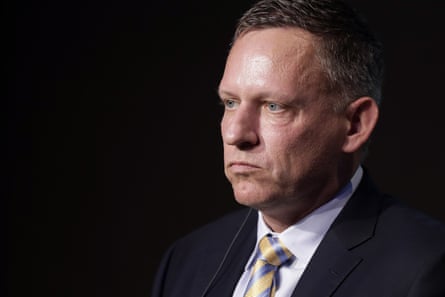
Peter Thiel in Tokyo in 2019

One might assume that it is contradictory for Trump, elected on a flag-waving “America first” platform, to lend credence to this vision of sovereign territories ruled over by billionaire god-kings. And much has been made of the colorful flame wars between the Maga mouth-piece Steve Bannon, a proud nationalist and populist, and the Trump-allied billionaires he has attacked as “technofeudalists” who “don’t give a flying fuck about the human being” – let alone the nation state. And conflicts inside Trump’s awkward, jerry-rigged coalition certainly exist, most recently reaching a boiling point over tariffs. Still, the underlying visions might not be as incompatible as they first appear.

The startup country contingent is clearly foreseeing a future marked by shocks, scarcity and collapse. Their high-tech private domains are essentially fortressed escape pods, designed for the select few to take advantage of every possible luxury and opportunity for human optimization, giving them and their children an edge in an increasingly barbarous future. To put it bluntly, the most powerful people in the world are preparing for the end of the world, an end they themselves are frenetically accelerating.

That is not so far away from the more mass-market vision of fortressed nations that has gripped the hard right globally, from Italy to Israel, Australia to the United States: in a time of ceaseless peril, openly supremacist movements in these countries are positioning their relatively wealthy states as armed bunkers. These bunkers are brutal in their determination to expel and imprison unwanted humans (even if that requires indefinite confinement in extra-national penal colonies from Manus Island to Guantánamo Bay) and equally ruthless in their willingness to violently claim the land and resources (water, energy, critical minerals) they deem necessary to weather the coming shocks.

Interestingly, at a time when previously secular Silicon Valley elites are suddenly finding Jesus, it is noteworthy that both of these visions – the priority-pass corporate state and the mass-market bunker nation – share a great deal in common with the Christian fundamentalist interpretation of the biblical Rapture, when the faithful will supposedly be lifted up to a golden city in heaven, while the damned are left to endure an apocalyptic final battle down here on earth.

If we are to meet our critical moment in history, we need to reckon with the reality that we are not up against adversaries we have seen before. We are up against end times fascism.

Reflecting on his childhood under Mussolini, the novelist and philosopher Umberto Eco observed in a celebrated essay that fascism typically has an “Armageddon complex” – a fixation on vanquishing enemies in a grand final battle. But European fascism of the 1930s and 1940s also had a horizon: a vision for a future golden age after the bloodbath that, for its in-group, would be peaceful, pastoral and purified. Not today.

Alive to our era of genuine existential danger – from climate breakdown to nuclear war to sky-rocketing inequality and unregulated AI – but financially and ideologically committed to deepening those threats, contemporary far-right movements lack any credible vision for a hopeful future. The average voter is offered only remixes of a bygone past, alongside the sadistic pleasures of dominance over an ever-expanding assemblage of dehumanized others.

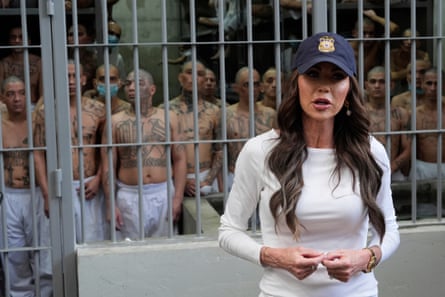
And so we have the Trump administration’s dedication to releasing its steady stream of real and AI-generated propaganda designed solely for these pornographic purposes. Footage of shackled immigrants being loaded on to deportation flights, set to the sounds of clanking chains and locking cuffs, which the official White House X account labeled “ASMR”, a reference to audio designed to calm the nervous system. Or the same account sharing news of the detention of Mahmoud Khalil, a US permanent resident who was active in Columbia University’s pro-Palestinian encampment, with the gloating words: “SHALOM, MAHMOUD.” Or any number of homeland security secretary Kristi Noem’s sadism-chic photo ops (atop a horse at the US-Mexican border, in front of a crowded prison cell in El Salvador, slinging a machine gun while arresting immigrants in Arizona …).

Kristi Noem speaks during a tour of an El Salvador prison in March 2025

The governing ideology of the far right in our age of escalating disasters has become a monstrous, supremacist survivalism.

It is terrifying in its wickedness, yes. But it also opens up powerful possibilities for resistance. To bet against the future on this scale – to bank on your bunker – is to betray, on the most basic level, our duties to one another, to the children we love, and to every other life form with whom we share a planetary home. This is a belief system that is genocidal at its core and treasonous to the wonder and beauty of this world. We are convinced that the more people understand the extent to which the right has succumbed to the Armageddon complex, the more they will be willing to fight back, realizing that absolutely everything is now on the line.

Our opponents know full well that we are entering an age of emergency, but have responded by embracing lethal yet self-serving delusions. Having bought into various apartheid fantasies of bunkered safety, they are choosing to let the Earth burn. Our task is to build a wide and deep movement, as spiritual as it is political, strong enough to stop these unhinged traitors. A movement rooted in a steadfast commitment to one another, across our many differences and divides, and to this miraculous, singular planet.

Not so long ago, it was primarily religious fundamentalists who greeted signs of apocalypse with gleeful excitement about the long-awaited Rapture. Trump has handed critical posts to people who subscribe to that fiery orthodoxy, including several Christian Zionists who see Israel’s use of annihilatory violence to expand its territorial footprint not as illegal atrocities but as felicitous evidence that the Holy Land is getting closer to the conditions under which the Messiah will return, and the faithful will get their celestial kingdom.

Mike Huckabee, Trump’s newly confirmed ambassador to Israel, has strong ties to Christian Zionism, as does Pete Hegseth, his secretary of defense. Noem and Russell Vought, the Project 2025 architect who now leads the office of budget and management, are both staunch advocates for Christian nationalism. Even Thiel, who is gay and notorious for his party lifestyle, has been heard musing about the arrival of the antichrist of late (spoiler: he thinks it’s Greta Thunberg, more on that soon).

But you don’t need to be a biblical literalist, or even religious, to be an end times fascist. Today, plenty of powerful secular people have embraced a vision of the future that follows a nearly identical script, one in which the world as we know it collapses under its weight and a chosen few survive and thrive in various kinds of arks, bunkers and gated “freedom cities”. In a 2019 paper titled Left Behind: Future Fetishists, Prepping and the Abandonment of Earth, the communication scholars Sarah T Roberts and Mél Hogan described the longing for a secular Rapture: “In the accelerationist imaginary, the future is not about harm reduction, limits or restoration; rather it is a politics driving toward an endgame.”

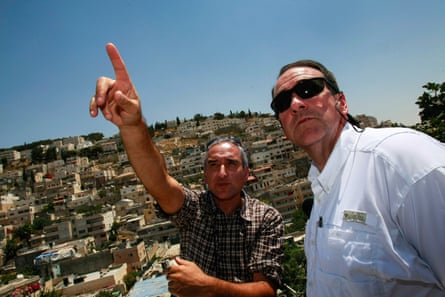
Mike Huckabee touring Jewish settlements in East Jerusalem in 2008

Elon Musk, who dramatically grew his fortune alongside Thiel at PayPal, embodies this implosive ethos. This is a person who looks up at the wonders of the night sky and apparently sees only opportunities to fill that inky unknown with his own space junk. Though he burnished his reputation warning about the dangers of the climate crisis and AI, he and his so-called “department of government efficiency” (Doge) henchmen now spend their days escalating those same risks (and many others) by slashing not only environmental regulations but entire regulatory agencies, with the apparent end goal of replacing federal workers with chatbots.

Who needs a functioning nation state when outer space – now reportedly Musk’s singular obsession – beckons? For Musk, Mars has become a secular ark, which he claims is key to the survival of human civilization, perhaps via uploaded consciousnesses to an artificial general intelligence. Kim Stanley Robinson, author of the sci-fi Mars Trilogy that appears to have partially inspired Musk, is blunt about the dangers of the billionaire’s fantasies about colonizing Mars. It is, he says, “just a moral hazard that creates the illusion we can wreck Earth and still be okay. It’s totally not true.”

segunda-feira, 5 de maio de 2025

Naomi Klein on Trump, Musk, Far Right & "End Times Fascism"


Uma aliança entre a extrema-direita e os oligarcas de Silicon Valley deu origem a uma forma de "fascismo do fim dos tempos", afirma a jornalista Naomi Klein, que detalha num ensaio recente escrito em coautoria com Astra Taylor como muitas elites ricas se estão a preparar para o fim do mundo, mesmo contribuindo para a crescente desigualdade, instabilidade política e crise climática. Klein diz que, enquanto os multimilionários sonham em escapar para enclaves isolados ou mesmo para o espaço, o presidente Donald Trump e outros líderes de direita estão a transformar os seus países em estados-fortaleza militarizados para manter os imigrantes do estrangeiro afastados e aumentar o controlo autoritário internamente.

domingo, 6 de novembro de 2022

COP27 “num estado policial patrocinada pela Coca-Cola” é greenwashing, dizem activistas

Os activistas denunciam que o patrocínio de uma mega-poluidora mina as conversações políticas para um acordo climático, uma vez que a maioria dos plásticos são feitos de combustíveis fósseis.

A cimeira anual das Nações Unidas sobre o clima, que arranca no final desta semana na turística cidade egípcia de Sharm el-Sheik, é apresentada como uma oportunidade para os chefes de Estado fazerem um balanço dos progressos climáticos e (espera-se) acelerar a acção.

Mas estas reuniões da Conferência das Partes, ou COPs, são também cada vez mais um ponto de encontro para muitas das maiores empresas do mundo, suscitando preocupações sobre a influência das empresas na tomada de decisões políticas.

Mesmo antes da chegada dos delegados à COP27, começou uma discussão em torno do patrocínio da Coca-Cola ao evento. A escritora e activista canadiana Naomi Klein escreveu sarcasticamente que é “super divertido ter uma cimeira climática num estado policial patrocinada pela Coca-Cola”, enquanto a Greenpeace disse que era chocante a COP27 escolher o “maior poluidor de plástico do mundo” como patrocinador, dado que “99% dos plásticos são feitos de combustíveis fósseis”.

A utilização de plástico virgem pela Coca-Cola, em volume, aumentou 3% nos últimos dois anos, mostra o relatório de progresso dos signatários do Compromisso Global da Fundação Ellen Macarthur para acabar com a poluição por plástico.

Uma petição criada este mês, exigindo que a ONU retire a Coca-Cola da lista de patrocinadores, tem mais de 230 mil assinaturas. Ao mesmo tempo, uma carta assinada por mais de 240 organizações ambientais de todo o mundo exige que também a Microsoft cesse o patrocínio.

“A Coca-Cola gasta milhões de dólares em greenwashing, fazendo-nos acreditar que estão a resolver o problema. Mas, nos bastidores, têm uma longa história de lobbying para atrasar e descarrilar regulamentos que impediriam a poluição, mantendo-nos viciados em plástico descartável”, lê-se no texto da petição da ambientalista Georgia Elliott-Smith.

No final de Outubro, um relatório da Greenpeace mostrava que apenas foi reciclado 5% do lixo de plástico gerado nos Estados Unidos da América, em 2021. A organização aponta que uma das razões para esta taxa de insucesso é que fica mais barato para as empresas comprar plástico novo do que reciclado.

A ideia de que a reciclagem é uma tábua de salvação, ao invés da urgência da redução do consumo ou da reutilização, tem sido promovida pelas mesmas empresas que causam a poluição, alerta o relatório. A Greenpeace sublinha que a reciclagem de plástico é praticamente impossível.

“Não deve ser concedido aos grandes poluidores o acesso à elaboração de políticas climáticas”, lê-se numa carta assinada por mais de 400 organizações ambientais. “Como próximo passo imediato, a começar na COP27, todos os participantes devem ser obrigados a divulgar publicamente e declarar os seus interesses. As pessoas merecem saber quem está na mesa de definição de políticas, e qual é a sua verdadeira agenda.”

sexta-feira, 14 de outubro de 2022

Livro e Documentário - "Tudo Pode Mudar- Capitalismo vs. Clima" de Naomi Klein

“Democracy is not just the right to vote, it is the right to live in dignity.” - Naomi Klein
"A democracia não é apenas o direito de votar, é o direito de viver com dignidade." - Naomi Klein


Naomi Klein é uma escritora e jornalista que ficou conhecida pelo seu ativismo ambiental e pelas suas críticas à globalização e ao capitalismo. Galardoada e autora de vários bestsellers internacionais, Naomi ficou conhecida por livros como ”A doutrina do choque”, “No logo” e “Tudo pode mudar”, a obra que motiva o presente artigo. Natural do Canadá, ganhou prémios como o Sydney Peace Prize ou o Hilary Weston Writers’ Trust Prize for Nonfiction. Publicou ainda imensos artigos em várias revistas e é cofundadora da organização ambientalista The Leap.

Um grande foco da sua obra é analisar a mudança climática que o mundo tem vindo a enfrentar há muito anos e que continuará por mau caminho caso não sejam tomadas medidas sérias. A sua maior obra sobre este tema é “Tudo Pode mudar: Capitalismo Versus Clima”, publicada em 2014 e que foi bestseller do New York Times e livro do ano para o Observer. É muito comum ver esta obra nas listas de livros recomendados sobre temas como as alterações climáticas ou a sustentabilidade do nosso planeta. Neste livro, Naomi tenta explicar com exemplos históricos e estudos científicos, como as alterações climáticas estão a mudar o mundo e qual o papel do capitalismo como sua força motriz. O trajeto histórico do livro vai desde os primeiros inícios deste movimento de alerta sobre o que estamos a fazer ao mundo, até aos dias de hoje e é um breve olhar sobre os caminhos que podemos ter que enfrentar em função de qual seja a nossa atitude como civilização para como solucionar este problema.

A autora alerta como ainda existem muitos negacionistas e pessoas que veem os esforços de alerta para o aquecimento global como uma ameaça comunista para controlar a sociedade. Estudos demostraram que os negacionistas são mais comuns em países onde uma visão mais individualista e a hierárquica do mundo está mais bem vista. O primeiro encontro internacional com objetivo de reduzir as emissões que provam o aquecimento global aconteceu em 1988, em Toronto, contando com mais de 300 cientistas e políticos de 46 países diferentes. Neste encontro acordaram reduzir 20% das emissões até 2005. Acontece que nada disso foi cumprido e como tal o desafio que herdamos é muito pior. Temos vindo a adiar e ignorar o problema, a piorá-lo para as gerações seguintes. 

Vários acontecimentos levaram à degradação das alterações climáticas. Um deles muito destacado no livro é a globalização, ou seja, o abrir fronteiras a todo o tipo de mercancia e a economia global onde os produtos são feitos em diferentes países e transportados para todo o lado. Não só pelo óbvio crescimento de emissões a que isso leva, mas também porque do ponto de vista de reportar dados, o que permitiu a alguns países dizerem que tinham estabilizados as suas emissões quando, na realidade, estavam a não incluir as emissões dos transportes que levavam produtos a outros lugares do mundo. Como os países são responsáveis pelas emissões geradas dentro das suas fronteiras, as outras emissões ficavam “debaixo do tapete”. 

Em 2007, a China era já responsável por dois terços do aumento das emissões. Aqui neste ponto, é onde surge uma questão fundamental que é o da culpa pelas consequências das emissões. Vejamos o seguinte: alguns países estão a sofrer maiores consequências com o aquecimento global do que outros e a culpa pertence aos países que mais contribuem para esse aquecimento global. Por exemplo, se um país pequeno pouco desenvolvido e que poucas emissões tem, de repente, sofre com cheias que destroem casas e lugares públicos, vai ser o contribuinte desse país a pagar pelas reparações, quando essas cheias foram maioritariamente consequência das emissões dos maiores poluidores, como a China ou os Estados Unidos. Isto gera uma injustiça social e económica global que leva Naomi a defender uma política de “o poluidor paga”.

Outro fator fundamental é a necessidade de termos políticas de longo prazo que defendam uma economia sustentável para o meio ambiente, capaz de dizer não a grandes empresas. A autora dá exemplos de como não podemos depender da boa vontade de grandes empresas e de grandes empresários, já que, muitas vezes, certas iniciativas que apresentam ser verdes, estão a esconder algo pior ou a encobrir um aumento de emissões. O livro apresenta ainda como algumas empresas fintaram completamente as leis contra emissões com esquemas que, em alguns casos, permitiam aumentar emissões e ainda lucrar com isso, escândalos reais difíceis de acreditar.

Olhando para o futuro, para que as pessoas possam acreditar, é preciso que elas vejam alternativas reais e concretas e evitar o típico discurso opaco de que a tecnologia nos vai salvar de tudo. Precisamos de uma solução global que tenha em conta dois fatores: a responsabilidade histórica que cada país teve nas emissões e a capacidade que cada tem para contribuir (com base no seu nível de desenvolvimento). Esta mudança levará grandes empresas a perderem triliões de euros, mas não há custo maior para todos do que dar cabo do nosso próprio planeta. A autora defende ainda a visão de que resolver este problema ambiental é uma oportunidade enorme para, ao mesmo tempo, reduzir a desigualdade económica que há no mundo. Segundo Naomi, o que o mundo precisa é de se concentrar na utilização dos recursos pela humanidade, noutras palavras, o sistema planetário está em guerra com o nosso sistema económico.

Estamos perante um bom livro, muito documentado, sobre aquela que talvez seja a maior questão do mundo, as alterações climáticas e a sustentabilidade do nosso planeta.

Projecto (livro, documentário e impacto)

Conferência:


Biografia:
Naomi Klein

quarta-feira, 27 de julho de 2022

Micro utopias for an inclusive future


When Gijsbert Huijink, a Dutch national living in Banyoles, in the Catalan province of Girona, set out to install solar panels in his home he stumbled upon a legal labyrinth that criminalized energy self-consumption. “If I wanted to connect to the grid to recharge my batteries and supply my excess, I had to pay a fortune,” Gijsbert Huijink said in an interview.1 Huijink then hatched a plan to exact sweet collective revenge: he founded Som Energia,2 Spain’s first power cooperative. With the help of his wife, his university students, and some friends, Gijsbert laid the foundations to effect a change in the Spanish energy market. Som Energia has since grown from an initial 150 contracts in 2010 to 125,589 in March 2021,3 and it is currently the fastest growing energy cooperative in Europe. Hundreds of city governments have hired its services and dozens of new energy cooperatives are replicating the model.

Som Energia has a characteristic that sets it apart from most environmentalist efforts. It is not a project that merely reacts: it proposes. It does not focus on protesting, but on action. It does not stop at defending certain ideals, but puts those ideals into practice. It goes beyond criticizing an economic model based on fossil fuels: it sets a new model in motion. It does not just denounce the injustice of certain regulations, but goes on to experiment with new forms of democracy. It does not focus on the individual: it aims for sustainability with community and networked solutions.

Som Energia was one of the thirty-two initiatives that participated in the first edition of the Transformative Cities People’s Choice Award and the Atlas of Utopias, the unique coopetition4 launched by the Transnational Institute (TNI) in 2018. Having completed a total of three editions,5 it perfectly embodies the spirit that infuses all those initiatives. The award-winning projects6 are a refreshing mosaic of “real utopias”. Pragmatic, adaptable utopias in progress. Simple utopias that satisfy simple desires, as Rutger Bregman notes in his book Utopias for Realists.7 “Real utopias.”8

What features do the Atlas of Utopias initiatives share?9 What horizons do they open up?

Ever since 1516, when Thomas More described an island with a perfect political, social, and legal system in his book Utopia, that word has inspired pages and pages of writing. As of that moment, humanity began to project its desires onto the future. The mythology that explained the past—foundational myths, legends—was channeled toward the future, creating utopia. The most exalted version came with Ernst Bloch’s The Principle of Hope, published in the 1950s, which combined the modern myths of utopia with revolution and the arts.10 Utopia was on the horizon. And it served to keep us walking.11

However, when Francis Fukuyama proclaimed the end of history in 1992,12 a claustrophobic present governed by the global economy emerged. According to that author, the collapse of communist governments confirmed liberal democracy as the only possible alternative. The future began to fall short of the expectations of so many utopian centuries. The future lost its inspiring glow. Possible horizons became blurred. The grandiose dreams of modernity unraveled, perhaps precisely because they were overly ambitious. Utopia fizzled out. As Franco “Bifo” Berardi notes in After the Future,13 technology has emerged as a despotic deity that cancels the future, turning time into an unlimited generation of identical fragments.

The Atlas of Utopias is an invigorating breath of fresh air in a world that has lost its great utopia. And it is tangible proof that “real utopias” are underway. We no longer have a Utopia with a capital U, but dozens, hundreds, and even thousands of networked micro utopias.14 Micro utopias where humans come together to weave territories. Concrete micro utopias that activate what Argentine sociologist Maristella Svampa calls “affinity communities.”15 Communities that recreate and reproduce themselves as they go about doing. When the people of San Pedro Magisterio, a neighborhood in the Bolivian city of Cochabamba, organized to build and operate a wastewater treatment plant, they strengthened the community management of the water cycle and the neighborhood itself. The installation of a wastewater treatment plant in the neighborhood was made possible by Fundación Abril, with the support of several organizations.16 The process became a tool for teaching (with sessions in schools), political action, and social unity. Territory-based community water management exceeds the paradigm of what is considered public. The finalists of every edition of the Transformative Cities Award, which feeds the Atlas of Utopias, are utopias situated at the territory level and in communities, and they are anchored in what is the most conducive sphere for putting these micro utopias into practice: the local sphere.

From “asking as we walk” to “learning by doing”

“Asking as we walk” (Caminando preguntamos) was one of the most widely known catchphrases of the Neo-Zapatista movement that erupted in southern Mexico in the 1990s. “Asking as we walk” opens the game up to others, inviting them to join the struggle. Dialogue is a process, not a substance: an unfolding, not a synthesis. The Zapatista movement does not talk, it listens. It does not respond, it asks. It recognizes particularities and proposes a place for all of them. It strives for a polyphonic dialogue built from many dialogues.17 In the Zapatista listening process, a common fabric emerges, a plurality of voices, a subject that is very different from the Western exclusive ‘we’. From the communities of affinity, from the communities of territorial practices, emanates an open and inclusive subject, in which every person teaches and learns. Bolivian sociologist Silvia Rivera Cusicanqui18 takes up the Aymara word jiwasa, a fourth person pronoun that acts as an inclusive ‘we’. The pronoun jiwasa differs from the pronoun nayanaka, which is the exclusive ‘we’. When someone hears jiwasa they hear an invitation to join in, to belong. The San Pedro Magisterio cooperative would not have been possible without the jiwasa, or without the ayni, the practice of community reciprocity.

The Dhaka Water Board Union Cooperative,19 another of the initiatives participating in the coopetition,20 offers a major lesson: the knowledge held by a company’s workers is more useful for its management than the knowledge any experts can provide. When the World Bank recommended privatizing the state-owned company Dhaka Water Supply and Sewerage Authority (WASA), in Bangladesh’s capital city Dhaka, a group of workers said no. They then managed to organize their work in the form of a cooperative. Bringing their decades of experience into the effort, the workers applied a different method, which involved consulting the affected communities in the water system managed by the company, thus improving its efficiency.

The territorial nature of the local sphere and the new ways of doing, such as the feminization of politics and networking,21 alter how utopia interferes with reality. Cooperative and community practices do not subordinate their action to great ideals. Rather, it is the other way around: values emanate from their action. Barcelona en Comú,22 another of the coopetition finalists, embodies this spirit that places practice and common solutions to concrete problems at the center. The social movement behind Barcelona en Comú’s operation creates inclusive networks of persons and ecosystems of practices, not closed ideological networks. Networks and spaces open to coexistence, in which anyone can contribute to a problem’s solution. This is the case of CasaNat in Porto Alegre, Brazil, one of the 2020 winners of the People’s Choice Award.23 CasaNat is a center that fights hunger, the pandemic, and repression by the Bolsonaro government. A space for social organization and education in thinking about the city, which strengthens communities and acts as a hub for the response to the COVID-19 pandemic.24 A micro-utopia that serves as a space for exchanging, learning, and resisting.

Creative resistance

In her book No Is Not Enough, the Canadian journalist Naomi Klein unpacks the importance of creating and affirming a new world. Reacting against a system is not enough. “No is not enough. It must be a yes and there must be confidence in that yes. It is necessary to propose an alternative that generates trust. We have to begin by designing real alternatives that are not only credible, but inspiring and exciting.”25 The propositional demand raised by Klein echoes one of the most mythical sayings by Buckminster Fuller: “You never change things by fighting the existing reality. To change something, build a new model that makes the existing model obsolete.”26 A world is combated with a world. A vision, with another vision. Unlike utopia, networked micro utopias make a new system visible, a new world woven with mutual recognition mechanisms and habits.

The Irish ecovillage Cloughjordan, a finalist in the 2020 edition of the Transformative Cities Award, moves in the direction of Naomi Klein’s holistic yes. And it enunciates a complete world. It does not merely denounce the unchecked and unsustainable growth of cities, but implements a transition model based on communities and local consumption. Thanks to the low-carbon design of its fifty-five houses, a carbon-neutral district heating system, a community farm, a green enterprise center, and a planned reed-bed treatment plant, Cloughjordan has the lowest ecological footprint in Ireland. The world of the ecovillage is interconnected and multiplied through numerous educational activities.

While the viability of the new system lies in the yes and the assertion of a world, there are cases in which an action is no and yes at the same time. Some of the initiatives of the Atlas of Utopias share the uncommon characteristic of creative resistance. When an action manages to be both yes (creation) and no (resistance), the micro utopia maximizes the visibility of the transformative power of the new model. The experience of the beedi (cigar) industry women workers in the Indian city of Solapur reveals how resistance against speculation and substandard housing can result in shaping a world. After years of struggling and forming cooperatives, the cigar industry women eventually founded the RAY Nagar Cooperative Housing Federation,27 the largest housing cooperative in Asia. In 2015, local governments agreed to build 30,000 affordable houses for beedi and textile workers in the marginal neighborhood of Kumbhari. The project includes outdoor spaces, as well as land to establish community services, schools, and hospitals. The state and federal governments contributed with the laying of power lines, the construction of an electrical substation, and the installation of water tanks. Kumbhari has experienced a rebirth with the new public services and the opening of new shops. The Kranti Chowk produce market is one of the most thriving markets in Solapur.

Exceeding the principle of hope

In his unique way, philosopher Bertrand Russell rejected a categorical definition of utopia when he said, “It is not a finished utopia that we ought to desire, but a world where imagination and hope are alive and active.”28 After the collapse of the grand narrative of modern utopia, the great potential of the utopian goal lies not so much in realizing and describing a closed reality that is to come, but in making it possible for the world to be necessarily populated by multiple worlds, as the neo-Zapatista movement has been insisting for decades. A world that can be inhabited by hope. Perhaps that explains why Ernst Bloch focused so much on studying the hope that persists even in horrific situations, thanks to what he calls “wishful images”. Images that serve as prototypes to cross borders. Images charged with emotions. Positive emotions that,2 while they may not lead to actions as urgent as those prompted by negative emotions, eventually open up and broaden the repertoire of thoughts and actions.

“Wishful images” are what emanates from the Atlas of Utopias initiatives, images that, in a way, make a new world desirable. Whether it is children participating in a river cleanup in Cochabamba or a group of cigar workers taking a public bus to work in their Solapur factory, these “wishful images” push the horizon of the possible. They excite. And they expand, connecting the networked micro utopias set in motion by the most diverse communities. Naomi Klein’s yes is not viable if it is merely a theoretical model. The no is not enough. But neither is a yes that springs from theory. The yes has to be inhabited by political and civic practices, by narratives, by imaginaries, by new symbols, by shared values, by emotions, by new shared meanings, by world visions, by alternative economic systems. The welcoming spaces for a coming together, an open we (the jiwasa of the Aymaras), the unifying slogans (the “We are the 99%” of Occupy Wall Street), and the shared positive emotions, these all exceed Bloch’s principle of hope. Collective action multiplies hope toward a future that can be inhabited in common. And because it is controlled by communities, there is less uncertainty about that future.

Which is why—Andrea de la Serna writes in her article Un común por venir29—we should no longer pin our hopes for the revolution on a future horizon; we should instead concentrate on generating the conditions that can give us the horizon we want. In order to climb over the wall of the end of history and catch a glimmer of hope, humanity must restore its confidence in the strengths of the present. When a detour, however small, appears, we need to seize and boost it, feed it, make it breathe. We need to organize gatherings, take care of ourselves as a community, create “wishful images” everywhere.

Birgitta Jónsdóttir, a poet and founder of the Icelandic Pirate Party, highlights the importance of enunciating a future populated by images and visions of hope: “When people are forced to choose between fear and hope, they usually choose hope. The future is not going to be a single vision, but a collage of visions. We need to think inclusively about the future.”31

Notes

1 Eva Dallo, “El holandés que ha puesto en jaque el sistema energético español,” El Mundo, January 10, 2016.


3 Figure as of March 19, 2021.

4 TNI understands coopetition as a process that seeks to promote cooperation and solidarity by introducing an element of competition to encourage public interaction and engagement.


7 Rutger Bregman, Utopias for Realists: How We Can Build the Ideal World (London and New York: Bloomsbury Publishing PLC, 2017)

8 The concept of “real utopias” was developed by sociologist Erik Olin Wright. See Erik Olin Wright, Envisioning Real Utopias (London: Verso, 2010)


10 Juan Emilio Burucúa, “Prometeo contra el cambio climático,” El País, March 1, 2019.

11 Paraphrasing the poem Ventana sobre la Utopía (Window on Utopia) by Eduardo Galeano: “La utopía está en el horizonte. Camino dos pasos, ella se aleja dos pasos. Camino diez pasos y el horizonte se corre diez pasos más allá. Entonces… ¿para qué sirve la utopía? Para eso, sirve para caminar.”(“Utopia is on the horizon. I move two steps closer; it moves two steps further. I walk another ten steps and the horizon runs ten steps further away. As much as I may walk, I’ll never reach it. So what’s the point of utopia? The point is this: to keep walking.”) Eduardo Galeano, Las palabras andantes(Siglo XXI: Madrid, 2003).

12 Francis Fukuyama, The End of History and the Last Man (New York: The Free Press, 1992).

13 Franco “Bifo” Berardi, Alter the Future (Oakland, CA: AK Press, 2011).

14 Bernardo Gutiérrez, “Microutopías en red: los prototipos del 15M,” 20minutos.es , May 12, 2013 (https://codigoabiertocc.wordpress.com/2013/05/12/microutopias-en-red-los-prototipos-del-15m/) .

15 Maristella Svampa, “Movimientos sociales, matrices sociopolíticas y nuevos escenarios en América Latina,” in One World Perspectives, Kassel, Universidad de Kassel: Working Paper 1 (2010).


17 Esteban Rodríguez, “Un diálogo con muchos diálogos” 

18 Silvia Rivera Cusicanqui, “Un mundo ch’ixi es posible” (Buenos Aires: Tinta Limón, 2018).


21 See the chapter on “ways of doing” written by Laura Roth.


25 Naomi Klein interviewed on November 7, 2018 by Jordi Évole, on the television program Salvados.

26 L. Steven Sieden, A Fuller View: Buckminster Fuller’s Vision of Hope and Abundance for All (London: Divine Arts Media, 2011), 358.


28 Rutger Bregman, Utopias for Realists, 29.


30 Andrea de la Serna, “Un común por venir” Revista Re-visiones, Madrid, 2016, 

31 Bernardo Gutiérrez, Pasado Mañana. Viaje a la España del cambio (Barcelona: Arpa Editores, 2017).

segunda-feira, 19 de abril de 2021

Documentário: Disobedience


Disobedience is a 40-minute film directed by award-winning Kelly Nyks of PF Pictures. The CMG Focus Fund grant supported the production and distribution of the film, a sequel to the well-received documentary Disruption. Production for the film occured from January to April and distribution was coordinated with the worldwide Break Free from Fossil Fuels campaign planned for May 4-15, 2016.

The film featured verité footage of inspiring front line actions in Brazil, Turkey, Germany, The Philippines, Canada, and the United States interwoven with interviews from some of the most renowned voices in the conversation of social movements and the climate crisis, including Elizabeth Kolbert, Naomi Klein, Marshall Ganz, Malcom Gladwell, Naomi Oreskes, Michael Mann, and Bill McKibben.

“Disobedience will tell the behind-the-scenes stories from the rising climate movement around the world,” said director Kelly Nyks. “Viewers will experience a global journey profiling activists from Brazil to Germany, as they stage acts of civil disobedience to lift the climate movement to new heights of commitment and engagement at this critical moment in human history.”

Payal Parekh, Program Director of 350.org added, “Through the articulation of the best practices of civil disobedience and a crash-course in social movement history, this film will make the irrefutable case for direct and local engagement. In doing so, Disobedience offers an answer to the all-important question concerned citizens ask about climate change: “What can I do?””

Nyks & his team at PF Pictures have been committed to making films that impact viewers and motivate change. As PF Pictures website states: We use film as a tool for social change.

About the Grantees
Kelly Nyks is an award-winning writer/director of narrative and documentary films and has worked across Europe, Asia and America. His most recent film, Requiem for the American Dream, is currently in theatrical release to widespread critical acclaim including a New York Times Critics Pick. His credits include Disruption (2014), Impossible (2014), Do The Math (2013), Money is Material (2013), The Artificial Leaf (2012) and Split: A Deeper Divide (2012), among others. To learn more visit: PF Pictures

Break Free from Fossil Fuels was organized by a wide range of international, national and local organizations. From May 4-15, 2016 they are mobilized to keep fossil fuels in the groun and accelerated a just transition to 100% renewable energy and a sustainable future for all. 

Project Updates and Milestones
Feature Fund Grantee Kelly Nyks released Disobedience on April 29th. Distribution was coordinated with the worldwide Break Free From Fossil Fuels campaign. The campaign ran from May 4-15 with the following notable actions taking place with over 30,000 participants and 20 escalated actions over 6 continents. The major fossil fuels disruptions were:
  • Newcastle Coal Port in Australia shut down for one day.
  • Vattenfall Welzow-Sued coal mine + Schwarze Pumpe coal power station in Germany was shut down coal plant for 3 days of successive acts of civil disobedience to demand an end to coal.
  • Action against the Pecém coal power plant, the largest thermal power plant in the Brazil it is a symbol of the federal government’s contradiction of the agreement signed at COP21.
  • Ffos-y-Fran coal mine, the largest open-cast coal mine in the United Kingdom - was shut down for over 12 hours, with no injuries and no arrests.
  • Thousands converged by land and water on March Point in Anacortes, WA — the largest unmitigated source of CO2 in the northwest United States and, the site of two oil refineries. Over three days, the action included multiple kayak flotillas, a march led by Indigenous leaders, and an overnight sit-in on the train tracks that led to over 50 arrests.
  • Community leaders led a mass action Aliaga coal ash disposal site near Izmir, Turkey calling for a stop to four fossil fuel plant projects in the surrounding area.

sexta-feira, 2 de outubro de 2020

Estamos a viver o período mais perigoso na história humana, alerta Chomsky

Fonte: aqui

Aos 91 anos, Noam Chomsky continua ativo na intervenção cívica e política, este fim de semana ao lado de Bernie Sanders, Naomi Klein e Yanis Varoufakis no encontro online da “Internacional Progressista”. Entrevistado pela New Statesman(link is external) Chomsky alertou que o mundo está perante uma “impressionante confluência de crises muito graves”, cuja dimensão ficou patente no último acerto do famoso “Relógio do Juízo Final”. “Tem sido ajustado todos os anos desde o bombardeamento atómico, o ponteiro dos minutos tem avançado e recuado. Mas em Janeiro passado, abandonaram os minutos e passaram aos segundos para a meia-noite, o que significa a extinção. E isso foi antes da escalada da pandemia”, recorda.

Para o linguista norte-americano, a ameaça de guerra nuclear nos dias de hoje “é provavelmente mais grave do que era no tempo da Guerra Fria”. Por outro lado, há as ameaças da catástrofe climática e da deterioração da democracia, “que à primeira vista parece que nada tem a ver com as outras, mas na verdade tem muito, porque a única esperança de lidarmos com as outras duas crises existenciais, que são mesmo uma ameaça de extinção, é através de uma democracia vibrante, com cidadãos informados e empenhados que participem na construção de respostas a essas crises”.


Chomsky sublinha o papel de Donald Trump no agravar destas três crises, ao destruir os mecanismos de controlo do armamento e investir em novas armas mais perigosas, ao maximizar o uso de combustíveis fósseis e enfraquecer a regulação ambiental e ao afastar todas as vozes dissidentes no executivo, formando na prática uma “internacional reacionária” ao lado de figuras como o brasileiro Bolsonaro, o egípcio al-Sisi, o indiano Modi ou o húngaro Orbán.

“Ele já disse e repetiu que se não gostar do resultado das eleições não sairá do lugar”, lembra Chomsky, afirmando que nesse caso existe um dever dos militares, nomeadamente da 82ª Divisão Aerotransportada, de o remover à força. O facto de este tema estar em cima da mesa não só não tem precedentes no regime norte-americano, como pode ter consequências graves. No plano de transição presidencial, altos responsáveis democratas e republicanos têm colocado a questão de o que pode acontecer se Trump se recusar a sair e “todos os cenários que eles levantaram conduzem à guerra civil. Isto não é uma piada”, avisa Chomsky.

A mensagem de Chomsky para a esquerda dos EUA é que faça o que “deve fazer sempre: reconhecer que a política verdadeira é o ativismo constante”. O que no caso de uma eleição num sistema bipartidário significa ter de votar no candidato que se opõe a Trump. “Mas logo depois o que há a fazer é desafiá-lo, manter a pressão para o empurrar em direção de propostas mais progressistas”, acrescenta o intelectual que se define como anarquista, “tal como o é toda a gente se parar um pouco para pensar, tirando as pessoas que são patológicas”.

quarta-feira, 23 de setembro de 2020

L’insoutenable légèreté du capitalisme vis-à-vis de notre santé, par Eva Illouz

TRIBUNE. Dans ce texte brillant, qui souligne le lien étroit entre santé et économie, la grande sociologue franco-israélienne analyse la crise planétaire du coronavirus. Elle dénonce « l’imposture » du néolibéralisme qui, privant l’Etat de ses ressources, a sacrifié le monde dont il se nourrit.


En regardant le film hypnotique de Lars von Trier « Melancholia », le spectateur comprend peu à peu, dans un mélange de terreur et d’impuissance, que le monde est sur le point de disparaître, condamné à entrer en collision avec la planète « Melancholia ». A la fin du film, ce spectateur, à la fois fasciné et paralysé, voit cette planète finir sa course pour s’écraser sur la Terre. D’abord apparue sous la forme d’un point lointain dans le ciel, elle grossit jusqu’à finalement devenir un disque qui envahit tout l’écran, au moment du choc.

Nous sommes tous plongés dans un événement mondial dont nous n’avons pas encore pleinement saisi l’ampleur. Dans ce moment inédit, j’ai tenté de trouver des analogies et je me suis souvenue de cette scène finale du film de Lars von Trier.

Une nouvelle réalité

C’est au cours de la deuxième semaine de janvier que j’ai lu pour la première fois un article au sujet d’un étrange virus ; c’était dans la presse américaine et j’y ai prêté une attention toute particulière parce que mon fils devait partir en Chine. Le virus était encore à distance, comme le point lointain d’une planète menaçante. Mon fils annula son voyage mais le point est devenu disque et a poursuivi sa course inexorable, venant progressivement s’écraser sur nous, en Europe et au Moyen-Orient. Désormais, nous observons tous, tétanisés, les progrès de la pandémie, tandis que le monde que nous connaissions a baissé le rideau.

Le coronavirus est un événement planétaire d’une magnitude que nous peinons à saisir, non seulement en raison de son échelle mondiale, non seulement en raison de la rapidité de la contamination, mais aussi parce que les institutions dont nous n’avions jamais questionné le colossal pouvoir ont été mises à genoux en l’espace de quelques semaines. L’univers archaïque des épidémies dévastatrices a brutalement fait irruption dans le monde aseptisé et avancé de la puissance nucléaire, de la chirurgie laser et de la technologie virtuelle. Même en temps de guerre, les cinémas et les bars underground continuaient de fonctionner ; or ici, les villes animées d’Europe que nous aimons sont devenues de sinistres villes fantômes, leurs habitants forcés de se terrer chez eux. Comme l’écrivit Albert Camus dans « la Peste », « tous ces changements, dans un sens, étaient si extraordinaires et s’étaient accomplis si rapidement, qu’il n’était pas facile de les considérer comme normaux et durables. »

Du transport aérien aux musées, c’est le cœur battant de notre civilisation qui a été arrêté. La liberté, la valeur cardinale de la modernité, a été mise entre parenthèses, non pas à cause d’un nouveau tyran mais en raison de la peur, cette émotion qui domine toutes les autres. Du jour au lendemain, le monde est devenu unheimlich, étrangement inquiétant, vidé de sa familiarité. Les gestes les plus réconfortants – se serrer la main, s’embrasser, s’étreindre, manger ensemble – sont devenus sources de danger et d’angoisse. En l’espace de quelques jours, de nouvelles notions ont fait leur apparition pour donner sens à une réalité nouvelle : nous sommes tous devenus spécialistes des différents types de masques et de leur pouvoir filtrant (N95, FPP2, FPP3, etc.), nous savons désormais quelle quantité d’alcool est nécessaire à un lavage de mains efficace, nous connaissons la différence entre la « suppression » et l’« atténuation », entre Saint-Louis et Philadelphie au temps de la grippe espagnole, et bien sûr, nous nous sommes familiarisés, surtout, avec les étranges règles et rituels de la distanciation sociale. En quelques jours en effet, une nouvelle réalité a fait son apparition, avec de nouveaux objets, de nouveaux concepts et de nouvelles pratiques.

Rupture du contrat de l’Etat

Les crises révèlent les structures mentales et politiques et, dans le même temps, elles mettent au défi les structures conventionnelles et la routine. Une structure est habituellement dissimulée au regard, mais les crises n’ont pas leur pareil pour exposer à l’œil nu les structures mentales et sociales tacites.

La santé, selon Michel Foucault, est l’épicentre de la gouvernance moderne (il parlait de « biopouvoir »). A travers la médecine et la santé mentale, affirmait-il, l’Etat gère, surveille et contrôle la population. Dans un langage qu’il n’aurait pas utilisé, nous pourrions dire que le contrat implicite passé entre les Etats modernes et leurs citoyens est fondé sur la capacité des premiers à garantir la sécurité et la santé physiques des seconds.

Cette crise met en lumière deux choses opposées : d’abord le fait que ce contrat, dans de nombreuses parties du monde, a progressivement été rompu par l’Etat, qui a changé de vocation en devenant un acteur économique entièrement préoccupé de réduire les coûts du travail, d’autoriser ou encourager la délocalisation de la production (et, entre autres, celle de médicaments clés), de déréguler les activités bancaires et financières et de subvenir aux besoins des entreprises. Le résultat, intentionnel ou non, a été une érosion extraordinaire du secteur public. Et la deuxième chose, c’est le fait, évident aux yeux de tous, que seul l’Etat peut gérer et surmonter une crise d’une telle ampleur. Même le mammouth Amazon ne peut faire plus qu’expédier des colis postaux, et encore, avec de grandes difficultés.

« Retombées zoonotiques »

Pour Dennis Carroll, expert mondial de premier plan en maladies infectieuses, travaillant aux Etats-Unis pour le CDC (Centers for Disease Control and Prevention), l’agence nationale de protection de la santé, nous devons nous attendre à voir ce type de pandémies se répéter plus souvent à l’avenir. Et cela en raison de ce qu’il appelle les « retombées zoonotiques », c’est-à-dire les conséquences d’un contact de plus en plus fréquent entre des agents pathogènes d’origine animale et les hommes – un contact lui-même causé par la présence toujours plus importante des humains dans des écozones qui, jusqu’ici, étaient hors de notre portée. Ces incursions dans les écozones s’expliquent par la surpopulation et par l’exploitation intensive de la terre (en Afrique, par exemple, l’extraction pétrolière ou minière s’est considérablement développée dans des régions qui étaient d’ordinaire peu habitées par les hommes).

Cela fait au moins une décennie que Caroll et de nombreux autres (dont, par exemple, Bill Gates et l’épidémiologiste Larry Brilliant, directeur de la fondation Google.org) nous avertissent que des virus inconnus menaceront toujours plus à l’avenir les êtres humains. Mais personne n’y a prêté attention. La crise actuelle est le prix que nous payons tous pour le manque d’attention de nos politiciens : nos sociétés étaient bien trop occupées à réaliser des bénéfices, sans relâche, et à exploiter la terre et la main d’œuvre, en tout temps et en tous lieux. Dans un monde post-Corona, les retombées zoonotiques et les marchés chinois d’animaux vivants devront devenir le souci de la communauté internationale. Si l’arsenal nucléaire de l’Iran est étroitement contrôlé, il n’y a aucune raison de ne pas exiger un contrôle international des sources de retombées zoonotiques. Le milieu des affaires, partout à travers le monde, peut enfin réaliser que pour pouvoir exploiter le monde, il faut encore qu’il y ait un monde.

Une femme, sur le pont de Brooklyn à New York, le 20 mars 2020.

L’économie ou la vie ? La santé, socle invisible du marché

La peur du public met toujours les institutions en danger (les monstres politiques du XXème siècle ont tous utilisé la peur pour dépouiller la démocratie de ses institutions). Mais l’inédit de cette crise, c’est à quel point elle se montre hantée par l’« économisme ». Le modèle britannique (décrié depuis) a initialement consisté à adopter la méthode d’intervention la moins intrusive possible, soit le modèle de l’auto-immunisation (c’est-à-dire de la contamination) de 60 % de la population – une option qui revenait à sacrifier une partie de cette population au nom du maintien de l’activité économique. L’Allemagne et la France avaient d’abord réagi de la même manière, ignorant la crise tant que cela fut possible. Comme l’a relevé l’essayiste italien Giuliano Da Empoli, même la Chine, qui piétine les droits de l’homme, n’a pas utilisé aussi ouvertement que les nations européenne l’« économisme » comme un critère à prendre en considération dans la lutte contre le virus (du moins au début). Le dilemme est sans précédent : sacrifier la vie de nombreuses personnes âgées et vulnérables ou sacrifier la survie économique de beaucoup de jeunes et d’indépendants.

Il n’est pas sans ironie que ce soit le monde de la finance, généralement arrogant et si souvent impénétrable, qui ait été le premier à s’effondrer. Cela a montré que la circulation de l’argent dans le monde repose sur une ressource que nous considérions tous comme acquise : la santé des citoyens. Les marchés se nourrissent de la confiance comme d’une monnaie pour construire le futur, et il s’avère que la confiance se fonde sur l’hypothèse de la santé. Les Etats modernes ont garanti la santé des citoyens : ils ont construit des hôpitaux, formé des médecins, subventionné la recherche médicale et conçu des systèmes de protection sociale. Ce système de santé était le socle invisible qui rendait possible la confiance dans l’avenir qui, à son tour, conditionne les investissements et la spéculation financière. Sans santé, les transactions économiques perdent leur sens.

La santé était donc tenue pour acquise ; et ces dernières décennies, les politiciens, les places financières, les grandes entreprises s’accordèrent tous pour promouvoir des politiques qui réduisaient drastiquement les budgets dévolus aux ressources publiques, de l’éducation aux soins de santé, ignorant ainsi de façon paradoxale à quel point les entreprises avaient pu bénéficier de ces biens publics (éducation, santé, infrastructures), sans rien débourser pour cela. Toutes ces ressources dépendent de l’Etat et conditionnent l’existence même des échanges économiques. Pourtant, en France, 100 000 lits d’hôpitaux ont été supprimés ces vingt dernières années (les soins à domicile ne sauraient compenser des lits en unités de soins intensifs). En juin 2019, les médecins et infirmières urgentistes avaient manifesté contre les coupes budgétaires qui sapent le système de santé français – une référence mondiale – jusqu’à le pousser au bord de l’effondrement.

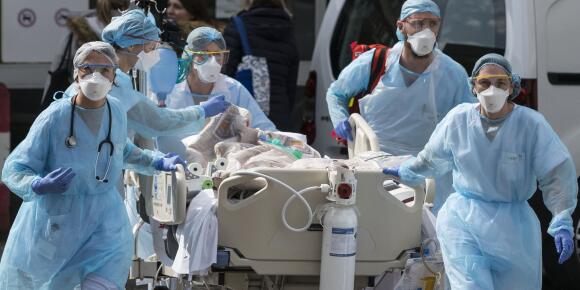
A l’hôpital Emile Muller de Mulhouse, le 22 mars 2020.

Au moment même où j’écris ces lignes, un collectif de 600 médecins annoncent porter plainte contre le Premier ministre, Edouard Philippe, et l’ex-ministre de la Santé, Agnès Buzyn, pour leur mauvaise gestion de la crise (jusqu’au 14 mars, aucune mesure n’avait été prise). Aux Etats-Unis, le pays le plus puissant de la planète, les médecins se démènent pour trouver des masques, afin de se protéger eux-mêmes. En Israël, en 2019, le ratio lits d’hôpitaux/population totale était tombé à son plus bas niveau depuis trois décennies, selon un rapport publié par le ministère de la Santé.