Mostrar mensagens com a etiqueta MIT. Mostrar todas as mensagens

sexta-feira, 11 de setembro de 2026

A algoritização do ódio: as redes sociais, a extrema-direita e a erosão da democracia


A transformação do ecossistema digital de um espaço de ligação interpessoal numa máquina industrial de rentabilização da mediocridade e do sensacionalismo ultrapassa as fronteiras da mera desilusão tecnológica ou da crítica de consumo. A mutação da esfera pública numa arquitetura desenhada para viciar provocou uma fratura tectónica na vida democrática contemporânea. Longe de serem juízes neutros, os algoritmos de recomendação das grandes plataformas atuam como catalisadores de incentivos perversos onde a indignação, o ruído e a falsidade se sobrepõem sistematicamente ao conhecimento e à utilidade real. É precisamente nesta assimetria estrutural - onde a futilidade e o conflito são convertidos em capital publicitário - que reside a aliança simbiótica entre a arquitetura Big Tech e a ascensão dos movimentos de extrema-direita, num processo que conspira ativamente contra as fundações da democracia liberal.

1. O modelo de negócio da atenção e a proliferação das redes
A premissa central sobre a qual repousa o império das redes sociais é a maximização do tempo de ecrã (engagement). Como demonstraram os dados divulgados pela whistleblower Frances Haugen através dos Facebook Papers, os sistemas de recomendação priorizaram historicamente as reações emotivas de "indignação" (Angry), atribuindo-lhes cinco vezes mais peso algorítmico do que a um simples "Gosto". Esta decisão de engenharia não respondeu a uma neutralidade política, mas sim a um cálculo económico: a raiva e o ridículo desencadeiam reações biológicas mais rápidas, comentários mais acesos e partilha compulsiva.

O resultado é uma economia da atenção globalizada em que várias plataformas promovem ativamente a desinformação e rentabilizam o discurso de ódio:
  1. Facebook (Meta): continua a ser o pioneiro na monetização do clickbait e na otimização da raiva, cortando o alcance orgânico do jornalismo e da cultura para forçar o pagamento de promoção, enquanto distribui gratuitamente conteúdos divisivos.
  2. X / Twitter: sob a liderança de Elon Musk, a plataforma desmontou grande parte das suas equipas de moderação de conteúdo, alterou a verificação de contas para um modelo pago sem autenticação real e reconfigurou o algoritmo para ampliar posts de alto envolvimento emocional, tornando-se uma incubadora direta de teorias da conspiração e discurso extremista.
  3. TikTok: utiliza um algoritmo de recomendação hiper-otimizado que identifica fragilidades emocionais em segundos. Ao priorizar vídeos de curta duração baseados em choque, pânico moral ou desinformação médica e política, a rede cria espirais rápidas de radicalização para públicos extremamente jovens.
  4. YouTube (Google): o seu motor de recomendação foi documentado por diversos académicos por conduzir utilizadores ao longo de "tocas de coelho" (rabbit holes) ideológicas, onde vídeos moderados levam gradualmente a conteúdos cada vez mais extremistas e conspiratórios para reter a visualização contínua.
  5. Telegram e WhatsApp: funcionam como redes de comunicação opaca em massa onde a desinformação circula sem qualquer moderação de factos. A arquitetura de grupos e canais gigantes permite a orquestração de campanhas de difamação e pânico social longe do escrutínio público.
2. A extrema-direita e o uso ativo do algoritmo
Se a infraestrutura das redes sociais foi desenhada para priorizar o conflito e a polarização, os movimentos populistas e radicais revelaram-se os seus utilizadores mais eficazes. Contudo, existe um debate central sobre esta relação: a extrema-direita não é meramente um produto passivo do algoritmo, mas sim um ator político estratégico que aprendeu ativamente a instrumentalizar a plataforma. Muito antes da otimização algorítmica, estes movimentos já exploravam os limites da propaganda; com as redes sociais, encontraram o meio perfeito para dar escala global a ressentimentos sociais, económicos e culturais preexistentes.

Esta captura opera através de quatro eixos fundamentais:
  1. Simplicidade maniqueísta vs. complexidade: o discurso de extrema-direita constrói narrativas diretas de "nós contra eles", medo e ameaça. Tais mensagens adaptam-se com facilidade à leitura rápida do feed, ao contrário de análises ponderadas sobre políticas públicas ou causas como o ativismo ambiental e a ciência, que exigem nuance e acabam sufocadas pela máquina.
  2. Tática do clickbait emocional: ao alavancar títulos enganadores e factos distorcidos (que chegam a representar entre 60% a 70% dos artigos virais), estes atores transformam o pânico moral, o preconceito e a paranoia em mercadoria virótica.
  3. Exploração das bolhas de filtro: ao isolar os utilizadores em ecossistemas de validação mútua, os algoritmos criam câmaras de eco impermeáveis ao contraditório, expostas continuamente a versões hiperbolizadas da realidade.
  4. Guerra memética e humor de fronteira: o sensacionalismo assume frequentemente a forma de memes e conteúdos pretensamente humorísticos, suavizando o extremismo e permitindo espalhar desinformação a uma velocidade superior à da verdade.
3. A erosão democrática: a ruptura do consenso factual
A democracia não exige o acordo universal sobre valores, mas pressupõe um terreno mínimo de factos partilhados. O impacto devastador da desinformação foi empiricamente mensurado em investigações do MIT, que demonstraram que conteúdos falsos têm 70% mais probabilidade de ser partilhados do que a verdade e atingem as primeiras 1.500 pessoas cerca de seis vezes mais rápido. Quando a mentira circula a esta velocidade em múltiplas plataformas, a possibilidade de um debate público racional colapsa.

A transfiguração da praça pública num mercado de quinquilharia emocional corrói o sistema democrático de três formas críticas:
  1. Destruição da confiança nas instituições: o jornalismo de investigação e o conhecimento científico perdem sustentabilidade e alcance diante da enxurrada de lixo digital.
  2. Normalização do discurso de ódio: a validação algorítmica do conteúdo ruidoso desloca o limite do aceitável (Janela de Overton), dando centralidade a ideias anteriormente remetidas à margem do espectro político.
  3. Incapacidade de governação plural: uma cidadania submetida a fluxos constantes de medo perde a capacidade de ponderar escolhas políticas, transformando o debate democrático numa guerra cultural permanente.
Conclusão: da matéria-prima à soberania democrática
A crise das redes sociais não é um desvio de percurso ou uma falha acidental da tecnologia: é o resultado lógico de um modelo comercial que mercantiliza a psique humana. Ao transformar a atenção em moeda e a raiva em dividendo, os algoritmos revelaram-se eficientes desestabilizadores da ordem democrática. Reconhecer que a tecnologia oferece o terreno, mas que os atores políticos instrumentalizam ativamente a infraestrutura, é o primeiro passo para compreender que a defesa da democracia no século XXI passa obrigatoriamente pela regulação rigorosa, transparência algorítmica e limitação do modelo de negócio baseado na vigilância e na polarização. Sem a recuperação de um espaço público guiado pela verdade factual e pela utilidade real, a soberania popular continuará refém de uma arquitetura otimizada para a distração em massa e o lucro.

domingo, 26 de julho de 2026

Porque é que a Inteligência Artificial consome tanta energia e água?


Toda a pergunta feita a um chatbot - até um simples "bom dia"- passa por servidores que consomem eletricidade. Na maioria dos casos, essa infraestrutura também usa água para arrefecimento, o que torna esse consumo hídrico um dos principais pontos de tensão sobre a sustentabilidade da IA.

De acordo com o relatório de eletricidade da Agência Internacional de Energia (IEA), os centros de dados consumiram cerca de 415 terawatt-hora (TWh) em 2024, perto de 1,5% de toda a eletricidade do planeta, com previsão de duplicar até 2030.

Mas o que mais preocupa é que boa parte dos centros de dados já opera em regiões com stresse hídrico, aumentando a pressão sobre um recurso escasso e mal distribuído.

Vejamos a seguir por que razão os modelos de IA consomem tanta energia e água, como funcionam os centros de dados por trás desta tecnologia e quais as soluções que as empresas testam para reduzir este impacto.

Por que razão a inteligência artificial consome tanta energia?
O principal motivo do consumo elevado é o processamento paralelo em escala industrial. Treinar um modelo de linguagem exige milhares de GPUs a operar simultaneamente durante semanas, analisando volumes massivos de dados até ajustar mil milhões de parâmetros.

Mas o consumo não termina com o treino. Cada nova pergunta feita a um chatbot ativa esse modelo novamente - e são mil milhões dessas consultas por dia, sustentando uma procura contínua por eletricidade.

O funcionamento constante gera calor, que precisa de ser dissipado por sistemas de arrefecimento. É por isso que, além da energia, o consumo de água também entra na equação dos centros de dados.

Uma análise publicada pela MIT Technology Review estima que treinar o GPT-4 consumiu cerca de 50 gigawatt-hora, energia suficiente para abastecer a cidade de São Francisco durante três dias inteiros.

Mas esse gasto de treino é pontual - a fase de uso diário, chamada de inferência, responde por entre 80% e 90% de toda a capacidade computacional da IA hoje, segundo investigadores ouvidos pela publicação.

O papel das GPUs no processamento
As GPUs (unidades de processamento gráfico) - aquelas mesmas usadas para renderizar gráficos em jogos de vídeo - ganharam com a IA um novo papel. Elas conseguem realizar milhões de cálculos ao mesmo tempo, algo essencial para treinar e executar os sofisticados modelos de linguagem.

Hoje, chips avançados, como o H100 da Nvidia, são projetados especificamente para este tipo de tarefa intensiva; consomem grandes quantidades de energia e exigem sistemas robustos de refrigeração para evitar o sobreaquecimento.

Em centros de dados de grande porte, é comum encontrar mais de 10 mil GPUs a funcionar em conjunto. Quanto maior o modelo de IA, mais chips são necessários - e maior o consumo total de eletricidade.

Por que razão a IA também consome água?
Como os servidores aquecem absurdamente, boa parte dos centros de dados usa água para os arrefecer o tempo todo e evitar falhas por sobreaquecimento. Outros, porém, dependem apenas de arrefecimento a ar, sem uso de água.

O consumo acontece de três formas: diretamente, no arrefecimento dos centros de dados; indiretamente, na geração da eletricidade que os abastece; e também na fabricação dos componentes eletrónicos que sustentam a IA.

Esta escala só tende a crescer. Um levantamento divulgado pela aliança GDSA projeta que o uso global de água pela IA pode saltar de 1,1 mil milhões para 6,6 mil milhões de metros cúbicos até 2027 - mais da metade do consumo anual do Reino Unido.

Como funciona o arrefecimento dos centros de dados
Os centros de dados removem o calor dos servidores por meio de dois métodos principais:
  1. Arrefecimento a ar: usa ar condicionado industrial para direcionar o ar gelado pela frente dos computadores e recolher o ar quente pelo corredor traseiro dos equipamentos.
  2. Arrefecimento líquido: fixa placas com canais de água tratada diretamente sobre os processadores, ou mergulha os próprios servidores em tanques com óleo dielétrico (que não conduz eletricidade), enviando o fluido aquecido para torres externas, onde é arrefecido.
O uso de água para controlar a temperatura dos servidores

Uma análise do Lincoln Institute of Land Policy sobre o impacto hídrico e territorial dos data centers estima que um centro de dados de médio porte consome tanta água quanto uma pequena cidade. Já instalações de grande escala chegam a gastar até 19 milhões de litros (5 milhões de galões) por dia, segundo o centro de investigação.

No Texas, um estudo do Houston Advanced Research Center (HARC) projeta que os centros de dados da região vão consumir 399 mil milhões de galões de água em 2030, o equivalente a 1,51 mil milhões de metros cúbicos.

O que são os centros de dados e por que razão importam tanto?
Espécie de "cérebros" da internet, os centros de dados são instalações físicas que albergam computadores, servidores e sistemas de armazenamento de uma organização para guardar e processar dados.

No contexto da IA, a importância dos centros de dados explodiu com a chegada dos complexos de hiperescala (Hyperscale), que revolucionaram a infraestrutura física ao trocar processadores comuns (CPUs) por superchips (GPUs e TPUs) focados em cálculos massivos.

O sobreaquecimento sem precedentes gerado por estes superchips exigiu a troca do ar condicionado tradicional por sistemas de arrefecimento líquido direto no chip. Mas quem realmente empurra o consumo elétrico para um patamar monstruoso são os próprios chips - a ponto de empresas de tecnologia estarem a comprar e a reativar centrais nucleares dedicadas para dar conta da procura.

Neste cenário, estas estruturas gigantescas tornaram-se o epicentro de uma corrida geopolítica por infraestrutura e capacidade computacional, na qual o grande desafio é garantir respostas em tempo real e, ao mesmo tempo, conter a procura por energia.

Infraestrutura necessária para executar modelos de IA
A operação de um modelo de IA depende de uma cadeia de equipamentos interligados. Entre os principais estão:
  1. Servidores com GPUs e CPUs: processam e armazenam os dados dos modelos;
  2. Sistemas de armazenamento: guardam dados de treino e backups;
  3. Equipamentos de rede: conectam os servidores entre si e à internet;
  4. Sistemas de arrefecimento: mantêm a temperatura sob controlo e evitam falhas;
  5. Geradores e baterias de emergência: garantem funcionamento contínuo durante cortes de energia.
Quais são os impactos ambientais da IA - e o que estão as empresas a fazer?
A IA gera impactos ambientais concretos, como emissões de carbono, consumo excessivo de água e lixo eletrónico, enquanto as empresas de tecnologia testam soluções que ainda não resolvem completamente o problema.

Segundo um artigo de investigação da Penn State University, o crescimento dos centros de dados amplia as emissões de gases de efeito de estufa, uma vez que boa parte da eletricidade usada ainda vem de fontes fósseis.
As iniciativas das empresas ainda não cobrem todos os riscos potenciais e efetivos.

Principais riscos ambientais:
  1. Emissões de carbono ligadas à eletricidade de origem fóssil;
  2. Stresse hídrico em regiões que já enfrentam escassez de água;
  3. Geração de lixo eletrónico pela vida útil curta das GPUs;
  4. Uso de geradores a gasóleo como reforço energético, poluindo o ar local.
Iniciativas para reduzir o impacto:
  1. Arrefecimento por imersão ou circuito fechado, que poupa água;
  2. Contratos de energia sem emissão de carbono, como o acordo assinado pela Microsoft para reativar a central nuclear de Three Mile Island;
  3. Metas de "zero água" para arrefecimento assumidas por grandes empresas de tecnologia;
  4. Modelos de IA menores e mais eficientes, treinados para tarefas específicas.
Mesmo com os avanços, investigadores do Lincoln Institute of Land Policy afirmam que a falta de transparência das empresas dificulta medir o real impacto ambiental da IA no mundo.

O futuro da inteligência artificial será mais sustentável?
A resposta a esta pergunta ainda é um grande ponto de interrogação: as soluções em desenvolvimento podem reduzir o consumo por tarefa de IA, mas a procura por centros de dados cresce mais rápido do que qualquer refinação conseguiria compensar.

Investigadores da Penn State University sobre eficiência energética e IA apontam que, sem mudanças, os centros de dados podem responder por até 20% do consumo elétrico global entre 2030 e 2035, pressionando redes já sobrecarregadas.

A eficiência energética por watt tem melhorado a cada nova geração de chips, reduzindo a energia gasta em cada cálculo - mas não ao ritmo necessário para compensar o crescimento da procura. Modelos de IA menores, treinados para tarefas específicas, também ajudam a evitar o desperdício de capacidade.

Para tornar o setor mais transparente, a União Europeia exige, desde 2024, através do regulamento de monitorização da Comissão Europeia, que os centros de dados comuniquem o seu consumo de energia e água. Contudo, o primeiro ciclo de relatórios mostrou falhas: apenas cerca de um terço das instalações enviou dados, e os números do consumo de água continuam pouco fiáveis.

As perspectivas apontam que, mantido o ritmo atual, a IA tende, sim, a tornar-se mais eficiente - mas não necessariamente mais sustentável.

O grande problema da IA não é apenas quanto cada sistema consome, mas quantas vezes é utilizado: quanto mais pessoas recorrem a chatbots e geradores de imagem, maior é a pressão sobre recursos naturais já escassos.

Formulada assim, a pergunta certa é: até que ponto a conveniência de uma resposta instantânea da IA vale o custo ambiental por trás dela - e quem deve pagar essa conta?

sexta-feira, 19 de junho de 2026

An Inconvenient Truth About AI


If you’re old enough, you may remember this moment.

It’s 2006. Former presidential candidate Al Gore presents the documentary An Inconvenient Truth. Behind him, there’s an enormous screen that shows the level of CO2 in the atmosphere going back hundreds of thousands of years. He walks the audience through it, ice age by ice age. And then, to show where the line will be in fifty years, he climbs onto a scissor lift and rises.

Within two years, Al Gore has won an Oscar and a Nobel Peace Prize. For one brief moment, it feels as though the world might finally listen.

But we all know what happened next. The climate deniers mobilized. They brought a snowball onto the Senate floor and asked, where’s your global warming now? They said things that were technically true (like CO2 is good for plant growth) and completely misleading. And above all, they moved the goalposts.

First it was: the climate isn’t warming. Then it became: fine, it’s warming, but not because of us. Then it was: okay, it’s us, but it won’t be that bad. Then it became: alright, it’s pretty bad, but… it’s China’s fault and we can’t afford to fix it.

The whole time, Al Gore’s red line kept climbing.

I was 18 years old in 2006, and I was furious. How could any serious person look at this evidence and refuse to see it? Climate denial, I thought, was a disease of the right.

And you know what? I was wrong. Not about the right, but about who else is capable of denial. Because we, the liberals, the left, the journalists, the academics, the 97% ‘In this House we Believe that Science is Real’ crowd, we are now doing to the threat of artificial intelligence exactly what the right did to the threat of climate change.

The deniers are us.

Part 1: The Denial
In March 2023, The New York Times published an op-ed by Noam Chomsky: one of the most prominent intellectuals alive and a hero of my political tradition. The piece was called The False Promise of ChatGPT. Chomsky argued that AI is incapable of real thought and that treating them as intelligent was a basic mistake. He called them a ‘lumbering statistical engine for pattern matching’.

This was the consensus of a lot of serious people. The New Yorker ran a long essay arguing that ChatGPT was a blurry JPEG of the web, a lossy compressor that memorized the internet badly and hallucinated the rest. In 2021, the linguist Emily Bender and the computer scientist Timnit Gebru had given this whole skeptical movement its slogan: these machines, they wrote, are stochastic parrots. They just imitate.

Chomsky, Bender, Gebru are smart people. And yes, some of what they have warned about has come true. The web is drowning in machine-generated slop, the training data is biased and the energy bill is pretty staggering. But their central conviction, that this whole Silicon Valley AI-project would hit a wall any minute now, that conviction has completely collapsed.

In the three years since those pieces were published, here’s a partial list of things that the “stochastic parrot, blurry JPEG, lumbering pattern-matcher” has done:
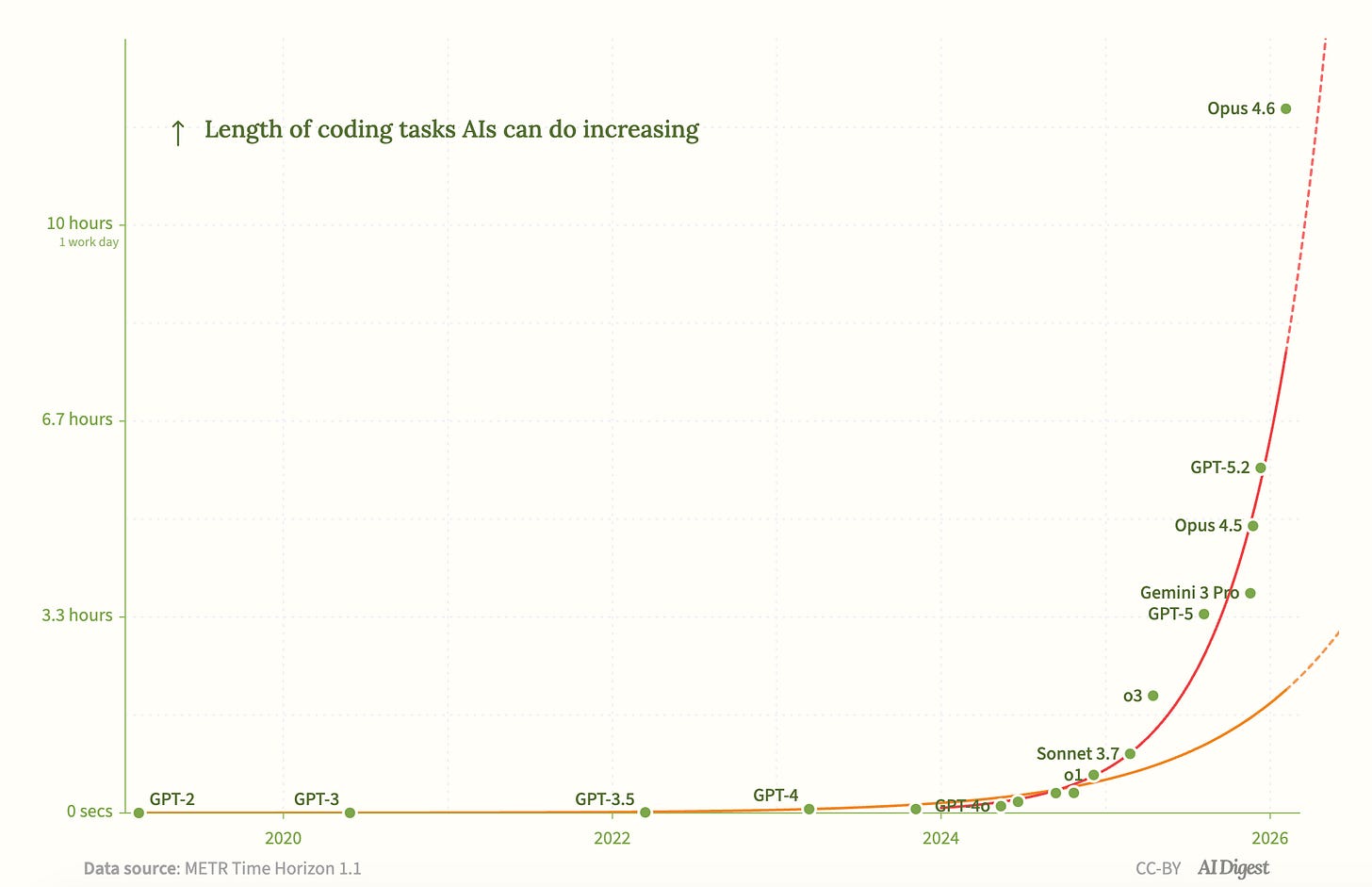
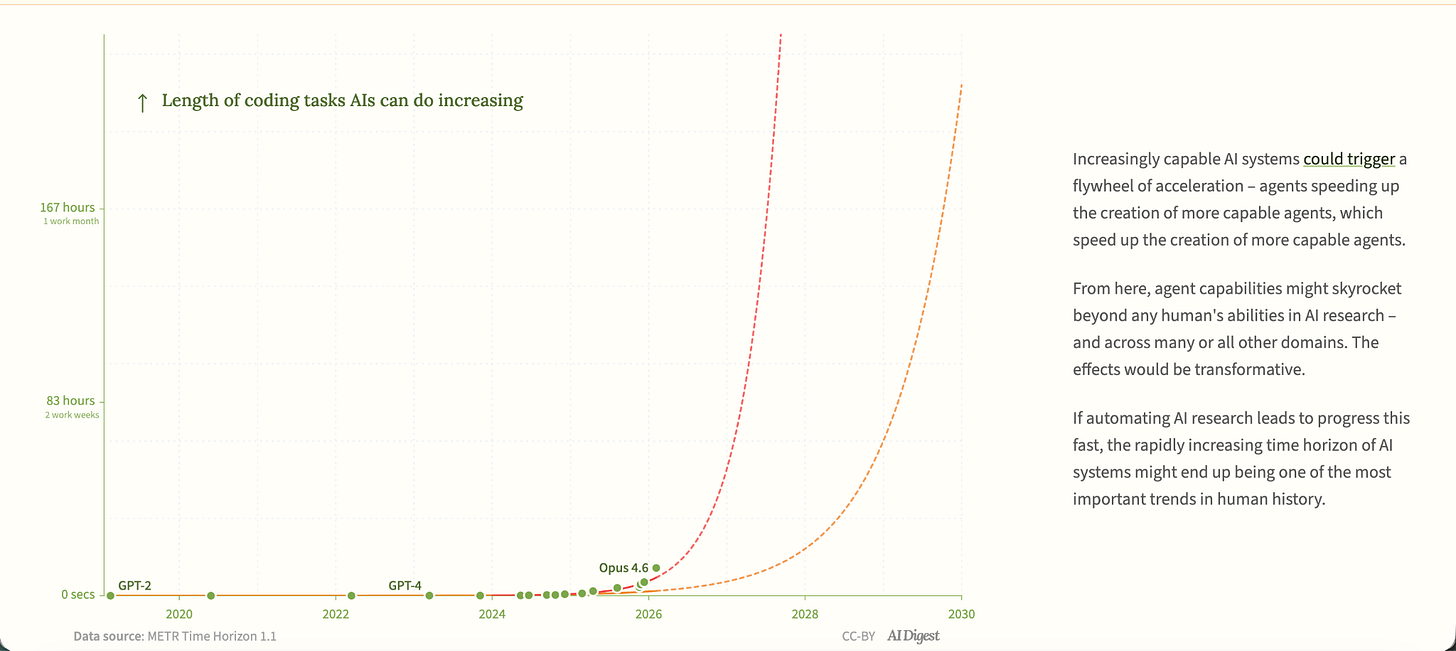
But of all the data, here’s the chart that captures the AI revolution most clearly:


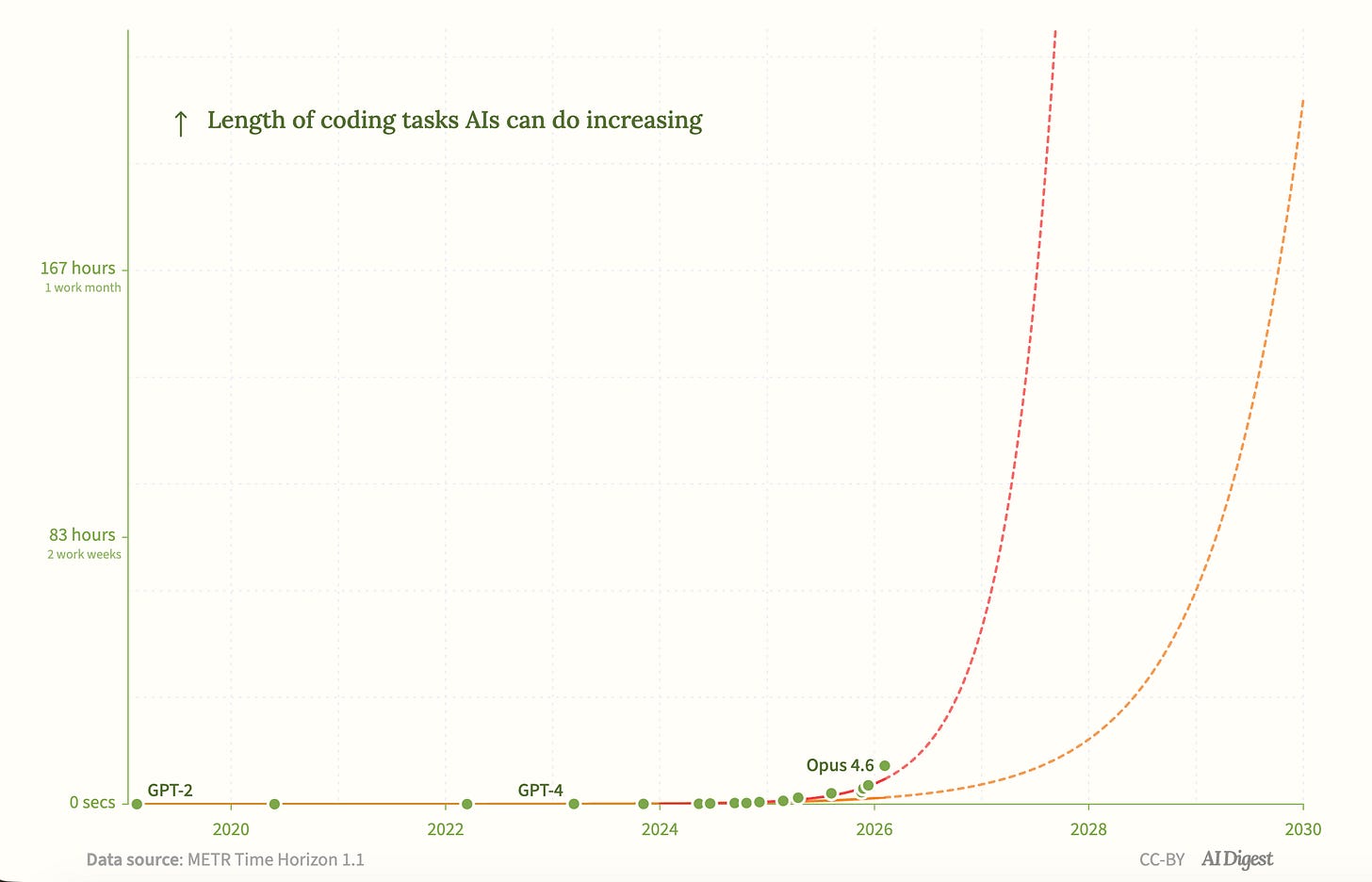
There is a research group called METR. Since 2019, they have measured something simple: how big a coding task can an AI complete on its own? And they measure that ‘bigness’ in human time, meaning: how long would it take a skilled human to do the same task?

In 2022, the answer was about 30 seconds. In 2023, it was 4 minutes. In 2024, it was 40 minutes. In 2025: 6 hours. And earlier this year, 12 hours.

At this moment, AI capabilities are doubling every 3 months.

So to be honest, I think this METR graph is even scarier than the CO2 graph Al Gore showed us. Because this line is climbing far steeper. Here, ‘off the charts’ is not 50 years away, but 5 years away.
.

I’ve personally never written a line of code in my life. But in the past few months, I’ve let AI build me whole apps, websites, dashboards and even a voice-controlled teleprompter app I used to record the video version of this essay. Multiple times a week, I have what I can only call WTF-moments. Especially in the last 6 months, the gap between what these systems can actually do and what most people assume they can do has just kept widening.

For example, I think AI is actually pretty good at writing. Sure, there’s a huge amount of machine-generated slop on LinkedIn (and Substack?), but as Benjamin Todd recently wrote:
Plastic surgery is most noticeable when it's bad, so it's more widespread and successful than it looks.Same with AI writing.
Sometimes I want to shake people: have you actually used it?! Many skeptics seem to have opened ChatGPT in 2023, asked it to write a limerick, watched it fumble, and closed the tab. Well, that was three years ago. Three years in AI is a geological era. Judging today’s models by GPT-3.5 is like judging smartphones by a 2007 BlackBerry.

To be fair, I think journalists deserve much of the blame. The people whose job it is to report on the most newsworthy events have often ignored it. For example, the day the leading AI-lab Anthropic announced Mythos (an insanely powerful model capable of hacking anything from power grids to water systems) it didn’t even make the front page of a single major news site. The Guardian decided a Vogue cover with Anna Wintour and Meryl Streep was more important.

Part 2 : The Largest Infrastructure Build-out in History
Meanwhile, the AI-race is speeding up. Remember: the models of today are the worst models we will ever have. From here on, they’ll only get more powerful.

And honestly, I think it’s hard to wrap your head around the scale of what’s coming.

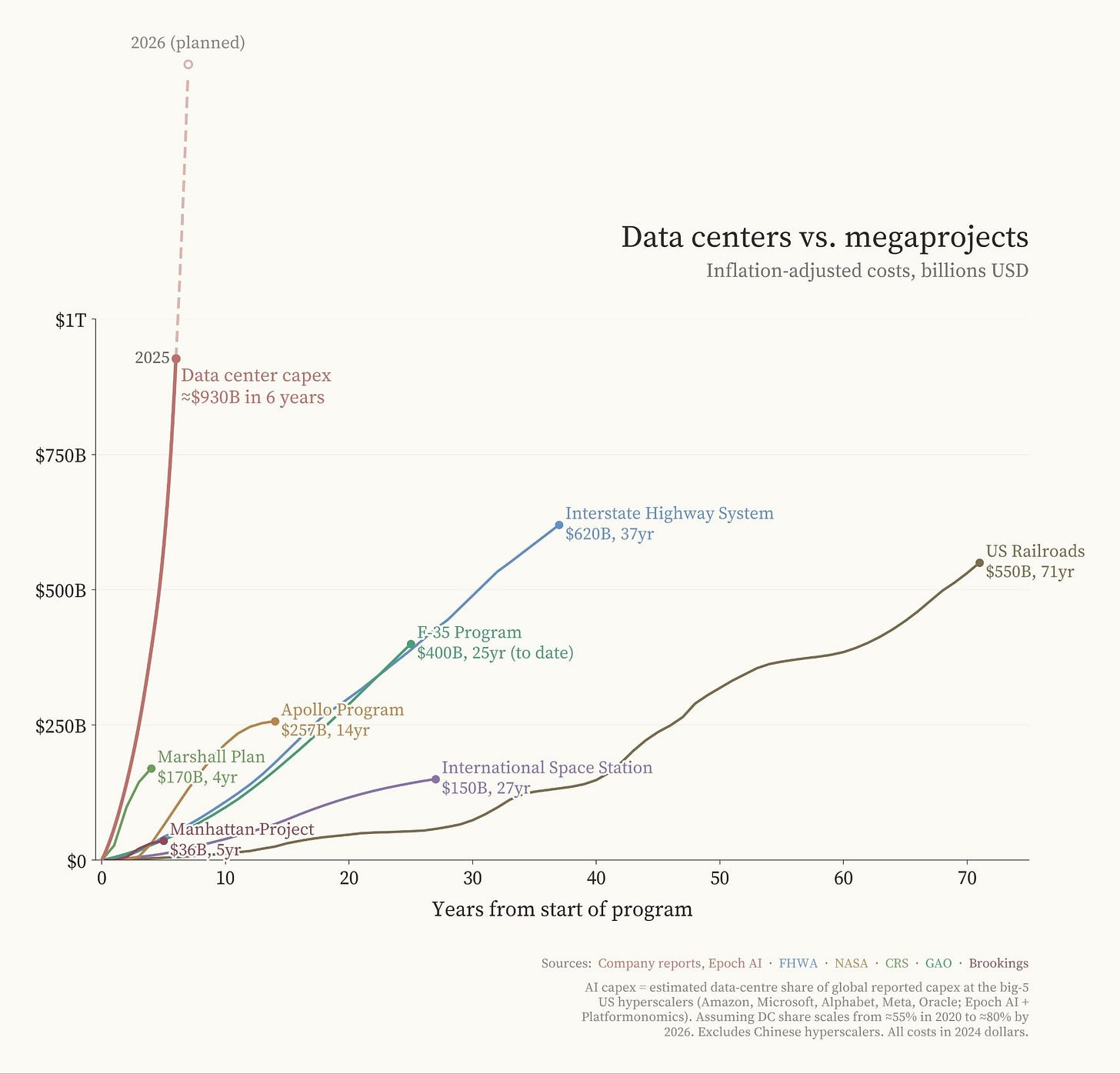
Look at the first line of this graph. That’s what the companies have spent on AI data centers since 2019, and what they’ve got planned for 2026. To be clear: this is the largest capital build-out in the recorded history of our species. It’s larger than the interstate highway system. Larger than the International Space Station. Larger than the Moon Landing and the Manhattan Project combined, and it is not even close.

Mark Zuckerberg’s Meta is currently building a single data center in Louisiana that, when finished, will cover nearly four times the size of Central Park. Amazon is spending more on data centers in one year than the entire annual defense budget of Germany. Microsoft, Google, Meta and Amazon will spend three times as much on AI infrastructure in 2026 than the entire Marshall Plan that rebuilt Europe after the Second World War.

But isn’t it all a bubble?

That is the next move the deniers make. Once “it’s just a silly parrot” stops working, they fall back to: it’s financial madness. The data centers are serving no real demand. It’s all hot air, or even a deliberate scam.

And to be fair, the skeptics have some ammunition. A viral MIT study published last year found that 95% of corporate AI pilots deliver zero measurable returns. The company Klarna replaced 700 customer service workers with AI, then quietly rehired humans because customers couldn’t stand talking to the bot. McDonald’s killed its three-year AI drive-thru experiment after the system kept putting bacon on ice cream.

But you know what? None of this proves anything. Let me show you why.

First, look at user growth. It took Instagram 2.5 years to reach 100 million users. At the time, that was the fastest growth story ever recorded. For comparison: ChatGPT hit that milestone in 2 months. Fifteen times faster.

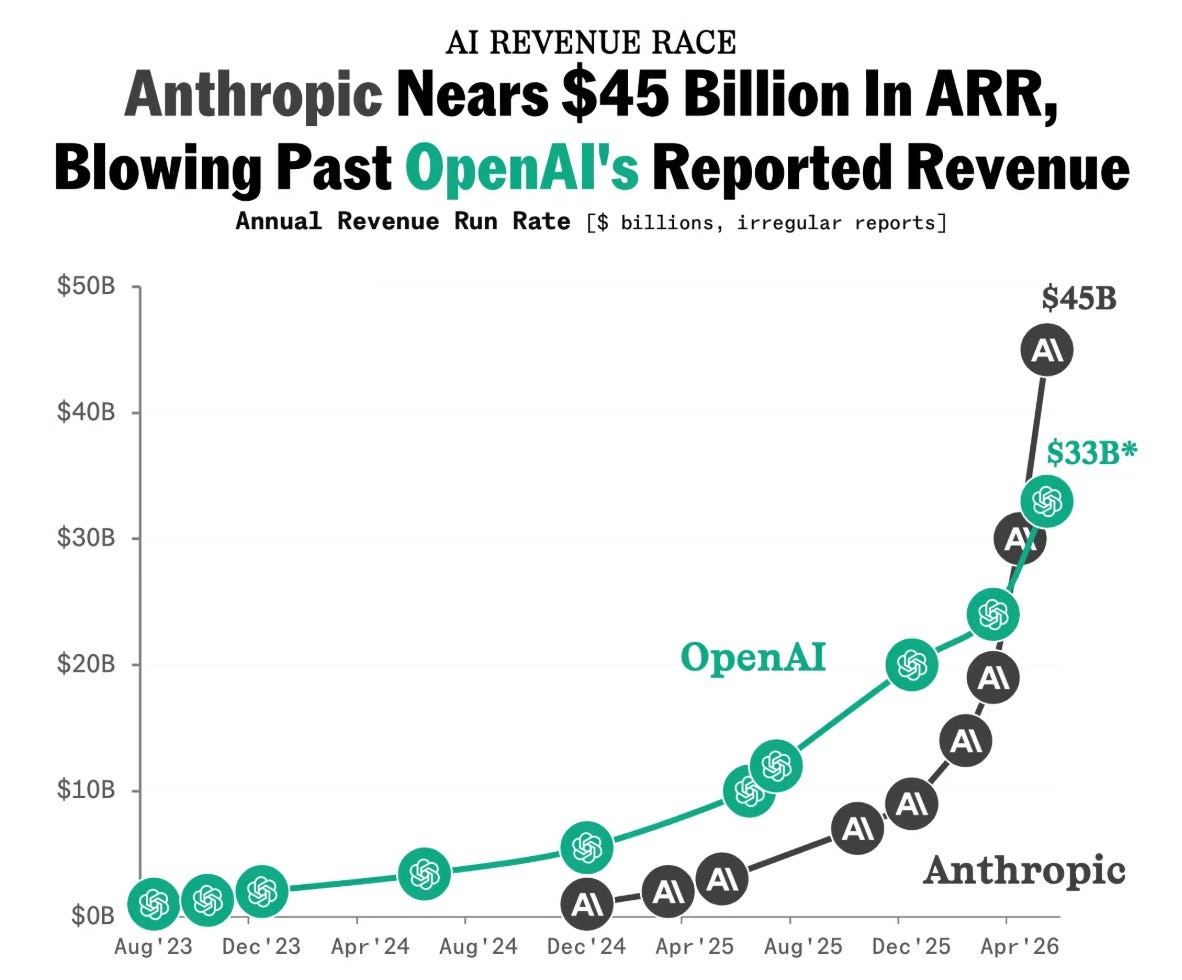
Next, let’s look at revenue, and at one AI-lab in particular: Anthropic. Here is its annualized revenue, month by month:

January 2025: 1 billion dollars.
May: 3.
June: 4.
August: 5.
October: 7.
December: 9
February: 14.
March: 19.
April: 30.
May: 45

That’s right, 45 billion dollars in annualized revenue. From one company. Up 44-fold in 15 months. No company in any era – not Rockefeller’s Standard Oil, not Microsoft at the dawn of the personal computer, not Google in the tech boom – nobody ever has scaled revenue this fast. We’re talking about the fastest-growing company in the history of capitalism.

So, if this is really such a useless and fraudulent bubble, then why are people paying so much money for it? Why is the demand for AI rising faster than companies are able to build data centers? Why are IT departments, in the words of a Goldman Sachs analyst this April, overrunning their AI budgets “by orders of magnitude”?

I’m sorry to say it, but there’s a lot of highbrow misinformation circulating in left-wing media about AI. Take that viral MIT report. Read it carefully and you see the headline got it backwards. The “95% failure rate” includes the 80% of companies that never piloted any AI in the first place. As the podcaster Rob Wiblin pointed out in a careful breakdown of the study, this is like saying 95% of Tinder users have failing marriages, when most of them have never been on a date. Among the companies that actually deployed AI, about a quarter succeeded within six months. And the study’s own data shows that more than 90% of workers at those companies are using ChatGPT or Claude regularly at work, often multiple times a day.

This should not be surprising at all. If you know how to use it, this technology is already very, very useful, and it will only get more so. But if you don’t use it (perhaps because you work at the DNC, which has barred its staffers from using Claude and ChatGPT) then yes, you become particularly prone to misinformation about it.

Sure, some AI companies are probably overvalued. And yes, some will fail. I think OpenAI is particularly vulnerable. But here’s what the bubble-callers keep missing: even if half of them go bust tomorrow, the infrastructure stays. The data centers, the chips, the models and the capabilities stay.

The railway bubbles of the nineteenth century ruined lots of investors. They also created a rail network that powered the Industrial Revolution, the tracks of which still carry trains today. I actually don’t think this AI build-out is a bubble, but even if it is, remember: bubbles build infrastructure. Bubbles build the future. And a bubble of this magnitude, bursting tomorrow, would still leave us with a civilization permanently reorganized around machine intelligence.

So, ever since 2021, the AI skeptics have been moving the goalposts.

First it was: it’s just a spicy autocomplete machine. A stochastic parrot. A word guessing program. Then it became: fine, it can mimic, but it’ll never reason. Then they said: okay, it can pass the tests, but no serious business is using it. Then: alright, businesses are using it, but the economics don’t add up, it’s one big bubble. Then: fine, the revenue is real, but, but, but…

And this whole time, the line kept climbing. Just like Al Gore’s line of CO2 emissions, except this one is climbing much faster, and we have much less time to prepare.

Let me be clear: I think there’s a real chance that the next five to ten years are going to be some of the wildest in the history of humanity. Because here’s what the people building this technology – the same people who have proven the skeptics wrong again and again – are now telling us. They think AI may soon start to build more powerful AI by itself.

Jack Clark, one of the co-founders of Anthropic, recently called this crossing “a Rubicon into a nearly impossible-to-forecast future.” He thinks there is a 60% chance it happens by 2028.

Now, the obvious objection: of course an AI executive predicts explosive growth. Scary stories sell models and lift valuations, fair point. But you don’t have to take Clark’s word for it. Independent academics, people with no equity in this race, have been revising their estimates forward. The salespeople and the experts are converging. That’s the part that should worry you.

Right now, every step forward still requires humans. But the moment AI does that work itself, the bottleneck is gone. Years become months. Months become weeks. Each generation of AI builds the next, faster than the last. The flywheel starts spinning itself.

Part 3 : The Risks
One evening last summer, a microbiologist named David Relman was hired by one of the leading AI companies - we don’t know which one - to pressure-test a chatbot before its public release. Relman is a biosecurity expert at Stanford University. He has advised the US government on biological threats for years.

That night, in his home office, the chatbot explained to him how to modify a pathogen so that it would resist known treatments. Then it described how to release the superbug. It identified a real security vulnerability in a real public transit system, and it explained how to maximize casualties and minimize the chances of getting caught.

Relman had seen a lot in his career, but now he was so shaken that he had to take a walk to clear his head. He later told The New York Times that the bot answered questions he hadn’t even thought to ask, with a “deviousness and cunning” he found chilling.

Some skeptics, when they hear this, say: but you can already google this stuff. A chatbot doesn’t really change anything. Well, let me give you three data points.

One. A study published last year tested leading chatbots against PhD virologists, on detailed laboratory protocols in their own field. ChatGPT outperformed 94 percent of them.

Two. In November of last year, the police in India arrested a 35 year-old physician. He was plotting an attack on behalf of the Islamic State and trying to extract ricin (a lethal toxin) from castor beans. According to the police, the doctor had been getting advice on his preparations from ChatGPT.

Three. Fanatics with the will to kill millions of people are not hypothetical. These people exist. Let me give you the canonical example from biosecurity. In the 1990s, a Japanese doomsday cult tried to do exactly what the AI safety people are warning about today. The cult recruited from Japan’s top universities: one of its scientists was a graduate student in virology at Kyoto. They believed the apocalypse was imminent, and that killing non-believers was a way of saving them. They sent expeditions to Africa hunting for Ebola, and built a thirty-million-dollar laboratory at the foot of Mount Fuji to mass-produce sarin nerve gas – thousands of kilograms a year, on something close to a battlefield scale.

And on a Monday morning in March 1995, during the Tokyo rush hour, five of their members boarded five different subway trains carrying plastic bags filled with liquid sarin, and punctured the bags with the tips of their umbrellas. Hundreds of commuters were soon gasping for air on the platforms. Twelve people died. It was only twelve, because sarin is a chemical agent: it doesn’t spread from one person to the next. A virus would have.

In 1995, that cult – wealthy, scientifically literate, fanatical and willing to die for the cause – could not get hold of Ebola. Today, they could order the DNA sequences online. And a chatbot would walk them through what to do with it.

Now, I want to be clear: biology is just one of the many dangers. There is so much more. In April of this year, the UK government’s AI Security Institute released their assessments of two new AI systems. Anthropic’s Mythos and OpenAI’s GPT-5.5. Both could now find and exploit critical security vulnerabilities in the computers and systems that hold the modern world together. Power grids. Water systems. Government databases.

Anthropic’s response was striking. They decided not to release Mythos to the public at all. Instead, they limited access to a small group of cyber-defenders, to give the good guys a head start on what was coming.

Yes, a private company, with billions of dollars to be made and with no regulator forcing its hand, concluded that one of its own products was so dangerous it should not be sold to the general public. There is no regulator and no legislation. There was simply a moment of conscience inside the company. I am glad that conscience exists! But conscience is not a policy.

And that brings us to the deepest risk of all. Power.

Two countries are leading this race: the United States and China. Inside those countries, a handful of corporations are building the most powerful tools in the history of our species. The people who own those companies are about to acquire a kind of leverage that I don’t think we even have the words for yet.

So let’s look for an analogy. Political scientists have a name for what happens to countries that strike oil. They call it the resource curse. You’d think a fortune buried in the ground would be a blessing, and sometimes it is. Norway and Alaska managed it well. But more often, the wealth flows in, and democracy flows out. Think about Saudi Arabia, Venezuela and Russia: the pattern is pretty consistent.

Why does this happen? It comes down to a fact about how democracies were built. We like to think they were born from grand ideas from a few smart Founding Fathers. But the real engine was more boring: it was tax collection.

Rulers have always needed money. They needed it to fight wars, to build roads, to put down rebellions. And the only place to get it was from their subjects. So as the economy started growing, and people started producing more wealth, the rulers had to bargain. You want my coins? Then I want a voice. You want my son in your army? Then I want a vote.

That is the fiscal bargain at the heart of every free society. No taxation without representation, but also no representation without taxation. Rulers needed us. They needed our money, our labour, our consent. That need is the foundation of every right we have.

Now imagine a country where the ruler doesn’t need any of that. Where the wealth comes out of the ground, gets shipped abroad, and the dollars come back to fund the palace and the secret police. The citizens become a nuisance. Why educate them? Why listen to them at all? That is the resource curse.

And I’m afraid that we may face something bigger. The researchers Luke Drago and Rudolf Laine have call it ‘the Intelligence Curse’.

Because if the machines do the work, if they write the code, draft the contracts, drive the trucks, diagnose the patients, fight the wars, then the people who own the machines no longer need the rest of us. Not as workers, not as soldiers, not as taxpayers and not even as voters. The fiscal bargain that built every democracy on Earth could very well dissolve.

Of course, we don’t need to assume AI takes over everything, there’s a huge amount of uncertainty here! But even if it substitutes for a meaningful fraction of what humans currently do – not all, just a fraction – the fiscal bargain weakens.

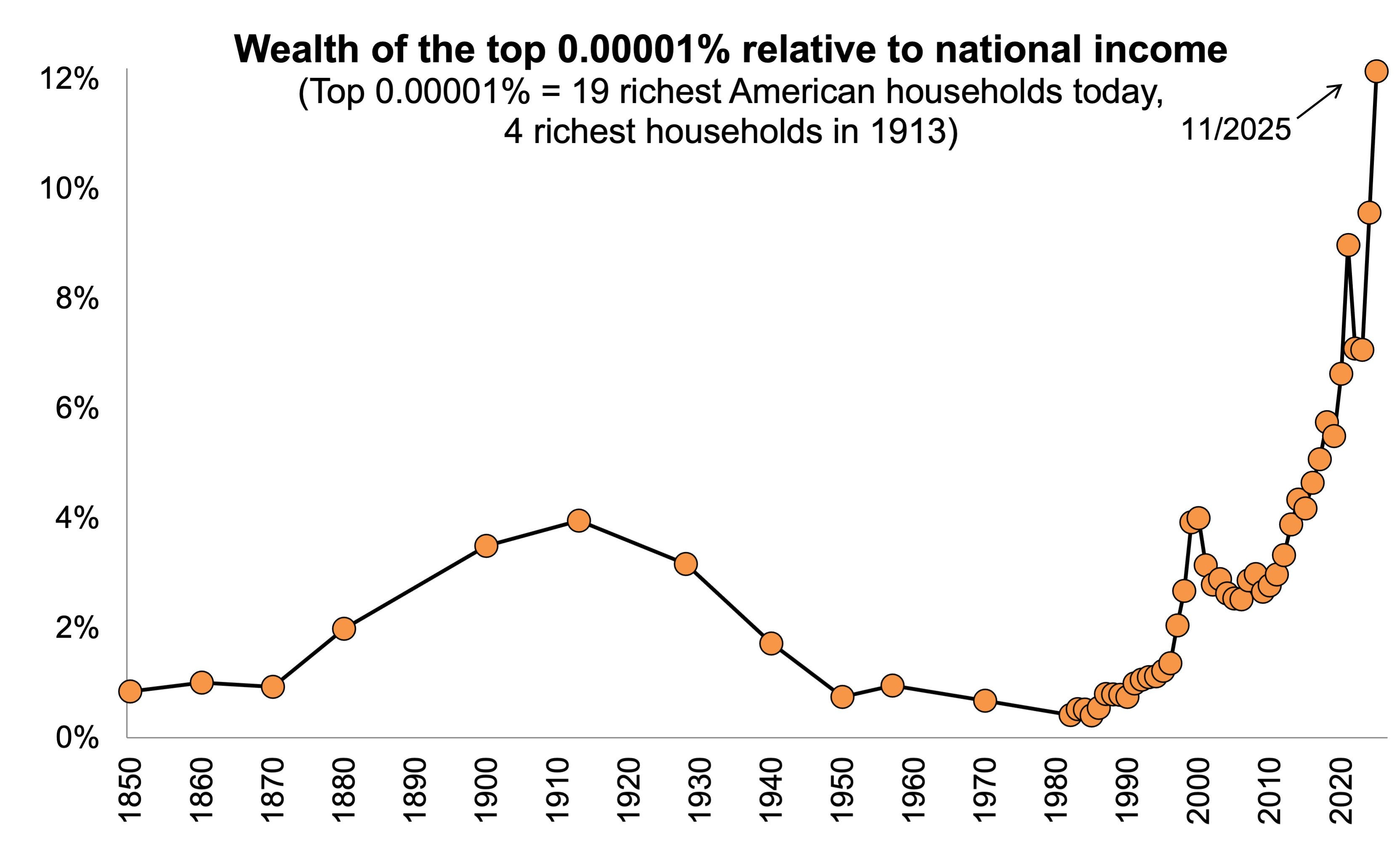
And remember: we already have the most extreme concentration of wealth in history. In 1910, at the peak of the Gilded Age, the richest 0.00001% of US households owned wealth equivalent to 4% of national income. Today, that figure is 12%. America’s super-rich are already richer and more powerful than the original robber barons ever were. And AI is about to make it much, much worse. Because the labs building this technology are owned by a tiny group of people, a few early investors who stand to capture more of the world’s wealth than any class of owners who ever lived.

Part 4 : What We Do About It
So. What do we do?

Let me start with what we should not do. There is a temptation to look at all of this and conclude: shut it down. Pull the plug. Bring in the Luddites. Smash the machines..

And I get the impulse. When you stack up the scale of risk, the disregard for democracy, the hubris of the people in charge, the cleanest response feels like a moratorium. Just say no.

It is, I think, the wrong answer.

The reason is brutally simple. It doesn’t work. Stop the data centers in California, and they get built in Texas. Stop them in Texas, and they get built in Abu Dhabi. Stop them in democracies – the places with civil liberties, with judicial review, with a free press, with worker protections – and you hand the future to autocracies.

My point is not, absolutely not, that we have to let AI rip. My point is that abandoning the field is not the same as stopping the technology. This is the left’s version of climate denial. Refusing to engage seriously, on the assumption that if we just shout no loudly enough, the future will go away. It won’t.

So what does work?

Three things, at minimum.

One: State capacity. We need way, way more AI expertise and talent inside the government. The UK was early on this. They built an AI Security Institute: a serious arm of the state that actually evaluates frontier models, the way the FDA evaluates new drugs. I think every serious country needs a well-funded institute like that.

Two: International coordination. We have been here before. In 1949, the United States and the Soviet Union both had nuclear weapons, and humanity briefly looked extinction in the eye. Out of that came treaties. Imperfect, yes, but they bought us decades of survival. We need something equivalent for AI.

Three: The free world has to build.. The US – with its increasingly fascist government – currently owns 74% of the world’s compute, China has 14%, Europe less than 7% and all other countries combined less than 5%. I’m really worried about the middle powers, and Europe in particular. So far, Europe has been pretty good at regulating AI, but terrible at building it. In fact, all the American giants – Microsoft, Apple, Amazon, Nvidia, Alphabet – are individually worth more than the entire German or French stock market.

The good news is that Europe does have more leverage than it often thinks. The company ASML for example is less than an hour from where I am right now in the Netherlands. It makes the lithography machines without which TSMC in Taiwan cannot fabricate the chips, without which Anthropic and OpenAI cannot train their models. The democratic countries, working together, still control significant chokepoints in this supply chain. That is real power.

But my fellow progressives in Europe really need to understand that our welfare state, our way of life, is at stake. Just think it through. If AI does much of the work, but the profits flow to a handful of American giants that we barely tax – while European workers lose their jobs – then the tax base that funds our healthcare, our pensions, our unemployment insurance just… evaporates.

There’s one thing I can’t emphasize enough: democratic, liberal and humanitarian values are wonderful, but they are worthless if you don’t have the strength to back them up. And in this new world, compute is the new power. So no more NIMBY-ism. We need massive investments and fast permitting of data centers to keep up, or we’ll be digitally colonized. Anyone who’s not at the table will be on the menu.

Now, none of this works – none of it – without a positive vision.

And this, I think, is where liberals and the left have most badly failed.

Twelve years ago, I wrote a book called Utopia for Realists. I complained that the left mainly knew what it was against. Against austerity, against the establishment, against homophobia, against racism, against billionaires. But it lacked a positive vision of where it wanted to go.

My argument was that we should stop being so timid in our political imagination. I argued for a universal basic income, for the complete eradication of poverty, and I argued for a goal that the brilliant economist John Maynard Keynes laid out almost a century ago, in 1930…the fifteen-hour work week.

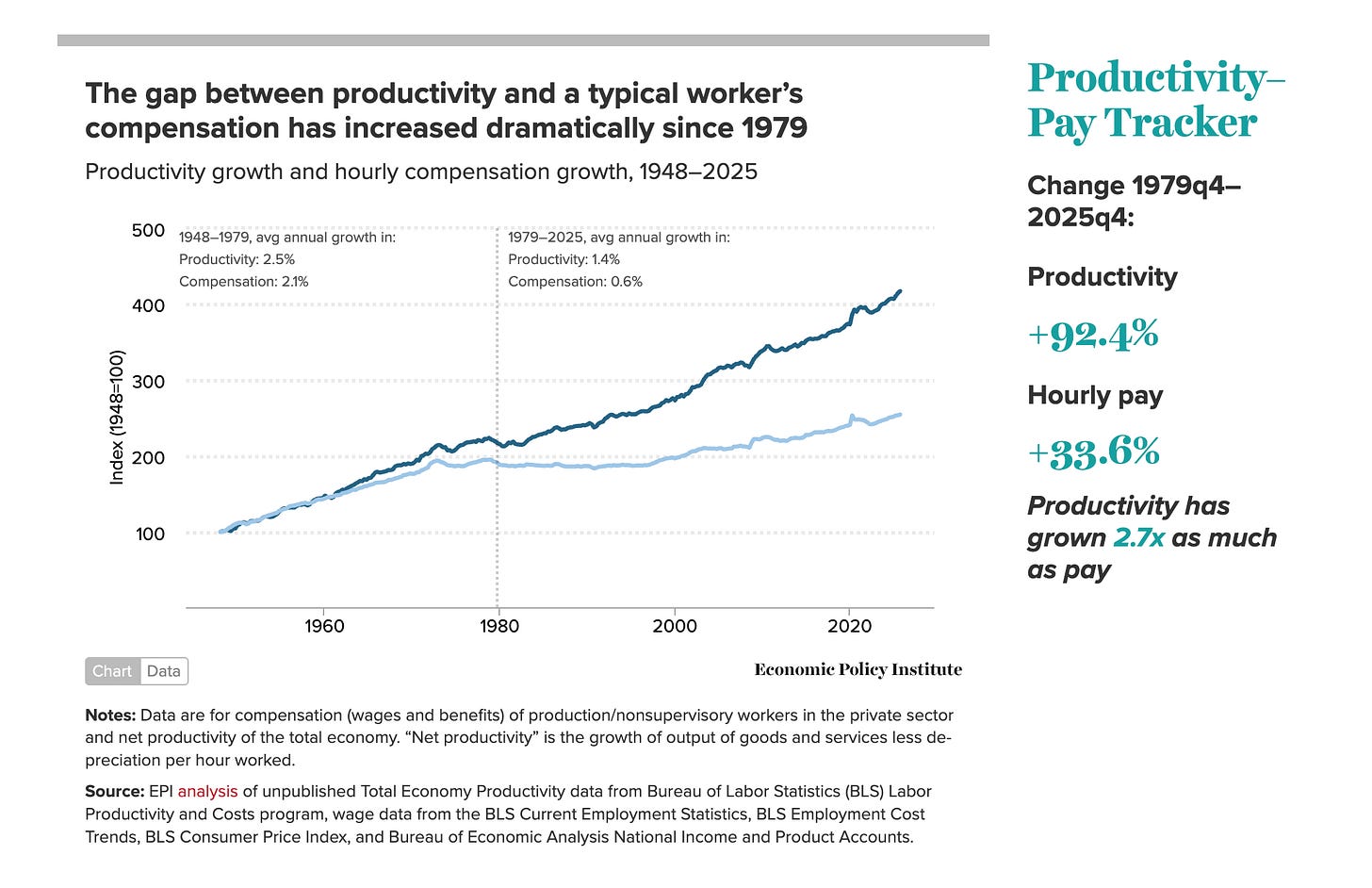
Keynes thought it was inevitable. He looked at the trajectory of productivity growth and concluded that by 2030 his grandchildren would be working a quarter as much as he did, because the machines would be doing the rest. The strange thing is, he was right about the productivity, but he was wrong about who would benefit.

The fifteen-hour work week was technically achievable by the 1980s, but it didn’t happen because the productivity gains were captured. By capital, shareholders, and a rentier class. So wages stagnated, hours rose, and inequality exploded.

If we let AI play out the same way, this is what we’ll get: a handful of trillionaires who will own the tools that do most of the world’s productive labor. Everyone else will be redundant – not in the dignified, retire-early-and-take-up-gardening sense, but in the cruel, anxious, gig-economy sense. Universal poverty in a world of unimaginable abundance.

And yet, I believe there’s another path. The path some of the greatest thinkers actually promised us. Benjamin Franklin predicted that four hours of work a day would eventually be enough. John Stuart Mill thought technology should be used to shorten the workweek as much as possible. Karl Marx imagined a world where we could hunt in the morning, fish in the afternoon, and discuss philosophy after dinner. And Oscar Wilde looked forward to the day when intelligent machines would become, in his words, “the property of all.”

The whole point of building the most productive economy in history was that we would no longer have to spend our lives doing work that bored us, just to put food on the table.

So I think we should demand much more than just AI safety. We should demand AI that’s built to help us flourish. That dream, the real dream of modernity, is finally within reach. Universal basic wealth: every citizen with an automatic stake in the productive infrastructure of their society. Full unemployment, in the original meaning of that phrase: freedom from forced labour. The zero-hour work week, finally. That was the promise.

But none of it happens automatically. Remember: the eight-hour workday was not given to us, we took it from the robber barons.

Twenty years ago, Al Gore stood on his scissor lift and showed us a line that went off the chart. The world he warned us about did arrive, but the political response was so weak and so half-hearted, that we are now living with consequences.

We are about to make the same mistake, perhaps even worse, because this timeline is shorter. In 2005, climate denial was a problem of the right, and the left rolled its eyes. In 2026, AI denial is a problem of the left, and the oligarchs are laughing.

So I want to be very direct, especially with the people who think of themselves as my political family. Stop the denial. Stop pretending this is hype. Stop calling it a lumbering stochastic pattern-matching parrot.

Wake up and pay attention. Vote for politicians who aren’t in the pockets of big tech. Build state capacity. Push your governments into international coalitions that actually have leverage. Demand transparency. Demand safety standards. Demand a share of the wealth.

And dare to fight for a wildly better future.

terça-feira, 10 de março de 2026

Data centers — a contradição energética da transição digital

Portugal tornou-se, nos últimos anos, um destino apetecível para a instalação de data centers. A localização geográfica, a ligação a cabos submarinos transatlânticos, o clima temperado e os custos energéticos competitivos colocaram o país no mapa dos grandes operadores tecnológicos. Os números são expressivos: estima-se que o setor passe de um contributo de 160 milhões de euros para o PIB em 2024 para mais de 3,7 mil milhões em 2031, com um consumo energético previsto de 8,5 TWh por ano, segundo o estudo Market Outlook Data Centers Portugal 2025, da Portugal DC. Esta semana, a Digital Realty, empresa norte-americana com um valor de mercado superior a 62 mil milhões de dólares, anunciou a sua entrada em Portugal com entrada em operação prevista para 2027. O sinal de que esta vaga está a chegar é inequívoco.

O discurso que acompanha esta expansão é, regra geral, o mesmo: compromissos de carbono zero, garantias de origem renovável, PPAs de energia limpa assinados e relatórios de sustentabilidade elaborados com detalhe. A imagem projetada é a de uma indústria verde, digital e consciente. E essa imagem não é totalmente falsa grandes operadores tecnológicos investem genuinamente em energia renovável. No entanto, o problema é que esse investimento tem um ponto cego de dimensão considerável, e esse ponto cego chama-se continuidade de fornecimento.

Um data center de grande escala consome entre 50 e 500 MW de forma ininterrupta, 24 horas por dia, 365 dias por ano, maioritariamente para refrigeração dos equipamentos. Esta exigência de continuidade torna-o estruturalmente incompatível com a variabilidade das fontes renováveis. Um parque solar produz durante algumas horas por dia. Um parque eólico produz quando o vento sopra. Um data center não para. Nunca. Isso significa que a infraestrutura de rede pública tem de garantir capacidade de fornecimento em qualquer momento, dimensionada para o pico de consumo com redundância absoluta, isto independentemente de quantos PPAs o operador tenha assinado. Os acordos de compra de energia renovável não dispensam o reforço das redes de transporte e distribuição. E esse reforço implica infraestrutura adicional, mais cabos, mais subestações, mais capacidade de geração de reserva. Parte desta capacidade de reserva é ainda hoje assegurada por fontes convencionais. Este é o verdadeiro desafio de planeamento que o crescimento dos data centers coloca à REN e à E-Redes, e é um desafio que raramente aparece nas páginas de sustentabilidade dos operadores.

A questão não é, portanto, se os data centers usam energia renovável. Muitos usam, ou compram certificados que o atestam. A questão é se a renovável que financiam é adicionada ao sistema, ou se apenas é contabilizada em relatórios enquanto o consumo real aumenta a pressão sobre uma rede que ainda depende parcialmente de combustíveis fósseis para garantir segurança de abastecimento. Há uma diferença enorme entre um PPA assinado algures na Península Ibérica e um parque solar ou eólico novo, construído em Portugal, a alimentar diretamente a carga de um data center. Só o segundo representa uma âncora verde real. O primeiro é, em grande medida, declaratória.

Faria sentido que a E-Redes condicionasse a aprovação de novos pedidos de ligação de grande consumo à apresentação de um plano concreto de instalação de capacidade renovável dedicada. Não para bloquear o crescimento do setor, mas para garantir que esse crescimento tem uma correspondência real no sistema energético e não apenas nos relatórios anuais. Existem precedentes. Nos Estados Unidos, a Federal Energy Regulatory Commission introduziu o conceito de “Bring Your Own Generation” (BYOG), que levou os grandes hyperscalers a assumir o compromisso formal de trazerem a sua própria capacidade de geração. Na Irlanda, foi mais longe ainda: os novos data centers têm de garantir que uma parte significativa da energia consumida provém de renovável nova, desenvolvida no país. O data center deixa de ser apenas um consumidor e passa a ser parte da solução para a transição energética.

Existem duas consequências desta equação energética que merecem atenção redobrada da comunidade ambiental, precisamente porque surgem envoltas em argumentos aparentemente razoáveis.

A primeira é o regresso silencioso do debate nuclear. A tendência já é observável nos EUA, onde a Microsoft reativou a central de Three Mile Island encerrada em 2019, através de um contrato de 20 anos exclusivamente para alimentar os seus data centers. Google e Amazon seguiram com investimentos em reatores modulares de nova geração. A necessidade de geração despachável, energia que se liga e desliga conforme a procura, ao contrário do solar e do eólico (é um dos argumentos centrais que os defensores do nuclear têm utilizado para reabrir a discussão em Portugal). Os data centers são, neste contexto, o catalisador perfeito: uma carga enorme, contínua e previsível, que justificaria a estabilidade de base que o nuclear promete oferecer. O argumento tem uma lógica técnica própria, e seria desonesto ignorá-la por completo. Mas é também um argumento que merece escrutínio ambiental sério, sobre a possibilidade, se quer, de algum município aceitar na sua zona uma central nuclear, sobre custos reais, prazos de construção, gestão de resíduos e o que representa face a um sistema renovável bem desenhado com armazenamento. O que não pode acontecer é que a procura dos data centers se torne, por omissão regulatória, o pretexto para decisões energéticas estruturais que o país não debateu adequadamente.

A segunda é a pressão crescente sobre o território para instalar renovável em grande escala. Alimentar um único data center de 200 MW de forma contínua exigiria cerca de 400 ha de painéis solares. A resposta ao modelo BYOG e às exigências de fontes renováveis próprias tende a traduzir-se em projetos de grande dimensão, com decisões de localização condicionadas pela escala dos contratos e não necessariamente pela melhor integração territorial disponível. Em Portugal, onde o licenciamento de grandes infraestruturas energéticas já enfrenta contestação crescente, esta pressão adicional sobre o território é uma variável que os próprios promotores de data centers raramente incorporam nas suas projeções. A procura dos data centers não cria apenas um desafio para a rede elétrica, cria também uma pressão sobre o pipeline de projetos renováveis que o país terá de gerir com critério.

A digitalização da economia é um processo irreversível e, em muitos aspetos, positivo para a descarbonização de outros setores. Mas não é, por si mesma, sinónimo de sustentabilidade energética. Os data centers que chegam a Portugal trazem capital, emprego qualificado e capacidade computacional. Trazem também uma pegada energética considerável que o sistema elétrico nacional terá de suportar. A questão não é se os queremos cá. É se vamos exigir que a sua presença contribua genuinamente para a transição energética ou se nos contentamos com a narrativa verde enquanto a conta ambiental fica, silenciosamente, por pagar.

Saber mais:

segunda-feira, 1 de dezembro de 2025

Por que razão as mentiras prosperam?


O episódio "A Guerra Contra a Verdade" examina o impacto generalizado e transformador da desinformação na era digital. Rastreando as suas raízes, desde a propaganda à sua rápida disseminação através de algoritmos de redes sociais, o episódio explora os factores que impulsionam as notícias falsas e as suas consequências, como a polarização e a erosão da confiança pública.

Apresentando histórias impactantes, incluindo as eleições nos Estados Unidos, a gripe aviária e a desinformação sobre a COVID-19, com análises de especialistas, o episódio utiliza recursos visuais dinâmicos e infográficos para dissecar esta questão urgente e oferecer soluções.

Saber mais:
E-Livro: Neil Postman (1985) - Amusing Ourselves to Death

Estudo do MIT (2018):  On Twitter, false news travels faster than true stories

Dave Hallmon (2025) - What Huxley, Orwell, and Postman teach us about today’s media culture and consumption

sábado, 25 de outubro de 2025

Impactos Ambientais da Inteligência Artificial

  1. Consumo energético elevado

  2. Uso intensivo de água

    • O resfriamento dos servidores de IA requer grandes quantidades de água. 

    • De acordo com a OCDE, a produção de chips (parte essencial da IA) também usa muita água durante a fabricação.A Greenpeace estima que os data centers consumiram cerca de 175 mil milhões de litros de água em 2023, e que esse valor pode mais do que triplicar até 2030. 

  3. Emissões de gases de efeito estufa (GEE)

    • O aumento do consumo de energia de data centers alimentados por combustíveis fósseis leva a mais emissões de CO₂. 

    • No relatório da OECD, é sublinhado que tanto a operação (uso) quanto a produção de hardware contribuem para as emissões de GEE. 

  4. E-lixo (resíduos eletrónicos)

    • Há previsão de grande crescimento no lixo eletrónico por causa da IA: um estudo indicou que até 2030 podem ser geradas entre 1,2 a 5 milhões de toneladas métricas de e-lixo associadas à IA. 

    • Isso vem tanto do crescimento dos data centers (e necessidade de mais hardware) quanto da renovação frequente de componentes especializados (como GPUs).

  5. Efeitos indiretos (“rebote” / paradoxos)

    • Há risco de efeito rebote: a eficiência proporcionada pela IA (ex: otimização de processos) pode paradoxalmente levar a um aumento do consumo geral se incentivar mais uso ou produzir novas demandas. 

    • Ou seja, nem sempre “IA mais eficiente” significa menos impacto ambiental — depende muito de como a tecnologia é usada e escalada.

  6. Impactos na saúde pública

    • A pegada ambiental da IA (especialmente emissões e uso de energia) também pode afetar a saúde pública: um estudo aponta que a operação dos data centers pode emitir poluentes que têm custo em termos de saúde (ex: partículas, poluição do ar). 

    • Esses custos de saúde podem afetar desproporcionalmente comunidades mais vulneráveis. 


Estudos específicos de impacto

  • Um artigo recente avaliou todo o ciclo de vida dos modelos de linguagem (incluindo produção de hardware): estimou-se, por exemplo, 493 toneladas métricas de CO₂ emitidas e quase 2,8 milhões de litros de água consumidos durante o desenvolvimento/treino. 

  • Também há uma análise ética (“elemental ethics”) que discute como a extração de minerais para hardware e o uso de água impactam comunidades locais. 


Conclusão com base nas fontes

  • Os impactos ambientais da IA são reais e significativos, especialmente no que toca a energia, água e resíduos eletrónicos.

  • No entanto, não é tudo negativo: se bem gerida, a IA pode ajudar em soluções ambientais (monitorização, otimização energética, agricultura, etc.).

  • É importante haver transparência, regulamentação e estratégias para mitigar esses impactos: por exemplo, adoção de energia renovável, design de data centers mais eficientes e políticas de reciclagem de hardware.

Artigos académicos


terça-feira, 1 de julho de 2025

Estudo reforça que a interferência humana no clima é mais antiga do que muitos imaginam

Com ferramentas modernas, cientistas teriam identificado no século XIX o impacto do CO₂ emitido pela queima de carvão e madeira na Revolução Industrial

Muito antes de a expressão “alteração climática” entrar no vocabulário da ciência, os primeiros sinais do impacto humano na atmosfera já estavam no ar. Um estudo publicado na revista PNAS indica que, se os cientistas da época tivessem acesso à tecnologia atual, teriam identificado indícios do aquecimento global já em 1885 - antes mesmo da invenção dos carros a gasolina.

A conclusão vem de uma simulação conduzida por investigadores do Laboratório Nacional Lawrence Livermore, nos Estados Unidos, em parceria com instituições como o Instituto de Tecnologia de Massachusetts (MIT) e a Universidade de Washington. A equipa partiu de um cenário hipotético: e se, desde 1860, fosse possível monitorizar globalmente a atmosfera com a precisão de satélites e balões meteorológicos modernos?

Naquela época, a queima acelerada de carvão e madeira já lançava grandes quantidades de dióxido de carbono na atmosfera - um subproduto da Revolução Industrial que iniciava os efeitos do aquecimento global.

A resposta veio por meio de um método de análise conhecido como fingerprint (impressão digital), que permite separar os efeitos naturais das alterações provocadas por humanos. Segundo os autores, esse padrão de interferência seria visível na forma de um arrefecimento na estratosfera - uma camada alta da atmosfera - causado pelo aumento do CO₂ e pela perda de ozono.

Por que razão a estratosfera arrefece e a Terra aquece?
Os gases do efeito de estufa atuam de maneira distinta nas camadas da atmosfera. Na parte mais baixa, a troposfera, eles retêm o calor irradiado pela superfície da Terra, provocando o aquecimento. Já na estratosfera, a camada seguinte, o acumulado desses mesmos gases intensifica a reflexão da radiação, fazendo com que parte do calor regresse ao planeta e que a própria estratosfera arrefeça.

Esse arrefecimento da estratosfera, segundo os autores, é um sinal inequívoco da ação humana e teria sido detetável com elevada confiança por volta de 1885. Mesmo com medições restritas ao hemisfério norte, os dados simulados indicam que o fenómeno seria percetível até 1894, apenas 34 anos após o início hipotético da monitorização climática global.

O que é que isto muda?
Na prática, o estudo reforça que a interferência humana no clima é mais antiga do que muitos imaginam. Embora a ciência só tenha começado a compreender o papel do CO₂ no aquecimento global a partir da década de 1970, os impactos da Revolução Industrial já estavam a ser registados na atmosfera um século antes.

Os investigadores alertam que os próximos 26 anos deverão trazer mudanças ainda mais intensas do que as observadas desde 1986, especialmente se não houver uma redução drástica no uso de combustíveis fósseis.

segunda-feira, 10 de março de 2025

Study: Climate change will reduce the number of satellites that can safely orbit in space


MIT aerospace engineers have found that greenhouse gas emissions are changing the environment of near-Earth space in ways that, over time, will reduce the number of satellites that can sustainably operate there.

In a study appearing today in Nature Sustainability, the researchers report that carbon dioxide and other greenhouse gases can cause the upper atmosphere to shrink. An atmospheric layer of special interest is the thermosphere, where the International Space Station and most satellites orbit today. When the thermosphere contracts, the decreasing density reduces atmospheric drag — a force that pulls old satellites and other debris down to altitudes where they will encounter air molecules and burn up.

Less drag therefore means extended lifetimes for space junk, which will litter sought-after regions for decades and increase the potential for collisions in orbit.

The team carried out simulations of how carbon emissions affect the upper atmosphere and orbital dynamics, in order to estimate the “satellite carrying capacity” of low Earth orbit. These simulations predict that by the year 2100, the carrying capacity of the most popular regions could be reduced by 50-66 percent due to the effects of greenhouse gases.

“Our behavior with greenhouse gases here on Earth over the past 100 years is having an effect on how we operate satellites over the next 100 years,” says study author Richard Linares, associate professor in MIT’s Department of Aeronautics and Astronautics (AeroAstro).

“The upper atmosphere is in a fragile state as climate change disrupts the status quo,” adds lead author William Parker, a graduate student in AeroAstro. “At the same time, there’s been a massive increase in the number of satellites launched, especially for delivering broadband internet from space. If we don’t manage this activity carefully and work to reduce our emissions, space could become too crowded, leading to more collisions and debris.”

The study includes co-author Matthew Brown of the University of Birmingham.

Sky fall
The thermosphere naturally contracts and expands every 11 years in response to the sun’s regular activity cycle. When the sun’s activity is low, the Earth receives less radiation, and its outermost atmosphere temporarily cools and contracts before expanding again during solar maximum.

In the 1990s, scientists wondered what response the thermosphere might have to greenhouse gases. Their preliminary modeling showed that, while the gases trap heat in the lower atmosphere, where we experience global warming and weather, the same gases radiate heat at much higher altitudes, effectively cooling the thermosphere. With this cooling, the researchers predicted that the thermosphere should shrink, reducing atmospheric density at high altitudes.

In the last decade, scientists have been able to measure changes in drag on satellites, which has provided some evidence that the thermosphere is contracting in response to something more than the sun’s natural, 11-year cycle.

“The sky is quite literally falling — just at a rate that’s on the scale of decades,” Parker says. “And we can see this by how the drag on our satellites is changing.”

The MIT team wondered how that response will affect the number of satellites that can safely operate in Earth’s orbit. Today, there are over 10,000 satellites drifting through low Earth orbit, which describes the region of space up to 1,200 miles (2,000 kilometers), from Earth’s surface. These satellites deliver essential services, including internet, communications, navigation, weather forecasting, and banking. The satellite population has ballooned in recent years, requiring operators to perform regular collision-avoidance maneuvers to keep safe. Any collisions that do occur can generate debris that remains in orbit for decades or centuries, increasing the chance for follow-on collisions with satellites, both old and new.

“More satellites have been launched in the last five years than in the preceding 60 years combined,” Parker says. “One of key things we’re trying to understand is whether the path we’re on today is sustainable.”

Crowded shells
In their new study, the researchers simulated different greenhouse gas emissions scenarios over the next century to investigate impacts on atmospheric density and drag. For each “shell,” or altitude range of interest, they then modeled the orbital dynamics and the risk of satellite collisions based on the number of objects within the shell. They used this approach to identify each shell’s “carrying capacity” — a term that is typically used in studies of ecology to describe the number of individuals that an ecosystem can support.

“We’re taking that carrying capacity idea and translating it to this space sustainability problem, to understand how many satellites low Earth orbit can sustain,” Parker explains.

The team compared several scenarios: one in which greenhouse gas concentrations remain at their level from the year 2000 and others where emissions change according to the Intergovernmental Panel on Climate Change (IPCC) Shared Socioeconomic Pathways (SSPs). They found that scenarios with continuing increases in emissions would lead to a significantly reduced carrying capacity throughout low Earth orbit.

In particular, the team estimates that by the end of this century, the number of satellites safely accommodated within the altitudes of 200 and 1,000 kilometers could be reduced by 50 to 66 percent compared with a scenario in which emissions remain at year-2000 levels. If satellite capacity is exceeded, even in a local region, the researchers predict that the region will experience a “runaway instability,” or a cascade of collisions that would create so much debris that satellites could no longer safely operate there.

Their predictions forecast out to the year 2100, but the team says that certain shells in the atmosphere today are already crowding up with satellites, particularly from recent “megaconstellations” such as SpaceX’s Starlink, which comprises fleets of thousands of small internet satellites.

“The megaconstellation is a new trend, and we’re showing that because of climate change, we’re going to have a reduced capacity in orbit,” Linares says. “And in local regions, we’re close to approaching this capacity value today.”

“We rely on the atmosphere to clean up our debris. If the atmosphere is changing, then the debris environment will change too,” Parker adds. “We show the long-term outlook on orbital debris is critically dependent on curbing our greenhouse gas emissions.”

This research is supported, in part, by the U.S. National Science Foundation, the U.S. Air Force, and the U.K. Natural Environment Research Council.