Mostrar mensagens com a etiqueta EURATOM. Mostrar todas as mensagens

sexta-feira, 23 de fevereiro de 2024

Música do BioTerra: Beck - European Son


You killed your European son
You spit on those under twenty-one
But now your blue cars are gone
You better say so long
Hey hey hey, bye bye bye

You made your wallpapers green
You want to make love to the scene
Your European son is gone
You'd better say so long
Your clowns bid you goodbye

sexta-feira, 7 de outubro de 2022

Russia's €200m nuclear exports untouched by EU sanctions


"Russian nuclear terror requires a stronger response from the international community [including] sanctions on the Russian nuclear industry and nuclear fuel." Those were the words Ukraine's president Volodomyr Zelensky tweeted in August, after the shelling of a nuclear power plant in the country.

Since the beginning of Russia's war in Ukraine, the European Union has passed multiple sanctions packages aimed at hurting the Russian economy and reducing its ability to finance the war. Sanctions have included personalities, products of all kinds, and of course, fossil fuels.

Russian cargo in Dunkirk port, France (Photo: Greenpeace)

But so far, nuclear sanctions were always left out.

On Wednesday 28 September, history repeated itself again. The European Commission proposed another sanction package against Russia, the eighth since the beginning of the invasion. It includes additional trade restrictions and an oil price cap for third countries. But still nothing on nuclear cooperation with Russia and imports of Russian uranium, even if many called for it.

The European Parliament itself backs the idea to sanction Russian nuclear power, calling for "an immediate full embargo on Russian imports of oil, coal, nuclear fuel and gas" and asked to "terminate collaboration with Russian companies on existing and new nuclear projects, including in Finland, Hungary and Bulgaria, where Russian experts can be replaced by Western ones, and to phase out the use of Rosatom services".

On Friday 23 September, days before the commission's proposal, five EU countries — Poland, Ireland, Estonia, Latvia and Lithuania — suggested a ban on cooperation with any nuclear activities with Russia. Germany has also supported a uranium ban behind the scenes.

German state secretary Sven Giegold confirmed this to Investigate Europe: "We would have liked to end the dependency from Russia on all energy resources, which includes, of course, uranium. So we have proposed this several times, but we have to accept that unfortunately, sanction decisions are taken unanimously," he said, adding that the German coalition government wants to scrap unanimity in several EU decision-making areas.

However, some national delegations see the German focus on uranium as tactical, knowing there is no chance of it being approved, because of the unanimity requirement.

"Uranian was often presented in a tactical way, to show the others that they also have their weaknesses", an EU Council diplomat told us, "as Germany has been accused of being too soft on gas sanctions."

On Wednesday 5 October, the ambassadors of the member states to the EU approved the eighth wave of sanctions against Russia, which was adopted the following morning by written procedure.

Europe's dependency

The reason for this resistance can be explained in one word: dependence. So far, an import ban on uranium or other sanctions on the Russian nuclear energy sector has only been discussed in EU circles, but never formally proposed.

"The European Commission never proposed it because the impact would be stronger for some Eastern member states, that are heavily-dependent on Russian infrastructure and technologies, than for Russia itself," one diplomatic source told Investigate Europe.

According to Ariadna Rodrigo, EU sustainable finance campaigner at Greenpeace, the main resistance came from Hungary and Bulgaria.

"The country that is the most forceful against [a ban on nuclear import from Russia] is Hungary," she told Investigate Europe. "Hungary is building two nuclear reactors with Russian loans."

She added: "If EU governments are serious about stopping war, they need to cut the European nuclear industry's umbilical cord to the Kremlin and focus instead on accelerating energy savings and renewables. Ignoring the nuclear trade leaves a hole in EU sanctions so big you could drive a tank through it."

How big is that hole? In economic terms, the EU countries paid around €210m for raw uranium imports from Russia in 2021 and another €245m from Kazakhstan, where the uranium mining is controlled by Russian state-owned company Rosatom.

Raw uranium imports from Russia to EU utilities were 2,358 tonnes last year, almost 20 percent of all EU imports. Only Niger (24.3 percent) and Kazakhstan (23.0 percent) were bigger uranium trade partners, according to the 2021 annual report from the EU body, Euratom Supply Agency (ESA).

While nuclear power generates around one quarter of all electricity in the EU as a whole, the share amounts to over 40 percent in Slovakia, Hungary and Bulgaria, and over 70 percent for France, according to EU figures.

The dependency on Russian nuclear fuel is highest in eastern and central Europe, where 18 nuclear power plants were designed by Russia and rely on Russian technologies and services, as well as fuel elements provided by Rosatom.

More precisely, they are in two reactors in Bulgaria, six in Czech Republic, two in Finland, four in Hungary and four in Slovakia.

"There are European nuclear companies that work closely with Rosatom, the only Russian nuclear company," Rodrigo adds. "Rosatom provides Europe with technology, uranium and services. It's so entrenched, so linked, that cutting that tie is seen as very dangerous for the nuclear industry."

In August, the government in Hungary surprised its EU neighbours by moving ahead with the construction of two more Russian nuclear reactors that have been planned for several years.

The role of France

Many governments, first and foremost the French, have pushed for Germany to break their dependence on Russian natural gas. But its own dependency on Russian uranium is shrouded in silence.

France imports on average around 20 percent of the needed raw uranium from Kazakhstan, where the uranium mining is controlled by Rosatom, according to Le Monde.

Green MEP Michèle Rivasi, a strong opponent of nuclear energy, exemplifies the French-Russian nuclear connection by citing Henri Proglio, the former CEO of EDF, the French semi-public main electricity company, who sits on the international advisory board of Rosatom.

"If Macron had asked Proglio to resign, he would have done so of course," she told Investigate Europe. French dependence is not only on uranium imports, but also on nuclear waste treatment and many other activities, she said.

MEP Christophe Grudler, of the Renew Europe party, supports the exclusion of nuclear activity from the EU sanctions. In his view, one cannot impose sanctions against Russian gas (there is no embargo planned yet, unlike for crude oil) and then against Russian uranium. Unless we want a general blackout, he says.

"We must not forget that the nuclear business is not only about the power plant," Grudler told Investigate Europe. "It is also about steam turbines. One of the world's leading players, if not the leading one, is the French technology [company] Arabelle. However, we should not forget that two thirds of the turbines are sold... to Rosatom."

According to some French media reports at the start of the year, Rosatom was set to acquire a 20 percent stake in GEAST, the manufacturer of the Arabelle turbine for nuclear power plants.

"If we open several fronts, hitting gas and nuclear, we will have a serious energy problem," Grudler argued.

Meanwhile, a French diplomatic source told Investigate Europe: "Civil nuclear power is not affected by the sanctions. The member states did not consider it to be a relevant area for putting an end to Russian aggression against Ukraine. France ensures strict compliance by economic actors with all European sanctions adopted against Russia."

The need to diversify sources of supply

But at least one of the nuclear-dependent countries seems open to sanctions on Russian nuclear activities: Finland. In one of the meetings among EU ambassadors, in May, during discussions about the sixth sanction package, the issue of sanctioning the nuclear energy sector also came up.

In those discussions, Poland, Germany, Austria, Estonia and Lithuania supported the idea, while Finland was open to the proposal, according to a diplomatic report from the meeting from one national delegation.

Another diplomatic source close to the discussions indicated that the issue is about the need to adapt, which can only be done in the long term: technologies need to be adapted, engineers need to be trained, sources of supply need to be diversified.

If sanctions on Russian uranium were to be integrated, then they would have to be coupled with very long implementation times for them to be acceptable to all member states. "So long that it would have been ridiculous," the source said.

In its annual report, the ESA noted: "So far, nuclear fuel and services have been exempted from sanctions but the situation could evolve." While the report recommendations added: "Ideal security of supply means at least two alternative suppliers for each stage of the fuel cycle, and whenever possible at least one EU supplier."

Meanwhile, the REPower EU initiative, which aims to end Europe's reliance on Russian energy, states: "Diversification options are also important for member states currently dependent on Russia for nuclear fuel for their reactors serving either power generation or non-power uses."

This requires "working within the EU and with international partners to secure alternative sources of uranium and boosting the conversion, enrichment and fuel fabrication capacities available in Europe or in EU's global partners."

According to the World Nuclear Association, a pro-nuclear organisation supported by the industry, strategies are being put in place to reduce the independence of Russian routes.

"The transport route for uranium from Kazakhstan [around 45 percent of world supply of uranium] has been a topic of interest for many, given this is mostly shipped to western convertors via St Petersburg," spokesperson Henry Preston told Investigate Europe.

"Kazatomprom [the largest Kazakhstan supply company] had already developed an alternative trans-Caspian international transport route which completely excludes Russian territory. Additionally, there are routes east of Kazakhstan through China.".

Since the start of the Russian invasion of Ukraine, some EU companies have chosen to halt imports. One example is Swedish energy giant Vattenfall, which decided on 24 February, the day of the invasion, to stop all uranium imports from Russia for the time being and replace them with imports from Canada and Australia.

European decoupling from Russian uranium and Russian nuclear know-how is likely to happen very gradually.

In the meantime, Europe will continue to feed Russia's finances — while adopting sanctions to drain the Kremlin's treasury.

Infográficos: aqui

sexta-feira, 29 de abril de 2022

6 reasons why nuclear energy is not the way to a green and peaceful world


Demolition of the two cooling towers of the Philippsburg nuclear power plant near the river Rhine. The site of the now decommissioned Philippsburg Nuclear Power Plant is located in Philippsburg, near Karlsruhe, Germany. © Bernd Hartung / Greenpeace

Nuclear power is often hailed as a magic bullet solution for the rapid and large-scale decarbonisation of our societies which we all know needs to happen if we have any hope of mitigating the worst effects of the unfolding climate emergency. Among politicians and industry groups, it is consistently favoured over meaningful investment in renewable energy systems, bolstered with misleading claims of its safety, efficiency, stability, and speed of deployment.

With the costs and efficiency of renewable energy solutions improving year on year, and the effects of our rapidly changing climate accelerating across the globe, we need to take an honest look at some of the myths being perpetuated by the nuclear industry and its supporters. Here are six reasons why nuclear power is not the way to a green and peaceful zero carbon future.

1. Nuclear energy delivers too little to matter

According to scenarios from the World Nuclear Association and the OECD Nuclear Energy Agency (both nuclear lobby organisations), doubling the capacity of nuclear power worldwide in 2050 would only decrease greenhouse gas emissions by around 4%. But in order to do that, the world would need to bring 37 new large nuclear reactors to the grid every year from now, year on year, until 2050.

The last decade only showed a few to 10 new grid connections per year. Ramping that up to 37 is physically impossible – there is not sufficient capacity to make large forgings like reactor vessels. There are currently only 57 new reactors under construction or planned for the coming one-and-a-half decade. Doubling nuclear capacity – different from the explosive growth of clean renewable energy sources like solar and wind – is therefore unrealistic. And that for only 4% when we already need to reduce 100%.

2. Nuclear power plants are dangerous and vulnerable

Nuclear factories and plants are easy targets for malevolent acts: terrorist threats, the risk of unintentional or voluntary airliner crashes, cyberattacks or acts of war. The enclosures of plants and certain ancillary buildings containing radioactive materials are not designed to withstand this type of attack or shock.

Nuclear power plants present unique hazards in terms of the potential consequences resulting from a severe accident. Nuclear reactors and their associated high level spent fuel stores are vulnerable to natural disasters, as Fukushima Daiichi showed, but they are also vulnerable in times of military conflict.

For the first time in history, a major war is being waged in a country with multiple nuclear reactors and thousands of tons of highly radioactive spent fuel. The war in southern Ukraine around Zaporizhzhia puts them all at heightened risk of a severe accident.

Nuclear power plants are some of the most complex and sensitive industrial installations, which require a very complex set of resources in ready state at all times to keep them operational. This cannot be guaranteed in a war.

This can’t be guaranteed in a time of climate crisis and extreme weather events either. Nuclear power is a water-hungry technology. Nuclear power plants consume a lot of water for cooling. They are vulnerable to water stress, the warming of rivers, and rising temperatures, which can weaken the cooling of power plants and equipment. Nuclear reactors in the United States and France are often shut down during heatwaves, or see their activity drastically slowed.

3. Nuclear energy is too expensive

To protect the climate, we must abate the most carbon at the least cost and in the least time.

The cost of generating solar power ranges from $36 to $44 per megawatt-hour (MWh), the World Nuclear Industry Status Report said, while onshore wind power comes in at $29–$56 per MWh. Nuclear energy costs between $112 and $189 per MWh.

Over the past decade, the World Nuclear Industry Status Report estimates levelised costs – which compare the total lifetime cost of building and running a plant to lifetime output – for utility-scale solar have dropped by 88% and for wind by 69%. According to the same report, these costs have increased by 23% for nuclear.*

According to a November 2021 study released by Greenpeace France and the Rousseau Institute, power from the under-construction European Pressurised Reactor (EPR) at Flamanville in France would be 3 times as expensive as the country’s most competitive renewable sources.

4. Nuclear energy is too slow

Stabilising the climate is an emergency. Nuclear power is slow.

The 2021 World Nuclear Industry Status Report estimates that since 2009 the average construction time for reactors worldwide was just under 10 years, well above the estimate given by the World Nuclear Association (WNA) industry body of between 5 and 8.5 years.

The extra time that nuclear plants take to build has major implications for climate goals, as existing fossil-fueled plants continue to emit CO2 while awaiting substitution. The construction of a nuclear plant is a long and complex process that obviously releases CO2, as does the demolition of decommissioned nuclear sites.

Uranium extraction, transport and processing is obviously not free of greenhouse gas emissions either. All in all, nuclear power stations score comparable with wind and solar energy. But this latter can be implemented much faster and on a much bigger scale. We cannot wait for another decade for emissions to go down. They need to go down now. With clean renewable sources and energy efficiency, we can do that.

5. Nuclear energy generates huge amounts of toxic waste

The multiple stages of the nuclear fuel cycle produce large volumes of radioactive waste. No government has yet resolved how to safely manage this waste.

Some of this nuclear waste is highly radioactive and will remain so for several thousand years. Nuclear waste is a real scourge for our environment and for future generations, who will still have the responsibility of managing it in several centuries.

Countries like France are pushing hard for nuclear power at the EU level, hoping that when it comes to waste, out of sight is out of mind. But nuclear waste will never go away, and will never be sustainable.

This is one of the obvious reasons why nuclear power shouldn’t be eligible for green funding nor marketed as ‘sustainable’, as pointed out recently by countries like Austria, Denmark, Germany, Luxembourg, and Spain, who spoke against the inclusion of nuclear power in the EU’s green finance taxonomy. This is also one of the reasons why, on 9 March 2020, the EU Commission’s Technical Expert Group on Sustainable Finance (TEF) rejected nuclear energy because it did not meet the EU’s ‘Do No Significant Harm’ principle and recommended excluding nuclear power from the green taxonomy.

Nuclear waste management is costing taxpayers absurd amounts of money, costs for storage projects reaching into the billions. This is true both for Europe and North America. In 2019, a US Energy Department report showed the projected cost for long-term nuclear waste cleanup jumped more than $100 billion in just one year.

6. The nuclear industry is falling short of its promises
 
The EPR nuclear reactor technology has been showcased by the French government and French nuclear operator EDF as a revolutionary technology announcing the dawn of a nuclear renaissance. The reality is that this technology isn’t any kind of technological leap. More importantly, the French EPR reactor located in Flamanville is more than 10 years overdue and nearly four times over budget.

This so-called “next-generation nuclear reactor”, has also sustained multiple problems, delays and cost overruns in France, the United Kingdom, Finland and China.

Hypothetical new nuclear power technologies have been promised to be the next big thing for the last forty years, but in spite of massive public subsidies, that prospect has never panned out. That is also true for Small Modular Reactors (SMRs).

And for nuclear fusion, an idea that is as old as the nuclear industry, which somehow always seems to be fifty years away. The cost and uncertainty of fusion mean investing in thermonuclear reactors at the expense of other available clean energy options. This technology won’t arrive in time, if ever, and the money would be better invested elsewhere.

Let’s exert the utmost caution when presented with pro-nuclear opinions coming from experts and organisations regularly working with stakeholders from the nuclear sector and potentially tainted by vested interests. Nuclear energy has no place in a safe, clean, sustainable future. It is more important than ever that we steer away from false solutions and leave nuclear power in the past.

Fonte: Greenpeace

segunda-feira, 7 de março de 2022

Entrevista - « L'uranium de la colère »


Segunda-feira, hoje, 7 de março, às 21h (hora de França), a France 5 transmitirá uma nova série documental inédita “Vert de Rage” de Martin Boudot: “O urânio da raiva”.

Enquanto a Comissão Europeia acaba de conceder o rótulo “verde” à energia nuclear, “O urânio da raiva”, inédito na France 5, permite entender como as centrais nucleares são abastecidas com urânio.

Em Narbonne, no Aude, os cidadãos denunciam a poluição da maior central de conversão de urânio da Europa, gerida por Orano, o novo nome da Areva. Abastecido com urânio da África em particular, o local despeja dezenas de milhares de toneladas de resíduos, a três quilómetros do centro da cidade.

Em Arlit, no Níger, em uma região assolada por ataques terroristas, perto de uma enorme mina de urânio, os moradores vivem em áreas que excedem a radioatividade da zona proibida de Chernobyl.

Apesar das proibições, Martin Boudot e a equipa Vert de Rage, auxiliados por cientistas, estão a investigar nos dois países e a coletar dezenas de amostras para saber mais sobre a poluição de urânio que alimenta nossas centrais nucleares.

Os resultados de sua investigação serão divulgados pela mídia francesa e nigeriana. As suas revelações farão parte do debate político e servirão de evidência para que os cidadãos preservem seu meio ambiente e sua saúde. Cidadãos nigerianos apresentaram queixa, enquanto em Narbonne uma nova rede de vigilância cidadã está se formando em torno da central de conversão de urânio.

terça-feira, 30 de novembro de 2021

Austria ready to sue EU over nuclear’s inclusion in green finance taxonomy


Austria’s energy and climate minister Leonore Gewessler told EURACTIV in an exclusive interview that her country was ready to go to court if the EU decides to include nuclear power into the bloc’s taxonomy on sustainable finance.

In October, European Commission President Ursula von der Leyen announced that the EU executive would soon table proposals on gas and nuclear as part of the bloc’s sustainable finance taxonomy, a set of rules designed to provide investors with a common definition of what is green and what is not.

A group of twelve EU countries, led by France and Finland, want nuclear energy included, arguing it is a low-carbon energy source and that radioactive waste can be handled safely if appropriate measures are taken.

But Austria would be ready to challenge that decision in front of the European Court of Justice said Leonore Gewessler, the Austrian minister for climate protection and energy.

“There is no legal basis for including nuclear power in the EU taxonomy,” Gewessler said adding that, “Yes, if the EU taxonomy includes nuclear energy, we are ready to challenge that in court.”

Austria is at the centre of a five-country alliance bringing together Denmark, Germany, Luxembourg and Portugal, which seeks to prevent the inclusion of nuclear energy in the EU’s green finance rules. The alliance was launched during the COP26 climate summit in Glasgow.

In face of a French-led push to revive nuclear power in Europe, a group of five EU countries led by Germany have banded together to urge the European Commission to keep nuclear out of the EU’s green finance taxonomy.

Legal analysis

For Gewessler, “the credibility of the taxonomy is at stake” when deciding how to classify nuclear under the EU’s green finance rules.

The Austrian energy and climate ministry commissioned a legal analysis earlier this year, which found that “that the inclusion of nuclear energy is not compatible with the legal basis of Article 10 of the Taxonomy Regulation,” she said.

“We have a great responsibility here, in terms of taxonomy, to remain consistent and coherent” with the ambitions of the European Green Deal and maintain trust in the financial markets, she argued.

“The considerable damage caused by nuclear energy is well documented historically,” she explained, citing “the dangers of nuclear power itself” as evidenced by the Chernobyl and Fukushima disasters.

The safe disposal of spent radioactive fuel is also a matter of concern. “We have not yet found a global solution for…the question of final storage,” she said.

Besides, nuclear power “is much too expensive and much too slow to make a contribution” to the bloc’s climate goals, Gewessler continued.

The next-generation French reactor currently being built at Flamanville, whose construction started in 2007, has been massively delayed, with completion now scheduled in 2023 while costs have increased fivefold, she remarked.

Earlier this month, leading French EU lawmaker Pascal Canfin proposed letting nuclear energy and gas in the taxonomy as “transition” energy sources while the bloc pursues its long-term switch to renewable energy sources.

Canfin’s suggestion is to label gas a “transition” investment when it replaces coal and provided strict emission thresholds are met.

But Gewessler rejected that proposal too. “Just because something is less bad than coal doesn’t make it good or sustainable. It is still fossil energy,” she said.


With proper safeguards in place, both gas and nuclear power can be included in the “transition” category of the EU’s green finance taxonomy, says Pascal Canfin, a leading lawmaker in the European Parliament.

According to Gewessler, Austria will be able to count on the support of Germany and Spain in case it goes to court over the matter.

“Spain shares Austria’s position one-to-one. Spain sees neither nuclear energy nor fossil gas in the taxonomy and has made this very clear before,” she said.

While Spain has been absent from the five-country alliance announced at COP26, it “sent a joint letter [with Austria and others] on nuclear energy to the Commission months ago. There is no room between us,” explained Gewessler.

And Austria’s neighbour Germany can always be counted on in the fight against nuclear power.

“Nuclear power cannot be a solution in the climate crisis, it is too risky, it is too slow, it is too expensive,” explained her German counterpart Svenja Schulze, caretaker minister of the environment, on 11 November.

“No climate activist should rely on nuclear power,” she added.
A proposal to bring both nuclear power and natural gas into the bloc’s green finance taxonomy is circulating in Brussels. The paper has been branded as a “scientific disgrace” by campaigners who warned it would damage the EU’s credibility on green finance.

segunda-feira, 29 de novembro de 2021

Fact check: Is nuclear energy good for the climate?

Supporters of nuclear energy say it can help us wean our economies off polluting fossil fuels. No surprise, it's a heated issue. But what about the facts? Can nuclear power really help save the climate?


The latest figures on global carbon dioxide emissions call into question the world's efforts to tackle the climate crisis. CO2 emissions are set to soar 4.9% in 2021, compared with the previous year, according to a study published earlier this month by the Global Carbon Project (GCP), a group of scientists that track emissions.

In 2020, emissions dropped 5.4% due to the COVID-19 pandemic and associated lockdowns. Most observers expected a rebound this year — but not to such an extent. The energy sector continues to be the largest emitter of greenhouse gases, with a share of 40% — and rising.

But what about nuclear? Supporters of the controversial energy source say it's a climate-friendly way to generate electricity. At the very least, it's something we could use until we're able to develop comprehensive alternatives. In recent weeks, particularly during the COP26 climate summit, advocates have been creating a stir online with statements like "if you're against nuclear energy, you're against climate protection" and "nuclear energy is about to make a comeback." But is there anything to it?

Is nuclear power a zero-emissions energy source?

No. Nuclear energy is also responsible for greenhouse gas emissions. In fact, no energy source is completely free of emissions, but more on that later.

When it comes to nuclear, uranium extraction, transport and processing produces emissions. The long and complex construction process of nuclear power plants also releases CO2, as does the demolition of decommissioned sites. And, last but not least, nuclear waste also has to be transported and stored under strict conditions — here, too, emissions must be taken into account.

And yet, interest groups claim nuclear energy is emission-free. Among them is Austrian consulting firm ENCO. In late 2020, it released a study prepared for the Dutch Ministry of Economic Affairs and Climate Policy that looked favorably at the possible future role of nuclear in the Netherlands.

"The main factors for its choice were reliability and security of supply, with no CO2 emission," it read. ENCO was founded by experts from the International Atomic Energy Agency, and it regularly works with stakeholders in the nuclear sector, so it's not entirely free of vested interests.

At COP26, environmental initiative Scientists for Future (S4F) presented a paper on nuclear energy and the climate. The group came to a very different conclusion. "Taking into account the current overall energy system, nuclear energy is by no means CO2 neutral," they said.

Ben Wealer of the Technical University of Berlin, one of the report's authors, told DW that proponents of nuclear energy "fail to take into account many factors," including those sources of emissions outlined above. All the studies reviewed by DW said the same thing: Nuclear power is not emissions-free.

How much CO2 does nuclear power produce?

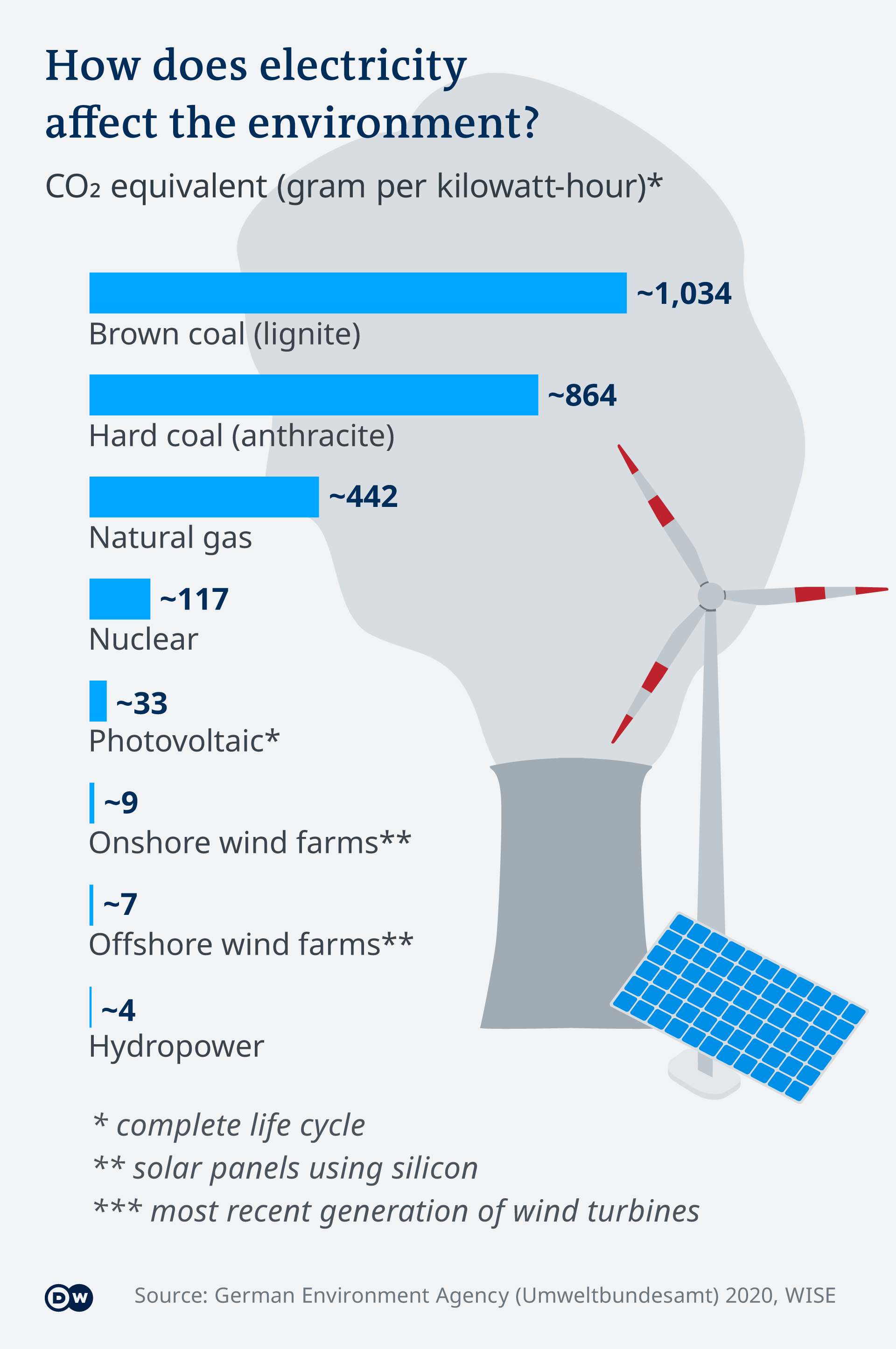
Results vary significantly, depending on whether we only consider the process of electricity generation, or take into account the entire life cycle of a nuclear power plant. A report released in 2014 by the UN's Intergovernmental Panel on Climate Change (IPCC), for example, estimated a range of 3.7 to 110 grams of CO2 equivalent per kilowatt-hour (kWh).

It's long been assumed that nuclear plants generate an average of 66 grams of CO2/kWh — though Wealer believes the actual figure is much higher. New power plants, for example, generate more CO2 during construction than those built in previous decades, due to stricter safety regulations.

Studies that include the entire life cycle of nuclear power plants, from uranium extraction to nuclear waste storage, are rare, with some researchers pointing out that data is still lacking. In one life cycle study, the Netherlands-based World Information Service on Energy (WISE) calculated that nuclear plants produce 117 grams of CO2 emissions per kilowatt-hour. It should be noted, however, that WISE is an anti-nuclear group, so is not entirely unbiased.

Emissions Balance Energy Sources 2020

However, other studies have come up with similar results when considering entire life cycles. Mark Z. Jacobson, director of the Atmosphere / Energy Program at California's Stanford University, calculated a climate cost of 68 to 180 grams of CO2/kWh, depending on the electricity mix used in uranium production and other variables.

How climate-friendly is nuclear compared to other energies?

If the entire life cycle of a nuclear plant is included in the calculation, nuclear energy certainly comes out ahead of fossil fuels like coal or natural gas. But the picture is drastically different when compared with renewable energy.

According to new but still unpublished data from the state-run German Environment Agency (UBA) as well as the WISE figures, nuclear power releases 3.5 times more CO2 per kilowatt-hour than photovoltaic solar panel systems. Compared with onshore wind power, that figure jumps to 13 times more CO2. When up against electricity from hydropower installations, nuclear generates 29 times more carbon.

Could we rely on nuclear energy to help stop global warming?

Around the world, nuclear energy representatives, as well as some politicians, have called for the expansion of atomic power. In Germany, for example, the right-wing populist AfD party has backed nuclear power plants, calling them "modern and clean." The AfD has called for a return to the energy source, which Germany has pledged to phase out completely by the end of 2022.

Other countries have also supported plans to build new nuclear plants, arguing that the energy sector will be even more damaging for the climate without it. But Wealer from Berlin's Technical University, along with numerous other energy experts, sees takes a different view.

"The contribution of nuclear energy is viewed too optimistically," he said. "In reality, [power plant] construction times are too long and the costs too high to have a noticeable effect on climate change. It takes too long for nuclear energy to become available."

Mycle Schneider, author of the World Nuclear Industry Status Report, agrees.

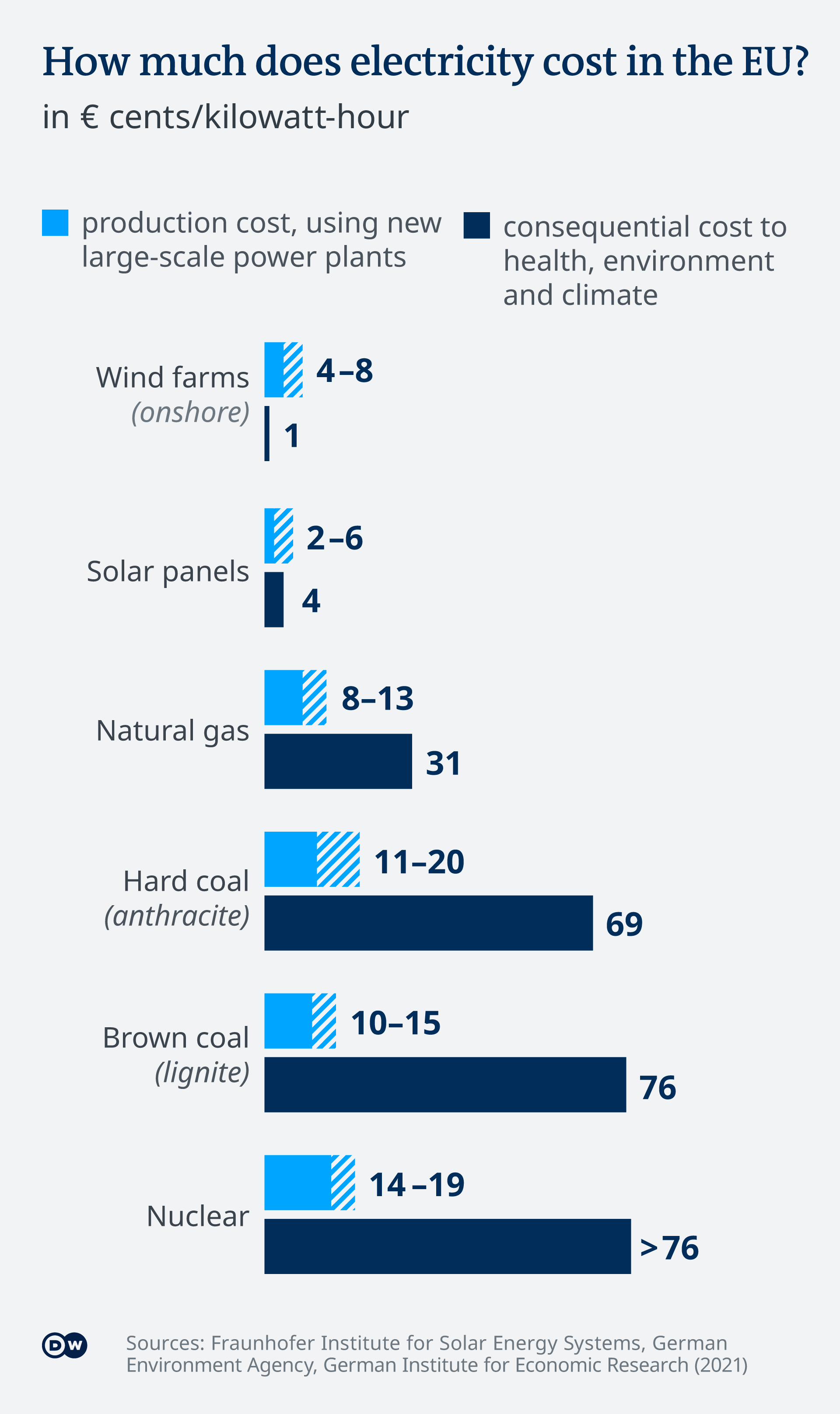
"Nuclear power plants are about four times as expensive as wind or solar, and take five times as long to build," he said. "When you factor it all in, you're looking at 15-to-20 years of lead time for a new nuclear plant."

He pointed out that the world needed to get greenhouse gases under control within a decade. "And in the next 10 years, nuclear power won't be able to make a significant contribution," added Schneider.

"Nuclear power is not being considered at the current time as one of the key global solutions to climate change," said Antony Froggatt, deputy director of the environment and society program at the international affairs think tank Chatham House in London.

He said a combination of excessive costs, environmental consequences and lack of public support were all arguments against nuclear power.

A graphic comparing the cost of various energy sources, along with environmental and health costs

Nuclear funding could go toward renewables

Due to the high costs associated with nuclear energy, it also blocks important financial resources that could instead be used to develop renewable energy, said Jan Haverkamp, a nuclear expert and activist with environment NGO Greenpeace in the Netherlands. Those renewables would provide more energy that is both faster and cheaper than nuclear, he said.

"Every dollar invested in nuclear energy is therefore a dollar diverted from true urgent climate action. In that sense, nuclear power is not climate-friendly," he said.

In addition, nuclear energy itself has been affected by climate change. During the world's increasingly hot summers, several nuclear power plants have already had to be temporarily shut down or taken off the grid. Power plants depend on nearby water sources to cool their reactors, and with many rivers drying up, those sources of water are no longer guaranteed.

The much vaunted "renaissance of nuclear power" is anything but when all the facts are taken into consideration, Mycle Schneider told DW. He said the nuclear industry has been shrinking for years.

"In the last 20 years, 95 nuclear power plants have gone online and 98 have been shut down. If you take China out of the equation, the number of nuclear power plants has shrunk by 50 reactors in the last two decades," Schneider added. "The nuclear industry is not thriving."

Fonte: DW

domingo, 7 de novembro de 2021

COP26: Crise energética e agenda climática impulsionam energia nuclear

Após o acidente nuclear de 2011 na central nuclear  japonesa de Fukushima, houve uma relutância crescente para o uso de usinas nucleares, mas crise energética e climática trouxeram tema à tona.


Impulsionados pela crise climática, os defensores da energia nuclear, a começar pelo chefe da Agência Internacional de Energia Atômica (AIEA), vieram promover seus méritos na COP26, em Glasgow.

"Esta COP é talvez a primeira em que a energia nuclear tem lugar na mesa de negociações, é levada em consideração e pode falar sem o fardo ideológico que existia antes", comentou à AFP o argentino Rafael Mariano Grossi, diretor-geral da AIEA.

Nos anos após o acidente nuclear de 2011 na usina japonesa de Fukushima, houve uma relutância crescente, mas agora "a situação mudou", garante.

No contexto das mudanças climáticas, ganha importância o argumento sobre suas baixas emissões de CO2, principalmente ligadas à extração de urânio e concreto para as usinas.

"A energia nuclear é parte da solução para o aquecimento global. Não é uma panaceia, pode não ser para todos, mas já fornece mais de 25% da energia limpa".

"Sem ela, não teremos sucesso", defende Grossi, defensor da causa desde que assumiu o cargo, em dezembro de 2019.

"A minha primeira COP foi em Madrid", no final daquele ano, lembra. "Fui lá apesar da ideia difundida de que a energia nuclear não seria bem-vinda. Agora até desperta muito interesse", acrescenta.
Reatores centenários

Em Glasgow, reuniu-se com ministros e outras autoridades, explicando que essas tecnologias podem substituir os combustíveis fósseis.

O átomo acarreta grandes riscos: acidentes, armazenamento complicado e tratamento de lixo altamente radioativo por milhares de anos, custos elevados... argumentos que mobilizam várias ONGs.
Mas Grossi defende que as críticas são exageradas.

"Você tem que ver os fatos", diz. "Na França ela representa mais de 70% (da eletricidade), nos Estados Unidos 20%, na Rússia o mesmo... A energia nuclear nunca para, ela complementa outras fontes, inclusive as renováveis", argumenta.

Em sua opinião, "os acidentes são raros, se olhar as estatísticas em termos de consequências, bem abaixo do que outras fontes de energia".

Mas será que novos reatores podem ser implantados com rapidez suficiente para reagir às mudanças climáticas? O argentino defende que "temos que começar preservando os existentes".

E quanto tempo podem durar? "Estamos vendo usinas planejadas para 60 anos com os mais rígidos padrões aplicados pelos reguladores nacionais e supervisionados pela AIEA", afirma.

Nos corredores da COP26, ativistas da "Nuclear for Climate" - alguns deles profissionais do setor - se fazem ouvir.

"Vamos falar de energia nuclear!", diz a camiseta de Callum Thomas, um observador britânico nas negociações em nome do Fórum Industrial Atômico do Japão. "Muitos veem os preços do gás quadruplicar e a viabilidade da energia nuclear aumentar", destaca.

Para todos?

O mundo está tão atrasado em seus objetivos climáticos e na transição energética para eliminar os hidrocarbonetos que o argumento nuclear pode ser muito poderoso. Alguns cientistas o defendem.

Na maioria dos cenários do Painel Intergovernamental da ONU sobre Mudanças Climáticas (IPCC) para limitar o aquecimento a +1,5°C, a proporção da energia nuclear aumentou, embora também alertem que sua implantação "pode ser limitada pelas preferências da sociedade".

Os países estão divididos. A Alemanha se opõe enquanto a França o defende, a China tem o maior número de reatores do mundo e a União Europeia debate se deve incluí-lo em sua classificação de investimentos "sustentáveis".

Muitas instituições também não financiam projetos nucleares, como o Banco Mundial, recentemente visitado por Grossi. Na COP26, "os países em desenvolvimento, em particular, vieram nos pedir ajuda", afirma.

"Os países veem as pequenas unidades como uma alternativa interessante, envolvendo centenas de milhões (de dólares) e não biliões", explica ele, propondo também "programas em etapas" para acompanhar os recém-chegados.

Canadá e Estados Unidos já desenvolvem pequenos reatores modulares, ou SMR por sua sigla em inglês, embora até agora apenas a Rússia tenha aberto uma central flutuante com essa tecnologia.

terça-feira, 13 de setembro de 2016

Quem são os 10 senhores mundiais do urânio

Estoque para gerar energia em reatores nucleares chega a 7,1 biliões de toneladas. Segundo a Agência Internacional de Energia, as reservas identificadas podem suprir a procura atual por um século. Veja os países com as maiores reservas.


Carga atómica 

São Paulo – No começo do ano, a China anunciou a retomada da construção da maior central de energia nuclear do mundo. Em paralelo, outros países também estão desenvolvendo um apetite voraz por essa fonte – seja para alcançar segurança energética ou para diminuir a pressão sobre combustíveis fósseis. É o caso dos Emirados Árabes, Indonésia e até do Brasil, que voltou a discutir a instalação de novas centrais nucleares. Não é só a procura que cresce. O estoque de urânio, matéria-prima necessária para gerar energia em reatores nucleares, aumentou 12,5% entre 2008 e 2010, para 7,8 bilhões de toneladas. E o Brasil é um dos que lidera em novas descobertas. Para se ter uma ideia, as reservas nacionais de urânio cresceram 357%, entre 2001 e 2011, segundo dados do World Nuclear. Conheça a seguir, onde estão as maiores reservas de urânio do mundo.

1. - Austrália zoom_out_map
Reservas comprovadas: 1,66 biliões de ton Participação mundial: 31% Produção em 2011: 5,98 mil toneladas Produção em 2001: 7,75 mil toneladas .Variação em 10 anos: - 30%

2. - Cazaquistão zoom_out_map
Reservas comprovadas: 629 milhões de ton Participação mundial: 12% Produção em 2011: 19,45 mil toneladas Produção em 2001: 2 mil toneladas Variação em 10 anos: 848%

3. - Rússia zoom_out_map
Reservas comprovadas: 487,7 milhões de ton Participação mundial: 9% Produção em 2011: 3 mil toneladas Produção em 2001: 2,5 mil toneladas Variação em 10 anos: 19,7%

4. - Canadá zoom_out_map
Reservas comprovadas: 468,7 milhões de ton Participação mundial: 9% Produção em 2011: 9,2 mil toneladas Produção em 2001: 12,5 mil toneladas Variação em 10 anos: - 27%

5. - Nigéria zoom_out_map
Reservas comprovadas: 421 milhões de ton Participação mundial: 8% Produção em 2011: 4,35 mil toneladas Produção em 2001: 2,9 mil toneladas Variação em 10 anos: 50%

6. - África do Sul zoom_out_map
Reservas comprovadas: 279,1 milhões de ton Participação mundial: 5% Produção em 2011: 582 toneladas Produção em 2001: 873 toneladas Variação em 10 anos: - 33,3%

7. - Brasil zoom_out_map
Reservas comprovadas: 276,7 milhões de ton Participação mundial: 5% Produção em 2011: 265 toneladas Produção em 2001: 58 toneladas Variação em 10 anos: 357%

8.- Namíbia zoom_out_map
Reservas comprovadas: 261 milhões de ton Participação mundial: 5% Produção em 2011: 3,25 mil toneladas Produção em 2001: 2,24 mil toneladas Variação em 10 anos: 45,5%

9.- Estados Unidos zoom_out_map
Reservas comprovadas: 207,4 milhões de ton Participação mundial: 4% Produção em 2011: 1,53 mil toneladas Produção em 2001: mil toneladas Variação em 10 anos: 52%

10. - China zoom_out_map
Reservas comprovadas: 166,1 milhões de ton Participação mundial: 3% Produção em 2011: 1,5 mil toneladas Produção em 2001: 655 toneladas Variação em 10 anos: 130%

terça-feira, 29 de setembro de 2015

domingo, 14 de outubro de 2012

Tratado EURATOM

Paul-Henri Spaak e Jean-Charles Snov et d’Oppuers no momento da assinatura do Tratado que institui a Comunidade Europeia da Energia Atómica (Euratom), 25 de março de 1957


Tratado que institui a Comunidade Europeia da Energia Atómica

Foram assinados dois tratados em 25 de Março de 1957 – o Tratado que institui a Comunidade Económica Europeia (CEE) e o Tratado que institui a Comunidade Europeia da Energia Atómica (CEEA ou EURATOM). Os principais objectivos do Tratado EURATOM são:
  • promover a investigação e assegurar a difusão dos conhecimentos técnicos
  • estabelecer normas de segurança uniformes com vista a proteger a saúde da população e dos trabalhadores da indústria
  • facilitar a investigação
  • garantir que os materiais nucleares não são desviados para fins diferentes daqueles a que se destinam, em particular militares
A importância do Tratado EURATOM pode ser claramente constatada no contexto do alargamento. A energia nuclear é uma importante fonte de energia para muitos países da Europa de Leste, mas as normas de segurança das suas centrais de energia nuclear e o nível de protecção da população e dos trabalhadores nem sempre são suficientes. É no contexto do Tratado EURATOM que se desenvolve a ajuda da UE neste domínio.
Assinado em: Roma (Itália), 25 de Março de 1957
Entrada em vigor: 1 de Janeiro de 1958

segunda-feira, 10 de maio de 2010

Nuclear e Europa - Destino dos lixos radioactivos - Consulta Pública (até 31 de Maio)


A Comissão Europeia lançou uma consulta para a elaboração de um nova Directiva Euratom relativa aos resíduos nucleares. O objectivo desta directiva é basicamente tentar convencer os cidadãos da Europa que o problema radioactivo dos resíduos será resolvido, a fim de fazer um grande grupo daqueles que se opõem à energia nuclear mudar sua mente. Pedimos a sua ajuda para impedir que isto aconteça. Para ser claro: nós entendemos que uma directiva da UE sobre Gestão de resíduos nucleares pode ser benéfico -, mas não deve ser usado como uma ferramenta de manipulação nuclear. Por isso, vimos pedir-lhe para participar nesta consulta.

Preencher o questionário e enviar uma cópia para jan.haverkamp@greenpeace.org


Sítio da Consulta Pública

Energy Public Consultation