Mostrar mensagens com a etiqueta WNISR. Mostrar todas as mensagens

quarta-feira, 11 de setembro de 2024

The World Nuclear Industry Status Report 2024


The World Nuclear Industry Status Report 2024 (WNISR2024) assesses the status and trends of the international nuclear industry. Earth Track was pleased to have contributed to the report again this year, with the focus chapter Power Firming and Competitive Pressure on Nuclear Energy assessing how solar/wind + storage put increasing competitive pressures on the nuclear sector.

By pulling together a mix of core data on the nuclear sector globally while addressing a handful of complex and important special topics each year, the WNISR has become a critical resource for tracking industry trends, pressures, and risks. As part of its core data review, the analysis provides a comprehensive overview of nuclear power plant data, including information on operation, production, fleet age, and construction. The WNISR discusses the status of newbuild programs in existing as well as in potential newcomer nuclear countries; notably in this year's Türkiye Focus which provides critical context to the ongoing construction of the country’s first nuclear power plant. A section is dedicated as well to ambitions and prospects for nuclear deployment in Potential Newcomer Countries in Africa, while Taiwan Focus covers the current situation and implementation of the nuclear phaseout policy.

In addition to the chapter we contributed on power firming, WNISR2024 includes special focus chapters on Nuclear Power vs. Renewable Energy Deployment; developments with Small Modular Reactor (SMR) developments; an analysis of the Russia Nuclear Dependencies of the global nuclear sector with a case study on Russian designed fuel assembly manufacturing; an analysis of the Militarization of Civil Power Plants based on the case study of tritium production for weapons in the United States and its significance for France; and an assessment of Civil-Military Cross-Financing in the U.K. Nuclear Sector discussing how tax- and rate-payers unknowingly subsidize the civil and military nuclear establishments.

The Fukushima Status Report provides an overview of ongoing onsite/offsite challenges of the 2011-disaster. The Decommissioning Status Report looks at the current situation of the now over 210 closed nuclear power reactors, close to one third of all units in the world that have generated electricity at some point. Annex 1 offers an overview by region and country of all operating nuclear programs not covered in the focus chapters.

In addition to this year's report linked to above, Earth Track's contribution on Nuclear Economics and Finance, including a review of fuel chain subsidies around the world, from last year's WNISR can be accessed here.

sexta-feira, 29 de abril de 2022

6 reasons why nuclear energy is not the way to a green and peaceful world


Demolition of the two cooling towers of the Philippsburg nuclear power plant near the river Rhine. The site of the now decommissioned Philippsburg Nuclear Power Plant is located in Philippsburg, near Karlsruhe, Germany. © Bernd Hartung / Greenpeace

Nuclear power is often hailed as a magic bullet solution for the rapid and large-scale decarbonisation of our societies which we all know needs to happen if we have any hope of mitigating the worst effects of the unfolding climate emergency. Among politicians and industry groups, it is consistently favoured over meaningful investment in renewable energy systems, bolstered with misleading claims of its safety, efficiency, stability, and speed of deployment.

With the costs and efficiency of renewable energy solutions improving year on year, and the effects of our rapidly changing climate accelerating across the globe, we need to take an honest look at some of the myths being perpetuated by the nuclear industry and its supporters. Here are six reasons why nuclear power is not the way to a green and peaceful zero carbon future.

1. Nuclear energy delivers too little to matter

According to scenarios from the World Nuclear Association and the OECD Nuclear Energy Agency (both nuclear lobby organisations), doubling the capacity of nuclear power worldwide in 2050 would only decrease greenhouse gas emissions by around 4%. But in order to do that, the world would need to bring 37 new large nuclear reactors to the grid every year from now, year on year, until 2050.

The last decade only showed a few to 10 new grid connections per year. Ramping that up to 37 is physically impossible – there is not sufficient capacity to make large forgings like reactor vessels. There are currently only 57 new reactors under construction or planned for the coming one-and-a-half decade. Doubling nuclear capacity – different from the explosive growth of clean renewable energy sources like solar and wind – is therefore unrealistic. And that for only 4% when we already need to reduce 100%.

2. Nuclear power plants are dangerous and vulnerable

Nuclear factories and plants are easy targets for malevolent acts: terrorist threats, the risk of unintentional or voluntary airliner crashes, cyberattacks or acts of war. The enclosures of plants and certain ancillary buildings containing radioactive materials are not designed to withstand this type of attack or shock.

Nuclear power plants present unique hazards in terms of the potential consequences resulting from a severe accident. Nuclear reactors and their associated high level spent fuel stores are vulnerable to natural disasters, as Fukushima Daiichi showed, but they are also vulnerable in times of military conflict.

For the first time in history, a major war is being waged in a country with multiple nuclear reactors and thousands of tons of highly radioactive spent fuel. The war in southern Ukraine around Zaporizhzhia puts them all at heightened risk of a severe accident.

Nuclear power plants are some of the most complex and sensitive industrial installations, which require a very complex set of resources in ready state at all times to keep them operational. This cannot be guaranteed in a war.

This can’t be guaranteed in a time of climate crisis and extreme weather events either. Nuclear power is a water-hungry technology. Nuclear power plants consume a lot of water for cooling. They are vulnerable to water stress, the warming of rivers, and rising temperatures, which can weaken the cooling of power plants and equipment. Nuclear reactors in the United States and France are often shut down during heatwaves, or see their activity drastically slowed.

3. Nuclear energy is too expensive

To protect the climate, we must abate the most carbon at the least cost and in the least time.

The cost of generating solar power ranges from $36 to $44 per megawatt-hour (MWh), the World Nuclear Industry Status Report said, while onshore wind power comes in at $29–$56 per MWh. Nuclear energy costs between $112 and $189 per MWh.

Over the past decade, the World Nuclear Industry Status Report estimates levelised costs – which compare the total lifetime cost of building and running a plant to lifetime output – for utility-scale solar have dropped by 88% and for wind by 69%. According to the same report, these costs have increased by 23% for nuclear.*

According to a November 2021 study released by Greenpeace France and the Rousseau Institute, power from the under-construction European Pressurised Reactor (EPR) at Flamanville in France would be 3 times as expensive as the country’s most competitive renewable sources.

4. Nuclear energy is too slow

Stabilising the climate is an emergency. Nuclear power is slow.

The 2021 World Nuclear Industry Status Report estimates that since 2009 the average construction time for reactors worldwide was just under 10 years, well above the estimate given by the World Nuclear Association (WNA) industry body of between 5 and 8.5 years.

The extra time that nuclear plants take to build has major implications for climate goals, as existing fossil-fueled plants continue to emit CO2 while awaiting substitution. The construction of a nuclear plant is a long and complex process that obviously releases CO2, as does the demolition of decommissioned nuclear sites.

Uranium extraction, transport and processing is obviously not free of greenhouse gas emissions either. All in all, nuclear power stations score comparable with wind and solar energy. But this latter can be implemented much faster and on a much bigger scale. We cannot wait for another decade for emissions to go down. They need to go down now. With clean renewable sources and energy efficiency, we can do that.

5. Nuclear energy generates huge amounts of toxic waste

The multiple stages of the nuclear fuel cycle produce large volumes of radioactive waste. No government has yet resolved how to safely manage this waste.

Some of this nuclear waste is highly radioactive and will remain so for several thousand years. Nuclear waste is a real scourge for our environment and for future generations, who will still have the responsibility of managing it in several centuries.

Countries like France are pushing hard for nuclear power at the EU level, hoping that when it comes to waste, out of sight is out of mind. But nuclear waste will never go away, and will never be sustainable.

This is one of the obvious reasons why nuclear power shouldn’t be eligible for green funding nor marketed as ‘sustainable’, as pointed out recently by countries like Austria, Denmark, Germany, Luxembourg, and Spain, who spoke against the inclusion of nuclear power in the EU’s green finance taxonomy. This is also one of the reasons why, on 9 March 2020, the EU Commission’s Technical Expert Group on Sustainable Finance (TEF) rejected nuclear energy because it did not meet the EU’s ‘Do No Significant Harm’ principle and recommended excluding nuclear power from the green taxonomy.

Nuclear waste management is costing taxpayers absurd amounts of money, costs for storage projects reaching into the billions. This is true both for Europe and North America. In 2019, a US Energy Department report showed the projected cost for long-term nuclear waste cleanup jumped more than $100 billion in just one year.

6. The nuclear industry is falling short of its promises
 
The EPR nuclear reactor technology has been showcased by the French government and French nuclear operator EDF as a revolutionary technology announcing the dawn of a nuclear renaissance. The reality is that this technology isn’t any kind of technological leap. More importantly, the French EPR reactor located in Flamanville is more than 10 years overdue and nearly four times over budget.

This so-called “next-generation nuclear reactor”, has also sustained multiple problems, delays and cost overruns in France, the United Kingdom, Finland and China.

Hypothetical new nuclear power technologies have been promised to be the next big thing for the last forty years, but in spite of massive public subsidies, that prospect has never panned out. That is also true for Small Modular Reactors (SMRs).

And for nuclear fusion, an idea that is as old as the nuclear industry, which somehow always seems to be fifty years away. The cost and uncertainty of fusion mean investing in thermonuclear reactors at the expense of other available clean energy options. This technology won’t arrive in time, if ever, and the money would be better invested elsewhere.

Let’s exert the utmost caution when presented with pro-nuclear opinions coming from experts and organisations regularly working with stakeholders from the nuclear sector and potentially tainted by vested interests. Nuclear energy has no place in a safe, clean, sustainable future. It is more important than ever that we steer away from false solutions and leave nuclear power in the past.

Fonte: Greenpeace

sábado, 23 de abril de 2022

Scientists: Nuclear Energy is a Waste of Time


Status Quo

It turns out that nuclear energy, which advocates say is a more feasible means of transitioning away from fossil fuels than solar or wind, might not actually be up to the task.

That’s according to research published Monday in the journal Nature Energy, which shows that countries that adopted nuclear energy didn’t actually reduce their carbon emissions a significant amount — but that countries with renewable energy investments did. It’s a compelling case that clean energy initiatives ought to focus on solar and wind, and perhaps skip nuclear as a stepping stone on the road to decarbonization.

Town Ain’t Big Enough

Looking at global data from the years 1990-2014, the University of Sussex science policy researchers also found that nuclear and renewable energy programs don’t play well together, in part since large, centralized nuclear plants require different infrastructure from more distributed solar fields, for example. Since one had a much bigger impact on emissions than the other, the team recommends being strategic.

“This paper exposes the irrationality of arguing for nuclear investment based on a ‘do everything’ argument,” study coauthor Andy Stirling said in a press release.

Least Resistance

With only so much time and money available, study coauthor Benjamin Sovacool argues that spending money on a new nuclear program might effectively block subsequent renewables programs from working and, as a result, continue to emit too much carbon into the air.

“Countries planning large-scale investments in new nuclear power are risking suppression of greater climate benefits from alternative renewable energy investments,” Sovacool said in the release.

Ler mais:

domingo, 6 de março de 2022

A Ucrânia é Auschwitz da nossa geração

Em manifestação contra a guerra, russa pede desculpas aos ucranianos

A artista plástica Olga Ivanova, de 26 anos, deixou a Rússia há 5 por causa de Putin e participou de protesto nessa quinta-feira, em Barcelona


O medo é uma ficção. Um "bluff". Putin sabe que os direitos humanos estão no coração de cada pessoa de bem deste planeta, por mais que tenhamos aprendido a ignorar os migrantes afogados, os povos em fuga de guerras, ou pura e simplesmente os envenenados do Kremlin. Mas há limites: ver morrer em direto os ucranianos, hora a hora, na sua própria terra, invadida sem qualquer legitimidade, é um novo teste de indiferença que finalmente não vamos conseguir passar.

As Nações Unidas e a NATO têm de colocar em cima da mesa a "legítima defesa humanitária". Novos tempos exigem novos conceitos. Holocausto nuclear? Nós já estamos a perecer aos poucos neste holocausto da liberdade de um povo que podia ser qualquer país livre. Gente como nós, colocada num gigantesco campo de concentração - a sua própria terra.

Exige-se às Nações Unidas, ou à NATO, ou à União Europeia, ou a alguns dos países da União Europeia, o apoio aéreo a um povo indefeso: aviões com logística de sobrevivência, a par de outros para defesa de um espaço de exclusão militar nos céus da Ucrânia. E, se não funcionar, responder com a entrada em ação desses aviões para concretizarem essa "legítima defesa".

Zelensky roga esse mínimo: lutar em terra, na desproporção de 10 ou 20 ou 100 soldados russos por cada ucraniano, até morrerem todos os que defendem Kiev e o resto do país. Implora apenas uma batalha justa, sem ataques aéreos. A cobardia russa não autoriza. Nós obedecemos. E aguardamos a qualquer momento o óbvio massacre, inimaginável, das bombas e colunas de blindados de 50 km a desfazerem Kiev e as outras cidades. Lamentaremos então o horror, impossível de olhar. Será tarde demais.

O equilíbrio do mundo não tem forma de se manter. A mais pequena tentativa do Ocidente de defender Zelensky, ou a capital da Ucrânia, culminará numa resposta "legítima" de um homem que se considera detentor do "ethos" da guerra, da vontade dos vizinhos e arquiteto de fronteiras imaginárias. Não temos como evitar o confronto com Putin.

Na II Guerra Mundial, em Varsóvia, 1938, o Ocidente tolerou o gueto: era "apenas" um gueto. Eram "apenas" judeus. A seguir vieram os campos de concentração. Como não atuámos antes, não sabíamos até onde o mal pode ir. E continuamos a não aprender. Hoje dizemos: são "ucranianos". Porque não são da NATO - por medo nosso, não os deixamos ser. Portanto, podem morrer.

Ainda só passaram 10 dias. A desgraça é gigantesca e ainda nem sequer começou. Este é um momento decisivo na História: ou vencem os valores do Ocidente, com as pessoas e a democracia em primeiro lugar, ou perpetuamos ditadores globais no poder.

Não parecia crível que tivéssemos de enfrentar uma escolha tão medieval. Mas não podemos ter dúvidas. O nosso testemunho para as gerações vindouras é o de cairmos de pé ou triunfarmos sem medo. Não ceder a Putin, Xi Jinping, ao indiano Modi, ao ISIS, aos talibãs, não reeleger Trump, é uma resposta de cada um dos povos.

Mas a Ucrânia, neste momento de genocídio, é uma responsabilidade da humanidade.
Esta é a nossa oportunidade. Putin tornou isto cristalino. Porque connosco vivos não voltará a haver o império soviético. Mesmo que haja a hipótese ("bluff"?) de morrermos de frio e fome ou sobre bombas nucleares.
Um homem é apenas pó, terra, cinza, nada. Temer Golias é ignorar que uma pequena pedra o derrubará.

Ler mais:

Assistir a este debate:

Documentários para perceber a Guerra na Ucrânia

Cinco municípios PCP e PS, votam claramente contra a Invasão Russa da Ucrânia, em contraciclo com a Direção Nacional do PCP, que insiste na "ocupação territorial" e acusa a NATO e UE.

A caixa de Pandora de Vladimir Putin

Victor Ângelo* : aqui

Os últimos dois anos têm sido tempos excecionais, de grandes preocupações a nível mundial. A verdade é que não estávamos preparados para enfrentar reptos desta dimensão e que vieram juntar-se ao problema muito complexo - e vital - das alterações climáticas.

Primeiro, foi a pandemia, que continua a ser um desafio enorme, sobretudo para os países com menos recursos e sistemas de saúde pública extremamente frágeis.

Com este pano de fundo ainda a fazer parte do nosso horizonte, surgiu agora um segundo fator de enorme instabilidade e que, tal como a covid-19, deverá contribuir para a reconfiguração do futuro das nossas sociedades e das relações internacionais. Este fator tem como ponto de origem a decisão inexplicável, anacrónica e ilegal de Vladimir Putin de declarar guerra ao povo da Ucrânia.

O ditador russo abriu uma caixa de Pandora. É preciso ter consciência disso. E, neste momento, até a esperança parece ter saído da caixa e andar à deriva. O próprio ministro dos Negócios Estrangeiros da Rússia, Sergei Lavrov, que agora se comporta de modo visível como um lacaio do seu mestre, veio alimentar o sentimento coletivo de ansiedade. Na quarta-feira, ao falar das sanções que foram impostas ao seu país, o ministro afirmou que a resposta poderá ser uma terceira guerra mundial. E sublinhou que seria "uma guerra nuclear devastadora".

Muitos pensarão que isto é só conversa, para fazer subir a parada, ou seja, para conseguirem destruir a Ucrânia e guardar os escombros, pressionar o Ocidente, ganhar peso estratégico e evitar uma nova vaga de sanções.

Por mim, sou dos que levam estas bravatas muito a sério. As medidas tomadas contra Putin e os círculos que sustentam o seu poder são extraordinariamente abrangentes, próximas de uma declaração de hostilidades. O impacto nas áreas da economia, da finança e da política interna será enorme. Perante isso, a resposta do Kremlin pode ser económica, para além das proibições de uso do espaço aéreo, do trânsito de mercadorias vindas da China, de vistos, etc. Mas receio que Putin não considere essas retaliações suficientes. Poderá querer mostrar que a Rússia não joga baixinho, que não é nem o Irão nem a Venezuela.

Como já aqui o escrevi, chegámos a um ponto de viragem muito perigoso.

A única solução razoável passaria por um esforço diplomático de bons ofícios - no entendimento que seria necessário encontrar uma solução que garantisse a independência da Ucrânia, mas aceitando igualmente que está em jogo algo muito maior do que essa questão. A ONU e o seu secretário-geral deveriam ser os agentes principais dessa iniciativa. Faz parte das suas atribuições e devem ousar. Mas, não vejo hipótese, Putin não aceitaria uma mediação desse tipo. Para ele, a ONU é apenas um secretariado, uma estrutura ao serviço dos Estados, mas sem equiparação e abaixo deles. E Guterres é agora apresentado em Moscovo como um agente dos americanos.

A mediação teria de caber a um Estado aceite por todas as partes. Se a questão fosse apenas entre a Rússia e a Ucrânia, penso que a possibilidade de a China poder desempenhar esse papel não deveria ser descartada. Mesmo tendo em conta que a retórica chinesa antiamericana se tem agravado nos últimos dois ou três dias. Hoje, perante a complexidade da crise, seria preferível que a mediação fosse feita por um tandem, ou mesmo um triunvirato, de países. Por exemplo, a China, a França e um outro país, que reunisse a confiança dos europeus e dos americanos, mas independente da NATO e exterior à cena europeia. Qual poderia ser?

Dito isto, queria que ficasse claro que não tenho muita fé na possibilidade de uma mediação. Preferiria que se apostasse num golpe palaciano. Aí, sim, poderá estar a solução. Mas, oficialmente, há que insistir na via diplomática. A encruzilhada em que estamos é bem clara: ou há diplomacia ou haverá uma forte possibilidade de confrontação em larga escala, sofrimento e caos. Cabe a cada um responsabilizar-se pela sua escolha e, no fim, pagar a conta, a começar por Vladimir Putin.

*Conselheiro em segurança internacional. Ex-secretário-geral adjunto da ONU

Ler mais:

Documentários para perceber a Guerra na Ucrânia

sábado, 5 de março de 2022

Memorando de Budapeste sobre Garantias de Segurança


"Em 1994, a Ucrânia detinha um gigantesco arsenal nuclear até assinar o Memorando de Budapeste e entregou cerca de 1.600 armas nucleares remanescentes da antiga União Soviética à Rússia, em troca de um tratado de paz e da garantia de nunca ser invadida ou ameaçada", lê-se no post de 24 de fevereiro no Facebook.

"Hoje, a Rússia invade a Ucrânia demonstrando o resultado de entregar a sua capacidade de defesa a alguém contando com a sua benevolência", acrescenta-se.

São factos históricos?

Contactado pelo Polígrafo, Arturo Zoffmann Rodriguez, investigador no Instituto de História Contemporânea da Universidade Nova de Lisboa e especialista em História da Rússia, confirma que o tratado mencionado na publicação, o Memorando de Budapeste, "ratificou o envio do arsenal nuclear soviético da Ucrânia para a Rússia".

"Os promotores desta iniciativa foram, de facto, os norte-americanos, que receavam o espalhamento do arsenal nuclear soviético em pequenas repúblicas recém criadas e politicamente instáveis. Além disso, a enorme concentração de armas nucleares na Ucrânia era um entrave à expansão da NATO para o Leste", acrescenta.

Segundo o historiador, os termos do acordo são claros. "A Federação Russa, o Reino Unido e os Estados Unidos da América (EUA) reafirmam a sua obrigação de abster-se da ameaça ou do uso da força contra a integridade territorial ou a independência política da Ucrânia, e que nenhuma de suas armas jamais será utilizada contra a Ucrânia, excepto em legítima defesa ou de outra forma, de acordo com a Carta das Nações Unidas", lê-se no texto do tratado (pode consultar aqui na íntegra).

Questionado sobre se o presente ataque militar da Rússia à Ucrânia constitui uma violação do acordo de 1994, Zoffmann Rodriguez entende que "formalmente poderia argumentar-se que sim". No entanto, considera que a questão acaba por ser "irrelevante", uma vez que "aos olhos da Rússia, o regime que tomou o poder na Ucrânia em 2014 é ilegítimo".

Saiba mais:

Documentários para perceber a Guerra na Ucrânia
1. Como é que chegámos aqui?
2. The Putin Files
3. Putin´s Way

terça-feira, 30 de novembro de 2021

Austria ready to sue EU over nuclear’s inclusion in green finance taxonomy


Austria’s energy and climate minister Leonore Gewessler told EURACTIV in an exclusive interview that her country was ready to go to court if the EU decides to include nuclear power into the bloc’s taxonomy on sustainable finance.

In October, European Commission President Ursula von der Leyen announced that the EU executive would soon table proposals on gas and nuclear as part of the bloc’s sustainable finance taxonomy, a set of rules designed to provide investors with a common definition of what is green and what is not.

A group of twelve EU countries, led by France and Finland, want nuclear energy included, arguing it is a low-carbon energy source and that radioactive waste can be handled safely if appropriate measures are taken.

But Austria would be ready to challenge that decision in front of the European Court of Justice said Leonore Gewessler, the Austrian minister for climate protection and energy.

“There is no legal basis for including nuclear power in the EU taxonomy,” Gewessler said adding that, “Yes, if the EU taxonomy includes nuclear energy, we are ready to challenge that in court.”

Austria is at the centre of a five-country alliance bringing together Denmark, Germany, Luxembourg and Portugal, which seeks to prevent the inclusion of nuclear energy in the EU’s green finance rules. The alliance was launched during the COP26 climate summit in Glasgow.

In face of a French-led push to revive nuclear power in Europe, a group of five EU countries led by Germany have banded together to urge the European Commission to keep nuclear out of the EU’s green finance taxonomy.

Legal analysis

For Gewessler, “the credibility of the taxonomy is at stake” when deciding how to classify nuclear under the EU’s green finance rules.

The Austrian energy and climate ministry commissioned a legal analysis earlier this year, which found that “that the inclusion of nuclear energy is not compatible with the legal basis of Article 10 of the Taxonomy Regulation,” she said.

“We have a great responsibility here, in terms of taxonomy, to remain consistent and coherent” with the ambitions of the European Green Deal and maintain trust in the financial markets, she argued.

“The considerable damage caused by nuclear energy is well documented historically,” she explained, citing “the dangers of nuclear power itself” as evidenced by the Chernobyl and Fukushima disasters.

The safe disposal of spent radioactive fuel is also a matter of concern. “We have not yet found a global solution for…the question of final storage,” she said.

Besides, nuclear power “is much too expensive and much too slow to make a contribution” to the bloc’s climate goals, Gewessler continued.

The next-generation French reactor currently being built at Flamanville, whose construction started in 2007, has been massively delayed, with completion now scheduled in 2023 while costs have increased fivefold, she remarked.

Earlier this month, leading French EU lawmaker Pascal Canfin proposed letting nuclear energy and gas in the taxonomy as “transition” energy sources while the bloc pursues its long-term switch to renewable energy sources.

Canfin’s suggestion is to label gas a “transition” investment when it replaces coal and provided strict emission thresholds are met.

But Gewessler rejected that proposal too. “Just because something is less bad than coal doesn’t make it good or sustainable. It is still fossil energy,” she said.


With proper safeguards in place, both gas and nuclear power can be included in the “transition” category of the EU’s green finance taxonomy, says Pascal Canfin, a leading lawmaker in the European Parliament.

According to Gewessler, Austria will be able to count on the support of Germany and Spain in case it goes to court over the matter.

“Spain shares Austria’s position one-to-one. Spain sees neither nuclear energy nor fossil gas in the taxonomy and has made this very clear before,” she said.

While Spain has been absent from the five-country alliance announced at COP26, it “sent a joint letter [with Austria and others] on nuclear energy to the Commission months ago. There is no room between us,” explained Gewessler.

And Austria’s neighbour Germany can always be counted on in the fight against nuclear power.

“Nuclear power cannot be a solution in the climate crisis, it is too risky, it is too slow, it is too expensive,” explained her German counterpart Svenja Schulze, caretaker minister of the environment, on 11 November.

“No climate activist should rely on nuclear power,” she added.
A proposal to bring both nuclear power and natural gas into the bloc’s green finance taxonomy is circulating in Brussels. The paper has been branded as a “scientific disgrace” by campaigners who warned it would damage the EU’s credibility on green finance.

segunda-feira, 29 de novembro de 2021

Fact check: Is nuclear energy good for the climate?

Supporters of nuclear energy say it can help us wean our economies off polluting fossil fuels. No surprise, it's a heated issue. But what about the facts? Can nuclear power really help save the climate?


The latest figures on global carbon dioxide emissions call into question the world's efforts to tackle the climate crisis. CO2 emissions are set to soar 4.9% in 2021, compared with the previous year, according to a study published earlier this month by the Global Carbon Project (GCP), a group of scientists that track emissions.

In 2020, emissions dropped 5.4% due to the COVID-19 pandemic and associated lockdowns. Most observers expected a rebound this year — but not to such an extent. The energy sector continues to be the largest emitter of greenhouse gases, with a share of 40% — and rising.

But what about nuclear? Supporters of the controversial energy source say it's a climate-friendly way to generate electricity. At the very least, it's something we could use until we're able to develop comprehensive alternatives. In recent weeks, particularly during the COP26 climate summit, advocates have been creating a stir online with statements like "if you're against nuclear energy, you're against climate protection" and "nuclear energy is about to make a comeback." But is there anything to it?

Is nuclear power a zero-emissions energy source?

No. Nuclear energy is also responsible for greenhouse gas emissions. In fact, no energy source is completely free of emissions, but more on that later.

When it comes to nuclear, uranium extraction, transport and processing produces emissions. The long and complex construction process of nuclear power plants also releases CO2, as does the demolition of decommissioned sites. And, last but not least, nuclear waste also has to be transported and stored under strict conditions — here, too, emissions must be taken into account.

And yet, interest groups claim nuclear energy is emission-free. Among them is Austrian consulting firm ENCO. In late 2020, it released a study prepared for the Dutch Ministry of Economic Affairs and Climate Policy that looked favorably at the possible future role of nuclear in the Netherlands.

"The main factors for its choice were reliability and security of supply, with no CO2 emission," it read. ENCO was founded by experts from the International Atomic Energy Agency, and it regularly works with stakeholders in the nuclear sector, so it's not entirely free of vested interests.

At COP26, environmental initiative Scientists for Future (S4F) presented a paper on nuclear energy and the climate. The group came to a very different conclusion. "Taking into account the current overall energy system, nuclear energy is by no means CO2 neutral," they said.

Ben Wealer of the Technical University of Berlin, one of the report's authors, told DW that proponents of nuclear energy "fail to take into account many factors," including those sources of emissions outlined above. All the studies reviewed by DW said the same thing: Nuclear power is not emissions-free.

How much CO2 does nuclear power produce?

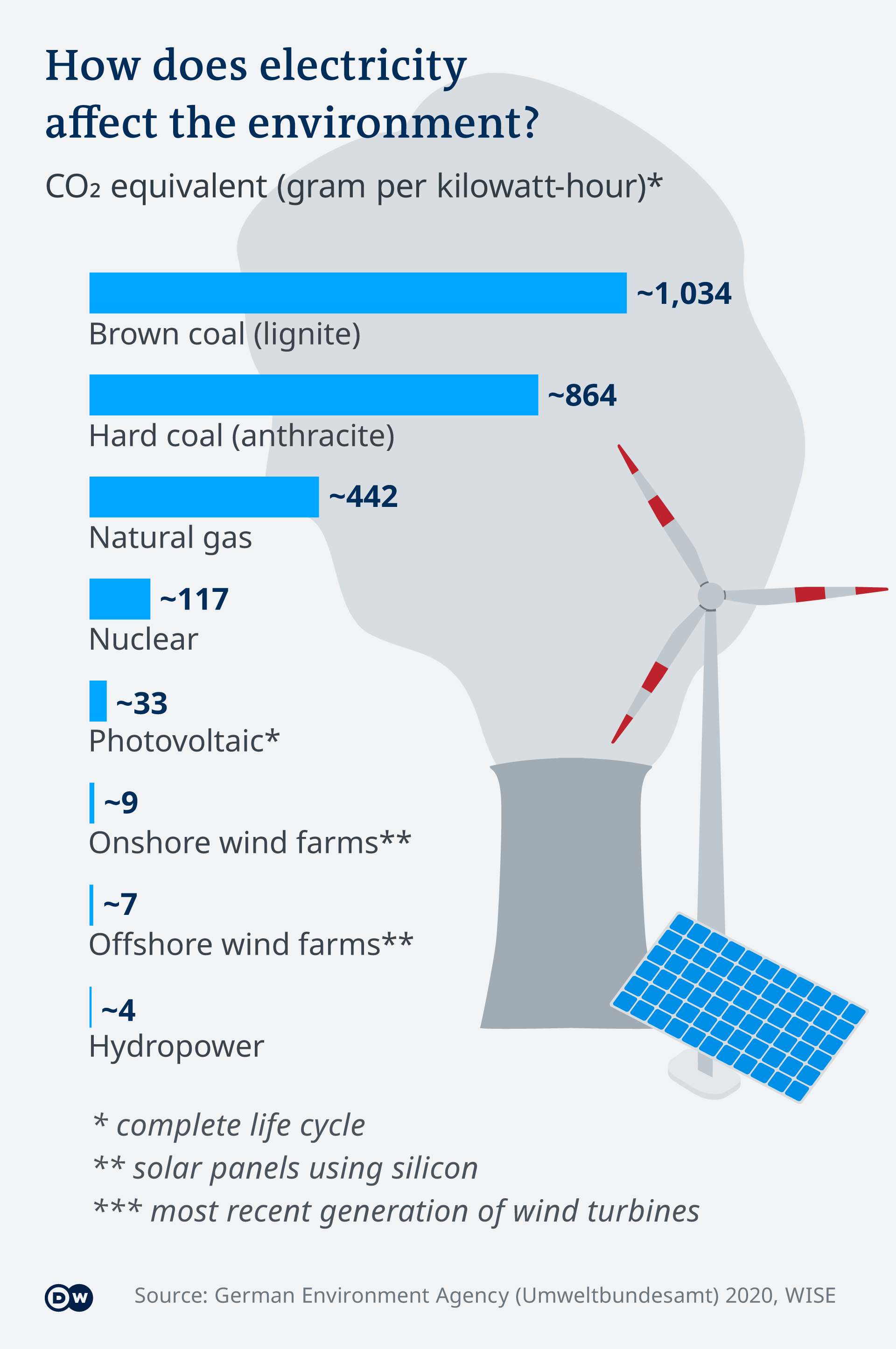
Results vary significantly, depending on whether we only consider the process of electricity generation, or take into account the entire life cycle of a nuclear power plant. A report released in 2014 by the UN's Intergovernmental Panel on Climate Change (IPCC), for example, estimated a range of 3.7 to 110 grams of CO2 equivalent per kilowatt-hour (kWh).

It's long been assumed that nuclear plants generate an average of 66 grams of CO2/kWh — though Wealer believes the actual figure is much higher. New power plants, for example, generate more CO2 during construction than those built in previous decades, due to stricter safety regulations.

Studies that include the entire life cycle of nuclear power plants, from uranium extraction to nuclear waste storage, are rare, with some researchers pointing out that data is still lacking. In one life cycle study, the Netherlands-based World Information Service on Energy (WISE) calculated that nuclear plants produce 117 grams of CO2 emissions per kilowatt-hour. It should be noted, however, that WISE is an anti-nuclear group, so is not entirely unbiased.

Emissions Balance Energy Sources 2020

However, other studies have come up with similar results when considering entire life cycles. Mark Z. Jacobson, director of the Atmosphere / Energy Program at California's Stanford University, calculated a climate cost of 68 to 180 grams of CO2/kWh, depending on the electricity mix used in uranium production and other variables.

How climate-friendly is nuclear compared to other energies?

If the entire life cycle of a nuclear plant is included in the calculation, nuclear energy certainly comes out ahead of fossil fuels like coal or natural gas. But the picture is drastically different when compared with renewable energy.

According to new but still unpublished data from the state-run German Environment Agency (UBA) as well as the WISE figures, nuclear power releases 3.5 times more CO2 per kilowatt-hour than photovoltaic solar panel systems. Compared with onshore wind power, that figure jumps to 13 times more CO2. When up against electricity from hydropower installations, nuclear generates 29 times more carbon.

Could we rely on nuclear energy to help stop global warming?

Around the world, nuclear energy representatives, as well as some politicians, have called for the expansion of atomic power. In Germany, for example, the right-wing populist AfD party has backed nuclear power plants, calling them "modern and clean." The AfD has called for a return to the energy source, which Germany has pledged to phase out completely by the end of 2022.

Other countries have also supported plans to build new nuclear plants, arguing that the energy sector will be even more damaging for the climate without it. But Wealer from Berlin's Technical University, along with numerous other energy experts, sees takes a different view.

"The contribution of nuclear energy is viewed too optimistically," he said. "In reality, [power plant] construction times are too long and the costs too high to have a noticeable effect on climate change. It takes too long for nuclear energy to become available."

Mycle Schneider, author of the World Nuclear Industry Status Report, agrees.

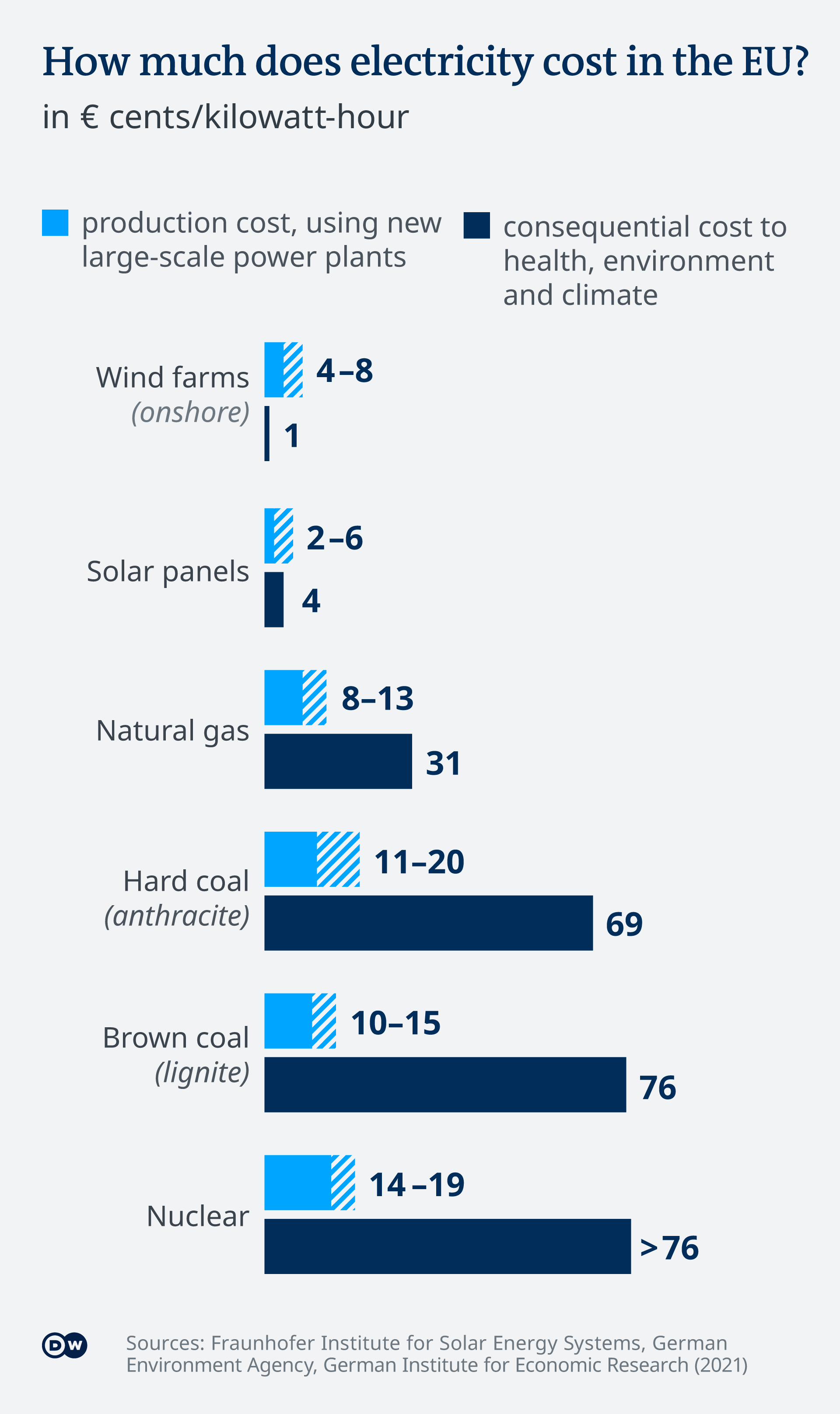
"Nuclear power plants are about four times as expensive as wind or solar, and take five times as long to build," he said. "When you factor it all in, you're looking at 15-to-20 years of lead time for a new nuclear plant."

He pointed out that the world needed to get greenhouse gases under control within a decade. "And in the next 10 years, nuclear power won't be able to make a significant contribution," added Schneider.

"Nuclear power is not being considered at the current time as one of the key global solutions to climate change," said Antony Froggatt, deputy director of the environment and society program at the international affairs think tank Chatham House in London.

He said a combination of excessive costs, environmental consequences and lack of public support were all arguments against nuclear power.

A graphic comparing the cost of various energy sources, along with environmental and health costs

Nuclear funding could go toward renewables

Due to the high costs associated with nuclear energy, it also blocks important financial resources that could instead be used to develop renewable energy, said Jan Haverkamp, a nuclear expert and activist with environment NGO Greenpeace in the Netherlands. Those renewables would provide more energy that is both faster and cheaper than nuclear, he said.

"Every dollar invested in nuclear energy is therefore a dollar diverted from true urgent climate action. In that sense, nuclear power is not climate-friendly," he said.

In addition, nuclear energy itself has been affected by climate change. During the world's increasingly hot summers, several nuclear power plants have already had to be temporarily shut down or taken off the grid. Power plants depend on nearby water sources to cool their reactors, and with many rivers drying up, those sources of water are no longer guaranteed.

The much vaunted "renaissance of nuclear power" is anything but when all the facts are taken into consideration, Mycle Schneider told DW. He said the nuclear industry has been shrinking for years.

"In the last 20 years, 95 nuclear power plants have gone online and 98 have been shut down. If you take China out of the equation, the number of nuclear power plants has shrunk by 50 reactors in the last two decades," Schneider added. "The nuclear industry is not thriving."

Fonte: DW

domingo, 7 de novembro de 2021

COP26: Crise energética e agenda climática impulsionam energia nuclear

Após o acidente nuclear de 2011 na central nuclear  japonesa de Fukushima, houve uma relutância crescente para o uso de usinas nucleares, mas crise energética e climática trouxeram tema à tona.


Impulsionados pela crise climática, os defensores da energia nuclear, a começar pelo chefe da Agência Internacional de Energia Atômica (AIEA), vieram promover seus méritos na COP26, em Glasgow.

"Esta COP é talvez a primeira em que a energia nuclear tem lugar na mesa de negociações, é levada em consideração e pode falar sem o fardo ideológico que existia antes", comentou à AFP o argentino Rafael Mariano Grossi, diretor-geral da AIEA.

Nos anos após o acidente nuclear de 2011 na usina japonesa de Fukushima, houve uma relutância crescente, mas agora "a situação mudou", garante.

No contexto das mudanças climáticas, ganha importância o argumento sobre suas baixas emissões de CO2, principalmente ligadas à extração de urânio e concreto para as usinas.

"A energia nuclear é parte da solução para o aquecimento global. Não é uma panaceia, pode não ser para todos, mas já fornece mais de 25% da energia limpa".

"Sem ela, não teremos sucesso", defende Grossi, defensor da causa desde que assumiu o cargo, em dezembro de 2019.

"A minha primeira COP foi em Madrid", no final daquele ano, lembra. "Fui lá apesar da ideia difundida de que a energia nuclear não seria bem-vinda. Agora até desperta muito interesse", acrescenta.
Reatores centenários

Em Glasgow, reuniu-se com ministros e outras autoridades, explicando que essas tecnologias podem substituir os combustíveis fósseis.

O átomo acarreta grandes riscos: acidentes, armazenamento complicado e tratamento de lixo altamente radioativo por milhares de anos, custos elevados... argumentos que mobilizam várias ONGs.
Mas Grossi defende que as críticas são exageradas.

"Você tem que ver os fatos", diz. "Na França ela representa mais de 70% (da eletricidade), nos Estados Unidos 20%, na Rússia o mesmo... A energia nuclear nunca para, ela complementa outras fontes, inclusive as renováveis", argumenta.

Em sua opinião, "os acidentes são raros, se olhar as estatísticas em termos de consequências, bem abaixo do que outras fontes de energia".

Mas será que novos reatores podem ser implantados com rapidez suficiente para reagir às mudanças climáticas? O argentino defende que "temos que começar preservando os existentes".

E quanto tempo podem durar? "Estamos vendo usinas planejadas para 60 anos com os mais rígidos padrões aplicados pelos reguladores nacionais e supervisionados pela AIEA", afirma.

Nos corredores da COP26, ativistas da "Nuclear for Climate" - alguns deles profissionais do setor - se fazem ouvir.

"Vamos falar de energia nuclear!", diz a camiseta de Callum Thomas, um observador britânico nas negociações em nome do Fórum Industrial Atômico do Japão. "Muitos veem os preços do gás quadruplicar e a viabilidade da energia nuclear aumentar", destaca.

Para todos?

O mundo está tão atrasado em seus objetivos climáticos e na transição energética para eliminar os hidrocarbonetos que o argumento nuclear pode ser muito poderoso. Alguns cientistas o defendem.

Na maioria dos cenários do Painel Intergovernamental da ONU sobre Mudanças Climáticas (IPCC) para limitar o aquecimento a +1,5°C, a proporção da energia nuclear aumentou, embora também alertem que sua implantação "pode ser limitada pelas preferências da sociedade".

Os países estão divididos. A Alemanha se opõe enquanto a França o defende, a China tem o maior número de reatores do mundo e a União Europeia debate se deve incluí-lo em sua classificação de investimentos "sustentáveis".

Muitas instituições também não financiam projetos nucleares, como o Banco Mundial, recentemente visitado por Grossi. Na COP26, "os países em desenvolvimento, em particular, vieram nos pedir ajuda", afirma.

"Os países veem as pequenas unidades como uma alternativa interessante, envolvendo centenas de milhões (de dólares) e não biliões", explica ele, propondo também "programas em etapas" para acompanhar os recém-chegados.

Canadá e Estados Unidos já desenvolvem pequenos reatores modulares, ou SMR por sua sigla em inglês, embora até agora apenas a Rússia tenha aberto uma central flutuante com essa tecnologia.

quinta-feira, 4 de novembro de 2021

China acusa EUA de “manipulação” após relatório sobre capacidade nuclear de Pequim


A China denunciou esta quinta-feira o que classificou de “manipulação” por parte dos Estados Unidos, após a publicação de um relatório do Pentágono sobre a aceleração mais rápida do que o previsto do programa nuclear chinês.

O Departamento de Defesa norte-americano (Pentágono) estimou que Pequim está a desenvolver o seu arsenal nuclear muito mais rápido do que o antecipado e que já pode lançar mísseis balísticos armados com ogivas nucleares a partir do mar, terra e ar.

A China está a modernizar o seu exército para “enfrentar os Estados Unidos da América (EUA)” na região do Indo-Pacífico e facilitar a reunificação de Taiwan, notou o documento.

Pequim considera a ilha de Taiwan parte do seu território, apesar de esta funcionar como uma entidade política soberana.

Wang Wenbin, o porta-voz do Ministério dos Negócios Estrangeiros da China, acusou os Estados Unidos de tentar “puxar” pela tese da ameaça chinesa.

“O relatório, divulgado pelo Pentágono, como os anteriores, ignora os factos e está cheio de preconceitos”, disse Wang aos jornalistas, criticando Washington por “manipulação”.

Na edição anterior deste relatório entregue no Congresso norte-americano, e publicado no início de setembro de 2020, o Pentágono estimou que a China tinha “cerca de 200” ogivas nucleares, mas anteviu que este número podia duplicar nos próximos dez anos.

Com 700 ogivas nucleares, até 2027, e 1.000, até 2030, as novas projeções dos militares dos EUA mostram uma forte aceleração da capacidade atómica de Pequim.

“A China provavelmente já estabeleceu uma 'tríade nuclear' nascente, ou seja, a capacidade de lançar mísseis balísticos nucleares a partir do mar, terra e ar”, lê-se no documento.

Os autores do relatório basearam-se, em particular, em declarações das autoridades chinesas na imprensa oficial e em imagens de satélite que mostram a construção de um número significativo de silos nucleares.

Apenas parte deste documento foi tornado público, sendo o restante classificado como segredo da Defesa dos EUA.

“É muito preocupante para nós”, admitiu um responsável norte-americano, acrescentando que esta aceleração “levanta questões sobre as intenções” da China.

Mesmo com 1.000 ogivas nucleares, o arsenal chinês estaria longe de se igualar ao dos Estados Unidos e da Rússia, que juntos possuem mais de 90% das armas nucleares mundiais.

Em outubro de 2020, o Partido Comunista Chinês estabeleceu como meta modernizar a organização, o pessoal, o armamento e o equipamento do seu exército, até 2027, lembrou o relatório.

O Presidente norte-americano, Joe Biden, afirmou recentemente que os Estados Unidos têm o “compromisso” de defender militarmente Taiwan no caso de um ataque chinês.

O Pentágono acrescentou este ano ao seu relatório anual um capítulo sobre as pesquisas químicas e biológicas do país asiático, que considera “preocupantes”.

“A China envolveu-se em atividades biológicas potencialmente aplicáveis” no campo militar, disse o documento norte-americano.

“Com base nas informações disponíveis, os Estados Unidos não podem garantir que a China cumpra a Convenção Internacional de Armas Químicas”, frisou.

quarta-feira, 25 de agosto de 2021

Documentário: The Battle of Chernobyl


Em 26 de abril de 1986, o quarto reator da central nuclear de Chernobyl explodiu, desencadeando uma reação em cadeia que ameaçou desencadear uma segunda explosão ainda mais poderosa. Durante 8 meses, 800.000 soldados, mineiros e civis trabalharam dia e noite para “liquidar” a radioatividade, construindo um “sarcófago” ao redor do reator arruinado. Oito meses no inferno que seus sobreviventes provavelmente não esquecerão. Cobrindo um período de 20 anos, usando imagens 3D e imagens de arquivo, o filme é a reencenação de uma batalha implacável contra um inimigo invisível e mortal.

sexta-feira, 30 de abril de 2021

Documentário: Coreia do Norte- armas nucleares, terror e propaganda


A cada ano, 5.000 turistas ocidentais visitam a Coreia do Norte. À frente do país, um estadista misterioso e caprichoso, Kim Jong-un. Seu país nunca esteve tão perto de se tornar uma potência nuclear. Na imersão, vimos o que o regime quer mostrar aos estrangeiros através da propaganda. Reportagem secreta na Coreia do Norte.
Nota: para ver em Português, clicar em definições.

terça-feira, 27 de outubro de 2020

Documentário - Chernobyl: Hour by Hour


O acidente em Chernobyl libertou pelo menos 100 vezes mais radiação do que as bombas atómicas lançadas sobre Hiroshima e Nagasaki. Um número incalculável de europeus ainda guarda as cicatrizes do que aconteceu naquela noite desastrosa em Chernobyl.

terça-feira, 13 de setembro de 2016

Quem são os 10 senhores mundiais do urânio

Estoque para gerar energia em reatores nucleares chega a 7,1 biliões de toneladas. Segundo a Agência Internacional de Energia, as reservas identificadas podem suprir a procura atual por um século. Veja os países com as maiores reservas.


Carga atómica 

São Paulo – No começo do ano, a China anunciou a retomada da construção da maior central de energia nuclear do mundo. Em paralelo, outros países também estão desenvolvendo um apetite voraz por essa fonte – seja para alcançar segurança energética ou para diminuir a pressão sobre combustíveis fósseis. É o caso dos Emirados Árabes, Indonésia e até do Brasil, que voltou a discutir a instalação de novas centrais nucleares. Não é só a procura que cresce. O estoque de urânio, matéria-prima necessária para gerar energia em reatores nucleares, aumentou 12,5% entre 2008 e 2010, para 7,8 bilhões de toneladas. E o Brasil é um dos que lidera em novas descobertas. Para se ter uma ideia, as reservas nacionais de urânio cresceram 357%, entre 2001 e 2011, segundo dados do World Nuclear. Conheça a seguir, onde estão as maiores reservas de urânio do mundo.

1. - Austrália zoom_out_map
Reservas comprovadas: 1,66 biliões de ton Participação mundial: 31% Produção em 2011: 5,98 mil toneladas Produção em 2001: 7,75 mil toneladas .Variação em 10 anos: - 30%

2. - Cazaquistão zoom_out_map
Reservas comprovadas: 629 milhões de ton Participação mundial: 12% Produção em 2011: 19,45 mil toneladas Produção em 2001: 2 mil toneladas Variação em 10 anos: 848%

3. - Rússia zoom_out_map
Reservas comprovadas: 487,7 milhões de ton Participação mundial: 9% Produção em 2011: 3 mil toneladas Produção em 2001: 2,5 mil toneladas Variação em 10 anos: 19,7%

4. - Canadá zoom_out_map
Reservas comprovadas: 468,7 milhões de ton Participação mundial: 9% Produção em 2011: 9,2 mil toneladas Produção em 2001: 12,5 mil toneladas Variação em 10 anos: - 27%

5. - Nigéria zoom_out_map
Reservas comprovadas: 421 milhões de ton Participação mundial: 8% Produção em 2011: 4,35 mil toneladas Produção em 2001: 2,9 mil toneladas Variação em 10 anos: 50%

6. - África do Sul zoom_out_map
Reservas comprovadas: 279,1 milhões de ton Participação mundial: 5% Produção em 2011: 582 toneladas Produção em 2001: 873 toneladas Variação em 10 anos: - 33,3%

7. - Brasil zoom_out_map
Reservas comprovadas: 276,7 milhões de ton Participação mundial: 5% Produção em 2011: 265 toneladas Produção em 2001: 58 toneladas Variação em 10 anos: 357%

8.- Namíbia zoom_out_map
Reservas comprovadas: 261 milhões de ton Participação mundial: 5% Produção em 2011: 3,25 mil toneladas Produção em 2001: 2,24 mil toneladas Variação em 10 anos: 45,5%

9.- Estados Unidos zoom_out_map
Reservas comprovadas: 207,4 milhões de ton Participação mundial: 4% Produção em 2011: 1,53 mil toneladas Produção em 2001: mil toneladas Variação em 10 anos: 52%

10. - China zoom_out_map
Reservas comprovadas: 166,1 milhões de ton Participação mundial: 3% Produção em 2011: 1,5 mil toneladas Produção em 2001: 655 toneladas Variação em 10 anos: 130%

domingo, 27 de março de 2011

Técnicos e especialistas independentes passaram já o acidente de Fukushima para grau 7


Por Sylvestre Huet, 26 de Março (Le Monde)

Depuis ce matin les réacteurs 1, 2 et 3 de Fukushima sont refroidis avec de l'eau douce. Une information qui est venue atténuer la tension remontée d’un cran, vendredi, à Fukushima. Comme en témoigne la décision de porter à 30 kilomètres la zone évacuée autour de la centrale nucléaire et l’annonce qu’il y aurait un danger accru au réacteur numéro 3. Mais on apprend également que la Tepco repousse encore la remise en route des systèmes de refroidissement en raison des risques pour les travailleurs intervenant sur le site, notamment sur les réacteurs 1 et 3. C'est une conséquence de l'irradiation, jeudi, de trois techniciens. D'après l'AIEA, la Tepco a annoncé que 17 travailleurs avaient reçu une dose entre 100 et 180 millisieverts. On peut en conclure qu'ils ont été évacués du site.
Dans le même temps, l’Agence de sécurité nucléaire japonaise (la Nisa) annonçait qu’il «est hautement probable que le réacteur 3 de Fukushima Daichi ait été gravement endommagé et rejette une quantité importante de substances radioactives».
Le propos peut sembler étrange car il n’est pas vraiment différent de ce que l’on savait déjà. Mais, alors que les spécialistes français l’assurent depuis plusieurs jours, la Nisa n’avait pas admis que l’enceinte de confinement du réacteur, en acier et béton, fuyait. Une perte d’étanchéité à l’origine de rejets radioactifs continus et non filtrés.
La réelle nouveauté se trouve ailleurs : dans l’hypothèse d’une rupture de la cuve du réacteur. Une rupture non avérée pour l’instant, mais qui pourrait avoir commencé. Pour un point précis de la situation ce matin à 10h, lire ici.
Le scénario qui en découlerait ? Selon Thierry Charles, de l’Institut de radioprotection et de sûreté nucléaire (IRSN), il dépend en grande partie de ce que le corium (le cœur fondu du réacteur) rencontrerait après avoir percé la cuve. D’abord, quelques mètres de vide. Sont-ils plein d’eau ? De vapeur ? Les ingénieurs japonais eux-mêmes ne le savent pas. Puis, 8 mètres de béton, avant la roche.
Que peut-il se passer avec la chute du corium en fusion ? «Cela dépend de sa dispersion, de la quantité
d’eau. Mais le pire scénario, c’est une explosion de vapeur, suivie d’une explosion d’hydrogène
», explique Thierry Charles. Cela pourrait ébranler une nouvelle fois les structures du bâtiment et relâcher des gaz et aérosols radioactifs.
Tout dépend ensuite de ce qui reste de puissance thermique. En attaquant le béton, le corium va se refroidir, mais aussi libérer des gaz inflammables (monoxyde de carbone et hydrogène). S’il se refroidit assez, il va rester coincé dans le béton. Mais s’il lui reste assez de puissance, il va le percer et se retrouver coincé dans la roche qui se trouve en dessous. Le risque est alors de voir les eaux souterraines charrier petit à petit ces matières vers la mer. «Pour l’instant, soulignait hier soir Thierry Charles après avoir appris l'épaisseur exacte du béton du radier (8 mètres), nos calculs favorisent l’hypothèse où le corium reste coincé dans le béton

Reste «l’affaire du plutonium». Les radionucléides «légers» se dispersent sous forme de gaz ou d’aérosols (Xénon, krypton, tellure, iode, césium, technétium, lanthane, strontium…) dans l’atmosphère. Mais qu’en est-il de la matière principale du combustible - uranium et plutonium - et des actinides mineurs (neptunium, américium et curium), atomes plus lourds formés par capture de neutrons ?
Le réacteur numéro 3 comporte plus de plutonium que les autres. Il a été partiellement chargé en MOX, qui en comporte environ 7% (contre 1% dans un combustible UOX en fin de séjour en réacteur). Le plutonium est très chimiotoxique et radiotoxique. Mais, rappelle Thierry Charles, «l’uranium et le plutonium sont lourds. Même à Tchernobyl, où ils étaient poussés par le brasier, ils ne se sont pas dispersés au-delà de 30 km. A Fukushima, c’est un enjeu de contamination important, mais local».
Vendredi midi, ce scénario noir ne semblait pas encore engagé… tout au moins au vu des niveaux de radioactivité mesurés à la porte du site de Fukushima Daichi : 0,2 millisievert par heure, contre 10 au moment des relâchages de vapeur d’eau contaminée les 13 et 14 mars, ou 2 millisieverts lundi dernier.
A court terme, le pire de ce scénario serait une aggravation de la radioactivité sur le site, interdisant d’y continuer les travaux. L’objectif de Tepco est de remettre en marche les circuits de refroidissement des piscines et des réacteurs. Depuis vendredi, les Japonais utilisent enfin de l’eau douce, apportée en grande quantité et stockée sur des barges ancrées à proximité, avec l’aide de l’armée américaine. Les réacteurs numéros 1 et 3 sont passés à ce régime qui va permettre de diminuer la teneur en sel de l’eau. Un sel qui menace vannes, moteurs, tuyaux… Le réacteur numéro 2 vient de passer à l’eau douce ce samedi matin.
Mais si la lumière est revenue dans les salles de contrôle, la remise en route des systèmes de refroidissement se heurte à la dévastation du site. Il faut vérifier les armoires électriques, les connexions, les pompes, les moteurs afin que la tentative de les redémarrer ne fasse pas «sauter les plombs partout en déclenchant des courts-circuits» et ne ruine tout espoir de stabiliser les réacteurs. Tepco, après avoir plusieurs fois annoncé la mise en route des systèmes, ne donne plus de délais. Et l'irradiation de trois techniciens jeudi vient encore retarder les opérations.

Opacité et transparence...
Opacité complète d’un côté, transparence de l’autre. C’est l’étrange pas de deux que dansent les Japonais - gouvernement, Tepco, Autorité de sûreté nucléaire (Nisa) - depuis le début de la catastrophe de Fukushima.
Les informations officielles japonaises sur la radioactivité dégagée par les réacteurs dévastés de la centrale de Fukushima sont-elles sincères et exactes ? A cette question, la blogosphère et les internautes répondent souvent non. Au mieux «on» nous ment pour cacher la vérité. Et tout cela fait partie d’un complot nucléariste international.
De nombreux signes montrent pourtant que, sur ce plan au moins, Fukushima est l’anti-Tchernobyl. 
Julien Collet, directeur environnement et situation d’urgence à l’Autorité de sûreté nucléaire, explique : «Les Japonais nous donnent accès en temps réel à plusieurs balises du site de Fukushima via leur intranet de crise - Speedi - qui permet d’échanger de l’information en continu. Nous y accédons via l’agent de l’Institut de radioprotection et de sûreté nucléaire (IRSN) à Tokyo, en accord avec eux. Je ne vois pas comment ils pourraient truquer ces données.» C’est d’ailleurs à partir de ces enregistrements et autres informations sur l’état des réacteurs que les ingénieurs américains, allemands ou britanniques confrontent chaque jour en téléconférence leurs analyses de l’accident et de ses développements. L’exploitant des centrales, Tepco, annonce ses relâchements volontaires et  révèle le contenu exact, en atomes radioactifs, de la flaque d’eau qui a irradié jeudi trois techniciens.
D’autres sources d’informations indépendantes confortent la sincérité et la véracité des niveaux de radioactivité officiels. Les premières sont venues des balises des gros instruments de physique de Tsukuba, près de Tokyo (lire ici une note du 16 mars sur les mesures près d'un synchrotron). Elles mesurent, en continu, la radioactivité dans l’environnement. Elles sont gérées par des physiciens compétents en radioprotection. Et leurs mesures sont affichées en temps réel sur le Net.
Ainsi, hier à 10 h 19, une balise de l’accélérateur de particules KEK affichait 0,23 microsievert par heure. Contre une radioactivité naturelle de 0,07 à 0,09 microsievert par heure. A la même heure, la balise Teleray, installée sur le toit de l’ambassade de France à Tokyo, affichait «0,13 microsievert par heure», affirme Julien Collet.
Les mesures de radioactivité en France ou en Scandinavie, effectuées par des ONG, telle la Commission de recherche et d’information indépendantes sur la radioactivité (Criirad), ainsi que les services officiels, lors du passage de la contamination de Fukushima, ont convergé avec les annonces japonaises. Et conforté la modélisation de l’émission faite par l’Institut de radioprotection et de sûreté nucléaire. Cette transparence permet une bonne évaluation des risques. Ils seraient nuls en Europe ou en Amérique. Ils exigent des précautions au Japon : interdiction de récolter certains légumes dans quatre régions autour de la centrale et restriction d’usage de l’eau potable pour les enfants à Tokyo ou dans d'autres villes à chaque fois que les normes sont dépassés. Ils existent surtout pour les équipes qui tentent de reprendre le contrôle de la centrale.
En revanche, l’opacité règne sur la stratégie conduite pour venir à bout de l’accident et sur les raisons qui  ont empêché une arrivée plus rapide sur le site des moyens de lutte des pompiers ou d’un câble haute tension. Aucune information, non plus, à propos d’un éventuel «plan B», si la radioactivité grimpait au-delà
du supportable. Rien ne laisse entrevoir qu’on préparerait l’évacuation des personnes (plus d’un million) qui habitent entre 30 et 70 km autour de la centrale. Une procédure qui pourrait devenir nécessaire si le panache devenait plus dense et que les vents le poussaient vers l’Est.
Thierry Charles, de l’Institut de radioprotection et de sûreté nucléaire (IRSN), s’en étonne : «Si on avait à faire face à un tel accident, nous serions plutôt heureux de voir nos collègues réaliser des calculs, des simulations d’évolutions, proposer des stratégies.» Mais voilà, il semble que de proposer son aide serait toujours vécu comme un «affront» par les Japonais.
Pourtant, le déroulement de l’accident fait douter de  la capacité d’anticipation des équipes de crise de Tepco et de la Nisa, submergées par l’ampleur des destructions et le nombre des urgences.
Concentrées sur les réacteurs, elles n’ont pas vu monter la menace explosive de l’hydrogène au-dessus des piscines. Or, il aurait été possible, en perçant le toit des bâtiments, d’éviter ces explosions. Des échanges avec les équipes américaines, françaises ou allemandes auraient peut-être permis d'anticiper ce risque et de l'éviter. Il aurait aussi fallu lancer, dès le début, un appel à l’aide massif, en logistique, eau douce et matériel électrique.
Dans cette catastrophe en cours, de nombreux mystères demeurent.