Mostrar mensagens com a etiqueta Peter Thiel. Mostrar todas as mensagens

domingo, 28 de junho de 2026

California’s proposed billionaire tax: what you need to know

I have some tremendous news to share: we've just won a decisive victory against Mark Zuckerberg and the Silicon Valley billionaires. Together with my colleague Emmanuel Saez, we’ve spent years working alongside California's civil society to make the 200 Silicon Valley billionaires - including Mark Zuckerberg and Peter Thiel - pay their fair share. Today (26/06/2026), they have just lost a crucial battle.
It all began in July 2025, when Donald Trump signed the One Big Beautiful Bill Act into law.
The legislation included sweeping budget cuts, slashing funding for Medicaid, the health insurance program that serves low-income Americans.
To offset these devastating cuts, the SEIU-UHW union has spent the past six months gathering signatures to put a ballot initiative before California voters that would impose a one-time 5% tax on Silicon Valley billionaires.The tax on extreme wealth could raise nearly $100 billion.
Panicked, the billionaires did everything they could to stop it. Everything.
The initiative first needed to collect roughly one million signatures to qualify for the November ballot.

So what did the billionaires do over the past few months?
They poured enormous sums of money into preventing the union from gathering enough signatures.
They spent hundreds of millions of dollars and used every tool at their disposal. According to some reports, they even paid homeless people (!!) to sabotage the signature drive. 
That tells you just how rattled they were.

But every one of their maneuvers failed miserably.
The billionaires didn't concede defeat, however, and fought until the very last minute to have the measure removed. The deadline was June 25.
They could count on California Governor Gavin Newsom, who worked behind the scenes to kill the initiative and shield the billionaires to the very end.

Despite enormous pressure, the union held firm.
It is now official and irreversible: Californians will vote on November 3 on whether to tax billionaires. The people will decide. This is a hugely important milestone.
Now comes four months of campaigning to convince Californians to vote in favor of taxing Mark Zuckerberg and the state's other billionaires.
A 5% tax on just 200 individuals could raise $100 billion to fund education and healthcare for millions of Californians.
Since 1982, the wealth of California's billionaires—the richest 0.0002% of the population—has increased thirtyfold.
It grew by 144% between 2023 and 2025 alone.
California's billionaires now hold $2.3 trillion in wealth - equivalent to roughly half of California's GDP and about 10% of U.S. GDP.That would be enough to offset the cuts imposed by the One Big Beautiful Bill Act.
According to a study we have just completed, California's billionaires pay only 0.07% of their wealth each year in California income tax - representing barely 0.2% of the state's total tax revenue.

Take Sergey Brin and Larry Page, Google's founders.
In 2019, 2020, and 2023, they reported no taxable income and paid no California income tax on the wealth generated by Alphabet.
Since 2019, their fortunes have increased by more than $400 billion.Sergey Brin is now spending tens of millions of dollars to defeat the billionaire tax initiative.
In the United States, extreme wealth has reached levels never seen before - not even during the Gilded Age of the late nineteenth and early twentieth centuries, when railroad, finance, and oil tycoons dominated the economy through monopolies.This is the concentration of wealth we must confront.
Because extreme wealth always brings with it extreme power: the power to crush competition, manipulate public debate, shape public policy, and buy elections.
Of course, billionaires will use that power to influence the November 3 ballot.
They are preparing to spend without limit while predicting every imaginable catastrophe should the 5% tax be adopted, backed by dubious studies and every kind of threat they can muster.

But democratic forces are more prepared than ever to take them on.
There is every reason to believe that the California ballot will be one of the defining political battles of the U.S. midterm elections.
If the measure passes, California's billionaire tax could quickly inspire similar initiatives in states such as New York, Washington, and Massachusetts.
In time, this process could very well lead to the creation of a federal tax on extreme wealth.
That's precisely what happened more than a century ago with the progressive income tax, which first emerged at the state level before being adopted by the federal government in 1913.

With a sufficiently large coalition of states - or, better yet, a federal tax - nothing would stand in the way of moving from a one-time levy to an annual tax on the largest fortunes, since wealthy Americans would not be able to escape taxation simply by moving to another state.

In 1978, California stood at the forefront of the anti-tax revolt by passing the famous Proposition 13, which capped property taxes and foreshadowed the conservative revolution that swept across the United States a few years later.

Nearly half a century later, history may be repeating itself - but in reverse.
California is now emerging as the front line in the fight for global tax justice. The November 3 vote could mark the beginning of a worldwide movement to end the tax impunity of the ultra-rich.

sábado, 25 de abril de 2026

The Worst Neo Robber Baron of Them All


I’m tempted to give Elon Musk that title. But when it comes to greedy and irresponsible corporate behavior, one CEO is outdoing even Musk.

When the history of this sordid second Gilded Age is written, the list of neo robber barons will obviously include Musk as well as Meta’s (Facebook’s) Mark Zuckerberg, Palantir’s Alex Karp, Palantir’s co-founder and board chair Peter Thiel, Oracle’s Larry Ellison (and his son, David), Google’s Sundar Pichai, Blackstone’s Stephen Schwarzman, and the Trump Organization’s monumentally corrupt Donald Trump, Donald Trump Jr., and Eric Trump.

But one greedy, public-be-damned CEO stands out even above Musk, Trump, and the rest. His name: Jeff Bezos. His corporation: Amazon.

It is difficult for the human mind to comprehend all the ways Bezos is shafting Americans.

Start with prices. According to a newly unsealed filing released Monday in an antitrust lawsuit brought by California Attorney General Rob Bonta, Amazon has pressured major brands like Levi’s and Hanes to demand that competing retailers raise prices on their products.

The New York Times’s David McCabe reports on unsealed evidence that Amazon punishes sellers on its marketplace for offering lower prices on other websites, like those of Walmart or Target. When it spots a competitor’s lower price, Amazon tells the brands to demand that rival sites raise their prices for the products.

The filing includes an email to Hanes from Amazon, with links to Target’s and Walmart’s lower prices, along with Hanes’s apologetic response that it “reached out to Target and Walmart to have the prices increased.” And an email to Levi’s from Amazon, with links to lower-priced khakis on Walmart’s website, along with Levi’s response that Walmart had agreed to raise its price.

According to the lawsuit, Amazon has been able to exert pressure on different brands to raise their prices because of Amazon’s power and reach.

At a time when most Americans are having trouble making ends meet, Amazon’s push to raise prices — to enlarge its profits (and put more money into Jeff Bezos’s pockets) — is beyond unconscionable.

This is hardly Bezos’s and Amazon’s first brush with antitrust law. In 2023, the Federal Trade Commission and 17 states accused Amazon of illegally maintaining a monopoly in online retail by squeezing merchants who sell on its site and prioritizing its own products, resulting in “artificially higher prices.”

In September, the FTC agreed to settle another lawsuit against Amazon that accused it of making it difficult for consumers to cancel its Prime subscription service. Amazon agreed to pay up to $2.5 billion — including $1 billion in penalties and additional payouts to consumers — but didn’t admit or deny wrongdoing.

Meanwhile, The American Prospect’s Harold Meyerson reports that Virginia is subsidizing Amazon’s “second headquarters” in Crystal City, Virginia — just across the Potomac from Washington, D.C. — with $750 million in taxpayer funds, yet the corporation is wildly behind its job-creation pledge. Having promised to create 25,000 new jobs by 2038, it created a mere 1,600 jobs last year and is up to just 29 percent of the number of jobs it promised by now.

Speaking of Amazon jobs: Until earlier this month, attorneys for the National Labor Relations Board were prosecuting Amazon for firing employees that make Amazon deliveries because they’d voted to join the Teamsters, a clear violation of labor laws.

But then, a few weeks ago, the NLRB attorneys — now firmly under control of Trump’s NLRB general counsel — announced they’d reached a “settlement” with Amazon in which Amazon agreed to pay the workers who’d been laid off for more than two years, two weeks’ worth of wages. Two weeks.

Amazon’s workers are among the worst-treated in America.

Ryan Haas of The Western Edge reports that on April 6, an Amazon warehouse worker collapsed and died on the floor of Amazon’s warehouse in Troutdale, Oregon. A co-worker trained in CPR tried to help but was told by a manager to turn around. For more than an hour, employees said, they were instructed to continue picking items and loading trucks as the man lay dead. One manager reportedly told workers to “just turn around and not look” and get back to work.

Jeff Bezos couldn’t care less. As of April 2026, his net worth is estimated to be between $259 billion and $269 billion, making him one of the three richest people in the world.

Like the robber barons of the first Gilded Age, Bezos’s consumption is of the conspicuous kind.

He celebrated his wedding last year to Lauren Sánchez with a multi-day star-studded event in Venice, Italy, estimated to cost more than $50 million, featuring guests like Oprah Winfrey and Kim Kardashian, and including a ceremony on the island of San Giorgio Maggiore and a pajama-themed afterparty at the Arsenal.

His “homes” include three adjacent properties on Indian Creek Island in Florida, costing over $230 million; the former Warner estate in Beverly Hills, California, which features a 13,600-square-foot mansion and a golf course, which he purchased for $165 million; a 14-acre compound on Maui with a 4,500-square-foot main house and 700-square-foot pool; a $23 million mansion in Washington, D.C.; and a massive multi-lot compound with waterfront frontage in Medina, Washington.

But what puts Bezos at the head of all the other robber barons in this second Gilded Age is his slavish sycophancy toward the worst president in American history.

Bezos bought the legendary Washington Post for $250 million in October 2013 and has turned it into a Trump cheerleader — prohibiting its editorial page from endorsing Kamala Harris in 2024 and barring it from writing anything critical about American capitalism or Trump.

(That’s not all Bezos has done to ruin the Post. In February, he fired more than 300 Post journalists, about a third of its staff.)

Then he shamelessly paid $40 million to license the documentary “Melania” plus $35 million to market it — and earned back a tiny percentage. It was a blatant bribe of Trump.

And he does whatever Trump asks. After Trump complained to Bezos about a report that Amazon planned to display for consumers the costs of Trump’s tariffs, Bezos immediately canceled the plan.

Bezos has sucked up to Trump presumably to secure Pentagon contracts for his Blue Origin rocket company, which landed a $2.3 billion NASA contract early in Trump's second term. And to avoid further antitrust lawsuits or labor law scrutiny.

That he has zero scruples does not necessarily distinguish Bezos from the other robber barons of this despicable era.

But his public-be-damned business practices, his especially conspicuous consumption, and his excessive sucking up to Trump make Jeff Bezos the worst CEO of them all.

What can you do? You might share this post and boycott Amazon.

domingo, 15 de março de 2026

Who’s Winning from Trump’s War? Follow the Money


Today I want to talk about who’s getting the most out of Trump’s war.

That war is costing the U.S. about $1 billion a day. The Pentagon’s budget is around $1 trillion this year, and Trump wants an additional $500 billion. Because of the war, the cost of oil has topped $100 a barrel, and the price of a gallon of gas at the U.S. pump now averages $3.67 — up from $2.92 before the war.

The strain on the federal budget has given Republicans an excuse to demand further cuts in federal assistance to people in need. JD Vance recently kicked off a “war on waste and fraud” by announcing suspension of Medicaid payments to Minnesota, charging that the program is rife with fraud perpetrated by “bad actors in our society … [who] decide to make themselves rich.”

But if you want to find real waste and fraud, look no further than Pete Hegseth’s “Department of War.”

A new analysis by government watchdog Open the Books found that as the 2025 fiscal year was ending, Hegseth’s Pentagon spent: nearly $100,000 on a Steinway grand piano to outfit the home of the Air Force chief of staff; $60,719 on premium office furniture, including at least one luxurious $1,844 Aeron Chair; $12,540 for three-tiered fruit basket stands; $2 million on Alaskan king crab, $6.9 million on lobster tail, $15.1 million on ribeye steak, and $1 million on salmon; $124,000 for ice cream machines; and $26,000 for sushi preparation tables.


The ballooning profits of military contractors are helped by their near monopoly on defense production. Since the 1990s, the number of prime contractors for the Defense Department has shrunk from 55 to five.

Keep following the money.
These giants have been spending more on enriching their investors than expanding production. Between 2020 and 2025, top military contractors devoted $110 billion to stock buybacks and dividends — more than double what they spent on capital expenditures — which boosted their stock values and the pay packages of their CEOs.

And who are their biggest investors and CEOs? Trump loyalists.

Larry Ellison’s Oracle provides Hegseth’s war machine with cloud infrastructure and enterprise software. (Reminder: Ellison is the second-richest person in America and a Trump loyalist on the verge of owning a media empire comprised of CBS, CNN, TikTok, Comedy Central, and HBO.)

Elon Musk’s SpaceX has secured billions in contracts for launching sensitive satellites and space surveillance. Musk’s xAI has received a Pentagon contract to develop advanced AI tools. (Reminder: Musk is the richest person in the world and spent a quarter of a billion dollars getting Trump reelected in 2024.)

Peter Thiel’s Palantir Technologies has landed multibillion-dollar defense contracts, including a $10 billion agreement with the U.S. Army to provide AI-driven data analytics and software to integrate AI, surveillance, and battlefield management systems. (Reminder: Thiel is a billionaire who contributed $1.25 million to Trump’s 2016 presidential campaign, including $1 million to a pro-Trump super PAC, and then $10 million to getting JD Vance elected to the U.S. Senate in 2022.)

Not to forget Big Oil, now enjoying windfall profits as global oil prices soar. (Recall Trump asking oil company executives for $1 billion for his 2024 campaign, in return for undisclosed favors.)

Among others benefitting from the turmoil is Jared Kushner, Trump’s son-in-law and one of the U.S. government’s chief negotiators in the Middle East, who’s busily raising at least $5 billion or more for his private-equity investment firm from governments in the Middle East, including Saudi Arabia’s Public Investment Fund.

Finally, there’s Trump’s on-again, off-again ally Vladimir Putin. In just two weeks of war, Russia has reaped an estimated $6.9 billion from the increase in oil prices and the easing of sanctions.

What to do? At the very least, Congress should:
  1. Prohibit defense contractors from making campaign donations or lobbying Congress. Why should taxpayers subsidize these activities?
  2. Tax windfall profits from Trump’s war (or from any war). America has had windfall profits taxes during wartime before. Given the size of current windfalls, we need it again.
  3. Cut the defense budget. Start by cutting it 10 percent each year it fails audits. This is particularly important during the Trump-Hegseth era of defense bloat.
As long as Trump and his Republicans control Congress and the executive branch, these reforms don’t have a prayer. Still, Democrats should introduce them and push for them. Let Trump and his Republicans go on record voting against them.

terça-feira, 6 de maio de 2025

The rise of end times fascism


The movement for corporate city states cannot believe its good luck. For years, it has been pushing the extreme notion that wealthy, tax-averse people should up and start their own high-tech fiefdoms, whether new countries on artificial islands in international waters (“seasteading”) or pro-business “freedom cities” such as Próspera, a glorified gated community combined with a wild west med spa on a Honduran island.

Yet despite backing from the heavy-hitter venture capitalists Peter Thiel and Marc Andreessen, their extreme libertarian dreams kept bogging down: it turns out most self-respecting rich people don’t actually want to live on floating oil rigs, even if it means lower taxes, and while Próspera might be nice for a holiday and some body “upgrades”, its extra-national status is currently being challenged in court.

Now, all of a sudden, this once-fringe network of corporate secessionists finds itself knocking on open doors at the dead center of global power.

The first sign that fortunes were shifting came in 2023, when a campaigning Donald Trump, seemingly out of nowhere, promised to hold a contest that would lead to the creation of 10 “freedom cities” on federal lands. The trial balloon barely registered at the time, lost in the daily deluge of outrageous claims. Since the new administration took office, however, would-be country starters have been on a lobbying blitz, determined to turn Trump’s pledge into reality.

“The energy in DC is absolutely electric,” Trey Goff, the chief of staff of Próspera, recently enthused after a trip to Capitol Hill. Legislation paving the way for a bevy of corporate city-states should be complete by the end of the year, he claims.

Inspired by the political philosopher Albert Hirschman, figures including Goff, Thiel and the investor and writer Balaji Srinivasan have been championing what they call “exit” – the principle that those with means have the right to walk away from the obligations of citizenship, especially taxes and burdensome regulation. Retooling and rebranding the old ambitions and privileges of empires, they dream of splintering governments and carving up the world into hyper-capitalist, democracy-free havens under the sole control of the supremely wealthy, protected by private mercenaries, serviced by AI robots and financed by cryptocurrencies.
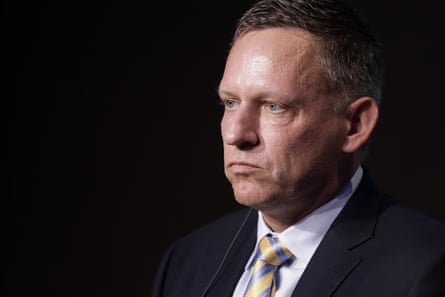
Peter Thiel in Tokyo in 2019

One might assume that it is contradictory for Trump, elected on a flag-waving “America first” platform, to lend credence to this vision of sovereign territories ruled over by billionaire god-kings. And much has been made of the colorful flame wars between the Maga mouth-piece Steve Bannon, a proud nationalist and populist, and the Trump-allied billionaires he has attacked as “technofeudalists” who “don’t give a flying fuck about the human being” – let alone the nation state. And conflicts inside Trump’s awkward, jerry-rigged coalition certainly exist, most recently reaching a boiling point over tariffs. Still, the underlying visions might not be as incompatible as they first appear.

The startup country contingent is clearly foreseeing a future marked by shocks, scarcity and collapse. Their high-tech private domains are essentially fortressed escape pods, designed for the select few to take advantage of every possible luxury and opportunity for human optimization, giving them and their children an edge in an increasingly barbarous future. To put it bluntly, the most powerful people in the world are preparing for the end of the world, an end they themselves are frenetically accelerating.

That is not so far away from the more mass-market vision of fortressed nations that has gripped the hard right globally, from Italy to Israel, Australia to the United States: in a time of ceaseless peril, openly supremacist movements in these countries are positioning their relatively wealthy states as armed bunkers. These bunkers are brutal in their determination to expel and imprison unwanted humans (even if that requires indefinite confinement in extra-national penal colonies from Manus Island to Guantánamo Bay) and equally ruthless in their willingness to violently claim the land and resources (water, energy, critical minerals) they deem necessary to weather the coming shocks.

Interestingly, at a time when previously secular Silicon Valley elites are suddenly finding Jesus, it is noteworthy that both of these visions – the priority-pass corporate state and the mass-market bunker nation – share a great deal in common with the Christian fundamentalist interpretation of the biblical Rapture, when the faithful will supposedly be lifted up to a golden city in heaven, while the damned are left to endure an apocalyptic final battle down here on earth.

If we are to meet our critical moment in history, we need to reckon with the reality that we are not up against adversaries we have seen before. We are up against end times fascism.

Reflecting on his childhood under Mussolini, the novelist and philosopher Umberto Eco observed in a celebrated essay that fascism typically has an “Armageddon complex” – a fixation on vanquishing enemies in a grand final battle. But European fascism of the 1930s and 1940s also had a horizon: a vision for a future golden age after the bloodbath that, for its in-group, would be peaceful, pastoral and purified. Not today.

Alive to our era of genuine existential danger – from climate breakdown to nuclear war to sky-rocketing inequality and unregulated AI – but financially and ideologically committed to deepening those threats, contemporary far-right movements lack any credible vision for a hopeful future. The average voter is offered only remixes of a bygone past, alongside the sadistic pleasures of dominance over an ever-expanding assemblage of dehumanized others.

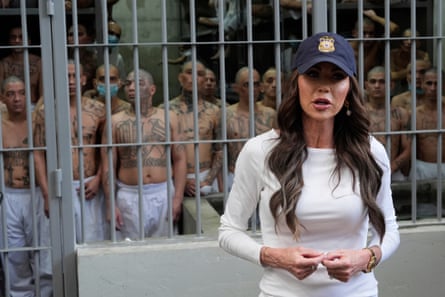
And so we have the Trump administration’s dedication to releasing its steady stream of real and AI-generated propaganda designed solely for these pornographic purposes. Footage of shackled immigrants being loaded on to deportation flights, set to the sounds of clanking chains and locking cuffs, which the official White House X account labeled “ASMR”, a reference to audio designed to calm the nervous system. Or the same account sharing news of the detention of Mahmoud Khalil, a US permanent resident who was active in Columbia University’s pro-Palestinian encampment, with the gloating words: “SHALOM, MAHMOUD.” Or any number of homeland security secretary Kristi Noem’s sadism-chic photo ops (atop a horse at the US-Mexican border, in front of a crowded prison cell in El Salvador, slinging a machine gun while arresting immigrants in Arizona …).

Kristi Noem speaks during a tour of an El Salvador prison in March 2025

The governing ideology of the far right in our age of escalating disasters has become a monstrous, supremacist survivalism.

It is terrifying in its wickedness, yes. But it also opens up powerful possibilities for resistance. To bet against the future on this scale – to bank on your bunker – is to betray, on the most basic level, our duties to one another, to the children we love, and to every other life form with whom we share a planetary home. This is a belief system that is genocidal at its core and treasonous to the wonder and beauty of this world. We are convinced that the more people understand the extent to which the right has succumbed to the Armageddon complex, the more they will be willing to fight back, realizing that absolutely everything is now on the line.

Our opponents know full well that we are entering an age of emergency, but have responded by embracing lethal yet self-serving delusions. Having bought into various apartheid fantasies of bunkered safety, they are choosing to let the Earth burn. Our task is to build a wide and deep movement, as spiritual as it is political, strong enough to stop these unhinged traitors. A movement rooted in a steadfast commitment to one another, across our many differences and divides, and to this miraculous, singular planet.

Not so long ago, it was primarily religious fundamentalists who greeted signs of apocalypse with gleeful excitement about the long-awaited Rapture. Trump has handed critical posts to people who subscribe to that fiery orthodoxy, including several Christian Zionists who see Israel’s use of annihilatory violence to expand its territorial footprint not as illegal atrocities but as felicitous evidence that the Holy Land is getting closer to the conditions under which the Messiah will return, and the faithful will get their celestial kingdom.

Mike Huckabee, Trump’s newly confirmed ambassador to Israel, has strong ties to Christian Zionism, as does Pete Hegseth, his secretary of defense. Noem and Russell Vought, the Project 2025 architect who now leads the office of budget and management, are both staunch advocates for Christian nationalism. Even Thiel, who is gay and notorious for his party lifestyle, has been heard musing about the arrival of the antichrist of late (spoiler: he thinks it’s Greta Thunberg, more on that soon).

But you don’t need to be a biblical literalist, or even religious, to be an end times fascist. Today, plenty of powerful secular people have embraced a vision of the future that follows a nearly identical script, one in which the world as we know it collapses under its weight and a chosen few survive and thrive in various kinds of arks, bunkers and gated “freedom cities”. In a 2019 paper titled Left Behind: Future Fetishists, Prepping and the Abandonment of Earth, the communication scholars Sarah T Roberts and Mél Hogan described the longing for a secular Rapture: “In the accelerationist imaginary, the future is not about harm reduction, limits or restoration; rather it is a politics driving toward an endgame.”

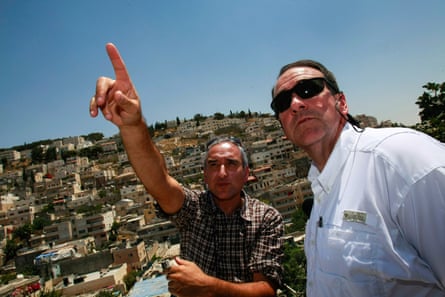
Mike Huckabee touring Jewish settlements in East Jerusalem in 2008

Elon Musk, who dramatically grew his fortune alongside Thiel at PayPal, embodies this implosive ethos. This is a person who looks up at the wonders of the night sky and apparently sees only opportunities to fill that inky unknown with his own space junk. Though he burnished his reputation warning about the dangers of the climate crisis and AI, he and his so-called “department of government efficiency” (Doge) henchmen now spend their days escalating those same risks (and many others) by slashing not only environmental regulations but entire regulatory agencies, with the apparent end goal of replacing federal workers with chatbots.

Who needs a functioning nation state when outer space – now reportedly Musk’s singular obsession – beckons? For Musk, Mars has become a secular ark, which he claims is key to the survival of human civilization, perhaps via uploaded consciousnesses to an artificial general intelligence. Kim Stanley Robinson, author of the sci-fi Mars Trilogy that appears to have partially inspired Musk, is blunt about the dangers of the billionaire’s fantasies about colonizing Mars. It is, he says, “just a moral hazard that creates the illusion we can wreck Earth and still be okay. It’s totally not true.”

quarta-feira, 24 de julho de 2024

O catolicismo de J.D. Vance. Perfil teológico do herdeiro aparente de Trump


Em 15 de julho, menos de uma semana antes de Joe Biden abandonar a corrida presidencial, Donald Trump escolheu JD Vance, o senador de 39 anos de Ohio (eleito em novembro de 2022) como seu companheiro de chapa. Se eleito com Trump em 5 de novembro, Vance seria o segundo vice-presidente católico na história dos EUA depois de Biden. No entanto, ele seria o primeiro católico “convertido” recente a ascender a essa posição, e isso diz muito sobre as trajetórias teológicas e políticas da Igreja nos Estados Unidos.

1. Um recém-convertido católico, parte de um movimento
Mais do que qualquer outra igreja no Ocidente, o catolicismo dos EUA tem uma parcela significativa de convertidos, ou seja, de membros que se juntaram à Igreja Católica quando adultos (sou casado com um deles). Há muitos convertidos recentes entre os católicos nos Estados Unidos que tornam sua fé pública. Na política, é uma mudança radical do "catolicismo de berço" de gerações mais velhas, como Joe Biden e Nancy Pelosi. Também difere da geração jovem de católicos no Partido Democrata, como Alexandria Ocasio-Cortez, que prioriza outros aspectos de suas identidade em sua política.

Vance falou abertamente sobre seu catolicismo no passado recente: a campanha de Trump entre agora e novembro pode precisar de alguns ajustes nessa mensagem. Ao se juntar à Igreja Católica, Vance faz parte de uma tendência maior de conversões de alto perfil. Nas últimas décadas, vários políticos, jornalistas e intelectuais públicos de persuasão conservadora se juntaram à Igreja Católica, vendo-a como a tradição cristã "mais antiga" e "conservadora". Em contraste com o protestantismo americano tradicional, eles veem essa conversão como um meio de salvar a América do declínio.

"A escolha de Vance de se juntar à Igreja Católica não interferiu, mas acompanhou sua conversão ao trumpismo."

Mas Vance fez isso durante os anos de Trump, durante seu (primeiro) mandato na Casa Branca, em 2019. A escolha de Vance de se juntar à Igreja Católica não interferiu, mas acompanhou sua conversão ao trumpismo; embora ele tivesse sido muito crítico de Trump apenas alguns anos antes, ele então abraçou e se tornou o rosto mais apresentável de Trump.

Sabe-se que os americanos tendem a mudar de igreja ou tradição religiosa frequentemente ao longo de suas vidas, mais do que outros cristãos no Ocidente. Vance foi exposto ao pregador batista do sul Billy Graham por sua avó, e ao pentecostalismo protestante quando adolescente, em uma família que, em seu best-seller de 2016 (com argumento político) Hillbilly Elegy. A Memoir of a Family and a Culture in Crisis (Harper 2016), ele descreveu como profundamente disfuncional. Ele o escreveu entre 2013 e 2015, vários anos antes de se tornar católico, e não dá nenhuma pista de que já tenha considerado o catolicismo. Vance menciona a palavra "católico" ou "católicos" apenas cinco vezes no livro de 264 páginas, e ele nunca se envolve com os ensinamentos católico.

Vance passou por um período de ateísmo, e seus esforços para resolver as contradições entre fé e ciência foram cruciais para sua adoção do cristianismo e do catolicismo. Como ele escreveu em seu ensaio autobiográfico publicado em 2020 na revista católica The Lamp, “Eu li Christopher Hitchens e Sam Harris, e me chamei de ateu.”

Ele foi batizado e confirmado na Igreja Católica em agosto de 2019 no Priorado de Santa Gertrudes em Cincinnati, Ohio, pelo Rev. Henry Stephan, um frade dominicano. Ele escolheu Santo Agostinho como seu santo padroeiro, como disse ao seu amigo e ideólogo "cristão" Rod Dreher (autor do manifesto best-seller internacional de 2017 The Benedict Option, que agora vive e trabalha na corte de Viktor Orban em Budapeste) numa entrevista de agosto de 2019 publicada no The American Conservative.

Vance é um jovem e recente católico que cresceu como um cristão não denominacional e superou muitos estereótipos negativos sobre o catolicismo típicos do protestantismo americano (o suposto antibiblicismo e a mariolatria). Nisso, há um certo orgulho em ser católico que é contracultural e se opõe à tendência dos progressistas liberais de culpar a Igreja Católica por vários males sociais, culturais e políticos. Para Vance, o cristianismo e a igreja não são o problema, mas a solução para os males do projeto político-religioso chamado Estados Unidos da América. Ele disse que as revelações sobre a crise de abuso na Igreja Católica atrasaram sua conversão, mas, no final, não a impediram. A eclesiologia de Agostinho da ecclesia permixta, feita de santos e pecadores, certamente ajuda os fiéis a superar o desgosto que levou muitos católicos de berço, tanto da esquerda quanto da direita, a deixar a igreja.

"Ele é um católico orgulhoso e, como muitos recém-convertidos do protestantismo, não traz o clericalismo consigo."

Ele também é alguém que escolheu o catolicismo como uma resposta à sua percepção dos limites do protestantismo americano, mas também de seu impacto limitado na cultura e na política dos EUA. Ele é um católico orgulhoso e, como muitos convertidos recentes do protestantismo, não traz o clericalismo consigo: há um "orgulho leigo" nesse tipo de catolicismo - o que não implica uma teologia progressista, mas é parte de um certo populismo eclesiológico e raiva conservadora contra a corrupção percebida do sistema eclesiástico e das hierarquias clericais.

2. Mais Vale do Silício do que Doutrina Social Católica
Vance é uma mistura de tecnocracia tipo Elon Musk e catolicismo civilizacional de Charles Maurras. Ele é um protegido de Peter Thiel (o bilionário gay que inventou, entre outras coisas, o PayPal), e a sua ascensão foi amplamente ajudada por um grupo de titãs da tecnologia. Vance personifica a aliança peculiar no GOP de hoje entre tradicionalistas culturais-religiosos (católicos, neste caso) e o Vale do Silício.

O dele é o antielitismo proclamado pelas novas elites, alimentando a raiva daqueles que são social e economicamente marginalizados. A escolha de Vance de abraçar a fé foi uma forma de expressar seu desprezo pelas elites intelectuais seculares: como ele escreveu em The Lamp, “O secularismo pode não ter sido um pré-requisito para se juntar às elites, mas certamente tornou as coisas mais fáceis”. O dele é um catolicismo muito americano, em certo sentido um “catolicismo 'América Primeiro'”, distante do Vaticano e do catolicismo global, que se tornou complacente com o “Make America Great Again” de Trump, bem como com seu gangsterismo e retórica violenta. A visão de Vance sobre as relações entre religião e política é mais próxima de Pat Buchanan, um dos principais ideólogos republicanos e católicos das “guerras culturais” desde a era Nixon, do que de João Paulo II ou Bento XVI.

Comparado a outros convertidos recentes dos EUA, ele tem sido menos polêmico contra o Papa Francisco (embora em 2021, ele educadamente discordou das restrições contra a "Missa Latina" pré-Vaticano II). Vance é um político e não pode prejudicar seu apelo aos católicos romanos, que não gostam de ver o papa atacado. O populismo de Vance nas políticas econômicas pode convergir com alguns aspectos da crítica do Papa Francisco ao capitalismo, mas apenas em um nível superficial. Na entrevista com Dreher, ele disse: "Acho que o Partido Republicano tem tido uma parceria por muito tempo entre conservadores sociais e libertários de mercado, e não acho que os conservadores sociais tenham se beneficiado muito dessa parceria. Parte do desafio do conservadorismo social para a viabilidade no século 21 é que ele não pode ser apenas sobre questões como o aborto, mas tem que ter uma visão mais ampla da economia política e do bem comum."

"Vance adotou o populismo como resposta às políticas neoliberais às quais o catolicismo progressista foi indiferente por muito tempo."

Certamente, há um mar de diferença entre a mensagem de Francisco sobre o meio ambiente e a imigração e o negacionismo de Vance, que é típico do Partido Republicano de hoje. Seu catolicismo não é o catolicismo social do século XX que pressupunha um papel forte para programas governamentais: Vance é apoiado por libertários do Vale do Silício que sabem que se beneficiarão de uma segunda presidência de Trump. Mas, em público, Vance abraçou o populismo como uma resposta contra as políticas neoliberais às quais o catolicismo progressista tem sido indiferente por muito tempo.

3. Teologia e Igreja: Agostinho e Aquino
Teologicamente, é relevante que Vance tenha sido batizado e confirmado (e tenha chegado a essa decisão) por meio de conexões e conversas com membros da Ordem Dominicana. Intelectualmente, é um mundo diferente da conexão de Biden com os jesuítas, a vanguarda do progressismo liberal católico americano, especialmente nas costas leste e oeste. A escolha de seu santo de confirmação confirma a importância fundamental do binômio Agostinho – Tomás de Aquino (interpretado de maneiras que muitas vezes diferem da teologia europeia e continental) para o catolicismo conservador, pós-liberal ou antiliberal nos EUA contemporâneos. Quando ele falou sobre Agostinho em seu artigo em The Lamp, Vance enfatizou não o lado doutrinário e eclesiológico, mas o pessoal-emocional (The Confessions) e o político-Weltanschauung (The City of God : "Eu era fã de Agostinho desde que um teórico político na faculdade designou City of God." Como acontece frequentemente hoje em dia em faculdades e universidades americanas, ele foi exposto ao catolicismo não por um teólogo, mas por um cientista político. Ele expressou interesse em René Girard graças (novamente) a Peter Thiel em 2013, seis anos antes de seu batismo e confirmação.

Ele é um político que pensou por muito tempo sobre religião, cristianismo e catolicismo, mas sem intelectualizá-los demais. Como ele disse várias vezes, "eu gosto que a Igreja Católica seja antiga". Ele não é um católico do Vaticano II: ele é mais a favor do ressourcement do que do aggiornamento em sua busca por solidez teológica e estabilidade doutrinária. O Concílio Vaticano II não aparece em seu panteão teológico, nem se encaixa em sua persona política: isso é típico de muitos convertidos católicos de convicções políticas e religiosas conservadoras. Mas à sua maneira, típico de todos os católicos americanos, incluindo aqueles do lado conservador do espectro, ele é um católico que não poderia viver sem o Vaticano II. Sua esposa, Usha, é filha de imigrantes da Índia e é hindu. Quando o casal se casou em 2014, eles realizaram duas cerimônias, incluindo uma em que um especialista hindu os abençoou. Quando se trata de religiões não cristãs, o islamismo é um assunto diferente, como convém ao companheiro de chapa de Trump: ele afirmou que o Reino Unido, sob o Partido Trabalhista, pode ser o primeiro país "verdadeiramente islâmico" com armas nucleares.

Ele está no lado oposto da doutrina social católica moldada pelo Vaticano II. Como Michael Sean Winters disse em 2022, “a fraudulência de Vance é discernida no fato de que, enquanto ele celebra o catolicismo como um veículo para sua visão sociocultural, ele se afasta do ensinamento da igreja em uma série de questões, da imigração aos direitos trabalhistas e às mudanças climáticas.”

Em 2021, Vance compareceu ao encontro anual do Instituto Napa de grandes doadores e influenciadores católicos de direita, com a participação de alguns bispos conservadores. Em 2022, ele participou de um evento público em uma universidade católica franciscana onde palestrantes argumentaram a favor do integralismo. Vance ainda precisa responder perguntas sobre seus próprios pensamentos a respeito do integralismo católico, isto é, sobre as relações entre a Igreja e o Estado, e suas opiniões sobre o recente aumento do pensamento integralista entre pensadores católicos dos EUA na última década. (Recentemente, Trump desmentiu o "Projeto 2025" da Heritage Foundation, propostas de política conservadora e de direita para remodelar o governo federal dos Estados Unidos e consolidar o poder executivo se ele vencesse a eleição presidencial de 2024. Mas em 2022, ele o endossou, e alguns de seus aliados estão por trás do projeto.)

Ele não fez mistério em uma entrevista recente com o colunista do New York Times Ross Douthat de que ele tolerou o que Trump fez em 6 de janeiro de 2021, em sua tentativa de derrubar o governo que levou a cinco mortes e à mais séria ameaça em gerações à estabilidade do sistema democrático de governo americano. Isso deve dar aos católicos dos EUA (bispos incluídos) que lutaram por pelo menos um século e meio para se tornarem parte do projeto de democracia constitucional na América alguma pausa.

4. Um rosto do novo catolicismo dos EUA
Para onde vai o catolicismo de Vance? Qual será seu efeito na política dos EUA e na igreja? Uma diferença importante em comparação a outros convertidos católicos proeminentes, Vance é um político, e ele precisa vencer no que agora é um país menos religioso, mesmo entre os conservadores, em comparação a apenas dez anos atrás.

Nós, crentes modernos, somos todos viajantes. Vance viajou do ateísmo ao catolicismo, do libertarianismo ao populismo econômico, dos Apalaches a Yale e ao Senado em Washington, DC, passando pelo Vale do Silício. Vance parece ter resolvido, à sua maneira, o famoso ditado do grande escritor católico americano Walker Percy (outro adulto convertido ao catolicismo), que disse uma vez que o homem moderno tem duas escolhas — Roma ou Califórnia. Vance ainda está viajando e pode ir muito mais longe, até mesmo à Casa Branca. Seu catolicismo público está sujeito a mais negociações do que para uma pessoa privada, um jornalista ou um pastor.

Não houve menção à igreja ou ao catolicismo em seu discurso de aceitação na Convenção Nacional Republicana, onde a religião figurou muito marginalmente, seguindo as dicas de Trump e um Partido Republicano mais secular e pós-cristão. Ele mudou sua posição sobre o aborto, deixando os católicos pró-vida com uma sensação de abandono. Mais do que pragmatismo moral contra a crueldade para as mulheres de algumas políticas antiaborto, sua mudança de posição soa como cinismo à luz do fato de que a decisão da Suprema Corte de 2022 "Dobbs" transformou o aborto em uma responsabilidade política para os republicanos. Em uma mensagem de arrecadação de fundos de campanha em 8 de julho, Vance pediu deportações em massa de imigrantes sem status legal, uma promessa também presente na plataforma do Partido Republicano. "Precisamos deportar cada pessoa que invadiu nosso país ilegalmente." É difícil entender como ele conciliará isso com a posição do Papa Francisco e dos bispos dos EUA sobre imigração.

Vance é um millennial neocatólico em uma América secularizada que ainda é o centro do Ocidente. Abraçar a fé é uma forma de dissidência cultural , uma dissidência que, embora genuína, pode se dar bem em uma aliança com tecnocratas neopagãos e antirreligiosos do Vale do Silício que governam o mundo.

O catolicismo americano não é mais apenas o refúgio de ideólogos conservadores, como foi entre os anos 1990 e alguns anos atrás. Agora é uma marca à venda, e Vance também chegou ao cenário nacional, político e global graças aos novos mestres do universo. Não está claro o quão interessado ele está pessoalmente em comprar essa marca e ser identificado com ela porque depende das necessidades políticas determinadas por seu mestre, Donald Trump. Mas outros estão comprando essa marca, pessoas politicamente próximas ao seu partido.

A escolha de Trump marca “a unção de um vice-presidente jovem e herdeiro aparente”, como seu amigo, colunista do New York Times e companheiro convertido católico Ross Douthat colocou. Se eleito com Donald Trump, JD Vance pode não apenas acabar comandando o país, mas também contribuir daquele púlpito para mudar a Igreja Católica nos Estados Unidos.