Today, the
Copernicus Climate Change Service (C3S), implemented by the European Centre for Medium-Range Weather Forecasts (ECMWF) on behalf of the European Commission with funding from the European Union, releases new data showing that the last seven years globally were the seven warmest on record by a clear margin. Within these seven years, 2021 ranks among the cooler years, alongside 2015 and 2018. Meanwhile, Europe experienced its warmest summer on record, though close to previous warmest summers in 2010 and 2018. In conjunction with the
Copernicus Atmosphere Monitoring Service (CAMS), C3S also reports that preliminary analysis of satellite measurements confirm that atmospheric greenhouse gas concentrations continued to rise during 2021, with carbon dioxide (CO2) levels reaching an annual global column-averaged record of approximately 414 ppm, and methane (CH4) an annual record of approximately 1876 ppb. Carbon emissions from wildfires worldwide amounted overall to 1850 megatonnes, especially fuelled by fires in Siberia. This was slightly higher than last year (1750 megatonnes of carbon emissions), although, the trend since 2003 is declining.
Global surface air temperatures
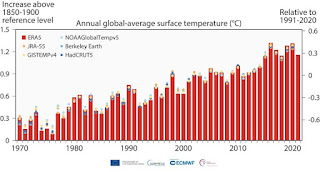
Globally, 2021 was the fifth warmest year on record, but only marginally warmer than 2015 and 2018
The annual average temperature was 0.3°C above the temperature of the 1991-2020 reference period, and 1.1-1.2°C above the pre-industrial level of 1850-1900
The last seven years have been the warmest years on record by a clear margin
Globally, the first five months of the year experienced relatively low temperatures compared to the recent very warm years. From June until October, however, monthly temperatures were consistently at least amongst the fourth warmest on record. Temperatures of the last 30 years (1991-2020) were close to 0.9°C above the pre-industrial level. Compared to this latest 30-year reference period, regions with most above average temperatures include a band stretching from the west coast of the USA and Canada to north-eastern Canada and Greenland, as well as large parts of central and northern Africa and the Middle East. The most below-average temperatures were found in western and easternmost Siberia, Alaska, over the central and eastern Pacific – concurrent with La Niña conditions at the beginning and the end of the year –, as well as in most of Australia and in parts of Antarctica.Annual averages of global air temperature at a height of two metres estimated change since the pre-industrial period (left-hand axis) and relative to 1991-2020 (right-hand axis) according to different datasets: Red bars: ERA5 (ECMWF Copernicus Climate Change Service, C3S); Dots: GISTEMPv4 (NASA); HadCRUT5 (Met Office Hadley Centre); NOAAGlobalTempv5 (NOAA), JRA-55 (JMA); and Berkeley Earth. Credit: Copernicus Climate Change Service/ECMWF
For the year as a whole, Europe was just 0.1 °C above the 1991-2020 average, which ranks outside the ten warmest years
The ten warmest years for Europe have all occurred since 2000, with the seven warmest years being 2014-2020
The last months of winter and the whole of spring were generally close to or below the 1991-2020 average over Europe. A cold phase in April, after a relatively warm March, caused late season frost in the western parts of the continent. Conversely, the 2021 European summer was the warmest on record, though close to previous warmest summers in 2010 and 2018. June and July were both the second warmest of their respective months, while August was close to average overall, but saw a large split between above-average temperatures in the south and below-average temperatures in the north.
European summer extreme events
Several high-impact extreme events happened during summer 2021 in Europe. July saw a very heavy rainfall event in western central Europe in a region with soils close to saturation, leading to severe floods in several countries, with the most heavily impacted including Germany, Belgium, Luxembourg, and the Netherlands. The Mediterranean region experienced a heatwave during July and part of August, with high temperatures particularly affecting Greece, Spain, and Italy. The European record for maximum temperature was broken in Sicily, where 48.8°C was reported, 0.8°C above the previous high, though this new record is still to be officially confirmed by the World Meteorological Organization (WMO). Hot and dry conditions preceded intense and prolonged wildfires, particularly in the eastern and central Mediterranean with Turkey being one of the most impacted countries, in addition to Greece, Italy, Spain, Portugal, Albania, North Macedonia, Algeria, and Tunisia.
During 2021, several regions in North America experienced large temperature anomalies. In Northeast Canada, average monthly temperatures were unusually warm during both the start of the year and autumn. An exceptional heatwave occurred in western North America in June, with maximum temperature records broken by several degrees Celsius, resulting in the warmest June on record for the continent. Regional hot and dry conditions exacerbated a series of extreme wildfires throughout July and August. The worst affected areas were several Canadian provinces and west coast states in the USA, though not all regions were equally impacted. The second largest fire recorded in California’s history, the ‘Dixie Fire’, not only caused widespread devastation, but resulted in a significant reduction of air quality for thousands of people from the pollution. Air quality was reduced across the continent, as particulate matter and other pyrogenic pollutants emitted from the fires were transported eastward. In all, North America experienced the highest amount of carbon emissions - 83 megatonnes, and other pyrogenic emissions
from wildfires for any summer in the CAMS data record starting in 2003.
CO2 and CH4 concentrations continue to rise in 2021
Preliminary analysis of satellite data shows that the trend of steadily rising carbon dioxide concentrations continued in 2021 leading to an annual global column-averaged record (XCO2) of approximately 414.3 ppm. The month with the highest concentration was April 2021, when global monthly mean XCO2 reached 416.1 ppm. The estimated global annual mean XCO2 growth rate for 2021 was 2.4 ± 0.4 ppm/year. This is similar to the growth rate in 2020, which was 2.2 ± 0.3 ppm/year. It is also close to the average growth rate of approximately 2.4 ppm/year seen since 2010, but below the high growth rates of 3.0 ppm/year in 2015 and 2.9 ppm/year 2016, associated with a strong El Niño climate event.Monthly global CH4 concentrations from satellites (top panel) and derived annual mean growth rates (bottom panel) for 2003–2021. Top: The listed numerical values in red indicate annual XCH4 averages in the latitude range 60oS – 60oN. Bottom: Annual mean XCH4 growth rates derived from data shown in the top panel. The listed numerical values correspond to the growth rate in ppb/year including an uncertainty estimate in brackets.
Atmospheric methane concentrations have also continued to rise in 2021 according to preliminary analysis of satellite data, thereby reaching an unprecedented global column-averaged (XCH4) maximum of approximately 1876 ppb. The estimated annual mean XCH4 growth rate for 2021 was 16.3 ± 3.3 ppb/year. This is slightly larger than the growth rate in 2020, which was 14.6 ± 3.1 ppb/year. Both rates are very high compared to rates of the preceding two decades of satellite data. However, at present it is not fully understood why this is the case. The identification of the origin of the increase is challenging as methane has many sources, with some anthropogenic (e.g., exploitation of oil and gas fields) but also some natural or semi-natural ones (e.g., wetlands).
Mauro Facchini, Head of Earth Observation at the Directorate General for Defence Industry and Space, European Commission, comments: “Europe's commitment to respond to the Paris agreement can only be achieved through effective analysis of climate information. The Copernicus Climate Change Service provides an essential global resource through operational, high-quality information about the state of our climate that is instrumental for both climate mitigation and adaptation policies. The 2021 analysis, showing that globally the warmest years by far were recorded in the last seven years, is a reminder of the continued increase in global temperatures and the urgent necessity to act.”
Carlo Buontempo, Director of the Copernicus Climate Change Service, adds: "2021 was yet another year of extreme temperatures with the hottest summer in Europe, heatwaves in the Mediterranean, not to mention the unprecedented high temperatures in North America. The last seven years have been the seven warmest on record. These events are a stark reminder of the need to change our ways, take decisive and effective steps toward a sustainable society and work towards reducing net carbon emissions.”
Vincent-Henri Peuch, Director of the Copernicus Atmosphere Monitoring Service, concludes: “Carbon dioxide and methane concentrations are continuing to increase year on year and without signs of slowing down. These greenhouse gases are the main drivers of climate change. This is why the new observation-based service led by CAMS to support monitoring and verification of anthropogenic CO2 and CH4 emissions estimates will be a crucial tool to assess the effectiveness of emissions mitigation measures. Only with determined efforts backed up by observational evidence can we make a real difference in our fight against the climate catastrophe.”
C3S will comprehensively review different 2021 climate events in Europe in its annual
European State of the Climate, due to be published in April 2022.


