
Mostrar mensagens com a etiqueta GPI. Mostrar todas as mensagens
Mostrar mensagens com a etiqueta GPI. Mostrar todas as mensagens
terça-feira, 20 de janeiro de 2026
Por uma Economia da Felicidade e dizer não ao regresso do Fascismo

quinta-feira, 24 de julho de 2025
Portugal sobe uma posição (7º lugar em 163) e ultrapassa a Dinamarca na lista de países mais seguros do mundo

O GPI é elaborado pelo Institute for Economics & Peace. E cruzando outros dados como a OCDE, Numbeo e Ministério da Coesão Territorial/Interior de ambos os países, obtemos os seguintes resultados:
1º Taxas de homicídio
Dinamarca: Cerca de 0,8 a 1,0 caso por 100.000 habitantes.
Portugal: Cerca de 0,6 a 0,8 casos por 100.000 habitantes.
→ Ambas as taxas são consideradas muito baixas e estão entre as mínimas históricas da Europa Ocidental. A diferença entre elas é, normalmente, inferior a 0,3 pontos percentuais.
→ Ambas as taxas são consideradas muito baixas e estão entre as mínimas históricas da Europa Ocidental. A diferença entre elas é, normalmente, inferior a 0,3 pontos percentuais.
2.º Furto (crimes contra a propriedade, especialmente roubos reportados por 100.000 habitantes):
Dinamarca: Tende a ter uma taxa moderadamente mais elevada de pequenos furtos (por exemplo, furto de bolsa ou furto de carteira), embora isto varie de acordo com a cidade.
Portugal: Apresenta também taxas baixas, ligeiramente inferiores às da Dinamarca em geral.
Dinamarca: Tende a ter uma taxa moderadamente mais elevada de pequenos furtos (por exemplo, furto de bolsa ou furto de carteira), embora isto varie de acordo com a cidade.
Portugal: Apresenta também taxas baixas, ligeiramente inferiores às da Dinamarca em geral.
No geral, Portugal tem taxas de homicídio e de roubo ligeiramente mais baixas do que a Dinamarca, mas a diferença não é drástica.
Consultar relatório do GPI completo aqui
No ranking FIFA a nossa selecção é 7ª e no ranking UEFA os nossos clubes seguem em 5° (Porto) e 7º (Benfica)


Conclusão: Estamos melhor em segurança do que em futebol contudo, em ambas, quase lideramos o mundo
domingo, 29 de junho de 2025
Europe’s Security Gamble: NATO’s New Budget Push
.jfif)
Across Europe, budgets are tightening, classrooms are overcrowded, hospitals are understaffed, and climate targets are slipping out of reach. Yet, in the midst of this so-called austerity, NATO countries are preparing to commit to something extraordinary: raising military spending to 5% of GDP. At a time when governments claim there’s “no money” for essential services, this massive shift demands scrutiny. Who benefits from this build-up? What are we sacrificing to fund it? And most importantly, is this really what security looks like in the 21st century?
Can NATO’s military build-up coexist with Europe’s climate and peace goals?
The world seems to be becoming a less safe place. According to the 2024 Global Peace Index, the world is now witnessing the highest number of armed conflicts since World War II. Regardless of the origins of the conflicts or the actors involved, the outcomes are often very similar: significant civilian casualties, large-scale displacement, and systematic violations of human rights and international humanitarian law. Just in the past year, 160,000 people died in conflict, with Ukraine accounting for 83,000 deaths and Palestine for at least 33,000 as of April 2024.
Faced with this grim reality, governments are ramping up military budgets. In 2024, global military spending surged to a record-breaking $2.7 trillion, the sharpest increase since the end of the Cold War and the tenth consecutive year of rising expenditures. European countries, particularly NATO members, are following this trend. Over the past decade, defence spending by EU NATO member states rose by 45%, from €145 billion in 2014 to an estimated €326 billion in 2024. That is about 1.9% of EU GDP, edging closer to NATO’s current 2% target, and equivalent to the entire annual GDP of several EU member states such as Finland, Portugal, or the Czech Republic.
But here’s the rub: this rapid increase is happening even as public finances are under increasing pressure. Overall, government spending in NATO EU countries grew by just 20% in real terms over the past decade, while defence budgets jumped by more than double that. Spending on health grew 34%, education just 12%, and environmental protection 10%. This highlights a growing imbalance of EU priorities.
A big chunk of this money is going straight into arms and military equipment. In 2024, EU NATO spent €90bn on military hardware, a staggering 50% increase over 2023, accounting for nearly 90% of all defence investments. But does buying more arms make us safer? That depends on what we’re buying, why, who benefits, and what kind of “security” we want. At the same time, the freshly reformed EU fiscal rules have been suspended to allow an increase in military spending, without any changes to the need to generally reduce budgets, meaning austerity still applies.
At NATO’s upcoming summit in The Hague on 24 June, there is momentum to raise the alliance’s defence spending target from 2% to an alarming 5% of GDP. This article does not aim to argue whether military defence is needed. But it encourages us to ask, how much is too much? Who’s profiting? And what does this mean for Europe’s democratic and social fabric? Because a jump to 5% won’t just tweak budgets – it will transform priorities for decades to come. This is not a technical or isolated defence issue. As budgets are redirected toward weapons and away from healthcare, education, housing, nature protection, and green transitions, we must ask: What kind of Europe are we building? If civil society does not pose the right questions, this decision risks being made behind closed doors, without a clear democratic mandate or transparent debate.
What kind of security are we talking about?
Europe needs to be able to defend itself, but one key piece is missing: a serious, independent assessment of what Europe needs to do so. Peace researchers Herbert Wulf and Christopher Steinmetz, in a report commissioned by Greenpeace, found that even without the U.S., NATO Europe far surpasses Russia in nearly all key military parameters. The idea that we are dramatically underprepared is not supported by the data. So, why the rush to build up? What threats are driving this? Are we confronting non-military threats like cyber-attacks, disinformation, or economic coercion with the same urgency as discussions around “air and missile defence” or “long-range weapons, logistics, and large land manoeuvre formations” as suggested by NATO Secretary General Mark Rutte?
Framing defence needs as a percentage of GDP doesn’t help; it’s arbitrary. The proposed 5% defence target is not based on a transparent, evidence-based assessment of actual security needs. Using a percentage of GDP doesn’t reflect either the actual capabilities or military efficiency, nor differences in country size or economic performance, and non-military security needs (e.g., climate, energy, cyber resilience). It’s also proposed without public debate on the consequences for health, education, climate, or social spending.
In short, basing policy on a percentage of GDP distracts from the real work of defining what “security” means and how to achieve it holistically.
Who is benefiting from the increase in military spending?
Follow the money, and another pattern emerges: Europe isn’t just spending more – it’s spending outward. Nearly 80% of European defence procurement is imported, mostly from the United States. So, are our investments really strengthening European security and resilience, or simply boosting American military firms? And what happens when those suppliers are tied to fossil fuel lobbies, political instability, or unpredictable presidents? Let’s not forget: the U.S. military industry played a key role in Trump’s last campaign and could again. By feeding this system, are we fuelling the very instability we claim to resist?
Meanwhile, public money flows steadily into the hands of military shareholders. Where do we draw the line? What becomes of budgets meant for healthcare, education, childcare, housing, nature protection and the climate? If we see direct transfers from public pockets to company shareholders as part of the industrial-military complex, would the wealthiest rentiers not again reap profits at the expense of taxpayers? When arms companies and investment funds profit from conflict, how do we safeguard democratic oversight? Should we revisit, if not reverse, the privatisation of military industries to preempt a situation where profits depend on global unrest?
This is more than just a budget issue. It’s a structural shift that could weaken democracy, deepen inequality, and make conflict more profitable than peace.
How beneficial is militarisation for economic performance and jobs?
Not in the way some claim. Military spending may look like an economic stimulus, but evidence shows otherwise. Military expenditure often has a smaller multiplier effect compared to green and social investments. It creates fewer jobs per euro spent than health, education, or green investment. That’s because defence projects are capital-intensive, dominated by a handful of companies, and often happen outside the EU.
Compare that to investments in energy efficiency, renewables, public transport, care work, or nature restoration, which generate more employment, faster returns, and healthier communities. At a time of fiscal constraint, prioritising defence risks crowding out essential public services, deepening social inequalities, and weakening economic resilience.
And what about the climate and the environment?
Militarisation comes with a hefty environmental price tag, long before war ever breaks out. Military forces are among the world’s biggest energy users. Building and maintaining military forces consume large amounts of fossil fuels, critical minerals, and water, which places a strain on ecosystems and contributes to global emissions. Control over such materials has become a strategic priority, influencing geopolitical decisions in regions like Ukraine and the DRC. Day-to-day military readiness requires constant training, and training means consuming resources and energy, notably oil, with low levels of energy efficiency.
The global military carbon footprint is estimated at 5.5% of all greenhouse gas emissions, yet it’s mostly invisible in climate accounting frameworks. That means countries can meet climate targets on paper while quietly ramping up emissions through their armies.
There’s also the question of land. Militaries also occupy vast land and sea areas, up to 6% of the planet’s surface, including ecologically sensitive zones. Some areas may be shielded by restricted access, but many suffer heavy degradation from training, testing, and infrastructure. Pollution, habitat loss, and contamination are all common issues, with little to no public accountability.
This raises a fundamental issue: what if military “readiness” is undermining planetary stability, the very foundation of long-term peace?
A turning point
We are living through uncertain, volatile times. The threats are real, but so are the choices.
We can choose to define security broadly, not just as the absence of war but as the presence of care, fairness, resilience, and sustainability. We can build safety from the ground up — with strong communities, thriving nature, and just economies.
Or we can double down on outdated models of defence, lock in spending that benefits the few, and lose sight of the Europe we claim to defend. Civil society must not shy away from this debate.
Because in the end, security isn’t just about protecting borders; it’s about protecting what matters most.
Gaza’s Hunger Games - Os jogos da fome de Gaza. Artigo de Chris Hedges

Israel’s weaponization of starvation is how genocides always end. I covered the insidious effects of orchestrated starvation in the Guatemalan Highlands during the genocidal campaign of Gen. Efraín Ríos Montt, the famine in southern Sudan that left a quarter of a million dead — I walked past the frail and skeletal corpses of families lining roadsides — and later during the war in Bosnia when Serbs cut off food supplies to enclaves such as Srebrencia and Goražde.
Starvation was weaponized by the Ottoman Empire to decimate the Armenians. It was used to kill millions of Ukrainians in the Holodomor in 1932 and 1933. It was employed by the Nazis against the Jews in the ghettos in World War II. German soldiers used food, as Israel does, like bait. They offered three kilograms of bread and one kilogram of marmalade to lure desperate families in the Warsaw Ghetto onto transports to the death camps. “There were times when hundreds of people had to wait in line for several days to be ‘deported,’” Marek Edelman writes in “The Ghetto Fights.” “The number of people anxious to obtain the three kilograms of bread was such that the transports, now leaving twice daily with 12,000 people, could not accommodate them all.” And when crowds became unruly, as in Gaza, the German troops fired deadly volleys that ripped through emaciated husks of women, children and the elderly.
This tactic is as old as warfare itself.
The report in the Israeli newspaper Haaretz, that Israeli soldiers are ordered to shoot into crowds of Palestinians at aid hubs, with 580 killed and 4,216 wounded, is not a surprise. It is the predictable denouement of the genocide, the inevitable conclusion to a campaign of mass extermination.
Israel, with its targeted assassinations of at least 1,400 health care workers, hundreds of United Nations (U.N.) workers, journalists, police and even poets and academics, its obliteration of multi-story apartment blocks wiping out dozens of families, its shelling of designated “humanitarian zones” where Palestinians huddle under tents, tarps or in the open air, its systematic targeting of U.N. food distribution centers, bakeries and aid convoys or its sadistic sniper fire that guns down children, long ago illustrated that Palestinians are regarded as vermin worthy only of annihilation.
The blockade of food and humanitarian aid, imposed on Gaza since March 2, is reducing Palestinians to abject dependence. To eat, they must crawl towards their killers and beg. Humiliated, terrified, desperate for a few scraps of food, they are stripped of dignity, autonomy and agency. This is by intent.
Yousef al-Ajouri, 40, explained to Middle East Eye his nightmarish journey to one of four aid hubs set up by the Gaza Humanitarian Foundation (GHF). The hubs are not designed to meet the needs of the Palestinians, who once relied on 400 aid distribution sites, but to lure them from northern Gaza to the south. Israel, which on Sunday again ordered Palestinians to leave northern Gaza, is steadily expanding its annexation of the coastal strip. Palestinians are corralled like livestock into narrow metal chutes at distribution points which are overseen by heavily armed mercenaries. They receive, if they are one of the fortunate few, a small box of food.
Al-Ajouri, who before the genocide was a taxi driver, lives with his wife, seven children and his mother and father in a tent in al-Saraya, near the middle of Gaza City. He set out to an aid hub at Salah al-Din Road near the Netzarim corridor, to find some food for his children, who he said cry constantly “because of how hungry they are.” On the advice of his neighbor in the tent next to him, he dressed in loose clothing “so that I could run and be agile.” He carried a bag for canned and packaged goods because the crush of the crowds meant “no one was able to carry the boxes the aid came in.”
He left at about 9 p.m. with five other men “including an engineer and a teacher,” and “children aged 10 and 12.” They did not take the official route designated by the Israeli army. The massive crowds converging on the aid point along the official route ensure that most never get close enough to receive food. Instead, they walked in the darkness in areas exposed to Israeli gunfire, often having to crawl to avoid being seen.
“As I crawled, I looked over, and to my surprise, saw several women and elderly people taking the same treacherous route as us,” he explained. “At one point, there was a barrage of live gunfire all around me. We hid behind a destroyed building. Anyone who moved or made a noticeable motion was immediately shot by snipers. Next to me was a tall, light-haired young man using the flashlight on his phone to guide him. The others yelled at him to turn it off. Seconds later, he was shot. He collapsed to the ground and lay there bleeding, but no one could help or move him. He died within minutes.”
He passed six bodies along the route who had been shot dead by Israeli soldiers.
Al-Ajouri reached the hub at 2 a.m., the designated time for aid distribution. He saw a green light turned on ahead of him which signaled that aid was about to be distributed. Thousands began to run towards the light, pushing, shoving and trampling each other. He fought his way through the crowd until he reached the aid.
“I started feeling around for the aid boxes and grabbed a bag that felt like rice,” he said. “But just as I did, someone else snatched it from my hands. I tried to hold on, but he threatened to stab me with his knife. Most people there were carrying knives, either to defend themselves or to steal from others. Eventually, I managed to grab four cans of beans, a kilogram of bulgur, and half a kilogram of pasta. Within moments, the boxes were empty. Most of the people there, including women, children and the elderly, got nothing. Some begged others to share. But no one could afford to give up what they managed to get.”
The U.S. contractors and Israeli soldiers overseeing the mayhem laughed and pointed their weapons at the crowd. Some filmed with their phones.
“Minutes later, red smoke grenades were thrown into the air,” he remembered. “Someone told me that it was the signal to evacuate the area. After that, heavy gunfire began. Me, Khalil and a few others headed to al-Awda Hospital in Nuseirat because our friend Wael had injured his hand during the journey. I was shocked by what I saw at the hospital. There were at least 35 martyrs lying dead on the ground in one of the rooms. A doctor told me they had all been brought in that same day. They were each shot in the head or chest while queuing near the aid center. Their families were waiting for them to come home with food and ingredients. Now, they were corpses.”
GHF is a Mossad-funded creation of Israel’s Defense Ministry that contracts with UG Solutions and Safe Reach Solutions, run by former members of the CIA and U.S. Special Forces. GHF is headed by Rev. Johnnie Moore, a far-right Christian Zionist with close ties to Donald Trump and Benjamin Netanyahu. The organization has also contracted anti-Hamas drug-smuggling gangs to provide security at aid sites.
As Chris Gunness, a former spokesperson for the United Nations Relief and Work Agency (UNRWA) told Al Jazeera, GHF is “aid washing,” a way to mask the reality that “people are being starved into submission.”
Israel, along with the U.S. and European countries that provide weapons to sustain the genocide, have chosen to disregard the January 2024 ruling by the International Court of Justice (ICJ) which demanded immediate protection for civilians in Gaza and widespread provision of humanitarian assistance.
Haaretz, in its article headlined “‘It’s a Killing Field’: IDF Soldiers Ordered to Shoot Deliberately at Unarmed Gazans Waiting for Humanitarian Aid” reported that Israeli commanders order soldiers to open fire on crowds to keep them away from aid sites or disperse them.
“The distribution centers typically open for just one hour each morning,” Haaretz writes. “According to officers and soldiers who served in their areas, the IDF fires at people who arrive before opening hours to prevent them from approaching, or again after the centers close, to disperse them. Since some of the shooting incidents occurred at night — ahead of the opening — it’s possible that some civilians couldn't see the boundaries of the designated area.”
“It's a killing field,” one soldier told Haaretz. “Where I was stationed, between one and five people were killed every day. They're treated like a hostile force — no crowd-control measures, no tear gas — just live fire with everything imaginable: heavy machine guns, grenade launchers, mortars. Then, once the center opens, the shooting stops, and they know they can approach. Our form of communication is gunfire.”
“We open fire early in the morning if someone tries to get in line from a few hundred meters away, and sometimes we just charge at them from close range. But there’s no danger to the forces,” the soldier explained, “I’m not aware of a single instance of return fire. There’s no enemy, no weapons.”
He said the deployment at the aid sites is known as “Operation Salted Fish,” a reference to the Israeli name for the children’s game “Red light, green light.” The game was featured in the first episode of the South Korean dystopian thriller Squid Game, in which financially desperate people are killed as they battle each other for money.
Israel has obliterated the civilian and humanitarian infrastructure in Gaza. It has reduced Palestinians, half a million of whom face starvation, into desperate herds. The goal is to break Palestinians, to make them malleable and entice them to leave Gaza, never to return.
There is talk from the Trump White House about a ceasefire. But don’t be fooled. Israel has nothing left to destroy. Its saturation bombing over 20 months has reduced Gaza to a moonscape. Gaza is uninhabitable, a toxic wilderness where Palestinians, living amid broken slabs of concrete and pools of raw sewage, lack food and clean water, fuel, shelter, electricity, medicine and an infrastructure to survive. The final impediment to the annexation of Gaza are the Palestinians themselves. They are the primary target. Starvation is the weapon of choice.
Tradução aqui
terça-feira, 6 de maio de 2025
The rise of end times fascism

The movement for corporate city states cannot believe its good luck. For years, it has been pushing the extreme notion that wealthy, tax-averse people should up and start their own high-tech fiefdoms, whether new countries on artificial islands in international waters (“seasteading”) or pro-business “freedom cities” such as Próspera, a glorified gated community combined with a wild west med spa on a Honduran island.
Yet despite backing from the heavy-hitter venture capitalists Peter Thiel and Marc Andreessen, their extreme libertarian dreams kept bogging down: it turns out most self-respecting rich people don’t actually want to live on floating oil rigs, even if it means lower taxes, and while Próspera might be nice for a holiday and some body “upgrades”, its extra-national status is currently being challenged in court.
Now, all of a sudden, this once-fringe network of corporate secessionists finds itself knocking on open doors at the dead center of global power.
The first sign that fortunes were shifting came in 2023, when a campaigning Donald Trump, seemingly out of nowhere, promised to hold a contest that would lead to the creation of 10 “freedom cities” on federal lands. The trial balloon barely registered at the time, lost in the daily deluge of outrageous claims. Since the new administration took office, however, would-be country starters have been on a lobbying blitz, determined to turn Trump’s pledge into reality.
“The energy in DC is absolutely electric,” Trey Goff, the chief of staff of Próspera, recently enthused after a trip to Capitol Hill. Legislation paving the way for a bevy of corporate city-states should be complete by the end of the year, he claims.
Inspired by the political philosopher Albert Hirschman, figures including Goff, Thiel and the investor and writer Balaji Srinivasan have been championing what they call “exit” – the principle that those with means have the right to walk away from the obligations of citizenship, especially taxes and burdensome regulation. Retooling and rebranding the old ambitions and privileges of empires, they dream of splintering governments and carving up the world into hyper-capitalist, democracy-free havens under the sole control of the supremely wealthy, protected by private mercenaries, serviced by AI robots and financed by cryptocurrencies.
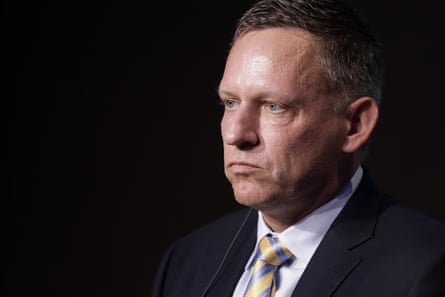
Peter Thiel in Tokyo in 2019
One might assume that it is contradictory for Trump, elected on a flag-waving “America first” platform, to lend credence to this vision of sovereign territories ruled over by billionaire god-kings. And much has been made of the colorful flame wars between the Maga mouth-piece Steve Bannon, a proud nationalist and populist, and the Trump-allied billionaires he has attacked as “technofeudalists” who “don’t give a flying fuck about the human being” – let alone the nation state. And conflicts inside Trump’s awkward, jerry-rigged coalition certainly exist, most recently reaching a boiling point over tariffs. Still, the underlying visions might not be as incompatible as they first appear.
The startup country contingent is clearly foreseeing a future marked by shocks, scarcity and collapse. Their high-tech private domains are essentially fortressed escape pods, designed for the select few to take advantage of every possible luxury and opportunity for human optimization, giving them and their children an edge in an increasingly barbarous future. To put it bluntly, the most powerful people in the world are preparing for the end of the world, an end they themselves are frenetically accelerating.
That is not so far away from the more mass-market vision of fortressed nations that has gripped the hard right globally, from Italy to Israel, Australia to the United States: in a time of ceaseless peril, openly supremacist movements in these countries are positioning their relatively wealthy states as armed bunkers. These bunkers are brutal in their determination to expel and imprison unwanted humans (even if that requires indefinite confinement in extra-national penal colonies from Manus Island to Guantánamo Bay) and equally ruthless in their willingness to violently claim the land and resources (water, energy, critical minerals) they deem necessary to weather the coming shocks.
Interestingly, at a time when previously secular Silicon Valley elites are suddenly finding Jesus, it is noteworthy that both of these visions – the priority-pass corporate state and the mass-market bunker nation – share a great deal in common with the Christian fundamentalist interpretation of the biblical Rapture, when the faithful will supposedly be lifted up to a golden city in heaven, while the damned are left to endure an apocalyptic final battle down here on earth.
If we are to meet our critical moment in history, we need to reckon with the reality that we are not up against adversaries we have seen before. We are up against end times fascism.
Reflecting on his childhood under Mussolini, the novelist and philosopher Umberto Eco observed in a celebrated essay that fascism typically has an “Armageddon complex” – a fixation on vanquishing enemies in a grand final battle. But European fascism of the 1930s and 1940s also had a horizon: a vision for a future golden age after the bloodbath that, for its in-group, would be peaceful, pastoral and purified. Not today.
Alive to our era of genuine existential danger – from climate breakdown to nuclear war to sky-rocketing inequality and unregulated AI – but financially and ideologically committed to deepening those threats, contemporary far-right movements lack any credible vision for a hopeful future. The average voter is offered only remixes of a bygone past, alongside the sadistic pleasures of dominance over an ever-expanding assemblage of dehumanized others.
And so we have the Trump administration’s dedication to releasing its steady stream of real and AI-generated propaganda designed solely for these pornographic purposes. Footage of shackled immigrants being loaded on to deportation flights, set to the sounds of clanking chains and locking cuffs, which the official White House X account labeled “ASMR”, a reference to audio designed to calm the nervous system. Or the same account sharing news of the detention of Mahmoud Khalil, a US permanent resident who was active in Columbia University’s pro-Palestinian encampment, with the gloating words: “SHALOM, MAHMOUD.” Or any number of homeland security secretary Kristi Noem’s sadism-chic photo ops (atop a horse at the US-Mexican border, in front of a crowded prison cell in El Salvador, slinging a machine gun while arresting immigrants in Arizona …).
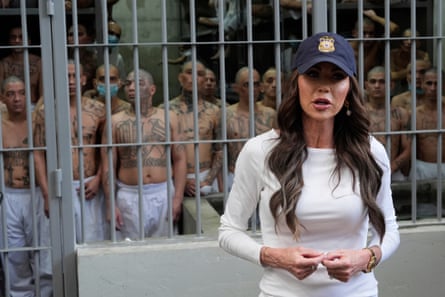
Kristi Noem speaks during a tour of an El Salvador prison in March 2025
The governing ideology of the far right in our age of escalating disasters has become a monstrous, supremacist survivalism.
It is terrifying in its wickedness, yes. But it also opens up powerful possibilities for resistance. To bet against the future on this scale – to bank on your bunker – is to betray, on the most basic level, our duties to one another, to the children we love, and to every other life form with whom we share a planetary home. This is a belief system that is genocidal at its core and treasonous to the wonder and beauty of this world. We are convinced that the more people understand the extent to which the right has succumbed to the Armageddon complex, the more they will be willing to fight back, realizing that absolutely everything is now on the line.
Our opponents know full well that we are entering an age of emergency, but have responded by embracing lethal yet self-serving delusions. Having bought into various apartheid fantasies of bunkered safety, they are choosing to let the Earth burn. Our task is to build a wide and deep movement, as spiritual as it is political, strong enough to stop these unhinged traitors. A movement rooted in a steadfast commitment to one another, across our many differences and divides, and to this miraculous, singular planet.
Not so long ago, it was primarily religious fundamentalists who greeted signs of apocalypse with gleeful excitement about the long-awaited Rapture. Trump has handed critical posts to people who subscribe to that fiery orthodoxy, including several Christian Zionists who see Israel’s use of annihilatory violence to expand its territorial footprint not as illegal atrocities but as felicitous evidence that the Holy Land is getting closer to the conditions under which the Messiah will return, and the faithful will get their celestial kingdom.
Mike Huckabee, Trump’s newly confirmed ambassador to Israel, has strong ties to Christian Zionism, as does Pete Hegseth, his secretary of defense. Noem and Russell Vought, the Project 2025 architect who now leads the office of budget and management, are both staunch advocates for Christian nationalism. Even Thiel, who is gay and notorious for his party lifestyle, has been heard musing about the arrival of the antichrist of late (spoiler: he thinks it’s Greta Thunberg, more on that soon).
But you don’t need to be a biblical literalist, or even religious, to be an end times fascist. Today, plenty of powerful secular people have embraced a vision of the future that follows a nearly identical script, one in which the world as we know it collapses under its weight and a chosen few survive and thrive in various kinds of arks, bunkers and gated “freedom cities”. In a 2019 paper titled Left Behind: Future Fetishists, Prepping and the Abandonment of Earth, the communication scholars Sarah T Roberts and Mél Hogan described the longing for a secular Rapture: “In the accelerationist imaginary, the future is not about harm reduction, limits or restoration; rather it is a politics driving toward an endgame.”
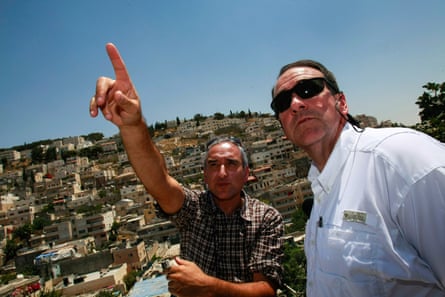
Mike Huckabee touring Jewish settlements in East Jerusalem in 2008
Elon Musk, who dramatically grew his fortune alongside Thiel at PayPal, embodies this implosive ethos. This is a person who looks up at the wonders of the night sky and apparently sees only opportunities to fill that inky unknown with his own space junk. Though he burnished his reputation warning about the dangers of the climate crisis and AI, he and his so-called “department of government efficiency” (Doge) henchmen now spend their days escalating those same risks (and many others) by slashing not only environmental regulations but entire regulatory agencies, with the apparent end goal of replacing federal workers with chatbots.
Who needs a functioning nation state when outer space – now reportedly Musk’s singular obsession – beckons? For Musk, Mars has become a secular ark, which he claims is key to the survival of human civilization, perhaps via uploaded consciousnesses to an artificial general intelligence. Kim Stanley Robinson, author of the sci-fi Mars Trilogy that appears to have partially inspired Musk, is blunt about the dangers of the billionaire’s fantasies about colonizing Mars. It is, he says, “just a moral hazard that creates the illusion we can wreck Earth and still be okay. It’s totally not true.”
quarta-feira, 15 de junho de 2022
Portugal entre os melhores no Índice Global de Paz apesar de descida ligeira
Portugal desceu uma posição no Índice Global de Paz de 2022, para sexto lugar entre 163 países, devido a um aumento da criminalidade e instabilidade política, segundo o relatório do Instituto de Economia e Paz (IEP).

Islândia e Nova Zelândia mantêm os dois primeiros lugares, seguidos pela Irlanda, que subiu três posições, ultrapassando a Dinamarca e Portugal. A Áustria também melhorou, para a 5.ª posição.
O fundador e diretor do IEP, Steve Killelea, desvalorizou a descida de Portugal, a qual atribuiu a "uma maior taxa de detenções, ligeiro aumento nas taxas de homicídio, um ligeiro aumento na instabilidade política e um ligeiro aumento nas perceções de criminalidade".
O Afeganistão é o país menos pacífico do mundo pelo quinto ano consecutivo, seguido pelo Iémen, Síria, Rússia e Sudão do Sul, países que estão entre os dez piores nos últimos três anos.
Devido à guerra em curso, entre os cinco países com as maiores deteriorações na paz estão a Rússia e a Ucrânia, juntamente com a República da Guiné, Burkina Faso e Haiti, também palco de conflitos.
O relatório indica que o mundo já começou a recuperar da pandemia de covid-19, mas que os efeitos ainda estão a ser sentidos, nomeadamente nos atrasos e problemas das cadeias de abastecimento, falta de produtos, preços mais elevados da energia e dos produtos alimentares.
O aumento da inflação, sobretudo na alimentação e combustíveis, "aumentou a insegurança alimentar e a instabilidade política globalmente, mas especialmente em regiões de baixa resiliência, como África Subsaariana, Sul da Ásia e Médio Oriente e Norte de África", escreveram os autores.
"É nessas condições já instáveis que a Rússia lançou um ataque à Ucrânia em fevereiro de 2022. O conflito só vai agravar ainda mais esses problemas. O conflito vai acelerar a inflação global, com as sanções ocidentais contribuindo ainda mais para a escassez e aumentos de preços", preveem.
Segundo o IEP, a paz piorou nos últimos catorze anos e, dos 163 países analisados no Índice, 84 registaram deterioração, enquanto 77 registaram melhorias e dois não registaram alteração.
O Índice Global de Paz, atualmente 16ª edição, faz uma análise sobre as tendências da paz, o valor económico e como desenvolver sociedades pacíficas, usando 23 indicadores qualitativos e quantitativos em três domínios: o nível de segurança e proteção social, a dimensão do Conflito Doméstico e Internacional em Curso, e o grau de militarização.
Ler mais:
sexta-feira, 29 de outubro de 2021
As alterações climáticas vão atuar como um multiplicador de ameaças
Serge Stroobants é o diretor para a Europa, Médio Oriente e Norte de África do Instituto de Economia e Paz, conhecido pelo seu Global Peace Index, e apresenta hoje em Lisboa o Relatório de Ameaças Ecológicas. Ao DN, por email, falou do aquecimento global e do aumento da violência no mundo.

Normalmente quando pensamos em aquecimento global ou alterações climáticas não pensamos em conflitos ou guerra. Qual é a ligação entre os dois conceitos?
O Relatório de Ameaças Ecológicas [ETR, na sigla em inglês] mostra que estas e as alterações climáticas representam sérias ameaças ao desenvolvimento global e à paz. Os efeitos adversos vão afetar de forma desproporcional os países mais pobres e mais vulneráveis do mundo e criar pressões indiretas nos países vizinhos através do movimento em massa de pessoas e extração de recursos. Construir resiliência às ameaças ecológicas será cada vez mais importante e irá requerer já hoje um investimento substancial. Muitas ameaças ecológicas existem independentemente das alterações climáticas. Contudo, estas têm um efeito amplificador, causando mais degradação ecológica e empurrando alguns países para pontos de inflexão violentos. Olhando para o futuro, as alterações climáticas vão atuar como um multiplicador de ameaças, exacerbando potencialmente a concorrência e tensões entre os países com menos recursos e resiliência.
E que países são esses?
O relatório identificou 30 países que são hotspots [pontos quentes], sendo que 28 desses 30 estão também na metade inferior do Global Peace Index [GPI] do Instituto de Economia e Paz. Onze dos 15 países com maior impacto ecológico estão já em conflito e os outros quatro países estão a cair na armadilha da violência e estão à beira desse conflito. Os recursos vão continuar a esgotar-se e a luta para aceder e eventualmente gerir esses recursos vai continuar a intensificar-se. Por exemplo, notámos um aumento de 270% nas disputas relacionadas com água na última década, concentradas em países como o Iraque ou o Iémen, mas também vimos um aumento forte (250%) da violência para resolver essas disputas. Esta é uma tendência que irá continuar. Estes são os ciclos viciosos que o relatório
menciona.
É importante a Administração de Joe Biden ter vindo dizer que as alterações climáticas representam uma ameaça crescente à segurança nacional dos EUA?
É importante porque sublinha a relação entre as ameaças ecológicas e a segurança. Chama a atenção para a luta por recursos e os seus efeitos nas migrações. Como disse, o relatório identificou 30 hotspots, países onde o impacto das ameaças é maior e a resiliência é menor. Estes países são a casa de 1,26 mil milhões de pessoas, que enfrentam o risco potencial de deslocamento. Ao todo, 3,3 mil milhões de pessoas vivem hoje em 47 países que enfrentam riscos ecológicos elevados ou extremos, sendo que o número irá aumentar 2% até 2050, quando 4,7 mil milhões de pessoas ou 48,7% da população mundial viverá nesses países. O relatório refere ainda que a evolução demográfica será mais forte nos países mais afetados ou onde a ameaça é maior, que são também países com níveis baixos ou muito baixos de paz.
Quais são as ameaças para Portugal?
Portugal tem uma pontuação de 1 no índice, o que revela uma ameaça muito baixa. Está em 28.º de 178 países, mas esta é uma classificação relativa. O maior risco prende-se com o indicador da água e das anomalias de temperatura. Mas Portugal é um país europeu e, como a maioria dos países da União Europeia, está exposto a um número reduzido de ameaças e desenvolveu altos níveis de resiliência. Daí o ranking muito bom. Os países onde a resiliência é alta não têm pontuações más, porque têm a adaptabilidade para tomar os passos necessários para evitar ou mitigar as ameaças.
Falou no GPI, pelo qual o instituto é mais conhecido. Este é o segundo relatório sobre ameaças ecológicas. Porque é que decidiram abordar este tema e qual é a correlação entre os dois relatórios?
Foi simplesmente por causa da forte relação entre a degradação ecológica e os conflitos. O instituto tem como objetivo uma mudança de paradigma de forma a que o mundo pense na paz, usando investigação baseada em dados para mostrar que a paz é uma medida positiva, tangível e alcançável do bem-estar humano e desenvolvimento. Fazemos isto desenvolvendo índices globais e nacionais, calculando os custos económicos da violência, analisando o risco dos países e as fragilidades e compreendendo a Paz Positiva. Ao todo, 19 dos 20 países com a maior pontuação no ETR estão entre os cem países menos pacíficos medidos pelo GPI. Estes países incluem o Afeganistão, o Iémen, a Somália, o Níger, o Burkina Faso e o Paquistão. À medida que a paz se deteriora, o nível do ETR tende a piorar. Como resultado, os países com alto ou muito alto índice de paz tendem a ter um ETR melhor do que os países com níveis de paz médios, baixos ou muito baixos.
Angola e Moçambique, dois dos membros da Comunidade de Países de Língua Portuguesa, estão entre aqueles com o ETR mais elevado. Porquê?
As previsões apontam para que ambos dupliquem a sua população até 2050. No caso de Angola terá o segundo maior crescimento populacional a nível mundial. Ambos também têm alguns dos níveis mais elevados de malnutrição e insegurança alimentar. A relação entre a paz e a insegurança alimentar, a falta de água e o crescimento populacional é complexa. Mudanças adversas no ambiente natural podem levar ao aumento das tensões sociais e à agitação civil se as sociedades não tiverem os níveis necessários de resiliência para lidar com estas ameaças. Da mesma maneira, o conflito e o crescimento populacional descontrolado têm impactos bem documentados no ambiente. Estas duas dinâmicas - de aumento da escassez de recursos e conflito - podem criar um ciclo vicioso onde uma aumenta a possibilidade da outra, levando a sociedades falhadas.
O vosso relatório não mostra apenas o cenário negro, também oferece recomendações para tentar quebrar este ciclo. O que pode ser feito para impedir que a situação piore?
Em 2020, o instituto organizou uma série de seis seminários com 60 peritos de governos, think tanks, instituições militares e organizações de desenvolvimento para explorar opções políticas com base no relatório do ano passado. A principal contribuição desse relatório foi a identificação e análise do ciclo vicioso que existe entre os conflitos violentos e a degradação dos recursos. Países que sofrem a pior degradação ecológica também tendem a ser alguns dos mais violentos. Uma mensagem recorrente dos seminários foi que é pouco provável que a comunidade internacional consiga reverter os ciclos viciosos em algumas partes do mundo. É o caso em particular no Sahel ou no Corno de África, com os seus elevados níveis de degradação de recursos, crescimento populacional e correntes conflitos.
A recente queda do Afeganistão para os talibãs pôs em destaque a incapacidade de as grandes democracias ocidentais implementarem uma agenda de desenvolvimento para o país. O estudo da Universidade de Brown sobre os custos da guerra diz que o governo norte-americano gastou 2,261 biliões de dólares na guerra do Afeganistão. Isso não inclui os gastos das forças da coligação ou os gastos norte-americanos no vizinho Paquistão. Ou seja, o custo per capita da guerra é mais do que cem vezes o rendimento anual per capita do Afeganistão e dado que o estudo foi conservador, o verdadeiro custo pode ser muito maior. O exemplo afegão demonstra que o modelo para os programas de desenvolvimento e de construção de resiliência precisa de ser revisto para desenvolver um alinhamento mais próximo às necessidades das comunidades locais. Os desafios sistémicos requerem análises sistémicas que levam a soluções sistémicas. Aconselhamos o agilizar da revisão dos esforços de desenvolvimento com uma abordagem internacional compreensiva e concertada. Enfrentar a degradação ecológica reforçada pelas alterações climáticas está na casa dos mil milhões agora, mas irá ser de biliões nos próximos anos. Só os conflitos custam 600 mil milhões por ano, isto irá aumentar gradualmente até aos biliões se não for tratado de forma adequada e sistemática. O custo total da violência é estimado em 14,5 biliões. Imagine quanto dinheiro poderia ser redirecionado para a ajuda ao desenvolvimento e climática se mudássemos o paradigma existente! Apenas um ou dois por cento, sendo que 1% já representa o equivalente ao orçamento para a ajuda global ao desenvolvimento.
O que espera ver dos líderes mundiais na cimeira do clima em Glasgow (COP26) que começa no domingo? Acha que haverá algum avanço?
Eles precisam de concordar num investimento mais considerável do que o que está a ser feito hoje para responder a muitos dos temas e quebrar o ciclo vicioso de degradação ecológica e violência que muitos países sofrem e vão continuar a sofrer. O que devíamos esperar dos nossos líderes era uma mudança de paradigma e a concentração na natureza sistémica dos problemas em causa.

sexta-feira, 18 de dezembro de 2020
The Roadmap to COP26 Roundtable- WHF Digital Summit 2020
segunda-feira, 29 de setembro de 2014
World peace? These are the only 11 countries in the world that are actually free from conflict
 |
| Fonte: Independent |
With the crisis in Gaza, the rise of Islamist militants in Iraq and Syria and the international stand-off ongoing in Ukraine, it can sometimes feel like the whole world is at war.
But experts believe this is actually almost universally the case, according to a think-tank which produces one of the world’s leading measures of “global peacefulness” – and things are only going to get worse.
It may make for bleak reading, but of the 162 countries covered by theInstitute for Economics and Peace’s (IEP’s) latest study, just 11 were not involved in conflict of one kind or another.
Worse still, the world as a whole has been getting incrementally less peaceful every year since 2007 – sharply bucking a trend that had seen a global move away from conflict since the end of the Second World War.
The UK, as an example, is relatively free from internal conflict, making it easy to fall to thinking it exists in a state of peace. But recent involvement in foreign fighting in the likes of Afghanistan, as well as a fairly high state of militarisation, means Britain actually scores quite poorly on the 2014 Global Peace Index, coming 47th overall.
Then there are countries which are involved in no actual foreign wars involving deaths whatsoever - like North Korea – but which are fraught by the most divisive and entrenched internal conflicts.
The IEP’s findings mean that choices are slim if you want to live in a completely peaceful country. The only ones to achieve the lowest score for all forms of conflict were Switzerland, Japan, Qatar, Mauritius, Uruguay, Chile, Botswana, Costa Rica, Vietnam, Panama and Brazil
And even those countries are not entirely exempt from other problems that, the IEP says, could lend to conflict further down the line.
In Brazil and Costa Rica, for instance, the level of internal conflict may be the lowest possible – but civilian access to small arms and the likelihood of violent demonstrations are worryingly high.
Switzerland is famously detached when it comes to any external conflict, and has a very low risk of internal problems of any kind – but loses a number of points on the overall index because of its proportionately huge rate of arms exports per 100,000 of the population.
The IEP says that for a country to score at the lowest level for all its indicators for conflict, it must not have been involved in any “contested incompatibility that concerns government and/or territory where the use of armed force between two parties, of which at least one is the government of a state, results in at least 25 battle-related deaths in a year”.
Harder still, analysts from the Economist Intelligence Unit must be satisfied that it has “no conflict” within its borders. This rating on civil unrest cannot even include “latent” conflict involving “positional differences over definable values of national importance”.
The Global Peace Index measures the latest data up to the end of the year before – meaning that the state of international conflict right now is actually even worse than the study suggests. With the protests over the World Cup still vivid in collective memory, for instance, Brazil might find itself off the list of peaceful countries by 2015.
Speaking to The Independent, the director of the IEP Camilla Schippa warned that the state of peace in our time has been “slowly but steadily decreasing” in recent years.“Major economic and geopolitical shocks, such as the global financial crisis and the Arab Spring, have left countries more at risk of falling into conflict,” Ms Schippa said.“In the last year we have seen a large increase in terrorist activity, a resurgence of conflict in Gaza, and no resolution to the crisis in Syria and Iraq.“Outside of the Middle East, civil unrest in Ukraine has turned into armed rebellion, and there has been increasing violence in South Sudan and the Democratic Republic of the Congo.”She added: “Continuing global unrest means that there is unlikely to be a reversal of this trend in the short run.”
To explore the 2014 Global Peace Index in full, visit the IEP’s website here
Dossier Bioterra relacionado
Paz e Não Violência
Dossier Bioterra relacionado
Paz e Não Violência
Subscrever:
Mensagens (Atom)