
On the 2015 Paris climate accord, 197 countries agreed to limit warming to “well below 2 degrees Celsius,” and to strive for 1.5 degrees Celsius. To have even a roughly 50 percent chance of achieving this goal, net global greenhouse gas emissions must be cut by nearly half from 2010 levels this decade and reach zero by mid-century (UNFCCC 2021). Consequently, at least 140 countries, accounting for about 90 percent of global greenhouse gas emissions, have pledged to reach net zero emissions around the middle of this century (Climate Action Tracker 2021). But few have specified how they will do so. A growing number, including the European Union, the United Kingdom, and the United States, have declared wood bioenergy to be carbon neutral, allowing them to exclude the carbon dioxide generated from wood bioenergy combustion in their greenhouse gas accounting. Many subsidize wood bioenergy to help meet their renewable energy targets (Norton et al. 2019). The appeal is intuitive: burning fossil fuels adds carbon that has been sequestered underground for millions of years to the atmosphere, while forests might regrow, eventually removing carbon dioxide from the atmosphere.
But can burning trees—including not just the trunk, but also the bark, branches, needles or leaves, roots, stumps, mill waste, sawdust, and all the other vegetative materials known as “biomass” that make up a forest—help cut carbon emissions in time to prevent climate catastrophe?
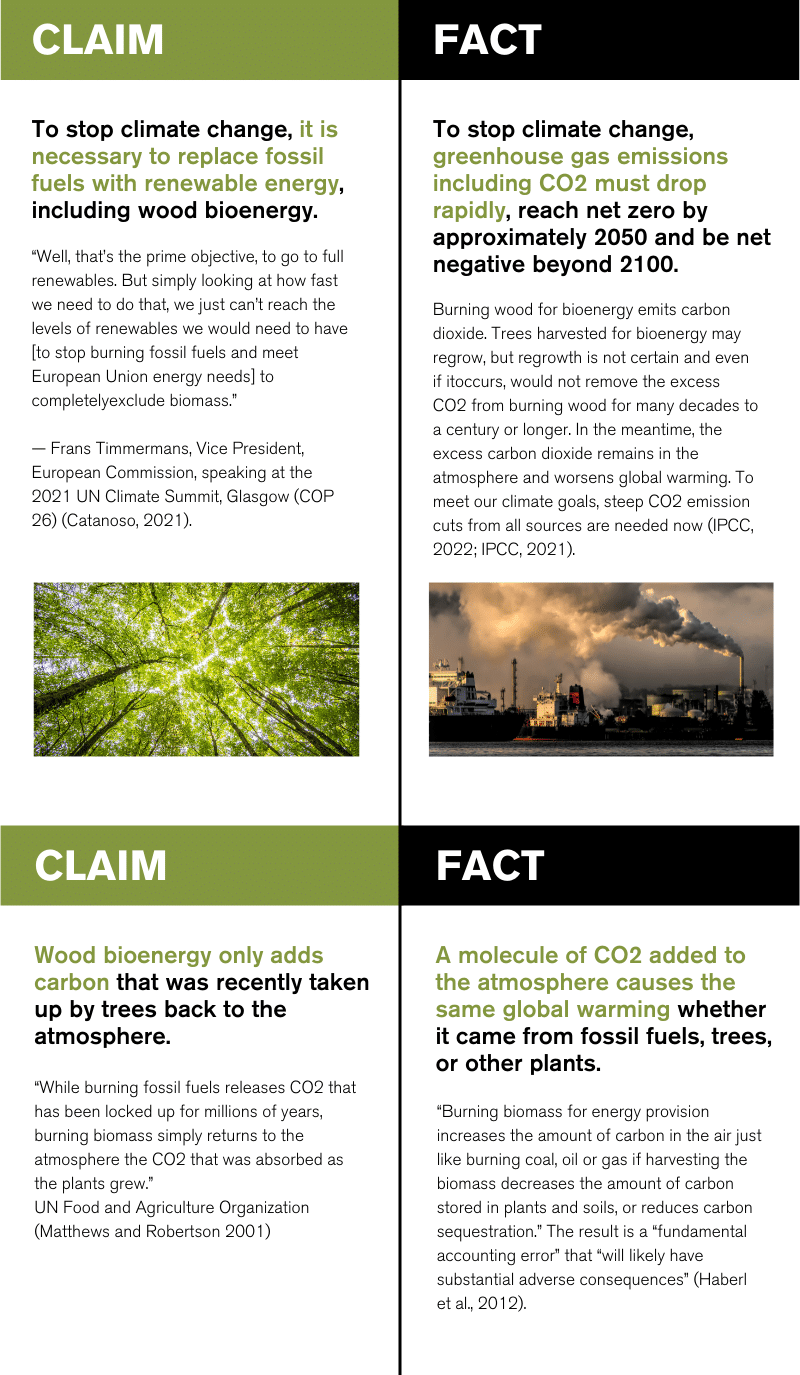
The bioenergy industry and many governments argue that wood bioenergy is carbon neutral. The “Claims and Facts” tables throughout the text below list some of the common claims the industry makes, together with the science showing these claims to be incorrect. For example, the UN Food and Agriculture Organization claims that “While burning fossil fuels releases CO2 that has been locked up for millions of years, burning biomass simply returns to the atmosphere the carbon dioxide that was absorbed as the plants grew” (Matthews and Robertson 2001). But the fact that the carbon in wood was previously removed from the atmosphere as the trees grew is irrelevant: A molecule of carbon dioxide added to the atmosphere today has the same impact on radiative forcing—its contribution to global warming—whether it comes from fossil fuels millions of years old or biomass grown last year. When burned, the carbon in those trees immediately increases atmospheric carbon dioxide above what it would have been had they not been burned.
To illustrate, consider a forest that was harvested for lumber, pulpwood, or energy 50 years ago, and has been regrowing since then. (Few forests in the United States and Europe are mature, “old growth”—most are “working forests” and go through cycles of harvest, regrowth, and reharvest [see US Forest Service 2014]). What happens if that forest is now cut and burned for energy? When the wood is burned, the carbon it contains is emitted as carbon dioxide into the atmosphere. If the forest regrows, after another 50 years it will have removed about the same amount of carbon dioxide it emitted when it was cut and burned for energy. Until then, there’s more carbon dioxide in the atmosphere than if it had not been burned, accelerating climate change.
But the situation is worse: If the forest had not been cut, it would have continued to grow, removing additional carbon from the atmosphere. Compared to allowing the forest to grow, cutting it for bioenergy would increase carbon dioxide emissions and worsen global warming for at least half a century—time we do not have to reach net-zero emissions and avoid the worst harms from climate change.
But what if the wood used to generate electricity reduces the use of fossil fuels? Wouldn’t total carbon dioxide emissions then fall? That depends on how much carbon dioxide is emitted from wood relative to the fuel being displaced. To determine whether wood bioenergy can slow climate change, we therefore need to know answers to a series of questions:
How much carbon dioxide does burning wood for energy add to the atmosphere?
Burning wood to generate electricity emits more carbon dioxide per kilowatt-hour generated than fossil fuels—even coal, the most carbon-intensive fossil fuel. Although wood and coal contain about the same amount of carbon per unit of primary energy—the raw energy in the fuel—(EPA 2018), wood burns less efficiently, in part because it contains more water than coal. The higher the water content, the larger the fraction of the energy of combustion goes into vaporizing that water and up the flue instead of producing the heat needed to make the steam that powers the turbines and generators (Dzurenda and Banski 2017, FAO 2015).
Carbon dioxide emissions from the wood supply chain also exceed those from coal. Wood must be harvested, transported to a mill, dried, processed into chips or pellets, and transported to a power plant (Figure 1). These activities emit carbon dioxide from fossil fuel-powered vehicles and machinery, plus emissions from burning wood or fossil fuels to reduce the water content of chips and pellets from approximately 50 percent for raw wood to about 10 percent for dried pellets. About 27 percent of the harvested biomass is lost in the wood pellet supply chain, of which the largest share—18 percent—arises from burning some of the biomass to generate heat to dry pellets (Röder et al. 2015). In contrast, coal processing adds only about 11 percent to emissions (Sterman et al. 2018a).
The situation is worse if wood displaces other fossil fuels: Wood releases about 25 percent more carbon dioxide per joule of primary energy than fuel oil, and about 75 percent more carbon dioxide than fossil (so-called “natural”) gas (EPA 2018). Wood bioenergy therefore emits more carbon dioxide per kilowatt-hour of power generated than all fossil fuels, including coal (PFPI 2011), incurring a “carbon debt”—an immediate increase in carbon dioxide in the atmosphere, worsening climate change every year, unless and until that carbon debt is repaid later by forest regrowth.
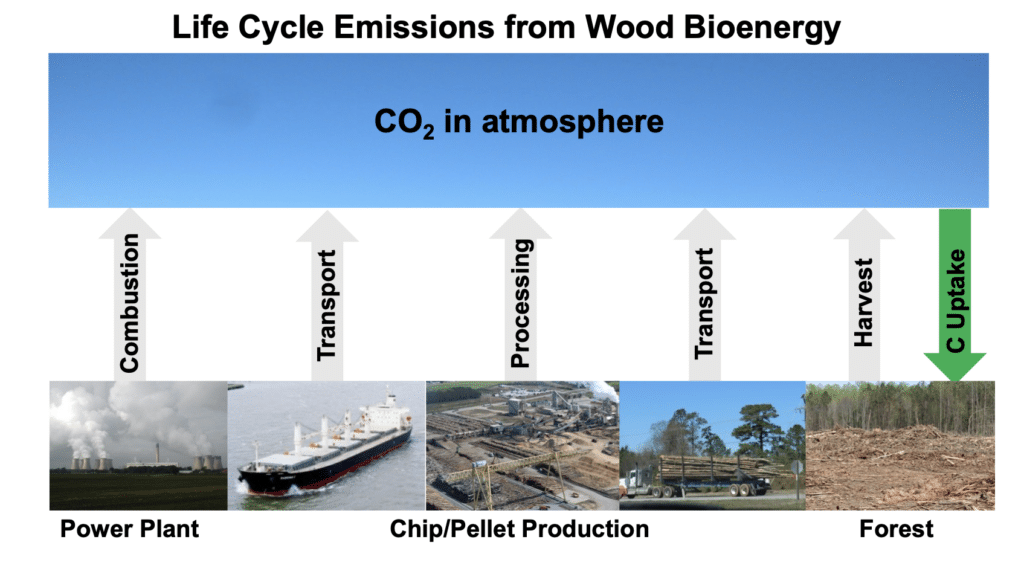 Figure 1. Life cycle emissions from wood bioenergy. Every stage of the supply chain adds CO2 to the atmosphere, from cutting the trees through transport, processing the wood into chips or pellets, transporting them to a power plant, and combustion. CO2 is removed only later, and only if, the harvested land regrows. Photo credits, left to right: Power Plant, courtesy of Paul Glazzard, Creative Commons Attribution-ShareAlike 2.0 license. Transport: Handymax bulk carrier, courtesy of Nsandel/Wikimedia/Public Domain. Pellet mill, Truck Transport, and Forest images all courtesy of Dogwood Alliance, used with permission.
Will the forests harvested for bioenergy regrow? If so, how long will it take?
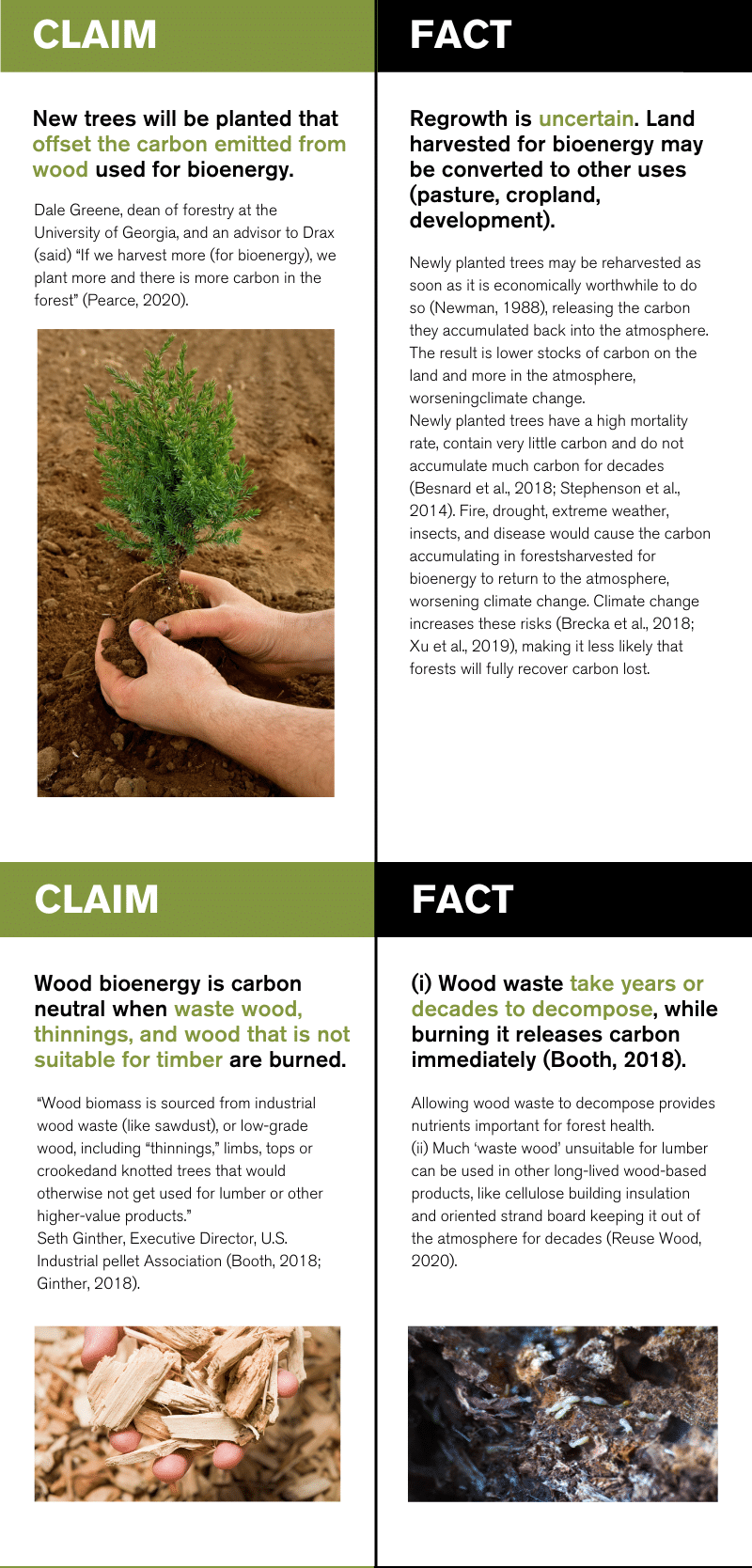
The wood bioenergy industry claims to practice sustainable forestry and be carbon neutral (e.g., Drax 2021, Enviva 2021). The most important claim is that wood bioenergy is carbon neutral because the harvested forests will regrow, removing the carbon they add to the atmosphere when burned (Table 1). However, regrowth is uncertain, and regrowth takes time.
Regrowth is uncertain: Land harvested for bioenergy might be converted to pasture, cropland, or development, preventing regrowth. The carbon dioxide emitted when the trees are burned is then never taken back up by forest regrowth on that land. Even if the harvested land is allowed to regrow, the trees may be harvested again, legally or illegally. The carbon dioxide released in each rotation returns to the atmosphere, where it worsens climate change.
Even if the recovering forest is somehow protected against all future harvest, the trees face risks from wildfire, insects, disease, extreme weather, and drought, all increasing as the climate warms (Brecka et al. 2018; Xu et al. 2019, Boulton, Lenton and Boers 2022). These factors slow or prevent carbon dioxide removal from the atmosphere by forests and may even convert forests from carbon sinks to carbon sources (Gatti et al. 2021). These growing risks to regrowth would limit the future removal of the carbon dioxide emitted by burning wood, permanently worsening climate change.
Regrowth takes time: Even if land conversion, repeated harvests, fire, drought, disease, and other adverse events never arise, regrowth takes time. The time required for regrowth to remove the carbon dioxide emitted when wood is burned for energy is known as the “carbon debt payback time.”

Are the forests harvested for bioenergy growing and removing carbon dioxide now?
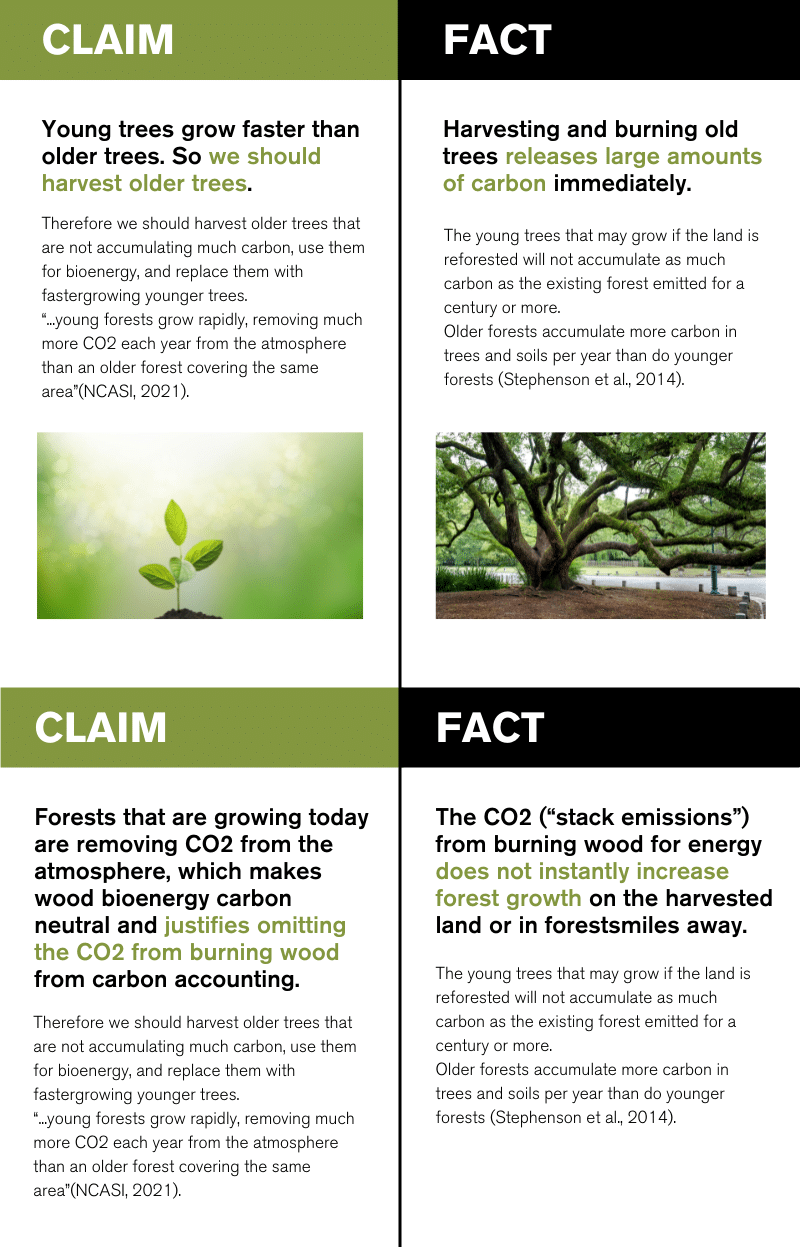
The US bioenergy industry uses the fact that many US forests are growing today to claim that wood bioenergy is carbon neutral. For example, Enviva, the largest US pellet producer, with multiple mills in the Southeast United States, falsely argues that “…continued forest carbon gain across the landscape… means that products from the Southeast U.S., including wood bioenergy, are not adding carbon emissions to the atmosphere. As a result, when wood pellets from this region are used to generate energy, we can set stack emissions to zero.” (Enviva, nd; see Table 1).
It is true that forests in the Southeast US are acting as carbon sinks today as the result of intensive management and recovery from prior harvests. But these and other forest carbon sinks are already accounted for in the national greenhouse gas emissions inventories required under the United Nations Framework Convention on Climate Change, which sets the rules for greenhouse gas accounting under international agreements (e.g., UNFCCC 2014). Therefore, what counts is what happens to emissions on the margin—that is, the incremental impact of harvesting forests for bioenergy compared to allowing those forests to continue to grow and serve as carbon sinks. Typical rotation periods for working forests are far shorter than the time required for them to reach maturity and maximum carbon storage (Moomaw, Masino, and Faison 2019, Sohngen and Brown 2011, US Forest Service 2014). The younger the forest and faster it is growing when harvested for bioenergy, the more future carbon sequestration is lost.
A dynamic lifecycle assessment of wood bioenergy
To determine the impact of wood bioenergy on carbon dioxide emissions we developed a model for dynamic lifecycle assessment of wood bioenergy (Sterman et al. 2018a; Sterman et al. 2018b). The model includes carbon dioxide emissions from bioenergy, carbon dioxide uptake by regrowth, and carbon dioxide emissions avoided if wood displaces fossil fuels. Supply chain emissions for both wood and fossil fuels are included. Model parameters were estimated from data on forest regrowth in a wide range of forests in the southern and eastern USA, regions increasingly supplying wood for pellets, much of which is exported to Europe and the United Kingdom.
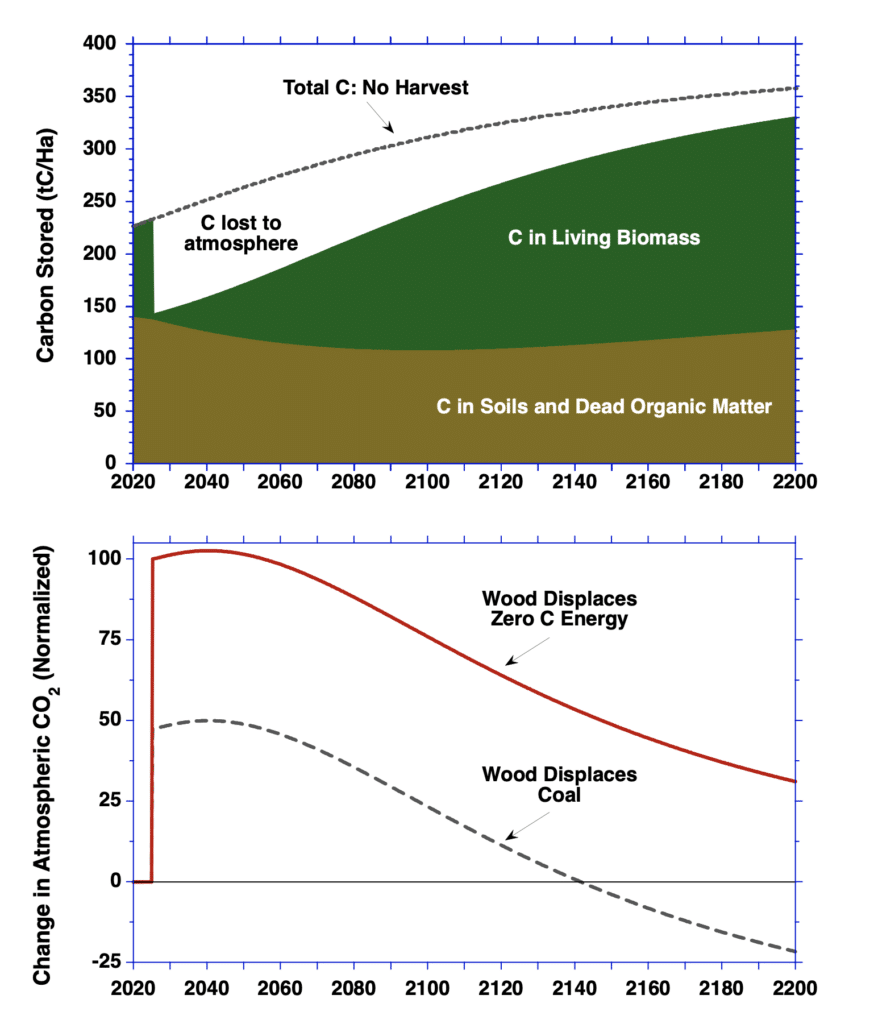
Figure 2. Impact of harvesting wood for bioenergy in 2025 from a 50-year-old oak-hickory forest in the south central USA. Top: Change in carbon on the harvested land (tons C per hectare). Brown: carbon in soils and dead organic matter; Green: carbon in living biomass. Dotted line: the total carbon stock (living biomass and soils) if the forest were not harvested in 2025. The forest would have continued to grow and remove carbon from the atmosphere but for being cut for bioenergy. The difference between the dotted no-harvest line and the top of the green band is the carbon emitted into the atmosphere by the harvest. Bottom: Change in atmospheric CO2 resulting from the harvest and combustion of the wood. Solid line: wood displaces a zero-carbon energy source. Dotted line: wood displaces coal. Scale: the initial rise in atmospheric CO2 when wood displaces zero-carbon energy is normalized to 100%. The initial rise in atmospheric CO2 when wood displaces coal is about 50% less due to the emissions avoided by the reduction in coal use.
Figure 2 (above) shows the impact of wood harvested for bioenergy from an oak-hickory forest, “perhaps the most extensive deciduous forest type of eastern North America” (Dick 2016). The simulation parameters are estimated for oak-hickory forests in the south central United States, among the forests used to supply wood pellets for bioenergy, including exports to the United Kingdom (Buchholz & Gunn 2015; Sterman et al. 2018a 2018b report results for other forests in the southern and eastern US). Most forests in the United States have been cut multiple times. We assume the last prior harvest was 50 years ago. To assess the dynamic impact of wood bioenergy use, Figure 2 traces the impact of a single harvest in 2025, showing the stocks of carbon in the biomass and soil and the resulting change in the concentration of carbon dioxide in the atmosphere. We consider two scenarios:The harvested wood is used to generate electric power that replaces an equivalent amount of energy generated from coal, the most carbon-intensive fossil fuel.
The harvested wood is used to generate electric power that replaces an equivalent amount of energy produced by zero-carbon sources (e.g., wind and solar).
The top panel of Figure 2 shows the stock of carbon on the land harvested for bioenergy (metric tons of carbon per hectare), including the carbon in the living biomass and in soils and dead organic matter. The harvest and combustion of wood for energy immediately reduces the stock of carbon in living biomass on the land and increases atmospheric carbon dioxide. The stock of carbon in dead biomass and soil also begins to drop: the wood harvest reduces the flux of carbon from living biomass to soils, while heterotrophic respiration by bacteria, fungi, and other organisms continues to release the carbon in dead biomass and soils into the atmosphere. After the harvest, the forest begins to recover. Soil carbon continues to drop for some time, however, until the flux of carbon transferred to the soils from living biomass exceeds the flux of carbon emitted to the atmosphere from the soil by heterotrophic respiration.
The simulation assumes the land is harvested 50 years after the last rotation. The forest at that time is still recovering. The dotted line in the top panel of Figure 2 shows that the total stock of carbon on that land would have continued to grow through 2200 (and beyond), but for the harvest for bioenergy. The difference between the no-harvest and harvest cases is the quantity of carbon lost to the atmosphere due to the bioenergy harvest. The bioenergy harvest not only adds the carbon extracted and burned to the atmosphere, but prevents the additional growth that would have occurred had the forest not been harvested.
The bottom panel of Figure 2 shows the change in the concentration of carbon dioxide in the atmosphere for the two scenarios above. The figure shows the evolution of atmospheric carbon dioxide relative to the no-harvest case, scaled relative to the magnitude of the initial change in carbon dioxide when the wood displaces zero-carbon energy such as wind and solar (the absolute change in atmospheric carbon dioxide depends on the amount of wood harvested and burned). Cutting and burning trees for bioenergy immediately increases the concentration of carbon dioxide in the atmosphere. The jump in atmospheric carbon dioxide when wood displaces coal is approximately half as much as when the wood displaces zero-carbon energy. The impact of displacing other fossil fuels such as fuel oil or fossil (“natural”) gas lies between the coal and zero-carbon scenarios because these fuels emit less carbon dioxide per kilowatt-hour than coal, but of course more than wind or solar.
Note that, in both cases atmospheric carbon dioxide continues to increase through approximately 2040, 15 years after the assumed harvest in 2025. Although the harvested land begins to regrow immediately, seedlings and saplings have much smaller leaf area for photosynthesis and accumulate carbon slower than older trees. Consequently, the carbon sequestered by regrowth is initially less than the carbon the forest would have stored had it not been harvested.
After approximately the year 2040, the excess carbon dioxide in the atmosphere from the harvest and combustion of the wood begins to fall as regrowth outpaces the growth in carbon in the no-harvest case. However, atmospheric carbon dioxide remains above the level it would have had but for the harvest well beyond the year 2100. Even when wood displaces coal, the excess carbon dioxide is not taken back up by forest regrowth until after the year 2140: The carbon debt payback time in this scenario is approximately 115 years. When the wood displaces zero-carbon energy, atmospheric carbon dioxide remains above its initial level well past the year 2200.
The simulation shows the impact of clearing a stand of forest and using the wood for bioenergy. The bioenergy industry claims that they practice what they call “sustainable” forestry—avoiding clearcutting, taking only residues from lumber and pulpwood harvests, or thinning forests by taking only small or diseased trees. Environmental groups, however, have documented the harvest of large trees and clear-cutting by the industry (Norton et al. 2019; Stashwick et al. 2019; Stashwick et al. 2017). To address this issue, we also simulated the impact of thinning, in which only 25 percent of the living biomass is removed from the harvested forest (Sterman et al. 2018a 2018b). Across all the forests examined, thinning reduces the carbon debt payback times somewhat. For example, in the scenario shown in Figure 2, thinning reduces the carbon debt payback year from 2140 to 2115—still too late.
The simulations favor wood bioenergy. We assume that the land remains forested, that the forest grows back without any subsequent harvest, and that it suffers no losses from wildfire, disease, insects, extreme weather or other threats to regrowth. We do not consider additional carbon loss from soils due to the disturbance caused by the harvest. We do not consider non-climate harms from wood harvest and bioenergy production, including habitat fragmentation, loss of biodiversity, and the health effects of exposure to particulates and other pollutants from wood processing and power plants.
To track the impact of wood bioenergy, the simulation shows the impact of harvesting and burning wood for energy in a single year. But the bioenergy industry is growing rapidly, stimulated by the false declaration that wood is carbon neutral and resulting subsidies in many nations. The International Energy Agency reports primary energy from biomass for electricity generation grew at an average rate of more than 6 percent per year between 1990 and 2018 (IEA 2020). The IEA’s “Net-Zero by 2050” scenario projects modern bioenergy—which includes wood—will grow by more than a factor of four by 2050 (IEA 2021b).
What happens to atmospheric carbon dioxide in the realistic case of growing wood bioenergy use? Each year the carbon dioxide emissions from cutting and burning wood would exceed the removal of carbon dioxide by regrowth, continually increasing the concentration of carbon dioxide in the atmosphere, just as filling your bathtub faster than it drains will continually raise the level of water in the tub (until it overflows and damages your home).
The situation is analogous to a government that runs a continually growing fiscal deficit. The outstanding debt rises every year even if the government fully repays every bond it issues at maturity. In the same way, the growing use of wood bioenergy adds more carbon dioxide to the atmosphere every year, increasing the outstanding carbon debt, even if the forests are managed sustainably and all harvested lands eventually recover enough to fully repay the carbon debt incurred when the wood was extracted and burned.
Eventual carbon neutrality is not climate neutrality
Even under the best case where wood displaces coal, regrowth does not remove the excess carbon dioxide emitted by wood for many decades or more, and far longer if the harvested forests are growing today—as most are—and far more if wood displaces other fossil fuels. At that future time, wood bioenergy can be said to have achieved carbon neutrality. Until then, wood bioenergy increases the level of carbon dioxide in the atmosphere above what it would have been, accelerating global warming.
But is the climate impact of that additional warming reversed if regrowth finally removes the excess carbon dioxide? Is eventual carbon neutrality the same as climate neutrality?
The answer is “No.”
Even temporarily elevated levels of atmospheric carbon dioxide cause irreversible climate damage (IPCC 2022; Solomon et al. 2009). The excess carbon dioxide from wood bioenergy begins warming the climate immediately upon entering the atmosphere. The harms caused by that additional warming are not undone even if the carbon debt from wood energy is eventually repaid: The Greenland and Antarctic ice sheets melt faster, sea level rises higher, wildfires become more likely, permafrost thaws faster, and storms intensify more than if the wood had not been burned. Eventual full forest recovery will not replace lost ice, lower sea level, undo climate disasters, put carbon back into permafrost, or bring back homes lost to floods or wildfires. The excess warming from wood bioenergy increases the chances of going beyond various climate tipping points that could lead to runaway climate change: emissions “pathways that overshoot 1.5°C run a greater risk of passing through ‘tipping points’, thresholds beyond which certain impacts can no longer be avoided even if temperatures are brought back down later on” (IPCC 2018, p. 283). Carbon neutrality is not climate neutrality.
Why does it matter? We have already raised global average surface temperatures about 1.1 degrees Celsius (2 degrees Fahrenheit) above preindustrial levels, and most of humanity already suffers from its effects (Callaghan et al. 2021, IPCC 2022). The consequences of warming beyond 2 degrees Celsius are expected to be devastating. Sea levels could rise by well over a meter by the end of this century, exposing millions of people to coastal flooding (Kulp & Strauss 2019). More than half the world’s people would be exposed to deadly heat waves (Mora et al. 2017). The yields of crops including wheat, maize, rice, and soy would fall even as the United Nations projects that world population will grow by billions (Zhao et al. 2017, United Nations 2019). Droughts, wildfires, and intense storms will become more frequent and extreme (IPCC 2018). Warming could push the Earth beyond various tipping points that could lead to irreversible harm (IPCC 2018). These impacts would intensify hunger, economic disruption, mass migration, civil conflict, and war (Burke et al. 2015; Hsiang & Burke 2014; Koubi 2019; Levy 2019). Scientists and nearly all nations on Earth therefore agree that global greenhouse gas emissions must fall as deeply and quickly as possible, reaching net zero by approximately midcentury.
Wood bioenergy moves the world in the wrong direction.
Policy implications
What can be done? First, policies that treat wood bioenergy as carbon neutral must end. These policies allow power plants and nations to ignore the carbon dioxide they emit by burning wood on the false assumption that those emissions are quickly offset by forest growth somewhere else, creating a “critical climate accounting error” (Searchinger, et al. 2009). The carbon dioxide emitted from wood should be counted the same way emissions from other fuels are: fully, at the point of combustion.
Second, subsidies for wood bioenergy must end. Subsidizing wood bioenergy means taxpayers are paying pellet and power producers to make climate change worse.
Third, the fact that wood bioenergy is worse than coal in no way justifies the continued use of coal or any fossil fuel. To avoid the worst harms from climate change we must not only keep the vast majority of remaining fossilized carbon in the ground, we must also keep the vast majority of the carbon in our forests on the land.
The good news is that existing technologies such as energy efficiency, and the use of renewables such as solar, wind, and geothermal energy, can meet people’s needs for comfort, light, mobility, communication, and other purposes. The costs of these technologies are falling rapidly, and in many places are already lower than fossil fuels (IEA 2021a). Innovations in clean energy, energy storage, smart grids, and other technologies are expanding our ability to meet everyone’s energy needs affordably. Unlike wood bioenergy, these technologies allow forests to continue growing and sequestering atmospheric carbon dioxide. Investments in energy efficiency and clean energy also generate multiple co-benefits including increased community resilience, jobs, and improved health and economic well-being, especially for low-income individuals and households (Belesova et al. 2020; Burke et al. 2018; IEA 2021a; IPCC 2018; Pollin et al. 2014; Shindell et al. 2018). In contrast, particulate emissions and other pollutants from wood bioenergy damage human health (Allergy & Asthma Network et al. 2016).
To keep global warming under 2 degrees Celsius, net greenhouse gas emissions must fall to net zero by approximately mid-century, less than 30 years from now. Wood bioenergy increases greenhouse gas emissions and makes climate change worse during these critical years and beyond, even if the wood displaces coal. More effective ways to cut greenhouse gas emissions and meet human needs are available and affordable now. Ending subsidies and policies that promote wood bioenergy will reduce emissions and allow forests to continue to grow, preserving their vital role as carbon sinks that moderate climate change.
Disclosure Statement
No potential conflict of interest was reported by the authors.
Funding
Authors John Sterman and Lori Siegel received no specific grant from any funding agency in the public, commercial, or not-for-profit sectors for this work. Author William Moomaw was supported by a grant from the Rockefeller Brothers Foundation. Author Juliette N. Rooney-Varga was supported by the National Science Foundation under grant ICER-1701062.
References
Allergy & Asthma Network, American Academy of Pediatrics, American Lung Association, American Public Health Association, Asthma and Allergy Foundation of America, National Association of County & City Health Officials, et al. 2016. Letter to policymakers [Press release]. https://www.naccho.org/uploads/downloadable-resources/Policy-and-Advocacy/Health-organizational-letter-health-impacts-of-biomass.pdf.
Belesova, K., Heymann, D. L., & Haines, A. 2020. “Integrating climate action for health into Covid-19 recovery plans.” BMJ, 370, m3169. https://doi.org/10.1136/bmj.m3169.
Booth, M. 2018. “Not carbon neutral: Assessing the net emissions impact of residues burned for bioenergy.” Environmental Research Letters, 13(3), 035001. http://stacks.iop.org/1748-9326/13/i=3/a=035001.
Boulton, C., Lenton, T., Boers, N. Pronounced loss of Amazon rainforest resilience since the early 2000s. Nature Climate Change 12(271-2378). https://doi.org/10.1038/s41558- 022-01287-8.
Brecka, A. F. J., Shahi, C., & Chen, H. Y. H. 2018. “Climate change impacts on boreal forest timber supply.” Forest Policy and Economics, 92, 11-21. https://doi.org/10.1016/j.forpol.2018.03.010.
Buchholz, T., & Gunn, J. 2015. Carbon emission estimates for Drax biomass powerplants in the UK sourcing from Enviva Pellet Mills in U.S. Southeastern Hardwoods using the BEAC model. https://www.southernenvironment.org/wp-content/uploads/legacy/news-feed/SIG_BEAC_calculations_SE_hardwoods_2015-05-27.pdf.
Burke, M., Davis, W., & Diffenbaugh, N. 2018. “Large potential reduction in economic damages under UN mitigation targets.” Nature, 557(7706), 549-553. https://doi.org/10.1038/s41586-018-0071-9.
Burke, M., Hsiang, S. M., & Miguel, E. 2015. “Climate and Conflict.” Annual Review of Economics, 7(1), 577-617. https://doi.org/10.1146/annurev-economics-080614-115430.
Callaghan, M., Schleussner, C.-F., Nath, S., Lejeune, Q., Knutson, T. R., Reichstein, M., et al. 2021. “Machine-learning-based evidence and attribution mapping of 100,000 climate impact studies.” Nature Climate Change. https://doi.org/10.1038/s41558-021-01168-6.
Catanoso, J. 2021. “COP26: E.U. is committed to forest biomass burning to cut fossil fuel use.” Mongabay: News and Inspiration from Natures Frontline. November 10. https://news.mongabay.com/2021/11/cop26-e-u-is-committed-to-forest-biomass- burning-to-cut-fossil-fuel-use/.
Climate Action Tracker. 2021. Warming Projections Global Update. https://climateactiontracker.org/publications/glasgows-2030-credibility-gap-net-zeros- lip-service-to-climate-action/.
Cubbage, F., & Abt, R. 2020. “Wood pellets offer NC’s best carbon-neutral energy source.” https://www.envivabiomass.com/wood-pellets-offer-ncs-best-carbon- neutral-energy-source/.
D’Amore, D.; Kane, E. 2016. Climate Change and Forest Soil Carbon. US Department of Agriculture, Forest Service, Climate Change Resource Center. www.fs.usda.gov/ccrc/topics/forest-soil-carbon.
Dick, C. 2016. Oak-hickory forest: a vestige of Native American land use? https://sites.lsa.umich.edu/cwdick-lab/2016/03/27/oak-hickory-forest-a-vestige-of-native-american-land-use/.
Drax. 2021. Sustainability. https://www.drax.com/sustainability/.
Dzurenda, L., Banski, A. 2017/ “Influence of moisture content of combusted wood on the thermal efficiency of a boiler.” Archives of Thermodynamics. 38(1), 63-74 https://journals.pan.pl/Content/100834/PDF/04_paper.pdf.
Dzurenda, L., Banski, A. 2019. “The Effect of Firewood Moisture Content on the Atmospheric Thermal Load by Flue Gases Emitted by a Boiler.” Sustainability. 11, 284. https://doi/10.3390/su11010284.
Enviva. 2021. Corporate Sustainability Report https://www.envivabiomass.com/wp- content/uploads/Enviva-2021-CSR.pdf.
Enviva (nd). Carbon Accounting. https://www.envivabiomass.com/sustainability/environment/carbon-accounting/.
EPA. 2018. Emissions Factors for Greenhouse Gas Inventories. https://www.epa.gov/sites/default/files/2018-03/documents/emission- factors_mar_2018_0.pdf.
Food and Agriculture Organization. 2015. Wood Fuels Handbook. UN FAO. http://large.stanford.edu/courses/2017/ph240/timcheck1/docs/fao-krajnc-2015.pdf.
Gatti, L., Basso, L., Miller, J. et al. 2021. “Amazonia as a carbon source linked to deforestation and climate change.” Nature 595, 388–393. https://doi.org/10.1038/s41586-021-03629-6.
Ginther, S. 2018. Opinion: “Climate and Fire, Why Biomass Matters to Both.” Biomass Magazine. December 14. http://biomassmagazine.com/articles/15824/opinion-climate-and-fire-why-biomass- matters-to-both.
Haberl, H., Sprinz, D., Bonazountas, M., et al. 2012. “Correcting a fundamental error in greenhouse gas accounting related to bioenergy.” Energy Policy, 45, 18-23. https://doi.org/10.1016/j.enpol.2012.02.051.
Hsiang, S., & Burke, M. 2014. “Climate, conflict, and social stability: what does the evidence say?” Climatic Change, 123(1), 39-55. https://doi.org/10.1007/s10584-013-0868-3.
IEA. 2020. World Energy Outlook. International Energy Agency.
IEA. 2021a. World Energy Outlook 2021. International Energy Agency.
IPCC. 2018. Global Warming of 1.5 ˚C. Intergovernmental Panel on Climate Change, Special Report SR15.
IPCC. 2022. Summary for Policymakers. In H.-O. Pörtner, D. C. Roberts, E. S. Poloczanska, K. Mintenbeck, M. Tignor, A. Alegría, M. Craig, S. Langsdorf, S. Löschke, V. Möller, & A. Okem (Eds.), Climate Change 2022: Impacts, Adaptation, and Vulnerability. Contribution of Working Group II to the Sixth Assessment Report of the Intergovernmental Panel on Climate Change. Cambridge, UK: Cambridge University Press. .
IPCC. 2021. Summary for Policymakers. In V. Masson-Delmotte, P. Zhai, A. Pirani, S. L. Connors, Péan, S. Berger, N. Caud, Y. Chen, L. Goldfarb, M. I. Gomis, M. Huang, K. Leitzell, K. E. Lonnoy, J. B. R. Matthews, T. K. Maycock, T. Waterfield, O. Yelekçi, O. R. Yu, & B. Zhou (Eds.), Climate Change 2021: The Physical Science Basis. Contribution of Working Group I to the Sixth Assessment Report of the Intergovernmental Panel on Climate Change: Cambridge University Press.
Koubi, V. 2019. Climate Change and Conflict. Annual Review of Political Science, 22(1), 343- 360.
Kulp, S., Strauss, B. 2019. New elevation data triple estimates of global vulnerability to sea-level rise and coastal flooding. Nature Communications 10, 4844 https://doi.org/10.1038/s41467-019-12808-z.
Levy, B. 2019. “Increasing Risks for Armed Conflict: Climate Change, Food and Water Insecurity, and Forced Displacement.” International Journal of Health Services, 49(4), 682-691. https://doi.org/10.1177/0020731419845249.
Matthews, R., and Robertson, K. 2001. Answers to ten frequently asked questions about bioenergy, carbon sinks and their role in global climate change, prepared by the International Energy Agency (IEA) Bioenergy Task 38, “Greenhouse Gas Balances of Biomass and Bioenergy Systems.” Graz, Austria, Joanneum Research. https://www.fao.org/3/y4450e/y4450e07.htm.
Mora, C., Dousset, B., Caldwell, I. et al. 2017. Global risk of deadly heat. Nature Climate Change 7, 501–506. https://doi.org/10.1038/nclimate3322.
Moomaw, W., Masino, S, Faison, E. 2019. Intact Forests in the United States: Proforestation Mitigates Climate Change and Serves the Greatest Good, Frontiers in Forests and Global Change, 2, https://doi.org/10.3389/ffgc.2019.00027.
NCASI. 2021. “Forest carbon from young vs. old forests.” https://www.ncasi.org/resource/forest-carbon-from-young-vs-old-forests/.
Newman, D. H. 1988. The optimal forest rotation: a discussion and annotated bibliography.
Asheville, NC USA: https://www.srs.fs.usda.gov/pubs/gtr/uncaptured/gtr_se048.pdf.
Norton, M., Baldi, A., Buda, V., Carli, B., Cudlin, P., Jones, M. B., et al. 2019. “Serious mismatches continue between science and policy in forest bioenergy.” GCB Bioenergy, 11(11), 1256-1263. https://doi.org/10.1111/gcbb.12643.
Ouzts, E. 2019. “Wood pellets cause more climate pollution than coal when they’re burned. So why does Europe call them ‘carbon neutral’?” Energy News Network. December 2. https://energynews.us/2019/12/02/wood-pellets-cause-more-climate-pollution-than-coal-when-theyre-burned-so-why-does-europe-call-them-carbon-neutral/.
Pearce, F. 2020. “Bioenergy from forests may turn natural landscapes into monocultures.” China Dialogue. November 10. https://chinadialogue.net/en/climate/bioenergy-from-forests-may-turn-natural- landscapes-into-monocultures/.
PFPI, 2011. Carbon emissions from burning biomass for energy. Partnership for Policy Integrity https://www.pfpi.net/wp-content/uploads/2011/04/PFPI-biomass-carbon-accounting- overview_April.pdf
Pollin, R., Garrett-Peltier, H., Heintz, J., & Hendricks, B. 2014. Green Growth: A U.S. Program for Controlling Climate Change and Expanding Job Opportunities. https://www.americanprogress.org/issues/green/reports/2014/09/18/96404/green- growth/.
Reuse Wood. 2020. About oriented stranded board (OSB). https://reusewood.org/guide/oriented-strand-board.
Röder, M., Whittaker, C., & Thornley, P. 2015. “How certain are greenhouse gas reductions from bioenergy? Life cycle assessment and uncertainty analysis of wood pellet-to- electricity supply chains from forest residues.” Biomass and Bioenergy, 79, 50-63. https://doi.org/10.1016/j.biombioe.2015.03.030.
Searchinger, T., Hamburg, S., Melillo, J., et al. 2009. “Fixing a Critical Climate Accounting Error.” Science 326(5952), 527-528. https://doi.org/10.1126/science.1178797.
Shindell, D., Faluvegi, G., Seltzer, K., & Shindell, C. 2018. “Quantified, localized health benefits of accelerated carbon dioxide emissions reductions.” Nature Climate Change, 8(4), 291-295. https://doi.org/10.1038/s41558-018-0108-y.
Sohngen, B., Brown, S. 2011. Extending timber rotations: carbon and cost implications. Climate Policy, 8:5, 435-451, https://doi.org/10.3763/cpol.2007.0396.
Solomon, S., Plattner, G.-K., Knutti, R., & Friedlingstein, P. 2009. “Irreversible climate change due to carbon dioxide emissions.” Proceedings of the National Academy of Sciences, 106(6), 1704-1709. https://doi.org/10.1073/pnas.0812721106.
Stashwick, S., Frost, R., & Carr, D. W. 2019. Global Markets for Biomass Energy Are Devastating US Forests. https://www.nrdc.org/sites/default/files/global-markets-biomass-energy-06172019.pdf.
Stashwick, S., Macon, A., & Carr, D. W. 2017. European Imports of Wood Pellets for “Green Energy” Devastating US Forests. https://www.nrdc.org/sites/default/files/european-imports-wood-pellets-greenenergy- devastating-us-forests.pdf.
Stephenson, N. L., Das, A., Condit, R., Russo, S., Baker, P., Beckman, N., et al. 2014. “Rate of tree carbon accumulation increases continuously with tree size.” Nature, 507(7490), 90- 93. https://doi.org/10.1038/nature12914.
Sterman, J. D., Siegel, L., & Rooney-Varga, J. N. 2018a. “Does replacing coal with wood lower carbon dioxide emissions? Dynamic lifecycle analysis of wood bioenergy.” Environmental Research Letters, 13(1), 015007. http://stacks.iop.org/1748-9326/13/i=1/a=015007.
Sterman, J. D., Siegel, L., & Rooney-Varga, J. N. 2018b. Reply to comment on ‘Does replacing coal with wood lower carbon dioxide emissions? Dynamic lifecycle analysis of wood bioenergy.’ Environmental Research Letters, 13(12), 128003. https://doi.org/10.1088/1748-9326/aaf354.
UNFCCC 2021. Glasgow Climate Pact. Paper presented at the COP26, Glasgow, Scotland, UK. https://unfccc.int/sites/default/files/resource/cop26_auv_2f_cover_decision.pdf.
UNFCCC 2014. Report of the Conference of the Parties on its nineteenth session, held in Warsaw from 11 to 23 November 2013. United Nations Framework Convention on Climate Change. January 2014. https://unfccc.int/resource/docs/2013/cop19/eng/10a03.pdf#page=2.
United Nations 2019. World Population Prospects 2019. https://population.un.org/wpp/.
US EPA. 2018. EPA’s Treatment of Biogenic Carbon Dioxide Emissions from Stationary Sources that Use Forest Biomass for Energy Production. https://www.epa.gov/sites/default/files/2018-04/documents/biomass_policy_statement_2018_04_23.pdf.
US Forest Service 2014. US Forest Research Facts and Trends, Forest Service FS-1035. https://www.fia.fs.fed.us/library/brochures/docs/2012/ForestFacts_1952-2012_English.pdf.
Voegele, E. 2016. “Senate passes Energy Bill with pro-biomass amendment.” Biomass Magazine.http://biomassmagazine.com/articles/13172/senate-passes-energy-bill- with-pro-biomass-amendment.
Xu, C., McDowell, N., Fisher, R., Wei, L., Sevanto, S., Christoffersen, B., et al. 2019. “Increasing impacts of extreme droughts on vegetation productivity under climate change.” Nature Climate Change, 9(12), 948-953. https://doi.org/10.1038/s41558-019- 0630-6.
Zhao, C., Liu, B., Piao, S, et al. 2017. Temperature increase reduces global yields of major crops in four independent estimates. Proceedings of the National Academies of Sciences. 114(35): 9326-9331. https://doi.org/10.1073/pnas.1701762114.

.jpg)

