Mostrar mensagens com a etiqueta Declaração Kunming. Mostrar todas as mensagens

quinta-feira, 23 de outubro de 2025

Contra a extinção do ICNF


A anunciada intenção do Governo de extinguir o Instituto da Conservação da Natureza e das Florestas (ICNF), redistribuindo as suas competências pela Agência Portuguesa do Ambiente (APA) e pelas Comissões de Coordenação e Desenvolvimento Regional (CCDR), representa um retrocesso preocupante na política de conservação da natureza.

A conservação da natureza exige uma visão estratégica que ultrapasse fronteiras administrativas e compromissos limitados a cada região. A biodiversidade e os ecossistemas não obedecem a fronteiras locais. Integram um património comum cuja proteção decorre em grande medida de responsabilidades assumidas por Portugal no quadro europeu e internacional, incluindo a Estratégia da Biodiversidade 2030 e o Pacto Ecológico Europeu, bem como as obrigações decorrentes da Convenção sobre a Diversidade Biológica da ONU e dos seus Acordos de Kunming-Montreal sobre o Quadro Global da Biodiversidade 2030. Gerir espécies e ecossistemas protegidos apenas a nível regional é abdicar da coerência científica e política necessária para cumprir estas obrigações partilhadas. É indispensável existir uma instituição da administração central do Estado com uma visão nacional, e supra-nacional, da conservação da natureza para garantir a salvaguarda de espécies e habitats que, embora abundantes localmente, são raros e estratégicos no contexto nacional, europeu e global.

O ICNF, apesar das suas limitações operacionais e orçamentais, é a única entidade pública com uma visão nacional das prioridades de conservação da natureza, capacidade técnica e científica para gerir áreas protegidas, conservar habitats e espécies, e promover uma silvicultura sustentável. A sua extinção não resolve os problemas que enfrenta – pelo contrário, agrava-os, fragmentando competências e diluindo responsabilidades. É fundamental a administração central do Estado manter esta capacidade técnica e esta visão nacional, e a salvaguarda dos interesses de Portugal nas negociações internacionais neste domínio.

A APA tem outra vocação e um foco principal na gestão da água, na defesa do clima e atmosfera, e na monitorização e licenciamento ambientais, enquanto as CCDR são estruturas político-administrativas regionais, com missões de desenvolvimento territorial que frequentemente conflituam com os imperativos da conservação da natureza.

Mais grave ainda é o risco de politização. O ICNF, apesar de ser um instituto público, tem mantido uma relativa autonomia técnica, essencial para resistir a pressões locais, políticas e de interesses económicos. Ao colocar a gestão da natureza nas mãos de estruturas regionais, mais expostas a lógicas de proximidade, e com uma visão parcelar do território nacional, abre-se a porta à erosão dos critérios científicos e visão integrada que devem nortear a proteção ambiental. É uma medida que descredibilizará o país e poderá colocar em risco financiamento europeu.

Pensemos no exemplo de uma espécie protegida – o sobreiro. O montado de sobro cobre cerca de 30% da região do Alentejo, menos de 10% do território nacional e menos de 0,5% do território da União Europeia. Tendo a CCDR Alentejo por missão desenvolver a sua região, poderá este organismo regional ter a mesma independência e sensibilidade que o ICNF para avaliar a relevância do abate de sobreiros para se construir uma estrada, um empreendimento turístico, um data centre ou uma exploração agrícola intensiva? É evidente que não, dados os conflitos de interesses a que estará exposta.

Reformar o ICNF, tornando-o mais eficiente, reforçando a sua presença no território e melhorando a sua articulação com outras entidades, faz todo o sentido. Extinguir este instituto é abdicar de uma visão integrada da conservação da natureza, substituindo-a por uma abordagem dispersa, vulnerável e, em última instância, menos eficaz. A natureza e os serviços dos ecossistemas, essenciais a vida humana neste planeta, não se defendem com estruturas administrativas fragmentadas. Defende-se com instituições fortes, tecnicamente capazes, independentes e comprometidas com o interesse público. O ICNF, com todos os seus defeitos, é uma dessas instituições. Extingui-lo, ou reduzi-lo a um departamento da APA, será um erro histórico.

Ler mais:

quarta-feira, 8 de outubro de 2025

The conservation world comes together on the eve of IUCN Congress 2025


As participants arrive in Abu Dhabi, UAE, for the IUCN World Conservation Congress 2025, protected and conserved areas actors gathered across the city.

Fifty-one delegates of the Biodiversity and Protected Area Management (BIOPAMA) programme assembled for a Knowledge Sharing Day, bringing a close to one of IUCN's largest and longest-running grant-making initiatives (approximately 55 million over 13 years). Grantees from Africa, the Caribbean and the Pacific reflected on the impact of their grants, ranging from supporting management effectiveness through the IMET and PAME tools, strengthening governance of protected areas, and to supporting grassroots organisations to stay afloat during the COVID-19 pandemic and build their financial capacity.

"For a long time, protected areas have ignored the rights and contributions of local communities. BIOPAMA has put the focus on governance to make conservation more equitable."
Samuel Shaba, Honeyguide Foundation Tanzania.

"Through BIOPAMA, it’s evident that good governance is the foundation of sustainable conservation. When decisions are transparent and communities are empowered, conservation becomes shared and a lasting success." 
Annick Zanga Ada, African Marine Conservation Organisation

The BIOPAMA initiative, funded by the European Union and the Organisation of African, Caribbean and Pacific States (OACPS) has supported +160 organisations across 79 countries since its inception in 2012. IUCN Congress will host almost 30 events in which BIOPAMA grantees will showcase their conservation work. Click here to learn about the events.

At the ADNEC Centre, the first ever in person ‘World Summit of Indigenous Peoples and Nature “Our Traditional Knowledge is the Language of Mother Earth”’ took place, a historic first for IUCN, led by Anita Tzec, Maya leader and Senior Programme Manager of IUCN. The event gathered IUCN Director General Dr. Grethel Aguilar; IUCN President Razan Al Mubarak; and Indigenous leader and IUCN Vice President, Ramiro Batzin Chojoj, alongside IUCN’s Indigenous Peoples Organisations members and partner representatives from across the globe. The opening spiritual ceremony was followed by high level segments that acknowledged the outsized role that Indigenous peoples and local communities play in conserving biodiversity through centuries of practices rooted in traditional knowledge, customary governance, cultural and spiritual values that tie Indigenous peoples to their ancestral territories.

“For Indigenous peoples, conservation is everything, it is about life, it is about mother earth, it a way of living for Indigenous peoples, so conservation must be about the rights, governance and knowledge of Indigenous peoples”. Ramiro Batzin Chojoj, IUCN Vice President.

The issues discussed at the Indigenous Peoples Summit shouldn’t remain aspirational but rather form strong action oriented plans that can drive change: “The first Indigenous Peoples Summit in the history of IUCN is not just symbolic, it is a promise to work closely with Indigenous peoples and local communities” said Razan Al Mubarak, “the priorities that are set here must carry forward into national plans and global frameworks”. The messages on the first day were clear, Indigenous peoples are rightsholders not just stakeholders, and are leaders not beneficiaries. It is up to us to build long term trusted partnerships to effect real change. The Indigenous Peoples Summit will be followed by the first Indigenous Peoples Pavilion and IUCN PCA Team will follow the key messages and recommendations closely.

Last but not least, the IUCN Protected and Conserved Areas team were hard at work across the ADNEC Exhibition space to prepare the the pavilions for the opening of the Exhibition tomorrow. See you at IUCN Congress 2025!

View the IUCN Protected and Conserved Areas team's 09 October events by clicking here

sexta-feira, 8 de novembro de 2024

Indigenous Peoples’ Biocentric Restoration gains global Momentum at CBD COP16


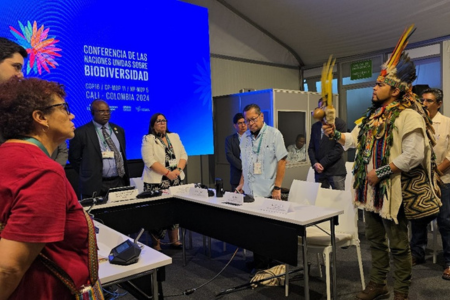
At the 16th Conference of the Parties (COP16) to the Convention on Biological Diversity (CBD) in Cali, Colombia, groundbreaking initiatives on Indigenous Peoples’ biocentric restoration were unveiled by the FAO in partnership with Costa Rica, Ecuador, Peru, Colombia, and Indigenous Peoples’ representatives.

The new initiatives aim to restore degraded ecosystems by putting Indigenous Peoples’ cosmogony, knowledge systems and traditional practices at the centre, in efforts to halt biodiversity loss and promote sustainable environmental management.


“The importance of incorporating Indigenous Peoples’ knowledge into environmental restoration cannot be overstated. Indigenous Peoples have been stewards of the land for millennia, and their territorial management practices offer valuable insights into how we can restore and protect biodiversity,” said H.E. Franz Tattenbach, Minister of Environment and Energy of Costa Rica. “Costa Rica is proud to be at the forefront, developing the world’s first National Plan on Indigenous Peoples’ Biocentric Restoration, which integrates Indigenous Peoples’ food and knowledge systems into national environmental strategies.

The Indigenous Peoples’ Biocentric Restoration programme, a collaboration between FAO and Indigenous Peoples’ leaders, is designed to restore ecosystems while respecting Indigenous Peoples' collective rights, spiritual beliefs and territorial management practices. The programme, initiated in 2019, emphasizes the critical role that Indigenous Peoples’ communities play in ecosystem restoration, not just as participants but as leaders in the process.


Ramiro Batzin, Co-Chair of the International Indigenous Forum on Biodiversity (IIFB), opened the session alongside Mr Godfrey Magwenzi, Director of the FAO Director General’s Office, to emphasize the importance of Indigenous Peoples’-led restoration initiatives.

“Science shows that by being holistic, Indigenous Peoples' food and knowledge systems are key to preserving and restoring the biodiversity and allies for the fulfilment of the Kunming-Montreal Global Biodiversity Framework’’, underlined Mr Magwenzi. FAO, together with Indigenous Peoples' organizations, has co-developed the Indigenous Peoples’ Biocentric Restoration approach, by centering Indigenous Peoples’ knowledge and cosmogony, and promotes the restoration of ecosystems through the strengthening of their food and knowledge systems.

“It is a pleasure for IIFB to host this event,” stated Ramiro Batzin, on behalf of the IIFB. “I would like to recognize the role of the Indigenous Peoples’ biocentric restoration approach at COP16. This approach has been presented and recognized at the TRɄA World Summit on Traditional Knowledge related to Biodiversity [that] we organized last August in Bogota, to prepare the negotiations at COP. At that Summit, we managed to bring together over 150 Indigenous Peoples’ leaders from all 7 socio-cultural regions, UN Agencies, government and key actors. These recommendations and presentations, including on biocentric, have been crucial for the work at the CBD COP16”.

Speakers recognized the relevance of the approach and the importance of the ongoing national plans. “This initiative is not just about restoring ecosystems; it’s about recognizing the rights of Indigenous Peoples and our role as custodians of the genetic diversity and nature. It’s a matter of justice, respect, and equity” said Mr Donald Rojas, President of the Mesa Nacional Indígena de Costa Rica (National Indigenous Platform of Costa Rica). “By integrating Indigenous Peoples’ cosmogony and knowledge, we can ensure that restoration efforts are effective and ensuring long-term sustainability for future generations. Through these kind of processes, we ensure the recognition of Indigenous Peoples as custodiams of biodiversity”.

Ms Nelly Paredes, Executive Director of the National Forest and Wildlife Service of Peru (SERFOR), reaffirmed Peru’s commitment to Indigenous Peoples’ biocentric restoration, highlighting efforts to develop a Regional Plan on Indigenous Peoples’ Biocentric Restoration in the Southern Andes. This plan will work in close collaboration with local governments and Indigenous Peoples’ self-governance authorities. “We are committed to restoring the Southern Andes together with Indigenous Peoples. A biocentric restoration regional plan is starting to ensure Indigenous Peoples’ knowledge is considered for the restoration and conservation with native species,” said Ms Paredes. “By involving Indigenous Peoples as implementers and partners in the conservation strategies, we are creating a powerful, sustainable biocentric plan for effective environmental restoration.”


Other nations, including Ecuador and Colombia, have also made significant strides in integrating Indigenous Peoples’ knowledge into restoration strategies. Ms Glenda Ortega, Undersecretary of Natural Heritage in Ecuador’s Ministry of Environment, Water, and Ecological Transition, shared the country’s work with the International Bamboo and Rattan Organization (INBAR) in Latin America to promote the use of native bamboo species for restoration in the Amazon basin.

Mr Pacha Kanchay, Spiritual Leader of the Organización Nacional Indígena de Colombia (ONIC), reaffirmed Colombia's commitment to initiate Indigenous Peoples-led restoration activities in their territories. “In Colombia, we are learning from the ancestral knowledge of Indigenous Peoples’ communities to address environmental challenges,” said Mr Kanchay. “The integration of our spiritual and cultural values into restoration practices will help us heal our lands and preserve our biodiversity for future generations.”


The Indigenous Peoples’ Biocentric Restoration Initiative includes the creation of “schools of life” to support intergenerational knowledge transmission; the establishment of community nurseries; and the careful consideration of species with ecological, spiritual, and medicinal value. These efforts emphasize the importance of respecting Indigenous Peoples' collective rights, including the right to Free, Prior, and Informed Consent (FPIC).

Yon Fernandez de Larrinoa, Head of FAO Indigenous Peoples Unit, explained the approach, welcoming the attendees to the high-level side event and reiterating the significance of these efforts in the global context. “Indigenous Peoples’ biocentric restoration is not just a solution for today, but a long-term strategy for planetary health,” said Mr Fernandez de Larrinoa. “It aligns directly with the goals of the UN Decade on Ecosystem Restoration and supports the targets of the Kunming-Montreal Global Biodiversity Framework.


The Initiative has already launched restoration efforts in Bolivia, Brazil, Colombia, Costa Rica, Ecuador, India, Nepal, Peru and Thailand. Future activities are planned for Kenya and the Democratic Republic of Congo.

As global environmental challenges continue to grow, the integration of Indigenous Peoples’ knowledge into biodiversity conservation efforts has become more urgent. The launch of the Indigenous Peoples’ Biocentric Restoration Initiative at COP16, dubbed “The COP of the People,” marks a crucial step towards ensuring that Indigenous Peoples’ rights and traditional ecological knowledge are prioritized in global biodiversity frameworks.

“Indigenous Peoples’-led restoration is not only an environmental imperative; it is a human rights issue,” concluded Mr Mariano Castro, from the Peace and Biodiversity Dialogue Initiative at the Secretariat of the CBD. “This initiative exemplifies how the world can work together to restore our ecosystems while honoring the rights of Indigenous Peoples and support the implementation of the CBD commitments,” he added.

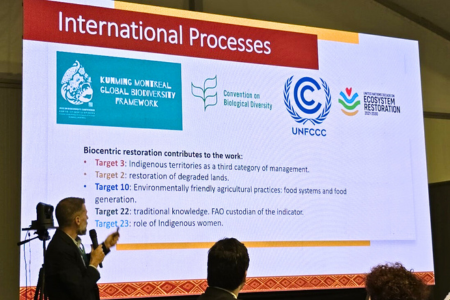
Mr Pablo J. Innecken, FAO Officer for Biodiversity and Climate Change, thanked the speakers and participants at the event with the conclusion that Indigenous Peoples’ biocentric restoration, as an initiative rooted in the work of the UN Decade on Ecosystem Restoration, is aiming to support the implementation of targets 2, 3, 10 and 22 of the Kunming-Montreal Global Biodiversity Framework.

The event at COP16 marks a significant step forwards in global efforts to prioritize Indigenous Peoples’ rights and knowledge in biodiversity conservation, aligning with the commitment of CBD member states embodied in the adoption of the new Programme of Work on Article 8(j) and the creation of a Subsidiary Body to support the implementation of this Article.

quarta-feira, 19 de junho de 2024

Government Subsidies to Planet-Harming Sectors Surpass $2.6T, Going Against Global Climate Goals


Since 2022, environmentally harmful subsidies from governments have risen by roughly $800B, now accounting for 2.5% of the world’s GDP each year.

Despite pledging to repurpose at least $500B of planet-harming subsidies a year by 2030, governments around the world have poured $800B more into fossil fuels, deforestation and water pollution, new research has found.

Since 2022, when the Kunming-Montreal Global Biodiversity Framework was signed, countries’ contributions to climate-destroying sectors have crossed $2.6T, or 2.5% of the global GDP, per year.

Governments have been granting subsidies, tax breaks, below-market leases and other funds to activities that go against the promises they made at the biodiversity COP15 in Montreal two years ago, the report by the organisation Earth Track revealed.

“Despite 196 governments agreeing to reform harmful subsidies in 2022, progress has been too slow. We’re spending more than ever on subsidies that are unintentionally destroying the planet on which all our livelihoods and economies depend,” said Eva Zabey, CEO of Business for Nature, a global coalition of conversation agencies.

Fossil fuel use drives rise in climate-harming subsidies
Doug Koplow and Ronald Steenblik are leading experts on government subsidies relating to the environment, and their latest work is an update on their review from 2022, which incorporated multiple sectors affecting resource extraction and land use change.

The authors argue that most international analyses of subsidies are too focused on a single sector, but it’s in fact the combined effect that drives nature and biodiversity loss. In the new report, they have included estimates from non-energy mining and plastics production.

This – combined with improved data, inflation, and rising fossil fuel subsidies – primarily led to the $800B hike. When adjusted for inflation, this increase amounts to $570B.

The fossil fuel sector saw the largest spike, with subsidies up by an average of $340B a year owing to the war in Ukraine and consequent energy price surges. Government subsidies towards carbon capture and sequestration, as well as energy stockpiling, took the sector’s annual total to $1.05T.

The report notes that fossil fuel subsidies represented over 10 times the total revenues from carbon pricing schemes. Meanwhile, additional large-scale funding of international fossil fuel projects via public lenders provided nearly $50B a year during 2020-22 – lending has been “heavily skewed” towards oil and gas over clean energy.

At $600B, agriculture received the second-largest share of annual subsidies. Total subsidies are actually much higher, but much of this funding went to support food security, so isn’t considered planet-harming. Still, the farming sector saw a $25B hike in public subsidies, mostly for monoculture and biofuels.

The fishing industry was the recipient of $55B in subsidies, geared towards large fisheries that promote overfishing and are linked to illegal, unregulated, and unreported catch. Subsidies towards water totalled $390B, going towards direct freshwater withdrawal for agriculture (71% of the share) and industry (16%). Only 6% of these subsidies benefit the lowest income quintile.

Other harmful industries that have benefitted from state support include transportation ($180B in subsidies), forestry ($175M), construction ($150B), non-energy mining ($40B), and plastics ($30B).

Governments must deliver on subsidy reform promise at COP16
At COP15, governments pledged to redirect subsidies worth half a trillion towards policies that benefit people and the planet, as part of the Kunming-Montreal Global Biodiversity Framework.

In the text of Target 18, governments vowed to “identify by 2025, and eliminate, phase out or reform incentives, including subsidies, harmful for biodiversity, in a proportionate, just, fair, effective and equitable way, while substantially and progressively reducing them by at least $500B by 2030”. They said they would start with the “most harmful incentives, and scale up positive incentives for the conservation and sustainable use of biodiversity”.

The numbers from this Earth Track’s report show that these promises aren’t on track. And that’s before you realise that the figures were likely an underestimate due to the lack of high-quality data.

That said, some governments have begun to assess the impact of these subsidies. The Netherlands has published a report on food and nature subsidies and their impact on biodiversity, Brazil’s federal audit court is examining whether the country is prepared to repurpose subsidies, and the EU has produced a draft methodology for subsidy reform.

To help governments advance their efforts, Business for Nature has published a list of ways to implement Target 18. It’s asking countries to conduct national assessments to identify the scale and types of subsidy mechanisms, co-develop and publish a robust reform roadmap, and redirect planet-harming subsidies while ensuring a just transition and bolstering social purposes.

Countries should also enhance accountability and governance of such policies, and advance international cooperation on the issue. Governments will meet at COP16 in Colombia next month, and they’re being urged to keep the promises they made in the last biodiversity summit.

“With COP16 fast approaching, it’s time for governments to ditch these harmful subsidies and redirect them to accelerate the transition to a nature-positive economy for all,” said Zabey. “Businesses have an important role to play, starting by assessing their dependencies and actively supporting governments in their reform efforts.”

Meanwhile, food awareness organisation ProVeg International is calling on world leaders to recognise the potential of food system change, which it says should be the leading strategy to stop Amazonian deforestation.

“We really hope to get this message across at the biodiversity summit in Colombia in a way that inspires countries to take concrete action and introduce policies that will save our precious wildlife,” said Laura Weidgenant, the non-profit’s senior UN policy manager.

segunda-feira, 6 de maio de 2024

Acção Climática Já: mitigação e adptação


A mitigação refere-se aos esforços para reduzir ou prevenir a emissão de gases de efeito estufa. Adaptação é o processo de ajuste aos impactos atuais ou esperados das alterações climáticas. A necessidade de adaptação varia de um local para outro, dependendo do risco para os sistemas humanos ou ecológicos.

Mitigation refers to efforts to reduce or prevent emission of greenhouse gases. Adaptation is the process of adjusting to current or expected impacts of climate change. The need for adaptation varies from one location to another, depending on the risk to human or ecological systems.

sexta-feira, 16 de dezembro de 2022

COP15 - quem deve pagar a defesa dos ecossistemas?


Começou esta quarta-feira a Conferência das Partes da Convenção das Nações Unidas (COP15), sobre Biodiversidade no Canadá. A humanidade tornou-se uma "arma de extinção maciça" e é tempo de parar a nossa "guerra contra a natureza", afirmou o Secretário-Geral das Nações Unidas, António Guterres, apelando aos países para que tomem decisões corajosas durante a cimeira COP15 sobre a biodiversidade. O director do Instituto da Biodiversidade e das Áreas Protegidas, na Guiné-Bissau, Justino Biai, lembra que "estamos a dar prioridade ao desenvolvimento em relação à biodiversidade".

Depois de dois anos de adiamento, por causa da pandemia da Covid-19, a conferência da ONU sobre biodiversidade, a COP15, arrancou esta quarta-feira, 7 de Dezembro, em Montreal, no Canadá. Os objectivos dos negociadores para as próximas duas semanas: chegar a um acordo internacional com compromissos concretos até 2030 para proteger a natureza.

"A biodiversidade é um dos componentes essenciais no meio ambiente. Não podemos separar a biodiversidade do meio ambiente", defende o director do Instituto da Biodiversidade e das Áreas Protegidas (IBAP), na Guiné-Bissau, Justino Biai, que lembra que "estamos a dar prioridade ao desenvolvimento em relação à biodiversidade".

Segundo o último relatório do World Wildlife Fund (WWF), as populações de animais selvagens diminuíram em média 69% desde 1970. Enquanto os estudos mostram uma degradação da biodiversidade, a COP15 da biodiversidade vai traçar novos objectivos para a preservação dos ecossistemas. "Só as pessoas que estão próximas da biodiversidade é que sentem que ela está a ser ameaçada. Enquanto as mudanças climáticas todos estamos a sentir os seus impactos. Talvez seja por isso que existe maior lobbing em torno das mudanças climáticas", compara o directo do IBAP.

Os cientistas descrevem um círculo vicioso: quanto mais altas as temperaturas, mais certas espécies, plantas ou animais, ficam desprotegidas: árvores, pássaros, morcegos, peixes. Essas mudanças na biodiversidade afectam os ciclos do carbono e da água e, portanto, aceleram as mudanças climáticas.

No início da COP15, que decorre em Montreal, no Canadá, até dia 19 de Dezembro, António Guterres realçou que um terço do planeta está degradado, com um milhão de espécies em risco de extinção, causando danos à natureza e também à sobrevivência das populações.

"A perda da natureza e da biodiversidade traz um custo humano acentuado. Um custo que medimos em empregos perdidos, fome, doenças e mortes. Um custo que medimos em 3 triliões de dólares [2,8 biliões de euros] em perdas anuais até 2030 pela degradação dos ecossistemas. Um custo que medimos em preços mais elevados da água, alimentos e energia. E um custo que medimos nas perdas profundamente injustas e incalculáveis dos países mais pobres, populações indígenas, mulheres e jovens", acrescentou António Guterres.

segunda-feira, 12 de dezembro de 2022

Verificação de factos: 1.200 especialistas em clima assinaram 'declaração' negando a emergência climática?

Versão pdf


Um documento que nega o clima, supostamente assinado por 1.200 importantes cientistas e académicos, tornou-se viral nas redes sociais.

A "Declaração Mundial do Clima" - que afirma que "não há emergência climática" - foi partilhada pela primeira vez em 27 de junho.

Um senador australiano partilhou o documento no Facebook afirmando que "esta é mais uma confirmação de que não há emergência climática".

Outros grupos de conspiração bem conhecidos argumentaram que não há consenso científico de que os humanos são os culpados pelo aquecimento global porque “o clima da Terra tem variado desde que o planeta existiu, com fases frias e quentes ocorrendo naturalmente”.

Um relatório de 2021 da Cornell University descobriu que 99,9% de mais de 88.000 estudos sobre alterações climáticas concordam que os humanos aceleraram o fenómeno, em grande parte devido às emissões de carbono.

Além disso, os últimos 15 anos mais quentes já registados ocorreram desde 2005, sendo os oito anos mais recentes os mais quentes, de acordo com a NASA .

As investigações mostram que praticamente nenhum dos signatários da "Declaração Mundial do Clima" é climatologista.

Os dois principais atores holandeses por trás da declaração são Guus Berkhout, um geofísico aposentado que trabalhou para a gigante petrolífera Shell, e o jornalista Marcel Crok.

Ambos foram acusados ​​de receber dinheiro de empresas de combustíveis fósseis para financiar seu trabalho cético em relação ao clima. Eles negam as acusações,

Olhando mais de perto a lista de signatários, são precisamente 1.107, incluindo seis mortos. Menos de 1% dos nomes listados se descrevem como climatologistas ou cientistas do clima.

Oito dos signatários são ex-funcionários ou atuais da gigante petrolífera Shell, enquanto muitos outros nomes têm ligações com empresas de mineração.

Um dos signatários é Ivar Giaever, co-vencedor do Prêmio Nobel de Física em 1973 por seu trabalho em supercondutores. No entanto, ele nunca publicou nenhum trabalho sobre ciência do clima.

De acordo com uma contagem independente de 2019 dos signatários da declaração, 21% eram engenheiros, muitos ligados à indústria de combustíveis fósseis. Outros eram lobistas e alguns até trabalhavam como pescadores ou pilotos de avião.


quinta-feira, 16 de janeiro de 2020

Parlamento Europeu quer metas vinculativas para travar perda da Biodiversidade


Os eurodeputados pediram hoje uma posição forte da União Europeia na COP15, onde será acordada a estratégia mundial para travar a perda da biodiversidade até 2030.

A 15ª Conferência das Partes (COP) da Convenção para a Diversidade Biológica – que entrou em vigor em 1993 – vai ser realizada em Outubro na cidade chinesa de Kunming.

Durante a COP15, 193 países deverão adoptar metas vinculativas para conservar e recuperar a natureza do planeta de 2020 a 2030, pediu hoje o Parlamento Europeu, numa votação em sessão plenária.

Com cerca de um milhão de espécies ameaçadas de extinção, o tempo urge, salienta.

A resolução aprovada hoje pelo Parlamento Europeu apela à União Europeia (UE) para liderar os trabalhos na COP15 e conseguir um acordo legal vinculativo – como foi o caso do Acordo de Paris para as alterações climáticas – para travar a perda da biodiversidade. Esse acordo vinculativo deve ter prazos e indicadores de sucesso, acrescenta.

O documento salienta ainda que a UE só terá credibilidade para o fazer se ela própria der o exemplo no seu território. Por isso, os eurodeputados pediram uma Estratégia Europeia da Biodiversidade 2030 mais ambiciosa, capaz de resolver as principais causas da perda da biodiversidade, com metas legais vinculativas para a UE e para os seus Estados membros.

Os eurodeputados pediram, por exemplo, a conservação de, pelo menos, 30% de áreas naturais e o restauro de, pelo menos, 30% dos ecossistemas degradados, tanto no mundo como na UE, até 2030.

“2020 será um ano crucial para a biodiversidade”, disse, em comunicado, Pascal Canfin, responsável pelo Comité do Ambiente em Estrasburgo.

Os eurodeputados propõem também que, pelo menos, 10% do orçamento da UE para o período de 2021 a 2027 seja investido na melhoria da biodiversidade. Incluindo o restauro de florestas, zonas húmidas, turfeiras, prados, zonas costeiras e áreas marinhas.

Defendem ainda que sejam implementadas metas vinculativas de redução do uso de pesticidas na UE.

“O Parlamento Europeu deu um sinal claro à Comissão Europeia no apoio a metas ambiciosas e legalmente vinculativas para trazer a natureza de volta”, disse, em comunicado, Sabien Leemans, da responsável da WWF para as Políticas Europeias.

“Agora, a Comissão deve responder a este apelo, tanto do Parlamento como dos cidadãos europeus, quando apresentar a Estratégia da Biodiversidade Europeia 2030.” Esta será debatida em Junho pelo Conselho Europeu.

Uma delegação do Parlamento Europeu vai participar na COP15, na China, de 19 de Outubro a 1 de Novembro deste ano.