Quarta-feira, 30 de Setembro de 2009

A versão de «leitura amigável» da Constituição da União Europeia

EUABC - The Lisbon Treaty, the readable version

[clica na imagem para descarregar o e-livro gratuito]

O EUABC é um dicionário, disponível na internet, que fornece explicações concisas para a maior parte dos termos utilizados nos debates da UE. Poderá também encontrar muitas ligações úteis!

Este dicionário tem igualmente como objectivo informar o público do debate sobre o futuro de Europa.

Inclui muitos termos relacionados com assuntos de debate político, muitas vezes temas de controvérsia e de tensão.

Os federalistas poderão encontrar argumentos e explicações tanto a favor como contra a integração europeia, assim como os euro-cépticos e os europeístas poderão encontrar argumentos em favor das suas posições.

Os conteúdos deste site estão em actualização constante. Assim, vai aqui encontrar novas entradas, relativas à Constituição da União Europeia, aprovada pelos Chefes de Estado e de governo dos Vinte e Cinco a 18 de Junho de 2004. Recomendamos a versão de «leitura amigável», que pode descarregar, através do Menu, secção «Constituição Europeia».

Por favor, sempre que encontrar erros ou omissões não hesite em contactar-nos pelo email: editor@euabc.com

Ireland now has 2.0% of the EU vote
The Lisbon Treaty will halve it to 0.9%

The heart of the Lisbon Treaty is a change in the way member states vote in the Council of Ministers. Small member states like Ireland will halve its vote. Germany will double its share of the vote.

There must still be a majority of states behind each law. The Lisbon Treaty introduces voting according to the exact number of citizens in each state.

See the more precise rules under Voting in the Council and in Art. 238 TFEU in the Lisbon Treaty.


Nice Treaty Lisbon Treaty
% of votes in the Council Number of votes % of EU population Population in millions
Germany 8.4 29 16.41 82.00
France 8.4 29 12.88 64.35
United Kingdom 8.4 29 12.33 61.63
Italy 8.4 29 12.02 60.05
Spain 7.8 27 9.17 45.83
Poland 7.8 27 7.63 38.14
Romania 4.1 14 4.30 21.50
Netherlands 3.8 13 3.30 16.49
Greece 3.5 12 2.25 11.26
Czech Republic 3.5 12 2.09 10.47
Belgium 3.5 12 2.15 10.75
Hungary 3.5 12 2.01 10.03
Portugal 3.5 12 2.13 10.63
Sweden 2.9 10 1.85 9.26
Austria 2.9 10 1.67 8.36
Bulgaria 2.9 10 1.52 7.61
Denmark 2.0 7 1.10 5.51
Slovakia 2.0 7 1.08 5.41
Finland 2.0 7 1.07 5.33
Ireland 2.0 7 0.89 4.47
Lithuania 2.0 7 0.67 3.35
Latvia 1.2 4 0.45 2.26
Slovenia 1.2 4 0.41 2.03
Estonia 1.2 4 0.27 1.34
Cyprus 1.2 4 0.16 0.79
Luxembourg 1.2 4 0.10 0.49
Malta 0.9 3 0.08 0.41
EU-27 Total 100.0 345 100.00 499.75
Blocking Minority 26.38% 91 35% 174,913
Qualified majority 73.91% 255 65% 324,838

WHO will appoint the Commission?

Today each member state government decides WHO shall be on the Commission in Brussels. The Lisbon Treaty will change the word propose to suggest.

Then the new Commission President will decide WHO shall be in the Commission - together with a qualified majority of prime ministers.

Read about the rules under the word Commission and Voting in the Council and see Art. 17.7 TEU in the Lisbon Treaty.

Can migrant workers be paid less?

According to the treaties the EU has no say on salaries. But the EU Court in Luxembourg has decided that migrant workers can work for much less than the normal pay.

Read about the rulings in the euabc under Laval, Rüffert, Viking and Luxembourg.

Can the EU decide new taxes?

Taxes can only be harmonised when all member states agree. But the Lisbon Treaty introduces a new clause in Art. 113 TFEU permitting the EU to outlaw tax competition in the Internal Market.

Art. 311 TFEU permits the EU to establish new taxes to finance the EU itself.

Read more under Taxes.

Is there a national veto on the WTO?

David O`Sullivan, the Director-General of trade in the EU Commission, says Yes in his comment under World Trade Organisation.

Jens-Peter Bonde, MEP from 1979-2008, says mostly No in his comment. Read the different comments and decide on your own. See also Art. 218.8 TFEU in the Lisbon Treaty

Can the EU decide on abortion?

The EU has already decided on abortion. In 1991 the EU Court decided that abortion is an economic service which can be sold freely. The Advocate-General wanted to outlaw the Irish rules on abortion. The EU Court decided to allow them "on balance". Read more under Abortion.

Different books on the Lisbon Treaty

Here you can download different books on the Lisbon Treaty for free.
80,000 pieces of law voters can't change
The size of strawberries for sale in shops is decided by the EU
The size of strawberries for sale in shops is decided by the European Commission in a regulation "binding in its entirety and directly applicable in all Member States".

The national parliaments or the European Parliament has no say. It is one of 80,000 rules which cannot be changed by the voters. See under "Strawberries" and "Number of laws"


The EU is composed of 27 member states all with parliamentary democracies. Voters may participate in elections, leading to a new majority and then new laws.

We have managed to establish the existence of more than 80,000 pieces of law in the EU where this fundamental principle of democracy does not apply.

Firstly, we have 26,560 pieces of valid law decided in the European institutions. They can only be amended after a decision by the non-elected members of the Commission. The Council of Ministers must approve important changes by a qualified majority.

The European Parliament can change nothing itself, even if all members of the parliament were to unanimously agree.

Then we have 4,112 international agreements binding citizens and companies in the same way as law. There are also 10,337 verdicts from the EU Court in Luxembourg which can only be amended by new verdicts from the judges or by a new treaty.

Finally we have 44,838 harmonised standards which can normally be amended by the Commission or/and a qualified majority among member states. Again, even a unanimous parliament cannot change them at all after new elections.

European voters are set aside in relation to maybe more than 80,000 rules of laws and harmonisations. We cannot change the content by putting our vote in the ballot box.

Why not insist on the principle of democracy which would say: All laws must be approved by a majority in a national or European Parliament. This does not mean that all 85,832 pieces of hard and soft law must actually be approved by members of parliaments.Those elected by the voters may delegate the more technical decisions to specialised organs.

We would still have democracy if those powers that had been delegated to the common level were able to be brought back by a simple majority in Parliament if necessary. The fact that this is no longer possible means that there is no democracy for the change of these 80,000 hard and soft laws.

Look under "Number of laws" to find the full table of hard and soft laws in the EU. Look under "Democracy" to learn about the decision making process in the EU.


Uma viagem por toda a História da Botânica - Exposição Order From Chaos: Linnaeus Disposes


The from which Linnaeus brought order can be seen not only as the previous and contemporary literature in which plants and animals were named and described in as many styles as there were authors but also as the explosion in new species found during European voyages of discovery that had to be accounted for in the overall knowledge of the plant world.


To bring order from chaos, Linnaeus did two things:
1. He synthesized the previous literature about all plants and animals known to the western world, determining which descriptions in one work correlated to which descriptions in another work.
2. He developed a comprehensive system for grouping, naming and describing species, and he added references from previous authors to his own text, correlating his names and descriptions to those of earlier and current writers.

His new plant classification system was artificial and thus undesirable from the point of view of those working to achieve a natural system of classification. However, what it lacked in naturalness it made up for in ease of application, usability, and expansibility. A problem with many earlier systems was that an inexperienced person with an unknown plant in hand could not easily find its place within the system and could not ascertain whether it was already recorded somewhere else.

The essence of Linnaeus’ achievement is that he succeeded in regularizing the way plants and animals were studied. He made systematics systematic, through a system of uniform description, classification and nomenclature, which in turn simplified and facilitated identification. Others had done one or more of these things before but in a more limited and less coherent way. His precise terminology, use of an international language, consistently-applied system and global scope ensured widespread usability of his system. The magnitude, utility and comprehensiveness of his system made it unique and influenced the way that his colleagues and successors would approach their work. Modern systematic biology began with his mid-18th-century publications.

Visita merecida até Hunt Institute


Terça-feira, 29 de Setembro de 2009

Página oficial da Associação Árvores de Portugal


Caros amigos e amigas das árvores,

Vimos por este meio comunicar que a nossa página oficial está finalmente disponível: http://www.arvoresdeportugal.net/
Por motivos de funcionamento interno da própria Árvores de Portugal, ainda não estamos em condições de aceitar inscrições para sócios. Esta é uma questão que contamos ter resolvida brevemente e da qual iremos dando conta na nossa página oficial.

Até lá, agradecemos o envio de notícias sobre árvores para posterior divulgação na nossa página no Twitter: twitter.com/arvoresportugal

Por outro lado, a colaboração pode ser feita através da partilha de fotografias de árvores notáveis, utilizando o nosso grupo no Flickr: flickr.com/groups/arvoresdeportugal/

Por último, mas não menos importante, aguardamos a sua colaboração com o nosso blogue. Assim sendo, caso o lei­tor pos­sua uma his­tó­ria sobre a temá­tica das árvo­res, não hesite e partilhe-a com todos os que ama­mos os gigan­tes dos nos­sos jar­dins e flo­res­tas. As suas con­tri­bui­ções serão apre­ci­a­das e pode­rão ser envi­a­das para a nossa página de contacto.

Um abraço.

Foto: Murtosa


Segunda-feira, 28 de Setembro de 2009

Arquitectura, Guggenheim - Um voto pela Cortiça portuguesa


Fui alertado pela minha esposa, Teresa Freitas, que encontrou este apelo ao voto na revista Café Portugal ( segunda-feira, 28 de Setembro de 2009, que a seguir reproduzo). Já votei, estou a tuitar e ainda encontrei este vídeo excelente no youtube. Passem a palavra e/ou façam como eu, republiquem nos vossos blogues:)

Um português com um abrigo concebido em cortiça, posiciona-se entre os 10 finalistas num concurso internacional promovido pelo Museu Guggnheim, Nova Iorque. O voto é popular e decorre até 10 de Outubro.


O português David Mares é um dos 10 finalistas de arquitectura no concurso internacional lançado pela Fundação Guggenheim e a empresa Google SKetchUp. Ao longo dos últimos meses perto de 600 concorrentes de 68 países aceitaram um desafio: desenhar um modelo 3D de um abrigo utilizando as ferramentas Google SketchUp e Google Earth.

David Mares utiliza no abrigo que arquitectou uma das maiores riquezas florestais de Portugal, a Cortiça.

O arquitecto, fazendo usa das novas tecnologias, aproveita as características milenares da cortiça. O Vale de Barris, próximo a Palmela, caracteriza-se por verões quentes e invernos húmidos. A Cortiça, isolante térmico e acústico, presta-se à finalidade deste abrigo: Uma zona de estudo e de descanso.
Até 10 de Outubro é momento de votar no abrigo preferido. É permitido apenas um voto por pessoa.

VOTAR AQUI


O vencedor do prémio será anunciado a 21 de Outubro data em que se celebram os 50 anos sobre a abertura do famoso museu nova-iorquino.


Investigador em astrobiologia e endosimbiose inauguram uma hipótese muito provável acerca da evolução da vida na Terra

Published By Matt

Humans might not be walking on Earth today if not for the ancient fusing of two microscopic, single-celled organisms called prokaryotes, NASA-funded research has found.

By comparing proteins present in more than 3000 different prokaryotes – a type of single-celled organism without a nucleus – molecular biologist James A. Lake from the University of California at Los Angeles’ Center for Astrobiology showed that two major classes of relatively simple microbes fused together more than 2.5 billion years ago. Lake’s research reveals a new pathway for the evolution of life on Earth. These insights are published in the Aug. 20 online edition of the journal Nature.

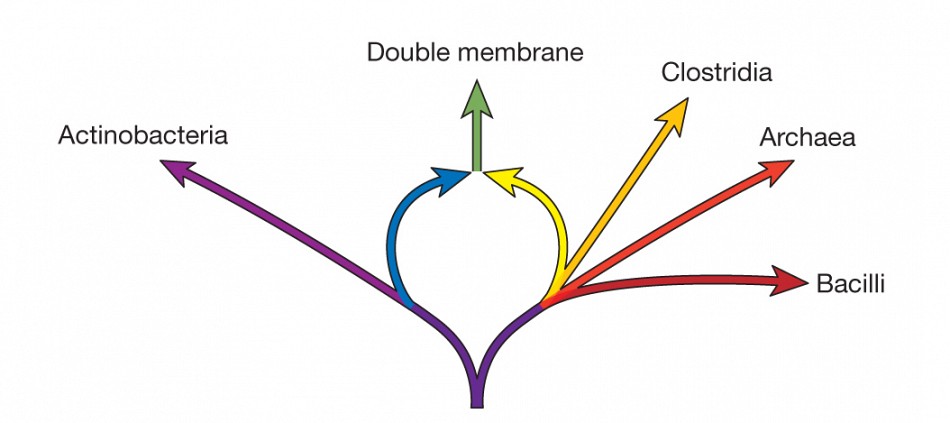
A schematic diagram illustrating the prokaryotic ring of life. The actinobacterial genome donor, at the left (blue), and the clostridial genome donor, at the right (yellow), transfer their genomes to form the doublemembrane prokaryotes at the top of the ring (green). The protein family data identify the Actinobacteria and the Clostridia as donors, and the doublemembrane prokaryotes as the fusion organism.

A schematic diagram illustrating the prokaryotic ring of life. The actinobacterial genome donor, at the left (blue), and the clostridial genome donor, at the right (yellow), transfer their genomes to form the doublemembrane prokaryotes at the top of the ring (green). The protein family data identify the Actinobacteria and the Clostridia as donors, and the doublemembrane prokaryotes as the fusion organism.

This endosymbiosis, or merging of two cells, enabled the evolution of a highly stable and successful organism with the capacity to use energy from sunlight via photosynthesis. Further evolution led to photosynthetic organisms producing oxygen as a byproduct. The resulting oxygenation of Earth’s atmosphere profoundly affected the evolution of life, leading to more complex organisms that consumed oxygen, which were the ancestors of modern oxygen-breathing creatures including humans.

“Higher life would not have happened without this event,” Lake said. “These are very important organisms. At the time these two early prokaryotes were evolving, there was no oxygen in the Earth’s atmosphere. Humans could not live. No oxygen-breathing organisms could live.”

The genetic machinery and structural organization of these two organisms merged to produce a new class of prokaryotes, called double membrane prokaryotes. As they evolved, members of this double membrane class, called cyanobacteria, became the primary oxygen-producers on the planet, generating enough oxygen to alter the chemical composition of the atmosphere and set the stage for the evolution of more complex organisms such as animals and plants.

“This work is a major advance in our understanding of how a group of organisms came to be that learned to harness the sun and then effected the greatest environmental change Earth has ever seen, in this case with beneficial results,” said Carl Pilcher, director of the NASA Astrobiology Institute at NASA’s Ames Research Center in Moffett Field, Calif., which co-funded the study with the National
Science Foundation in Arlington, Va.

Founded in 1998, the NASA Astrobiology Institute (NAI) is a partnership between NASA, 14 U.S. teams, and six international consortia. NAI’s goals are to promote, conduct, and lead interdisciplinary astrobiology research, train a new generation of astrobiology researchers, and share the excitement of astrobiology with learners of all ages. The Astrobiology Institute is part of NASA’s Astrobiology Program. The Astrobiology Program supports research into the origin, evolution, distribution and future of life on Earth and the potential for life elsewhere.


Domingo, 27 de Setembro de 2009

No Dia Mundial do Turismo (hoje), sugiro o turismo digital- uma (nova) forma de mitigar a recessão e de práticas mais amigas do ambiente (?)


360 cidades já aderiram e muitas mais numa rede crescente de serviços panorâmicos e experiências imersivas em paisagens e outros espaços, tudo confortavelmente no ecrã do teu computador!

Em Portugal temos o excelente Portugal a 360º

No Google Earth, polulam vídeos de ruas inteiras, muitos recriando passeios a pé.
Constitui ainda um grande enriquecimento para a Escola enquanto material educativo.


Brian Eno - In Dark Trees


Influenced by the quieter aspects of the concurrent, German experimentalist scene, Another Green World adds an increased maturity and contemplative side to the spastic art rock of Eno's previous efforts. It is mostly a series of compelling instrumental snapshots, all widely diverse in texture and feel. The wobbling, vaguely sinister feel of Somber Reptiles and the clicking, clacking menace of In Dark Trees represent the darker pieces on the album. These are countered by the brightness of The Big Ship and the luxuriant Becalmed. [fonte]


Sábado, 26 de Setembro de 2009

Período de reflexão eleitoral

[recebido por mail]

Caros amigos,

No próximo domingo, dia 27 de Setembro, haverá eleições para a Assembleia da República, onde teremos oportunidade de eleger os 230 deputados que nos representarão na discussão e decisão dos problemas de Portugal.
Para uma correcta escolha dos deputados que nos representarão, devemos votar no partido que apresenta as propostas com as quais mais concordamos. E a melhor maneira de conhecermos estas propostas é analisando os programas eleitorais de cada partido.
Serve este mail para os seguintes incentivos, simples mas importantíssimos:

1. Exerce o teu direito de voto!
2. Vota no partido que apresenta, em tua análise, as melhores propostas para o país, isto é, o melhor programa eleitoral!

Para poderes decidir o teu voto é essencial que conheças os programas
eleitorais, pelo menos o do partido que escolhes. Podem e devem consulta-los
nos seguintes endereços:

BE http://www.bloco.org/media/programabe.pdf
CDS-PP http://www.cds.pt/rubricas/programaeleitoralCDS.pdf
CDU http://www.pcp.pt/dmfiles/programa-eleitoral-ar2009.pdf
FEH http://www.ecologiahumanismo.net/
MEP http://mep.pt/images/Legislativas/programamep2009.pdf
MMS http://www.mudarportugal.pt/anexos/programa.pdf
PND http://www.pnd.pt/legislativas-2009/programa-politico-2009/
POUS http://pous4.no.sapo.pt/Manifesto_POUS_legislativas_Set_09.pdf
PPM http://www.slideshare.net/s19yorky/programa-eleitoral-ppm-legislativas-2009
PPV http://portugalprovida.googlegroups.com/web/PPV_sintese.pdf?hl=pt-PT&gda=drr5T0AAAABUJsR3QfVDCkRbqNAzCkOKymWr9mx6uOdiB9I7OwT6RWFdcyIH7jlCztQRllem8cKK39hcfVCplQ_8NpHmmxMC&gsc=j5Ql7gsAAAAJ96Ux9LO0kA6MQLjrNYRE
PS http://www.ps.pt/media/Programa_de_Governo_do_PS.pdf
PSD http://www.politicadeverdade.com/archive/doc/Compromisso_de_Verdade_-_Programa_Eleitoral_do_PSD_-_Legislativas_2009_0.pdf
PTP http://www.ptp.com.pt/programa.htm

Se quiseres ter uma ideia da tua área política e dos partidos que te são mais próximos, consulta: http://www.bussolaeleitoral.pt/

Poderás procurar todas as informações sobre estas eleições em http://www.cne.pt/index.cfm?sec=0201000000&NewsID=129 e consultar o teu local de voto em http://www.recenseamento.mai.gov.pt/ .

Cumprimentos e bons votos!


1969 - Luís Cília - Canção


Maravilhosa e singela peça musical com um belo poema de Fernando Morgado, criada pelo Luís Cília no exílio em França, nos idos anos sessenta. Vale a pena ouvir e deixar a vida correr ao seu ritmo.


Quinta-feira, 24 de Setembro de 2009

Google's Search Engine Pinpoints Extinction

By Julia Whitty | Fri September 4, 2009 4:32 PM PST
Photo courtesy Wikimedia Commons

Thanks to the BBC for a link to this paper describing how Google's algorithm for ranking web pages could determine what species are most critical for sustaining ecosystems.

The authors write in PLoS Computational Biology that their version of PageRank could ascertain which extinction would likely lead to ecosystem collapse.

Species are embedded in complex networks of relationships. Some more so than others. In those cases, a single extinction can cascade into the loss of many other species.Figuring this out in advance is supremely difficult. The number of links in even simple ecosystems exceeds the number of atoms in the universe. We can't sort out that kind of complexity without quantum computers.

But maybe Google can. Researchers Stefano Allesina and Mercedes Pascual reversed the definition of the PageRank algorithm that ranks a webpage as important if important pages point to it. In the conservation biology context, even humble species are important if they point to important species.

The researchers also designed a cyclical element into the foodweb system by including the detritus pool (you know, that to which all returns and that from which all arises).

Allesina and Pascual then tested their method against published foodwebs to rank species according to the damage caused if they were removed from the ecosystem. They also tested algorithms already in use in computational biology to find a solution to the same problem.The results: PageRank gave them exactly the same solution as the more complicated algorithms.In the real world, this research will likely make it easier to quickly target conservation efforts for maximum benefit.

Hope evolves in that muddy puddle where technology meets environmentalism.


Terça-feira, 22 de Setembro de 2009

Foto do Dia: Um letreiro que diz "Klimakiller" foi afixado carro durante uma demonstração da Geenpeace na 63ª International Car Show , Frankfurt


Photo: Ralph Orlowski

A sign that reads Klimakiller (climate killer) is fixed to a car during a Geenpeace demonstration against pollution at the 63rd international car show IAA in Frankfurt September 17, 2009.

The world's biggest auto show starts on Thursday and will run until September 27.

© Thomson Reuters 2009 All rights reserved


No Dia Sem Carros- o blogue activista Passeio Livre


Passeio Livre


Imprime e cola nos vidros laterais das viaturas mal estacionadas
Clica na imagem para visitares o blogue!


Segunda-feira, 21 de Setembro de 2009

Brighter Planet - sítio e pequeno vídeo

Your Planet, Brighter


We are pioneering a new environmentalism, one that is accessible to everyone, fits one's lifestyle, and is fun to share.


Alguns dos cartazes mais criativos da WWF


Óptimos recursos educativos (apresentações, e-correio, blogues escolares, inspiração para trabalhos,etc).

creative wwf campaigns 1

creative wwf campaigns 2

creative wwf campaigns 3

creative wwf campaigns 4

creative wwf campaigns 5

creative wwf campaigns 6

creative wwf campaigns 7


creative wwf campaigns 8

creative wwf campaigns 9

creative wwf campaigns 10

creative wwf campaigns 11

creative wwf campaigns 12

creative wwf campaigns 12

creative wwf campaigns 13

creative wwf campaigns 14 width=

creative wwf campaigns 15

creative wwf campaigns 16

creative wwf campaigns 17

creative wwf campaigns 18

creative wwf campaigns 19

creative wwf campaigns 20


creative wwf campaigns 21

creative wwf campaigns 22

creative wwf campaigns 23

creative wwf campaigns 24

creative wwf campaigns 25

creative wwf campaigns 26

creative wwf campaigns 28

creative wwf campaigns 29

creative wwf campaigns 30

creative wwf campaigns 31

creative wwf campaigns 32

creative wwf campaigns 33


creative wwf campaigns 35

creative wwf campaigns 36

creative wwf campaigns 37

creative wwf campaigns 38


creative wwf campaigns 40

creative wwf campaigns 41


creative wwf campaigns 43

creative wwf campaigns 44

creative wwf campaigns 45

creative wwf campaigns 46

creative wwf campaigns 47

creative wwf campaigns 48

creative wwf campaigns 49

creative wwf campaigns 50


Compilação original em Zuza Fun


Gostou? Compartilhe: