
Did you know that more than 4 million people have been affected by catastrophic floods in Southeast Asia this week and more than 600 have already died?
While much of the Western world went about its normal routines, a climate-charged humanitarian disaster was unfolding across Indonesia, Thailand and Malaysia. According to a recent report from Reuters, over 4 million people have now been directly impacted. Entire communities vanished under water. Families were swept away in the night. Roads crumbled. Landslides buried homes with people still inside. Survivors clung to rooftops as rivers exploded out of their banks and swallowed everything in their path. More than 600 lives lost in a few days and yet Western media attention remains fleeting.
“Research published in 2025 found that global media coverage of natural disasters is heavily skewed toward events in countries with close social or genetic ties to the reporting country meaning that catastrophes in many climate-vulnerable regions are largely ignored.”
A week of unimaginable human suffering
In the hardest-hit areas of Indonesia, the death toll climbed to at least 303. Rescue agencies report many missing, entire villages unreachable because roads and communications infrastructure washed away. In southern Thailand, flooding and landslides pushed fatalities into the high hundreds; in some provinces morgues became overwhelmed. Across the region, tens of thousands have been displaced, homes destroyed beyond repair, farmland submerged or swept away, and local economies devastated. Villages remain cut off inside debris-filled flood zones even as relief efforts struggle to reach them.
Behind every statistic there is a human reality:
⚠️ Children wading through waist-deep muddy water after schools collapsed.
⚠️ Parents carrying their children on their backs through flooded roads, uncertain if home still stands.
⚠️ Families living on damp floors or makeshift shelters, hungry, cold, and terrified as rain continues to fall.
⚠️ Farmers staring at drowned fields, their harvests ruined, livelihoods destroyed, futures uncertain.
This is not a disaster. It is collective trauma. This is not “just monsoon season” — this is climate disruption in real time The scale, intensity, and unpredictability of the flooding are not random. Scientists have long warned that a warming world brings heavier rainfall, more volatile storm systems, and increased risk of extreme floods. Warmer air can hold more moisture; warmer seas feed storms; the result is more frequent and more intense rainfall events. Many experts say that what Southeast Asia is enduring now; unusual, catastrophic floods across multiple countries at once is precisely the kind of climate-driven extreme weather that belongs to the future. Today it is the present. This horrific upheaval should not be dismissed as “just bad luck.” It must be seen as a warning, evidence of a planet growing increasingly unstable under human-induced climate change.
Why the world’s silence is so dangerous
When more than 4 million people are affected and 600+ die in a few days — and yet global attention remains shallow — something fundamental is broken. If tragedies in the Global South are treated as distant background noise. If the suffering of millions remains largely invisible to the world’s richest and most powerful countries.If disasters fueled by climate disruption are not met with sustained global solidarity — then we are not just failing in empathy. We are failing in foresight.
Selective attention kills urgency
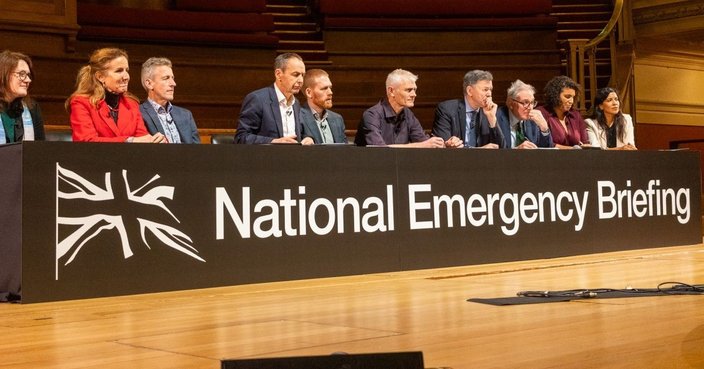
And without urgency, we will never mount the global response such a crisis demands. And while Asia drowned, something else happened in London This same week, the UK hosted the first-ever National Emergency Briefing at Westminster Central Hall — gathering more than a thousand politicians, business leaders, media figures, faith and community voices, all briefed by a panel of top scientists, health-, food- and security-experts.
The message delivered behind closed doors was unambiguous: the climate and nature crisis is already a national security threat. The same forces tearing apart lives in Southeast Asia — extreme rainfall, destabilized weather patterns, overwhelmed infrastructure — can strike any country.
What climate-driven disasters trigger there, they can trigger here. The flooding in Asia is not a distant regional catastrophe. It is a front-line preview of what could happen anywhere including countries in the Global North. This is not a regional crisis. This is a national emergency everywhere. The floods decimating lives across Southeast Asia are not “somebody else’s problem.” They are a warning — raw, unfiltered, urgent. If we cannot look at the suffering of 4 million people today.If we cannot grant their lives the dignity of our attention.
Then how will we protect our own tomorrow?
Because geography will not protect us from climate collapse. Borders will not stop rising waters. Storms will not ask permission. The question is not if it will happen here — But when. If we stay asleep, the water will open our eyes but that will be too late. One powerful way to wake up the people in charge is to do what a group of courageous scientists and civil-society leaders just did in the UK: host a National Emergency Briefing and put political leaders directly in front of the facts. Bringing politicians into the same room as independent experts without spin, without filters, without delay, is one of the most effective tools we have to cut through denial and inertia. We Don’t Have Time is proud to be the official media partner for this groundbreaking initiative. On this page, you can rewatch the full briefing, hear from the scientists themselves, and learn how the model works:


.png)


