quinta-feira, 30 de abril de 2026

Espanha: Elétricas e PP propagam notícias falsas culpando as renováveis pelo apagão

A Greenpeace denunciou quatro notícias falsas que estão sendo propagadas por empresas elétricas e pelo Partido Popular (PP), com o objetivo de culpar as energias renováveis pelo apagão e justificar a manutenção de centrais nucleares e de gás:

1: “Havia energia renovável em excesso”
Realidade: O apagão foi causado por falhas no controle de tensão atribuíveis a centrais de gás e nucleares (que não forneceram os serviços de segurança pelos quais foram pagas). Países com maior participação renovável (Alemanha, Grécia) não sofreram apagão.

2: “Não podemos prescindir da energia nuclear para evitar novos apagões”
Realidade: A nuclear foi um peso durante a crise. Mais de metade do parque nuclear estava operacional, mas não ajudou a estabilizar o sistema (inclusive há processos contra centrais como Almaraz, Ascó e Vandellós II). Além disso, centrais nucleares são lentas para religar (levam dias), ao contrário de outras tecnologias.

3: “Sem gás não podemos viver”
Realidade: Embora as centrais de gás tenham ajudado na recuperação pós-apagão, 16 centrais de gás também falharam em controlar a tensão para evitar o colapso (e estão sendo sancionadas).

4: “Só com renováveis não podemos funcionar”
Realidade: Um estudo da Greenpeace (Energia para viver melhor) conclui que Espanha e Portugal podem abandonar completamente os combustíveis fósseis e a energia nuclear até 2040, com redução de 39% da procura energética total e abastecimento 100% renovável (eólica, solar, hidráulica, armazenamento e gestão da procura).

A Greenpeace sugere a aplicação de um imposto específico sobre as grandes empresas elétricas (que aumentaram lucros pós-apagão) para financiar o combate à pobreza energética e uma transição energética justa.

quarta-feira, 29 de abril de 2026

The Stargazer Lilies - Perfect World


Letra
Love would rule
Nothing be cruel
No one would hurt
Or feel like dirt
Every soul 
Honest and true
Each  moment 
Fresh and new

Oooooo
In a perfect world
Rainbows swirled
Blue and green twirled
Oooooo
In a perfect world
Space time curled
And rainbows swirled
Oooooo

 Poverty would be no more
As would disease and making war
All mistakes
Could be undone
Above all else
Life would be 

Esta canção é um hino ao idealismo utópico, pintando o retrato de uma realidade onde as falhas fundamentais da condição humana — o sofrimento, a malícia e a irreversibilidade do tempo - foram erradicadas. No seu âmago, a letra explora a pureza moral e emocional, sugerindo que num mundo perfeito a dor psicológica seria inexistente, pois a honestidade e a autovalorização seriam a norma, eliminando o sentimento de "ser lixo" ou a necessidade do engano.

A composição eleva-se acima das questões sociais ao tocar no campo da metafísica, especialmente quando menciona que o "espaço-tempo se curvaria". Esta ideia de que "todos os erros poderiam ser desfeitos" revela o maior desejo humano: a libertação do arrependimento e a capacidade de apagar as consequências permanentes das nossas falhas. Ao abordar a extinção da pobreza, da doença e da guerra, a letra confronta os três grandes pilares do sofrimento terreno, propondo um sistema de salvação absoluta.

Finalmente, ao terminar com a frase suspensa "a vida seria...", a canção sugere que, uma vez removido o ruído do conflito e da escassez, a verdadeira essência da existência é algo tão profundo e transcendente que ultrapassa a própria linguagem. É um contraste vibrante entre a dureza do nosso mundo e um sonho onde o amor não é apenas um sentimento, mas a própria lei que rege a física do universo.

Páginas oficiais
Bandcamp
Instagram
Spotify
Youtube

A advertência subtil, mas marcante, do rei Carlos III à América


Monarca britânico discursou perante o Congresso norte-americano, numa abordagem direta e contundente, suavizada pelo profundo respeito pelos anfitriões e pelas relações históricas entre os dois países

Numa nova era de revolta, foi preciso um rei para lembrar à América os seus valores republicanos: o Estado de direito, a democracia e o poder do seu exemplo internacional.

O rei Carlos III escolhe as suas palavras com precisão - tal como fazia a sua falecida mãe, a rainha Isabel II. O significado real tem frequentemente de ser inferido.

Mas, para os padrões reais, o seu discurso numa sessão conjunta do Congresso na terça-feira foi surpreendentemente direto.

Carlos não repreendeu nem criticou a administração Trump. Mas o monarca desaprovou implicitamente a atual direção política dos Estados Unidos e defendeu os pilares da democracia ocidental: freios e contrapesos internos, alianças e tolerância inter-religiosa.

Carlos apelou ainda à defesa firme da Ucrânia. E a “natureza”, disse ele, deve ser protegida, num apelo velado para combater as alterações climáticas, que o presidente Donald Trump chamou de “burla”.

E o rei salientou que os amigos podem discordar sem romper laços eternos, uma referência velada à “relação especial”, que tem sido abalada pela recusa do Reino Unido em aderir à guerra contra o Irão.

“As palavras da América têm peso e significado, tal como têm desde a independência”, disse Carlos, no hemiciclo da Câmara dos Representantes. “As ações desta grande nação importam ainda mais”.

A versão do rei sobre os valores dos Estados Unidos provavelmente agradou mais aos democratas “No Kings” do que ao vice-presidente JD Vance, que tem opiniões sobre o declínio civilizacional do Reino Unido e da Europa e que se sentou atrás dele na Câmara dos Representantes.

Mas Carlos amenizou a sua crítica demonstrando profundo respeito pelos anfitriões. Citou Trump, afirmando que o “laço de parentesco” entre os EUA e o Reino Unido é “inestimável e eterno”. E o seu discurso esteve repleto de elogios às conquistas históricas americanas.

E os pontos mais contundentes foram suavizados pela pompa coreografada de uma visita de Estado que retribui uma viagem de Trump no ano passado. Parafraseando o presidente Theodore Roosevelt, o rei falava suavemente enquanto empunhava um grande cetro.

O presidente não mostrou sinais de se sentir ofendido pelas observações de Carlos III. Donald Trump orgulha-se das suas relações pessoais com os líderes mais famosos do mundo. O rei também condenou por duas vezes a alegada tentativa frustrada de assassinato contra o presidente numa gala para a imprensa no sábado.

“The Firm”, como a família real é frequentemente conhecida, já passou por tudo isto antes. O rei Carlos III mencionou, num raro jantar de Estado de gala na Casa Branca na terça-feira à noite, que a sua mãe tinha vindo a Washington em 1957 para reparar as divisões entre os EUA e o Reino Unido provocadas pela crise de Suez.

“É difícil imaginar algo assim a acontecer hoje, mas não é difícil ver como a relação continua a ser importante, em assuntos visíveis e invisíveis”, disse o rei.

E Carlos III ofereceu ao presidente um presente único - o sino original da torre de comando do HMS Trump, um submarino da Marinha Real que esteve em serviço no Pacífico durante a Segunda Guerra Mundial.

“Se alguma vez precisar de nos contactar, basta dar-nos um toque!”, afirmou Carlos.

Esta forma cerimonial de abordar as divisões ideológicas de uma forma não ideológica destacou um paradoxo: os monarcas britânicos estão vinculados por convenção constitucional a serem apolíticos, mas a sua contenção confere-lhes um enorme poder simbólico quando optam, com moderação, pelo contrário.

Shell CEO sees energy crisis lasting until 2027


The shortage of oil and natural gas caused by the blockade of the Strait of Hormuz is likely to drag on for months and possibly into next year, the CEO of Shell, Wael Sawan, tells Bloomberg TV.

“We’re talking about roughly 900 million barrels that haven’t been produced in the last few months and have instead been replaced by inventory,” he says, adding:

“We’re now reaching some relatively low levels. We’re talking about constraints on demand in certain areas. And we’re talking about fuel switching.”

Sawan’s comments underscore the severity of the energy shock that has hit the global energy sector in the wake of President Donald Trump’s war with Iran, which began in late February.

About 20% of the world’s oil and natural gas cannot pass through the Persian Gulf, forcing countries like Iraq, Kuwait, and Qatar to shut down production and pushing customers—especially in Asia—to compete for supplies elsewhere by driving up prices.

“It’s leaving a deep mark—and not just on oil,” says Wael Sawan, noting that liquefied natural gas (LNG) is also at stake.

Earlier this week, Shell agreed to buy Canadian shale producer ARC Resources for USD 13.6bn in the energy giant’s largest deal in more than a decade.

The acquisition will support production growth through 2030 and help supply their LNG Canada facility, which exports natural gas to Asia.

RCP8.5 Is Officially Dead

The international committee responsible for the official scenarios that feed into climate modeling that are the basis for most projective climate research and the assessments of the Intergovernmental Panel on Climate Change (IPCC) has just published the next generation of climate scenarios.

Big news: The new framework has eliminated the most extreme scenarios that have dominated climate research over much of the past several decades — specifically, RCP8.5, SSP5-8.5, and SSP3-7.0. This is an absolutely huge development in climate science which will have lasting impacts across research and policy.

The future is not what it used to be.

Today’s post commends the researchers who have brought climate scenarios more in line with current understandings, but also raises some significant continuing issues with the scenarios.

Let’s get started . . .

The new scenarios come from the Coupled Model Intercomparison Project (CMIP) — a project of the World Climate Research Programme (WCRP), co-sponsored by the World Meteorological Organization, the International Science Council, and UNESCO’s Intergovernmental Oceanographic Commission.

Under CMIP, now in its seventh iteration, sits another little-known committee with responsibility for developing the scenarios necessary for earth system models to project future climate.1 That committee — called ScenarioMIP — just published the new scenario framework that will underpin the IPCC’s Seventh Assessment Report (AR7) and much of the research that it will draw upon.

In a paper released earlier this month, Van Vuuren et al. (VVetal26) introduce a new set of seven scenarios. The authors write of the obsolete high end emissions scenarios (emphasis added):

“For the 21st century, this range will be smaller than assessed before: on the high-end of the range, the CMIP6 high emission levels (quantified by SSP5-8.5) have become implausible, based on trends in the costs of renewables, the emergence of climate policy and recent emission trends.”

Read that again — The high end scenarios are Implausible.2

I disagree that the implausibility of the high-end scenarios resulted from the falling costs of renewables or the emergence of climate policy, but that is a debate for another day.

What matters today is that the group with official responsibility for developing climate scenarios for the IPCC and broader research community has now admitted that the scenarios that have dominated climate research, assessment, and policy during the past two cycles of the IPCC assessment process are implausible: They describe impossible futures.

Tens of thousands of research papers have been — and continue to be — published using these scenarios, a similar number of media headlines have amplified their findings, and governments and international organization have built these implausible scenarios into policy and regulation.

We now know that all of this is built on a foundation of sand.

What changed
The new CMIP7 ScenarioMIP framework offers seven scenarios spanning a range from “VERY LOW” through “HIGH.” The current naming convention drops the radiative-forcing target labels of the SSP era — there is no “8.5” scenario, and no “7.0” scenario, but as I’ll show below, each scenario has a radiative forcing level in 2100.

I ran the available new scenarios (HIGH, MEDIUM, LOW, and VERY LOW) through the FaIR calibrated and constrained ensemble that Sanderson and Smith (2025) used to characterize the CMIP7 set (FaIR v. 2.2.0 as described in their README file). I then ran each of the five tier-1 SSPs through the same emulator with identical parameters to ensure that the results are apples-to-apples. The full methodology, data, and code is in the appendix to this post.

The headline results follow.
CO₂ emissions: fossil fuels and industry, 2000–2100

The chart above shows fossil-fuel and industry CO₂ emissions for four CMIP7 scenarios alongside the five tier-1 SSPs and the two main reference scenarios from the 2025 IEA World Energy Outlook.

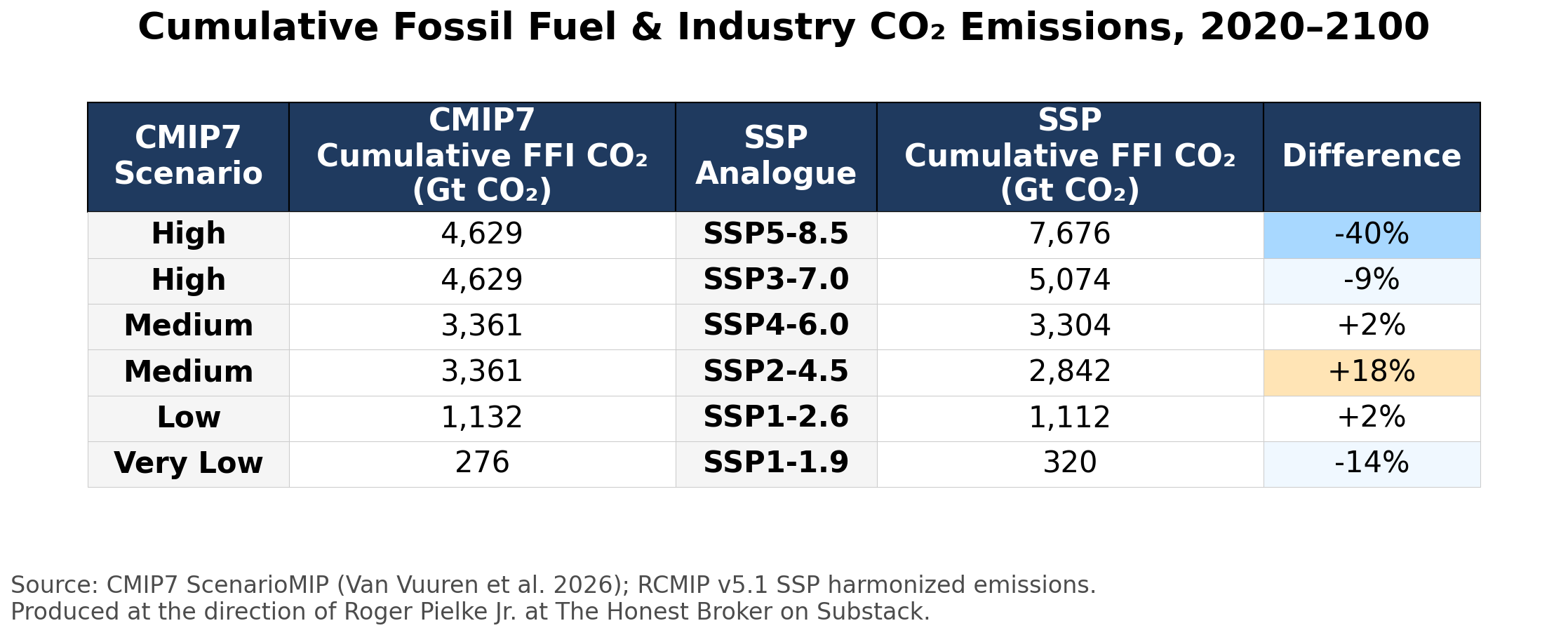
Note the massive gap between the new HIGH and SSP5-8.5. The new HIGH reaches 71 Gt CO₂/yr in 2100 — far below SSP5-8.5 at 128 Gt in 2100. Nothing in the CMIP7 set comes close to SSP5-8.5. The new HIGH also sits below SSP3-7.0 by about 9% in terms of cumulative emissions to 2100. Note also the gap between MEDIUM (solid yellow) and SSP2-4.5 (dashed yellow), which I’ll return to below.

Both of the most recent IEA near term scenarios — which run to 2050 — fall below MEDIUM and SSP2-4.5.

The table below compares the CMIP7 scenarios to their closest AR6 analogues, showing that the overall range has constricted. The higher scenarios have come down and the lower scenarios have come up — except VERY LOW, which moved down.
2100 effective radiative forcing and end-of-century temperature
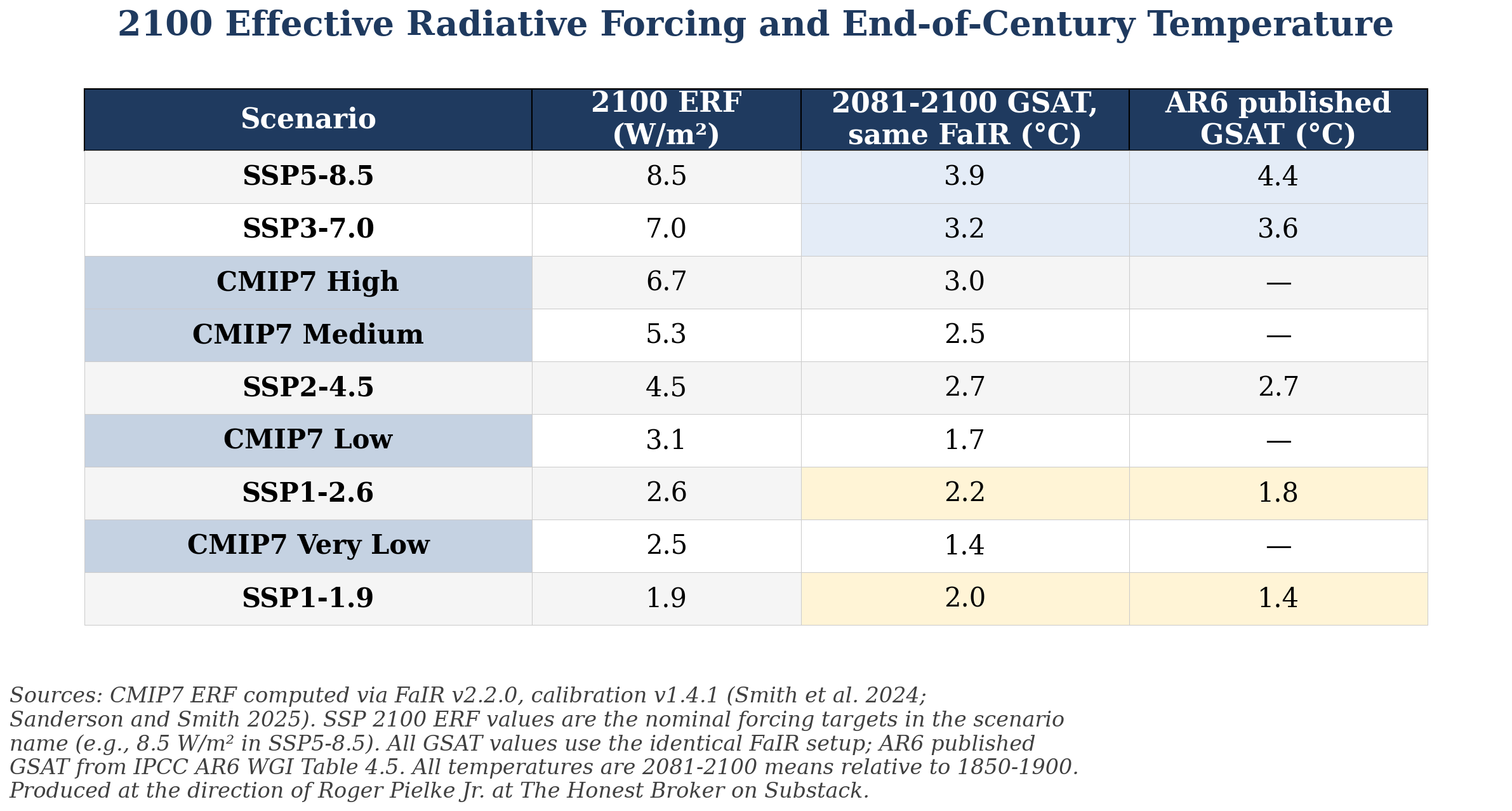
The table below lists AR6 and CMIP7 scenarios from highest to lowest 2100 radiative forcing. The middle column shows the average global temperature change from an 1850-1900 baseline, under the climate emulator used by CMIP7. The right column shows the average temperature change for the SSPs as projected by the IPCC AR6.
Interestingly, the projected 2080-2100 temperatures of the SSPs decreased from their AR6 values based solely on recent updates to the FaIR climate emulator.3 These changes resulted primarily from the updating of emissions trajectories from 2014 (used in AR6) to 2023 (used by CMIP7). The more moderate emissions trajectories resulted in lower projected end-of-century temperature increases.

The new CMIP7 HIGH is 0.9°C cooler than SSP5-8.5 in apples-to-apples terms (and 1.4°C cooler versus IPCC AR6), and 0.2°C cooler than SSP3-7.0 (-0.6°C against IPCC AR6).

The implausibility of upper-end legacy scenarios is now official.
CMIP7 avoided repeating the past with SSP3-7.0

Last April I argued here at THB that the climate science community was on the brink of repeating the RCP8.5 mistake with SSP3-7.0 — which assumed a 2100 global population approaching 13 billion, well above any contemporary demographic projection and a five-fold expansion of global coal use. Neither assumption survives current understandings of demographics or energy systems.

I don’t know if anyone in CMIP or ScenarioMIP reads THB4 — if not they should! — but regardless, they wisely chose not to adopt SSP3-7.0 as the new HIGH scenario.

The new HIGH scenario sits at 6.7 W/m² in 2100 — below the SSP3 baseline 7.0 W/m² — with 9 percent less cumulative fossil CO₂ through 2100. As I’ll discuss below, this is progress; it is partial but real.

But the new HIGH still sits well above the plausibility range that we identified in Pielke, Burgess, and Ritchie (2022). We found that of the >1,000 scenarios in the AR5 database, the plausible subset centered on a median of ~3.4 W/m² in 2100, with an upper end near 6 W/m². The new HIGH scenario is well above that upper end.

The authors of Van Vuuren et al. partially acknowledge that the new HIGH scenario is exploratory — a thought experiment, not a projection:

“Clearly, this scenario is not a “business-as-usual” scenario nor the no-policy reference scenario for the other scenarios. The scenario is intended to explore the upper end of GHG emissions resulting from deep political, technological, and structural deviation from current trends.”

Note that first sentence — It means that any future research that compares the HIGH scenario to lower scenarios in order to characterize the effects of climate policy will be fundamentally flawed. The HIGH scenario is not a projective scenario, but a “what if?” exercise.

Unfortunately, Van Vuuren et al. then engage in some unsupported speculation about the plausibility of the HIGH scenario in the real world:

“The are various reasons why such a scenario could emerge. For instance, a rollback of climate policies could result from a lack of public support for the energy transition. This could be related to, for instance, local opposition to building new wind farms or concerns about impacts on fossil industries related to jobs and national energy security. Also, the rapid cost decrease in renewable energy of the past decade could be discontinued, possibly as a result of regional scarcity and limited tradability in materials for solar and wind technologies and EV batteries . . .”

As discussed below, the new population assumptions of the updated SSP3 are ridiculous, and by themselves render the HIGH scenario implausible. The lack of any systematic effort to evaluate plausibility of scenarios remains a fundamental weakness of the scenario development process.
The new scenarios are SSPs in new clothing

The new CMIP7 framework does not start from a fresh socioeconomic foundation. Van Vuuren et al. explain:

“In practice, the IAM [Integrated Assessment Modeling] teams have based their current scenarios on various SSPs, as it was generally deemed pragmatic as these come with already available, suitably rich quantifications and were implemented by the participating modelling teams within the given timeline.”

The CMIP7 scenarios rely on the same narrative architecture as the IPCC AR6 SSPs. The table below shows how the SSP storylines map onto the new scenarios — Confusion is sure to result, as the old SSPs are not the new SSPs.
The new HIGH inherits the SSP3 storyline directly — the same SSP3 whose enormous 2100 population rendered it implausible when used in the IPCC AR6. Remarkably, the IIASA 2024 update to the SSPs did not bring the population projections down. Instead, it increased them, as you can see in the table below.
The 2024 demographic update (KC et al. 2024, IIASA Working Paper WP-24-003, also referred to as WIC2023) revises SSP 2100 populations upward: SSP3 jumps from 12.6 to 14.5 billion. SSP4 increases from 9.3 to 13.3 billion — an eye-popping 43% increase.

The SSP population update assumes that child mortality declines faster than WIC2013 anticipated, fertility declines slower in sub-Saharan Africa, and Africa’s 2020 base-year population was already 76 million higher than WIC2013 had projected. Africa’s 2100 population alone is now 3.55 billion, up from 2.62 billion in the AR6-era projection — a 35% upward revision.

This puts the CMIP7 HIGH scenario in a strange position: The cumulative fossil CO₂ from energy and industry in CMIP7 HIGH (4,629 Gt 2020-2100) is lower than SSP3-7.0 (5,074 Gt), but it has a 2100 population that is 15 percent larger. That means that the implied per-capita emissions trajectory in the new HIGH has a steeper decline.

How much of the new HIGH scenario’s warming is due to its incredible population projection?

I performed a simple sensitivity analysis:Take HIGH as published: 4,629 Gt cumulative fossil CO₂ over 2020-2100, producing about 3.0°C of 2081-2100 warming.
That means per-capita emissions intensity average about 5.2 tonnes of CO₂ per person per year using 11-billion as the mean population across the century.
Hold that per-capita intensity constant and replace the SSP3 population trajectory with the SSP1/SSP5 population trajectory — peaking at 8.5 billion in 2050, declining to 7.4 billion by 2100, averaging about 8 billion.

Under these assumptions, under HIGH, cumulative fossil CO₂ falls to roughly 3,330 Gt, a 1,300 Gt reduction. The IPCC AR6 central TCRE estimate (0.45°C per 1,000 Gt CO₂) gives about 0.6°C less warming. The HIGH scenario with SSP1/SSP5 population thus would deliver about 2.4°C of 2081-2100 warming — slightly cooler than the new MEDIUM at 2.5°C.

Under this simple method, about 0.6°C of the HIGH scenario’s projected warming traces to the population assumption alone. The HIGH scenario may be much less about carbon and much more about assumed human fecundity.

This is a sensitivity analysis, not a coherent scenario — combining SSP3’s per-capita intensity with the SSP1/SSP5 demographic profile is internally inconsistent. But it suggests that the demographic contribution to the HIGH scenario’s warming is significant.
The plausibility vacuum remains

The deeper problem with the SSP/RCP architecture, as Justin Ritchie has documented at length, is that physical climate modeling became decoupled from the underlying IAM socio-economic scenarios.

Under the RCPs, scenario creators identified concentration pathways and the underlying socio-economic assumptions were expected to be filled in later. Whether the underlying assumptions actually described a coherent picture of the world was never systematically assessed.

Ritchie called this a plausibility vacuum — a situation where any combination of climate model inputs could be used without any assessment of the real-world plausibility of the assumptions.

To be fair, the new CMIP7 framework does address some earlier shortfalls. The new design specifies emission-driven runs as the default, which allows for carbon-cycle feedbacks. The harmonization of emissions to observed 2023 data is an improvement — CMIP6 harmonized to 2014, and that harmonization had become well out-of-date by the time AR6 came out.

However, the plausibility vacuum problem remains. Van Vuuren et al. do not evaluate scenario plausibility against observed energy trends, against IEA projections, or against the body of literature critiquing the SSP set.

The 2023 ScenarioMIP workshop report — which kicked off the process of developing these new scenarios — recognized the plausibility problem and committed to addressing it. Van Vuuren et al. does not deliver on that commitment.

ScenarioMIP produces a better scenario set than those of AR6, but the improvement comes from incorporating more recent emissions data and accepting the undeniable collapse of SSP5-8.5’s credibility — not from any methodological reform of how scenario plausibility is assessed.
The MEDIUM scenario is not “current policy”

The walk-back at the high end is the most important change in the new framework. The story in the middle is more complicated.

Van Vuuren et al. describe the MEDIUM scenario as one that “shows the consequences of the current policy situation (as of 2025) and trends continuing over the century.” They specify that MEDIUM includes only policies “actually officially being implemented” — no NDC pledges, no net-zero announcements, unless backed by explicit policy. The framing implies that MEDIUM tracks where the world is actually headed under current policies.

That framing is not consistent with other approaches to defining a current policy trajectory. The CMIP7 MEDIUM scenario produces fossil-fuel CO₂ emissions that rise from about 38 Gt CO₂/yr today to 41 Gt by 2050 — that part compares well to the scenarios (CPS and STEPS) of IEA’s World Energy Outlook 2025, released last November.

However, it is post-2050 where the new MEDIUM scenario diverges from other current-policy projections, with its emissions slowly rising through the second half of the century.
In contrast, STEPS — the IEA’s standard reference for where current and announced policies actually take us — falls below 30 Gt by 2050 and produces about 2.5°C of 2100 warming.

The CMIP7 MEDIUM is more accurately characterized as a “policy stagnation” scenario rather than a “current policy” scenario. Cumulative fossil CO₂ emissions through the end of the century come in 18% higher than SSP2-4.5 — the AR6-era middle-of-the-road scenario — even though the MEDIUM 2081–2100 mean temperature is slightly cooler (explained below).

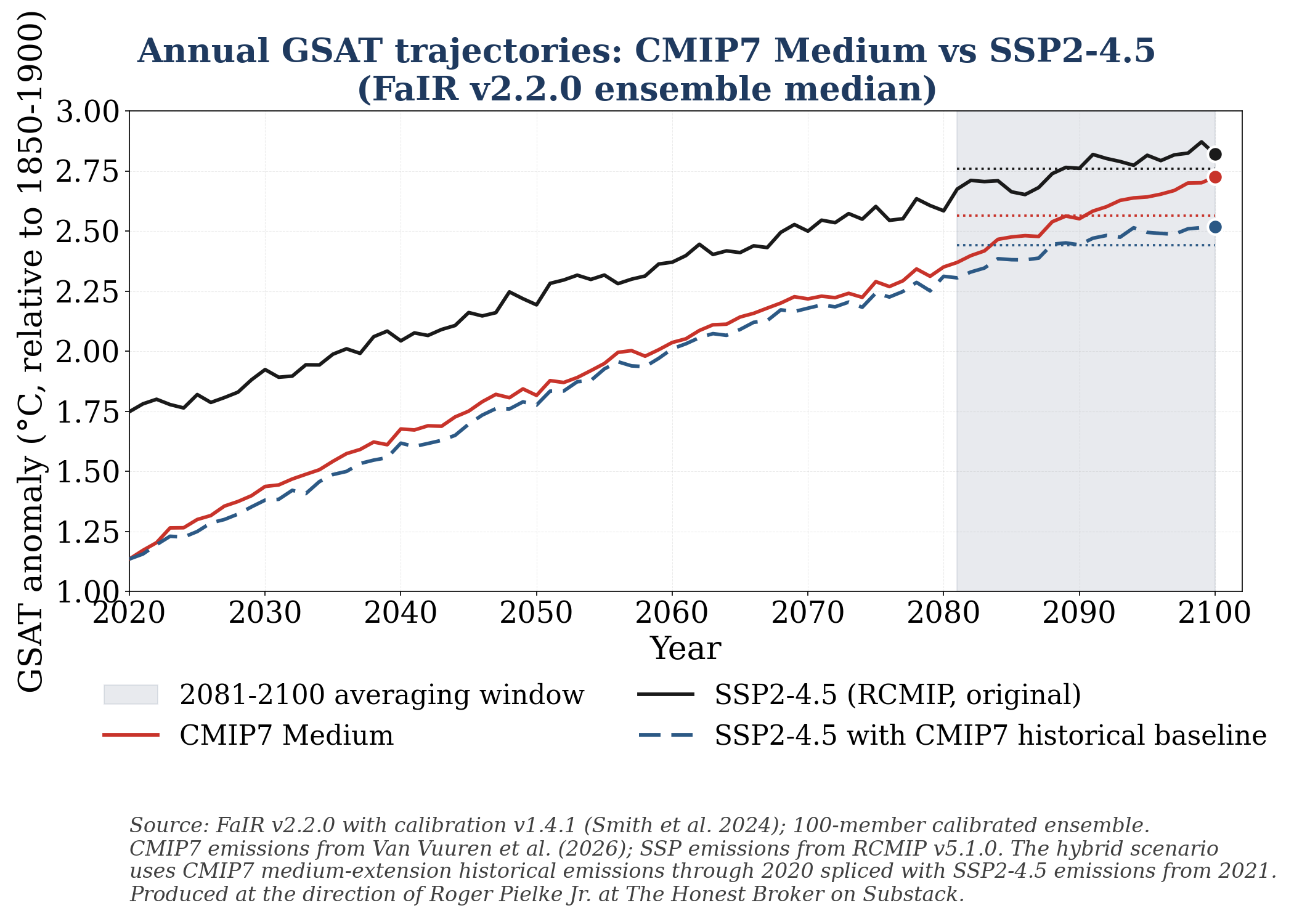
The figure below shows what happens once SSP2-4.5 and MEDIUM are anchored to the same observed 2020 baseline. The original SSP2-4.5 (black) sits roughly 0.6°C above CMIP7 MEDIUM (red) at 2020 — not because the 21st century plays out differently, but because the SSP framework’s historical emissions are harmonized to 2014 while CMIP7’s are harmonized to 2023. That head start propagates through the entire 21st century trajectory.
Running SSP2-4.5 post-2020 emissions through the CMIP7 FaIR emulator with CMIP7’s updated historical baseline (dashed blue), the picture inverts: SSP2-4.5 produces a 2081-2100 mean of 2.44°C against CMIP7 MEDIUM 2.56°C. On an apples-to-apples comparison, the new MEDIUM results in about 0.12-0.20°C more warming than SSP2-4.5 — due to its 520 Gt larger cumulative CO₂ budget over the century.

This connects to the larger argument in Pielke, Burgess, and Ritchie (2022): observed CO₂ emissions from 2005 through 2020 tracked closer to the SSP 3.4 W/m² range than to SSP2-4.5. Today, the gap has widened, not closed. IEA STEPS now has emissions falling to under 30 Gt by 2050 — a trajectory consistent with the SSP 3.4 forcing range. The center of the new CMIP7 scenario set sits well above that range.

The new framework compressed the high end. Good.

The middle did not move far enough. The new MEDIUM might be considered a worst-case scenario rather than a current policy scenario. Interestingly, that would mean that there is no real current-policy scenario in the new CMIP7 scenarios, which would be something like a SSP2-3.4 scenario with updated demographics.

Perhaps, if projected demographic changes continue to trend lower, CMIP7 LOW will come to represent something akin to a current policy trajectory.
Why this matters: these scenarios live in policy

The now-implausible upper-end scenarios — RCP8.5, SSP5-8.5, and SSP3-7.0 — are not just academic constructs used in esoteric research. They are embedded in the policies and regulations of most of the world’s largest economies, found across the world’s most important multilateral institutions, and used in the climate stress tests that govern hundreds of billions of dollars in bank capital.

The table below provides just a few examples.

National climate impact assessments in the United States, United Kingdom, Germany, Canada, Australia, Japan, and the Netherlands all use RCP8.5 or SSP5-8.5 as a reference scenario. The Network for Greening the Financial System framework, used by more than 140 central banks, has utilized a “Hot House World” scenario calibrated to RCP8.5 physical risk into the bank stress tests run by the European Central Bank, the Bank of England, the Reserve Bank of New Zealand, the Banque de France, and the US Federal Reserve. The World Bank’s Climate Change Knowledge Portal, which provides the climate diagnostics that feed into the Country Climate and Development Reports for more than 100 client countries, defaults to SSP5-8.5 and SSP3-7.0.

The abandonment of the high-end legacy scenarios by CMIP7 will need to propagate through this entire infrastructure. The policy machinery built on RCP8.5 and the other implausible scenarios is systemic.
What this means

The new CMIP7 ScenarioMIP framework represents a real course correction, but with more work to do. SSP5-8.5 is gone. SSP3-7.0 has a successor that is less extreme but arguably remains implausible. The middle of the set is more pessimistic than trajectories of current and announced policies. The plausibility vacuum at the heart of the architecture has yet to be addressed.

All this means that users of climate models and model output based on legacy scenarios will now face decisions about if and how they’d like to realign with the latest scientific understandings versus continuing to rely on outdated research.

Furthermore, there are no doubt many — hundreds if not thousands — of studies in the publication pipeline that depend upon the upper end scenarios. Editors and reviewers should ensure that they are properly characterized as exploratory and are not intended to be interpreted as projective.

We’ve known since 2017 that upper end climate scenarios are fatally flawed. Nine years later, that understanding has now become officially recognized. That is good news.

We can debate whether nine years is short or long for the overturning of scientific understandings with massive economic and policy implications. But today, that overturning is undeniable.

Science is self-correcting. What matters now is what happens next.

Testemunho impactante de Richard Zimmler em defesa do SNS

Há duas semanas, passei por um grande susto de saúde. Agora que a situação se acalmou e me sinto bem, quero escrever sobre isso para agradecer a todas as pessoas que me ajudaram. Eis o que aconteceu: 
Tive uma consulta com um novo médico porque tenho um problema com o meu intestino há alguns meses.  Ele receitou-me alguns suplementos. Tomei o primeiro, o Movicol, nessa tarde, e tive uma reação alérgica grave – choque anafilático. Um minuto depois de tomar o medicamento, comecei a sentir comichão na boca, nas costas, na barriga e nos pés. Sabia que a situação poderia piorar, por isso liguei imediatamente para o consultório do médico. A sua esposa (também médica) disse-me para tomar um anti-histamínico. Não tínhamos nenhum em casa, por isso o Alex e eu fomos à farmácia local. Foi uma sorte imensa…Enquanto estávamos lá, a minha pressão arterial baixou drasticamente e fiquei muito fraco e tonto. As farmacêuticas tentaram medir a minha pressão arterial, mas estava demasiado baixa para conseguir uma leitura!  As farmacêuticas foram maravilhosas e ajudaram-me a tomar o anti-histamínico. Sentaram-me numa cadeira, levanvaram-me as pernas e deram-me sal para colocar debaixo da língua.  A tontura fez com que a minha visão ficasse turva e eu estava tão fraco que não conseguia levantar-me. As farmacêuticas ligaram para o 112 e a ambulância chegou cerca de quinze minutos depois. 
Os paramédicos foram extremamente gentis comigo, tal como as farmacêuticas. Nessa altura, a minha pressão arterial tinha voltado a subir para cerca de 9/5. Já me sentia menos fraco. Os paramédicos colocaram-me numa cadeira de rodas e levaram-me para as urgências do Hospital de S. António, onde tenho todos os meus médicos. Foi a minha estreia mundial numa ambulância! O Alexandre veio comigo. Na sala onde acabei por ficar (não sei bem onde era), os médicos administraram-me soro intravenoso, cortisona e um anti-histamínico. A minha pressão arterial subiu lentamente depois disso. Três horas depois, às 20h, a pressão estava em cerca de 11/7 e mandaram-me para casa (depois de comer uma maçã assada e uma sopa diluida!). A médica disse para tomar o anti-histamínico durante três dias e, depois, começar a tomar os outros suplementos recomendados. Mas falei com a minha terapeuta francesa e ela disse para esperar uma semana porque o meu corpo precisava de descansar. 
É óbvio que nunca mais vou tomar Movicol.
Agora estou bem. Felizmente, não estou a sentir quaisquer consequências do choque anafilático. Tenho uma consulta marcada para 6 de maio com um alergologista para identificar qual o ingrediente do Movicol que causou o choque.
Escrevo agora para expressar os meus agradecimentos aos enfermeiros, médicos e as minhas queridas farmacêuticas pelo sua ajuda maravilhosa e eficiente. Estou extremamente grato, tal como o Alexandre. No dia seguinte ao meu incidente, levei 7 exemplares dos meus livros à farmácia (do Mercado da Foz) e dediquei um a cada um das farmacêuticas que me ajudaram.
Um grande obrigado ao Laurentino e ao Rui, os paramédicos. E à Inês e ao Pedro, os médicos do serviço de urgências. E a todos no SNS.  
Um pequeno pedido: por favor, lutem para manter o elevado nível de cuidados do SNS. Como sou dos EUA, sei o que é viver sem um sistema nacional de saúde. Isso significa que as pessoas vivem com um nível constante de stress, preocupadas com o que lhes acontecerá se adoecerem e se perderão todas as suas poupanças caso precisem de hospitalização. Um exemplo: após o grave AVC da minha mãe, ela ficou em estado vegetativo e passou duas semanas num hospital em Nova Iorque. Praticamente não recebeu cuidados. A conta de duas semanas foi de 120 000 euros. Sim, leu bem: 120 000 euros por duas semanas numa cama. Isso é completamente normal nos EUA. Quer isso em Portugal? Espero que não! Felizmente, o seguro privado da minha mãe pagou 119 000 euros da conta, mas os seguros privados são extremamente caros nos EUA.  É uma situação terrível que espero que nunca venhamos a viver em Portugal. E podem ter a certeza de que lutarei para manter a elevada qualidade dos cuidados de saúde no Serviço Nacional de Saúde.

Da censura editorial à algorítmica: o legado de "A Manipulação do Público"


A obra "A Manipulação do Público" estabeleceu que a comunicação de massa não serve apenas para informar, mas para moldar o pensamento de acordo com os interesses das elites. Na era das redes sociais, os cinco filtros de Chomsky e Herman não desapareceram; tornaram-se mais rápidos, granulares e, acima de tudo, personalizados.

1. O Algoritmo como gestor de atenção
No modelo original de "A Manipulação do Público", a curadoria do que era "noticiável" residia nas mãos de editores humanos, cujas decisões eram balizadas por linhas editoriais e interesses corporativos claros. Hoje, esse papel de porteiro da realidade foi delegado ao código. O filtro algorítmico não opera com base em critérios de verdade ou interesse público, mas sim na metrificação da atenção.

Como o modelo de negócio das grandes plataformas depende do tempo de permanência do utilizador, o algoritmo privilegia conteúdos que geram conflito e indignação. Estas emoções, por serem neuroquimicamente mais viciantes, garantem que o utilizador se mantenha ligado à plataforma por mais tempo. O efeito secundário desta lógica é a criação de "bolhas" informativas: o sistema entrega a cada indivíduo uma versão da realidade que confirma os seus preconceitos, eliminando o contraditório e tornando o diálogo impossível.

O resultado é uma fragmentação social sem precedentes. A visão sistémica do poder -  necessária para compreender como as instituições funcionam e como podem ser questionadas - é substituída por narrativas polarizadas e personalizadas. Ao vivermos em realidades paralelas, perdemos a capacidade de alcançar um consenso social alargado sobre factos básicos, o que imobiliza qualquer tentativa de resistência coletiva. A "manipulação" moderna não consiste em dizer ao público o que pensar, mas em garantir que os diferentes segmentos do público nunca consigam pensar juntos.

2. A Publicidade de Precisão (Microtargeting): a engenharia das vulnerabilidades
A dependência da publicidade, que Chomsky e Herman identificaram como um filtro vital para a sobrevivência dos meios de comunicação tradicionais, atingiu um novo e inquietante patamar com o advento do Big Data. No modelo do século XX, a publicidade era uma "bomba de fragmentação": uma mensagem única lançada para uma massa uniforme, na esperança de capturar a atenção de uma percentagem do público. Hoje, a manipulação é cirúrgica e individualizada.

Através da recolha massiva de dados — que inclui desde o histórico de compras até padrões de sono e localização — o sistema já não comunica com um "público", mas com perfis psicológicos granulares. O consentimento é agora fabricado através de campanhas invisíveis de microtargeting. Isto significa que duas pessoas sentadas no mesmo sofá podem receber narrativas políticas ou corporativas opostas sobre o mesmo tema, cada uma desenhada para explorar as suas vulnerabilidades, medos ou desejos específicos.

Esta evolução altera a natureza da propaganda. Se antes a manipulação era visível e passível de ser debatida no espaço público, agora ela ocorre na esfera privada do ecrã individual. O perigo reside no facto de estas perceções serem moldadas de forma subliminar; o alvo raramente percebe que a informação que está a consumir foi otimizada para contornar as suas defesas racionais. Ao transformar o cidadão num conjunto de pontos de dados, o filtro da publicidade moderna consegue fabricar um consentimento que não nasce da argumentação, mas da estimulação psicológica pré-consciente, tornando a resistência intelectual muito mais difícil de exercer.

3. O Novo "Flak": o disciplinamento digital e o silenciamento invisível
No modelo original de "A Manipulação do Público", o Flak manifestava-se como uma resposta barulhenta e institucional: processos judiciais, cartas de protesto ou editoriais de ataque agressivo. Na era digital, este filtro tornou-se descentralizado e muito mais sofisticado. Hoje, o Flak opera em duas frentes complementares: o ataque público coordenado e o silenciamento algorítmico invisível.

A primeira frente é a da retaliação instantânea. O filtro da pressão deixou de ser exclusivo das elites para se tornar uma ferramenta de massa através do "cancelamento", de campanhas de difamação e do uso de exércitos de bots. Jornalistas ou figuras públicas que ousem desafiar as narrativas hegemónicas enfrentam uma avalanche de ataques que funciona como uma ferramenta de disciplina social, gerando um clima de autocensura digital permanente.

Contudo, é no mundo dos algoritmos que o Flak assume a sua forma mais insidiosa através do Shadowbanning. Esta ferramenta permite que o sistema discipline vozes dissidentes sem necessidade de as banir formalmente. O utilizador continua a publicar, mas o seu alcance é artificialmente reduzido ou limitado apenas aos seus seguidores mais próximos. É a forma definitiva de censura na era da abundância: não se apaga a mensagem, mas garante-se que ela se perde na imensidão do ruído.

A grande eficácia desta mutação reside na sua invisibilidade. Enquanto o banimento direto gera revolta e cria "mártires" da liberdade de expressão, o shadowbanning neutraliza a influência do indivíduo de forma silenciosa. Ao não receber o retorno habitual, o produtor de conteúdos é levado a acreditar que o seu discurso perdeu interesse ou relevância, minando a sua vontade de persistir. Assim, o sistema não só pune a dissidência, como a torna irrelevante sem nunca ter de assumir o papel de censor.

4. A barreira do custo e as fontes
A observação de que a média depende de fontes oficiais por serem "baratas" ganhou um contorno irónico na Internet. Atualmente, a informação de qualidade está frequentemente protegida por paywalls (muros de pagamento), enquanto a desinformação e a propaganda estatal ou corporativa são gratuitas e de fácil acesso. Isto cria uma desigualdade informacional profunda: quem não pode pagar pelo jornalismo independente acaba por ser o alvo mais fácil para a manipulação através de conteúdos gratuitos de baixa qualidade.

Filtro de "A Manipulação do Público"Adaptação para a Era Digital
PropriedadeConcentração de poder nas Big Techs (Google, Meta, etc.).
PublicidadeEconomia da atenção e exploração de dados individuais.
FontesInfluenciadores, grupos de fachada e Astroturfing.
FlakLinchamento virtual, censura algorítmica e ataques de bots.
IdeologiaPolarização extrema e o "Nós contra Eles" das guerras culturais.
A grande ironia contemporânea reside no facto de termos a ilusão de uma escolha infinita quando, na verdade, os filtros digitais tornaram o comportamento humano mais previsível e manejável do que nunca. O "consentimento" de hoje não é imposto; é extraído através do nosso próprio envolvimento digital.

Esta evolução do modelo de "A Manipulação do Público" revela que a arquitetura do controlo social sofreu uma mutação: passámos de um sistema de exclusão para um de saturação. No paradigma de 1988, o poder exercia-se pela escassez; como o espaço nas colunas dos jornais e o tempo de antena televisivo eram recursos finitos, os filtros operavam decidindo o que era silenciado. No entanto, na era digital, o controlo é exercido pela abundância. O algoritmo raramente se dá ao trabalho de esconder a informação dissidente; em vez disso, soterra-a sob uma avalanche de entretenimento efémero, notícias irrelevantes e ruído constante. O consentimento já não nasce do silêncio imposto, mas de uma distração perpétua que impede a reflexão profunda.

Paralelamente, a dependência de fontes oficiais, que Chomsky identificou como um filtro vital, deu lugar ao fenómeno do Astroturfing. Esta é a versão digital da manipulação de base: criam-se movimentos que aparentam ser espontâneos e populares (grassroots), mas que são, na realidade, orquestrados e financiados por grandes corporações ou interesses políticos. Através de exércitos de perfis falsos e influenciadores contratados, gera-se a ilusão de um consenso esmagador. O efeito psicológico no indivíduo é devastador: ao sentir-se isolado na sua opinião, o cidadão tende a ceder à pressão da "maioria" artificial, um fenómeno conhecido como a espiral do silêncio, agora potenciado por algoritmos.

A mudança mais radical, contudo, reside na transição de um sistema reativo para um sistema preditivo baseado na psicometria. Se a propaganda tradicional tentava convencer o público após o facto, o modelo atual antecipa-se. Através da análise minuciosa de cada like, do tempo de visualização e até da velocidade com que percorremos o ecrã (scroll), as plataformas constroem perfis psicológicos que nos conhecem melhor do que nós próprios. Este filtro invisível consegue prever quais as narrativas que nos farão mudar de opinião ou que gatilhos emocionais despertarão a nossa indignação. Assim, o consentimento é "fabricado" de forma preventiva, moldando a nossa perceção antes mesmo de termos consciência de que estamos a formar uma ideia sobre o assunto. No fim, a liberdade de escolha torna-se uma miragem dentro de um sistema que já calculou todas as nossas reações possíveis.